Do you want to watch me talk about this stuff? This Thursday I’ll be doing a live (and free) webstream with Conscious 2, find out more below:
http://www.conscious2.com/freedom-from-suffering/
http://www.conscious2.com/teachers/tom-das/
Do you want to watch me talk about this stuff? This Thursday I’ll be doing a live (and free) webstream with Conscious 2, find out more below:
http://www.conscious2.com/freedom-from-suffering/
http://www.conscious2.com/teachers/tom-das/
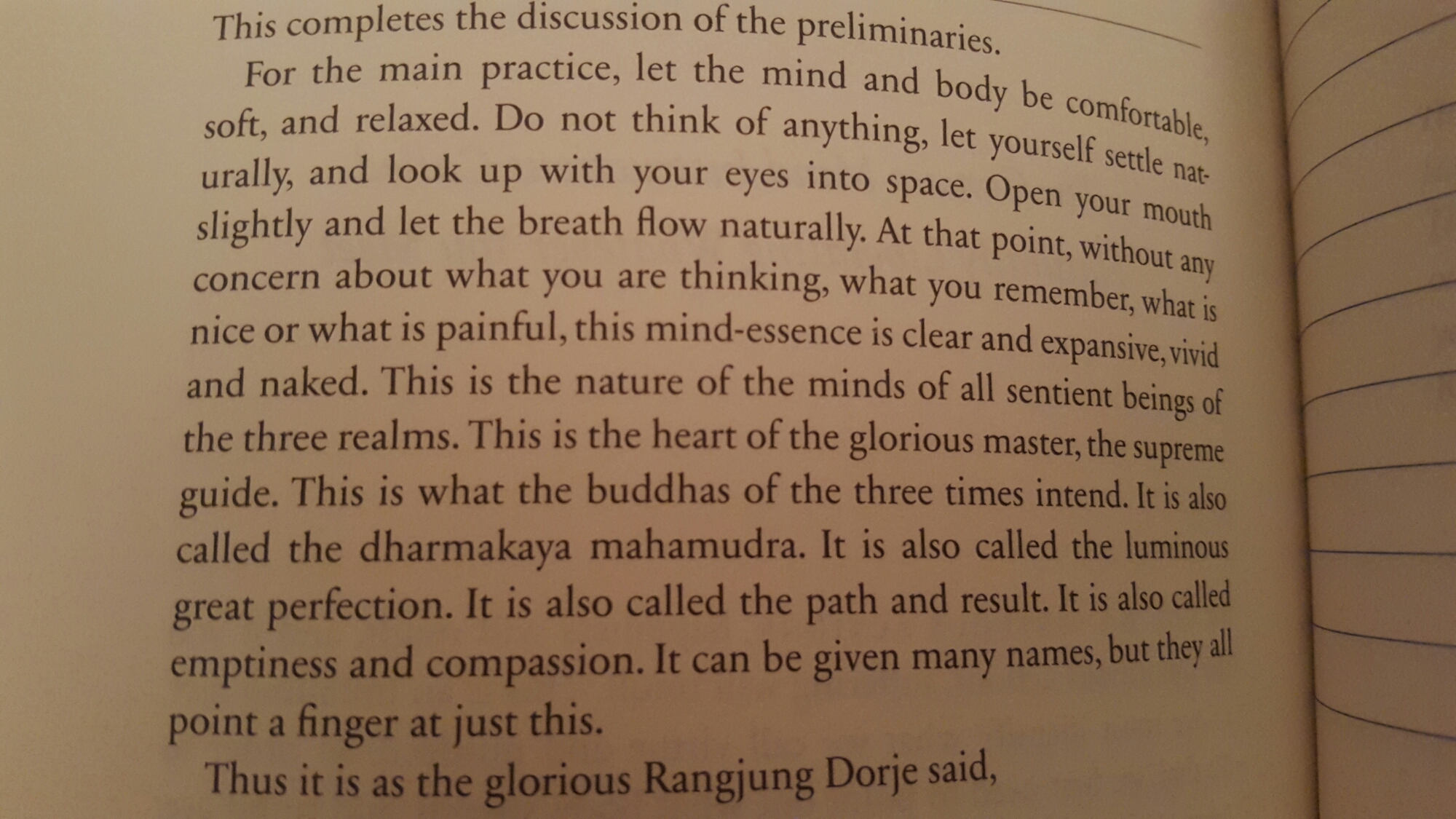
Above is an excerpt from a text called ‘The Concise Mind Instructions Called Naturally Liberating Whatever You Meet’ by Khenpo Gangshar, as found in the book Vivid Awareness by Khenchen Thrangu.
In this short text Khenpo Gangshar goes on to say:
Directly, whatever arises, do not change it – rest naturally. This fulfils the essence of all creation stages, completion stages, mantra recitations, and meditations.
This is the heart of the highest Tibetan Buddhist teachings: to rest naturally and be vividly aware. Just be. I would add that in this no sense of self is being created, and this is the practice. To simply be, and not to take yourself as being a ‘self’ or ‘doer’. To use a commonly used phrase in vedanta: do not take yourself to be ‘this or that’.
Khenpo Gangshar goes on to give advice on how to deal with difficulties along the way:
You must take sickness as the path, afflictions as the path, the bardo as the path, and delusion as the path. The heart of all these applications is to rest naturally in the essence.
This advice is very much in line with most of traditional Tibetan Buddhist teachings, but here it is stated in very concise form. When difficulties come along, just rest in your natural being. Don’t identify as being ‘this or that’, don’t start to create or believe in the concept of being a doer. This is the false concept that is rooted out and seen through in this practice.
When life throws us a challenge, don’t simply fall back into your old habits of self-identification. It is from this creation of an imaginary doer/self that all other afflictions and suffering follows. Instead, just rest, just be. Let your awareness shine, let it shine brightly. If the thought ‘I’ arises, let it, notice it, notice that it is empty and does not describe or pertain to any reality. There is no ‘I’, there is no self. Only the bright expanse of phenomena.
One final thought from me, a question:
Does any of this have anything to do with Freedom? Does Freedom depend on any practice? Does Freedom depend on any of this?

Don’t accept a lie.
If you see there is no evidence for there being a separate ‘you’,
Then whenever this thought or notion ‘you’ turns up in daily life,
See through it.
Deny it.
Not out of a belief,
Not as a formula to be repeated,
But as something that is clearly seen.
All I know is I don’t know.
I don’t even know what doesn’t know.
Just all this,
Happening by itself:
No knowledge of a knower,
And never understanding any of it.
Mystery is an apt label,
For this unknowing.
We don’t have to define reality
We don’t even need to see things as they are.
We don’t need to do anything.
Just this.
That’s it.
Naturally,
We already see things as they are,
Effortlessly,
It’s our natural intelligence,
(It’s not ‘ours’)
And wrong concepts are naturally dropped,
(Or maybe they are not).
Reality shines through all of this.
How could it not?

If you think: “I know Brahman well,” then surely you know but little of Its form
Kena Upanishad
One of the astounding things about this is that it is impossible to put this into words. Put what into words you may ask?….this! Just this! Call it Tao, God or call it Brahman – these are really just meaningless words unless we understand what the words are pointing to.
All the great teachings have tried to express the Inexpressible. They have tried to indicate That which gives meaning to life but is beyond meaning, That which is transformative but at the same time nothing changes when It is ‘realised’ (how can that be?), That in which suffering and separation are seen to be imaginary and illusory. When That is understood, all the scriptures can be made sense of, and all of the scriptures are also seen to be ultimately inaccurate.
The Tao Te Ching, that wonderful poem from ancient China, starts with the confession that what it is writing about cannot be written about:
The Tao that can be spoken of is not the eternal Tao
Tao Te Ching, verse 1
What you are seeking is constantly being realised, whether you realise it or not! One of the advantages of the concept of God is that God is not meant to be knowable. However with the concept of self-realisation and the ever increasing preponderance of the all-knowing guru on the spiritual scene, it is often thought that this is something that can be known by the mind. Here’s what our Sufi friend Abol-Hasan has to say about it.
One may speak of those absent,
but one who is Ever Present,
one can say nothing of
Sheikh Abol-Hasan, saying 92
Throughout the ages, people from all walks of life have spontaneously awoken to this ‘understanding’: scholars and illiterates, men and women and children, those with a spiritual tradition and those without one.
All true knowers of truth are always fuzzy when it comes to how to realise this for oneself, for there is no single path and no single practice that has the monopoly here. This is not always a popular message, and certainly not one that is easy to grasp (it’s impossible to grasp) and pass on through the generations.
Here we can see the Kena Upanishad trying to express the futility of organising a spiritual system around this understanding:
The one who has thought it out does not know it.
It is not understood by those who understand it;
it is understood by those who do not understand it.
Kena Upanishad
This is ever present, it is none other than Our-True-Self, which is simply life devoid of the illusion of doership. It is here, yet cannot be known by the mind or senses. It cannot be captured in words.
I do not think I know It well, nor do I think I do not know It.
He among us who knows the meaning of “Neither do I not know, nor do I know”
— knows Brahman.
Kena Upanishad
This realisation is nothing to be gained. When you realise, there is no realisation at all. It all just falls away. What is there to realise? Who is there to realise? There is just this. This is enough. Realisations come and go in this. And this is not a concrete thing that you can grasp or possess, but it is life just happening right now as it is.
Boddhidharma, the Indian monk and founder of Zen (Chan) Buddhism tells us just this, and he says it repeatedly – here is just one example:
“To say he attains anything at all is to slander a Buddha. What could he possibly attain?”
Boddhidharma from the Bloodstream Sermon
Ramana Maharshi was someone who had a spontaneous realisation of all of this as a teenage boy. He had no guru and knew little of any spiritual teaching. Over the years he learnt the language of Advaita Vedanta and found that its teachings described that which he was already experiencing. Here’s what he has to say about self-knowledge (Atma-Jnana in Sanskrit):
Q: When a man realises the Self, what will he see?
M: There is no seeing. Seeing is only being. The state of Self-realisation, as we call it, is not attaining something new or reaching some goal which is far away, but simply being that which you always are and which you always have been.
All that is needed is that you give up your realization of the not-true as true…At one stage you will laugh at yourself for trying to discover the Self which is so self-evident.
Ramana Maharshi
And he repeats this again and again (italics added by me):
If we talk of knowing the Self, there must be two selves, one a knowing self, another the self which is known, and the process of knowing.
The state we call realisation is simply being oneself, not knowing anything or becoming anything. If one has realised, one is that which alone is and which alone has always been. One cannot describe that state. One can only be that.
Ramana Maharshi
So if this is unknowable, how to reach this ‘understanding’ at all? Let us listen to the Maharshi:
Q: But how is one to reach this state?
M: There is no goal to be reached. There is nothing to be attained. You are the Self. You exist always. Nothing more can be predicated of the Self than that it exists. Seeing God or the Self is only being the Self or yourself. Seeing is being.
You, being the Self, want to know how to attain the Self. It is something like a man being at Ramanasramam asking how many ways there are to reach Ramanasramam and which is the best way for him.
Ramana Maharshi
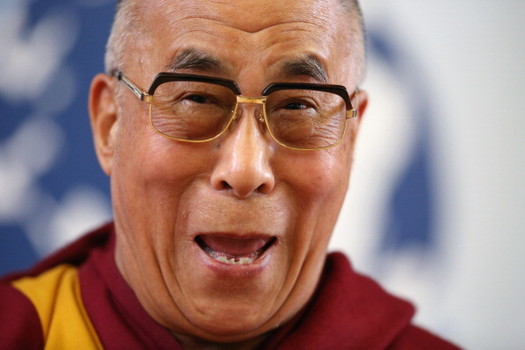
The following excerpt is taken from the book “How to see yourself as you really are” by the Dalai Lama:
What makes all this trouble in the world? Our own counterproductive emotions. Once they are generated, they harm us both superficially and deeply. These afflictive emotions accomplish nothing but trouble from beginning to end. If we tried to counteract each and every one individually, we would find ourselves in an endless struggle. So what is the root cause of afflictive emotions that we can address more fruitfully? Continue reading

One of the problems of Ramana’s teachings is that they are so simple. Most people do not want to be still and keep the mind quiet. They want to avoid themselves by discussing and understanding the concepts.
Now conceptual discussion has its place, but once one has understood the import of the teachings, namely silence, then it is time to sit down and shut up. Muruganar, who is regarded as Ramana’s closest and most influential devotee, says the same about Ramana’s teachings in his masterpiece Guru Vachaka Kovai:
And in case you still haven’t got the message, here’s another quote from Who Am I, which is the publication that Ramana had issued at his Ashram as an introduction to his teachings. Note that the Sanskrit word ‘Jnana’ below literally means ‘knowledge’ and in a spiritual context refers to Self-Knowledge/Realisation or Liberation itself:

Questioner: When I look into myself, I find my strongest desire is to create a monument, to build something which will outlast me. Even when I think of a home, wife and child, it is because it is a lasting, solid, testimony to myself. Continue reading
Freedom is everywhere. There is only freedom.
There is no individual freedom, only freedom, which is ‘freedom’ from individuality.
You can’t even say ‘freedom from individuality’ – that’s too much.
There is only freedom.
See it at once!
 Tom Das