
What do you need to do to be yourself?
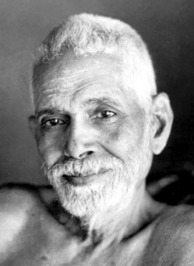
Questioner: Miseries appear in jagrat (waking sate). Why should they appear?
Ramana Maharshi: If you see your Self they will not appear.
Q: If I turn to look who I am I do not find anything.
RM: How did you remain in your sleep? There was no ‘I-thought’ there and you were happy. Whereas there are thoughts flowering in the wake of the root-thought ‘I’ in the jagrat and these hide the inherent happiness. Get rid of these thoughts which are the obstacles to happiness. Your natural state is one of happiness as was evident in your sleep.
Q: I do not know anything of my sleep experience.
RM: But you know that it was happiness. Otherwise you would not be saying “I slept happily”. When there is no thought, no ‘I’, and nothing In fact except yourself, you are happy. That is the whole Truth. This is exactly what is conveyed by the Mahavakya- Tatvamasi (You are That). Find your Self: and then “That” is known.
Q: How is that Brahman?
RM: Why do you want to know of Brahman apart from yourself? The scripture says “You are That”. The Self is intimate to you and you cannot indeed be without the Self. Realise it. That is the Realisation of Brahman also.
Q: But I am unable to do it. I am too weak to realise my Self.
RM: In that case surrender yourself unreservedly and the Higher Power will reveal Itself.
Q: What is unconditional surrender?
RM: If one surrenders oneself there will be no one to ask questions or to be thought of. Either the thoughts are eliminated by holding on to the root-thought ‘I’ or one surrenders oneself unconditionally to the Higher Power. These are the only two ways for Realisation.
Talk 321 – Talks with Sri Ramana Maharshi
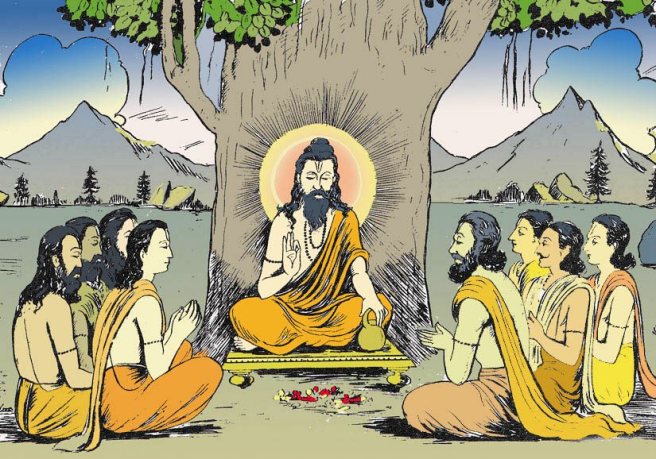
Tat Tvam Asi is one of the most famous phrases from the ancient upanishadic texts. But what does it mean?
Tat = that
Tvam = thou or you
Asi = art or are
Tat Tvam Asi = That thou art, or thou art that, or you are that
‘That’ refers to the Absolute. ‘You’ normally refers to the limited separate body-mind identity known in advaita vedanta as the jiva, but in this aphorism from the Upanishads it is implicitly declared, via the word ‘asi’, that you are not the jiva but the Absolute. Why does this matter? Well, when you know yourself as one with the Absolute, suffering ends.
This phrase, Tat Tvam Asi, is repeatedly uttered by Uddalaka to his son Shvetaketu as recorded in the Chandogya Upanishad, and is considered one of the four Mahavakyas (great utterances) of the Upanishads. Below are just two of the teaching exampes it occurs in, taken from sections twelve and thirteen of the Chandogya Upanishad:
Uddalaka: “Bring me a fruit from the banyan tree.”
Shvetaketu: “Here is one, Father.”
Uddalaka: “Break it open.”
Shvetaketu: “It is broken, Father.”
Uddalaka: “What do you see there?”
Shvetaketu: “These tiny seeds.”
Uddalaka: “Now break one of them open.”
Shvetaketu: “It is broken, Father.”
Uddalaka: “What do you see there?”
Shvetaketu: “Nothing, Father.”
Uddalaka: “My son, you know there is a subtle essence which you do not perceive, but through that essence the truly immense banyan tree exists. Believe it, my son. Everything that exists has its self in that subtle essence. It is Truth. It is the Self, and you, Shvetaketu, are that.”
Shvetaketu: “Please, Father, teach me more.”
Uddalaka: “I will, my son,”
——-
Uddalaka: “Place this salt in water, and come back to me in the morning.”
The son did as he was told.
Uddalaka (in the morning): “Bring me the salt you put in the water last night.”
Shvetaketu (after looking): “Father, I cannot find it.”
Uddalaka: “Of course not; it has dissolved. Now taste the water from the surface. How does it taste?”
Shvetaketu: “It’s salty.”
Uddalaka: “Taste the water from the middle of the bowl. How does it taste?”
Shvetaketu: “It’s salty.”
Uddalaka: “Now taste the water from the bottom. How does it taste?”
Shvetaketu: “It’s salty.”
Uddalaka: “Go, throw it away and come back to me.”
He did so, and returned.
Shvetaketu: “But, father, although I have thrown it away, the salt remains.”
Uddalaka: “Likewise, though you cannot hear or perceive or know the subtle essence, it is here. Everything that exists has its self in that subtle essence. It is Truth. It is the Self, and you, Shvetaketu, are that.”
Shvetaketu: “Please, Father, teach me more.”
Uddalaka: “I will, my son.”
 Tom Das