thought
Q: Why is it necessary for the mind to die? | Lakshmana Swamy | Ramana Maharshi
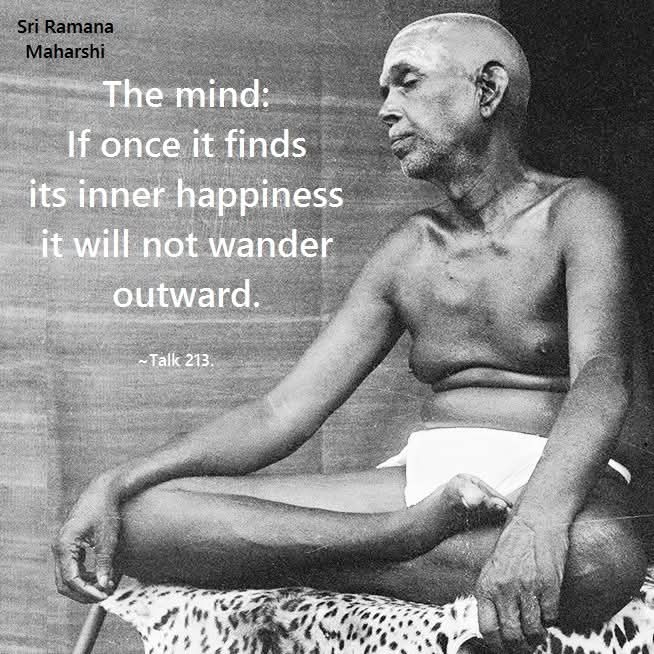
Q: Why is it necessary for the mind to die?
Lakshmana Swamy [a devotee of Ramana Maharshi]: The mind must die, there is no other way to realize the Self. Some people say that complete equanimity of mind is Self realization, but this is not true. This is only a stage one passes through on the way to Self-realization. Other people say that seeing the Self or God everywhere is Self-realization, but this idea is not true either. To see the Self everywhere there must be an “I” who sees, and while that “I” exists the mind will also exist. The jnani does not see anything because the seeing entity in him has died. In the Self there is no seeing, only being. When the mind still exists one can reach a stage where one can see the whole world as a manifestation of the Self, but when the mind dies, there is no one who sees the world and no world to be seen.
If you have a mind then the earth, the sky and the stars will exist and you will be able to see them. When the mind dies there will be no earth, no sky, no stars and no world. The world of objects, names and forms is only the mind, and when the mind dies, the world dies with it. Only the Self then remains.
Seeing everything as the Self gives the impression that the Self is equally distributed everywhere. This is also an idea in the mind. When the mind finally dies you realize that there is no distribution and no everywhere.
How can physical objects be part of my EGO?
THE POWER AND NATURE OF THOUGHT | Law of Attraction | Advaita | Non-Duality
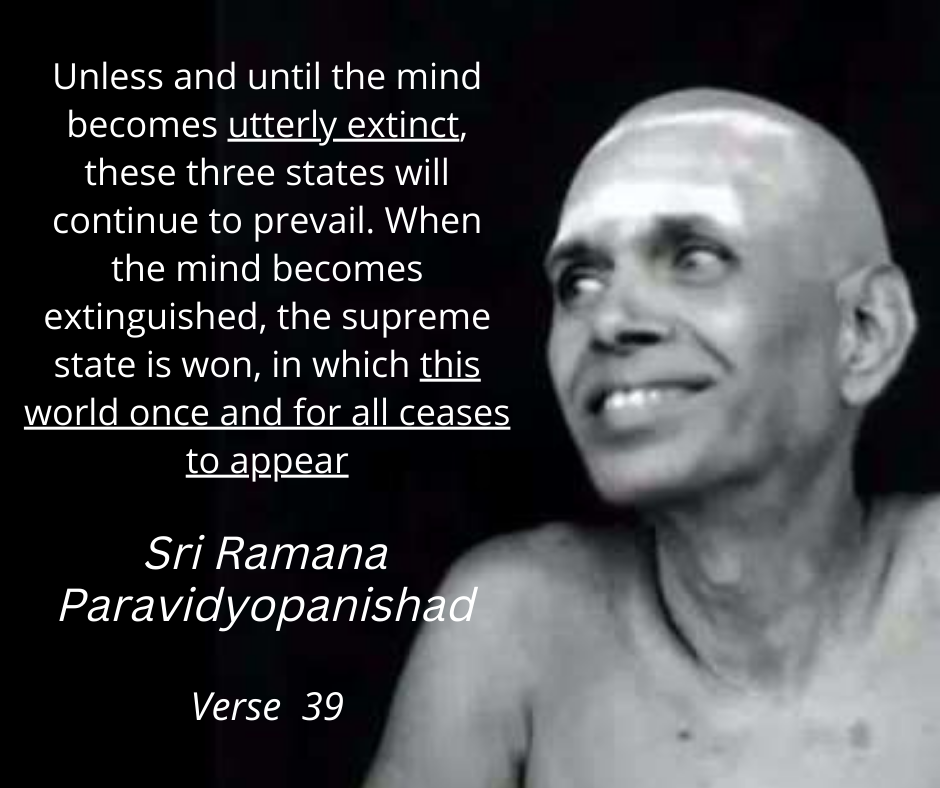
It is open for everybody to discover, when the mind is very still and turned inwards towards the sense ‘I’, which is not a thought, that it is thought that gives rise to the body and is there prior to the body and what we usually call the mind.
The first thought is the ‘I thought’, and it precedes the creation of the body.
Just as we commonly conceive that the mind projects a dream, it is actually the ‘I thought’ that gives rise to or projects the three states of waking, dream and deep sleep. These three states together with the ‘I thought’ are all unreal and illusory, and these must all go for liberation to occur and our true nature to be intuited or realised.
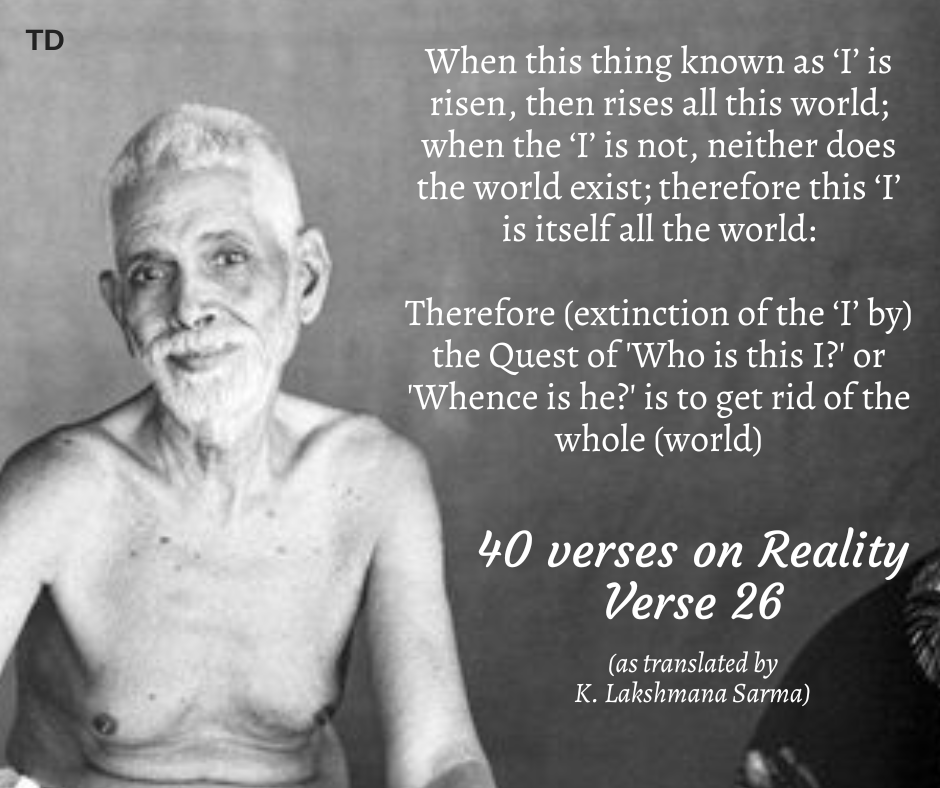
The ‘I thought’ is also known by various other names, such as ignorance, ego, original sin, Maya, the devil, delusion, Brahma, Isvara, ‘the first act of creation’ and the mind to name a few.
This is what is being shared here.
🙏❤️
Liberation or Self-Knowledge is not an understanding | Advaita Vedanta
Many erroneously think liberation is mere understanding in the mind ‘I am That’ or the ability to discern the difference (viveka) between what is lasting (nitya) and what is temporary (anitya), and thereby know in the mind that you are That which is lasting, and the temporary depends on you.
Sri Ramana Maharshi, completely in line with the vedanta scriptures, explains that Jnana or Liberation is nothing of the kind – it is not mere intellectual understanding or thoughts or discernment (viveka) in the mind, although this may be a useful precursor.
Here are two verses that Sri Ramana wrote himself:
‘Cease all talk of ‘I’ and search with inward diving mind whence the thought of ‘I’ springs up. This is the way of knowledge. To think, instead, ‘I am not this, but That I am,’ is helpful in the search, but it is not the search itself.’
~ Sri Ramana Maharshi, Ulladu Narpadu (Forty Verses on Reality), Verse 29
‘When the Vedas have declared, ‘Thou art That’ – not to seek and find the nature of the Self and abide in It, but to think ‘I am That, not This’ is want [ie. lack] of strength. Because, That abides forever as the Self.’
~ Sri Ramana Maharshi, Ulladu Narpadu (Forty Verses on Reality), Verse 32
If this is a new or strange teaching for you, please explore the recommended reading list here to understand these teachings in full.
UPANISHADS
In the Amritabindu Upanishad Jnana is defined as follows in verse 5:
‘The mind severed from all connection with sensual objects, and prevented from functioning out, awakes into the light of the heart, and finds the highest condition. The mind should be prevented from functioning, until it dissolves itself in the heart. This is Jnana, this is Dhyana, the rest is all mere concoction of untruth.’
Some people think I selectively quote merely to prove my own point, but note that this above verse was also quoted to make this very same point by Swami Vidyaranya (1296-1386), author of the wonderful Advaita Vedanta text Panchadasi and Shankaracharya (head monk and preserver of Advaita Vedanta) of Sringeri Math, in his work Jivanmukti Viveka.
GAUDAPADA AND SHANKARA
Sri Gaudapada wrote the following in his commentary on the Mandukya Upanishad, explaining how in liberation no mind exists:
3.32 When the Truth of Atman has been realised, the mind ceases to think; then the mind attains the state of not being the mind. In the absence of things to be perceived, it becomes a non-perceiver.
Shankara gives his commentary on this verse 3.31 explaining how the entire phenomenal existence is dependent on the mind and how mind is stilled or stopped in liberation, agreeing with Gaudapada above:
‘This duality as a whole, that is mano-drsyam, perceived by the mind; is nothing but the mind, which is itself imagined – this is the proposition [Tom: ie. meaning of the verse]. For duality endures so long as the mind does, and disappears with the disappearance of the mind.
‘For when the mind ceases to be mind when, like the illusory snake disappearing in the rope, the mind’s activity stops through the practice of discriminating insight and detachment, or when the mind gets absorbed in the state of sleep, duality is not perceived. From this non-existence is proved the unreality of duality. This is the purport. How does the mind cease to be the mind? This is being answered [in the next verse and commentary]’
The rest of the text continues in this manner.
MORE SHANKARA
We see the same teaching in Shankara’s masterpiece Vivekachudamani which explains all the teachings given in Shankara’s various commentaries in a much clearer form. Here is verse 169 where he equates the mind with ignorance:
169. There is no Ignorance (Avidya) outside the mind. The mind alone is Avidya, the cause of the bondage of transmigration. When that is destroyed, all else is destroyed, and when it is manifested, everything else is manifested.
Then he states the world is but an illusion projected by the mind, like a dream, essentially equating the mind with maya:
170. In dreams, when there is no actual contact with the external world, the mind alone creates the whole universe consisting of the experiencer etc. Similarly in the waking state also; there is no difference. Therefore all this (phenomenal universe) is the projection of the mind.
Shankara then warns the seeker to stay away from the mind:
176. In the forest-tract of sense-pleasures there prowls a huge tiger called the mind. Let good people who have a longing for Liberation never go there.
MANONASA
Shankara teaches us that the mind eventually must die (manonasa, a traditional synonym of self-realisation), and the method of how this is achieved:
277. The Yogi’s mind dies, being constantly fixed on his own Self.
407. This apparent universe has its root in the mind, and never persists after the mind is annihilated. Therefore dissolve the mind by concentrating it on the Supreme Self, which is thy inmost Essence.
481. My mind has vanished, and all its activities have melted, by realising the identity of the Self and Brahman; I do not know either this or not-this; nor what or how much the boundless Bliss (of Samadhi) is
502. How can there be merits and demerits for me, who am without organs, without mind, changeless, and formless – who am the realisation of Bliss Absolute? The Shruti also mentions this in the passage “Not touched”, etc.!
🙏🙏🙏
‘The practice of witnessing thoughts and events…was never even in the least recommended’ by Sri Ramana Maharshi | Sri Sadhu Om | The Path of Sri Ramana
The following is written by Sri Sadhu Om, a direct devotee of Sri Ramana Maharshi’s, and is taken from the text ‘The Path of Sri Ramana – Part 1’, from one of the footnotes in Chapter 7. You can download the entire text for free here – it is a wonderful and rare text that explains the entire path to liberation. Please also see recommended reading for liberation here as well as the introductory articles on the homepage for more.
The practice of witnessing thoughts and events, which is much recommended nowadays by lecturers and writers, was never even in the least recommended by Sri Bhagavan, Indeed, whenever He was asked what should be done when thoughts rise (that is, when attention is diverted towards second or third persons) during sadhana, He always replied in the same manner as He had done to Sri Sivaprakasam Pillai in ‘Who am I?’, where He says:
“If other thoughts rise, one should, without attempting to complete them, enquire ‘To whom did they rise?’. What does it matter however many thoughts rise? At the very moment that each thought rises, if one vigilantly enquires ‘To whom did this rise ?’, it will be known ‘To me’. If one then enquires ‘Who am I?’, the mind (our power of attention) will turn back (from the thought) to its source (Self)”.
Moreover, when He says later in the same work, “Not attending to what-is-other (that is, to any second or third person) is non-attachment (vairagya) or desirelessness (nirasa)”, we should clearly understand that attending to (witnessing, watching, observing or seeing) anything other than Self is itself attachment, and when we understand thus we will realize how meaningless and impractical are such instructions as ‘Watch all thoughts and events with detachment’ or ‘Witness your thoughts, but be not attached to them’, which are taught by the so-called gurus of the present day.
————
Tom: The following excerpt is also taken from the same chapter, chapter 7, of The Path of Sri Ramana – Part 1:
Since, whether we know it or not, Self, which is now wrongly considered by us to be unknown, is verily our reality, the very nature of our (the Supreme Self’s) attention itself is Grace (anugraha). This means that whatever thing we attend to, witness*, observe or look at, that thing is nourished and will flourish, being blessed by Grace…
…Hence, when the power of attention of the mind is directed more and more towards second and third person objects, both the strength (kriya-bala) to attend to those objects and the ignorance – the five sense-knowledges in the form of thoughts about them – will grow more and more, and will never subside! Have we not already said that all our thoughts are nothing but attention paid to second and third person objects? Accordingly, the more we attend to the mind, the thoughts which are the forms (the second and third person objects) of the world, the more they will multiply and be nourished. This is indeed an obstacle. The more our attention – the glance of Grace (anugraha-drishti) – falls on it, the more the mind’s wavering nature and its ascendancy will increase. That is why it is impossible for the mind to negate anything by thinking ‘I am not this, I am not this’ (neti, neti). (Footnote to text here: This is why aspirants who, in order to destroy evil thoughts like lust, anger and so on, fight against them and thereby think about them fail in their attempts, while aspirants practising Self-enquiry, who pay their full attention to Self with an indifference towards their thoughts, bypass them easily)
On the other hand, if our (Self’s) attention is directed only towards ourself, our knowledge of our existence alone is nourished, and since the mind is not attended to, it is deprived of its strength, the support of our Grace. “Without use when left to stay, iron and mischief rust away” – in accordance with this Tamil proverb, since they are not attended to, all the ‘vasana-seeds, whose nature is to rise stealthily and mischievously, have to stay quiet, and thus they dry up like seeds deprived of water and become too weak to sprout out into thought-plants. Then, when the fire of Self-knowledge (jnana) blazes forth, these tendencies (vasanas), like well-dried firewood, become a prey to it.
This alone is how the total destruction of all tendencies (vasanakshaya) is effected.
What happens to the mind whilst realising the Self? | Clarity of mind during realisation | Maya
What happens to the mind whilst realising the Self? | Clarity of mind during self- realisation | Maya
How to deal with and reduce vasanas and samskaras (Habitual Tendencies)
The need for an open loving heart and deep inner stillness of mind to discover the underlying Unity that is the Self
*Note that ‘seeing directly for oneself’ means only to Be That
 Tom Das