truth
Heart-Opening, Non-Duality & Freedom

(Continued from a previous post: Responsibility: if there is no doer and no-self, and if there no nobody here doing anything, then what about responsibility?)
Question: You mentioned earlier that the heart opens? That sounds rather fluffy and vague to me – what does it mean?
Tom: Yes, I know, it’s a bit of a vague term, but I like it! What I call heart opening is not the same as Freedom – it’s important to realise that – but there is a relationship between the two. The heart can open to a large extent without Freedom being realised, and conversely Freedom can be realised and the heart not be open. However the heart can only really fully open when Freedom has been realised, and by that I mean when the notion and sense of doership has been seen through and seen to be false.
So what is heart opening? Well it happens differently with different people, depending on their conditioning, but essentially it is an openness of the emotional centre and a tendency towards feeling open, loving, peaceful and joyous.
Question: What do you mean by ‘openness of the emotional centre’?
Tom: I mean a willingness to feel one’s feelings, really feel what you’re feeling. When this happens, when we allow feelings to come and go, over time our emotions start to balance out and a feeling of wellbeing and love can start to naturally emerge.
We start to feel happier, more grateful, more loving, kinder, and more considerate. A sense of wellbeing becomes our norm. These are the characteristics of an open heart, a loving heart, and as I said, it can occur before of after enlightenment (realising Freedom), or not at all.
Q: Does that mean that you become unconditionally loving all the time?
Good question. Of course, like all subtle objects (such as emotions, feelings and mental states), emotional love and compassion also come and go. This is quite natural. You are not necessarily loving 100% of the time, far from it! You remain thoroughly human: you can get irritated by relatively superficial things, you may feel grumpy if you haven’t had enough sleep, but the tendency is more towards those loving emotions.
You see in Freedom it doesn’t matter: you are not trying to be loving or kind, you are not trying to open the heart. It’s something that can’t be forced, and the heart is naturally more open at some times compared to at other times. That is fine, and that’s just how it goes. Sometimes it’s good for the heart to be closed. But, when it’s safe to do so, we can allow ourselves to feel whatever we are feeling, not pushing ourselves, not forcing our heart open or becoming overly sentimental, but by just being real with who we are at this moment in time.
This willingness to feel is a form of fearlessness. We are unafraid to feel, we are unafraid to feel unhappy, we are unafraid to feel even fear. When we are essentially unafraid of our feelings, we start to become extraordinarily sensitive. Lots of emotions and feelings can flood in, feelings we may have held back and suppressed for many years. Energetically and emotionally this can be a time of great ups and downs in our ‘spiritual-emotional’ journey.
Our emotional apparatus, over time, becomes more sensitive and we learn who we are on an emotional level. Over time our emotions start to balance our and come into alignment with the body and the world. At this point we can learn to better trust our emotions as a source of intelligence and allow them to guide us in our actions and relationships.
Q: Did you say that heart opening can come before or after Enlightenment? (To be continued in a future post)
Q: I’ve noticed that I often feel less than I did before, for example I care less about some things now (To be continued in a future post)
Jesus: How to pray

Alternative translation
“Whenever you pray, go into your room, close the door, and pray to your Father who is hidden. And your Father who sees from the hidden place will reward you.”
(International Standard Version)
Here is the context of the quote:
And when you pray, you shall not be like the hypocrites, for they love to pray standing in the synagogues and on the corners of the streets so that they might be seen by men. Truly I say to you, they have their recompense.
But you when you pray, enter into your inner room, and having shut your door, pray to your Father, the One in secret. And your Father, the One seeing in secret, will reward you.
And when you pray, do not babble on like pagans, for they think that by their many words they will be heard.
Do not be like them, for your Father knows what you need before you ask Him.
Matthew 6:5-8
Quote: God is just a word that points to that which is beyond words

Interview with Tom Das on Conscious 2
Action starts at 20 mins 30 secs into the video
Interview was streamed live on 18th Feb 2016
Practice vs no practice
Many ‘practice orientated paths’ just keep one going round and round samsara. Why? Because the assumption is that the Freedom we seek is not already here and that it has to be obtained.
Many instant-enlightenment teachings also do not result in fruition. Why? Because they shun the need for practice.
For some, diligent practice is required. For others, sporadic practice is required. For some, no practice is required.
For more read here:
Sufism: Infinite ways to an infinite god (even if you don’t believe in God)
Roadmap to enlightenment: a (fairly) comprehensive guide to spiritual practices
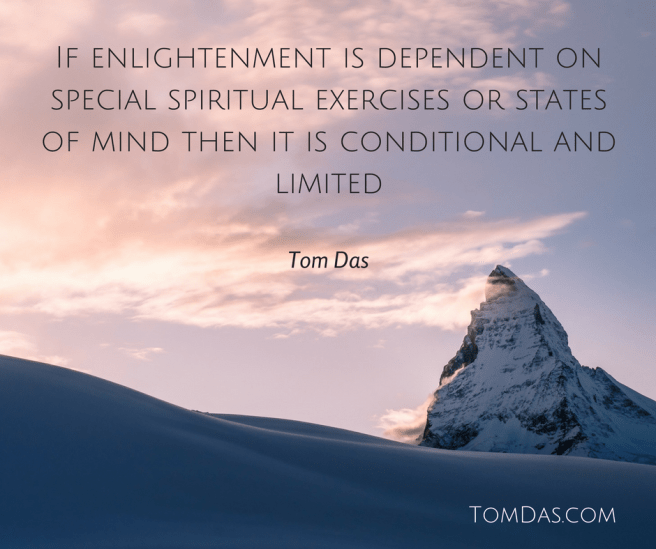
If enlightenment is dependent on special spiritual exercises or states of mind then it is conditional and limited
Absolute vs Relative Truth

One way of talking about spirituality is that it is that which is concerned with the ultimate truth or absolute truth. The concept is that absolute truth is universal, never changes and can be directly perceived/experienced at all times and places. It cannot be learnt or accumulated as it is always already present and known. I use various capitalised words synonymously to describe it, eg. God, Truth, Love, Wholeness, Love, the Universe. The teaching is that its perception does not require special equipment (such as a microscope or telescope) and it does not depend even on the body, mind or senses. It cannot be described and defies and transcends all concepts. Absolute truth cannot even be divided into the absolute and relative, the division being merely a conceptual one.
It cannot be learnt or accumulated as it is always already present and known.
In contrast to this, worldly knowledge can be called relative knowledge or relative truth. This includes scientific knowledge, knowledge of skills such as a sports game or knowing facts such as how tall Mount Everest is. This knowledge is relative because it does not stand alone and is only true in relation to something else. For example the height of Mount Everest depends on various factors such as defining the point from which height is measured and the unit of measurement. The height will also change over time as the mountain topography changes. In fact one of the cardinal features of relative knowledge is that it changes over time depending on specifics relating to time and place. Relative knowledge can also be accumulated and developed over time. Lastly it requires the body-mind-senses to reveal/discover it.
So to summarise we have two concepts, the relative and the absolute. The relative is concerned with those things which change. We can lump all things that change together and call it the world. This world includes the world outside us, as well as our inner world of thoughts, feelings, emotions and psychic perceptions. The absolute is that which, in theory at least, remains the same no matter what. You could call this Spirit. It is always and already known by everyone whether they know it or not.
So to summarise we have two concepts, the relative and the absolute. The relative is concerned with those things which change…The absolute is that which, in theory at least, remains the same no matter what…It is always and already known by everyone whether they know it or not.
Strictly speaking, this division into relative and absolute itself is arbitrary, but because we take ourself to be a doer, this division is provisionally made so our mistake can be corrected. Once corrected, concepts of relative and absolute disappear (we see they are also false concepts), and all that remains is this, the unnameable. But until that point, the concepts are useful teaching aids pointing one in the right direction like the proverbial finger that points at the moon: don’t worship the finger otherwise you will miss the moon in all its heavenly glory. The flip side is that once you have seen the moon, you don’t need the finger any more. Teachings are always conceptual and are to be thrown away eventually.
Strictly speaking, this division in relative and absolute itself is arbitrary, but because we take ourself to be a doer, this division is provisionally made so our mistake can be corrected.
This means, according to my definitions above, talking about and working with emotions, feelings and thought processes is still in the domain of the relative world and so is not spiritual. I would even go as far as to say as that someone who is only interested in these things remains a materialist caught in the clutches of the ego. In this teaching we place our attention beyond the body, senses and mind (including any psychic powers and mystical experiences) and discover what appears to transcend and permeate everything.
Teachings are always conceptual and are to be thrown away eventually.
Now, before I get accused of being a nihilist let me make it clear that I am not saying that we shouldn’t do worldly things. Politics, medicine, health, social work, psychotherapy, psychic work, art, music, etc, all have their place and worth. But there is something more. I sometimes call this Spirit, but you can use any word that resonates with you. Or you can use no word at all.
Through discovering that which already (apparently) transcends the world (which is the same as discovering your ‘true nature’, that which you already are) you can ‘realise’ your Natural State. It’s just noticing something that is already here, but that noticing is powerfully transformative and enables us to realise that we are already, and have always been, free.
Once [the root mistake has been] corrected, concepts of relative and absolute disappear (we see they are also false), and all that remains is this, the unnameable.
Love, happiness and non-duality
When the ego is seen through, all there is is what is. This is actually love, this is the real love.
Q. What is the relationship between love and non-duality?
A. Non-duality, as you call it, when it is fully seen, has nothing to do with trying to become more loving. But when the intrinsic-Freedom-that-already-exists is recognised, there is a tendency to become more loving, more open. Not that that actually matters. Openness and love are just what tend to happen when the illusion of a separate doer-entity is seen to be illusory. They are side effects.
Q. If in seeing this Freedom one tends to become more loving, then why do you say non-duality has nothing to do with being more loving?
A. This is about what is true, not what you want to be true. You may want to be more loving, more ethical or more whatever, but so-called ‘non-duality’ is about seeing what already is, right now. It is the ego or person that wants to become more loving, more ethical, more radiant, more popular, and so on. So the desire to be more loving is actually a subtle form of ego. ‘Non-duality’, or whatever you want to call it, is not about a continuation of the ego, but seeing that this ego is a fiction, that the sense of doership is an imagined belief without any evidence to underpin it.
It is the ego or person that wants to become more loving, more ethical, more radiant, more popular, and so on.
Who cares about love? Who cares about being ethical? It’s the ego of course. The ego cares, the doer-entity cares and it is the ego that wants to improve itself and therefore perpetuate itself. Ask yourself, ‘what is this entity that cares about being loving, being ethical?’. If you really are interested and you look, then it can become obvious that there is no ego there, it was all just a belief all along, a false belief. The story of doership is false.
Then all there is is what’s happening. Nobody doing anything, just what’s happening. I call this Freedom, but it doesn’t really have a name. It is simply what’s happening. It is simply the way things actually are, not they way you want things to be based on your projection which is in turn based on beliefs and concepts. It is the simplicity of life stripped clean of false notions and narratives, in which false notions are seen through as they arise.
I call this Freedom, but it doesn’t really have a name. It is simply what’s happening.
In Freedom, you don’t care about love, or any other projected ideal. You don’t try to be more ethical. Maybe you are more loving, maybe you are not. That’s why this automatically tends towards love – because there is no motive, because the ego is not at play. It may go against intuition but love does not care about love. Love just is when things are seen for what they are. To put it more poetically, in seeing truth (of no-self), love is.
In seeing truth, love is
Q. What about happiness?
A. Again, who cares about happiness? It’s the ego! The ego cares, and the ego is a fiction. Relax your mind and look for the ego – where is it? It is just empty thoughts, there is no entity there! But you have to really want to know the truth to see this: by that I mean that you have to be willing to drop all your ideas and concepts about yourself and your life. Then you really have to actually look – at least most people do. Some people just see this spontaneously, but all you have to do is notice what is already true.
When this is seen, that there is no ‘self-entity’, the neurotic drive for happiness naturally dissipates, and then Joy naturally arises. Why? Because the (neurotic) drive for happiness is actually a form of suffering. When there is no concern for happiness, then Joy naturally tends to manifest. A feeling of wellbeing may not always be there, but who cares? That’s just the way things are. No feeling-state or mind-state is permanent. Everything changes. Nothing lasts forever. Who cares? That’s the freedom.
Investigate the present reality instead of chasing a future projection.
When you are trying to get somewhere, you are chasing a projected ideal, something conceptual, not something actual. Instead of chasing the conceptual, why not remain with the actual, with what is actually happening now? Investigate the present reality instead of chasing a future projection. When the ego is seen through, all there is is what is. This is actually love, this is the real love. The lack of a centre, the lack of a doer, that’s what love really is. It’s not an emotion at all. It’s not necessarily even feeling loving, although that may happen when it’s appropriate.
When the ego is seen through, all there is is what is. This is actually love, this is the real love.
Without the ego at play, all there is is natural functioning. Emotions then act accordingly when they are required. It’s not healthy to be happy all the time, nor is it likely to be physiologically possible. Our varied emotions, fears and mental states are there to guide us as we navigate the world.
So, when the ego is seen through, this is what we could call love, although love is just a label for this as it actually is. This ‘love’ is not what most people mean by ‘love’. It is not an emotion, it includes everything that is happening, and it is not dependent on what is happening. It is un-conditional you could say. It is always here because it is none other that what is here. It is universal motion seeing through illusion. It is what is recognising what actually is.
Science does not lead to truth
Science is a tool
Science is a tool, not a means of truth. And like all tools, they are neither good or bad in themselves, but can be used according to the will of he who wields it. A spanner can be used to help make a hospital bed or it can be used to hit you over the head and put you in hospital bed. Science is no different, but due to its potential power it can be used to vastly improve or destroy the quality of human life on large scales.
Science does not tell us what is true, it is a method of prediction
However one thing it is useful to be clear on is that science does not tell us what is true. Science is a way of predicting what will happen in a given set of circumstances. A scientific theory is a model that explains what we observe. A model is a conceptual construct that is created by the human mind – it says if you do action ‘x’, then result ‘y’ is seen to occur. We call this cause and effect, but even that is an assumption. Perhaps I am being pedantic here, but we don’t really know that ‘x’ causes ‘y’ in any solid way. All we know is that when you do ‘x’, then this leads to ‘y’. This is all cause and effect really means.
If the theory works, it doesn’t mean that it is true, it just means that we can use it as a provisional way of predicting what will happen. This model can be used to predict what will happen in various scenarios. As long as the theory works, we continue to use it. If we find that it doesn’t work in some situations, then we have to re-examine the theory and come up with a better one that will work in those situations.
This has some interesting implications. For example we cannot say that there is such as thing as an electron. We can only say that the conceptual model of an electron is a good way of predicting what will happen in certain circumstances (ie. circumstances involving ‘electrons’). It may be there are no such things as individual electrons, but if the theory works, we can use it nonetheless.
So strictly speaking, when someone says that a theory is true, what they really mean is that the theory works based on what we are currently able to observe and measure. Note that what we can observe/measure is always via our senses, and is limited by our senses and the machines we have constructed to feed into our senses (such as microscopes, rulers, speedometers, x-ray machines, etc).
Science can only disprove, not prove
Another way of saying this is that scientific truth is not really truth as most of us would accept it. It is simply a theory that works. Science can never actually prove something is true. It can only say that a theory is false by disproving it, or that a theory has so far not been proven false. The theories we have not been able to prove as being false are the ones we take to be ‘true’ (provisionally), until they are proven false later on.
Lets embrace science to improve the quality of human life
So, lets use science, and all other tools we have, to improve our lot and raise the quality of our life. And what is the quality of our life? Well this is determined by our experience of life. We can use material resources, science, technology (including medicine) and spirituality to improve our experience of life. Let’s make these tools instruments of love and peace. Therefore, let us become loving and peaceful so this may be done.
 Tom Das