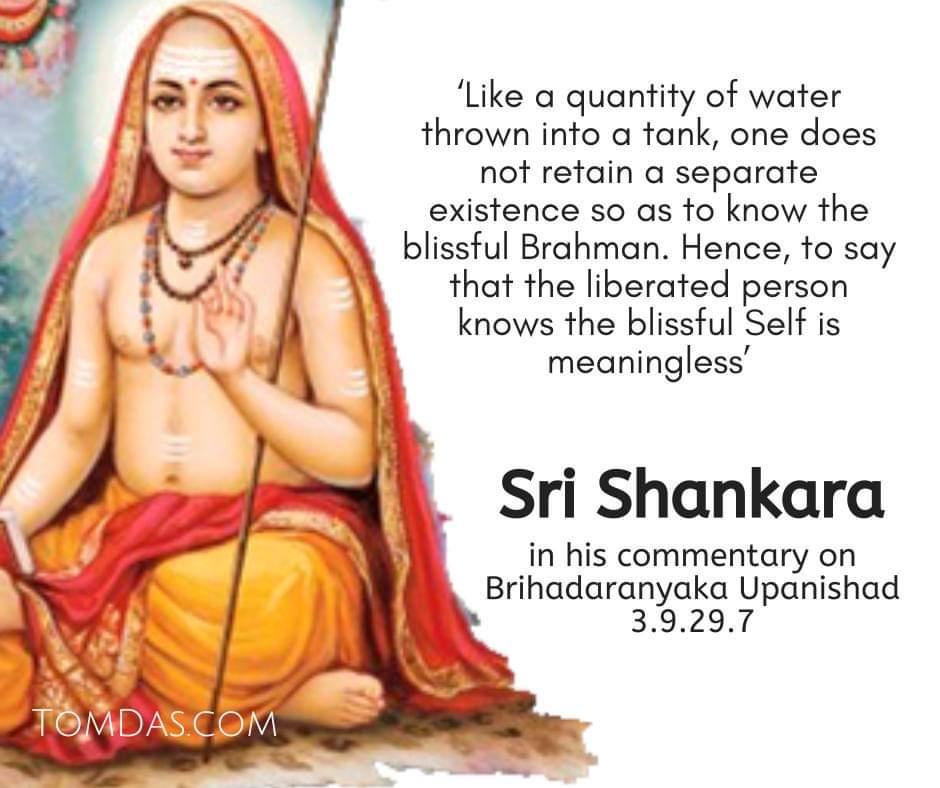
Some people have informed me of their view that in full liberation there is no appearance of the body, mind and world, but that this full liberation, called videhamukti, only occurs when the body dies. As long as the body lives, they say, the appearance of the world continues, this being called Jivanmukti (liberation whilst alive as a person or jiva). For the Jivanmukti, the appearance of the body, mind and world continue, but they are known to be an illusion.
The Jnani, they say, will continue to experience pleasure and pain, etc, until the body dies. Some say this means that some ignorance is retained for the jivanmukti and ignorance is only completely dispelled when the body dies after jivanmukti, which again is called videhamukti (liberation without the body, ie. The state of liberation once the body has died – note if this is true, then there are 2 forms of liberation, which itself is a contradiction to non-duality – ie. there cannot be 2 different forms of non-dual liberation by definition, for that would be inherently dualistic).
This is not Shankara’s view at all. He specifically states this view is not correct in many places throughout his writing. Incidentally Sri Ramana Maharshi also explains how this view is not correct too and is in full agreement with Shankara.
In this post I will demonstrate that Shankara has the following view:
1) for the liberated sage (jnani) there is no appearance of the body, mind or world – there is no appearance of a body, there is no appearance or experience of pleasure or of pain, and there is not even any experience or appearance of time and space for the jnani
2) this liberation does not occur only once the body has died – the implication is that whilst others may perceive the jnani to have a body, to experience pleasure, pain, etc, to experience time and space, this is only the view of the ignorant onlooker. The Jnani has a different ‘experience’, namely they do not perceive samsara, the world, pleasure, pain, time, space or a body – they only ‘experience’ the ever-blissful self, which is one, homogenous and ultimately beyond all experience, all conception and all description.
3) Shankara explains that the appearance of the body (and mind and world) is an effect of ignorance, and that the cessation of ignorance cannot depend on an action such as the death of the body (yes, death of the body is an action, and Shankara famously and repeatedly taught that actions cannot lead to removal of ignorance or liberation). Conversely, if the body mind and world appear, that is an indicator that ignorance is still in effect, for these are the hallmarks of duality, samsara, jivahood and suffering.
4) Moreoever, the body, being an effect of ignorance, cannot itself remove ignorance by dying. Ignorance is the cause, the body-appearance is a consequence of ignorance. Any changes to the effect cannot effect the root cause, no, rather the root cause of duality has to be removed, and when that occurs, any effects dependent on the cause will naturally fall away.
Shankara comments on the nature of liberation
In Shankara’s commentary on the Brahma Sutra 1.1.4 Shankara makes several definitive points about the nature of liberation. In this part of the commentary, his main aim is to show that the Self is not attained through any actions or thoughts, but through Jnana or knowledge (which he explains is not a thought or understanding). However in making his arguments, he also makes some other points about the nature of liberation.
Bodilessness is liberation
First he says that there is no body in liberation, that the jnani is without a body. He uses the word अशरीरत्व (aśarīratva) which literally means ‘the state of being without a body’ (sarira = body; a- is the negating prefix, -tva denotes the state of being, similar to the English suffix ‘-ness’) or ‘bodilessness’.
Shankara writes:
Hence it is proved that asiriratva (bodilessness), which is liberation, is eternal and different from the results of action…it is all pervasive like space, devoid of all modifications, ever happy, without parts and self-effulgent by nature. This is that bodilessness, called liberation, where the idea of the three periods of time does not exist, and the virtuous and unvirtuous deeds cease along with their effects, as stated in the scriptures…
We can clearly see in the text above that Shankara is stating the Jnani is without a body, and also does not experience any actions, any effects of actions, nor do they experience any concept of the three periods of time (past, present and future).
Of course, this teaching is given by Shankara repeatedly thoughout his commentarial works where he states the transactional reality (vyvaharika) only exists for the ignorant/ unrealised, and for the Jnani, there is only the Ultimate Truth (paramarthika). Shankara also writes this in his non-commentarial works, such Upadesa Saharsri, as follows:
All this world is unreal and proceeds from ignorance, because it is seen only by one afflicted by ignorance
Sri Shankara, Upadesa Sahasri 17.20
and also here:
Having thus effaced the triad consisting of dreamless sleep, dream and waking experience, one crosses over the great sea of ignorance. For he is then established in his own Self, void of all attributes of the empirical world, pure, enlightened, and by his very nature liberated.
Sri Shankara, Upadesa Sahasri 17.58
and also here:
Of me who am ever-liberated, pure, rock-firm and changeless, not subject to modification, immortal, indestructible and so without a body, there is no hunger or thirst or grief or delusion or old age or death. For I am bodiless…
Sri Shankara, Upadesa Sahasri 13.3-13.4
Bodilessness has nothing to do with the death of the body
But perhaps one could argue that this bodiless state of liberation only occurs when the body dies, ie. in so-called Videhamukti, but that the body persists in jivanmukti? Shankara addresses this very point in the same commentary on Brahma Sutra verse 1.1.4, where he writes the following:
Opponent: Suppose we argue that this bodilessness comes when the body falls [dies], but it cannot be so for the person still living?
Vedantin: Not so, for the idea of having a body is the result of ignorance. Unless it be through the ignorance of identifying the Self with the body, there can be no having a body for the self. And we have said that the bodilessness of the Self is eternal, since it is not a product of action.
Shankara is explaining 2 points here, firstly that the notion of the body itself is downstream from ignorance, ie. that the body only persists due to ignorance, and when ignorance has gone, so has the body. Therefore one does not need to wait for the body to die to become ‘bodiless’. These kinds of misconceptions arise from the strong identification of being a body in the first place.
His second point is that the death of the body is an action, and so cannot be responsible for the eternal state of bodilessness, which is liberation and the Self (note that earlier in this commentary Shankara has already made the point that all actions lead to effects which themselves are finite and impermanent, and so action cannot lead to something permanent such as the eternal state of bodilessness which is our true nature – ie. Shankara has argued that no action or karma can lead to liberation or moksha)
The Jnani’s worldly experience doesn’t continue as before
But surely, one could argue, the jnani has the same essential worldly experience as the ajnani (the unenlightened or ignorant one)? Don’t we see the Jnani walking, taking, eating, laughing, getting annoyed, etc? Shankara denies this – he goes on to say the following, again in his commentary on Brahma Sutra 1.1.4:
..it is established that the liberated one has no body even whilst living…hence one who has realised his own identity with Brahman cannot continue to experience the world (samsara) as before, whereas the one who experiences the world (samsara) as before has not realised his identity as Brahman. Thus it is all beyond criticism.
And again Shankara writes in his commentary on Brahma Sutra 1.1.4:
Opponent:…it is a patent fact that even one who has heard of Brahman continues to have his mundane life just as before?
Vedantin: To this the answer is being given: for one who has realised the state of the oneness of the Self and Brahman, it cannot be proved that his mundane life continues just as before, for this contradcits the knowledge of the oneness of Brahman and the Self…hence it is stated in the scriptures ‘Happiness and sorrow do not touch one who has become definitely without a body’ [Chandogya Upanishad 8.7.1]
We can see here the objection is raised that surely it is an obvious fact that the jnani experiences their mundane life just as before. Shankara denies this, stating firstly that this cannot be proved and secondly that this notion contradicts the scriptures and concept of non-dual realisation. Shankara in the above comments also explains that the Jnani does not experience any worldly happiness or sorrow, an idea consistent with what Shankara wrote earlier, namely there are no actions or effects of actions (such as happiness or sorrow) in the Self.
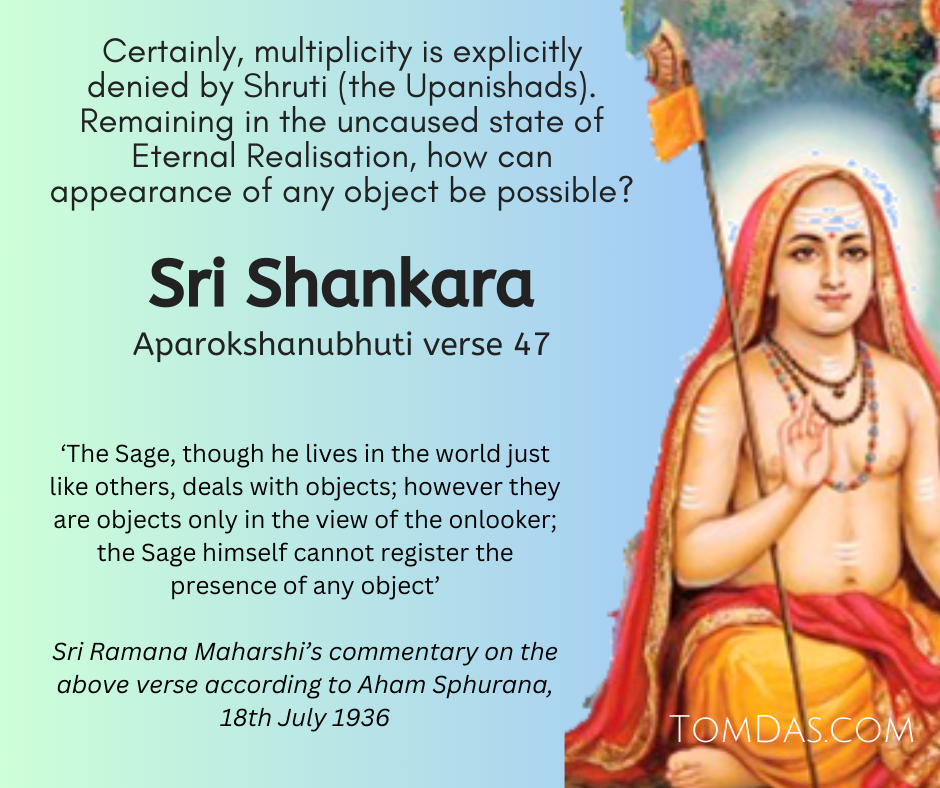
We see Sri Ramana explain the same in this picture quote below, when he is commenting on another writing of Shankara’s:
If you are interested to see how Sri Ramana Maharshi, Gaudapada and Suresvara give the same teachings please see this post here:
and
and
 Tom Das