Is peace and bliss the goal? Or is the experience of peace and bliss just another attachment for the ego to get trapped by? Perhaps peace and bliss and happiness…have something helpful to offer seekers on their journeys to awakening?
Tom explores these questions in this video
yoga
Starts tomorrow (book now) – Freedom from suffering in a world on fire with Tom Das
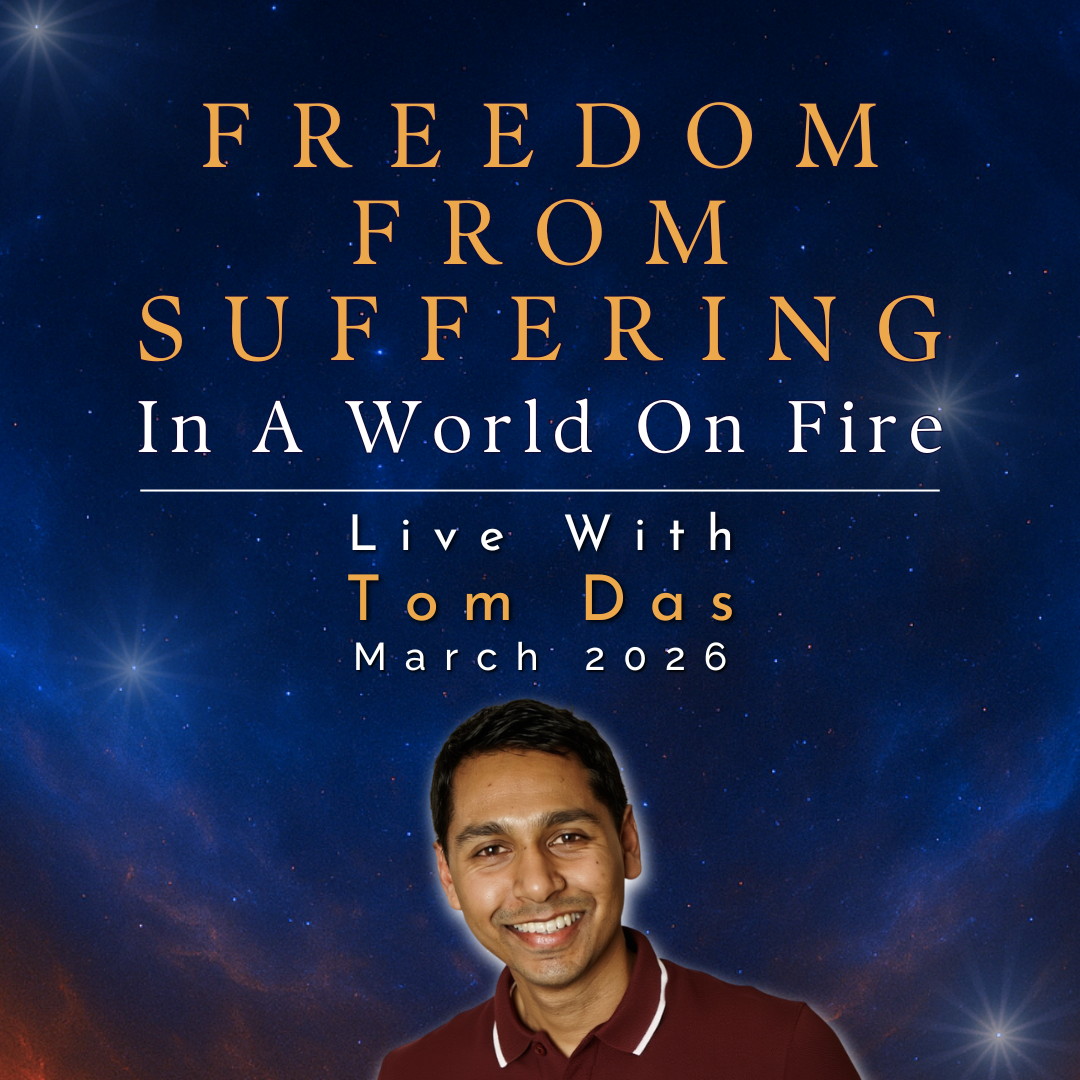
Please click on this link to find out more about this 4 part series in March 2026. Any tickets purchased using this link will result in Tom receiving some commission:
Ajata Vada as explained by Sage Vasistha in Yoga Vasistha
This article is an excerpt from a much longer article which you can view here, that gives further quotes on this same topic from others including Sri Ramana Maharshi, Sri Shankara, Suresvara and Ribhu Gita. The original article also gives disclaimer which you should read (ie. these teachings are for earnest seekers only and can have detrimental effects for those not ready for them) and makes some suggestions as how to best appraoch these teachings.

The following verses are taken from the text Voga Vasistha Sara, which you can view and download here in its entirely. As with most Advaita texts, various teachings from different levels are given in this text. In Yoga Vasistha mainly Ajata Vada and Dristi Sristi Vada teachings are given, and below I will list some of the quotes pointing to Ajata Vada:
1.17 Even the slightest thought immerses a man in sorrow; when devoid of all thoughts he enjoys imperishable bliss.
1.23 Nothing whatever is born or dies anywhere at any time. It is Brahman alone appearing illusorily in the form of the world.
2.1 Just as the great ocean of milk became still when the Mandara Mountain (with which it was churned by the Devas and the Asuras) became still, even so the illusion of samsara comes to an end when the mind is stilled.
2.2 Samsara rises when the mind becomes active and ceases when it is still. Still the mind, therefore, by controlling the breath and the latent desires (vasanas).
2.3 This worthless (lit. burnt out) samsara is born of one’s imagination and vanishes in the absence of imagination. It is certain that it is absolutely unsubstantial.
2.5 This long-living ghost of a samsara which is the creation of the deluded mind of man [ie. ignorance] and the cause of his sufferings disappears when one ponders over it.
2.8 Whatever is seen does not truly exist. It is like the mythical city of Gandharvas (fata morgana) or a mirage.
2.11 This creation, which is a mere play of consciousness, rises up, like the delusion of a snake in a rope (when there is ignorance) and comes to an end when there is right knowledge.
2.19 The bliss of a man of discrimination, who has rejected samsara and discarded all mental concepts, constantly increases.
3.22 If, by perceiving that the objects of perception do not really exist, the mind is completely freed (from those objects) there ensues the supreme bliss of liberation.
3.23 Abandonment of all latent tendencies is said to be the best (i.e. real) liberation by the wise; that is also the faultless method (of attaining liberation).
3.24 Liberation is not on the other side of the sky, nor is it in the nether world, nor on the earth; the extinction of the mind resulting from the eradication of all desires is regarded as liberation.
3.25 O Rama, there is no intellect, no nescience, no mind and no individual soul (jiva). They are all imagined in Brahman.
3.26 To one who is established in what is infinite, pure consciousness, bliss and unqualified non-duality, where is the question of bondage or liberation, seeing that there is no second entity?
4.1 Consciousness which is undivided imagines to itself desirable objects and runs after them. It is then known as the mind.
4.9 The mind is the cause of (i.e. produces) the objects of perception. The three worlds depend upon it. When it is dissolved the world is also dissolved. It is to be cured (i.e. purified) with effort.
4.12 O Rama, he who, with in-turned mind, offers all the three worlds, like dried-grass, as an oblation in the fire of knowledge, becomes free from the illusions of the mind.
4.13 When one knows the real truth about acceptance and rejection and does not think of anything but abides in himself, abandoning everything, (his) mind does not come into existence.
4.14 The mind is terrible (ghoram) in the waking state, gentle (santam) in the dream state, dull (mudham) in deep sleep and dead when not in any of these three states [ie. when in the fourth state, Turiya, self-realisation].
4.16 The mind is samsara; the mind is also said to be bondage;
6.2 The mind, the intellect, the senses, etc. are all the play of Consciousness. They are unreal and seem to exist only due to lack of insight [ie. objects only appear due to lack or self-knowledge, which is also known as ignorance].
6.9 The world which has come into existence on account of my ignorance has dissolved likewise in me.
7.16 It is again strange that while the Supreme Brahman is forgotten by men, the idea ‘this is mine’ called avidya is firmly held by them (lit. strongly confronts them).
10.1 Supreme Bliss cannot be experienced through contact of the senses with their objects. The supreme state is that in which the mind is annihilated through one-pointed enquiry.
10.2 The bliss arising from the contact of the senses with their objects is inferior. Contact with the sense objects is bondage; freedom from it is liberation.
10.5 The belief in a knower and the known is called bondage. The knower is bound by the known; he is liberated when there is nothing to know.
10. 6 Abandoning the ideas of seer, seen and sight along with latent desires (vasanas) of the past, we meditate on that Self which is the primal light that is the basis of sight.
10.11 The rock-like state in which all thoughts are still and which is different from the waking and dream states, is one’s supreme state.
10.16 There is only the one waveless and profound ocean of pure nectar, sweet through and through (i.e. blissful) everywhere
Siddhis: Are Spiritual Powers a Trap? (Enlightenment and Liberation)
In this Satsang, Tom offers a nuanced and insightful teaching on “Siddhis” — a Sanskrit term meaning “accomplishment,” “perfection,” or “attainment.” Siddhis often refer to extraordinary abilities or yogic powers said to arise through deep spiritual practice, such as levitation, invisibility, or telepathy. Tom explores how these phenomena are sometimes sought by spiritual seekers or arise spontaneously as by-products of genuine practice.
This video was recorded live during a Satsang meeting with Tom Das on November 20th , 2025 and put together by volunteers.
To download full unedited satsang recordings see here: https://payhip.com/tomdas To attend satsang, see here: https://tomdas.com/events
For guided meditations see the ‘guided meditation’ playlist here: https://www.youtube.com/c/TomDasNonduality/playlists
For recommended reading for liberation see here: https://tomdas.com/2020/10/19/recommended-reading-books-for-enlightenment-liberation-and-self-realisation/
Tejobindu Upanishad: what is Jivanmukti?
CHAPTER – IV
The Kumara asked the great Lord: “Please explain to me the nature of Jivanmukti and Videhamukti.” To which the great Shiva replied:
1. “I am Chidatma. I am Para-Atma. I am the Nirguna, greater than the great. One who will simply stay in Atman is called a Jivanmukta.
2. He who realises: ‘I am beyond the three bodies, I am the pure consciousness and I am Brahman’, is said to be a Jivanmukta.
3. He is said to be a Jivanmukta, who realises: ‘I am of the nature of the blissful and of the supreme bliss, and I have neither body nor any other thing except the certitude ‘I am Brahman’ only.
4-6. He is said to be a Jivanmukta who has not at all got the ‘I’ in myself, but who stays in Chinmatra (absolute consciousness) alone, whose interior is consciousness alone, who is only of the nature of Chinmatra, whose Atman is of the nature of the all-full, who has Atman left over in all, who is devoted to bliss, who is undifferentiated, who is all-full of the nature of consciousness, whose Atman is of the nature of pure consciousness, who has given up all affinities (for objects), who has unconditioned bliss, whose Atman is tranquil, who has got no other thought (than Itself) and who is devoid of the thought of the existence of anything.
7-11(a). He is said to be a Jivanmukta who realises: ‘I have no Chitta [mind], no Buddhi [intellect], no Ahamkara [ego, sense of doership and enjoyership], no senses, no body at any time, no Pranas, no Maya, no passion and no anger, I am the great, I have nothing of these objects or of the world and I have no sin, no characteristics, no eye, no Manas [mind], no ear, no nose, no tongue, no hand, no waking, no dreaming, or causal state in the least or the fourth state.’
~ Tejobindu Upanishad
Tom: Tejo means radiant; Bindu means point (or drop)
The Universal Way | The True Yoga | The Way, the Truth & the Light | Christ within
The Universal Way | The True Yoga | The Way, the Truth & the Light | Christ
How to get a glimpse of the Absolute
Can anyone become enlightened? The story of Pralada | Yoga Vasistha
Swami Sarvapriyananda: Seeing the eternal in daily life not just in samadhi
Also see: Does Swami Sarvapriyananda teach the same as Swami Vivekananda and Sri Ramakrishna?
Above is a nice presentation from Swami Sarvapriyananda, but this in my view this is actually a distortion of genuine vedanta teachings. I do want to be respectful towards Swamiji as I think he is doing a great job sharing Vedanta teachings – he is raising awareness of and popularising Vedanta in a very accessible and approachable way – and he is also a gifted teacher who is benefitting many – so I hope I will not offend anyone by merely stating an alternative view that I also hope will be of benefit to those seeking liberation (see the link above for more on my view of these types of teachings).
Imho these ‘Vedanta’ teachings are predominantly on the intellectual plane only and the genuinely infinite and blissful nature of the Self is not revealed with this type of teaching. The Jnana (knowledge) of the scriptures is not mere intellectual knowledge, as suggested by Swami Sarvapriyananda, but a synonym for Self-Realisation which is beyond any intellectual comprehension and does not depend on the mind/thought. Jnana is not merely a change in a point of view, but something much more radical and fundamental than this.
eg. there is a direct contrast between Swami S’s teaching in the video and with that of Sri Ramana Maharshi, who I consider to teach the genuine Vedanta teaching, as taught in the Upanishads and by Sri Shankaracharya. The following is taken from Sri Ramana’s text Who Am I? – can the teachings be any clearer? See how it contrasts to the exposition given, eg at around 23:40 mins into the video above where Swami S states the world/’what is seen’ need not be removed:
Questioner. When will the realization of the Self be gained?
Sri Ramana Maharshi: When the world which is what-is-seen has been removed, there will be realization of the Self which is the seer.
Questioner: Will there not be realization of the Self even while the world is there?
Sri Ramana Maharshi: There will not be.
Questioner: When will the world which is the object seen be removed?
Sri Ramana Maharshi: When the mind, which is the cause of all cognition’s and of all actions, becomes quiescent, the world will disappear.
This teaching is given by Sri Ramana as ignorance is only removed when we turn away from Maya and towards the Subject-Self, and thus discover what we truly are beyond the mind and objective phenomena. Sri Ramana is also telling us that the entire world is in fact an illusory projection of the mind, something that he further explains in the text ‘Who am I?’.
Ironically, this teaching given by Swami Sarvapriyananda is also in direct contrast to Swami Vivekananda (the founder of the organisation Swami S is in) who again and again explained the need for Samadhi, eg:
‘The conclusion of the Vedanta is that when there is absolute [ie. nirvikalpa] samadhi and cessation of all modifications, there is no return from that state’
Or contrast this with Sri Shankara, the founder of ‘modern’ Advaita Vedanta, in his commentary on the Katha Upanishad 2.1.1:
‘…The group of sense organs, beginning with the ear, should be turned away from all sense-objects. Such a one, who is purified thus, sees the indwelling self. For it is not possible for the same person to be engaged in the thought of sense-objects and to have the vision of the Self as well‘
Guru Ramana gives a rather cutting teaching in Guru Vachaka Kovai verse 599:
599.
The innocent girl-bride thinking that
Betrothal is full conjugal union
Is filled with joy. Even so the learned
Who have yet to turn within and taste true bliss
Claim that the verbal wisdom which they prattle
Is advaita jnana.
See here for more many more quotes like this from Sages such as Sri Shankara and the Upanishads: Do we need to turn away from the world of objects to realise the Self? | Advaita Vedanta | Sri Ramana Maharshi | Upanishads | Shankara
 Tom Das