Also see: Ramana Maharshi – the 3 levels of the teaching
There are several verses in the Bhagavad Gita (one of my favourite texts) which teach the higher advaita teaching of ajata vada. Here we will look at a few of them.
Ajata literally means ‘no birth’, ‘no creation’ or ‘no origination’, and vada means doctrine or view or teaching. Many misunderstand what ajata actually means, and even many prominent teachers of vedanta misunderstand this teaching, as fundamentally it cannot be truly understood by the mind.
Ajata is the notion that there was never any creation, and that the world, including the body and mind, never actually were created, and never even appeared in consciousness at all, not even as an illusory dream-like appearance. On the face of it this sounds ludicrous, but if you take on board this understanding of the scriptures, you will find that the deeper teachings of Advaita will be revealed to you, and parts of the teaching that would otherwise not make sense will start to make sense.
See here for Sri Ramana Maharshi explaining the ajata teachings in more detail and giving us the true meaning of these wonderful but radical teachings.
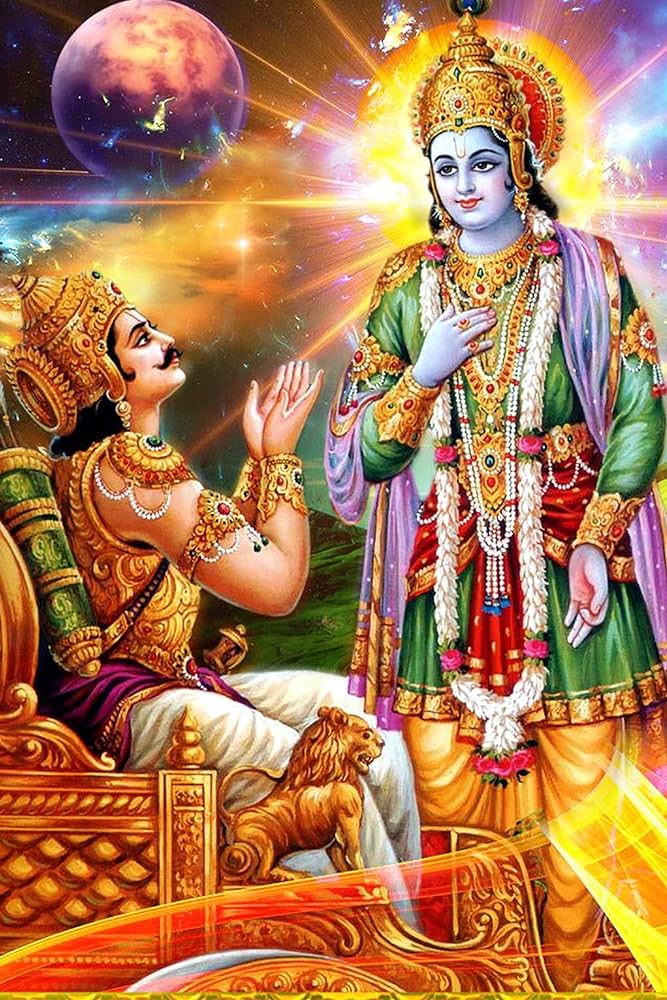
Perhaps the most famous of the verses from the Bhagavad Gita that give the Ajata teaching is 2.16:
‘The unreal has no being; the real never not-is [never is non-existent, ie. the real always IS]; The seers of ultimate reality have thus perceived the final truth about them both‘
We can see here the definitive statement at the start of the Bhagavad Gita which states the unreal never came to be, never had any being, and never actually existed. Unreal refers to that which comes and goes, that which is perceived, ie. the body, the mind and the world. Some misinterpret the verse to say that the unreal appears to exist, but actually doesn’t exist, like a dream or an illusion, but this is not the deeper meaning at all. The deeper, seeminlgy paradoxical meaning is that the unreal never came to be, as the verse clearly states, not even as an appearance.
Sri Ramana Maharshi, in Sri Ramana Paravidyopanishad, gives this teaching to us in verses 147 and 330, where he explains that creation and appearance are the same. Therefore ‘no-creation’ or ‘ajata’ means no appearance:
147. Creation is not other than seeing; seeing and creating are one and the same process. Annihilation is only the cessation of seeing and nothing else, for the world comes to an end by the right awareness of oneself.
330. There is no creation apart from seeing; seeing and creation are one and the same. And because that seeing is due to ignorance, to cease seeing is the truth of the dissolution (of the world).
And Sri Ramana also gives us a teaching from Guru Vachaka Kovai verse 87:
87. Self appearing as the world is just like a rope seeing itself as a snake; just as the snake is, on scrutiny, found to be ever non-existent, so is the world found to be ever non-existent, even as an appearance.
More verses like the one above from Sri Ramana Maharshi can be found here.
Another verse from the Bhagavad gita that teaches Ajata Vada is Chapter 7, Verse 24:
‘The unwise, lacking in discrimination, think of Me, the Unmanifest, as having manifestation, knowing not My higher, immutable and most excellent nature.’
For the ignorant, the world is considered to be a manifestation of the divine. This verse clearly states that in Truth, Brahman never has any manifestation. It is only through ignorance that Brahman seems to manifest, but the wise (the sage), with ignorance eradicated, see the truth – there is only Brahman, and He/That is without manifestation. To the Jnani (liberated sage), Brahman is unmanifest and immutable, while the world of manifestation is a distorted perception of the Unmanifest seen through the lens of ignorance.
We see Sri Ramana explain this too, in Guru Vachaka Kovai, verse 35:
35. Since this world of dyads [eg. knower/known] and triads [eg. knower/knowing/known] appears only in the mind, like the illusory ring of fire formed [in the darkness of ignorance] by whirling the single point of a glowing rope-end, it is false, and it does not exist in the clear sight of Self.
Here is the last verse in this post from the Bhagavad Gita where Ajata is taught. It is from Chapter 9, Verse 4:
‘By Me, in My unmanifest form, is this entire universe pervaded. All beings have their existence in Me, but I do not have My existence in them.’
For the ignorant, the world is considered to be a manifestation of the divine, but in Truth, there has never been any manifestation, there has never been any duality, there has never been any multiplicity, there has never been any appearance, there has never been any ignorance (indeed this is another ramification of the ajata teachings – that there never was really any ignorance at all, that the apparent evils and injustices of the world never actually occurred, and there has only ever been liberation or heaven). These have never ever come to be. But, whilst we consider the manifestation (of the world/universe) to be real, we can say all is Brahman, but in truth, Brahman is not to be found in the world. This is why Lord Krishna says ‘I do not have My existience in them [the manifestation])
We see a similar teaching given by Sri Ramana Maharshi in one of the first few verses of Guru Vachaka Kovai, verse 21. This verse does not give the highest ajata teaching, but does clarify that the lower teaching is to consider the world to be a manifestation of the divine, but that the higher teaching is that the world does not in Reality exist:
21. For those who take the world appearance as real and enjoy it, it is the Lord’s creation. But for those who, free from fear, have known the Truth, the undeluded Self, it is no more than a mere mental image projected by desire.
Let us now go back, full circle, to the first verse quoted, and enjoy both its poetry and its clarity of expression:


ajata vada di gaudatada is my master
LikeLiked by 1 person
That’s wonderful to hear
LikeLike