There are many various ideas spoken by many various teachers about what Turiya is and what it isn’t. As always, it is best to go to the source material (the Upanishads in this case) directly to find out what the original intended meaning of Turiya actually is.
In this post I have collated the main scriptural quotes from the Upanishads, from Gaudapada and from Sri Ramana Maharshi on the teachings about Turiya. In fact I have included some very rare instances of where Sri Ramana Maharshi has written teachings in English in his own handwriting about Turiya. I have also included some commentary from Sri Shankara too. At the end of the post there is a link to teachings on Turiyatita, the ‘state beyond the fourth’ – we will see this is simply another way of talking about Turiya itself.
Turiya, literally meaning ‘the fourth’, refers to the state beyond the three states of waking, dream and deep sleep that make up our entire experience of life as an apparent person. Turiya, as we will see, refers to the true Self that we are, Brahman, Atman, the One, that when realised dispells all illusion and suffering. It is pure bliss.
You are That.
Om Tat Sat.
Namaste.
Turiya is mentioned in several of the Upanishads, including the Brihadaranyaka Upanishad – the longest and likely first of all the Upanishads – but Turiya is most famously described in the shortest Upanishad of them all, the Mandukya Upanishad, which contains only 12 verses and is said to contain the entire Vedanta teaching in compressed but potent form for those who are able to understand it.
About 1500-1600 years ago Sri Gaudapada wrote a commentary on the Mandukya Upanishad called the Mandukya Karika or Gaudapada Karika, the entire text of which you can read for free here.
About 1400 years ago, Sri Shankara also wrote a commentary on the Mandukya Upanishad and also on Gaudapada’s commentary on the Mandukya Upanishad. In this text he refers to Turiya is various places, and you can see my translation of his introduction to this commentary here, which also elaborates some fundamental Advaita Vedanta teachings on Self-Realisation and Liberation (Moksha). I have also included some of Shankara’s commentary below.

On Turiya – the Mandukya Upanishad:
Firstly we shall see the most famous verse on Turiya, verse 7 of the Mandukya Upanishad, where Turiya is defined. Because it is such an important verse I have provided the original Sanskrit and the word for word translation below:
नान्तःप्रज्ञं न बहिःप्रज्ञं नोभयतःप्रज्ञं न प्रज्ञानघनं न प्रज्ञं नाप्रज्ञम् | दृश्यमव्यवहार्यमग्राह्यमलक्षणमचिन्त्यमव्यपदेश्यमेकात्मप्रत्ययसारं प्रपञ्चोपशमं शान्तं शिवमद्वैतं चतुर्थं मन्यन्ते स आत्मा स विज्ञेयः
nāntaḥprajñaṃ na bahiḥprajñaṃ nobhayataḥprajñaṃ na prajñānaghanaṃ na prajñaṃ nāprajñam | adṛśyam avyavahāryam agrāhyam alakṣaṇam acintyam avyapadeśyam ekātmapratyayasāraṃ prapañcopaśamaṃ śāntaṃ śivamadvaitaṃ caturthaṃ manyante sa ātmā sa vijñeyaḥ
na antaḥprajñaṃ: not inwardly conscious
na bahiḥprajñaṃ: not outwardly conscious
na ubhayataḥprajñaṃ: not conscious of both (inner and outer)
na prajñānaghanaṃ: not a mass of consciousness
na prajñaṃ: not (ordinary or simple or everyday) consciousness
na aprajñam: not unconsciousness
adṛśyam: unseen, unperceived, invisible
avyavahāryam: unrelated to empirical dealings or objects or karma
agrāhyam: ungraspable, incomprehensible
alakṣaṇam: uninferable, without characteristics
acintyam: unthinkable
avyapadeśyam: indescribable
ekātmapratyayasāraṃ: the essence of the realisation of oneness of the Self, essence of one-self-realisation
prapañcopaśamaṃ: cessation of the manifested world or phenomenal existence
śāntaṃ: tranquil
śivam: Shiva, auspicious, blissfull, benign, divine, holy
advaitaṃ: non-dual
caturthaṃ: the fourth
manyante: considered, thought of, known as
sa ātmā: that is the Self
sa vijñeyaḥ: that is to be realised
Turiya is not that which is conscious of the inner (subjective) world, nor that which is conscious of the outer (objective) world, nor that which is conscious of both, nor that which is a mass of consciousness. It is not simple or ordinary consciousness nor is it unconsciousness. It is unperceived, unrelated, incomprehensible, uninferable, unthinkable and indescribable. The essence of the realisation of oneness of the Self, it is the cessation of all phenomena; it is non-dual peace-holiness-bliss. This is what is known as the Fourth (Turiya). This is Atman and this has to be realised.
~ Mandukya Upanishad, verse 7
Turiya is here being equated with the Self, Atman, and it is this Turiya that is to be realised: ‘This is what is known as the Fourth (Turiya). This is Atman and this has to be realised’.
This Atman is not conscious of the waking, dream or deep sleep state, nor is it mere ordinary consciousness – it is indescribable and it contains no phenomena within it, so states the Upanishad: ‘Turiya is not that which is conscious of the inner (subjective) world, nor that which is conscious of the outer (objective) world, nor that which is conscious of both…It is not simple or ordinary consciousness…It is the cessation of all phenomena‘
Shankara, in his commentary on this verse 7 Mandukya Upanishad, confirms this is the correct interpretation of the verse. In fact this translation was made in line with Shankara’s commentary and explanation – Shankara’s commentary on verse 7 is too long to include here in this post, but he writes that Turiya is ‘the one in which all phenomena have ceased‘. This can sound like quite a strange or extreme teaching, so please see here for more on this teaching where more of an explanation is given.
Let us move onto verse 12, perhaps the 2nd most famous verse on Turiya:
The Fourth (Turiya) is without parts and without relationship; It is the cessation of phenomena; It is all good and non—dual. This AUM is verily Atman. He who knows this merges his self in Atman—yea, he who knows this.
~ Mandukya Upanishad, verse 12
This is the final verse in the Madukya Upanishad. Like in verse 7, Turiya is again equated with Atman (the Self) and AUM – it ‘is without any parts‘, meaning there are no objects that can arise in it, again emphasised by stating it is ‘without relationship‘ – meaning there is no relative ‘truth’ present and it has no relation to objects or phenomena.
This is further emphasised when it states ‘It is the cessation of phenomena’, as per verse 7 which states the same. It is all good, meaning it is pure positivity without any negativity whatsoever, without any opposite. It is non-dual, meaning without any time, space, people or objects. Again, please see here for more on this teaching.
Shankara, in his commentary on this verse writes that in Turiya there is ‘the disappearance of all names and nameables, that are but forms of speech and mind.‘ Shankara here has called objects ‘nameables’ and he is also giving us the Vedantic teaching of the scriptures that state that all things in the universe are created by the mind. For example, in the text Vivekachudamani written by Shankara as a summary of all the Vedanta teachings, Shankara writes:
169. There is no Ignorance (Avidya) outside the mind. The mind alone is Avidya, the cause of the bondage of transmigration. When that is destroyed, all else is destroyed, and when it is manifested, everything else is manifested.
170. In dreams, when there is no actual contact with the external world, the mind alone creates the whole universe consisting of the experiencer etc. Similarly in the waking state also; there is no difference. Therefore all this (phenomenal universe) is the projection of the mind.
Turiya is what you are. Aum Tat Sat. This will be further explained and elaborated upon in the following verses.
We will see Sri Ramana Maharshi’s teaching on Turiya later in the post, but here is a quick teaching from Sri Ramana Maharshi on this topic:
‘There is no mind, nor body, nor world, nor anyone called a soul; the One pure Reality alone exists, without a second, unborn and unchanging, abiding in utter Peace’
~Sri Ramana Maharshi, Guru Ramana Vachana Mala, verse 22
And
In reality, saying ‘We must see Brahman in everything and everywhere’ is also not quite correct. Only that state is final, where there is no seeing, where there is no time or space. There will be no seer, seeing and an object to see. What exists then is only the infinite eye.’
~ Sri Ramana Maharshi, Day by Day with Bhagavan page 193
Sri Gaudapada on Turiya:
About 1500-1600 years ago, Sri Gaudapada wrote a commentary on the Mandukya Upanishad called the Mandukya Karika, also known as Gaudapada’s Karika, that summarises the Advaita Vedanta teachings. Here are some of his writings on Turiya from the first chapter of this work:
1.10 Turiya, the changeless Ruler, is capable of destroying all miseries. All other entities being unreal, the non—dual Turiya alone is known as effulgent and all—pervading.
Tom: Turiya ends all suffering, everything other than turiya is unreal
1.11 Visva (the waker or waking state) and Taijasa (the dreamer, or dream state) are conditioned by cause and effect. Prajna (the sleeper, or deep sleep state) is conditioned by cause* alone. Neither cause nor effect exists in Turiya.
Tom: there is no cause or effect in Turiya
1.12 Prajna does not know anything of self or non-self, of truth or untruth. But Turiya is ever existent and all-seeing.
1.13 Non-cognition of duality is common to both Prajna (deep sleep) and Turiya. But Prajna is associated with sleep in the form of cause* and this sleep does not exist in Turiya.
*Tom: prajna, the sleeper or deep sleep, is characterised as being pure potentiality, the source of all manifestation, or maya, the seed of ignorance from which all manifestation arises. See verse 6 of Mandukya Upanishad where it states of prajna ‘He (prajna) is the source of all; for from him all beings originate and in him they finally disappear’
Tom: In both deep sleep and Turiya there is no cognition of duality or cognition of objects – we can see that Gaudapada equates perception of objects with perception of duality. However in deep sleep the Self is not known as there is a cause or seed of ignorance present (the Sanskrit word ‘bija’ used in this verse means both cause or seed, and Shankara in his commentary on this verse explains this is the meaning too). In Turiya this sleep-seed of ignorance is not present.
1.14 The first two, Visva and Taijasa, are associated with dreaming and sleep respectively; Prajna, with sleep bereft of dreams. Knowers of Brahman see neither sleep nor dreams in Turiya.
Tom: in Turiya (or for the knower of Brahman or the one who is Self-realised), there is no perception or arising of waking, dream or deep sleep
1.15 Dreaming is the wrong cognition, and sleep the non-cognition, of Reality. When the erroneous knowledge in these two is destroyed, Turiya is realised.
1.16 When the jiva, asleep under the influence of beginningless maya, is awakened, it then realises birthless, sleepless and dreamless Non—duality.
Tom: the reality (ie. Self or Turiya) is without birth (objects arising), without sleep, and without dream. ie. the waking, dream and deep sleep states are not present, nor do they arise in reality. So, do they disappear in self-realisation? Let us see…
1.17 If the phenomenal universe were real, then certainly it would disappear. The universe of duality which is cognised is mere illusion (maya); Non—duality alone is the Supreme Reality.
Tom: this verse is often quoted by itself without the preceding verses, and so misinterpreted. We can see in context that it is saying the following: if the phenomenal universe ever appeared, then it would certainly disappear upon Self-realisation. However, since the universe is maya, it (paradoxically to the mind) never actually appeared at all. There was only the non-dual Turiya or Self, nothing else.
Shankara explains this in more detail in his commentary on this verse 1.17. He writes ‘there is no doubt that had it [the world] existed, it would cease to be‘ and ‘this duality which is nothing but maya and is called the phenomenal world‘ – note he is equating maya with duality and the phenomenal world. Then Shankara concludes his commentary by summarising the meaning of this verse when he writes: ‘the meaning is that there is no such thing as a world that appears or disappears‘.
See here for more on this somewhat paradoxical teaching.
1.18 If anyone imagines illusory ideas such as the teacher, the taught and the scriptures, then they will disappear. These ideas are for the purpose of instruction. Duality ceases to exist when Reality is known.
Tom: The same point is being made again – ie. in truth duality or maya or appearances never actually ever came about. If you think they did come about, then they will disappear upon Self-Realisation. See Shankara’s commentary which explains the same.
Sri Ramana Maharshi on Turiya – in his own English handwriting:
First we have some writings of Sri Ramana Maharshi on Turiya, see here for verses written in English by Sri Ramana Maharshi himself, see this post here for more information on the context of these writing and for more teachings written by Sri Ramana Maharshi in English:
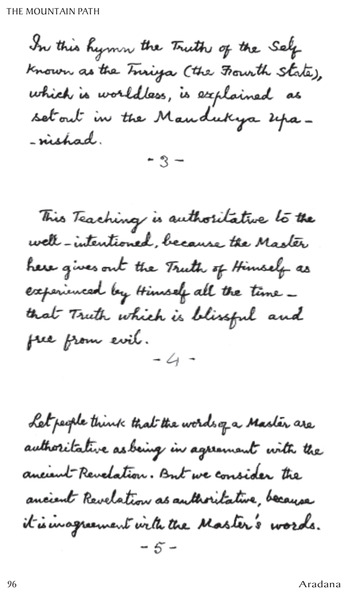
In the photo above we can see Sri Ramana Maharshi has written in English handwriting the following, in which is he saying Turiya is worldless, that is, without objective phenomena present, and this is taught in the Mandukya Upanishad:
‘In this hymn of Truth of the Self known as Turiya (the Fourth State), which is worldless, is explained as set out in the Mandukya Upanishad’
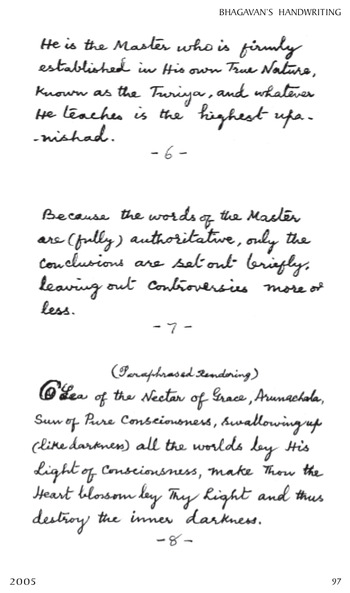
In this image above can see that Sri Ramana writes the following:
‘He is the master who is firmly established in his own True Nature, known as Turiya, and whatever he teaches is the highest upanishad’
We can see Sri Ramana is writing that Turiya is one’s own true nature, and that the sage is firmly established in this Turiya. He then states whatever the sage teaches is the highest Upanishad.
For more teachings written in English by Sri Ramana Maharshi see this post here and be sure to download the PDFs on that page for even more.
Sri Ramana Maharshi on Turiya – miscellaneous quotes:
Here are some other miscellaneous quote from Sri Ramana:
Turiya is only another name for the Self. Aware of the waking, dream and sleep states, we remain unaware of our own Self
~Sri Ramana Maharshi: Talks 353
It is the state of jivanmukti [Tom: liberation in this life] that is referred to as the attributeless Brahman and as the Turiya
~Sri Ramana Maharshi – Vichara Sangraham
Questioner: Why is the Self described both as the fourth state (turiya) and beyond the fourth state (turiyatita)?
Sri Ramana Maharshi: Turiya means that which is the fourth. The experiencers (jivas) of the three states of waking, dreaming and deep sleep, known as visva, taijasa and prajna, who wander successively in these three states, are not the Self. It is with the object of making this clear, namely that the Self is that which is different from them and which is the witness of these states, that it is called the fourth (turiya). When this is known, the three experiencers disappear and the idea that the Self is a witness, that it is the fourth, also disappears. That is why the Self is described as beyond the fourth (turiyatita).
~Sri Ramana Maharshi, Spritual Instruction 4.8
32. For one who seeks waking, dreaming or sleep there is a state beyond these three, a wakeful sleep, a fourth state called the turiya. But because this turiya state alone is real and the three apparent states are illusory, the ‘fourth’ state is indeed the transcendental state.
-Sri Ramana Maharshi, Supplement to 40 verses on reality
In the last verse Sri Ramana Maharshi equates Turiya with ‘wakeful sleep’ or ‘conscious sleep’, in Sanskrit, ‘Jagrat Sushupti’. Sri Ramana many times gave this teaching, which can help us better understand what Self-Enquiry actually is and how to realise the Self – see these articles for more on this topic:
Ramana Maharshi: the method of wakeful sleep (Jagrat Sushupti) to attain liberation
Conscious sleep (Jagrat Sushupti) is Self-knowledge
The point of Self-Enquiry is to go into Sleep Consciously
Sri Ramana Maharshi’s teaching on Turiya as recorded in Sri Ramana Paravidyopanishad:
The following teachings of Sri Ramana Maharshi were recorded in the text Sri Ramana Paravidyopanishad by Lakshmana Sarma (LS), a direct devotee who spend about 20 years with Sri Ramana. LS was one of only 2 people who received private tutelage from Sri Ramana on the deeper meaning of his teachings, the other being Sri Muruganar. LS was also a fluent English speaker and the translations below were made by LS himself, so we can be assured of their accuracy. LS has also provided his own commentary on the teachings, some of which I have provided below:
28. Since that state is changeless, worldless and calm, beyond the states of waking and the rest, it is called the fourth state. Such is the teaching of the Mandukya Upanishad.
Commentary from Lakshmana Sarma (LS): This is why there is no peace in the realm of ignorance. Peace prevails only in the transcendental state, which is the true state of the Self. Among the three states there is a distinction, which is stated next
30. The whole of this world is contained within this trinity of states. The reality of the fourth state, which is worldless, transcends these three states.
LS: Thus it is stated that, because of the underlying sleep of ignorance, the so-called waking is really a state of dream. This will be elaborated later, when the question of the reality of the world is discussed. The fourth state is in perfect contrast with the other three, being sleepless, dreamless and therefore worldless. It is the abode of freedom. Freedom cannot be had in any of the three states. This is one of the fundamentals of the transcendental metaphysics as taught by the sages.
34 Thus, every creature is asleep: none in this world of souls is awake. Only the sage, who, being firmly established in the fourth state, having transcended the three states, and who is free from ignorance, is awake.
LS: Being awake here means being aware of the real Self as it really is. Because of this awakening, he [the sage] is no more troubled by the dream called the world. This uniqueness of the sage is explained in the next two verses.
35 The sage is wide-awake, having become established in the true state of the Self, which is free from the darkness of ignorance. In respect of the dream-world that is being seen by those drowsy with ignorance of the Self, he is asleep.
36 Hence it is said that this world is as night to the sage, whereas to the ignorant the real Self is as night. For this reason the natural state, the fourth state is described by the sages as a state of waking sleep.
LS: This distinction between the sage and the ignorant finds a place in the following verse of the Gita: ‘The sage is awake in what is night to all creatures. That in which the creatures are awake is night to the sage, though he is, in fact, awake.’ This implies that from the standpoint of the sage, the world is unreal. This verse suggests a question: how the sage, whose body is still alive, can carry on his mission as a teacher of supreme wisdom. The solution to this riddle lies in the fact that the natural state of a sage does not interfere with the sage’s work as a teacher. That activity goes on in a mysterious way, which is explained to the extent possible in a later context. From all this it might appear that sagehood is something anomalous. What is anomalous is the worldly outlook, which is blind to the real and attentive to the unreal dream, the world-appearance. The worldly ones are just like intoxicated or mad people. It is the sage who is both sober and sane. Up to now the supreme state of the sage has been called the fourth state. But this name is only a concession to novices, as is shown presently.
37 For those to whom the three states, waking and the rest, are real, that [supreme] state is mentioned as ‘the fourth state’. But since that so-called fourth state alone is real, and these three are unreal, the term ‘fourth state’ is not rightly applicable to it.
LS: The supreme state is therefore just the transcendental state. When compared to this state, the three worldly states cannot be considered to be real. Their seeming reality is no more authentic than the reality that is ascribed to a dream while it lasts. This point will be further elaborated later. The cause of the difference between the three states and the supreme state is explained next.
38 In dream and waking, the mind, being active, itself creates the world. In deep sleep it goes into seed form; on awaking it again creates the world.
LS: In deep sleep the mind is not completely lost; it goes into a latent state, out of which it can emerge and become active again as before. This is the reason for the continuance of bondage. Thus, these three states form a vicious circle that can be broken only by finally extinguishing the mind so that it cannot revive on awaking. To reach this goal the mind-free state must be attained in the waking state itself since the other two states are useless for this purpose.
39 Unless and until the mind becomes utterly extinct, these three states will continue to prevail. When the mind becomes extinguished, the supreme state, in which this world once and for all ceases to appear [as real], is won.
LS: During the prevalence of ignorance the three states conceal the supreme state. The latter cannot be experienced because of these. To be able to experience that state the mind must be destroyed so that the world-creation will also cease. To this end, the quest must be taken up and pursued until the mind-free state is established. This is often styled the state of knowledge. But this description is misleading for the reason stated presently.
40 Though that state of being the real Self is called the state of knowledge, it is one in which there is none of the three: the knower, the object known, and the act of knowing. That being the case, what does one know there, by what means, and who is there to know? It must be understood that knowledge is just a name for the state of being the Self.
LS: That state is different from anything else because it is a state of non-duality (advaita). There is no object to be known, nor is there a knower – the soul – and hence there is no knowing. So ‘knowledge’ or ‘awareness’ are just arbitrary names for this state.
Sri Ramana Maharshi’s teachings on Turiya as recorded in Guru Vachaka Kovai:
The text Guru Vachaka Kovai, or Garland of Guru’s Sayings, is widely recognised and the most authoritative recording of Sri Ramana Maharshi’s verbal teachings, which fully and systematically explain the method and nature of Self Realisation, as much is possible in words. You can read the full text for free here. Here are some verses from that text on Turiya:
17. To those who look within, the highest
Good gained by the Master’s grace
Is wakeful sleep, the turiya state,
The undying flame, the sweet, uncloying
Fruit forever fresh.
80. Jivas suffer in the hot dry
Desert of the world, the dream
Born out of the whirling vasanas old.
Shady refuge from the triple
Fire of desire raging here,
They find beneath the spreading
Bodhi tree, turiya, Self-Awareness.
937. The sage whose ego is extinct
Is freed from the three seeming states
Of waking, dreaming and deep sleep.
All that remains for such a sage
Is turiya, the most noble state,
First, last and all-transcendent.
940. This true and laudable awareness,
Turiya, may be aptly named
Grand Sleep that knows no waking,
Or Eternal Wakefulness untouched
By slippery sleep
1009. The last, eternal resting place
For those who are tired of seeking bliss
Here, there, everywhere, what is it
But the marvellous turiya space
Revealed by sages who with Siva’s own
Bright, flawless Being-Awareness shine.
1123.He who has seen himself as Being
As Awareness sees the eternal Siva,
He has seen the death of terrible
Duality. He has seen his own
Natural state of turiya pure.
Birth is what this great one sees not.
Turiya and Turiyatita
See the following post for more on this topic:
Understanding Turiya (the 4th state) and Turiyatita (the state beyond the 4th state)
 Tom Das
5 thoughts on “TURIYA (the fourth state) as explained in the Upanishads, by Sri Gaudapada, by Sri Shankara and by Sri Ramana Maharshi | Turiyatita – beyond the fourth | Mandukya Upanishad | Gaudapada Karika | Advaita Vedanta”