The following is taken from the text Aham Sphurana, from the date 20th July 1936. See here to find out more about this text and also to download it for free:
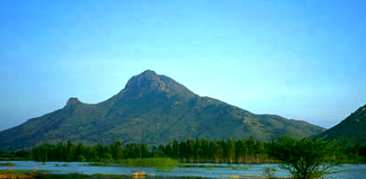
Questioner: It is said that the legendary Sanjeevani herb is found somewhere in this Arunachala hill, by consuming which one attains to state of Immortality. Will Bhagavan please let me know where it is in the hill?
Bhagavan Sri Ramana Maharshi: The hill itself bestows immortality.
Q.: How?
B.: Constant rememberance of Arunachala’s form steadily but surely introverts the mind. Then the mind accquires the strength to plunge inward, or rather loses the strength to move outwards, towards thoughts, intellectual concepts or physical objects. Eventually it becomes still entirely; then the Arunachala within pulls it into itself and destroys it once and for all. This is the Sanjeevani shakti [Tom: shakti means ‘power’] of Arunachala about which you are asking.
[Tom’s comments: here we have Bhagavan explaining how remembrance of Arunachala introverts the mind, pulling it inwards away from both gross and subtle objects, until it becomes entirely still. Arunachala then does the final step of destroying the mind, the result of which is explored below]
Q.: Is it not a herb?
B.: I have said what I know.
Q.: Is the ultimate aim of spiritual practice, only destruction of mind?
B.: Yes.
Q.: One whose mind is dead would perhaps have life in the body, but he would be in a state of comatose senselessness, like a stony, frigid vegetable, unable to understand anything. Is that the perverse fate toward which all spiritual aspirants are gravitating?
B.: Absence of mind is pure Bliss. It is possible to function in the world normally, without mind.
Q.: Oh! How so?
B.: Some power takes over his body and animates it without his knowledge.
Q.: Is it God?
B.: Give it any name you like- God, Providence, Fate, Karma, etc.; the nomenclature matters not.
[Tom’s comments: Bhagavan first confirms that manonasa, or destruction of mind, is indeed the ultimate aim of spiritual practice, thus equating manonasa with both self-knowledge or liberation. Then he goes onto explain that the body can continue to function without the mind under another higher power. This is done without the Jnani’s knowledge or awareness. Of course, Bhagavan is describing this form the relative standpoint, or the standpoint of ignorance/maya. Below we will see a higher teaching given later]
Q.: Are names unimportant in the scheme of things, then? How to call someone if he has no name?
B.: The fact is that in order to escape its own destruction the mind creates a world of name and form over the pure vastu [Tom: vastu means reality] that is the Atman. It abhors chaos and randomness and prefers order and systematisation. It creates cause-consequence relationships and gives itself to understand ideas about its environment, which is actually merely its own projection. It tries to study the nature of its body’s physical surroundings and formulates laws by means of which it then expects those surroundings to function; deviations from existing laws give rise to the birth of new laws! Never once does it wonder, ‘What is my self?’; thinking to conquer its surroundings, it foolishly occupies itself with sensory perceptions, thoughts, and intellectual hypotheses. Thus it is born again and again and needlessly undergoes all sorts of tribulations. Then it asks, ‘Alas! Why has God done this to me?’. Who is to blame for our mistake, if not ourselves?
[Tom’s comments: here Bhagavan explains that the mind creates the universe of name and form and superimposes this onto the formless objectless reality that is Atman, one’s true self. It then projects cause and effect, or karma, and starts to study the environment around it, which is actually nothing but its own projection, never asking or enquiring ‘who am I?’. Below Bhagavan will again confirm, as he has done many times in his own writings, the nature of Jnana:]
Q.: The state without mind is called Jnana?
B.: Yes.
Q.: Then what or who is a Jnani?
B.: One who has mastered the art of not knowing anything and not doing anything.
Q.: I am unable to divine the explication underlying Bhagavan’s sibylline [Tom: mysterious] words.
B.: The Jnani’s senses are unhinged from the world about him. He is sunk in the Self and quite irrevocably lost there.
[Tom’s comments: Bhagavan is explaining that the Jnani does not truly perceive the world, something he only intimated above, and he will expand on this below]
Q.: How is he different from the man on the Clapham omnibus (சாதாரண மனிதன) [Tom: the Tamil phrase given here means ‘the common man/person’ which the translator has translated as ‘the man on the Clapham omnibus’ a phrase popular in the 1930s which also means ‘the common everyday person’; this latter phrase was very common amongst lawyers, and the person who was said to have recorded these dialogues, Sri Gajapathi Aiyyer, was also said to have been a lawyer]
B.: The standard of reality employed by the man on the Clapham omnibus is the jagrat [Tom: waking] state in the jagrat state, and so on. For the Jnani the standard of reality is Reality itself.
Q.: What is this Reality?
B.: Man’s true Self.
Q.: How am I to realise this true Self?
B.: Whose Self is it?
Q.: Mine… but really who am I?
B.: Yes. All other questions lead up only to this supreme question.
[Tom’s comments: all paths eventually lead to self-enquiry]
Q.: What is the answer to the question?
B.: The discovery that the personal self, including the one making the discovery, never existed.
Q.: What remains thereafterward?
B.: Only the Truth; it is the state where the world of word, name and form perishes and silence alone prevails.
[Tom: here Bhagavan has clearly stated that for the jnani there is no world or name and form, only the Self or Silence remaining. Now Bhagavan will explain the method of Self-Enquiry:]
Q.: How to communicate thoughts to others without the assistance of words?
B.: That is only necessary so long as duality still persists in the mind.
Q.: How to get abiding shanti [Tom: peace]?
B.: Shanti is the natural state. The mind obstructs one’s inherent peace. Atma-vichara is only in the mind; it does not affect the Self. Investigate the mind; it will disappear. There is no entity by name mind. Because of emergence of thoughts, we surmise the existence of something from which they must originate; this we term mind. When we probe inwards to see what it is, there is nothing to be found except the real Self. After the false mind has vanished, Peace will be found to be Eternal.
Q.: Then what is buddhi?
B.: The thinking or discriminating faculty. These are only names. Call it the ego, the mind or the intellect; it is all the same. Whose mind? Whose intellect? The ego’s. Is the ego real? No. We confound ourselves with the ego and call it intellect or mind. This is because of the evil influence of avidyamaya [Tom: avidya means ignorance, maya means the power which projects the illusion of the body, mind and world. Here Sri Ramana is equating or compositing the two], which has superimposed this ephemeral, illusory, and worthless world of name and form over the ever-existing substratum, which is verily pure Reality and the supreme Peace itself. How to escape from the illusion? By searching for the mind and finding it, including that very finder, to be non-existent, to have been always non-existent, and in fact impossible of existence.
Q.: Emerson says, “Soul answers soul by itself – not by description or words.”
B.: Quite so. However much you learn, there can never be an end to objective knowledge. You ignore the doubter but try to solve the doubts. On the other hand, search for the doubter, and the doubter and his doubts will both disappear.
Q.: Therefore, the question resolves itself into one of knowing the Self.
B.: Quite so.
Q.: How to know the Self?
B.: Enquire into what the self is. What you are now imagining to be your Self, is really either the mind, the intellect or the ‘I-thought’. [Tom: Bhagavan has already said above that these three are the one same thing] Other thoughts are able to arise only after the ‘I-thought’ rises. So, hold on to the I-thought without pause. Soon, you will find that all thoughts vanish leaving the Self alone as the residue.
Q.: The difficulty lies in reaching the Self.
B.: There is no reaching it at all because it is eternal, here and now. If the Self were to be gained anew, it would not be permanent. What is impermanent is not worth striving for.
Q.: How to obtain equilibrium of mind? What is the best way?
[Tom’s comments: We will see Bhagavan subtly rebuking the questioner here – Bhagavan has advised self-enquiry in which the mind is no more, and instead the questioner is asking ‘how to obtain equilibrium of the mind?’]
B.: Just now you were asked to investigate the mind. It is eliminated and the Real you remain over. Let your standpoint become that of Jnana and then the world will be found to be not apart from the Self. Drishtin jnanamayim kritva pashyaet Brahmamayam jagat [Tom: ‘Having made your outlook one of Jnana, one will see the world full of Brahman’ ~Tejobindu Upanishad 1.29; this was a phrase often repeated by Sri Ramana, eg. also see Talks with Sri Ramana Maharshi, Talk 238, which is likely a record of the same conversation given here]. So, the question is one of outlook. The Atman pervades all. You have now lost hold of your Self and go on doubting about other things. Find your Real Self and all your problems and doubts will disappear.
Q.: But how to find this Real Self?
B.: Are there two ‘I’s in the same One? How do you know your own existence now? Do you see yourself with these eyes? Investigate into yourself. How does this question arise? Do I remain to ask it or not? Can I find my Self as in a mirror? Because your outlook has, owing to the poisonous delusion of ignorance, become outward-bent, it has lost sight of the actual Self and your vision is external. The Self is not to be found in external objects. Turn your gaze within and plunge within; you will be the Self.
Q.: It is said that the unknowable can be attained only by the grace of the unknowable.
B.: Yes. He helps you to Realise, if only you would forsake the external world of word, name and form. Such is His merciful Grace.
Q.: How to kill the mind, since the death of the mind is said to bring about Realisation easily?
B.: Will a thief betray himself? Will the mind find itself? The mind cannot kill the mind. You abandon what is real and are holding on to the mind which is unreal and also trying to find what this unreal mind is. Was there any mind in your sleep? No. It is now here. It is therefore impermanent. Can the mind be found by you? You are not the mind. You think you are the mind and therefore ask me how it is to be checked. If it is there it can be checked. But it does not exist at all. Understand this truth by search. Search for unreality is fruitless. Therefore seek the reality, i.e., the Self. That is the way to ruin the mind. There is only one thing Real, and that is Reality, which is the same as man’s true Self.
Q.: What is the nature of the true Self of man? Is it always happy?
B.: It alone is what IS: the ‘other elements’ are only appearances. Diversity is not the nature of the Real. We read the printed characters on the newspaper but ignore the paper which is the background. Similarly you are obsessed with the modifications of the mind and ignore the ever-present background of pure consciousness. Whose fault is it?
Q.: Is there a limit to the Real Self?
B.: What is the Real Self?
Q.: The Individual soul is the only self I know. According to Bhagavan it is unreal.
B.: What is the individual soul? What is the cosmic soul? Is there any difference between the two or are they identical? Any appearances are bound to disappear. Anything created will certainly be destroyed. The eternal is not born – consequently, nor can it die. We are now confounding appearances on Reality with Reality itself. Any appearance carries its own end in itself. Can there be anything that appears newly? If you cannot find the Self through the Jnana-vichara method, surrender to the substratum of appearances unreservedly; then, actual Reality will be left over as the residue.
Q.: What happens to a man after death?
B.: Engage yourself in the living present. The future will take care of itself. There is no need to worry about the future. The state before creation, the process of creation, etc., etc. are all dealt with in the scriptures in order that you may finally endeavour to know the present. Because you say you are born, therefore they say, yes, and add that God created you. But do you see God or anything else in your sleep? If God be real why does He not shine forth in your sleep also? You are always – now the same as you were in sleep.
You are not different from the one in sleep. Thus, why should there be any difference in the feelings or experiences governing the two states? Did you ask, while asleep, the question regarding your birth? Did you ask then, where do I go after death? Why think of all this now in the wakeful state? Let what is born think of its birth, the remedy, the cause and the ultimate results. What is birth? Is it of the ‘I-thought’ or of the body? Is ‘I’ separate from the body or identical with it? How did this ‘I-thought’ arise? Is the ‘I-thought’ your nature? If not, what is your Real nature?
Q.: To whom to ask these questions?
B.: Exactly – that is it. There is no end to it all.
Q.: Are we then to merely keep quiet?
B.: Doubts cease when your apparent ignorance is transcended.
Q.: How did this ignorance originally arise?
B.: Is ignorance asking you, ‘Why have I arisen?’. It is you who are asking the question. So, find out who you are. Then other things will take care of themselves.
Q.: The vichara again! Why should I engage in this Atma-vichara?
B.: Because if Atma-vichara is not pursued, loka-vichara creeps in [Tom: Loka means world, vichara means enquiry, Atma means self]. Engage in Self-investigation; thereby the non-self disappears. The true Self is left over. This is self-investigation of the Self. The one word ‘தான்’ [Tom: ‘Thaan’ or ‘Self’ or ‘oneself’] is equivalent to the mind, body, man, individual, the Supreme and all else.
 Tom Das