Author: Tom Das
All teachers and teachings are illusory

All teachers and teachings are illusory, empty.
No need to pay them too much attention.
Instead be with your-Self.

Advaita vedanta scholars and false teachers
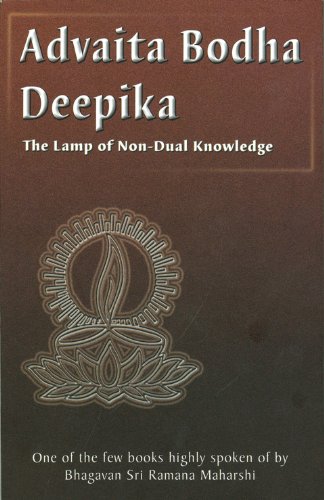
The following taken from a traditional vedanta text called Advaita Bodha Deepika (The Lamp of Nondual Knowledge). This text was one of Ramana Maharshi’s favourites and was often recommended by him. This is taken from Chapter 3 which is entitled ‘Sadhana’, or Spiritual Practice, and the bold has been added by myself for emphasis:
Verses 50-51:
Disciple: How is it that even scholars in Vedanta have not succeeded in the pursuit of enquiry?
Master: Though they always study Vedanta and give lessons to others yet in the absence of desirelessness they do not practise what they have learnt.
D.: And what do they do otherwise?
M.: Like a parrot they reproduce the Vedantic jargon but do not put the teachings into practice.
D.: What does Vedanta teach?
M.: The Vedanta teaches a man to know that all but the non-dual Brahman is laden with misery, therefore to leave off all desires for enjoyment, to be free from love or hate, thoroughly to cut the knot of the ego appearing as `I’, you, he, this, that, mine and yours, to rid himself of the notion of `I’ and `mine’, to live unconcerned with the pairs of opposites as heat and cold, pain and pleasure, etc., to remain fixed in the perfect knowledge of the equality of all and making no distinction of any kind, never to be aware of anything but Brahman, and always to be experiencing the Bliss of the nondual Self.
Though Vedanta is read and well understood, if dispassion is not practised, the desire for pleasures will not fade away. There is no dislike for pleasing things and the desire for them cannot leave the person. Because desire is not checked, love, anger, etc., the ego or the `false-I’ in the obnoxious body, the sense of possession represented by `I’ or `mine’ of things agreeable to the body, the pairs of opposites like pleasure and pain, and false values, will not disappear.
However well read one may be, unless the teachings are put into practice, one is not really learned. Only like a parrot the man will be repeating that Brahman alone is real and all else is false.
D.: Why should he be so?
M.: The knowers say that like a dog delighting in offal, this man also delights in external pleasures. Though always busy with Vedanta, reading and teaching it, he is no better than a mean dog.
“NOBODY HERE, I FEEL AMAZING!!”
Sometimes, when the firm understanding of no-self first comes upon you, it can unleash a vast reservoir of energy, especially if this understanding has dawned in a non-traditional context ie. without preparation of the body-mind.
That energy comes into and animates the body-mind, and energises it.
Sometimes negative, destructive, addictive and hedonistic habitual tendencies (vasanas) can be enhanced due to that injection of energy. We may feel negative or even euphoric, depending on the pre-existing conditioning.
Beware of this. Here the teachings on dispassion (vairagya) become more important than the insight (into no-self) teachings which have already begun to hit home.
Remember not to get involved or get carried away by such thoughts, desires, feelings and behaviours. Do not indulge in this (ego-) energy. The old ignorant habitual tendencies are still at play even though insight (into no-self) is here, and the suffering and potential destructiveness caused by them still has not been eradicated.
Instead continue to take up and press on with your sadhana: relax, remain calm, be still, allow all to come and go, be unattached, be as you are, until all the vasanas have gone. Then the sadhana will also go.

(please note, the title of this post is meant to be ironic!)
Bow, bow deeply
Bow to life,
Bow deeply,
Feel gratitude for the gifts God gives us,
And everything that comes our way
Is a gift from Him
Bow deeply,
And fall in love,
Fall in love with Life,
Allow Her to take you,
Overwhelm you,
And show you Her treasures.
Allow life to make you whole,
Make you clean,
Clean from outside through to within.
Bow deeply,
Bow to life,
Gratitude pouring in,
Taking you over,
One with Him,
Cleasing you,
Purging you of negativity
Ridding you of illusion,
as Love takes over.
Now Love takes over,
It compels you to bow,
And delights you,
Moves you this way and that,
A willing servitude,
All a gift,
Flowing with gratitude,
Flowing with bliss,
So thankful,
Only Her.
Now where are you?
Where are you to be found?
At first you were the lover
-that (subject) which was loving,
But now, where are you?
Where have you gone?
Where is the lover?
Where is the loved?
The distinctions have been lost:
We were once thrown and tossed by the oceans,
This way and that,
But now there is only Ocean,
Throwing Ocean,
This way and that.
We were once the Lover,
Loving God,
Loving life,
But now there is only Him,
Loving Himself,
Playing, toying,
And Still and Unmoving,
Only love.
How can I bow to Him,
When there is no me,
and no Him?
How can I love life,
when there is no love,
and no life?
Only Him,
Only Life,
Only Love.
Yet still
I bow deeply

What will never let you down?
Everyone and everything will eventually let you down. Make no mistake about this – it’s just a matter of time. Be sure to understand this.
This is not pessimism but reality. You can then enter into life knowlingly. We can enter into love and engage with life out of understanding rather than ignorance.
Know that everything will eventually let you down. You cannot rely on anyone or anything to give you lasting happiness, so dont expect that from people or things. Anything else leads to suffering.
The only exception is the ever-present Self, which of course is no particular object, yet is non-separate from everything. It is all there is. It is the essence of who you are. It is you.
And luckily its nature is sat-chit-ananda.
Therefore take refuge only in the Self.
Vivekachudamani (Crest Jewel of Discrimination) by Shankara
Vivekachudamani
(Crest Jewel of Discrimination)
By Adi Sankaracharya, 788-820 CE,
Translated by Swami Madhavananda in 1921
This seminal text is one of the most important in the Advaita Vedanta tradition. Attributed to Shankara, for centuries it has traditionally been used as a practice manual for seekers of spiritual liberation (Moksha). Many mahatmas (great souls) have considered this text to contain all that is required to know in order to attain liberation.
Swami Chinmayananda, that great sanskrit scholar and teacher of advaita vedanta, said Vivekachudamani contained the distilled wisdom from the Upanishads and Bhagavad Gita and presents it in a systematic readable form for a seeker of liberation, in which both ‘the goal and path are exhaustively dealt with’. He wrote of Vivekachudamani that ‘no other help is needed’ other than this text on the quest to liberation.
A very young (and already enlightened) Sri Ramana Maharshi also translated the entire text into Tamil (see here for this version of the text in English) for the benefit of his companions and devotees who were unable to read Sanskrit, in what was perhaps Ramana’s first spiritual work. The fact that Ramana wrote very little yet bothered to translate this in its entirely, that this was the first scripture he chose to translate, and that this is the longest of the scriptures he ever translated (to my knowledge) perhaps gives you an indication of the significance of this text. Ramana himself wrote an introduction to his own translation and in it he said that Vivekachudamani explained ‘in detail the points that have to be grasped by those who seek liberation, and thereby directing them to the true and direct path’.
The text itself takes the form of a dialogue between seeker and guru, and gives the reader an overview of the entire Advaita Vedantic path.. Please also note my comments on verses 11 and 13 below:
Click here for PDF version of the text
- I bow to Govinda, whose nature is Bliss Supreme, who is the Sadguru, who can be known only from the import of all Vedanta, and who is beyond the reach of speech and mind.
- For all beings a human birth is difficult to obtain, more so is a male body [note: at the time of this writing the higher practices were more available to men]; rarer than that is Brahmanahood; rarer still is the attachment to the path of Vedic religion; higher than this is erudition in the scriptures; discrimination between the Self and not-Self, Realisation, and continuing in a state of identity with Brahman – these come next in order. (This kind of) Mukti (Liberation) is not to be attained except through the well-earned merits of a hundred crore of births.
- These are three things which are rare indeed and are due to the grace of God – namely, a human birth, the longing for Liberation, and the protecting care of a perfected sage.
- The man who, having by some means obtained a human birth, with a male body and mastery of the Vedas to boot, is foolish enough not to exert himself for self-liberation, verily commits suicide, for he kills himself by clinging to things unreal.
- What greater fool is there than the man who having obtained a rare human body, and a masculine body too, neglects to achieve the real end of this life?
- Let people quote the Scriptures and sacrifice to the gods, let them perform rituals and worship the deities, but there is no Liberation without the realisation of one’s identity with the Atman, no, not even in the lifetime of a hundred Brahmas put together.
- There is no hope of immortality by means of riches – such indeed is the declaration of the Vedas. Hence it is clear that works cannot be the cause of Liberation.
- Therefore the man of learning should strive his best for Liberation, having renounced his desire for pleasures from external objects, duly approaching a good and generous preceptor, and fixing his mind on the truth inculcated by him.
- Having attained the Yogarudha state, one should recover oneself, immersed in the sea of birth and death by means of devotion to right discrimination.
- Let the wise and erudite man, having commenced the practice of the realisation of the Atman give up all works and try to cut loose the bonds of birth and death.
- Work leads to purification of the mind, not to perception of the Reality. The realisation of Truth is brought about by discrimination and not in the least by ten million of acts. [Tom: the Sanskrit word here translated as ‘discrimination’ is ‘vichara’, which is nowadays usually translated as self-enquiry. At the time this text was published in 1921, the practice or concept of self-enquiry was not well-known in the West. Shankara is really stating that Realisation is only due to Self-Enquiry and not by any other means; also see my comments on verse 13]
- By adequate reasoning the conviction of the reality about the rope is gained, which puts an end to the great fear and misery caused by the snake worked up in the deluded mind.
- The conviction of the Truth is seen to proceed from reasoning upon the salutary counsel of the wise, and not by bathing in the sacred waters, nor by gifts, nor by a hundred Pranayamas (control of the vital force). [Tom: ‘reasoning’ here is also a translation of the Sanskrit word ‘vichara’, which is nowadays translated as self-enquiry, so this verse is really saying that liberation is the result of following the sage’s instructions on self-enquiry, also see my comments on verse 11]
- Success depends essentially on a qualified aspirant; time, place and other such means are but auxiliaries in this regard.
- Hence the seeker after the Reality of the Atman should take to reasoning, after duly approaching the Guru – who should be the best of the knowers of Brahman, and an ocean of mercy.
- An intelligent and learned man skilled in arguing in favour of the Scriptures and in refuting counter-arguments against them – one who has got the above characteristics is the fit recipient of the knowledge of the Atman.
- The man who discriminates between the Real and the unreal, whose mind is turned away from the unreal, who possesses calmness and the allied virtues, and who is longing for Liberation, is alone considered qualified to enquire after Brahman.
- Regarding this, sages have spoken of four means of attainment, which alone being present, the devotion to Brahman succeeds, and in the absence of which, it fails.
- First is enumerated discrimination between the Real and the unreal; next comes aversion to the enjoyment of fruits (of one’s actions) here and hereafter; (next is) the group of six attributes, viz. calmness and the rest; and (last) is clearly the yearning for Liberation.
- A firm conviction of the mind to the effect that Brahman is real and the universe unreal, is designated as discrimination (Viveka) between the Real and the unreal.
- Vairagya or renunciation is the desire to give up all transitory enjoyments (ranging) from those of an (animate) body to those of Brahmahood (having already known their defects) from observation, instruction and so forth.
- The resting of the mind steadfastly on its Goal (viz. Brahman) after having detached itself from manifold sense-objects by continually observing their defects, is called Shama or calmness.
- Turning both kinds of sense-organs away from sense-objects and placing them in their respective centres, is called Dama or self-control. The best Uparati or self-withdrawal consists in the mind-function ceasing to be affected by external objects.
- The bearing of all afflictions without caring to redress them, being free (at the same time) from anxiety or lament on their score, is called Titiksha or forbearance.
- Acceptance by firm judgment as true of what the Scriptures and the Guru instruct, is called by sages Shraddha or faith, by means of which the Reality is perceived.
- Not the mere indulgence of thought (in curiosity) but the constant concentration of the intellect (or the affirming faculty) on the ever-pure Brahman, is what is called Samadhana or self-settledness.
- Mumukshuta or yearning for Freedom is the desire to free oneself, by realising one’s true nature, from all bondages from that of egoism to that of the body – bondages superimposed by Ignorance.
- Even though torpid or mediocre, this yearning for Freedom, through the grace of the Guru, may bear fruit (being developed) by means of Vairagya (renunciation), Shama (calmness), and so on.
- In his case, verily, whose renunciation and yearning for Freedom are intense, calmness and the other practices have (really) their meaning and bear fruit.
- Where (however) this renunciation and yearning for Freedom are torpid, there calmness and the other practices are as mere appearances, like water in a desert.
- Among things conducive to Liberation, devotion (Bhakti) holds the supreme place. The seeking after one’s real nature is designated as devotion.
- Others maintain that the inquiry into the truth of one’s own self is devotion. The inquirer about the truth of the Atman who is possessed of the above-mentioned means of attainment should approach a wise preceptor, who confers emancipation from bondage.
- Who is versed in the Vedas, sinless, unsmitten by desire and a knower of Brahman par excellence, who has withdrawn himself into Brahman; who is calm, like fire that has consumed its fuel, who is a boundless reservoir of mercy that knows no reason, and a friend of all good people who prostrate themselves before him.
- Worshipping that Guru with devotion, and approaching him, when he is pleased with prostration, humility and service, (he) should ask him what he has got to know:
- O Master, O friend of those that bow to thee, thou ocean of mercy, I bow to thee; save me, fallen as I am into this sea of birth and death, with a straightforward glance of thine eye, which sheds nectar-like grace supreme.
- Save me from death, afflicted as I am by the unquenchable fire of this world-forest, and shaken violently by the winds of an untoward lot, terrified and (so) seeking refuge in thee, for I do not know of any other man with whom to seek shelter.
- There are good souls, calm and magnanimous, who do good to others as does the spring, and who, having themselves crossed this dreadful ocean of birth and death, help others also to cross the same, without any motive whatsoever.
- It is the very nature of the magnanimous to move of their own accord towards removing others’ troubles. Here, for instance, is the moon who, as everybody knows, voluntarily saves the earth parched by the flaming rays of the sun.
- O Lord, with thy nectar-like speech, sweetened by the enjoyment of the elixir-like bliss of Brahman, pure, cooling to a degree, issuing in streams from thy lips as from a pitcher, and delightful to the ear – do thou sprinkle me who am tormented by worldly afflictions as by the tongues of a forest-fire. Blessed are those on whom even a passing glance of thy eye lights, accepting them as thine own.
- How to cross this ocean of phenomenal existence, what is to be my fate, and which of the means should I adopt – as to these I know nothing. Condescend to save me, O Lord, and describe at length how to put an end to the misery of this relative existence.
- As he speaks thus, tormented by the afflictions of the world – which is like a forest on fire – and seeking his protection, the saint eyes him with a glance softened with pity and spontaneously bids him give up all fear.
- To him who has sought his protection, thirsting for Liberation, who duly obeys the injunctions of the Scriptures, who is of a serene mind, and endowed with calmness – (to such a one) the sage proceeds to inculcate the truth out of sheer grace.
- Fear not, O learned one, there is no death for thee; there is a means of crossing this sea of relative existence; that very way by which sages have gone beyond it, I shall inculcate to thee.
- There is a sovereign means which puts an end to the fear of relative existence; through that thou wilt cross the sea of Samsara and attain the supreme bliss.
- Reasoning on the meaning of the Vedanta leads to efficient knowledge, which is immediately followed by the total annihilation of the misery born of relative existence.
- Faith (Shraddha), devotion and the Yoga of meditation – these are mentioned by the Shruti as the immediate factors of Liberation in the case of a seeker; whoever abides in these gets Liberation from the bondage of the body, which is the conjuring of Ignorance.
- It is verily through the touch of Ignorance that thou who art the Supreme Self findest thyself under the bondage of the non-Self, whence alone proceeds the round of births and deaths. The fire of knowledge, kindled by the discrimination between these two, burns up the effects of Ignorance together with their root.
- Condescend to listen, O Master, to the question I am putting (to thee). I shall be gratified to hear a reply to the same from thy lips.
- What is bondage, forsooth? How has it come (upon the Self)? How does it continue to exist? How is one freed from it? What is this non-Self? And who is the Supreme Self? And how can one discriminate between them? — Do tell me about all these.
- The Guru replied: Blessed art thou ! Thou hast achieved thy life’s end and hast sanctified thy family, that thou wishest to attain Brahmanhood by getting free from the bondage of Ignorance !
- A father has got his sons and others to free him from his debts, but he has got none but himself to remove his bondage.
- Trouble such as that caused by a load on the head can be removed by others, but none but one’s own self can put a stop to the pain which is caused by hunger and the like.
- The patient who takes (the proper) diet and medicine is alone seen to recover completely – not through work done by others.
- The true nature of things is to be known personally, through the eye of clear illumination, and not through a sage: what the moon exactly is, is to be known with one’s own eyes; can others make him know it?
- Who but one’s own self can get rid of the bondage caused by the fetters of Ignorance, desire, action and the like, aye even in a hundred crore of cycles?
- Neither by Yoga, nor by Sankhya, nor by work, nor by learning, but by the realisation of one’s identity with Brahman is Liberation possible, and by no other means.
- The beauty of a guitar’s form and the skill of playing on its chords serve merely to please a few persons; they do not suffice to confer sovereignty.
- Loud speech consisting of a shower of words, the skill in expounding the Scriptures, and likewise erudition – these merely bring on a little personal enjoyment to the scholar, but are no good for Liberation.
- The study of the Scriptures is useless so long as the highest Truth is unknown, and it is equally useless when the highest Truth has already been known.
- The Scriptures consisting of many words are a dense forest which merely causes the mind to ramble. Hence men of wisdom should earnestly set about knowing the true nature of the Self.
- For one who has been bitten by the serpent of Ignorance, the only remedy is the knowledge of Brahman. Of what avail are the Vedas and (other) Scriptures, Mantras (sacred formulae) and medicines to such a one?
- A disease does not leave off if one simply utter the name of the medicine, without taking it; (similarly) without direct realisation one cannot be liberated by the mere utterance of the word Brahman.
- Without causing the objective universe to vanish and without knowing the truth of the Self, how is one to achieve Liberation by the mere utterance of the word Brahman? — It would result merely in an effort of speech.
- Without killing one’s enemies, and possessing oneself of the splendour of the entire surrounding region, one cannot claim to be an emperor by merely saying, ‘I am an emperor’.
- As a treasure hidden underground requires (for its extraction) competent instruction, excavation, the removal of stones and other such things lying above it and (finally) grasping, but never comes out by being (merely) called out by name, so the transparent Truth of the self, which is hidden by Maya and its effects, is to be attained through the instructions of a knower of Brahman, followed by reflection, meditation and so forth, but not through perverted arguments.
- Therefore the wise should, as in the case of disease and the like, personally strive by all the means in their power to be free from the bondage of repeated births and deaths.
- The question that thou hast asked today is excellent, approved by those versed in the Scriptures, aphoristic, pregnant with meaning and fit to be known by the seekers after Liberation.
- Listen attentively, O learned one, to what I am going to say. By listening to it thou shalt be instantly free from the bondage of Samsara.
- The first step to Liberation is the extreme aversion to all perishable things, then follow calmness, self-control, forbearance, and the utter relinquishment of all work enjoined in the Scriptures.
- Then come hearing, reflection on that, and long, constant and unbroken meditation on the Truth for the Muni. After that the learned seeker attains the supreme Nirvikalpa state and realises the bliss of Nirvana even in this life.
- Now I am going to tell thee fully about what thou oughtst to know – the discrimination between the Self and the non-Self. Listen to it and decide about it in thy mind.
- Composed of the seven ingredients, viz. marrow, bones, fat, flesh, blood, skin and cuticle, and consisting of the following limbs and their parts – legs, thighs, the chest, arms, the back and the head:
- This body, reputed to be the abode of the delusion of ‘I and mine’, is designated by sages as the gross body. The sky, air, fire, water and earth are subtle elements. They –
- Being united with parts of one another and becoming gross, (they) form the gross body. And their subtle essences form sense-objects – the group of five such as sound, which conduce to the happiness of the experiencer, the individual soul.
- Those fools who are tied to these sense-objects by the stout cord of attachment, so very difficult to snap, come and depart, up and down, carried amain by the powerful emissary of their past action.
- The deer, the elephant, the moth, the fish and the black-bee – these five have died, being tied to one or other of the five senses, viz. sound etc., through their own attachment. What then is in store for man who is attached to all these five.
- Sense-objects are even more virulent in their evil effects than the poison of the cobra. Poison kills one who takes it, but those others kill one who even looks at them through the eyes.
- He who is free from the terrible snare of the hankering after sense-objects, so very difficult to get rid of, is alone fit for Liberation, and none else – even though he be versed in all the six Shastras.
- The shark of hankering catches by the throat those seekers after Liberation who have got only an apparent dispassion (Vairagya) and are trying to cross the ocean of samsara (relative existence), and violently snatching them away, drowns them half-way.
- He who has killed the shark known as sense-object with the sword of mature dispassion, crosses the ocean of Samsara, free from all obstacles.
- Know that death quickly overtakes the stupid man who walks along the dreadful ways of sense-pleasure; whereas one who walks in accordance with the instructions of a well-wishing and worthy Guru, as also with his own reasoning, achieves his end – know this to be true.
- If indeed thou hast a craving for Liberation, shun sense-objects from a good distance as thou wouldst do poison, and always cultivate carefully the nectar-like virtues of contentment, compassion, forgiveness, straight-forwardness, calmness and self-control.
- Whoever leaves aside what should always be attempted, viz. emancipation from the bondage of Ignorance without beginning, and passionately seeks to nourish this body, which is an object for others to enjoy, commits suicide thereby.
- Whoever seeks to realise the Self by devoting himself to the nourishment of the body, proceeds to cross a river by catching hold of a crocodile, mistaking it for a log.
- So for a seeker after Liberation the infatuation over things like the body is a dire death. He who has thoroughly conquered this deserves the state of Freedom.
- Conquer the dire death of infatuation over thy body, wife, children etc., — conquering which the sages reach that Supreme State of Vishnu.
- This gross body is to be deprecated, for it consists of the skin, flesh, blood, arteries and veins, fat, marrow and bones, and is full of other offensive things.
- The gross body is produced by one’s past actions out of the gross elements formed by the union of the subtle elements with each other, and is the medium of experience for the soul. That is its waking state in which it perceives gross objects.
- Identifying itself with this form, the individual soul, though separate, enjoys gross objects, such as garlands and sandal-paste, by means of the external organs. Hence this body has its fullest play in the waking state.
- Know this gross body to be like a house to the householder, on which rests man’s entire dealing with the external world.
- Birth, decay and death are the various characteristics of the gross body, as also stoutness etc., childhood etc., are its different conditions; it has got various restrictions regarding castes and orders of life; it is subject to various diseases, and meets with different kinds of treatment, such as worship, insult and high honours.
- The ears, skin, eyes, nose and tongue are organs of knowledge, for they help us to cognise objects; the vocal organs, hands, legs, etc., are organs of action, owing to their tendency to work.
93-94. The inner organ (Antahkarana) is called Manas, Buddhi, ego or Chitta, according to their respective functions: Manas, from its considering the pros and cons of a thing; Buddhi, from its property of determining the truth of objects; the ego, from its identification with this body as one’s own self; and Chitta, from its function of remembering things it is interested in.
- One and the same Prana (vital force) becomes Prana, Apana, Vyana, Udana and Samana according to their diversity of functions and modifications, like gold, water, etc.
- The five organs of action such as speech, the five organs of knowledge such as the ear, the group of five Pranas, the five elements ending with the ether, together with Buddhi and the rest as also Nescience, desire and action – these eight “cities” make up what is called the subtle body.
- Listen – this subtle body, called also the Linga body, is produced out of the elements before their subdividing and combining with each other, is possessed of latent impressions and causes the soul to experience the fruits of its past actions. It is a beginningless superimposition on the soul brought on by its own ignorance.
98-99. Dream is a state of the soul distinct from the waking state, where it shines by itself. In dreams Buddhi, by itself, takes on the role of the agent and the like, owing to various latent impressions of the waking state, while the supreme Atman shines in Its own glory – with Buddhi as Its only superimposition, the witness of everything, and is not touched by the least work that Buddhi does. As It is wholly unattached, It is not touched by any work that Its superimpositions may perform.
- This subtle body is the instrument for all activities of the Atman, who is Knowledge Absolute, like the adze and other tools of a carpenter. Therefore this Atman is perfectly unattached.
- Blindness, weakness and sharpness are conditions of the eye, due merely to its fitness or defectiveness; so are deafness, dumbness, etc., of the ear and so forth – but never of the Atman, the Knower.
- Inhalation and exhalation, yawning, sneezing, secretion, leaving this body, etc., are called by experts functions of Prana and the rest, while hunger and thirst are characteristics of Prana proper.
- The inner organ (mind) has its seat in the organs such as the eye, as well as in the body, identifying with them and endued with a reflection of the Atman.
- Know that it is egoism which, identifying itself with the body, becomes the doer or experiencer, and in conjunction with the Gunas such as the Sattva, assumes the three different states.
- When sense-objects are favourable it becomes happy, and it becomes miserable when the case is contrary. So happiness and misery are characteristics of egoism, and not of the ever-blissful Atman.
- Sense-objects are pleasurable only as dependent on the Atman manifesting through them, and not independently, because the Atman is by Its very nature the most beloved of all. Therefore the Atman is ever blissful, and never suffers misery.
- That in profound sleep we experience the bliss of the Atman independent of sense-objects, is clearly attested by the Shruti, direct perception, tradition and inference.
- Avidya (Nescience) or Maya, called also the Undifferentiated, is the power of the Lord. She is without beginning, is made up of the three Gunas and is superior to the effects (as their cause). She is to be inferred by one of clear intellect only from the effects She produces. It is She who brings forth this whole universe.
- She is neither existent nor non-existent nor partaking of both characters; neither same nor different nor both; neither composed of parts nor an indivisible whole nor both. She is most wonderful and cannot be described in words.
- Maya can be destroyed by the realisation of the pure Brahman, the one without a second, just as the mistaken idea of a snake is removed by the discrimination of the rope. She has her Gunas as Rajas, Tamas and Sattva, named after their respective functions.
- Rajas has its Vikshepa-Shakti or projecting power, which is of the nature of an activity, and from which this primeval flow of activity has emanated. From this also, mental modifications such as attachment and grief are continually produced.
- Lust, anger, avarice, arrogance, spite, egoism, envy, jealousy, etc., — these are the dire attributes of Rajas, from which the worldly tendency of man is produced. Therefore Rajas is a cause of bondage.
- Avriti or the veiling power is the power of Tamas, which makes things appear other than what they are. It is this that causes man’s repeated transmigrations, and starts the action of the projecting power (Vikshepa).
- Even wise and learned men and men who are clever and adept in the vision of the exceedingly subtle Atman, are overpowered by Tamas and do not understand the Atman, even though clearly explained in various ways. What is simply superimposed by delusion, they consider as true, and attach themselves to its effects. Alas ! How powerful is the great Avriti Shakti of dreadful Tamas !
- Absence of the right judgment, or contrary judgment, want of definite belief and doubt – these certainly never desert one who has any connection with this veiling power, and then the projecting power gives ceaseless trouble.
- Ignorance, lassitude, dullness, sleep, inadvertence, stupidity, etc., are attributes of Tamas. One tied to these does not comprehend anything, but remains like one asleep or like a stock or stone.
- Pure Sattva is (clear) like water, yet in conjunction with Rajas and Tamas it makes for transmigration. The reality of the Atman becomes reflected in Sattva and like the sun reveals the entire world of matter.
- The traits of mixed Sattva are an utter absence of pride etc., and Niyama, Yama, etc., as well as faith, devotion, yearning for Liberation, the divine tendencies and turning away from the unreal.
- The traits of pure Sattva are cheerfulness, the realisation of one’s own Self, supreme peace, contentment, bliss, and steady devotion to the Atman, by which the aspirant enjoys bliss everlasting.
- This Undifferentiated, spoken of as the compound of the three Gunas, is the causal body of the soul. Profound sleep is its special state, in which the functions of the mind and all its organs are suspended.
- Profound sleep is the cessation of all kinds of perception, in which the mind remains in a subtle seed-like form. The test of this is the universal verdict, “I did not know anything then”.
- The body, organs, Pranas, Manas, egoism, etc., all modifications, the sense-objects, pleasure and the rest, the gross elements such as the ether, in fact, the whole universe, up to the Undifferentiated – all this is the non-Self.
- From Mahat down to the gross body everything is the effect of Maya: These and Maya itself know thou to be the non-Self, and therefore unreal like the mirage in a desert.
- Now I am going to tell thee of the real nature of the supreme Self, realising which man is freed from bondage and attains Liberation.
- There is some Absolute Entity, the eternal substratum of the consciousness of egoism, the witness of the three states, and distinct from the five sheaths or coverings:
- Which knows everything that happens in the waking state, in dream and in profound sleep; which is aware of the presence or absence of the mind and its functions; and which is the background of the notion of egoism. – This is That.
- Which Itself sees all, but which no one beholds, which illumines the intellect etc., but which they cannot illumine. – This is That.
- By which this universe is pervaded, but which nothing pervades, which shining, all this (universe) shines as Its reflection. – This is That.
- By whose very presence the body, the organs, mind and intellect keep to their respective spheres of action, like servants !
- By which everything from egoism down to the body, the sense-objects and pleasure etc., is known as palpably as a jar – for It is the essence of Eternal Knowledge !
- This is the innermost Self, the primeval Purusha (Being), whose essence is the constant realisation of infinite Bliss, which is ever the same, yet reflecting through the different mental modifications, and commanded by which the organs and Pranas perform their functions.
- In this very body, in the mind full of Sattva, in the secret chamber of the intellect, in the Akasha known as the Unmanifested, the Atman, of charming splendour, shines like the sun aloft, manifesting this universe through Its own effulgence.
- The Knower of the modifications of mind and egoism, and of the activities of the body, the organs and Pranas, apparently taking their forms, like the fire in a ball of iron; It neither acts nor is subject to change in the least.
- It is neither born nor dies, It neither grows nor decays, nor does It undergo any change, being eternal. It does not cease to exist even when this body is destroyed, like the sky in a jar (after it is broken), for It is independent.
- The Supreme Self, different from the Prakriti and its modifications, of the essence of Pure Knowledge, and Absolute, directly manifests this entire gross and subtle universe, in the waking and other states, as the substratum of the persistent sense of egoism, and manifests Itself as the Witness of the Buddhi, the determinative faculty.
136.By means of a regulated mind and the purified intellect (Buddhi), realise directly thy own Self in the body so as to identify thyself with It, cross the boundless ocean of Samsara whose waves are birth and death, and firmly established in Brahman as thy own essence, be blessed.
- Identifying the Self with this non-Self – this is the bondage of man, which is due to his ignorance, and brings in its train the miseries of birth and death. It is through this that one considers this evanescent body as real, and identifying oneself with it, nourishes, bathes, and preserves it by means of (agreeable) sense-objects, by which he becomes bound as the caterpillar by the threads of its cocoon.
- One who is overpowered by ignorance mistakes a thing for what it is not; It is the absence of discrimination that causes one to mistake a snake for a rope, and great dangers overtake him when he seizes it through that wrong notion. Hence, listen, my friend, it is the mistaking of transitory things as real that constitutes bondage.
- This veiling power (Avriti), which preponderates in ignorance, covers the Self, whose glories are infinite and which manifests Itself through the power of knowledge, indivisible, eternal and one without a second – as Rahu does the orb of the sun.
- When his own Self, endowed with the purest splendour, is hidden from view, a man through ignorance falsely identifies himself with this body, which is the non-Self. And then the great power of rajas called the projecting power sorely afflicts him through the binding fetters of lust, anger, etc.,
- The man of perverted intellect, having his Self-knowledge swallowed up by the shark of utter ignorance, himself imitates the various states of the intellect (Buddhi), as that is Its superimposed attribute, and drifts up and down in this boundless ocean of Samsara which is full of the poison of sense-enjoyment, now sinking, now rising – a miserable fate indeed!
- As layers of clouds generated by the sun’s rays cover the sun and alone appear (in the sky), so egoism generated by the Self, covers the reality of the Self and appears by itself.
- Just as, on a cloudy day, when the sun is swallowed up by dense clouds, violent cold blasts trouble them, so when the Atman is hidden by intense ignorance, the dreadful Vikshepa Shakti (projecting power) afflicts the foolish man with numerous griefs.
- It is from these two powers that man’s bondage has proceeded – beguiled by which he mistakes the body for the Self and wanders (from body to body).
- Of the tree of Samsara ignorance is the seed, the identification with the body is its sprout, attachment its tender leaves, work its water, the body its trunk, the vital forces its branches, the organs its twigs, the sense-objects its flowers, various miseries due to diverse works are its fruits, and the individual soul is the bird on it.
- This bondage of the non-Self springs from ignorance, is self-caused, and is described as without beginning and end. It subjects one to the long train of miseries such as birth, death, disease and decrepitude.
- This bondage can be destroyed neither by weapons nor by wind, nor by fire, nor by millions of acts – by nothing except the wonderful sword of knowledge that comes of discrimination, sharpened by the grace of the Lord.
- One who is passionately devoted to the authority of the Shrutis acquires steadiness in his Svadharma, which alone conduces to the purity of his mind. The man of pure mind realises the Supreme Self, and by this alone Samsara with its root is destroyed.
- Covered by the five sheaths – the material one and the rest – which are the products of Its own power, the Self ceases to appear, like the water of a tank by its accumulation of sedge.
- On the removal of that sedge the perfectly pure water that allays the pangs of thirst and gives immediate joy, appears unobstructed before the man.
- When all the five sheaths have been eliminated, the Self of man appears – pure, of the essence of everlasting and unalloyed bliss, indwelling, supreme and self-effulgent.
- To remove his bondage the wise man should discriminate between the Self and the non-Self. By that alone he comes to know his own Self as Existence-Knowledge-Bliss Absolute and becomes happy.
- He indeed is free who discriminates between all sense-objects and the indwelling, unattached and inactive Self – as one separates a stalk of grass from its enveloping sheath – and merging everything in It, remains in a state of identity with That.
- This body of ours is the product of food and comprises the material sheath; it lives on food and dies without it; it is a mass of skin, flesh, blood, bones and filth, and can never be the eternally pure, self-existent Atman.
- It does not exist prior to inception or posterior to dissolution, but lasts only for a short (intervening) period; its virtues are transient, and it is changeful by nature; it is manifold, inert, and is a sense-object, like a jar; how can it be one’s own Self, the Witness of changes in all things?
- The body, consisting of arms, legs, etc., cannot be the Atman, for one continues to live even when particular limbs are gone, and the different functions of the organism also remain intact. The body which is subject to another’s rule cannot be the Self which is the Ruler of all.
- That the Atman as the abiding Reality is different from the body, its characteristics, its activities, its states, etc., of which It is the witness, is self-evident.
- How can the body, being a pack of bones, covered with flesh, full of filth and highly impure, be the self-existent Atman, the Knower, which is ever distinct from it?
- It is the foolish man who identifies himself with a mass of skin, flesh, fat, bones and filth, while the man of discrimination knows his own Self, the only Reality that there is, as distinct from the body.
- The stupid man thinks he is the body, the book-learned man identifies himself with the mixture of body and soul, while the sage possessed of realisation due to discrimination looks upon the eternal Atman as his Self, and thinks, “I am Brahman”.
- O foolish person, cease to identify thyself with this bundle of skin, flesh, fat, bones and filth, and identify thyself instead with the Absolute Brahman, the Self of all, and thus attain to supreme Peace.
- As long as the book-learned man does not give up his mistaken identification with the body, organs, etc., which are unreal, there is no talk of emancipation for him, even if he be ever so erudite in the Vedanta philosophy.
- Just as thou dost not identify thyself with the shadow-body, the image-body, the dream-body, or the body thou hast in the imaginations of thy heart, cease thou to do likewise with the living body also.
- Identifications with the body alone is the root that produces the misery of birth etc., of people who are attached to the unreal; therefore destroy thou this with the utmost care. When this identification caused by the mind is given up, there is no more chance for rebirth.
- The Prana, with which we are all familiar, coupled with the five organs of action, forms the vital sheath, permeated by which the material sheath engages itself in all activities as if it were living.
- Neither is the vital sheath the Self – because it is a modification of Vayu, and like the air it enters into and comes out of the body, and because it never knows in the least either its own weal and woe or those of others, being eternally dependent on the Self.
- The organs of knowledge together with the mind form the mental sheath – the cause of the diversity of things such as “I” and “mine”. It is powerful and endued with the faculty of creating differences of name etc., It manifests itself as permeating the preceding, i.e. the vital sheath.
- The mental sheath is the (sacrificial) fire which, fed with the fuel of numerous desires by the five sense-organs which serve as priests, and set ablaze by the sense-objects which act as the stream of oblations, brings about this phenomenal universe.
- There is no Ignorance (Avidya) outside the mind. The mind alone is Avidya, the cause of the bondage of transmigration. When that is destroyed, all else is destroyed, and when it is manifested, everything else is manifested.
- In dreams, when there is no actual contact with the external world, the mind alone creates the whole universe consisting of the experiencer etc. Similarly in the waking state also; there is no difference. Therefore all this (phenomenal universe) is the projection of the mind.
- In dreamless sleep, when the mind is reduced to its causal state, there exists nothing (for the person asleep), as is evident from universal experience. Hence man’s relative existence is simply the creation of his mind, and has no objective reality.
- Clouds are brought in by the wind and again driven away by the same agency. Similarly, man’s bondage is caused by the mind, and Liberation too is caused by that alone.
- It (first) creates an attachment in man for the body and all other sense-objects, and binds him through that attachment like a beast by means of ropes. Afterwards, the selfsame mind creates in the individual an utter distaste for these sense-objects as if they were poison, and frees him from the bondage.
- Therefore the mind is the only cause that brings about man’s bondage or Liberation: when tainted by the effects of Rajas it leads to bondage, and when pure and divested of the Rajas and Tamas elements it conduces to Liberation.
- Attaining purity through a preponderance of discrimination and renunciation, the mind makes for Liberation. Hence the wise seeker after Liberation must first strengthen these two.
- In the forest-tract of sense-pleasures there prowls a huge tiger called the mind. Let good people who have a longing for Liberation never go there.
- The mind continually produces for the experiencer all sense-objects without exception, whether perceived as gross or fine, the differences of body, caste, order of life, and tribe, as well as the varieties of qualification, action, means and results.
- Deluding the Jiva, which is unattached Pure Intelligence, and binding it by the ties of body, organs and Pranas, the mind causes it to wander, with ideas of “I” and “mine”, amidst the varied enjoyment of results achieved by itself.
- Man’s transmigration is due to the evil of superimposition, and the bondage of superimposition is created by the mind alone. It is this that causes the misery of birth etc., for the man of non-discrimination who is tainted by Rajas and Tamas.
- Hence sages who have fathomed its secret have designated the mind as Avidya or ignorance, by which alone the universe is moved to and fro, like masses of clouds by the wind.
- Therefore the seeker after Liberation must carefully purify the mind. When this is purified, Liberation is as easy of access as a fruit on the palm of one’s hand.
- He who by means of one-pointed devotion to Liberation roots out the attachment to sense-objects, renounces all actions, and with faith in the Real Brahman regularly practices hearing, etc., succeeds in purging the Rajasika nature of the intellect.
- Neither can the mental sheath be the Supreme Self, because it has a beginning and an end, is subject to modifications, is characterised by pain and suffering and is an object; whereas the subject can never be identified with the objects of knowledge.
- The Buddhi with its modifications and the organs of knowledge, forms the Vijnanamaya Kosha or knowledge sheath, of the agent, having the characteristics which is the cause of man’s transmigration.
- This knowledge sheath, which seems to be followed by a reflection of the power of the Chit, is a modification of the Prakriti, is endowed with the function of knowledge, and always wholly identifies itself with the body, organs, etc.
186-187. It is without beginning, characterised by egoism, is called the Jiva, and carries on all the activities on the relative plane. Through previous desires it performs good and evil actions and experiences their results. Being born in various bodies, it comes and goes, up and down. It is this knowledge sheath that has the waking, dream and other states, and experiences joy and grief.
- It always mistakes the duties, functions and attributes of the orders of life which belong to the body, as its own. The knowledge sheath is exceedingly effulgent, owing to its close proximity to the Supreme Self, which identifying Itself with it suffers transmigration through delusion. It is therefore a superimposition on the Self.
- The self-effulgent Atman, which is Pure Knowledge, shines in the midst of the Pranas, within the heart. Though immutable, It becomes the agent and experiencer owing to Its superimposition, the knowledge sheath.
- Though the Self of everything that exists, this Atman, Itself assuming the limitations of the Buddhi and wrongly identifying Itself with this totally unreal entity, looks upon Itself as something different – like earthen jars from the clay of which they are made.
- Owing to Its connection with the super-impositions, the Supreme Self, even thou naturally perfect (transcending Nature) and eternally unchanging, assumes the qualities of the superimpositions and appears to act just as they do – like the changeless fire assuming the modifications of the iron which it turns red-hot.
- The disciple questioned: Be it through delusion or otherwise that the Supreme Self has come to consider Itself as the Jiva, this superimposition is without beginning, and that which has no beginning cannot be supposed to have an end either.
- Therefore the Jivahood of the soul also must have no end, and its transmigration must continue for ever. How then can there be Liberation for the soul? Kindly enlighten me on this point, O revered Master.
- The Teacher said: Thou hast rightly questioned, O learned man ! Listen therefore attentively: The imagination which has been conjured up by delusion can never be accepted as a fact.
- But for delusion there can be no connection of the Self – which is unattached, beyond activity and formless – with the objective world, as in the case of blueness etc., with reference to the sky.
- The Jivahood of the Atman, the Witness, which is beyond qualities and beyond activity, and which is realised within as Knowledge and Bliss Absolute – has been superimposed by the delusion of the Buddhi, and is not real. And because it is by nature an unreality, it ceases to exist when the delusion is gone.
- It exists only so long as the delusion lasts, being caused by indiscrimination due to an illusion. The rope is supposed to be the snake only so long as the mistake lasts, and there is no more snake when the illusion has vanished. Similar is the case here.
198-199. Avidya or Nescience and its effects are likewise considered as beginningless. But with the rise of Vidya or realisation, the entire effects of Avidya, even though beginningless, are destroyed together with their root – like dreams on waking up from sleep. It is clear that the phenomenal universe, even though without beginning, is not eternal – like previous non-existence.
200-201. Previous non-existence, even though beginningless, is observed to have an end. So the Jivahood which is imagined to be in the Atman through its relation with superimposed attributes such as the Buddhi, is not real; whereas the other (the Atman) is essentially different from it. The relation between the Atman and the Buddhi is due to a false knowledge.
- The cessation of that superimposition takes place through perfect knowledge, and by no other means. Perfect knowledge, according to the Shrutis, consists in the realisation of the identity of the individual soul and Brahman.
- This realisation is attained by a perfect discrimination between the Self and the non-Self. Therefore one must strive for the discrimination between the individual soul and the eternal Self.
- Just as the water which is very muddy again appears as transparent water when the mud is removed, so the Atman also manifests Its undimmed lustre when the taint has been removed.
- When the unreal ceases to exist, this very individual soul is definitely realised as the eternal Self. Therefore one must make it a point completely to remove things like egoism from the eternal Self.
- This knowledge sheath (Vijnanamaya Kosha) that we have been speaking of, cannot be the Supreme Self for the following reasons – because it is subject to change, is insentient, is a limited thing, an object of the senses, and is not constantly present: An unreal thing cannot indeed be taken for the real Atman.
- The blissful sheath (Anandamaya Kosha) is that modification of Nescience which manifests itself catching a reflection of the Atman which is Bliss Absolute; whose attributes are pleasure and the rest; and which appears in view when some object agreeable to oneself presents itself. It makes itself spontaneously felt by the fortunate during the fruition of their virtuous deeds; from which every corporeal being derives great joy without the least effort.
- The blissful sheath has its fullest play during profound sleep, while in the dreaming and wakeful states it has only a partial manifestation, occasioned by the sight of agreeable objects and so forth.
- Nor is the blissful sheath the Supreme Self, because it is endowed with the changeful attributes, is a modification of the Prakriti, is the effect of past good deeds, and imbedded in the other sheaths which are modifications.
- When all the five sheaths have been eliminated by the reasoning on Shruti passages, what remains as the culminating point of the process, is the Witness, the Knowledge Absolute – the Atman.
- This self-effulgent Atman which is distinct from the five sheaths, the Witness of the three states, the Real, the Changeless, the Untainted, the everlasting Bliss – is to be realised by the wise man as his own Self.
- The disciple questioned: After these five sheaths have been eliminated as unreal, I find nothing, O Master, in this universe but a Void, the absence of everything. What entity is there left forsooth with which the wise knower of the Self should realise his identity.
213-214. The Guru answered: Thou has rightly said, O learned man ! Thou art clever indeed in discrimination. That by which all those modifications such as egoism as well as their subsequent absence (during deep sleep) are perceived, but which Itself is not perceived, know thou that Atman – the Knower – through the sharpest intellect.
- That which is perceived by something else has for its witness the latter. When there is no agent to perceive a thing, we cannot speak of it as having been perceived at all.
- This Atman is a self-cognised entity because It is cognised by Itself. Hence the individual soul is itself and directly the Supreme Brahman, and nothing else.
- That which clearly manifests Itself in the states of wakefulness, dream and profound sleep; which is inwardly perceived in the mind in various forms as an unbroken series of egoistic impressions; which witnesses the egoism, the Buddhi, etc., which are of diverse forms and modifications; and which makes Itself felt as the Existence-Knowledge-Bliss Absolute; know thou this Atman, thy own Self, within thy heart.
- Seeing the reflection of the sun mirrored in the water of a jar, the fool thinks it is the sun itself. Similarly the stupid man, through delusion, identifies himself with the reflection of the Chit caught in the Buddhi, which is Its superimposition.
- Just as the wise man leaves aside the jar, the water and the reflection of the sun in it, and sees the self-luminous sun which illumines these three and is independent of them;
220-222. Similarly, discarding the body, the Buddhi and the reflection of the Chit in it, and realising the Witness, the Self, the Knowledge Absolute, the cause of the manifestation of everything, which is hidden in the recesses of the Buddhi, is distinct from the gross and subtle, eternal, omnipresent, all-pervading and extremely subtle, and which has neither interior nor exterior and is identical with one self – fully realising this true nature of oneself, one becomes free from sin, taint, death and grief, and becomes the embodiment of Bliss. Illumined himself, he is afraid of none. For a seeker after Liberation there is no other way to the breaking of the bonds of transmigration than the realisation of the truth of one’s own Self.
- The realisation of one’s identity with Brahman is the cause of Liberation from the bonds of Samsara, by means of which the wise man attains Brahman, the One without a second, the Bliss Absolute.
- Once having realised Brahman, one no longer returns to the realm of transmigration. Therefore one must fully realise one’s identity with Brahman.
- Brahman is Existence, Knowledge, Infinity, pure, supreme, self-existent, eternal and indivisible Bliss, not different (in reality) from the individual soul, and devoid of interior or exterior. It is (ever) triumphant.
- It is this Supreme Oneness which alone is real, since there is nothing else but the Self. Verily, there remains no other independent entity in the state of realisation of the highest Truth.
- All this universe which through ignorance appears as of diverse forms, is nothing else but Brahman which is absolutely free from all the limitations of human thought.
- A jar, though a modification of clay, is not different from it; everywhere the jar is essentially the same as the clay. Why then call it a jar? It is fictitious, a fancied name merely.
- None can demonstrate that the essence of a jar is something other than the clay (of which it is made). Hence the jar is merely imagined (as separate) through delusion, and the component clay alone is the abiding reality in respect of it.
- Similarly, the whole universe, being the effect of the real Brahman, is in reality nothing but Brahman. Its essence is That, and it does not exist apart from It. He who says it does is still under delusion – he babbles like one asleep.
- This universe is verily Brahman – such is the august pronouncement of the Atharva Veda. Therefore this universe is nothing but Brahman, for that which is superimposed (on something) has no separate existence from its substratum.
- If the universe, as it is, be real, there would be no cessation of the dualistic element, the scriptures would be falsified, and the Lord Himself would be guilty of an untruth. None of these three is considered either desirable or wholesome by the noble-minded.
- The Lord, who knows the secret of all things has supported this view in the words: “But I am not in them” … “nor are the beings in Me”.
- If the universe be true, let it then be perceived in the state of deep sleep also. As it is not at all perceived, it must be unreal and false, like dreams.
- Therefore the universe does not exist apart from the Supreme Self; and the perception of its separateness is false like the qualities (of blueness etc., in the sky). Has a superimposed attribute any meaning apart from its substratum? It is the substratum which appears like that through delusion.
- Whatever a deluded man perceives through mistake, is Brahman and Brahman alone: The silver is nothing but the mother-of-pearl. It is Brahman which is always considered as this universe, whereas that which is superimposed on the Brahman, viz. the universe, is merely a name.
237-238. Hence whatever is manifested, viz. this universe, is the Supreme Brahman Itself, the Real, the One without a second, pure, the Essence of Knowledge, taintless, serene, devoid of beginning and end, beyond activity, the Essence of Bliss Absolute – transcending all the diversities created by Maya or Nescience, eternal, ever beyond the reach of pain, indivisible, immeasurable, formless, undifferentiated, nameless, immutable, self-luminous.
- Sages realise the Supreme Truth, Brahman, in which there is no differentiation of knower, knowledge and known, which is infinite, transcendent, and the Essence of Knowledge Absolute.
- Which can be neither thrown away nor taken up, which is beyond the reach of mind and speech, immeasurable, without beginning and end, the Whole, one’s very Self, and of surpassing glory.
241-242. If thus the Shruti, in the dictum “Thou art That” (Tat-Tvam-Asi), repeatedly establishes the absolute identity of Brahman (or Ishwara) and Jiva, denoted by the terms That (Tat) and thou (Tvam) respectively, divesting these terms of their relative associations, then it is the identity of their implied, not literal, meanings which is sought to be inculcated; for they are of contradictory attributes to each other – like the sun and a glow-worm, the king and a servant, the ocean and a well, or Mount Meru and an atom.
- This contradiction between them is created by superimposition, and is not something real. This superimposition, in the case of Ishwara (the Lord), is Maya or Nescience, which is the cause of Mahat and the rest, and in the case of the Jiva (the individual soul), listen – the five sheaths, which are the effects of Maya, stand for it.
- These two are the superimpositions of Ishwara and the Jiva respectively, and when these are perfectly eliminated, there is neither Ishwara nor Jiva. A kingdom is the symbol of a king, and a shield of the soldier, and when these are taken away, there is neither king nor soldier.
- The Vedas themselves in the words “now then is the injunction” etc., repudiate the duality imagined in Brahman. One must needs eliminate those two superimpositions by means of realisation supported by the authority of the Vedas.
- Neither this gross nor this subtle universe (is the Atman). Being imagined, they are not real – like the snake seen in the rope, and like dreams. Perfectly eliminating the objective world in this way by means of reasoning, one should next realise the oneness that underlies Ishwara and the Jiva.
- Hence those two terms (Ishwara and Jiva) must be carefully considered through their implied meanings, so that their absolute identity may be established. Neither the method of total rejection nor that of complete retention will do. One must reason out through the process which combines the two.
248-249. Just as in the sentence, “This is that Devadatta”, the identity is spoken of, eliminating the contradictory portions, so in the sentence “Thou art That”, the wise man must give up the contradictory elements on both sides and recognise the identity of Ishwara and Jiva, noticing carefully the essence of both, which is Chit, Knowledge Absolute. Thus hundreds of scriptural texts inculcate the oneness and identity of Brahman and Jiva.
- Eliminating the not-Self, in the light of such passages as “It is not gross” etc., (one realises the Atman), which is self-established, unattached like the sky, and beyond the range of thought. Therefore dismiss this mere phantom of a body which thou perceivest and hast accepted as thy own self. By means of the purified understanding that thou art Brahman, realise thy own self, the Knowledge Absolute.
- All modifications of clay, such as the jar, which are always accepted by the mind as real, are (in reality) nothing but clay. Similarly, this entire universe which is produced from the real Brahman, is Brahman Itself and nothing but That. Because there is nothing else whatever but Brahman, and That is the only self-existent Reality, our very Self, therefore art thou that serene, pure, Supreme Brahman, the One without a second.
- As the place, time, objects, knower, etc., called up in dream are all unreal, so is also the world experienced here in the waking state, for it is all an effect of one’s own ignorance. Because this body, the organs, the Pranas, egoism, etc., are also thus unreal, therefore art thou that serene, pure, supreme Brahman, the One without a second.
- (What is) erroneously supposed to exist in something, is, when the truth about it has been known, nothing but that substratum, and not at all different from it: The diversified dream universe (appears and) passes away in the dream itself. Does it appear on waking as something distinct from one’s own Self?
- That which is beyond caste and creed, family and lineage; devoid of name and form, merit and demerit; transcending space, time and sense-object – that Brahman art thou, meditate on this in thy mind.
- That Supreme Brahman which is beyond the range of all speech, but accessible to the eye of pure illumination; which is pure, the Embodiment of Knowledge, the beginningless entity – that Brahman art thou, meditate on this in thy mind.
- That which is untouched by the sixfold wave; meditated upon by the Yogi’s heart, but not grasped by the sense-organs; which the Buddhi cannot know; and which is unimpeachable – that Brahman art thou, meditate on this in thy mind.
- That which is the substratum of the universe with its various subdivisions, which are all creations of delusion; which Itself has no other support; which is distinct from the gross and subtle; which has no parts, and has verily no exemplar – that Brahman art thou, meditate on this in thy mind.
- That which is free from birth, growth, development, waste, disease and death; which is indestructible; which is the cause of the projection, maintenance and dissolution of the universe – that Brahman art thou, meditate on this in thy mind.
- That which is free from differentiation; whose essence is never non-existent; which is unmoved like the ocean without waves; the ever-free; of indivisible Form – that Brahman art thou, meditate on this in thy mind.
- That which, though One only, is the cause of the many; which refutes all other causes, but is Itself without cause; distinct from Maya and its effect, the universe; and independent – that Brahman art thou, meditate on this in thy mind.
- That which is free from duality; which is infinite and indestructible; distinct from the universe and Maya, supreme, eternal; which is undying Bliss; taintless – that Brahman art thou, meditate on this in thy mind.
- That Reality which (though One) appears variously owing to delusion, taking on names and forms, attributes and changes, Itself always unchanged, like gold in its modifications – that Brahman art thou, meditate on this in thy mind.
- That beyond which there is nothing; which shines even above Maya, which again is superior to its effect, the universe; the inmost Self of all, free from differentiation; the Real Self, the Existence-Knowledge-Bliss Absolute; infinite and immutable – that Brahman art thou, meditate on this in thy mind.
- On the Truth, inculcated above, one must oneself meditate in one’s mind, through the intellect, by means of the recognised arguments. By that means one will realise the truth free from doubt etc., like water in the palm of one’s hand.
- Realising in this body the Knowledge Absolute free from Nescience and its effects – like the king in an army – and being ever established in thy own Self by resting on that Knowledge, merge the universe in Brahman.
- In the cave of the Buddhi there is the Brahman, distinct from the gross and subtle, the Existence Absolute, Supreme, the One without a second. For one who lives in this cave as Brahman, O beloved, there is no more entrance into the mother’s womb.
- Even after the Truth has been realised, there remains that strong, beginningless, obstinate impression that one is the agent and experiencer, which is the cause of one’s transmigration. It has to be carefully removed by living in a state of constant identification with the Supreme Self. Sages call that Liberation which is the attenuation of Vasanas (impressions) here and now.
- The idea of “me and mine” in the body, organs, etc., which are the non-Self – this superimposition the wise man must put a stop to, by identifying himself with the Atman.
- Realising thy own Inmost Self, the Witness of the Buddhi and its modifications, and constantly revolving the positive thought, “I am That”, conquer this identification with the non-Self.
- Relinquishing the observance of social formalities, giving up all ideas of trimming up the body, and avoiding too mush engrossment with the Scriptures, do away with the superimposition that has come upon thyself.
- Owing to the desire to run after society, the passion for too much study of the Scriptures and the desire to keep the body in good trim, people cannot attain to proper Realisation.
- For one who seeks deliverance from the prison of this world (Samsara), those three desires have been designated by the wise as strong iron fetters to shackle one’s feet. He who is free from them truly attains to Liberation.
- The lovely odour of the Agaru (agalochum) which is hidden by a powerful stench due to its contact with water etc., manifests itself as soon as the foreign smell has been fully removed by rubbing.
- Like the fragrance of the sandal-wood, the perfume of the Supreme Self, which is covered with the dust of endless, violent impressions imbedded in the mind, when purified by the constant friction of Knowledge, is (again) clearly perceived.
- The desire for Self-realisation is obscured by innumerable desires for things other than the Self. When they have been destroyed by the constant attachment to the Self, the Atman clearly manifests Itself of Its own accord.
- As the mind becomes gradually established in the Inmost Self, it proportionately gives up the desires for external objects. And when all such desires have been eliminated, there takes place the unobstructed realisation of the Atman.
- The Yogi’s mind dies, being constantly fixed on his own Self. Thence follows the cessation of desires. Therefore do away with thy superimposition.
- Tamas is destroyed by both Sattva and Rajas, Rajas by Sattva, and Sattva dies when purified. Therefore do way with thy superimposition through the help of Sattva.
- Knowing for certain that the Prarabdha work will maintain this body, remain quiet and do away with thy superimposition carefully and with patience.
- “I am not the individual soul, but the Supreme Brahman” – eliminating thus all that is not-Self, do away with thy superimposition, which has come through the momentum of (past) impressions.
- Realising thyself as the Self of all by means of Scripture, reasoning and by thy own realisation, do away thy superimposition, even when a trace of it seems to appear.
- The sage has no connection with action, since he has no idea of accepting or giving up. Therefore, through constant engrossment on the Brahman, do away with thy superimposition.
- Through the realisation of the identity of Brahman and the soul, resulting from such great dicta as “Thou art That”, do away with thy superimposition, with a view to strengthening thy identification with Brahman.
- Until the identification with this body is completely rooted out, do away with thy superimposition with watchfulness and a concentrated mind.
- So long as even a dream-like perception of the universe and souls persists, do away with thy superimposition, O learned man, without the least break.
- Without giving the slightest chance to oblivion on account of sleep, concern in secular matters or the sense-objects, reflect on the Self in thy mind.
- Shunning from a safe distance the body which has come from impurities of the parents and itself consists of flesh and impurities – as one does an outcast – be thou Brahman and realise the consummation of thy life.
- Merging the finite soul in the Supreme Self, like the space enclosed by a jar in the infinite space, by means of meditation on their identity, always keep quiet, O sage.
- Becoming thyself the self-effulgent Brahman, the substratum of all phenomena – as that Reality give up both the macrocosm and the microcosm, like two filthy receptacles.
- Transferring the identification now rooted in the body to the Atman, the Existence-Knowledge-Bliss Absolute, and discarding the subtle body, be thou ever alone, independent.
- That in which there is this reflection of the universe, as of a city in a mirror – that Brahman art thou; knowing this thou wilt attain the consummation of thy life.
- That which is real and one’s own primeval Essence, that Knowledge and Bliss Absolute, the One without a second, which is beyond form and activity – attaining That one should cease to identify oneself with one’s false bodies, like an actor giving up his assumed mask.
- This objective universe is absolutely unreal; neither is egoism a reality, for it is observed to be momentary. How can the perception, “I know all”, be true of egoism etc., which are momentary?
- But the real ‘I” is that which witnesses the ego and the rest. It exists always, even in the state of profound sleep. The Shruti itself says, “It is birthless, eternal”, etc. Therefore the Paramatman is different from the gross and subtle bodies.
- The knower of all changes in things subject to change should necessarily be eternal and changeless. The unreality of the gross and subtle bodies is again and again clearly observed in imagination, dream and profound sleep.
- Therefore give up the identification with this lump of flesh, the gross body, as well as with the ego or the subtle body, which are both imagined by the Buddhi. Realising thy own Self, which is Knowledge Absolute and not to be denied in the past, present or future, attain to Peace.
- Cease to identify thyself with the family, lineage, name, form and the order of life, which pertain to the body that is like a rotten corpse (to a man of realisation). Similarly, giving up ideas of agency and so forth, which are attributes of the subtle body, be the Essence of Bliss Absolute.
- Other obstacles are also observed to exist for men, which lead to transmigration. The root of them, for the above reasons, is the first modification of Nescience called egoism.
- So long as one has any relation to this wicked ego, there should not be the least talk about Liberation, which is unique.
- Freed from the clutches of egoism, as the moon from those of Rahu, man attains to his real nature, and becomes pure, infinite, ever blissful and self-luminous.
- That which has been created by the Buddhi extremely deluded by Nescience, and which is perceived in this body as “I am such and such” – when that egoism is totally destroyed, one attains an unobstructed identity with Brahman.
- The treasure of the Bliss of Brahman is coiled round by the mighty and dreadful serpent of egoism, and guarded for its own use by means of its three fierce hoods consisting of the three Gunas. Only the wise man, destroying it by severing its three hoods with the great sword of realisation in accordance with the teachings of the Shrutis, can enjoy this treasure which confers bliss.
- As long as there is a trace of poisoning left in the body, how can one hope for recovery? Similar is the effect of egoism on the Yogi’s Liberation.
- Through the complete cessation of egoism, through the stoppage of the diverse mental waves due to it, and through the discrimination of the inner Reality, one realises that Reality as “I am This”.
- Give up immediately thy identification with egoism, the agent, which is by its nature a modification, is endued with a reflection of the Self, and diverts one from being established in the Self – identifying thyself with which thou hast come by this relative existence, full of the miseries of birth, decay and death, though thou art the Witness, the Essence of Knowledge and Bliss Absolute.
- But for thy identification with that egoism there can never be any transmigration for thee who art immutable and eternally the same, the Knowledge Absolute, omnipresent, the Bliss Absolute, and of untarnished glory.
- Therefore destroying this egoism, thy enemy – which appears like a thorn sticking in the throat of a man taking meal – with the great sword of realisation, enjoy directly and freely the bliss of thy own empire, the majesty of the Atman.
- Checking the activities of egoism etc., and giving up all attachment through the realisation of the Supreme Reality, be free from all duality through the enjoyment of the Bliss of Self, and remain quiet in Brahman, for thou hast attained thy infinite nature.
- Even though completely rooted out, this terrible egoism, if revolved in the mind even for a moment, returns to life and creates hundreds of mischiefs, like a cloud ushered in by the wind during the rainy season.
- Overpowering this enemy, egoism, not a moment’s respite should be given to it by thinking on the sense-objects. That is verily the cause of its coming back to life, like water to a citron tree that has almost dried up.
- He alone who has identified himself with the body is greedy after sense-pleasures. How can one, devoid of the body-idea, be greedy (like him)? Hence the tendency to think on the sense-objects is verily the cause of the bondage of transmigration, giving rise to an idea of distinction or duality.
- When the effects are developed, the seed also is observed to be such, and when the effects are destroyed, the seed also is seen to be destroyed. Therefore one must subdue the effects.
- Through the increase of desires selfish work increases, and when there is an increase of selfish work, there is an increase of desire also. And man’s transmigration is never at an end.
- For the sake of breaking the chain of transmigration, the Sannyasin should burn to ashes those two; for thinking of the sense-objects and doing selfish acts lead to an increase of desires.
315-316. Augmented by these two, desires produce one’s transmigration. The way to destroy these three, however, lies in looking upon everything, under all circumstances, always, everywhere and in all respects, as Brahman and Brahman alone. Through the strengthening of the longing to be one with Brahman, those three are annihilated.
- With the cessation of selfish action the brooding on the sense-objects is stopped, which is followed by the destruction of desires. The destruction of desires is Liberation, and this is considered as Liberation-in-life
- When the desire for realising Brahman has a marked manifestation, the egoistic desires readily vanish, as the most intense darkness effectively vanishes before the glow of the rising sun.
- Darkness and the numerous evils that attend on it are not noticed when the sun rises. Similarly, on the realisation of the Bliss Absolute, there is neither bondage nor the least trace of misery.
- Causing the external and internal universe, which are now perceived, to vanish, and meditating on the Reality, the Bliss Embodied, one should pass one’s time watchfully, if there be any residue of Prarabdha work left.
- One should never be careless in one’s steadfastness to Brahman. Bhagavan Sanatkumara, who is Brahma’s son, has called inadvertence to be death itself.
- There is no greater danger for the Jnanin than carelessness about his own real nature. From this comes delusion, thence egoism, this is followed by bondage, and then comes misery.
- Finding even a wise man hankering after the sense-objects, oblivion torments him through the evil propensities of the Buddhi, as a woman does her doting paramour.
- As sedge, even if removed, does not stay away for a moment, but covers the water again, so Maya or Nescience also covers even a wise man, if he is averse to meditation on the Self.
- If the mind ever so slightly strays from the Ideal and becomes outgoing, then it goes down and down, just as a play-ball inadvertently dropped on the staircase bounds down from one step to another.
- The mind that is attached to the sense-objects reflects on their qualities; from mature reflection arises desire, and after desiring a man sets about having that thing.
- Hence to the discriminating knower of Brahman there is no worse death than inadvertence with regard to concentration. But the man who is concentrated attains complete success. (Therefore) carefully concentrate thy mind (on Brahman).
- Through inadvertence a man deviates from his real nature, and the man who has thus deviated falls. The fallen man comes to ruin, and is scarcely seen to rise again.
- Therefore one should give up reflecting on the sense-objects, which is the root of all mischief. He who is completely aloof even while living, is alone aloof after the dissolution of the body. The Yajur-Veda declares that there is fear for one who sees the least bit of distinction.
- Whenever the wise man sees the least difference in the infinite Brahman, at once that which he sees as different through mistake, becomes a source of terror to him.
- He who identifies himself with the objective universe which has been denied by hundreds of Shrutis, Smritis and reasonings, experiences misery after misery, like a thief, for he does something forbidden.
- He who has devoted himself to meditation on the Reality (Brahman) and is free from Nescience, attains to the eternal glory of the Atman. But he who dwells on the unreal (the universe) is destroyed. That this is so is evidenced in the case of one who is not a thief and one who is a thief.
- The Sannyasin should give up dwelling on the unreal, which causes bondage, and should always fix his thoughts on the Atman as “I myself am This”. For the steadfastness in Brahman through the realisation of one’s identity with It gives rise to bliss and thoroughly removes the misery born of nescience, which one experiences (in the ignorant state).
- The dwelling on external objects will only intensify its fruits, viz. furthering evil propensities, which grow worse and worse. Knowing this through discrimination, one should avoid external objects and constantly apply oneself to meditation on the Atman.
- When the external world is shut out, the mind is cheerful, and cheerfulness of the mind brings on the vision of the Paramatman. When It is perfectly realised, the chain of birth and death is broken. Hence the shutting out of the external world is the stepping-stone to Liberation.
- Where is the man who being learned, able to discriminate the real from the unreal, believing the Vedas as authority, fixing his gaze on the Atman, the Supreme Reality, and being a seeker after Liberation, will, like a child, consciously have recourse to the unreal (the universe) which will cause his fall?
- There is no Liberation for one who has attachment to the body etc., and the liberated man has no identification with the body etc. The sleeping man is not awake, nor is the waking man asleep, for these two states are contradictory in nature.
- He is free who, knowing through his mind the Self in moving and unmoving objects and observing It as their substratum, gives up all superimpositions and remains as the Absolute and the infinite Self.
- To realise the whole universe as the Self is the means of getting rid of bondage. There is nothing higher than identifying the universe with the Self. One realises this state by excluding the objective world through steadfastness in the eternal Atman.
- How is the exclusion of the objective world possible for one who lives identified with the body, whose mind is attached to the perception of external objects, and who performs various acts for that end? This exclusion should be carefully practised by sages who have renounced all kinds of duties and actions and objects, who are passionately devoted to the eternal Atman, and who wish to possess an undying bliss.
- To the Sannyasin who has gone through the act of hearing, the Shruti passage, “Calm, self-controlled.” Etc., prescribes Samadhi for realising the identity of the universe with the Self.
- Even wise men cannot suddenly destroy egoism after it has once become strong, barring those who are perfectly calm through the Nirvikalpa Samadhi. Desires are verily the effect of innumerable births.
- The projecting power, through the aid of the veiling power, connects a man with the siren of an egoistic idea, and distracts him through the attributes of that.
- It is extremely difficult to conquer the projecting power unless the veiling power is perfectly rooted out. And that covering over the Atman naturally vanishes when the subject is perfectly distinguished from the objects, like milk from water. But the victory is undoubtedly (complete and) free from obstacles when there is no oscillation of the mind due to the unreal sense-objects.
- Perfect discrimination brought on by direct realisation distinguishes the true nature of the subject from that of the object, and breaks the bond of delusion created by Maya; and there is no more transmigration for one who has been freed from this.
- The knowledge of the identity of the Jiva and Brahman entirely consumes the impenetrable forest of Avidya or Nescience. For one who has realised the state of Oneness, is there any seed left for future transmigration?
- The veil that hides Truth vanishes only when the Reality is fully realised. (Thence follow) the destruction of false knowledge and the cessation of misery brought about by its distracting influence.
- These three are observed in the case of a rope when its real nature is fully known. Therefore the wise man should know the real nature of things for the breaking of his bonds.
349-350. Like iron manifesting as sparks through contact with fire, the Buddhi manifests itself as knower and known through the inherence of Brahman. As these two (knower and known), the effects of the Buddhi, are observed to be unreal in the case of delusion, dream and fancy, similarly, the modifications of the Prakriti, from egoism down to the body and all sense-objects are also unreal. Their unreality is verily due to their being subject to change every moment. But the Atman never changes.
- The Supreme Self is ever of the nature of eternal, indivisible knowledge, one without a second, the Witness of the Buddhi and the rest, distinct from the gross and subtle, the implied meaning of the term and idea “I”, the embodiment of inward, eternal bliss.
- The wise man, discriminating thus the real and the unreal, ascertaining the Truth through his illuminative insight, and realising his own Self which is Knowledge Absolute, gets rid of the obstructions and directly attains Peace.
- When the Atman, the One without a second, is realised by means of the Nirvikalpa Samadhi, then the heart’s knot of ignorance is totally destroyed.
- Such imaginations as “thou”, “I” or “this” take place through the defects of the Buddhi. But when the Paramatman, the Absolute, the One without a second, manifests Itself in Samadhi, all such imaginations are dissolved for the aspirant, through the realisation of the truth of Brahman.
- The Sannyasin, calm, self-controlled, perfectly retiring from the sense-world, forbearing, and devoting himself to the practice of Samadhi, always reflects on his own self being the Self of the whole universe. Destroying completely by this means the imaginations which are due to the gloom of ignorance, he lives blissfully as Brahman, free from action and the oscillations of the mind.
- Those alone are free from the bondage of transmigration who, attaining Samadhi, have merged the objective world, the sense-organs, the mind, nay, the very ego, in the Atman, the Knowledge Absolute – and none else, who but dabble in second-hand talks.
- Through the diversity of the supervening conditions (Upadhis), a man is apt to think of himself as also full of diversity; but with the removal of these he is again his own Self, the immutable. Therefore the wise man should ever devote himself to the practice of Nirvikalpa Samadhi, for the dissolution of the Upadhis.
- The man who is attached to the Real becomes Real, through his one-pointed devotion. Just as the cockroach thinking intently on the Bhramara is transformed into a Bhramara.
- Just as the cockroach, giving up the attachment to all other actions, thinks intently on the Bhramara and becomes transformed into that worm, exactly in the same manner the Yogi, meditating on the truth of the Paramatman, attains to It through his one-pointed devotion to that.
- The truth of the Paramatman is extremely subtle, and cannot be reached by the gross outgoing tendency of the mind. It is only accessible to noble souls with perfectly pure minds, by means of Samadhi brought on by an extraordinary fineness of the mental state.
- As gold purified by thorough heating on the fire gives up its impurities and attains to its own lustre, so the mind, through meditation, gives up its impurities of Sattva, Rajas and Tamas, and attains to the reality of Brahman.
- When the mind, thus purified by constant practice, is merged in Brahman, then Samadhi passes on from the Savikalpa to the Nirvikalpa stage, and leads directly to the realisation of the Bliss of Brahman, the One without a second.
- By this Samadhi are destroyed all desires which are like knots, all work is at an end, and inside and out there takes place everywhere and always the spontaneous manifestation of one’s real nature.
- Reflection should be considered a hundred times superior to hearing, and meditation a hundred thousand times superior even to reflection, but the Nirvikalpa Samadhi is infinite in its results.
- By the Nirvikalpa Samadhi the truth of Brahman is clearly and definitely realised, but not otherwise, for then the mind, being unstable by nature, is apt to be mixed up with other perceptions.
- Hence with the mind calm and the senses controlled always drown the mind in the Supreme Self that is within, and through the realisation of thy identity with that Reality destroy the darkness created by Nescience, which is without beginning.
- The first steps to Yoga are control of speech, non-receiving of gifts, entertaining of no expectations, freedom from activity, and always living in a retired place.
- Living in a retired place serves to control the sense-organs, control of the senses helps to control the mind, through control of the mind egoism is destroyed; and this again gives the Yogi an unbroken realisation of the Bliss of Brahman. Therefore the man of reflection should always strive only to control the mind.
- Restrain speech in the Manas, and restrain Manas in the Buddhi; this again restrain in the witness of Buddhi, and merging that also in the Infinite Absolute Self, attain to supreme Peace.
- The body, Pranas, organs, manas, Buddhi and the rest – with whichsoever of these supervening adjuncts the mind is associated, the Yogi is transformed, as it were, into that.
- When this is stopped, the man of reflection is found to be easily detached from everything, and to get the experience of an abundance of everlasting Bliss.
- It is the man of dispassion (Vairagya) who is fit for this internal as well as external renunciation; for the dispassionate man, out of the desire to be free, relinquishes both internal and external attachment.
- It is only the dispassionate man who, being thoroughly grounded in Brahman, can give up the external attachment to the sense-objects and the internal attachment for egoism etc.
- Know, O wise man, dispassion and discrimination to be like the two wings of a bird in the case of an aspirant. Unless both are there, none can, with the help of either one, reach the creeper of Liberation that grows, as it were, on the top of an edifice.
- The extremely dispassionate man alone has Samadhi, and the man of Samadhi alone gets steady realisation; the man who has realised the Truth is alone free from bondage, and the free soul only experiences eternal Bliss.
- For the man of self-control I do not find any better instrument of happiness than dispassion, and if that is coupled with a highly pure realisation of the Self, it conduces to the suzerainty of absolute Independence; and since this is the gateway to the damsel of everlasting liberation, therefore for thy welfare, be dispassionate both internally and externally, and always fix thy mind on the eternal Self.
- Sever thy craving for the sense-objects, which are like poison, for it is the very image of death, and giving up thy pride of caste, family and order of life, fling actions to a distance. Give up thy identification with such unreal things as the body, and fix thy mind on the Atman. For thou art really the Witness, Brahman, unshackled by the mind, the One without a second, and Supreme.
- Fixing the mind firmly on the Ideal, Brahman, and restraining the external organs in their respective centres; with the body held steady and taking no thought for its maintenance; attaining identity with Brahman and being one with It – always drink joyfully of the Bliss of Brahman in thy own Self, without a break. What is the use of other things which are entirely hollow?
- Giving up the thought of the non-Self which is evil and productive of misery, think of the Self, the Bliss Absolute, which conduces to Liberation.
- Here shines eternally the Atman, the Self-effulgent Witness of everything, which has the Buddhi for Its seat. Making this Atman which is distinct from the unreal, the goal, meditate on It as thy own Self, excluding all other thought.
- Reflecting on this Atman continuously and without any foreign thought intervening, one must distinctly realise It to be one’s real Self.
- Strengthening one’s identification with This, and giving up that with egoism and the rest, one must live without any concern for them, as if they were trifling things, like a cracked jar or the like.
- Fixing the purified mind in the Self, the Witness, the Knowledge Absolute, and slowly making it still, one must then realise one’s own infinite Self.
- One should behold the Atman, the Indivisible and Infinite, free from all limiting adjuncts such as the body, organs, Pranas, Manas and egoism, which are creations of one’s own ignorance – like the infinite sky.
- The sky, divested of the hundreds of limiting adjuncts such as a jar, a pitcher, a receptacle for grains or a needle, is one, and not diverse; exactly in a similar way the pure Brahman, when divested of egoism etc., is verily One.
- The limiting adjuncts from Brahma down to a clump of grass are all wholly unreal. Therefore one should realise one’s own Infinite Self as the only Principle.
- That in which something is imagined to exist through error, is, when rightly discriminated, that thing itself, and not distinct from it. When the error is gone, the reality about the snake falsely perceived becomes the rope. Similarly the universe is in reality the Atman.
- The Self is Brahma, the Self is Vishnu, the Self is Indra, the Self is Shiva; the Self is all this universe. Nothing exists except the Self.
- The Self is within, and the Self is without; the Self is before and the Self is behind; the Self is in the south, and the Self is in the north; the Self likewise is above as also below.
- As the wave, the foam, the whirlpool, the bubble, etc., are all in essence but water, similarly the Chit (Knowledge Absolute) is all this, from the body up to egoism. Everything is verily the Chit, homogeneous and pure.
- All this universe known through speech and mind is nothing but Brahman; there is nothing besides Brahman, which exists beyond the utmost range of the Prakriti. Are the pitcher, jug, jar, etc., known to be distinct from the clay of which they are composed? It is the deluded man who talks of “thou” and “I”, as an effect of the wine of Maya.
- The Shruti, in the passage, “Where one sees nothing else”, etc., declares by an accumulation of verbs the absence of duality, in order to remove the false superimpositions.
- The Supreme Brahman is, like the sky, pure, absolute, infinite, motionless and changeless, devoid of interior or exterior, the One Existence, without a second, and is one’s own Self. Is there any other object of knowledge?
- What is the use of dilating on this subject? The Jiva is no other than Brahman; this whole extended universe is Brahman Itself; the Shruti inculcates the Brahman without a second; and it is an indubitable fact that people of enlightened minds who know their identity with Brahman and have given up their connection with the objective world, live palpably unifold with Brahman as Eternal Knowledge and Bliss.
- (First) destroy the hopes raised by egoism in this filthy gross body, then do the same forcibly with the air-like subtle body; and realising Brahman, the embodiment of eternal Bliss – whose glories the Scriptures proclaim – as thy own Self, live as Brahman.
- So long as man has any regard for this corpse-like body, he is impure, and suffers from his enemies as also from birth, death and disease; but when he thinks of himself as pure, as the essence of good and immovable, he assuredly becomes free from them; the Shrutis also say this.
- By the elimination of all apparent existences superimposed on the soul, the supreme Brahman, Infinite, the One without a second and beyond action, remains as Itself.
- When the mind-functions are merged in the Paramatman, the Brahman, the Absolute, none of this phenomenal world is seen, whence it is reduced to mere talk.
- In the One Entity (Brahman) the conception of the universe is a mere phantom. Whence can there be any diversity in That which is changeless, formless and Absolute?
- In the One Entity devoid of the concepts of seer, seeing and seen – which is changeless, formless and Absolute – whence can there be any diversity?
- In the One Entity which is changeless, formless and Absolute, and which is perfectly all-pervading and motionless like the ocean after the dissolution of the universe, whence can there be any diversity?
- Where the root of delusion is dissolved like darkness in light – in the supreme Reality, the One without a second, the Absolute – whence can there be any diversity?
- How can the talk of diversity apply to the Supreme Reality which is one and homogeneous? Who has ever observed diversity in the unmixed bliss of the state of profound sleep?
- Even before the realisation of the highest Truth, the universe does not exist in the Absolute Brahman, the Essence of Existence. In none of the three states of time is the snake ever observed in the rope, nor a drop of water in the mirage.
- The Shrutis themselves declare that this dualistic universe is but a delusion from the standpoint of Absolute Truth. This is also experienced in the state of dreamless sleep.
- That which is superimposed upon something else is observed by the wise to be identical with the substratum, as in the case of the rope appearing as the snake. The apparent difference depends solely on error.
- This apparent universe has its root in the mind, and never persists after the mind is annihilated. Therefore dissolve the mind by concentrating it on the Supreme Self, which is thy inmost Essence.
- The wise man realises in his heart, through Samadhi, the Infinite Brahman, which is something of the nature of eternal Knowledge and absolute Bliss, which has no exemplar, which transcends all limitations, is ever free and without activity, and which is like the limitless sky, indivisible and absolute.
- The wise man realises in his heart, through Samadhi, the Infinite Brahman, which is devoid of the ideas of cause and effect, which is the Reality beyond all imaginations, homogeneous, matchless, beyond the range of proofs, established by the pronouncements of the Vedas, and ever familiar to us as the sense of the ego.
- The wise man realises in his heart, through Samadhi, the Infinite Brahman, which is undecaying and immortal, the positive Entity which precludes all negations, which resembles the placid ocean and is without a name, in which there are neither merits nor demerits, and which is eternal, pacified and One.
- With the mind restrained in Samadhi, behold in thy self the Atman, of infinite glory, cut off thy bondage strengthened by the impressions of previous births, and carefully attain the consummation of thy birth as a human being.
- Meditate on the Atman, which resides in thee, which is devoid of all limiting adjuncts, the Existence-Knowledge-Bliss Absolute, the One without a second, and thou shalt no more come under the round of births and deaths.
- After the body has once been cast off to a distance like a corpse, the sage never more attaches himself to it, though it is visible as an appearance, like the shadow of a man, owing to the experience of the effects of past deeds.
- Realising the Atman, the eternal, pure Knowledge and Bliss, throw far away this limitation of a body, which is inert and filthy by nature. Then remember it no more, for something that has been vomited excites but disgust when called in memory.
- Burning all this, with its very root, in the fire of Brahman, the Eternal and Absolute Self, the truly wise man thereafter remains alone, as the Atman, the eternal, pure Knowledge and Bliss.
- The knower of Truth does no more care whether this body, spun out by the threads of Prarabdha work, falls or remains – like the garland on a cow – for his mind-functions are at rest in the Brahman, the Essence of Bliss.
- Realising the Atman, the Infinite Bliss, as his very Self, with what object, or for whom, should the knower of Truth cherish the body.
- The Yogi who has attained perfection and is liberated-in-life gets this as result – he enjoys eternal Bliss in his mind, internally as well as externally.
- The result of dispassion is knowledge, that of Knowledge is withdrawal from sense-pleasures, which leads to the experience of the Bliss of the Self, whence follows Peace.
- If there is an absence of the succeeding stages, the preceding ones are futile. (When the series is perfect) the cessation of the objective world, extreme satisfaction, and matchless bliss follow as a matter of course.
- Being unruffled by earthly troubles is the result in question of knowledge. How can a man who did various loathsome deeds during the state of delusion, commit the same afterwards, possessed of discrimination?
- The result of knowledge should be the turning away from unreal things, while attachment to these is the result of ignorance. This is observed in the case of one who knows a mirage and things of that sort, and one who does not. Otherwise, what other tangible result do the knowers of Brahman obtain?
- If the heart’s knot of ignorance is totally destroyed, what natural cause can there be for inducing such a man to selfish action, for he is averse to sense-pleasures?
- When the sense-objects excite no more desire, then is the culmination of dispassion. The extreme perfection of knowledge is the absence of any impulsion of the egoistic idea. And the limit of self-withdrawal is reached when the mind-functions that have been merged, appear no more.
- Freed from all sense of reality of the external sense-objects on account of his always remaining merged in Brahman; only seeming to enjoy such sense-objects as are offered by others, like one sleepy, or like a child; beholding this world as one seen in dreams, and having cognition of it at chance moments – rare indeed is such a man, the enjoyer of the fruits of endless merit, and he alone is blessed and esteemed on earth.
- That Sannyasin has got a steady illumination who, having his soul wholly merged in Brahman, enjoys eternal bliss, is changeless and free from activity.
- That kind of mental function which cognises only the identity of the Self and Brahman, purified of all adjuncts, which is free from duality, and which concerns itself only with Pure Intelligence, is called illumination. He who has this perfectly steady is called a man of steady illumination.
- He whose illumination is steady, who has constant bliss, and who has almost forgotten the phenomenal universe, is accepted as a man liberated in this very life.
- He who, even having his mind merged in Brahman, is nevertheless quite alert, but free at the same time from the characteristics of the waking state, and whose realisation is free from desires, is accepted as a man liberated-in-life.
- He whose cares about the phenomenal state have been appeased, who, though possessed of a body consisting of parts, is yet devoid of parts, and whose mind is free from anxiety, is accepted as a man liberated-in-life.
- The absence of the ideas of “I” and “mine” even in this existing body which follows as a shadow, is a characteristic of one liberated-in-life.
- Not dwelling on enjoyments of the past, taking no thought for the future and looking with indifference upon the present, are characteristics of one liberated-in-life.
- Looking everywhere with an eye of equality in this world, full of elements possessing merits and demerits, and distinct by nature from one another, is a characteristic of one liberated-in-life.
- When things pleasant or painful present themselves, to remain unruffled in mind in both cases, through the sameness of attitude, is a characteristic of one liberated-in-life.
- The absence of all ideas of interior or exterior in the case of a Sannyasin, owing to his mind being engrossed in tasting the bliss of Brahman, is a characteristic of one liberated-in-life.
- He who lives unconcerned, devoid of all ideas of “I” and “mine” with regard to the body, organs, etc., as well as to his duties, is known as a man liberated-in-life.
- He who has realised his Brahmanhood aided by the Scriptures, and is free from the bondage of transmigration, is known as a man liberated-in-life.
- He who never has the idea of “I” with regard to the body, organs, etc., nor that of “it” in respect of things other than these, is accepted as one liberated-in-life.
- He who through his illumination never differentiates the Jiva and Brahman, nor the universe and Brahman, is known as a man liberated-in-life.
- He who feels just the same when his body is either worshipped by the good or tormented by the wicked, is known as a man liberated-in-life.
- The Sannyasin in whom the sense-objects directed by others are engulfed like flowing rivers in the sea and produce no change, owing to his identity with the Existence Absolute, is indeed liberated.
- For one who has realised the Truth of Brahman, there is no more attachment to the sense-objects as before: If there is, that man has not realised his identity with Brahman, but is one whose senses are outgoing in their tendency.
- If it be urged that he is still attached to the sense-objects through the momentum of his old desires, the reply is – no, for desires get weakened through the realisation of one’s identity with Brahman.
- The propensities of even a confirmed libertine are checked in the presence of his mother; just so, when Brahman, the Bliss Absolute, has been realised, the man of realisation has no longer any worldly tendency.
- One who is constantly practising meditation is observed to have external perceptions. The Shrutis mention Prarabdha work in the case of such a man, and we can infer this from results actually seen.
- Prarabdha work is acknowledged to persist so long as there is the perception of happiness and the like. Every result is preceded by an action, and nowhere is it seen to accrue independently of action.
- Through the realisation of one’s identity with Brahman, all the accumulated actions of a hundred crore of cycles come to nought, like the actions of dream-state on awakening.
- Can the good actions or dreadful sins that a man fancies himself doing in the dream-state, lead him to heaven or hell after he has awakened from sleep?
- Realising the Atman, which is unattached and indifferent like the sky, the aspirant is never touched in the least by actions yet to be done.
- The sky is not affected by the smell of liquor merely through its connection with the jar; similarly, the Atman is not, through Its connection with the limitations, affected by the properties thereof.
- The work which has fashioned this body prior to the dawning of knowledge, is not destroyed by that knowledge without yielding its fruits, like the arrow shot at an object.
- The arrow which is shot at an object with the idea that it is a tiger, does not, when that object is perceived to be a cow, check itself, but pierces the object with full force.
- Prarabdha work is certainly very strong for the man of realisation, and is spent only by the actual experience of its fruit; while the actions previously accumulated and those yet to come are destroyed by the fire of perfect knowledge. But none of the three at all affects those who, realising their identity with Brahman, are always living absorbed in that idea. They are verily the transcendent Brahman.
- For the sage who lives in his own Self as Brahman, the One without a second, devoid of identification with the limiting adjuncts, the question of the existence of Prarabdha work is meaningless, like the question of a man who has awakened from sleep having any connection with the objects seen in the dream-state.
- The man who has awakened from sleep never has any idea of “I” or “mine” with regard to his dream-body and the dream-objects that ministered to that body, but lives quite awake, as his own Self.
- He has no desire to substantiate the unreal objects, nor is he seen to maintain that dream-world. If he still clings to those unreal objects, he is emphatically declared to be not yet free from sleep.
- Similarly, he who is absorbed in Brahman lives identified with that eternal Reality and beholds nothing else. As one has a memory of the objects seen in a dream, so the man of realisation has a memory of the everyday actions such as eating.
- The body has been fashioned by Karma, so one may imagine Prarabdha work with reference to it. But it is not reasonable to attribute the same to the Atman, for the Atman is never the outcome of work.
- The Shrutis, whose words are infallible, declare the Atman to be “birthless, eternal and undecaying”. So, the man who lives identified with That, how can Prarabdha work be attributed?
- Prarabdha work can be maintained only so long as one lives identified with the body. But no one admits that the man of realisation ever identifies himself with the body. Hence Prarabdha work should be rejected in his case.
- The attributing of Prarabdha work to the body even is certainly an error. How can something that is superimposed (on another) have any existence, and how can that which is unreal have a birth? And how can that which has not been born at all, die? So how can Prarabdha work exist for something that is unreal?
462-463. “If the effects of ignorance are destroyed with their root by knowledge, then how does the body live?” – it is to convince those fools who entertain a doubt like this, that the Shrutis, from a relative standpoint, hypothesise Prarabdha work, but not for proving the reality of the body etc., of the man of realisation.
- There is only Brahman, the One without a second, infinite, without beginning or end, transcendent and changeless; there is no duality whatsoever in It.
- There is only Brahman, the One without a second, the Essence of Existence, Knowledge and Eternal Bliss, and devoid of activity; there is no duality whatsoever in It.
- There is only Brahman, the One without a second, which is within all, homogeneous, infinite, endless, and all-pervading; there is no duality whatsoever in It.
- There is only Brahman, the One without a second, which is neither to be shunned nor taken up nor accepted, and which is without any support, there is no duality whatsoever in It.
- There is only Brahman, the One without a second, beyond attributes, without parts, subtle, absolute and taintless; there is no duality whatsoever in It.
- There is only Brahman, the One without a second, whose real nature is incomprehensible, and which is beyond the range of mind and speech; there is no duality whatsoever in It.
- There is only Brahman, the One without a second, the Reality, the One without a second, the Reality, effulgent, self-existent, pure, intelligent, and unlike anything finite; there is no duality whatsoever in It.
- High-souled Sannyasins who have got rid of all attachment and discarded all sense-enjoyments, and who are serene and perfectly restrained, realise this Supreme Truth and at the end attain the Supreme Bliss through their Self-realisation.
- Thou, too, discriminate this Supreme Truth, the real nature of the Self, which is Bliss undiluted, and shaking off thy delusion created by thy own mind, be free and illumined, and attain the consummation of thy life.
- Through the Samadhi in which the mind has been perfectly stilled, visualise the Truth of the Self with the eye of clear realisation. If the meaning of the (Scriptural) words heard from the Guru is perfectly and indubitably discerned, then it can lead to no more doubt.
- In the realisation of the Atman, the Existence-Knowledge-Bliss Absolute, through the breaking of one’s connection with the bondage of Avidya or ignorance, the Scriptures, reasoning and the words of the Guru are the proofs, while one’s own experience earned by concentrating the mind is another proof.
- Bondage, liberation, satisfaction, anxiety, recovery from illness, hunger and other such things are known only to the man concerned, and knowledge of these to others is a mere inference.
- The Gurus as well as the Shrutis instruct the disciple, standing aloof; while the man of realisation crosses (Avidya) through Illumination alone, backed by the grace of God.
- Himself knowing his indivisible Self through his own realisation and thus becoming perfect, a man should stand face to face with the Atman, with his mind free from dualistic ideas.
- The verdict of all discussions on the Vedanta is that the Jiva and the whole universe are nothing but Brahman, and that liberation means abiding in Brahman, the indivisible Entity. While the Shrutis themselves are authority (for the statement) that Brahman is One without a second.
- Realising, at a blessed moment, the Supreme Truth through the above instructions of the Guru, the authority of the Scriptures and his own reasoning, with his senses quieted and the mind concentrated, (the disciple) became immovable in form and perfectly established in the Atman.
- Concentrating the mind for some time on the Supreme Brahman, he rose, and out of supreme bliss spoke as follows.
- My mind has vanished, and all its activities have melted, by realising the identity of the Self and Brahman; I do not know either this or not-this; nor what or how much the boundless Bliss (of Samadhi) is !
- The majesty of the ocean of Supreme Brahman, replete with the swell of the nectar-like Bliss of the Self, is verily impossible to express in speech, nor can it be conceived by the mind – in an infinitesimal fraction of which my mind melted like a hailstone getting merged in the ocean, and is now satisfied with that Essence of Bliss.
- Where is the universe gone, by whom is it removed, and where is it merged? It was just now seen by me, and has it ceased to exist? It is passing strange !
- In the ocean of Brahman filled with the nectar of Absolute Bliss, what is to be shunned and what accepted, what is other (than oneself) and what different?
- I neither see nor hear nor know anything in this. I simply exist as the Self, the eternal Bliss, distinct from everything else.
- Repeated salutations to thee, O noble Teacher, who art devoid of attachment, the best among the good souls and the embodiment of the essence of Eternal Bliss, the One without a second – who art infinite and ever the boundless ocean of mercy:
- Whose glance, like the shower of concentrated moonbeams, has removed my exhaustion brought on by the afflictions of the world, and in a moment admitted me to the undecaying status of the Atman, the Bliss of infinite majesty !
- Blessed am I; I have attained the consummation of my life, and am free from the clutches of transmigration; I am the Essence of Eternal Bliss, I am infinite – all through thy mercy !
- I am unattached, I am disembodied, I am free from the subtle body, and undecaying, I am serene, I am infinite, I am taintless and eternal.
- I am not the doer, I am not the experiencer, I am changeless and beyond activity; I am the essence of Pure Knowledge; I am Absolute and identified with Eternal Good.
- I am indeed different from the seer, listener, speaker, doer and experiencer; I am the essence of Knowledge, eternal, without any break, beyond activity, limitless, unattached and infinite.
- I am neither, this nor that, but the Supreme, the illuminer of both; I am indeed Brahman, the One without a second, pure, devoid of interior or exterior and infinite.
- I am indeed Brahman, the One without a second, matchless, the Reality that has no beginning, beyond such imagination as thou or I, or this or that, the Essence of Eternal Bliss, the Truth.
- I am Narayana, the slayer of Naraka; I am the destroyer of Tripura, the Supreme Being, the Ruler; I am knowledge Absolute, the Witness of everything; I have no other Ruler but myself, I am devoid of the ideas of “I’ and “mine”.
- I alone reside as knowledge in all beings, being their internal and external support. I myself am the experiencer and all that is experienced – whatever I looked upon as “this” or the not-Self previously.
- In me, the ocean of Infinite Bliss, the waves of the universe are created and destroyed by the playing of the wind of Maya.
- Such ideas as gross (or subtle) are erroneously imagined in me by people through the manifestation of things superimposed – just as in the indivisible and absolute time, cycles, years, half-years, seasons, etc., are imagined.
- That which is superimposed by the grossly ignorant fools can never taint the substratum: The great rush of waters observed in a mirage never wets the desert tracts.
- I am beyond contamination like the sky; I am distinct from things illumined, like the sun; I am always motionless like the mountain; I am limitless like the ocean.
- I have no connection with the body, as the sky with clouds; so how can the states of wakefulness, dream and profound sleep, which are attributes of the body, affect me?
- It is the Upadhi (superimposed attribute) that comes, and it is that alone which goes; that, again, performs actions and experiences (their fruits), that alone decays and dies, whereas I ever remain firm like the Kula mountain.
- For me who am always the same and devoid of parts, there is neither engaging in work nor cessation from it. How can that which is One, concentrated, without break and infinite like the sky, ever strive?
- How can there be merits and demerits for me, who am without organs, without mind, changeless, and formless – who am the realisation of Bliss Absolute? The Shruti also mentions this in the passage “Not touched”, etc.
- If heat or cold, or good or evil, happens to touch the shadow of a man’s body, it affects not in the least the man himself, who is distinct from the shadow.
- The properties of things observed do not affect the Witness, which is distinct from the, changeless and indifferent – as the properties of a room (do not affect) the lamp (that illumines it).
- As the sun is a mere witness of men’s actions, as fire burns everything without distinction, and as the rope is related to a thing superimposed on it, so am I, the unchangeable Self, the Intelligence Absolute.
- I neither do nor make others do any action; I neither enjoy nor make others enjoy; I neither see nor make others see; I am that Self-effulgent, Transcendent Atman.
- When the supervening adjunct (Upadhi) is moving, the resulting movement of the reflection is ascribed by fools to the object reflected, such as the sun, which is free from activity – (and they think) “I am the doer”, “I am the experiencer”, “I am killed, oh, alas!”
- Let this inert body drop down in water or on land. I am not touched by its properties, like the sky by the properties of the jar.
- The passing states of the Buddhi, such as agency, experience, cunning, drunkenness, dullness, bondage and freedom, are never in reality in the Self, the Supreme Brahman, the Absolute, the one without a second.
- Let there be changes in the Prakriti in ten, a hundred, or a thousand ways, what have I, the unattached Knowledge Absolute, got to do with them? Never do the clouds touch the sky !
- I am verily that Brahman, the One without a second, which is like the sky, subtle, without beginning or end, in which the whole universe from the Undifferentiated down to the gross body, appears merely as a shadow.
- I am verily that Brahman, the One without a second, which is the support of all, which illumines all things, which has infinite forms, is omnipresent, devoid of multiplicity, eternal, pure, unmoved and absolute.
- I am verily that Brahman, the One without a second, which transcends the endless differentiations of Maya, which is the inmost essence of all, is beyond the range of consciousness, and which is Truth, Knowledge, Infinity and Bliss Absolute.
- I am without activity, changeless, without parts, formless, absolute, eternal, without any other support, the One without a second.
- I am the Universal, I am the All, I am transcendent, the One without a second. I am Absolute and Infinite Knowledge, I am Bliss and indivisible.
- This splendour of the sovereignty of Self-effulgence I have received by virtue of the supreme majesty of thy grace. Salutations to thee, O glorious, noble-minded Teacher, salutations again and again !
- O Master, thou hast out of sheer grace awakened me from sleep and completely saved me, who was wandering, in an interminable dream, in a forest of birth, decay and death created by illusion, being tormented day after day by countless afflictions, and sorely troubled by the tiger of egoism.
- Salutations to thee, O Prince of Teachers, thou unnamable Greatness, that art ever the same and dost manifest thyself as this universe – thee I salute.
- Seeing the worthy disciple, who had attained the Bliss of the self, realised the Truth and was glad at heart, thus prostrating himself, that noble, ideal Teacher again addressed the following excellent words:
- The universe is an unbroken series of perceptions of Brahman; hence it is in all respects nothing but Brahman. See this with the eye of illumination and a serene mind, under all circumstances. Is one who has eyes ever found to see all around anything else but forms? Similarly, what is there except Brahman to engage the intellect of a man of realisation?
- What wise man would discard that enjoyment of Supreme Bliss and revel in things unsubstantial? When the exceedingly charming moon is shining, who would wish to look at a painted moon?
- From the perception of unreal things there is neither satisfaction nor a cessation of misery. Therefore, being satisfied with the realisation of the Bliss Absolute, the One without a second, live happily in a state of identity with that Reality.
- Beholding the Self alone in all circumstances, thinking of the Self, the One without a second, and enjoying the Bliss of the Self, pass thy time, O noble soul !
- Dualistic conceptions in the Atman, the Infinite Knowledge, the Absolute, are like imagining castles in the air. Therefore, always identifying thyself with the Bliss Absolute, the One without a second, and thereby attaining Supreme Peace, remain quiet.
- To the sage who has realised Brahman, the mind, which is the cause of unreal fancies, becomes perfectly tranquil. This verily is his state of quietude, in which, identified with Brahman, he has constant enjoyment of the Bliss Absolute, the One without a second.
- To the man who has realised his own nature, and drinks the undiluted Bliss of the Self, there is nothing more exhilarating than the quietude that comes of a state of desirelessness.
- The illumined sage, whose only pleasure is in the Self, ever lives at ease, whether going or staying, sitting or lying, or in any other condition.
- The noble soul who has perfectly realised the Truth, and whose mind-functions meet with no obstruction, no more depends upon conditions of place, time, posture, direction, moral disciplines, objects of meditation and so forth. What regulative conditions can there be in knowing one’s own Self?
- To know that this is a jar, what condition, forsooth, is necessary except that the means of knowledge be free from defect, which alone ensures a cognition of the object?
- So this Atman, which is an eternal verity, manifests Itself as soon as the right means of knowledge is present, and does not depend upon either place or time or (internal) purity.
- The consciousness, “I am Devadatta”, is independent of circumstances; similar is the case with the realisation of the knower of Brahman that he is Brahman.
- What indeed can manifest That whose lustre, like the sun, causes the whole universe – unsubstantial, unreal, insignificant – to appear at all?
- What, indeed, can illumine that Eternal Subject by which the Vedas and Puranas and other Scriptures, as well as all beings are endowed with a meaning?
- Here is the Self-effulgent Atman, of infinite power, beyond the range of conditioned knowledge, yet the common experience of all – realising which alone this incomparable knower of Brahman lives his glorious life, freed from bondage.
- Satisfied with undiluted, constant Bliss, he is neither grieved nor elated by sense-objects, is neither attached nor averse to them, but always disports with the Self and takes pleasure therein.
- A child plays with its toys forgetting hunger and bodily pains; exactly so does the man of realisation take pleasure in the Reality, without ideas of “I” or “mine”, and is happy.
- Men of realisation have their food without anxiety or humiliation by begging, and their drink from the water of rivers; they live freely and independently, and sleep without fear in cremation grounds or forests; their clothing may be the quarters themselves, which need no washing and drying, or any bark etc., the earth is their bed; they roam in the avenue of the Vedanta; while their pastime is in the Supreme Brahman.
- The knower of the Atman, who wears no outward mark and is unattached to external things, rests on this body without identification, and experiences all sorts of sense-objects as they come, through others’ wish, like a child.
- Established in the ethereal plane of Absolute Knowledge, he wanders in the world, sometimes like a madman, sometimes like a child and at other times like a ghoul, having no other clothes on his person except the quarters, or sometimes wearing clothes, or perhaps skins at other times.
- The sage, living alone, enjoys the sense-objects, being the very embodiment of desirelessness – always satisfied with his own Self, and himself present at the All.
- Sometimes a fool, sometimes a sage, sometimes possessed of regal splendour; sometimes wandering, sometimes behaving like a motionless python, sometimes wearing a benignant expression; sometimes honoured, sometimes insulted, sometimes unknown – thus lives the man of realisation, ever happy with Supreme Bliss.
- Though without riches, yet ever content; though helpless, yet very powerful, though not enjoying the sense-objects, yet eternally satisfied; though without an exemplar, yet looking upon all with an eye of equality.
- Though doing, yet inactive; though experiencing fruits of past actions, yet untouched by them; though possessed of a body, yet without identification with it; though limited, yet omnipresent is he.
- Neither pleasure nor pain, nor good nor evil, ever touches this knower of Brahman, who always lives without the body-idea.
- Pleasure or pain, or good or evil, affects only him who has connections with the gross body etc., and identifies himself with these. How can good or evil, or their effects, touch the sage who has identified himself with the Reality and thereby shattered his bondage?
- The sun which appears to be, but is not actually, swallowed by Rahu, is said to be swallowed, on account of delusion, by people, not knowing the real nature of the sun.
- Similarly, ignorant people look upon the perfect knower of Brahman, who is wholly rid of bondages of the body etc., as possessed of the body, seeing but an appearance of it.
- In reality, however, he rests discarding the body, like the snake its slough; and the body is moved hither and thither by the force of the Prana, just as it listeth.
- As a piece of wood is borne by the current to a high or low ground, so is his body carried on by the momentum of past actions to the varied experience of their fruits, as these present themselves in due course.
- The man of realisation, bereft of the body-idea, moves amid sense-enjoyments like a man subject to transmigration, through desires engendered by the Prarabdha work. He himself, however, lives unmoved in the body, like a witness, free from mental oscillations, like the pivot of the potter’s wheel.
- He neither directs the sense-organs to their objects nor detaches them from these, but stays like an unconcerned spectator. And he has not the least regard for the fruits of actions, his mind being thoroughly inebriated with drinking the undiluted elixir of the Bliss of the Atman.
- He who, giving up all considerations of the fitness or otherwise of objects of meditation, lives as the Absolute Atman, is verily Shiva Himself, and he is the best among the knowers of Brahman.
- Through the destruction of limitations, the perfect knower of Brahman is merged in the One Brahman without a second – which he had been all along – becomes very free even while living, and attains the goal of his life.
- As an actor, when he puts on the dress of his role, or when he does not, is always a man, so the perfect knower of Brahman is always Brahman and nothing else.
- Let the body of the Sannyasin who has realised his identity with Brahman, wither and fall anywhere like the leaf of a tree, (it is of little consequence to him, for) it has already been burnt by the fire of knowledge.
- The sage who always lives in the Reality – Brahman – as Infinite Bliss, the One without a second, does not depend upon the customary considerations of place, time, etc., for giving up this mass of skin, flesh and filth.
- For the giving up of the body is not Liberation, nor that of the staff and the water-bowl; but Liberation consists in the destruction of the heart’s knot which is Nescience.
- If a leaf falls in a small stream, or a river, or a place consecrated by Shiva, or in a crossing of roads, of what good or evil effect is that to the tree?
- The destruction of the body, organs, Pranas and Buddhi is like that of a leaf or flower or fruit (to a tree). It does not affect the Atman, the Reality, the Embodiment of Bliss – which is one’s true nature. That survives, like the tree.
- The Shrutis, by setting forth the real nature of the Atman in the words, “The Embodiment of Knowledge” etc., which indicate Its Reality, speak of the destruction of the apparent limitations merely.
- The Shruti passage, “Verily is this Atman immortal, my dear”, mentions the immortality of the Atman in the midst of things perishable and subject to modification.
- Just as a stone, a tree, grass, paddy, husk, etc., when burnt, are reduced to earth (ashes) only, even so the whole objective universe comprising the body, organs, Pranas, Manas and so forth, are, when burnt by the fire of realisation, reduced to the Supreme Self.
- As darkness, which is distinct (from sunshine), vanishes in the sun’s radiance, so the whole objective universe dissolves in Brahman.
- As, when a jar is broken, the space enclosed by it becomes palpably the limitless space, so when the apparent limitations are destroyed, the knower of Brahman verily becomes Brahman Itself.
- As milk poured into milk, oil into oil, and water into water, becomes united and one with it, so the sage who has realised the Atman becomes one in the Atman.
- Realising thus the extreme isolation that comes of disembodiedness, and becoming eternally identified with the Absolute Reality, Brahman, the sage no longer suffers transmigration.
- For his bodies, consisting of Nescience etc., having been burnt by the realisation of the identity of the Jiva and Brahman, he becomes Brahman Itself; and how can Brahman ever have rebirth?
- Bondage and Liberation, which are conjured up by Maya, do not really exist in the Atman, one’s Reality, as the appearance and exit of the snake do not abide in the rope, which suffers no change.
- Bondage and Liberation may be talked of when there is the presence or absence of a covering veil. But there can be no covering veil for Brahman, which is always uncovered for want of a second thing besides Itself. If there be, the non-duality of Brahman will be contradicted, and the Shrutis can never brook duality.
- Bondage and Liberation are attributes of the Buddhi which ignorant people falsely superimpose on the Reality, as the covering of the eyes by a cloud is transferred to the sun. For this Immutable Brahman is Knowledge Absolute, the One without a second and unattached.
- The idea that bondage exists, and the idea that it does not, are, with reference to the Reality, both attributes of the Buddhi merely, and never belong to the Eternal Reality, Brahman.
- Hence this bondage and Liberation are created by Maya, and are not in the Atman. How can there be any idea of limitation with regard to the Supreme Truth, which is without parts, without activity, calm, unimpeachable, taintless, and One without a second, as there can be none with regard to the infinite sky?
- There is neither death nor birth, neither a bound nor a struggling soul, neither a seeker after Liberation nor a liberated one – this is the ultimate truth.
- I have today repeatedly revealed to thee, as to one’s own son, this excellent and profound secret, which is the inmost purport of all Vedanta, the crest of the Vedas – considering thee an aspirant after Liberation, purged of the taints of this Dark Age, and of a mind free from desires.
- Hearing these words of the Guru, the disciple out of reverence prostrated himself before him, and with his permission went his way, freed from bondage.
- And the Guru, with his mind steeped in the ocean of Existence and Bliss Absolute, roamed, verily purifying the whole world – all differentiating ideas banished from his mind.
- Thus by way of a dialogue between the Teacher and the disciple, has the nature of the Atman been ascertained for the easy comprehension of seekers after Liberation.
- May those Sannyasins who are seekers after Liberation, who have purged themselves of all taints of the mind by the observance of the prescribed methods, who are averse to worldly pleasures, and who are of serene minds, and take a delight in the Shruti – appreciate this salutary teaching !
- For those who are afflicted, in the way of the world, by the burning pain due to the (scorching) sunshine of threefold misery, and who through delusion wander about in a desert in search of water – for them here is the triumphant message of Shankara pointing out, within easy reach, the soothing ocean of nectar, Brahman, the One without a second – to lead them on to Liberation.
**PRAYER AND GRATITUDE**
Jiddu Krishnamurti: A light to oneself

One has to be a light to oneself; this light is the law. There is no other law. All the other laws are made by thought and so are fragmentary and contradictory.
One has to be a light to oneself
To be a light to oneself is not to follow the light of another, however reasonable, logical, historical, and however convincing. You cannot be a light to yourself if you are in the dark shadows of authority, of dogma, of conclusion.
Morality is not put together by thought; it is not the outcome of environmental pressure, it is not of yesterday, of tradition. Morality is the child of love and love is not desire and pleasure. Sexual or sensory enjoyment is not love…
…love is not desire and pleasure
…Freedom is to be a light to oneself; then it is not an abstraction, a thing conjured up by thought. Actual freedom is freedom from dependency, attachment, from the craving for experience. Freedom from the very structure of thought is to be a light to oneself. In this light all action takes place and thus it is never contradictory.
Actual freedom is freedom from dependency, attachment, from the craving for experience.
Contradiction exists only when that light is separate from action, when the actor is separate from action. The ideal, the principle, is the barren movement of thought and it cannot coexist with this light; one denies the other.
Where the observer is, this light, this love, is not.
The structure of the observer is put together by thought, which is never new, never free. There is no ‘how’, no system, no practice.
Freedom from the very structure of thought is to be a light to oneself…
…The structure of the observer is put together by thought…
There is only the seeing that is the doing. You have to see, not through the eyes of another. This light, this law, is neither yours nor that of another.
There is only light. This is love.
The above is an excerpt from Krishnamurti’s Journal from the entry dated September 24, 1973
Mandukya Upanishad with Gaudapada’s Karika
Tom: For a brief exposition on how to practically apply these teachings on liberation see here: Advaita Vedanta: Gaudapada’s Method. See here for my translation of Sri Shankara’s Introduction to this great work. I have commented on a few verses here and there – my comments are given in italicised red:
Translation by Swami Nikhilananda
The Mandukya Upanishad is 12 verses on AUM Mantra. It is often cited as the most important of the Upanishads. Gaudapada’s Karika is commentary relating to those 12 verses and is one of the most important and authoritative texts in the Advaita Vedanta tradition.
Chapter I [of Gaudapada’s Karika] – Agama Prakarana (The Chapter based on Vedic Testimony)
Mandukya Upanishad – Verses I-VI:
I: Harih Aum! AUM, the word, is all this, the whole universe. A clear explanation of it is as follows: All that is past, present and future is, indeed, AUM. And whatever else there is, beyond the threefold division of time—that also is truly AUM.
Tom: all there is is AUM
II: All this is, indeed, Brahman. This Atman is Brahman. This same Atman has four quarters.
Tom: AUM is Brahman, they are one and the same. Brahman is Atman. It has 4 parts – we will see later that 3 of these 4 parts do not actually exist at all
III: The first quarter is called Vaisvanara (Tom: the waker), whose sphere of activity is the waking state, who is conscious of external objects, who has seven limbs and nineteen mouths and who is the experiencer of gross objects.
IV: The second quarter is Taijasa (Tom: the dreamer), whose sphere of activity is the dream state, who is conscious of internal objects, who is endowed with seven limbs and nineteen mouths and who is the experiencer of subtle objects.
V: That is the state of deep sleep wherein one asleep neither desires any object nor sees any dream. The third quarter is Prajna (Tom: the sleeper), whose sphere is deep sleep, in whom all experiences become unified, who is, verily, a mass of consciousness, who is full of bliss and experiences bliss and who is the door leading to the knowledge of dreaming and waking.
VI: He is the Lord of all. He is the knower of all. He is the inner controller. He is the source of all; for from him all beings originate and in him they finally disappear.
Tom: note that Prajna, or the sleeper or deep sleep, here is characterised as being the source of all maya, the seed of ignorance from which arises all manifestation/duality – ‘He is the source of all; for from him all beings originate and in him they finally disappear.’
Gaudapada’s Karika
1 Visva is all—pervading, the experiencer of external objects. Taijasa is the cognizer of internal objects. Prajna is a mass of consciousness. It is one alone that is thus known in the three states.
Tom: Vivsa is the waker – that which experiences the waking state, taijasa is the dreamer – that which experiences the dream state, and prajna is the sleeper – that which experiences the deep sleep state
2 Visva is the cognizer through the right eye; Taijasa is the cognizer through the mind within; Prajna is the akasa in the heart. Therefore the one Atman is perceived threefold in the same body.
3—4 Visva experiences the gross; Taijasa, the subtle; and Prajna, the blissful. Know these to be the threefold experience. The gross object satisfies Visva; the subtle, Taijasa; and the blissful, Prajna. Know these to be the threefold satisfaction.
5 The experiencer and the objects of experience associated with the three states have been described. He who knows these both does not become attached to objects though enjoying them.
6 Surely a coming into existence must be predicated of all positive entities that exist. Prana manifests all inanimate objects. The Purusha manifests the conscious beings in their manifold forms.
7 Some of those who contemplate the process of creation regard it as the manifestation of God’s powers; others imagine creation to be like dreams and illusions.
8 Those who are convinced about the reality of manifested objects ascribe the manifestation solely to God’s will, while those who speculate about time regard time as the creator of things.
9 Some say that the manifestation is or the purpose of God’s enjoyment, while others attribute it to His division. But it is the very nature of the effulgent Being. What desire is possible for Him who is the fulfillment of all desires?
Mandukya Upanishad Verse VII:
VII: Turiya is not that which is conscious of the inner (subjective) world, nor that which is conscious of the outer (objective) world, nor that which is conscious of both, nor that which is a mass of consciousness. It is not simple consciousness nor is It unconsciousness. It is unperceived, unrelated, incomprehensible, uninferable, unthinkable and indescribable. The essence of the Consciousness manifesting as the self in the three states, It is the cessation of all phenomena; It is all peace, all bliss and non—dual. This is what is known as the Fourth (Turiya). This is Atman and this has to be realized.
Tom: Turiya is here being equated with the Self, Atman, and it is this Turiya that is to be realised: ‘This is what is known as the Fourth (Turiya). This is Atman and this has to be realized’. This Atman is not conscious of the waking, dream or deep sleep state, nor is it mere ordinary consciousness – it is indescribable and it contains no phenomena within it, so states the Upanishad: ‘Turiya is not that which is conscious of the inner (subjective) world, nor that which is conscious of the outer (objective) world, nor that which is conscious of both…It is not simple consciousness…It is the cessation of all phenomena‘
Gaudapada’s Karika continued
10 Turiya, the changeless Ruler, is capable of destroying all miseries. All other entities being unreal, the non—dual Turiya alone is known as effulgent and all—pervading.
Tom: Turiya ends all suffering, everything other than turiya is unreal
11 Visva and Taijasa are conditioned by cause and effect. Prajna is conditioned by cause alone. Neither cause nor effect exists in Turiya.
Tom: there is no cause or effect in Turiya
12 Prajna does not know anything of self or non—self, of truth or untruth. But Turiya is ever existent and all—seeing.
13 Non—cognition of duality is common to both Prajna and Turiya. But Prajna is associated with sleep in the form of cause and this sleep does not exist in Turiya.
Tom: In both deep sleep and Turiya there is no cognition of duality or cognition of objects – we can see that Gaudapada equates perception of objects with perception of duality. However in deep sleep the Self is not known as there is a cause or seed of ignorance present (the Sanskrit word ‘bija’ used in this verse means both cause or seed). In Turiya this sleep-seed of ignorance is not present.
14 The first two, Visva and Taijasa, are associated with dreaming and sleep respectively; Prajna, with Sleep bereft of dreams. Knowers of Brahman see neither sleep nor dreams in Turiya.
Tom: in Turiya (or for the knower of Brahman or the one who is Self-realised), there is no perception or arising of waking, dream or deep sleep
15 Dreaming is the wrong cognition and sleep the non—cognition, of Reality. When the erroneous knowledge in these two is destroyed, Turiya is realized.
16 When the jiva, asleep under the influence of beginningless maya, is awakened, it then realizes birthless, sleepless and dreamless Non—duality.
Tom: the reality (ie. Self or Turiya) is without birth (objects arising), without sleep, and without dream. ie. the waking, dream and deep sleep states are not present, nor do they arise in reality. So, do they disappear in self-realisation? Let us see…
17 If the phenomenal universe were real, then certainly it would disappear. The universe of duality which is cognized is mere illusion (maya); Non—duality alone is the Supreme Reality.
Tom: this verse is often quoted by itself without the preceding verses, and so misinterpreted. We can see in context that it is saying the following: if the phenomenal universe every appeared, then it would certainly disappear. However, since the universe is maya, it (paradoxically to the mind) never actually appeared at all. There was only the non-dual Turiya or Self, nothing else. See here for more on this teaching.
18 If anyone imagines illusory ideas such as the teacher, the taught and the scriptures, then they will disappear. These ideas are for the purpose of instruction. Duality ceases to exist when Reality is known.
Tom: The same point is being made again – ie. in truth duality or maya or appearances never actually ever came about.
Mandukya Upanishad – Verses VIII-XI:
VIII: The same Atman explained before as being endowed with four quarters is now described from the standpoint of the syllable AUM. AUM, too, divided into parts, is viewed from the standpoint of letters. The quarters of Atman are the same as the letters of AUM and the letters are the same as the quarters. The letters are A, U and M.
IX: Vaisvanara Atman, whose sphere of activity is the waking state, is A, the first letter of AUM, on account of his all— pervasiveness or on account of his being the first. He who knows this obtains all desires and becomes first among the great.
X: Taijasa Atman, whose sphere of activity is the dream state, is U, the second letter of AUM, on account of his superiority or intermediateness. He who knows this attains a superior knowledge, receives equal treatment from all and finds in his family no one ignorant of Brahman.
XI: Prajna Atman, whose sphere is deep sleep, is M, the third letter of AUM, because both are the measure and also because in them all become one. He who knows this is able to measure all and also comprehends all within himself.
Gaudapada’s Karika continued
19 When it is desired to describe the identity of Visva and the letter A, the chief ground given is the fact that each is the first in its respective sphere. Another reason for this identity is the all—pervasiveness of each.
20 The clear ground for realizing Taijasa as of the same nature as the letter U is the common feature of superiority. Another plain reason for such identity is their being in the middle.
21 The indisputable reason given for the identity of Prajna and M is the common feature that both are the measure. The other reason for such identity is another common feature, namely, that both represent the state of mergence.
22 He who knows for certain the similarity of the three states and the three letters of AUM, based upon their common features, is worshipped and adored by all beings and also is a great sage.
23 Through meditation on A the seeker attains Visva; through meditation on U, Taijasa; and through meditation on M, Prajna. Meditation on the “soundless” brings no attainment.
Mandukya Upanishad – Verse XII:
XII: The Fourth (Turiya) is without parts and without relationship; It is the cessation of phenomena; It is all good and non—dual. This AUM is verily Atman. He who knows this merges his self in Atman—yea, he who knows this.
Tom: like in verse 7, Turiya is again equated with Atman and AUM – it is without any parts, meaning there are no objects that can arise in it, again emphasised by stating it is without relationship – meaning there is no relative ‘truth’ present and it has no relation to objects or phenomena. This is further emphasised when it states ‘It is the cessation of phenomena’, as per verse 7 which states the same. It is all good, meaning it is pure positivity without any negativity whatsoever, without any opposite. It is non-dual, meaning without any time, space, people or objects. It is what you are. Aum Tat Sat. This will be further explained and elaborated upon in the following verses. See here for more on this teaching.
End of Mandukya Upanishad
Gaudapada’s Karika continued
24 AUM should be known quarter by quarter. There is no doubt that the quarters are the same as the letters. Having understood AUM quarter by quarter, one should not think of anything else.
25 The mind should be concentrated on AUM. AUM is the fearless Brahman. He who is always absorbed in AUM knows no fear whatever.
26 AUM is verily the Lower Brahman. It is also stated to be the Higher Brahman. AUM is beginningless and unique. There is nothing outside it. It is unrelated to any effect and is immutable.
27 AUM is, indeed, the beginning, middle and end of all things. He who has realized AUM as immutable immediately attains the Supreme Reality.
28 Know AUM to be Isvara, ever present in the hearts of all. The calm soul, contemplating AUM as all—pervading, does not grieve.
29 One who knows AUM, which is soundless and also endowed with infinite sounds, which is all good and the negation of duality, is a real sage and none other.
Chapter II [of Gaudapada’s Karika] — Vaitathya Prakarana (The Chapter on Illusion)
Tom: see here for some of my comments on this chapter
1 Harih Aum. The wise declare the unreality of all entities seen in dreams, because they are located within the body and the space therein is confined.
2 The dreamer, on account of the shortness of the time involved, cannot go out of the body and see the dream objects. Nor does he, when awakened, find himself in the places seen in the dream.
3 Scripture, on rational grounds, declares the non—existence of the chariots etc. perceived in dreams. Therefore the wise say that the unreality established by reason is proclaimed by scripture.
4 The different objects seen in the confined space of dreams are unreal on account of their being perceived. For the same reason i.e. on account of their being perceived, the objects seen in the waking state are also unreal. The same condition i.e. the state of being perceived exists in both waking and dreaming. The only difference is the limitation of space associated with dream objects.
5 Thoughtful persons speak of the sameness of the waking and dream states on account of the similarity of the objects perceived in both states on the grounds already mentioned.
6 If a thing is non—existent both in the beginning and in the end, it is necessarily non—existent in the present. The objects that we see are really like illusions; still they are regarded as real.
7 The utility of the objects of waking experience is contradicted in dreams; therefore they are certainly unreal. Thus both experiences, having a beginning and an end, are unreal.
8 The objects perceived by the dreamer, not usually seen in the waking state, owe their existence to the peculiar conditions under which the cognizer i.e. the mind functions for the time being, as with those residing in heaven. The dreamer, associating himself with the dream conditions, perceives those objects, even as a man, well instructed here, goes from one place to another and sees the peculiar objects belonging to those places.
9—10 In dreams, what is imagined within the mind is illusory and what is cognized outside by the mind, real; but truly, both are known to be unreal. Similarly, in the waking state, what is imagined within by the mind is illusory and what is cognized outside by the mind, real; but both should be held, on rational grounds, to be unreal.
11 If the objects perceived in both waking and dreaming are illusory, who perceives all these objects and who, again, imagines them?
12 It is the self—luminous Atman who, through the power of Its own maya, imagines in Itself by Itself all the objects that the subject experiences within and without. It alone is the cognizer of objects. This is the decision of Vedanta.
13 The Lord (Atman), with His mind turned outward, imagines in diverse forms various objects either permanent, such as the earth, or impermanent, such as lightning, which are already in His mind in the form of vasanas, or desires. Again, He turns His mind within and imagines various ideas.
14 Those that are cognized internally only as long as the thought of them lasts and those that are perceived outside and relate to two points in time, are all mere objects of the imagination. There is no ground for differentiating the one from the other.
15 Those that exist within the mind as subjective ideas and are known as unmanifested and those that are perceived to exist outside in a manifested form, both are mere objects of the imagination. Their difference lies only in the difference of the organs by means of which they are perceived.
16 First of all is imagined the jiva, the embodied individual and then are imagined the various entities, both external such as sounds, forms, etc. and internal such as the pranas, sense— organs, etc., that are perceived to exist. As is one’s knowledge so is one’s memory.
17 As a rope lying in darkness, about whose nature one remains uncertain, is imagined to be a snake or a line of water, so Atman is imagined in various ways.
18 When the real nature of the rope is ascertained, all misconceptions about it disappear and there arises the conviction that it is nothing but a rope. Even so is the true nature of Atman determined.
19 Atman is imagined as prana and other numberless ideas. All this is due to maya, belonging to the effulgent Atman, by which It appears, Itself, to be deluded.
20 Those conversant with prana describe Atman as prana; those conversant with the elements, as the elements; those conversant with the gunas, as the gunas; and those conversant with the tattvas, as the tattvas.
21 Those acquainted with the padas call It the padas; those acquainted with objects, the objects; those acquainted with the lokas, the lokas; those acquainted with the gods, the gods.
22 Those conversant with the Vedas describe Atman as the Vedas; those conversant with the sacrifices, as the sacrifices; those conversant with the enjoyer, as the enjoyer; and those conversant with the objects of enjoyment call It the objects of enjoyment.
23 The knowers of the subtle call It the subtle and the knowers of the gross, the gross. Those that are familiar with the Personal Deity call It the Personal Deity and those that are familiar with the void, the void.
24 Those that know time call Atman time and those that know space call It space. Those versed in the art of disputation call It the object of dispute; and those knowing the worlds call It the worlds.
25 The knowers of the mind call Atman the mind; the knowers of the buddhi, the buddhi. The knowers of the chitta call It the chitta; and the knowers of righteousness and unrighteousness call It righteousness and unrighteousness.
26 Some say that Atman consists of twenty—five cosmic principles; some, of twenty—six principles; some, again, of thirty—one principles; while there are yet others who describe It as consisting of an infinite number of principles.
27 Those who know how to gratify others call Atman gratification; those who are conversant with the asramas call It the asramas. The grammarians call It the masculine, feminine and neuter genders; and still others, the Higher Brahman and the Lower Brahman.
28 The knowers of creation call It creation; the knowers of dissolution, dissolution; and the knowers of preservation, preservation. In truth, all such ideas are always imagined in Atman.
29 The disciple grasps only that idea which is presented to him by his teacher. Atman assumes the form of what is taught and thus protects the disciple. Absorbed in that idea, he realizes it as Atman.
30 Atman, though non—separate from all these ideas, appears to be separate. He who truly knows this interprets, without any fear, the meaning of the Vedas.
31 As dreams, illusions and castles in the air are viewed, so is the tangible universe viewed by the wise, well versed in Vedanta.
32 There is neither dissolution nor creation, none in bondage and none practicing disciplines. There is none seeking Liberation and none liberated. This is the absolute truth.
33 Atman is imagined as the unreal objects that are perceived to exist and as Non—duality as well. The objects, too, are imagined in the non—dual Atman. Therefore Non—duality is Bliss.
34 The diversity in the universe does not exist as an entity identical With Atman, nor does it exist by itself. Neither is it separate from Brahman nor is it non—separate. This is the statement of the wise.
35 The wise, who are free from attachment, fear and anger and are well versed in the Vedas, have realized Atman as devoid of all phantasms and free from the illusion of the manifold and as non—dual.
36 Therefore, knowing Atman as such, fix your attention on Non—duality. Having realized Non—duality, behave in the world like an inert object.
37 The illumined sannyasin does not praise any deity, does not salute any superior and does not perform rites to propitiate departed ancestors. Regarding both body and Atman as his abode, he remains satisfied with what comes by chance.
38 Having known the truth regarding what exists internally as also the truth regarding what exists externally, he becomes one with Reality, he exults in Reality and never deviates from Reality.
Chapter III [of Gaudapada’s Karika] – Advaita Prakarana – (The Chapter on Non—duality)
1 The jiva, betaking himself to devotional worship, abides in the manifest Brahman. He thinks that before the creation all was of the same nature as the birthless Reality. Therefore he is said to possess a narrow intellect.
2 Therefore I shall now describe Brahman, which is unborn, the same throughout and free from narrowness. From this one can understand that Brahman does not in reality pass into birth even in the slightest degree, though It appears to be manifest everywhere.
3 Atman, which is like akasa (infinite space), is said to be manifested in the form of jivas, which may be likened to the akasas enclosed in pots. The bodies, also, are said to be manifested from Atman, just as a pot and the like are created out of akasa. As regards the manifestation of Atman this is the illustration.
4 As, on the destruction of the pot etc., the akasa enclosed in them merge in the great akasa, so the jivas merge in Atman.
5 As the dust, smoke, etc. soiling the akasa enclosed in a particular pot do not soil the other akasas enclosed in other pots, so also the happiness, miseries, etc. of one jiva do not affect other jivas.
6 Though the diversity of forms, functions and names of the akasas associated with different receptacles is admitted, yet this does not imply any real differentiation in akasa itself. The same is the conclusion regarding the jivas.
7 As the akasa enclosed in a pot is neither an effect nor a part of the real akasa, so the jiva is neither an effect nor a part of atman.
8 Children regard akasa as being soiled by dirt; likewise the ignorant regard Atman as being similarly soiled.
9 Atman, in regard to Its birth and death, Its going and coming i.e. rebirth and Its dwelling in different bodies, is not unlike akasa.
10 All aggregates are produced by Atman’s maya, as in a dream. No rational argument can be given to establish their reality, whether they are of equal status or whether some are superior to others.
11 The Supreme Self is the self of the five sheaths, such as the physical and the vital, which have been described in the Taittiriya Upanishad. That the Supreme Self is like akasa has already been stated.
12 The same akasa dwells within both the earth and the stomach; likewise, the same Brahman dwells within the pairs described in the Madhu—Brahmana.
13 The identity of the jiva and Atman is praised by pointing out their non—duality; multiplicity is condemned. Therefore non— dualism alone is free from error.
14 The separateness of the jiva and Atman, which has been declared in the earlier section of the Upanishads, dealing with the creation, is figurative, because this section states only what will happen in the future. This separateness cannot be the real meaning of those passages.
15 The scriptural statements regarding the creation, using the examples of earth, iron and sparks, are for the purpose of clarifying the mind. Multiplicity does not really exist in any manner.
16 There are three stages of life, corresponding to the threefold understanding of men: inferior, mediocre and superior. Scripture, out of compassion, has taught this discipline for the benefit of the unenlightened.
17 The dualists, firmly clinging to their conclusions, contradict one another. The non—dualists find no conflict with them.
18 Since Non—duality is Ultimate Reality, duality is said to be Its effect. The dualist sees duality in both the Absolute and the relative. Therefore the non—dualist position does not conflict with the dualist position.
19 The unborn Atman becomes manifold through maya and not otherwise. For if the manifold were real, then the immortal would become mortal.
20 The disputants assert that the unborn entity (Atman) becomes born. Now can one expect that an entity that is birthless and immortal should become mortal?
21 The immortal cannot become mortal, nor can the mortal become immortal. For it is never possible for a thing to change its nature.
22 How can one who believes that an entity by nature immortal becomes mortal, maintain that the immortal, after passing through change, retains its changeless nature?
23 Corning into birth may be real or illusory; both views are equally supported by the scriptures. But that view which is supported by the scriptures and corroborated by reason is alone to be accepted and not the other.
24 From such scriptural passages as, “One does not see any multiplicity in Atman” and “Indra (the Supreme Lord), through maya, assumes diverse forms”, one knows that Atman, though ever unborn, appears to have become many only through maya.
25 Further, by the negation of the creation, coming into birth is negated. The causality of Brahman is denied by such a statement as “Who can cause It to come into birth?”
26 On account of the incomprehensible nature of Atman, the scriptural passage “Not this, not this” negates all dualistic ideas attributed to Atman. Therefore the birthless Atman alone exists.
27 What is ever existent appears to pass into birth through maya, yet from the standpoint of Reality it does not do so. But he who thinks this passing into birth is real asserts, as a matter of fact, that what is born passes into birth again.
28 The unreal cannot be born either really or through maya. For it is not possible for the son of a barren woman to be born either really or through maya.
29 As in dreams the mind acts through maya, presenting the appearance of duality, so also in the waking state the mind acts through maya, presenting the appearance of duality.
30 There is no doubt that the mind, which is in reality non—dual, appears to be dual in dreams; likewise, there is no doubt that what is non—dual, i.e. Atman, appears to be dual in the waking state.
31 All the multiple objects, comprising the movable and the immovable, are perceived by the mind alone. For duality is never perceived when the mind ceases to act.
32 When the mind, after realizing the knowledge that Atman alone is real, becomes free from imaginations and therefore does not cognize anything, for want of objects to be cognized, it ceases to be the mind.
33 Knowledge (Jnana), which is unborn and free from imagination, is described by the wise as ever inseparable from the knowable. The immutable and birthless Brahman is the goal of knowledge. The birthless is known by the birthless.
34 One should know the behavior of the mind which, being endowed with discrimination and free from illusions is under control. The condition of the mind in deep sleep is not like that but is of a different kind.
35 The mind is withdrawn in deep sleep, but it is not so when the mind is controlled. The controlled mind is verily the fearless Brahman, the light of whose omniscience is all—pervading.
36 Brahman is birthless, sleepless, dreamless, nameless and formless. It is ever effulgent and omniscient. No duty, in any sense, can ever be associated with It.
37 Atman is beyond all expression by words and beyond all acts of the mind. It is great peace, eternal effulgence and samadhi; It is unmoving and fearless.
38 Brahman is free from mental activity and hence from all ideas of acceptance or relinquishment. When knowledge is established in Atman it attains birthlessness and sameness.
39 This yoga, which is not in touch with anything, is hard for yogis in general to attain. They are afraid of it, because they see fear in that which is really fearlessness.
40 Yogis who are ignorant of Non—duality depend on the control of the mind for attaining fearlessness, the destruction of misery, Self—Knowledge and imperishable peace.
41 The mind is to be brought under Control by undepressed effort; it is like emptying the ocean, drop by drop, with the help of a blade of kusa grass.
42 The mind distracted by desires and enjoyments should be brought under control by proper means; so also the mind enjoying pleasure in inactivity (laya). For the state of inactivity is as harmful as the state of desires.
43 Turn back the mind from the enjoyment of desires, remembering that they beget only misery. Do not see the created objects, remembering that all this is the unborn Atman.
44 If the mind becomes inactive, arouse it from laya; if distracted, make it tranquil. Understand the nature of the mind when it contains the seed of attachment. When the mind has attained sameness, do not disturb it again.
45 The yogi must not taste the happiness arising from samadhi; he should detach himself from it by the exercise of discrimination. If his mind, after attaining steadiness, again seeks external objects, he should make it one with Atman through great effort.
46 When the mind does not lapse into inactivity and is not distracted by desires, that is to say, when it remains unshakable and does not give rise to appearances, it verily becomes Brahman.
47 This Supreme Bliss abides in the Self. It is peace; it is Liberation; it is birthless and cannot be described in words. It is called the omniscient Brahman, being one with the birthless Self, which is the true object of knowledge.
48 No jiva ever comes into existence. There exists no cause that can produce it. The supreme truth is that nothing ever is born.
Chapter IV [of Gaudapada’s Karika] — Alatasanti Prakarana (The Chapter on the Quenching of the Fire—brand)
1 I bow to the best among men, who, by means of knowledge, which is like akasa and which is non—different from the goal of knowledge, realized the nature of the jivas (dharmas), which, too, are like akasa.
2 I bow to the yoga known as asparsa, taught in the scriptures, which promotes the happiness and well—being of all creatures and is free from strife and contradictions.
3 Some disputants postulate that only an existing entity can again come into existence, while other disputants, proud of their intellect, postulate that only a non—existing entity can come into existence. Thus they quarrel among themselves.
4 An existing entity cannot again come into existence (birth); nor can a non—existing entity come into existence. Thus disputing among themselves, they really establish the non—dualistic view of ajati (non—creation).
5 We approve the ajati (non—creation) thus established by them. We have no quarrel with them. Now hear from us about Ultimate Reality, which is free from all disputations.
6—8 The disputants assert that the unborn entity (Atman) becomes born. How can one expect that an entity that is birthless and immortal should become mortal? The immortal cannot become mortal, nor can the mortal become immortal. For it is never possible for a thing to change its nature. How can one who believes that an entity by nature immortal becomes mortal, maintain that the immortal, after passing through change, retains its changeless nature?
9 By the prakriti, or nature, of a thing is understood that which, when acquired, becomes the essential part of the thing, that which is its characteristic quality, that which is its inalienable nature from its very birth, that which is not extraneous to it and that which never ceases to be itself.
10 All the jivas are, by their very nature, free from senility and death. But they think they are subject to senility and death and by the very power of thought they appear to deviate from their true nature.
11 The disputant according to whom the cause itself is the effect must maintain that the cause is born as the effect. If it is born, how can it be called birthless? If it is subject to modification, how then can it be said to be eternal?
12 If, as you say, the effect is non—different from the cause, then the effect too must be unborn. Further, how can the cause be eternal if it is non—different from the effect, which is born?
13 There is no illustration to support the view that the effect is born from an unborn cause. Again, if it is said that the effect is produced from a cause which itself is born, then this leads to an infinite regress.
14 How can they who assert that the effect is the cause of the cause and the cause is the cause of the effect, maintain the beginninglessness of both cause and effect?
15 Those who say that the effect is the cause of the cause and that the cause is the cause of the effect maintain, actually, that the creation takes place after the manner of the birth of father from son.
16 If causality is asserted, then the order in which cause and effect succeed each other must be stated. If it is said that they appear simultaneously, then, being like the two horns of an animal, they cannot be mutually related as cause and effect.
17 The cause that you affirm, cannot be established as the cause if it is produced from the effect. How can the cause, which itself is not established, give birth to the effect?
18 If the cause is produced from the effect and if the effect is, again, produced from the cause, which of the two is born first upon which depends the birth of the other?
19 The inability to reply to the question raised above, the ignorance about the matter and the impossibility of establishing the order of succession if the causal relation is admitted clearly lead the wise to uphold, under all conditions, the doctrine of ajati, or non—creation.
20 The illustration of the seed and the sprout is something which is yet to be proved. The illustration i.e. the middle term, which itself is not yet proved, cannot be used for establishing a proposition to be proved.
21 The ignorance regarding the antecedence and the subsequence of cause and effect clearly proves the absence of creation (ajati). If the jiva (dharma) has really been born, then why can you not point out its antecedent cause?
22 Nothing whatsoever is born, either of itself or of another entity. Nothing is ever produced, whether it be being or non—being or both being and non—being.
23 The cause cannot be produced from a beginningless effect; nor can the effect be produced from a beginningless cause. That which is without beginning is necessarily free from birth.
24 Subjective knowledge must have an object for its cause; otherwise variety becomes non—existent. Further, from the experience of pain, the existence of external objects, accepted by the dualistic scriptures, must be admitted.
25 The dualists, by force of reason, assert that there is a cause of subjective knowledge. But from the standpoint of the true nature of things we assert that the so—called cause is, after all, no cause.
26 The mind is not related to external objects or to the ideas that appear as such objects. This is so because objects are non— existent and the ideas that appear as external objects are not distinct from the mind.
27 The mind does not enter into the causal relation in any of the three periods of time. How can it ever be subject to delusion, when there is no cause for such delusion?
28 Therefore neither the mind nor the objects perceived by the mind are ever born. To see their birth is like seeing the footprints of birds in the sky.
29 The cause, Brahman, from which the birthless mind is asserted, by the dualists, to have been born is itself unborn. Because Brahman is ever unborn, therefore it is never possible for It to be other than what It is.
30 If, as the dualists contend, the world is beginningless, then it cannot be non—eternal. Moksha (Liberation) cannot have a beginning and be eternal.
31—32 If a thing is non—existent in the beginning and in the end, it is necessarily non—existent in the present. The objects that we see are really like illusions; still they are regarded as real. The utility of the objects of waking experience is contradicted in dreams; therefore they are certainly unreal. Both experiences have a beginning and an end.
33 All entities seen in dreams are unreal, because they are perceived inside the body. How is it possible for things that are perceived to exist, really to exist in Brahman, which is indivisible and homogeneous?
34 It is not reasonable to think that a dreamer actually goes out in order to experience the objects seen in the dream, because of the discrepancy of the time involved in such a journey. Nor does he, when awakened, find himself in the places seen in the dream.
35 The dreamer, after awaking, realizes the illusoriness of the conversations he had with friends etc. in the dream state. Further, he does not possess in the waking state anything he acquired while dreaming.
36 The dream body is unsubstantial because the other i.e. the physical body, different from it, is perceived. Like the dream body, all things cognized by the mind are unsubstantial.
37 Since the experience of objects in dreams is similar to the experience of objects in the waking state, waking experience is regarded as the cause of dream experience. It is only by him who admits waking experience to be the cause of dream experience that waking experience can be regarded as real.
38 All entities are said to be unborn, since birth cannot be established as a fact. It is utterly impossible for the unreal to be born of the real.
39 A man filled with the impressions of the unreal objects seen in the waking state sees those very things in dreams as well. But he does not see in the waking state the unreal objects seen in dreams.
40 The unreal cannot have another unreality for its cause, nor can the real have the unreal for its cause. The real cannot be the cause of the real. And how utterly impossible it is for the real to be the cause of the unreal!
41 As a person in the waking state through false knowledge appears to handle objects, whose nature is inscrutable, as if they were real, so also, in dreams, he perceives, through false knowledge, objects whose existence is possible in the dream state alone.
42 Wise men teach causality only for the sake of those who, afraid of non—creation, assert the reality of external objects because they perceive such objects and also because they cling to various social and religious duties.
43 Those who, because of their fear of the truth of absolute non— creation and also because of their perception of external objects, deny ajati (non—creation) are not affected by the evil consequent on the belief in creation. This evil, if there is any, is insignificant.
44 As an elephant conjured up by a magician is taken to be real because it is perceived to exist and also because it answers to the behavior of a real elephant, so also external objects are taken to be real because they are perceived to exist and because one can deal with them.
45 It is Consciousness, Vijnana, alone that appears to be born or to move or to take the form of matter. But this Consciousness is really ever unborn, immovable and free from the traits of materiality; it is all peace and non—dual.
46 Thus the mind is never subject to birth. All beings, too, are free from birth. Those who know this do not fall into false knowledge.
47 As the line made by a moving fire—brand appears to be straight, crooked, etc., so Consciousness, when set in motion, appears as the perceiver, the perceived and the like.
48 As the fire—brand, when not in motion, is free from all appearances and remains changeless, so Consciousness, when not in motion, is free from all appearances and remains Changeless.
49 When the fire—brand is set in motion, the appearances that are seen in it do not come from elsewhere. When it is still, the appearances do not leave the motionless fire—brand and go elsewhere, nor do they enter into the fire—brand itself.
50 The appearances do not emerge from the fire—brand, because their nature is not that of a substance. This applies likewise to Consciousness, because of the similarity of the appearances.
51—52 When Consciousness is associated with the idea of activity, as in the waking and dream states, the appearances that seem to arise do not come from anywhere else. When Consciousness is non—active, as in deep sleep, the appearances do not leave the non—active Consciousness and go elsewhere, nor do they merge in it. The appearances do not emerge from Consciousness, for their nature is not that of a substance. They are incomprehensible, because they are not subject to the relation of cause and effect.
53 A substance may be the cause of another substance and a non— substance, the cause of another non—substance. But the jivas cannot possibly be anything like a substance or a non— substance.
54 Thus external appearances (objects) are not caused by the mind, nor is the mind caused by them. Hence thoughtful people hold to the principle of absolute non—creation.
55 As long as a person clings to the belief in causality, he will find cause producing effect. But when this attachment to causality wears away, cause and effect become non—existent.
56 As long as a person clings to the belief in causality, samsara will continue to expand for him. But when this attachment to causality wears away, samsara becomes non—existent.
57 The entire universe is created by false knowledge; therefore nothing in it is eternal. Everything, again, as one with Ultimate Reality, is unborn; therefore there is no such thing as destruction.
58 Birth is ascribed to the jivas; but such birth is not possible from the standpoint of Reality. Their birth is like that of an illusory object. That illusion, again, does not exist.
59 The illusory sprout is born of the illusory seed. This illusory sprout is neither permanent nor destructible. The same applies to the jivas.
60 The term permanent or impermanent cannot be applied to the birthless jivas. What is indescribable in words cannot be discriminated about as permanent or impermanent.
61—62 As in dreams the mind acts through maya, presenting the appearance of duality, so also in the waking state the mind acts through maya, presenting the appearance of duality. There is no doubt that the mind, which is in reality non—dual, appears to be dual in dreams; likewise, there is no doubt that what is non—dual i.e. Atman, appears to be dual in the waking state.
63 The dreamer, wandering about in all the ten directions in his dream, sees the whole variety of jivas, born of eggs, moisture, etc.
64 These entities, which are objects of the mind of the dreamer, do not exist apart from his mind. Likewise, the mind of the dreamer is an object of perception of the dreamer alone.
65—66 The waking man, wandering about in all the ten directions in his waking state, sees the whole variety of jivas, born of eggs, moisture, etc. They are the objects of the mind of the waking man and do not exist apart from it. Likewise, the mind of the waking man is an object of his perception alone.
67 Both the mind and the jivas are objects of each other’s perception. Can the one exist independent of the other? The reply of the wise is in the negative. There is no evidence of the existence of the one without the other; they are cognized only through each other.
68—70 As the dream jiva comes into existence and disappears, so also these jivas perceived in the waking state appear and disappear. As the jiva conjured up by the magician comes into existence and disappears, so also these jivas perceived in the waking state appear and disappear. As an artificial jiva comes into existence and disappears, so also these jivas perceived in the waking state appear and disappear.
71 No jiva ever comes into existence. There exists no cause that can produce it. The supreme truth is that nothing ever is born.
72 The world of duality, which is perceived to exist and is characterized by the subject—object relationship, is verily a movement of the mind. The mind, again, from the standpoint of Reality has no contact with any object. Hence it is declared to be eternal and unattached.
73 That which exists on the strength of false knowledge based upon imagination does not really exist. Again, that which is said to exist on the strength of the views advanced by other schools of thought does not really exist.
74 Atman is called birthless (aja) from the standpoint of false knowledge based upon imagination; in reality It is not even birthless. The unborn Atman is said to be born from the standpoint of the false knowledge cherished by other schools of thought.
75 People persistently hold to the idea of unreality i.e. duality. But such duality does not exist. One who has realized the absence of duality is not born again, since there remains no longer any cause for his birth.
76 When the mind finds no cause—superior, inferior, or middling—it becomes free from birth. How can there be an effect without a cause?
77 The birthlessness of the mind, which is free from manifestation and causal relationship, is absolute and constant. For duality i.e. the perceiving mind and its objects is merely an objectification of the mind.
78 Realizing the absence of causality as ultimate truth and not finding any other reason for birth, one attains that state which is free from grief, desire and fear.
79 On account of attachment to unreal objects the mind pursues such objects. But it comes back to its pure state when it attains non—attachment, realizing their unreality.
80 The mind freed from attachment to all external objects and undistracted by fresh objects attains the state of immutability. The wise realize such a mind to be Brahman; It is undifferentiated, birthless and non—dual.
81 The birthless, dreamless and sleepless Reality reveals Itself by Itself; for this Dharma (Atman) by Its very nature is self— luminous.
82 The Lord (Atman) becomes easily hidden because of attachment to any single object and is revealed with great difficulty.
83 The ignorant, with their childish minds, verily cover Atman by predicating of It such attributes as existence, non—existence, existence and non—existence and total non—existence, deriving these characteristics from the notions of change, immovability, combination of change and immovability and absolute negation which they associate with Atman.
84 These are the four theories regarding Atman, through attachment to which It always remains hidden from one’s view. He who knows the Lord to be ever untouched by them indeed knows all.
85 What else remains to be desired by him who has attained the state of the brahmin—a state of complete omniscience and non—duality, which is without beginning, middle, or end?
86 The humility (vinaya) of the brahmins is natural. Their tranquility (sama) is also natural. Further, the control of the senses (dama) comes natural to them. He who has realized Brahman attains peace.
87 Vedanta recognizes the ordinary state of waking, in which duality, consisting of objects and the idea of coming in contact with them, is admitted. It also recognizes a purer ordinary state i.e. the dream state, in which is experienced duality consisting of objects and the idea of coming in contact with them, though such objects do not exist.
88 The wise recognize another state, in which there exist neither objects nor ideas regarding them. This state is beyond all empirical experiences. They describe the three: knowledge, the objects of knowledge i.e. the three states and the supremely knowable i.e. Ultimate Reality.
89 Having known knowledge and the threefold knowable, one after another, the knower, endowed with supreme intellect, attains in this very life and everywhere, the state of omniscience.
90 One should be conversant, at the very outset, with four things. These are as follows: the things to be avoided, the goal to be realized, the disciplines to be cultivated and the tendencies to be rendered ineffective. Of these four, all except the goal to be realized i.e. the Supreme Reality exist only as products of the imagination.
91 All Atmans (Dharmas) are to be known, by their very nature, to be beginningless and unattached like akasa. There is not the slightest variety in there in any way or at any time.
92 All jivas are, by their very nature, illumined from the very beginning. There can never be any doubt about their nature. He who, having known this, rests without seeking further knowledge is alone capable of attaining Immortality.
93 The jivas, from the very beginning and by their very nature, are all peace, unborn and completely free. They are characterized by sameness and non—separateness. The unborn Atman is always established in sameness and purity.
94 Those who always wander in the realm of separateness cannot realize the purity of Atman. Their minds are inclined to differentiation and they assert the separateness of the Atmans. Therefore they are called narrow—minded.
95 They alone in this world are endowed with the highest wisdom who are firm in their conviction of the sameness and birthlessness of Atman. The ordinary man does not understand their way.
96 Knowledge, which is the very essence of the unborn jivas, is itself called unborn and unrelated. This Knowledge is proclaimed to be unattached, since it is unrelated to any other object.
97 To those ignorant people who believe that Atman can deviate from Its true nature even in the slightest measure, Its eternally unrelated character is lost. In that case the destruction of the veil is out of the question.
98 All jivas are ever free from bondage and pure by nature. They are illumined and free from the very beginning. Yet the wise speak of the jivas as capable of knowing Ultimate Reality.
99 The Knowledge of the wise man, who is all light, is never related to any object. All the jivas, as well as Knowledge, are ever unrelated to objects. This is not the view of Buddha.
100 Having realized the Knowledge of the Supreme Reality, which is hard to grasp, profound, birthless, the same throughout, all light and free from multiplicity, we salute It as best we can.
Aum. Peace! Peace! Peace!
Final Salutation by Sri Sankaracharya [in the Mandukya Upanishad]
I salute Brahman, the destroyer of the fear of those who take refuge in It—which, though unborn, appears to be associated with birth through Its own majestic powers; which, though motionless, appears to be moving; and which, though non— dual, appears to have assumed many forms to those whose vision is deluded by the perception of diverse objects and their attributes.
I prostrate myself at the feet of the teacher of my teacher, the most adored among the adorable, who—out of sheer compassion for the beings drowned in the deep ocean of the world, infested by the terrible sharks of incessant births and deaths—rescued, for the benefit of all, this nectar, hardly attainable even by the immortals, from the inmost depths of the ocean of the Vedas by churning it with the rod of his illumined wisdom.
I make obeisance with my whole being to those holy feet—the dispellers of the fear of the chain of births and deaths—of my own great teacher, who, through the light of his illumined wisdom, destroyed the darkness of delusion enveloping my mind; who put an end, for ever, to my appearance and disappearance in this terrible ocean of innumerable births and deaths; and who enables all others, too, that take shelter at his feet, to attain unfailing knowledge of the scriptures, peace and the state of perfect non—differentiation.
Aum Tat Sat
 Tom Das