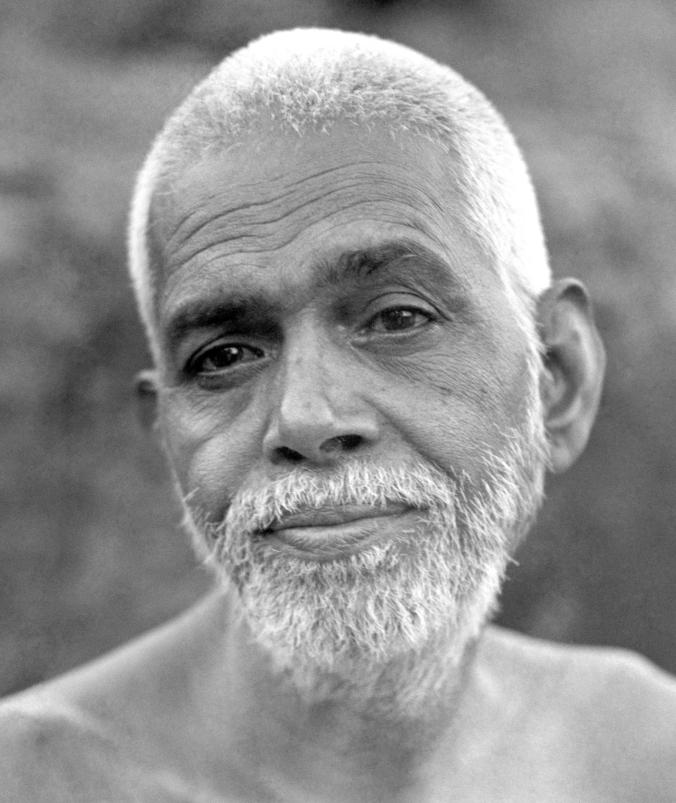
First know who you are. This requires no sastras (scripture) or scholarship. This is simple experience. The state of being is now and here all along. You have lost hold of yourself and are asking others for guidance. The purpose of philosophy is to turn the mind inward. “If you know yourself, no evil can come to you. Because you asked me I have told you this” (see Kaivalya Navaneeta). The ego comes up only by holding you (the Self). Hold yourself and the ego will vanish. Until then the sage will be happy saying, ‘There is’, and the ignorant will be asking, ‘Where?’
Regulation of life, such as getting up at a fixed hour, bathing, doing mantra-japa, etc., all this is for people who do not feel drawn to Self-enquiry, or are not capable of it. But for those who can practise this method all rules and disciplines are unnecessary.
Undoubtedly it is said in some books, that one should go on cultivating one good quality after another and thus prepare for moksha; but for those who follow the jnana or vichara marga, their sadhana is itself quite enough for acquiring all daivic (divine) qualities; they need not do anything else.
What is Gayatri? It really means ‘Let me concentrate on That which illumines all’.
Here is a testmonial from Anne that she very kindly wrote some months ago for me, but I have only recently got around to putting up onto tomdas.com (tomdas.com/testimonials):
Through Tom I’ve found a connection with Sri Ramana Maharshi. That’s made all the difference. It feels like there’s guidance that comes from beyond my own mind. I feel that my own mind can’t be trusted, that following the deeper intuition of the heart is the only way forward. That can only be done by quietening the mind and quietening the mind can only be done by self-inquiry. This has been transformative.
Miracles happen regularly and they are not miracles, but just the way it is. God is speaking directly to me through the heart and I have a sense of what direction to go in, what direction not to go in. It’s like having an inner compass. My questions and doubts are answered internally (though ‘internal’ and ‘external’ don’t make sense). I realise I don’t have any worries.
I’m reading scripture in a way I never have before and I’m reading it because I want to, not because I ought to. There’s a pull towards it, not a push. The scripture seems to have some direct line to the teacher, the teacher within. It settles the mind. Tom taught me through silence, through words, through laughter, through transmission (for want of a better word) that I’m OK.
He taught me to have faith, to trust that intuition, to put down the load I’ve been carrying and allow Bhagavan (the Beloved) to carry it for me. It’s been a huge release. My mind whirls sometimes at the immensity of it and then there’s silence. I can sit in silence and look at a garden. That’s the best thing. It’s a gift.
Tom: Here in this post I have selected some key teachings from Zen Master Huang Po that outline his view of the ‘Path’ to Liberation. In addition to this, I have also selected some specific teachings in order to compare and contrast Huang Po’s teachings to that of Advaita Vedanta and of Sri Ramana Maharshi (see here for some essential teachings of Sri Ramana Maharshi).Whilst I make no claim that these teachings are all exactly the same, in this particular post I have emphasised commonalities rather than differences.
As usual my comments will be in italicised red. To gain the most from this post please explore the related posts that are hyperlinked throughout, such as the one above on the Essential Teachings of Sri Ramana Maharshi. So you can read Huang Po’s zen teachings in their full context, I have provided the complete translation of Huang Po’s teachings as a PDF file below from which the various quotes below are taken:
The first teaching I cite is in fact the entire first teaching given in the above book, The Zen Teaching of Huang Po, teaching 1 from the Chun Chou record. Here is Huang Po:
‘The Master [Huang Po] said to me: All the Buddhas and all sentient beings are nothing but the One Mind, beside which nothing exists. This Mind, which IS without beginning, is unborn (Unborn not in the sense of eternity, for this allows contrast with its opposite; but unborn in the sense that it belongs to no categories admitting of alteration or antithesis) and indestructible.
‘It is not green nor yellow, and has neither form nor appearance. It does not belong to the categories of things which exist or do not exist nor can it be thought of in terms of new or old. It is neither long nor short, big nor small, for it transcends all limits, measures, names, traces, and comparisons. It IS that which you see before you – begin to reason about it and you at once fall into error. It is like the boundless void which cannot be fathomed or measured.
‘The One Mind alone is the Buddha, and there is no distinction between the Buddha and sentient things, but that sentient beings are attached to forms and so seek externally for Buddhahood. By their very seeking they lose it, for that is using the Buddha to seek for the Buddha and using mind to grasp Mind. Even though they do their utmost for a full aeon, they will not be able to attain to it.
‘They do not know that, if they put a stop to conceptual thought and forget their anxiety, the Buddha will appear before them, for this Mind is the Buddha and the Buddha is all living beings. It is not the less for being manifested in ordinary beings, nor is it greater for being manifested in the Buddhas.’
~ the first teaching from The Chun Chou record of Zen Master Huang Po, translated by John Blofeld, as found in the book ‘The Zen Teaching of Huang Po’
Tom’s Comments
Tom comments:
(1) The nature of Mind. All is Mind. Mind is That which is unborn, devoid of objectivity and objective characteristics and is unending/indestructible. It has no form or appearance according to Huang Po, indicating its pure Subjectivity, form and appearance pertaining only to objects. It also cannot be understood. Mind here is equivalent to Sri Ramana Maharshi’s concept of the Self. The implication of this is that it is something you already ‘have’ and/or already ‘are’. Huang Po writes:
‘This Mind, which IS without beginning, is unbornand indestructible. It is not green nor yellow, and has neither form nor appearance‘
Compare this with Shankara writing in Vivekachudamani, a major text in the Advaita Vedanta tradition:
‘254. That which is beyond caste and creed, family and lineage; devoid of name and form, merit and demerit; transcending space, time and sense-object – that Brahman art thou.‘
In teaching number 8 from this same text, the Chun Chou record, Huang Po states the following, confirming the lack of objects in Buddha-Mind:
‘Our original Buddha-Nature is, in highest truth, devoid of any atom of objectivity. It is void, omnipresent, silent, pure; it is glorious and mysterious peaceful joy – and that is all’
In teaching number 6 Huang Po states that Mind has nothing to do with conceptual thought (ie. the intellect) and it has nothing to do with forms:
‘This Mind is no mind of conceptual thought and it is completely detached from form‘
We see this in echoed in Shankara’s Vivekachudamani here, where he describes the Absolute as being distinct from the Universe/Maya (Maya means the illusion of the world, also known as duality):
‘261. That which is free from duality; which is infinite and indestructible; distinct from the universe and Maya, supreme, eternal; which is undying Bliss; taintless – that Brahman art thou‘
And from teaching number 2 Huang Po says:
‘The Mind IS the Buddha, nor are there any other Buddhas or any other mind. It is bright and spotless as the void, having no form or appearance whatever.’
From teaching 18 Huang Po says:
‘the real Mind as formless and neither coming nor going; his nature as something neither commencing at his birth nor perishing at his death, but as whole and motionless in its very depths’
And from teaching 22 of Wan Ling record Huang Po says (capitalisation present in the original translation):
‘NO BODIES AND NO MINDS – that is the Way of the Buddhas!‘
(2) Mind vs sentient beings (Self vs jiva): All is Mind, BUT Huang Po points out a very important distinction: when Mind seeks externally in forms, ie. when the mind goes out towards objects/objective phenomena, that characterises ‘sentient beings’, meaning jivas or apparent individual people. So we can see that the term ‘sentient being’ roughly translates as ‘jiva’ (apparent individual people). Huang Po writes ‘sentient beings are attached to forms and so seek externally for Buddhahood‘, the implication being that Buddhahood cannot be attained in this way through seeking externally.
This is similar to Sri Ramana Maharshi stating In Day by Day with Bhagavan:
‘The mind turned inwards is the Self; turned outwards, it becomes the ego and all the world’
Similarly the great Advaita text Yoga Vasishta states:
‘Consciousness which is undivided imagines to itself desirable objects and runs after them. It is then known as the mind.’
and
‘After knowing that by which you know this (world) turn the mind inward and then you will see clearly (i.e. realize) the effulgence of the Self.’
and
‘O Rama, the mind has, by its own activity, bound itself; when it is calm it is free.’
Similarly Huang Po states in teaching 5:
‘You students of the Way who do not awake to this in your own minds, and who are attached to appearances or who seek for something objective outside your own minds, have all turned your backs on the Way’
Again, Huang Po admonishes seeking Buddhahood/liberation externally via objective phenomena.
(3) Ego cannot know Mind or Self: John Blofeld capitalises the ‘M’ in Mind in some places and leaves it uncapitalised when it is referring to ego-mind: Huang Po says ‘By their very seeking they lose it, for that is using the Buddha to seek for the Buddha and using mind to grasp Mind’, meaning Mind cannot be known by mind, or Self cannot be known by ego/mind/jiva (a person).
In the Wan Ling record, Huang Po states in teaching 18:
‘It cannot be reached with the body nor sought with the mind. All sentient beings ARE ALREADY of one form with Bodhi [Tom: Bodhi means Knowledge or liberation/enlightenment]‘
Similarly, Shankara in Vivekachudamani states the Absolute (Brahman) cannot be known with the Mind or intellect (Buddhi):
‘256. That which is untouched by the sixfold wave; meditated upon by the Yogi’s heart, but not grasped by the sense-organs; which the Buddhi [intellect] cannot know; and which is unimpeachable – that Brahman art thou’
(4) The remedy is to end all thoughts(by knowing your true nature): What is the remedy? Huang Po says ‘Put a stop to conceptual thoughts and forget ones anxieties’. How to do this is not explained in this teaching. However, if all is one already, why the need to do this at all? Why not just allow things to be as they are? Why the need to stop thoughts? The reason is that only then does Buddha reveal himself as Mind (or Self). Otherwise, if thoughts are not stopped, the illusion of being a ‘sentient being’ (ie. the illusion of being a jiva, ie. an apparent individual person with an apparent individual and separate consciousness) continues unabated and unchallenged. This ignorance must be removed. When divested of its objectivity and seeming multiplicity, only then does Mind or Buddha or Self or God reveal itself as Self, only then does illusion cease and suffering end and unity and absolute love fully shine.
Amritabindu Upanishad, verse 5 states:
‘The mind should be prevented from functioning, until it dissolves itself in the heart. This is Jnana [Tom: knowledge (of our true nature)], this is Dhyana [Tom: meditation (on our true nature)], the rest is all mere concoction of untruth.’
In teaching 23 of the Wan Ling record, Huang Po answers a question:
Q: If I follow this Way, and refrain from intellectual processes and conceptual thinking, shall I be certain of attaining the goal? A: Such non-intellection IS following the Way!
We see this unambiguous teaching of needing to stop ALL thoughts given repeatedly by Huang Po. See here from teaching 23 of the Wan Ling record in which Huang Po explains further the method of liberation, explaining how thoughts create karma and the entire world/universe (or 3 worlds of samsara, see below):
Were you now to practice keeping your minds motionless at all times, whether walking, standing, sitting or lying; concentrating entirely upon the goal of no thought-creation, no duality, no reliance on others and no attachments; just allowing all things to take their course the whole day long, as though you were too ill to bother; unknown to the world; innocent of any urge to be known or unknown to others; with your minds like blocks of stone that mend no holes – then all the Dharmas [Tom: teachings] would penetrate your understanding through and through. In a little while you would find yourselves firmly unattached. Thus, for the first time in your lives, you would discover your reactions to phenomena decreasing and, ultimately, you would pass beyond the Triple World; and people would say that a Buddha had appeared in the world. Pure and passionless knowledge [Enlightenment] implies putting an end to the ceaseless flow of thoughts and images, for in that way you stop creating the karma that leads to rebirth – whether as gods or men or as sufferers in hell [Tom: this refers to ending the ‘triple world’ of suffering of (1) gods in heaven, (2) men on earth and (3) sufferers in hell].
Once every sort of mental process has ceased, not a particle of karma is formed. Then, even in this life, your minds and bodies become those of a being completely liberated. Supposing that this does not result in freeing you immediately from further rebirths, at the very least you will be assured of rebirth in accordance with your own wishes. The sutra declares: ‘Bodhisattvas are re-embodied into whatsoever forms they desire.’ But were they suddenly to lose the power of keeping their minds free from conceptual thought, attachment to form would drag them back into the phenomenal world, and each of those forms would create for them a demon’s karma!
Contrast this with Sri Ramana Maharshi himself writing in his poem Atma Vidya (Self-Knowledge), verse 5, in which he recommends stilling the mind completely in order to end karma and rebirth, ie to end samsara and suffering:
5. For loosening karma’s bonds and ending births, This path is easier than all other paths. Abide in stillness, without any stir Of tongue, mind, body. And behold The effulgence of the Self within; The experience of Eternity; absence Of all fear; the ocean vast of Bliss.
And Sri Ramana also writes in ‘Who Am I?’ in his answer to question 23 that the purpose of teaching is only to silence thoughts but discovering the Self, which is analogous to Huang Po saying end any and all conceptual thoughts and discover your true nature as Mind:
‘All the texts say that in order to gain liberation one should render the mind quiescent; therefore their conclusive teaching is that the mind should be rendered quiescent; once this has been understood there is no need for endless reading. In order to quieten the mind one has only to inquire within oneself what one’s Self is; how could this search be done in books?’
And here are some more teachings from Sri Ramana on the role of stilling thoughts:
True wealth is but the gracious silence of steady, unswerving Siva-awareness. This bright, rare treasure can be gained only by those who earnestly strive for extinction of all thoughts. Sri Ramana Maharshi, Guru Vachaka Kovai, verse 1066
When all thoughts cease, including thought of God, this thought-free state, this Pure Awareness Sri Ramana Maharshi, Guru Vachaka Kovai, verse 1207
Be still. Apart from this the mind has no task to do or thought to think Sri Ramana Maharshi, Guru Vachaka Kovai, verse 773
If you remain still, without paying attention to this, without paying attention to that, and without paying attention to anything at all, you will, simply through your powerful attention to being, become the reality, the vast eye, the unbounded space of consciousness. Sri Ramana Maharshi, Guru Vachaka Kovai, verse 647
Because that state is taught by silence, and also because it is attained by remaining in silence, it is called silence. The sage is in silence always, even when he speaks. Sri Ramana Maharshi, Sri Ramana Paravidyopanishad, verse 539
Further teachings on this by Huang Po from the Wan Ling record:
All phenomena cease in liberation/nirvana
In teaching 24 of the WanLing record Huang Po states all the 3 worlds of hell, earth and heaven will end in liberation:
‘For you also the Three Worlds [Tom: Trailoka – (1) hell – the world of desire, kamaloka, (2) earth – the world of form, rupaloka, and (3) heaven – the formless realm of heavenly beings, arupaloka; sometimes referred to as the 3 worlds of desire, form and formlessness] will vanish if you can reach the state beyond thought. On the other hand, if you still cling to the notion that something, even if it be as small as the hundredth part of a grain, might exist objectively, then even a perfect mastery of the entire Mahayana Canon will fail to give you victory over the Three Worlds. Only when every one of those tiny fragments [of the world or universe] is seen to be nothing can the Mahayana achieve this victory for you.’
Compare with Sri Ramana Maharshi as he writes in ‘Who Am I?’ in his response to Question 7:
‘When the mind, which is the cause of all cognition and of all actions, becomes quiescent, the world will disappear.’
Know your true nature
Later we will see Huang Po state all we have to do is awake to Mind, or as I sometimes say, awake to what we Really Are. This is similar to Sri Ramana Maharshi emphasising knowing Self rather than ending all thoughts. This is from teaching 2 of the Chun Chou record of Huang Po:
‘Only awake to the One Mind, and there is nothing whatsoever [more] to be attained.’
Here in teaching 26 of the Wan Ling record, Huang Po explains more on how to realise your true nature:
Q: How, then, does a man accomplish this comprehension of his own Mind? A: That which asked the question IS your own Mind [Tom: ie. you are the Mind/Self] but if you were to remain quiescent and to refrain from the smallest mental activity, its substance would be seen as a void [Tom: ie. devoid of objects] – you would find it formless, occupying no point in space and falling neither into the category of existence nor into that of non-existence. Because it is imperceptible Bodhidharma said: ‘Mind, which is our real nature[Tom; Here Huang Po confirms Mind is in fact the same as our real or true nature], is the unbegotten and indestructible womb [Tom: womb, ie. The Source, or the source of all phenomena or creation is Mind]; in response to circumstances, it transforms itself into phenomena[Tom: ie. Mind creates all phenomena]….Every one of the sentient beings [Tom: ie. Jivas] bound to the wheel of alternating life and death is re-created from the karma of his own desires! [Tom: ie. the illusion of samsara, the cycle of repeated birth, death and suffering experienced by the illusionary jiva/ego/person is created by our own desires, which is turn is born from ignorance of our true nature!]… We can see from this that every sort of dharma[Tom: note the use of a Sanskrit term here by Huang Po – dharma here means any phenomenal arising or ‘thing’, or Dharma can also mean teaching, meaning that every teaching or thing is just a creation of the mind] is but a creation of Mind. And all kinds of beings – humans, devas, sufferers in hell, asuras and all comprised within the six forms of life – each one of them is Mind-created[Tom: here it is clear that Huang Po is stating all phenomena are mind-created]. If only you would learn how to achieve a state of non-intellection [Tom: ie. no thoughts], immediately the chain of causation would snap…Chih Kung says: ‘Our bodies are the creations of our own minds.’ [Tom: ie. the above teachings tell us the body mind and world are all projections of Mind only] But how can one expect to gain such knowledge from books? If only you could comprehend the nature of your own Mind and put an end to discriminatory thought, there would naturally be no room for even a grain of error to arise. [Tom: the emphasis is on genuine Self-knowledge through cessation of mental activity and not book-knowledge]‘
Your True Nature
Still from teaching 26 of the Wan Ling record, Huang Po says:
‘Your true nature is something never lost to you even in moments of delusion, nor is it gained at the moment of Enlightenment [Tom: ie. Analogous to the Self in Vedanta]. It is the Nature of the Bhutatathata [Tom: Bhutatathata, this means the Unitary Substratum of Being or Isness/Thusness as opposed to the multiplicity of objective phenomena]. In it is neither delusion nor right understanding [Tom: both of which are of the ego-mind or thought]. It fills the Void everywhere and is intrinsically of the substance of the One Mind. How, then, can your mind-created objects exist outside the Void? The Void is fundamentally without spatial dimensions, passions, activities, delusions or right understanding. You must clearly understand that in it there are no things, no men and no Buddhas; for this Void contains not the smallest hairs-breadth of anything that can be viewed spatially; it depends on nothing and is attached to nothing. It is all-pervading, spotless beauty; it is the self-existent and uncreated Absolute. Then how can it even be a matter for discussion that the REAL Buddha has no mouth and preaches no Dharma, or that REAL hearing requires no ears, for who could hear it? [Tom: for there is no body, mind, world, thoughts or things in the real Buddha, so Buddha has no mouth and no ears, ie. in reality there is no mouth, ears, bodies, etc.]Ah, it is a jewel beyond all price!’
Conclusion
Here is a brief summary of some of the key points of Huang Po’s teachings taken from the above quotes:
Your true nature is Mind.
Mind is your true nature so it can never be lost (or ‘found’). This is the only Buddha there is, your True Nature. This is already what you ARE.
Mind is unborn and cannot be destroyed. It has no form and no objective qualities. It is unchanging and still/silent.
All we need to do is awaken to our own Mind
Mind is Liberation. It cannot be found outside yourself.
Mind is devoid of thought and completely detached from forms.
Mind cannot be understood or known by thought, and it is beyond the duality of knowing or not-knowing, ‘…that REAL hearing requires no ears…’
Mind creates or projects the body, thoughts and world and in this then roams among these objective phenomena that it itself has created, experiencing pleasure and pain and repeated births and deaths (samsara) according to desire/karma. The implication is that this is due to ignorance or lack of knowing our true nature.
‘You must clearly understand’ that in the true Buddha/ in true liberation there is no body, no mind, no world, no people, no things, no forms and nothing that has any spatial dimension whatsoever.
Implied in the above 2 points is that thoughts/Mind projects the multiplicity of the universe, including the various bodies and minds and things, and these thought-phenomena are impurities born of delusion/ignorance. ie. it is implied that through ignorance of one’s true nature that samsara is projected.
Even the idea of a teacher, a teaching or a seeker who could listen to the teaching is illusion – ‘the REAL Buddha has no mouth and preaches no Dharma…’.
The true Buddha or Mind is not a ‘nihilistic ‘nothing’, it is (and I quote) ‘spotless beauty’ or ‘a jewel beyond all price’ or ‘a glorious mysterious peaceful joy’.
Mind or True Buddha Nature cannot be known by thought, by a person/ego/sentient being, through the body, or by practices relating to the objective sphere. Seeking outside of yourself and attachment to objects is to abandon the path.
You can discover your true nature and thus end this illusion/delusion of samsara. This is by intuiting Mind/True Nature and ending all thoughts.
Mind divested of all thoughts and spontaneous recognition of Mind is the way to liberation.
All of these points are consistent with the path to realisation as outlined by Sri Ramana Maharshi and Upanishads in my view. There are many other teachings present in the Zen Teaching of Huang Po and I have just selected some that align with the teaching of Sri Ramana Maharshi. Perhaps some of the other teachings do not fully align, or perhaps they are distortions due to the one recording the teachings or due to the translation/translator. Or perhaps not. Regardless, I hope this post has been of interest and is perhaps even inspiring for you.
The method of how to still the mind and stop all conceptual thought/realise the One Mind (ie. the practice of Self-Enquiry) is not explained more fully by Huang Po, but in my view the method of self-enquiry is implied – ie. knowing Mind directly through Mind (and not through body, sense organs, mentation or thought), ending all karma/ phenomena/ thoughts, how going out towards objects/arising phenomena blocks the way and describing Mind as One, as formless and as essentially without time, space, dimension, and ultimately and essentially distinct from form/objects – all these together imply direct intuition of Self via Self-Enquiry as opposed to going out towards objective phenomena (when Huang Po denies practices, he is denying practice that involve objective phenomena, in my interpretation at least).
I will leave you the quote from teaching 22 of the Wan Ling record, perhaps the most radical of the teachings I found, in which Huang Po says, with the capitalisation being present in the original translation:
‘NO BODIES AND NO MINDS – that is the Way of the Buddhas!‘
I have also written an article contrasting traditional Buddhism with Vedanta. In this post you will also see references to other posts exploring themes in both these great traditions. Let me know what you think in the comments, best wishes:
Over the last few months several people have wrote testimonials for me which I have only just got around to putting onto tomdas.com (tomdas.com/testimonials). Here is what Hesther writes about attending Satsang and occasional 1 to 1 meetings with me:
I don’t understand how it works, but Tom’s guidance gives me added strength and energy to do Self-enquiry, to study and to meditate. I feel I am not alone on this path. The recommended readings, the satsangs, and the occasional 1-1 meetings are all so trustworthy.
Instead of confronting me with my ‘short-comings’ as a seeker I feel free, validated and encouraged to follow my path. The path is full of paradoxes, that Tom allows for, enhancing the sense of freedom and trust that I have. I have never felt that I am being pushed into a mould that fits his vision. On the contrary, he doesn’t fill in the blanks that I have but gives me pointers so that I can discover things in my own experience. He doesn’t give me direct advice so much as that he seems to create a context in which I blossom as a seeker of spiritual truth.
Thank you so much for all your help and guidance, love, Hesther, Portugal
Tom: SSS’s Magnum Opus was ‘The Method of Vedanta’.
On page 149 SSS quotes from Chapter 6 of the Bhagavad Gita to explain in more detail the method of Nididhyasana (the meditation that leads to Self-Realisation). According to SSS this process is not merely a purificatory practice, but one that leads directly to liberation. The following is quoted by SSS as a description of Nididhyasana, taken from Chapter 6 of Bhagavad Gita:
‘That yoga should certainly be practised with resolute mind. Giving up without exception all desires that come from individual, will, restraining the sense-organs on every side through the mind, one should gradually withdraw from all activity, with will and intellect firmly controlled; keeping the mind fixed on the Self, one should not think of anything. Wherever the fickle mind wanders, one should bring it back and fix it on the Self alone, under firm control. Supreme joy comes to such a yogi, whose mind is at perfect peace, whose lusts have subsided, who is sinless and who has become the Absolute.’
Questioner: Sravana, manana, nididhyasana, are ALL (direct) means (sakshat sadhanas) towards sadyo-mukti (i.e moksha)! Shravana is enough regarding the highest aspirant (here manana and nididhyasana are implied) whereas all others (middle and lower aspirants) need to continue until culminating in Atmanubhava (sadyo-mukti, and it’s many synonyms)! The important thing is that once complete knowledge (Atma jnanam) is attained, repetition of that knowledge (jnana abhyasa, practice of Jnana) is NO longer required, and consequently obsolete! This applies to all aspirants. OM
Tom: yes this is correct, see here for more, although SSS does state that nididhyasana implies repetition.
Jnana itself does not (and cannot) be repeated, as Jnana is moksha. I guess that is the point you are stressing.
Some Advaita texts do speak of repeating knowledge, but what they are referring to is repetition of nididhyasana (ie. repetiton of the PATH of knowledge, ie. repetition of sravana, manana, nididhyasana) and NOT repeating of Moksha, which as we have said, cannot be repeated as it is once and for all, ie. final. I think this is where the misunderstanding arises – different meaning of the word Jnana in different contexts.
However….
The issue here is, for those who need nididhyasana (which SSS says is most people/seekers), what is the nature of nididhyasana and how to do it? Here SSS clarifies the nature of nididhyasana, also known as Samadhi yoga or control of mind. This is the point I am stressing.
Questioner: There is Jagrat (waking), Swapna (Dream) and Sushupti (Deep sleep), the three avasthas (states) that have distinct qualities. Is there something else called Jagrat Sushupti (waking sleep)? Please can you explain?
Tom: Regarding Jagrat Sushupti, see the Annapurna Upanishad 2.12 and 2.13:
2.12. The quiescent state of the attenuated mind, free from all objective reference [Tom: ie. nirvikalpa samadhi], is said to be the deep sleep in wakefulness (Jagrat-Sushupti).
2.13. This state of slumber, O Nidagha, fully developed through practice, is styled the Fourth (Turiya) by the best knowers of Truth.
Note the term Turiya, or The Fourth, means the state of being the Self, also known as Moksha or Jnana. Here we can see that Jagrat Sushupti, Moksha, Turiya and (by implication) Nirvikalpa Samadhi are all being equated.
Sri Ramana Maharshi explains this teaching of Jagrat Sushupti in more detail in Talks with Sri Ramana Maharshi, talk 609:
‘The incentive to realise can arise only in the waking state and efforts can also be made only when one is awake. We learn that the thoughts in the waking state form the obstacle to gaining the stillness of sleep.
“Be still and know that I AM God”.
‘So stillness is the aim of the seeker. Even a single effort to still at least a single thought even for a trice goes a long way to reach the state of quiescence. Effort is required and it is possible in the waking state only. There is the effort here: there is awareness also; the thoughts are stilled; so there is the peace of sleep gained. That is the state of the Jnani. It is neither sleep nor waking but intermediate between the two. There is the awareness of the waking state and the stillness of sleep. It is called jagrat-sushupti.
‘Call it wakeful sleep or sleeping wakefulness or sleepless waking or wakeless sleep. It is not the same as sleep or waking separately. It is atijagrat (beyond wakefulness) or atisushupti (beyond sleep).
‘It is the state of perfect awareness and of perfect stillness combined. It lies between sleep and waking; it is also the interval between two successive thoughts. It is the source from which thoughts spring; we see that when we wake up from sleep. In other words thoughts have their origin in the stillness of sleep. The thoughts make all the difference between the stillness of sleep and the turmoil of waking.
‘Go to the root of the thoughts and you reach the stillness of sleep. But you reach it in the full vigour of search, that is, with perfect awareness. That is again jagrat-sushupti spoken of before. It is not dullness; but it is Bliss. It is not transitory but it is eternal.’
~Sri Ramana Maharshi, Talks with Sri Ramana Maharshi, talk 609
Questioner: Hi Tom, can you please explain verse 32 of Ulladu Narpadu (40 verses on Reality, a text written by Sri Ramana Maharshi)?
When the Vedas have declared, ‘Thou art That’ – not to seek and find the nature of the Self and abide in It, but to think ‘I am That, not This’ is want of strength. Because, That abides forever as the Self.
Sri Ramana Maharshi, Ulladu Narpadu, Verse 32
Tom: The idea is that we should turn within and discover what we truly are by inwardly and intuitively going towards the sense of ‘I’. When we go within in this way (this is also called self-enquiry) our mind becomes increasingly withdrawn and we start to discover, and eventually do discover, what we actually are: the formless, eternal, birthless, deathless Spirit that is devoid of objectivity, multiplicity, ego and suffering.
If instead of discovering what we truly are, we remain extroverted, sensing and perceiving objects and multiplicity, and merely repeat or think to ourselves ‘I am that’ or ‘all is already one’ or something like this, then we are fooling and deceiving ourselves, and we are weak and uncourageous, for we are not applying ourselves and developing true bravery or strength, which is turning within, away from the world, to discover our actual nature.