Author: Tom Das
How do we withdraw from the senses? | How to go towards the ‘I AM’ | Self-Enquiry | Sri Ramana Maharshi
A recent testimonial
I am always grateful to receive a testimonial – here is a recent testimonial I received from someone – note that ‘Guru’ simply means teacher – see here for more testimonials:
Tom is the only living Guru that I have met who speaks directly and one pointedly to the path and method of Sri Ramana. I came across Tom’s teachings while seeking some answers to questions about Sri Ramana’s methods applied to a householder’s life. After only a few 1 on 1 sessions I had strong clarity on how to deal with the obstacles I was running into. And I felt this sense of self confidence or confidence in my SELF that was being overlooked in the past. Through his loving acceptance of wherever I was, Tom kept bringing me back to the true Guru that is inside of me. The SELF. Along the way he also reminded me to honor my feelings and to drop self-judgment – another way of reinforcing my true self.
I also appreciated that Tom pointed me to the most relevant and effective texts amongst the sea of reading that is out there. It felt like every time he referred me to a text, that was exactly what I needed in that moment.
He helped me understand the true meaning of the texts and how to interpret them the way Sri Ramana had meant them, while still making it applicable to my busy lifestyle.
I’m deeply grateful to Tom’s guidance and teaching and his highly scientific and logical approach to the path of liberation.
Ramana Maharshi on those who ridicule idol-worship or image-worship | Non-duality | Bhakti
Also see:
Does Jnana (or Self-Enquiry) lead to Bhakti (or Self-Surrender) or the other way round?
Non-dual devotion, worship and prayer
Here we see Sri Ramana Maharshi’s teaching on those who ridicule and denounce idol-worship or image-worship as follows in Guru Vachaka Kovai verse 208:
208
O you that ridicule idol-worship, having not discovered through heart-melting love its secret, how is that you [daily] worship the filthy idol of your body as ‘I’?
Commentary on this verse by Sri Sadhu Om:
It is generally believed that idol worship is to mistake an idol as God and to treat it accordingly, offering it a bath, cloth, food, and all hospitality; but to mistake a body as Self, and to treat it accordingly, is also a form of idol worship. Indeed to treat and love a body as ‘I’ is the primal mistake which leads to all other forms of idol worship. So it is clear that we are all idol-worshippers, even if we take pride in scorning those that worship temple idols.
As long as one takes one’s body as ‘I’, there is no wrong in also worshipping an idol as God, and until one feels that it is wrong to treat one’s body as ‘I’, one should not be scornful and criticize others for treating an idol as God.
If one first roots out and destroys the ‘I am the body’ notion, one is then in a position to criticize idol worship, if such criticism is necessary [in the light of Jnana such criticism will of course be clearly seen as unnecessary].
Is ‘Awareness Watching Awareness’ the same as ‘Abiding in the Heart’?
The remedy for a restless mind: satsang
Tom, are you a Guru? Are you a Jnani?
Ramana Maharshi’s English Handwriting (with wonderful teachings!) – The Mountain Path 2005 (April & July)
Here we have wonderful teachings from Sri Ramana Maharshi in his own handwriting – and best of all for us English speakers and readers – he has written these teachings in English himself!
Many of the core themes of the teachings are given and because they have been written by Bhagavan, and because he was writing out in English the verses he himself corrected (see below for the full context), this means we can be sure of the authoritativeness of these teachings given below.
Be sure to download the PDF files below which contain even more verses than what I have included in this post. They were taken from editions of The Mountain Path (a quarterly Journal founded in 1964 by Arthur Osborne and published by Sri Ramanansramam) from 2005.
The following are all Sri Ramana Maharshi’s own English handwriting:
Sri Ramana Maharshi’s English Handwriting PDF 1 (Mountain Path April 2005)
Sri Ramana Maharshi’s English Handwriting PDF 2 (Mountain Path July 2005)
The following images are taken from The Mountain Path April 2005:

In the Mountain Path (April 2005) it explains the following:
In 1917 Bhagavan Sri Ramana Maharshi composed five cryptic Sanskrit slokas in Arya metre entitled Arunachalapancharatnam. These verses, the quintessence of upanishadic teachings, he later translated into Tamil and they are chanted by devotees at the end of the Tamil parayanam. Sri K. Lakshmana Sharma (WHO) wrote a Sanskrit commentary on these slokas entitled Laghu Vritti (Short Commentary) and this he submitted to Sri Bhagavan, who, on perusal of the text, corrected the title to vartikam. Vartikam is defined as a supplement which elucidates that which is said, that which is left unsaid, or that which is imperfectly said and needs clarification. There is a historical precedent in Sri Sureswaracharia, a direct disciple of Adi Sankara, who was known as Vartikakara because he had written a Vartikam on Sri Sankara’s bhashya (commentary) on Brihadaranyaka Upanishad and Dhakshinamoorthy stotra among others. Since Bhagavan corrected Sri Sarma’s title to Vartikam, he also named him Vartikakara.
A second note book containing Bhagavan’s corrections was submitted to Bhagavan who confirmed his original corrections and added some more verses. The original commentary of 79 slokas was increased to 108 slokas. The corrections made by Bhagavan with English and Tamil translations of this Vartikam was again rewritten in a pocket size note book by Bhagavan himself, and this book is maintained in the Ashram Archives. We have a rare example here of Bhagavan’s handwriting in three languages, namely Sanskrit, Tamil and English. This is one of the few instances of his written English; for reasons of its rarity we decided to print here only the English translation of some verses. In the next issue, Advent 2005 [see PDF downloads on this page], we will publish examples of Bhagavan’s handwriting in all three languages together for specific verses. We have slightly magnified the writing. Any discrepancies in size are due to the varying sizes Bhagavan used to accommodate the verses in the limited space available in the notebook.

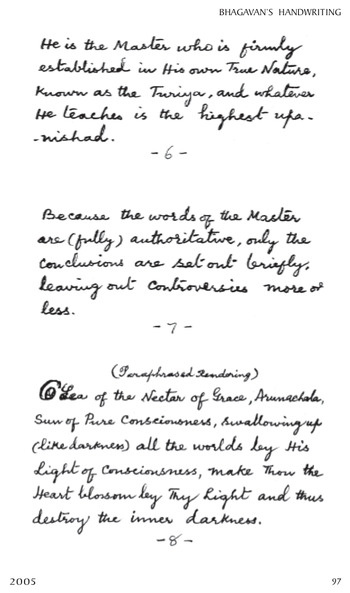
In verses 1 and 2, above, Sri Ramana declares that he is nothing other than the Self, pure consciousness.
In verse 3 above, Bhagavan Sri Ramana states that the Self, also known as Turiya, is worldless, that is, without objective phenomena, and in verse 4 he states it is blissful and free from evil.
In verses 5 (above) and 6 (below), Sri Ramana writes that his teaching is the true Upanishad (ie. the genuine revealed teaching or shruti).
In verse 7 (below) it is stated that because the teachings are authoritative, the conclusions will be stated in brief (without the need to provide logical reasoning as a support or proof).
Verse 8 (below) starts with ‘O Sea of the Nectar of Grace…’ and states how Arunachala, which is the Self, will swallow up the worlds (objective phenomena) just as light ‘swallows’ darkness, indicating how the world, which is illusion (see below) is merely ignorance (darkness).
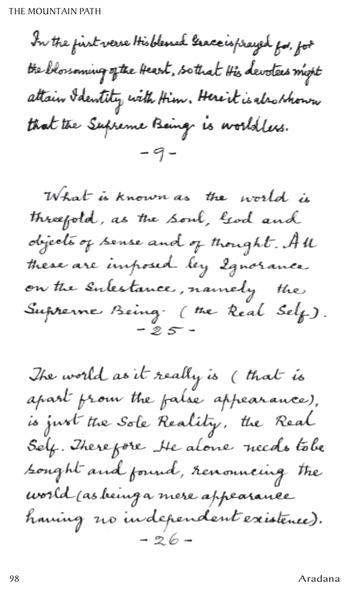
Below Sri Ramana explains ‘Here it is also shown that the Supreme Being is worldless’ (verse 9), meaning that the world appearance does not appear in the Self, and that the world appearance is due solely to ignorance (verse 25).
The triad of ‘soul, God and object’ in verse 25 refers to Jiva, Iswara and Jagat.
Verse 26 shows that ‘the world as it really is’ refers to pure consciousness devoid of objective phenomena, ie. when the nama rupa (names and forms) have been removed the Self is revealed, as the verse says, the world needs to be renounced.
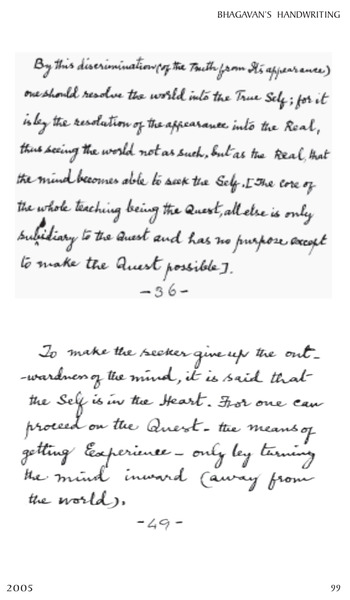
Below in verse 36 Sri Ramana states that the whole teaching is only to facilitate Self Enquiry (‘The Quest’), and in verses 36 and 49 he states that to do Self Enquiry one must ‘turn inwards’ explaining this means to turn ‘away from the world’:
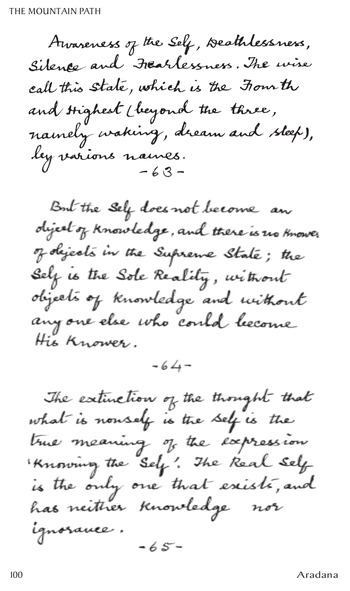
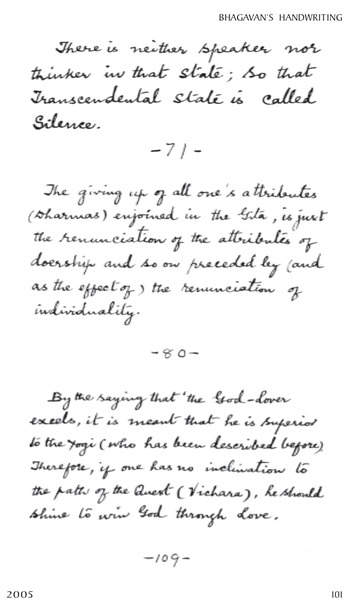
Here in verse 63 Bhagavan Sri Ramana states that Awareness of Self is Deathlessness, Silence and Fearlessness, also known as the Fourth (Turiya).
In verse 64 below Sri Ramana states that there are no objects and no knower of objects in the Self (which is formless and objectless, One Whole without any differentiation whatsoever):
The following images are from The Mountain Path July 2005:
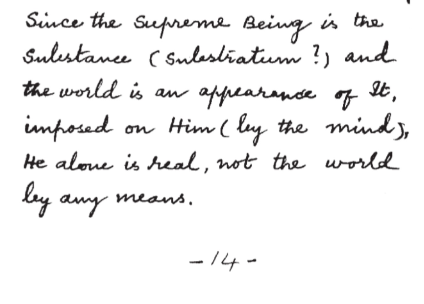
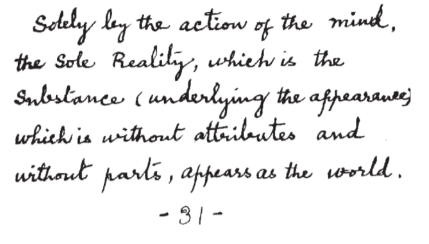
Here in verses 14 and 31 Sri Ramana states that the world is certainly not real, the world being a creation or projection of the mind:, only the Self, the Pure Consciousness devoid of objects and full of bliss is the only reality (and this must be known directly through Self-Enquiry, see verse 97 below)
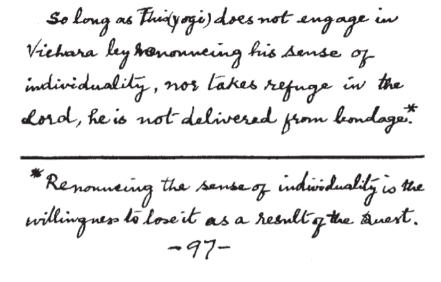
Here in verse 97 Sri Ramana states that unless one does Self-Enquiry (Vichara) or Self-Surrender, one will not end suffering. The asterixed portion confirms that Self-Surrender itself is essentially Self-Enquiry, there being truly onle One Path to the One Self:
Fear of Disappearing, ‘No free will’, Science & Faith | Intuitive Self-Knowledge | Ramana Maharshi | Advaita | Non-duality
If God is everywhere, why do we have to turn within? Why can’t we see God in the World? How is God to be seen? Sri Ramana Maharshi
Also see:
Ramana Maharshi: how to abide as the Self
The need to turn within according to Advaita Vedanta
‘We must see Brahman in everything and everywhere’ is also not quite correct
The following is from Talks with Sri Ramana Maharshi, Talk no. 244:
Question: How is God to be seen?
Sri Ramana Maharshi: Within. If the mind is turned inward God manifests as inner consciousness.
Tom: here Bhagavan Sri Ramana gives us the essential teaching – God is to be found within – not outside, meaning not in the body, mind or world, but within, meaning in the non-conceptual Self that is the Subject. As Ramana himself wrote in the text ‘Who Am I?’:
Question: When will the realization of the Self be gained?
Answer: When the world which is what-is-seen has been removed, there will be realization of the Self which is the seer.
And in the same text, Who Am I?, in the answer to question 16 it is written:
‘the Self itself is God’
However, the questioner poses a seemingly logical question, namely that if God is everywhere, why cannot be see God everywhere? Why the need to look within when we can just as easily look outside at ‘God’s creation’, through our senses and see God there? Let us see:
Q: God is in all – in all the objects we see around us. They say we should see God in all of them.
Sri Ramana Maharshi: God is in all and in the seer. Where else can God be seen? He cannot be found outside. He should be felt within. To see the objects, mind is necessary. To conceive God in them is a mental operation. But that is not real. The consciousness within, purged of the mind, is felt as God.
Tom: here Sri Ramana is stating that to see God outside is merely to see a projection of the mind, for according to Sri Ramana, as we shall see shortly, all objective phenomena are mere thoughts, or projections of the mind, much like a dream objects are projection of the mind. An alternative explanation is that to see God in objective phenomena is actually a subtle act of the mind, a conceptual framework we are overlaying onto objects.
However, the questioner persists in pursuing their line of enquiry by challening Sri Ramana – are not various objects beautiful? Are not colours lovely to look at? Can we not see God in these objects too? Let us see:
Q: There are, say, beautiful colours. It is a pleasure to watch them. We can see God in them.
Sri Ramana Maharshi: They are all mental conceptions.
Q: There are more than colours. I mentioned colours only as an example.
Sri Ramana Maharshi: They are also similarly mental.
Tom: the questioner states that we can see God in objects and through the senses, but Sri Ramana dismisses this as mere concepts. The questioner, having raised objective qualities such as colour, then having raised other senses, not just colour now goes onto the body and the mind:
Q: There is the body also – the senses and the mind. The soul makes use of all these for knowing things.
Sri Ramana Maharshi: The objects or feelings or thoughts are all mental conceptions. The mind rises after the rise of the I-thought or the ego. Wherefrom does the ego rise? From the abstract consciousness or Pure intelligence.
Tom: Here Sri Ramana again states that the body, senses and mind are all mental conceptions (or mental projections), as are all objects, feelings and thoughts.
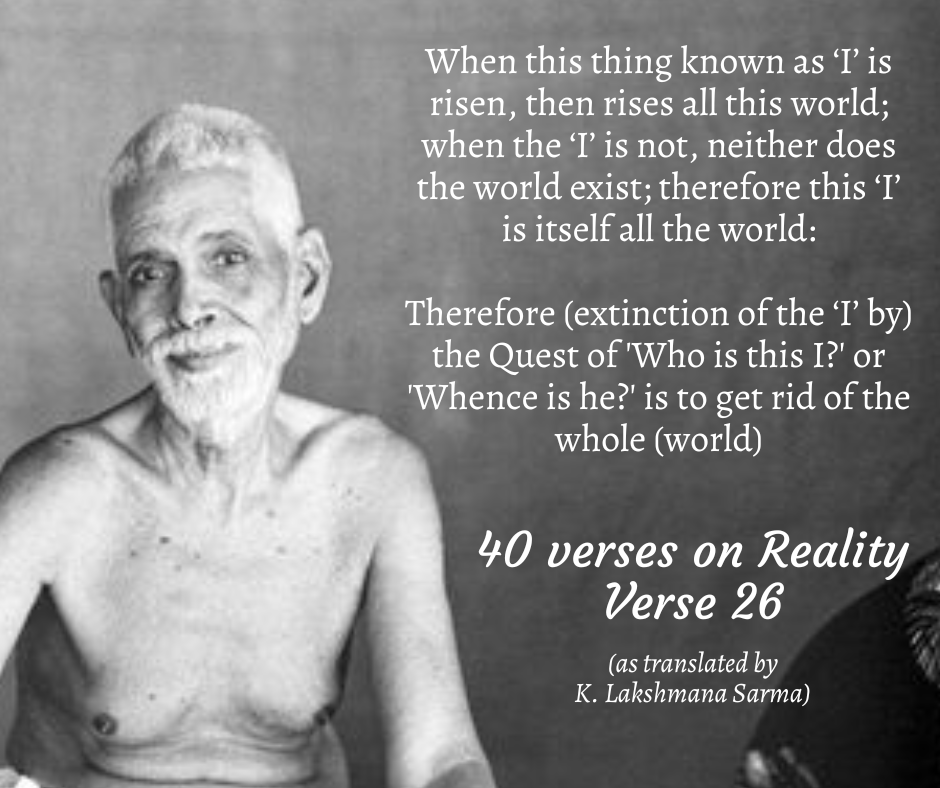
He then goes on to give a teaching given in the aforementioned text ‘Who Am I?’, that the first though is the ‘I-thought’ also known as the ego, and only once this has risen can other thoughts or objective phenomena arise such as the body, the mind and the world. In this way Bhagavan Sri Ramana is repeating his teaching, a teaching also taught in the Upanishads and by Sri Shankara, that the body-mind-world is actually a projection of ego or ignorance.
What is the source of this ego or I-thought? It is the Self, or Pure Consciousness as he refers to it here. The word ‘pure’ denotes the absence of arisising objective phenomena, which is consistent with the teaching explained in my above paragraph.

Later in the same dialogue (Talk 244) Sri Ramana explains that the ego or ‘I-thought’ gives rise to (or projects out) the mind, and the mind then projects out a body:
Sri Ramana Maharshi: The sense of body is a thought; the thought is of the mind, the mind rises after the ‘I-thought’, the ‘I-thought’ is the root thought. If that is held, the other thoughts will disappear. There will then be no body, no mind, not even the ego.
Q: What will remain then?
Sri Ramana Maharshi: The Self in its purity.
Tom: We can see that Sri Ramana is re-iterating that the body and mind are both projections of thought, and that their root is the ego, also known as the I-thought. When this ego-root (ie. ignorance) is cut down, by self-enquiry, all thoughts cease and the Self remains in its purity. As the body, mind and ego are all thoughts, Bhagavan Sri Ramana here explicitly states that in Self-Realisation there is no body, mind or ego. All that remains is the pure Self, again ‘pure’ denoting the lack of objective phenomena such as body, mind, world, feelings, sensations, etc.
As always, please do not simply accept teachings at face value. It is always good to read teachings in their proper context, so I encourage you to not just accept my commentary above, but to read the full talk for yourself so you can see it in its context. You will find many other valuable teachings in this talk too, such as Sri Ramana’s exposition of the three states and how he equates deep sleep with the Self, how he says that the world is a mere dream, his insistence that Self-Enquiry is the easiest path, and that Happiness or Pleasure or God can only truly be found Within.
 Tom Das