Author: Tom Das
Both thought and trying to get rid of thought are illusory mirages of separation
Objection:
The assumption that thought is an actual thing and that thought has a source, arises only in the realm of imaginary separation. There is, by definition, no way to determining the imaginary source of an imaginary thing.
Tom:
Whilst it is true that thought is ultimately an illusion, and trying to get rid of thought is also more of the same illusion, there is a logical flaw in this objection, as follows: thoughts may be imaginary, but that does not mean their source is imaginary. Fiction or imagination can have a real source. The teaching is to locate that Source (the Self) and abide there in Pure Being, which is devoid of thought, until the tendency to imagine duality (ie. thought) ceases.
Here are two quotes to illustrate the above points, one from Sri Shankara, and one from Sri Ramana:
‘The binding, and the getting rid of bondage, are both mirages. The belief that bondage of the Real, is, and the belief that it has ceased, are both mere things of thought‘
~Sri Shankara, Vivekachudamani verses 571 and 572
‘All doubts will cease only when the doubter and his source have been found. There is no use removing doubts. If we clear one doubt, another doubt will arise and there will be no end of doubts.‘
~Sri Ramana Maharshi, Day by Day with Bhagavan
What is the point of the Teachings? Where is effort best directed? Stilling the Mind. Self-enquiry
Is the point of the teachings is to remove all thinking, all thought, all concepts? Is that what is meant by stilling the mind? Tom describes how we can use objects such as the breath or a picture to help us to still the mind initially or we can attend directly to the I AM, the subject, which is Self-enquiry.
This video was recorded live during a Satsang meeting with Tom Das and put together by volunteers.
To attend satsang, see here: https://tomdas.com/events.
For guided meditations see the ‘guided meditation’ playlist here: https://www.youtube.com/c/TomDasNonduality/playlist
For recommended reading for liberation see here: https://tomdas.com/2020/10/19/recommended-reading-books-for-enlightenment-liberation-and-self-realisation/
To book a 1 to 1 session with Tom see here: https://tomdas.com/nondual-spiritual-counsellor/
You have to surrender the mind | holding on to the branch of the tree of Maya
We have to surrender the mind. And then That what we are looking for is revealed naturally, spontaneously, effortlessly, but not to the mind. If you start the practice, even if it is atrocious in the beginning, faith will come. You will start to fall into the path and accelerate.
Every attempt at stilling the mind is progress.
You are holding onto the branch of a tree (your mind is holding onto the illusion of body/mind/world – Maya) when your feet are on the ground (you are the Self already).
Only when you turn within and let go of the name and the form (the illusion/Maya) you will discover that you have always been standing on the ground (you have always been the Self).
Do not take this world to be real, or this body mind to be yourself. Do not take your thoughts to be your thoughts.
Abide as the Self. Merge with the Knowledge that is within you.
This video was recorded live during a Satsang meeting with Tom Das and put together by volunteers. To attend satsang, see here: https://tomdas.com/events.
For guided meditations see the ‘guided meditation’ playlist here: https://www.youtube.com/c/TomDasNonduality/playlist
For recommended reading for liberation see here: https://tomdas.com/2020/10/19/recommended-reading-books-for-enlightenment-liberation-and-self-realisation/
To book a 1 to 1 session with Tom see here: https://tomdas.com/nondual-spiritual-counsellor/
The mind wants to get there as soon as possible | Liberation & Non-duality (Advaita)
Is yearning for God Egoic? Isn’t devotion dualistic? | Everyone is a spirtual seeker
The teaching never ultimately points towards an object
What are we all really looking for? We are looking for total fulfillment devoid of any misery. This is our heart’s desire and you do not get that from someone else or something else. The best teacher/teaching can do is to point you back to yourself.
This video was recorded live during a Satsang meeting with Tom Das and put together by volunteers.
To attend satsang, see here: https://tomdas.com/events.
For guided meditations see the ‘guided meditation’ playlist here: https://www.youtube.com/c/TomDasNonduality/playlist
For recommended reading for liberation see here: https://tomdas.com/2020/10/19/recommended-reading-books-for-enlightenment-liberation-and-self-realisation/
To book a 1 to 1 session with Tom see here: https://tomdas.com/nondual-spiritual-counsellor/
Q. Arahant vs Bodhisattva – which is best? | Buddhism

Q. According to Buddhism is it better to be a Bodhisattva or an Arahant? I’ve heard quite a few conflicting things about this so would be good to get some clarity.
Tom: According to the Pali Suttas, the earliest records of Buddha’s teachings, true enlightenment/liberation is to be an Arahant, a Boddhisattva being anyone who desires liberation. By this definition, a Bodhisattva is unenlightened and still stuck in suffering/samsara, and an Arahant is an enlightened sage.
In later Buddhist schools/thought, a Bodhisattva became someone who foregoes enlightenment in order to help all sentient beings attain liberation. The idea here is that an Arahant, whilst liberated, is somehow ‘cold’ and ‘self-centred’ (I don’t agree with this by the way), placing their enlightenment above others, and so the ‘compassionate’ Bodhisattva rejects full liberation in place of compassion towards others. The problem with this, as has been oft pointed out, is that only a ‘liberated being’ can lead another to full liberation, and that with Nirvana, duality and the sense of ‘another’ outside of yourself, ceases (please excuse my dualistic language – see these quotes from Diamond sutra if you are unsure what I am talking about here when I say ‘dualistic language’)
Later still, a Bodhisattva was defined loosely as a compassionate enlightened being who helps all others attain liberation. By this definition, a Bodhisattva is a desirable outcome!
So take your pick!
There is more complexity and nuance in this topic if you want to delve into it, but the above is a broad outline. Hope that helps 🙏
Shankara: The Self or Brahman cannot be known!

A definition of Jnana by Shankara
The Brihadaranyaka Upanishad, verse 4.4.20, states the following:
20. It [Brahman] should be realised in one form only, (for) It is unknowable and eternal. The Self is taintless, beyond the (subtle) ether, birthless, infinite and constant.
Here we can see that the Upanishad is stating that Brahman is unknowable. So what of Self-Knowledge or knowledge of Brahman that is so often spoken about? Shankara explains this contradiction in his commentary on this verse:
The knowledge of Brahman too means only the cessation of the identification with extraneous things (such as the body). The relation of identity with It [Brahman] has not to be directly established, for it is already there. Everybody always has that identity with It, but it appears to be related to something else. Therefore the scriptures do not enjoin that identity with Brahman should be established, but that the false identification with things other than That should stop. When the identification with other things is gone, that identity with one’s own Self which is natural, becomes isolated; this is expressed by the statement that the Self is known. In Itself It is unknowable – not comprehended through any means. Hence both statements are consistent.
We can see that Shankara is stating that Brahman is indeed unknowable, and that Jnana, or knowledge, only signifies the cessation of identification with extraneous things, ie. loss of identification with objects, specifically the body-mind. Jnana is not of the mind and is not for the jiva or individual.
We do not need to affirm our identity as Brahman, as we already are and always have been and always will be Brahman. Any affirmation of Brahman would simply be on the level of thought or concepts, and so it would be Maya, or more ignorance. But once the false identification has been removed, then the Self naturally shines as itself, and this lack of wrong-knowledge, or lack of wrongly identifying as the body-mind, is what is called ‘Jnana’ or ‘knowledge’.
In Ulladu Narpadu verse 12, Sri Ramana Maharshi writes:
True Knowledge is being devoid of knowledge as well as ignorance of objects. Knowledge of objects is not true knowledge. Since the Self shines self-luminous, with nothing else for It to know, with nothing else to know It, the Self is Knowledge. Nescience It is not.
In Upadesa Saram verse 27, Sri Ramana Maharshi writes:
That is true knowledge which transcends
Both knowledge and ignorance,
For in pure knowledge
Is no object to be known.
The above is an excerpt from the following post which further explores this topic: What exactly is Jnana (knowledge) according to Shankara and Gaudapada and the scriptures?
Ramana Maharshi: There are not many Jivas/egos/people (Eka Jiva Vada)
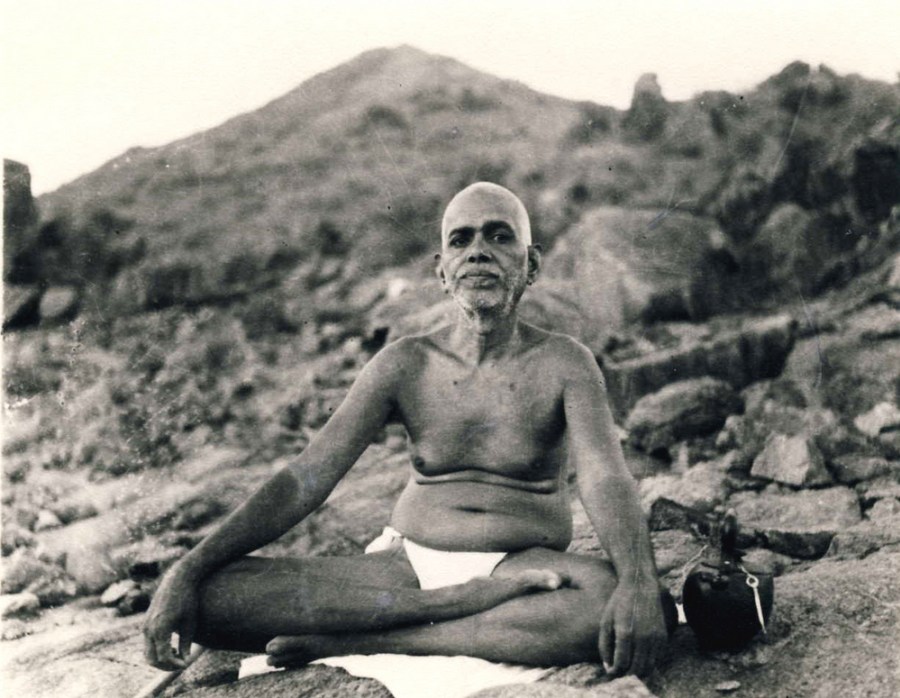
(Here a questioner asks are there not many jivas? Sri Ramana informs the questioner there is only one jiva)
A question was asked why it was wrong to say that there is a multiplicity of jivas. Jivas are certainly many. For a jiva is only the ego and forms the reflected light of the Self. Multiplicity of selves may be wrong but not of jivas.
Sri Ramana Maharshi: Jiva is called so because he sees the world. A dreamer sees many jivas in a dream but all of them are not real. The dreamer alone exists and he sees all. So it is with the individual and the world.
There is the creed of only one Self which is also called the creed of only one jiva*. It says that the jiva is only one who sees the whole world and the jivas therein.
~Talks 571
*Tom: This is called the doctrine of eka jiva vada (the view there is only a single jiva/ego/person). Our own body-mind, and the body-mind of apparent others are all projections of the Self. Like a dream, it appears we are many, but actually this entire dream world is an illusion, and there is only the Dreamer, the Self, the Consciousness from which all is projected. Tat Tvam Asi, You are That.
The above is an excerpt taken from this longer post that further explores this theme:
Ramana Maharshi: The world should be considered like a dream
 Tom Das