I am very happy to announce that I will now be holding ONLINE Satsang every Sunday at 3pm UK time (cost £5) in addition to the usual Thursday Satsang at 8pm UK time (cost £10). Further details can be found here.
All are welcome to attend and it’s easy to join if you have not done so before:
(If you have never used Zoom before it will prompt you to download the program onto your computer/phone/tablet)
I look forward to seeing you soon!
Tom
Note: nobody will be turned away due to inability to pay. In this situation please contact me if you would like to attend.
Disclaimer:
Meetings and sessions are not intended as a substitute for professional therapy, medical care, or legal advice. Please consult a licensed professional in these matters. Group meetings are usually recorded and may be shared publicly at a future date. Please read the full disclaimer at www.tomdas.com/disclaimer
In talk number 428 from the book Talks with Sri Ramana Maharshi, Ramana Maharshi selects 10 verses from Sivananda Lahari, a devotional work of 100 verses written by Sri Sankara. In it, Bhakti is described, and Ramana has provided his own free translations of the meaning of the verses. So, here in the following text we have in effect a combined statement on Bhakti from both Shakara and Ramana!
!Praise and blessings to Sri Ramana and Sri Shankara!
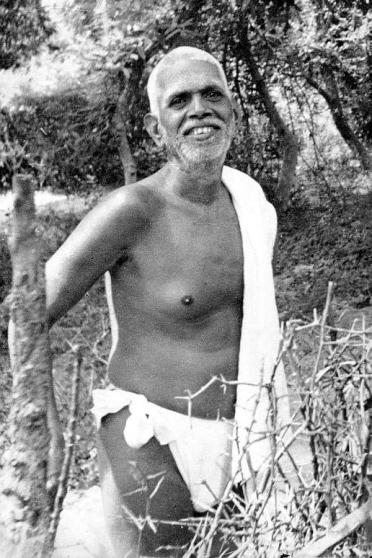
Sri Ramana Maharshi
(1) What is bhakti?
Just as the ankola fruit falling from the tree rejoins it or a piece of iron is drawn to magnet, so also thoughts, after rising up, lose themselves in their original source. This is bhakti. The original source of thoughts is the feet of the Lord, Isvara. Love of His Feet forms bhakti. (Verse 61)
(2) Fruit of bhakti:
The thick cloud of bhakti, formed in the transcendental sky of the Lord’s Feet, pours down a rain of Bliss (ananda) and fills the lake of mind to overflowing. Only then the jiva, always transmigrating to no useful end, has his real purpose fulfilled. (Verse 76)
(3) Where to place bhakti?
Devotion to gods, who have themselves their origin and end, can result in fruits similarly with origin and end. In order to be in Bliss everlasting our devotion must be directed to its source, namely the Feet of the ever blissful Lord. (Verse 83)
(4) Bhakti is a matter only for experience and not for words:
How can Logic or other polemics be of real use? Can the ghatapatas (favourite examples of the logicians, meaning the pot and the cloth) save you in a crisis? Why then waste yourself thinking of them and on discussion? Stop exercising the vocal organs and giving them pain. Think of the Feet of the Lord and drink the nectar! (Verse 6)
(5) Immortality is the fruit of Devotion:
At the sight of him who in his heart has fixed the Lord’s Feet, Death is reminded of his bygone disastrous encounter with Markandeya and flees away. All other gods worship only Siva, placing their crowned heads at His feet. Such involuntary worship is only natural to Siva. Goddess Liberation, His consort, always remains part of Him. (Verse 65)
(6) If only Devotion be there – the conditions of the jiva cannot affect him.
However different the bodies, the mind alone is lost in the Lord’s Feet. Bliss overflows! (Verse 10)
(7) Devotion always unimpaired:
Wherever or however it be, only let the mind lose itself in the Supreme. It is Yoga! It is Bliss! Or the Yogi or the Bliss incarnate! (Verse 12)
(8) Karma Yoga also is Bhakti:
To worship God with flowers and other external objects is troublesome. Only lay the single flower, the heart, at the feet of Siva and remain at Peace. Not to know this simple thing and to wander about! How foolish! What misery! (Verse 9)
(9) This Karma Yoga puts an end to one’s samsara:
Whatever the order of life (asrama) of the devotee, only once thought of, Siva relieves the devotee of his load of samsara and takes it on Himself. (Verse 11)
(10) Devotion is Jnana:
The mind losing itself in Siva’s Feet is Devotion. Ignorance lost! Knowledge! Liberation! (Verse 91)
A learned Telugu visitor, who had composed a song in praise of Sri Bhagavan, read it out, placed it at His feet and saluted. After a time he asked for upadesa.
[Tom: Upadesa means spiritual teaching or instruction. The text Ramana refers to below, Upadesa Saram, means ‘The Essential Teaching’, and was written by Sri Ramana Maharshi himself. You can find the full text on the link below, together with a PDF version for download.]
Sri Ramama Maharshi: The upadesa is contained in Upadesa Saram.
Questioner: But oral and personal instruction is valuable.
Sri Ramama Maharshi: If there be anything new and hitherto unknown upadesa will be appropriate. Here it happens to be stilling the mind and remaining free from thoughts.
Questioner: It looks impossible.
Sri Ramama Maharshi: But it is precisely the pristine and eternal state of all.
Questioner: It is not perceived in our everyday active life.
Sri Ramama Maharshi: Everyday life is not divorced from the Eternal State. So long as the daily life is imagined to be different from the spiritual life these difficulties arise. If the spiritual life is rightly understood, the active life will be found to be not different from it.
Can the mind be got at by the mind on looking for it as an object? The source of the mental functions must be sought and gained. That is the Reality.
One does not know the Self owing to the interference of thoughts. The Self is realised when thoughts subside.
Questioner: “Only one in a million pursues sadhanas to completion.” (Bhagavad Gita, VII, 3).
Sri Ramama Maharshi: “Whenever the turbulent mind wavers, then and there pull it and bring it under control.” (Bhagavad Gita, VI, 26.) “Seeing the mind with the mind” (manasa mana alokya), so proclaim the Upanishads.
Questioner: Is the mind an upadhi (limiting adjunct)?
Sri Ramama Maharshi: Yes.
Questioner: Is the seen (drisya) world real (satya)?
Sri Ramama Maharshi: It is true in the same degree as the seer (drashta), subject, object and perception form the triad (triputi). There is a reality beyond these three. These appear and disappear, whereas the truth is eternal.
[Tom: Triputi here refers to the triad of subject/ object/ verb, or perceiver/ perceived/ perceiving or knower/ known/ knowing]
Questioner: These triputi sambhava are only temporal.
Sri Ramama Maharshi: Yes, if one recognises the Self even in temporal matters these will be found to be non-existent, rather inseparate from the Self; and they will be going on at the same time.
I’ve created a playlist containing a series of videos on above topic, take a look! Click the playlist icon on the top-left to see all the videos. Please don’t forget to like and subscribe to support these videos, Namaste!
Tony Parsons has a relatively unique expression of non-duality. His uncompromising message (which I’m sure he would point out is not his), has influenced many and now there are numerous other people who speak in a way very similar to him – apparently (the word ‘apparently’ is one of Tony’s hallmarks).
However his expression has changed significantly over the years, and for me this is quite interesting, and I hope my comments will be of benefit to the seeker who is trying to plough through all the teachers and teachings now on offer. He has now revised his oldest writings, so the extent of the change may not be apparent to those reading his older works now, but I found both an older and newer version of his first book, The Open Secret, and present some of the differences below. For those of you more familiar with Tony’s current expression, you may be surprised to read the following, which I presume he no longer agrees with:
‘If, however inadequately, enlightenment could be described in terms of qualities, I see them as unconditional love, compassion, stillness, and joy without cause.’
Tony Parsons, from an earlier edition of The Open Secret (this text has now removed from newer editions)
There are many more quotes like this later on in the post. Please note that my intention here is not to criticise or condemn, but to discuss how Tony’s expression has changed and offer my view on this, whilst also acknowledging that this is speculation on my part. My hope is that this may be interesting to seekers who are trying to find their way through all the various teachings and communications on offer.
Radical Non-Duality/ Neo-Advaita
Tony shares what his proponents refer to as Radical Non-Duality: in short, there is no acceptance of the reality of a separate individual seeker, a teaching, a path or an enlightened person, all of which are dualistic concepts that keep the apparent ‘me’ ensnared – apparently. There is no need to cultivate anything such as awareness or presence, there is no need to discover who you really are or be kinder, more compassionate, more loving, etc, etc, these all being dualistic illusions in the egoic game of becoming. In Tony’s own words from his website:
‘This is a communication which illuminates the paradoxical nature of non-duality and exposes the deluded idea that it is something that can be acquired and experienced….Life is not a task. There is absolutely nothing to attain except the realisation that there is absolutely nothing to attain.’
This same communication is also referred to as Neo-Advaita, a derogatory term used by his detractors. Tony says he is not a teacher, for that implies duality and separation – the teacher and the taught – and there is no duality or separation. For the same reason there is no teaching – but Tony suggests this could be spoken of as a ‘communication’ for want of a better word.
The evolution of Tony Parsons’ mode of expression
I understand from people that have met him and know him that he is open about the fact that his expression and language has changed over the years. I understand he now openly admits that when he first started to share this non-dual communication there was actually a bit of ‘me’ (ego/separation) left, and that has now since completely dissolved away, apparently.
A couple of years ago I bought Tony’s first book, The Open Secret, after having some conversations with some people who had met him. On the front cover I noted that it was first published in 1995, but that it had been revised multiple times in 1998, 1999, 2000, 2005 and 2011. At the time I thought it would be interesting to see how the teaching expression had changed over the years, but at that time I couldn’t really be bothered and this was just an interesting thought that did not spur on any action.
For some reason today, I find myself writing this post. I found an earlier version of The Open Secret and compared it to my newer version and noticed that many of the older teachings have now been removed, and also in both versions there are many aspects of the teachings that are somewhat different from how he expresses himself now.
I have also looked at another book of Tony’s called ‘All There Is’ published in 2003. So, as The Open Secret was first published in 1995, the quotes below span at least the first 8 years of ‘him communicating’ this message, if not more.
Summary of my analysis
I have decided to place my summary at the start but I recommend you read the quotes below and come to your own conclusions. Is what I am surmising correct? There are also many quotes of Tony’s that I have not included as this post is already quite long, but if you are not familiar with him, just by listening to 10-20 minutes of one of his YouTube videos you will get a flavour of what he is stating.
For me, when I read how Tony’s expression has changed over the years, it seems to fit in very nicely – almost too nicely – with the classical progression of teachings in Advaita (non-dual) Vedanta. In fact, the gradual change in Tony’s expression that occurs over many years can be even found within single texts, such as Shankara’s Vivekachudamani. This is some ways is quite shocking, but in other ways is a testament to a teaching tradition which has centuries of experience underlying its teachings.
In Vedanta the teachings start off coarse and dualistic and then become increasingly more subtle and less dualistic, the idea being this will gradually but surely and effectively lead one to liberation with the least amount of suffering along the way. (This can sometimes be in direct contrast to the neo-advaita teachings which can often trigger anxiety and confusion and even worse – I have met many people like this who have come to my meetings over the years who are often very confused and anxious as their sense of self is falling away, like the rug being pulled out from under their feet. Of course, there are many advantages of the more radical expression too – see the next section in the post for links where I write about these.)
We see a similar progression with Tony’s mode of expression, with his earlier teachings being much more dualistic and a gradual progression to being less dualistic over many years. This is so strongly the case that we can see how it mirrors teachings found in single Advaita Vedanta texts. It is as if he is updating his teaching expression as his own ‘understanding’ progresses, and it is interesting how closely this mirrors the traditional progression of the teachings. I present some evidence below. Here is the basic step-wise progression that I infer from Tony’s writings.
(Of course, this is just my own theory, my speculation. I understand that Tony maintains that none of the spiritual-type activities he underwent himself had anything to do with an apparent liberation).
Step (1) Traditional spirituality, emotional healing and good works based on the notion ‘I am the body-mind’:
At the start of the Vedanta teachings, the teaching is highly dualistic – there is talk about the need for more traditional forms of Religion/Spirituality such as devotion and surrender to God and performing good works in society to purify coarser emotional and behavioural disturbances and this allows the mind to become open and receptive to higher less dualistic teachings, and also means when the rug of egotism is pull out from under you, there is much less anxiety and confusion. Tony writes in The Open secret about how he himself went through all of this, although he later says that this had nothing to do with liberation which happened later (apparently – as liberation itself is not real – we will see that the Vedanta teachings also state this, eg. at the end of Shankara’s Vivekachudamani).
Tony’s earlier writings also occasionally describe the use of ‘letting go’, something that was removed from later edits.
This stage is characterised by identification with the body-mind and practice done for the apparent body-mind.
Step (2): You are the Absolute
Now we come to what Vedanta calls Jnana Yoga or the teachings on Self-Knowledge. They state that your true nature is not that of the body-mind, but that you are sat-chit-ananda (see my section below on this) which is unchanging, eternal, ever-present, the nature of awareness and bliss. The emphasis now is on your identity – this is not something you need to acquire or attain – it is ever-attained and is already your true nature – you just have to realise this.
We can see this teaching very clearly in Tony’s earlier writings. This sat-chit-ananda is not an object – it is no-particular-thing – or ‘no thing’ as Tony refers to it – and it is also one with everything and the source of everything – again all ideas that Tony used to ‘teach’. Tony also emphasises that this awareness is who we really are, that it is the only constant and that it never changes. He goes on to say this awareness is the source of all manifestation.
It should be noted that this is still a dualistic teaching, although this duality is more subtle than in the previous step. Even though relative and absolute are One, they are also expressed as being two, with the emphasis on the absolute in this part of the teaching. Also there is still a ‘me’ entity, albeit one that is now primarily identified with the absolute.
This step is characterised by identification with the absolute as opposed to the body-mind-world.
Step (3): The relative is the absolute
In this step there is no duality whatsoever – you could say there is no relative or absolute. Again we see this progression in both Tony’s verbal expression and also in texts such as Vivekachudamani and other ‘more advanced’ Advaita texts such as the Ribhu Gita and Ashtavakra Gita. Now there is no emphasis on the absolute as there was in Step 2, the relative is the absolute, beyond ideas of oneness or two-ness or any other conceptual formulation.
eg. Vivekachudamani verse 467:
Verse 467: There is only Brahman, the One without a second, which is neither to be shunned nor taken up nor accepted, and which is without any support, there is no duality whatsoever in It.
Verse 469: There is only Brahman, the One without a second, whose real nature is incomprehensible…
Before the emphasis was on knowledge – knowing your true nature – now it is stated that this is beyond all comprehension, from Vivekachudamani:
481. My mind has vanished…I do not know either this or not-this; nor what or how much the boundless Bliss (of Samadhi) is
484 …what is to be shunned and what accepted, what is other (than oneself) and what different?
485. I neither see nor hear nor know anything in this…
Traditionally texts such as the Ashtavakra Gita, Ribhu Gita and Avadhuta Gita are to be read at this point in the teaching, and you will see the same trend in these scriptures, with the latter verses removing concepts that were used in earlier verses. Even strongly helpful Vedantic concepts such as Brahman are also negated in the ‘final analysis’.
This stage is characterised by lack of identification. We can see that step (2) – identification with a (dualistic) concept of the absolute – is there to remove the idenfitication with the body-mind found in step (1). Both are for the ‘me’
This is now Tony’s predominant mode of expression, but he has retrospectively gone back and removed some of the modes of expression from step (1) and (2) from his earliest work, as we shall see.
Step (4): There is no liberation, no teaching, no seeker
Again, we see the same progression in Tony’s expression and in Vivekachudamani. Previously Vivekachudamani spoke of liberation and how to attain it, now it speaks of these as being illusions (Maya), fantasies for the mind:
eg. in the later verses of Vivekachudamani:
Verse 569: Bondage and Liberation, which are conjured up by Maya, do not really exist in the Atman, one’s Reality…
Verse 573: Hence this bondage and Liberation are created by Maya, and are not in the Atman [ie. reality]. How can there be any idea of limitation with regard to the Supreme Truth…?
Verse 574: There is neither death nor birth, neither a bound nor a struggling soul, neither a seeker after Liberation nor a liberated one [ie. no seeker or guru]…
This step (4) goes hand in hand with step (3) and is not really a separate step, but I have just separated it out to make the above point.
The illusion of a spiritual path in Traditional Advaita Vedanta
I just wanted to make a note that whilst traditional Advaita Vedanta states there is a path to liberation, it is also clear that this path is actually an illusion, as per Step (4) above. To put it into neo-advaita style language, we could say there is an apparent path.
One of the most authoritative texts in Advaita Vedanta is the commentary on the Mandukya Upanishad written 1500-1600 years ago by Sri Gaudapada, the Guru of Shankara’s Guru. In this text Gaudapada outlines the path to liberation – you can find a summary of the method he outlines here, but he also makes it clear that this spiritual path is actually an illusion, this fact being seen only upon liberation. Liberation is also an illusion, as liberation is the removal of ignorance and suffering, and when this happens, it is realised that there never was any ignorance or Maya (illusion), and so there is no need for liberation or any such conception.This is what he writes in Chapter 4, verse 90:
IV 90. One should be conversant, at the very outset, with four things. These are as follows: the things to be avoided, the goal to be realised, the disciplines to be cultivated and the tendencies to be rendered ineffective. Of these four, all except the goal to be realised ie. the Supreme Reality, exist only as products of the imagination.
Essentially Gaudapada is saying there appears to be a spiritual path with a seeker and a goal and things to do and things to not do, but actually all there is is Reality. The spiritual path is an illusion.
He makes this clearer in this famous oft quoted verse from Chapter 2 verse 32:
II 32. There is neither dissolution nor creation, none in bondage and none practicing disciplines. There is none seeking Liberation and none liberated. This is the absolute truth.
The pros and cons of radical Non-duality/Neo-Advaita
I will not go into this too much here, but as with all modes of expression, there are both advantages and disadvantages. I have nothing against these types of more radical expression, and yes, they certainly do have advantages, but I offer my view on them in these articles (links below):
What is lacking from Radical Non-duality/neo-advaita and Tony Parson’s ‘teaching’
There are two main aspects of the traditional vedanta style teachings that are lacking from radical non-duality, and these two omissions account for why whilst these types of ‘radical’ teachings can feel so liberating in the moment, but the sense of separation and suffering keep on returning thereafter.
Firstly there is a notable absence of any meditation or stillness type teachings in Tony Parsons’ expression, which of course is one of the hallmarks of ‘neo-advaita’. Traditionally, without this deep stillness happening, either through deliberate practice or through spontaneous occurrence, eg. after insights or ‘awakening’, then the ananda (blissful) aspect of liberation-reality (sat-chit-ananda) and the morality aspect of the teaching (which happens when addiction/attachment to sense objects goes) will not manifest fully, and suffering will continue accordingly.
Therefore I would expect this radical non-duality style of teaching/communication to be more attractive to those with rajasic (ie. active, outgoing, passionate) mindsets. People who have predominantly tamasic (dull, low energy, low self-esteem, depressive) mental energy may also be attracted to the teaching but they will find it to have little benefit. (See here for more on these energies and how an understanding of this can be helpful for liberation).
Similarly, the nirvikapla aspect of the teaching is also absent. This is a huge ommission, as traditionally it is this aspect of the teaching that leads directly to liberation.
Please take the time to watch this video where I go into more detail about this aspect of the teaching, ie. the teaching that both traditionally and actually leads to liberation:
Quotes from Tony Parsons’ Older Works
Love, Compassion, Stillness, Joy and Presence
In the earlier version of The Open Secret, there is an entire chapter called ‘Presence’, which was completely removed from the later versions of the book. Interestingly it is one of the longer chapters of this relatively short book. For that reason I thought it would be interesting to quote extensively from it. As I said, these quote are no longer present in the newer revised version of The Open Secret:
‘If, however inadequately, enlightenment could be described in terms of qualities, I see them as unconditional love, compassion, stillness, and joy without cause.’
This kind of expression is quite interesting and is notably absent from Tony’s current (apparent) expression. In fact he is openly dismissive now of these kinds of sentiments, eg. Tony states in All There Is page 175 he states ‘The idea that an enlightened person walks around in something which is totally blissful is complete bullshit. It comes from either a deep ignorance or a wish to manipulate.’ and on page 21 of the same he states ‘In the old conditioned idea of enlightenment we all wanted to believe, enlightenment happens and there is no character there at all – there’s just total bliss and utter goodness. It is nonsense born out of the ignorance of the mind. Awakening has nothing to do with goodness or bliss…‘
Here are some more quotes (bold type added by myself). We will see how the concept of there being a true self which has to be known, which here is called presence, is still there, in the expression at least, and there is also a subtle teaching of letting go, another subtlely dualistic practice for a separate ‘me’. There is also the notion that presence is the source of the manifestation. This, again, is typical of aspects of more traditional teachings.
‘Whilst I do not know who I am, I am bereft.’
‘Enlightenment, however, has another quality, which is the bridge between the timeless and my illusory sense of separation. That quality is presence. Presence is our constant nature but most of the time we are interrupting it by living in a state of expectation, motivation or interpretation. We are hardly ever at home. In order to rediscover our freedom we need to let go of these projections and allow the possibility of presence.’
Here above we have the notion of an ever-existing presence which we seem to interrupt, so the solution naturally is to let go or stop this interruption. Ramana Maharshi says something quite similar: ‘Peace is our true nature. We spoil it. What is required is we cease to spoil it’. Again, this is something that Tony would later criticise as a subtle form of duality. Here are some more quotes from the same chapter ‘Presence’:
‘To live passionately is to let go of everything for the wonder of timeless presence. When we are courageous enough to allow this we suddenly rediscover that we are the sole source of all and everything.’
‘At first it is enough to allow dedicated awareness to what is. Letting go of the one who is aware can easily follow, but it can never be a task.’
‘I cannot ‘do’ presence, simply because I am presence. So there is no process to learn because I cannot learn or achieve something that I already am.’
‘Presence is totally effortless and is nearer to me than breathing. Presence can only be allowed and recognised. What I tend to do most of the time is sidestep it or interrupt it.’
‘Existence would not be if it were not for presence. I am presence and you are presence. If we were not present, existence would not be.’
‘Presence emanates from the source of all and everything known or unknown. And that is what we are. We are the sole source of our own unique creation.’
‘One moment of presence brings more light to the world than a thousand years of “good works”. In presence all action is uncluttered and unsullied. It is spontaneity born from stillness.’
‘When there is presence there is awareness and this is the light that enters the darkness. The light enters the darkness and dissipates those illusions that appear to interrupt oneness. Awareness does not divide or suppress and thereby give energy to the unreal. It simply sees what is and brings the light which allows that which is illusory to evaporate.’
‘When there is presence there is total intimacy and the senses are heightened to a degree previously unrecognised … I see and touch in innocence, I taste and smell for the first time, and hear a new sound that is vital, fresh and unknown.’
You are That!
Here we have Tony proclaiming ‘You are That!’, one of the great sayings of traditional Advaita Vedanta, and clearly from Step (2) in my proposed schema above. This is from page 90 of ‘All There Is’. You can see that he is quite confident and sure in the way that he expresses himself, abruptly cutting off the questioner mid-sentence:
Tony: Awareness simply is, and you are that. It has nothing to do with great depth or great sacrifice or great intelligence. You are already that.
Questioner: Theoretically, yes, but.. .
Tony: No, you are already that. You know that you are the one that sees, that you are joy without cause.
Tony even stated above that ‘you are the one that sees’, ie. the seer or the Self, and ‘you are joy without a cause’, ie. ananda in Sanskrit.
From ‘All There Is’ page 45:
‘And there is nothing out there that says, ‘You will be enlightened’, because there is no one who will ever be enlightened. You are enlightenment – you are that.’
From ‘All There Is’ page 67:
‘So how can anyone tell you to meditate or sing mantras or be serious or be honest or any of those things? How can anyone tell you that, when already you are that? All that’s going on here is that I’m telling you it’s already like that; you already are oneness; you are already that. That’s the difference. And there are a handful of people in the world who are talking like that’
From page 97:
Q. Could you say we’re the screen on which the film is projected?
Tony: You are the light that allows the film to be. And if you see it all from another point of view, you begin to open up to the possibility of dropping the idea of a journey towards somewhere that you’ll never get to. You’ll never get there – you already are there. And so in a way, the film is sacred. It’s telling you that you are that. I want to get you out of the idea – or rather I don’t, but something wants to get you out of the idea that you’re on a journey. When there is simply presence, all meaning ends. Meaning is always attached to a story – ‘We are going somewhere’.
In the earlier version of The Open Secret we find the following from the Chapter called ‘The Park’. This was subsequently removed from the later editions:
‘It is my birthright. It is my home. It is already that which I am.’
Sat-Chit-Ananda
Here is this excerpt from All There Is, page 87, we can see that Tony is essentially talking about Sat (Tony calls this ‘presence’) Chit (Tony calls this ‘awareness’) Ananda (Tony calls this ‘joy without a cause’), Sat-Chit-Ananda being a traditional way of speaking of liberation and the absolute. This Sat-Chit-Ananda is our true nature (‘what you already are’ according to Tony) and is not a thing or a person or an object (‘no thing…) but is the Source of all manifestation (…out of which everything arises’). It is not something to attain, for it already is, as per the traditional teachings. This is very much a step (2) teaching in my stages above. See if you agree with my analysis:
Q. Tony, when you talk about the presence, is that an illusion too? There isn’t a presence?
Tony: Well, there is only no thing, out of which everything arises. When there is no one and there is only presence, then you can come and tell me that it certainly wasn’t illusory, it isn’t illusory.
The joy without cause is the only thing that isn’t illusory. It’s the only constant.Awareness is the only constant, presence is the only constant. Everything else arises out of that. Without presence, there can be nothing.
Q. What about recognition? The word ‘recognition’ came to my mind you recognise the presence.
Tony: Yes, you remember, there is a recognition of what you already are. That’s it.It’s directly behind you now – it’s just back there, watching you watching me. You are the one that sees that looking at this.
You can see in the above the questioner is asking if the notion of Presence is actually itself an illusion. Tony states that this is not the case, that presence and awareness are the only constants.
Self-Knowledge
One feature of how the teaching expression has changed is that in the earlier days there was a teaching reminiscent of Vedanta-style self-knowledge teachings, things such as ‘knowing who you really are’ or ‘what you really are’. These notions are now often criticised by Tony, and he openly dismisses many traditional Advaita and Buddhist teachings. This is from an earlier version of The Open Secret, from the chapter ‘Context’:
‘Part of that realisation was that enlightenment is absolutely beyond my effort to change the way I live, or even of changing life at all. It has to do with a total shift in the realisation of who it is that lives. For I am already that which I seek.‘
We can see here that Tony is using the language of identity, knowing who you are or being that which is sought. In a later version of The Open Secret the same passage reads:
‘…It has to do with a total shift in the realisation of what it is that lives.’
You can see this is a subtle change, implying that our true nature is not personal but impersonal. Of course later Tony would go on to say that there is no true nature at all, but back in the 1990s and early 2000s he spoke differently. Here is another example from the same Chapter called Context:
‘For the sake of clarity, the terms enlightenment, liberation, fulfilment, freedom, oneness, and so on, are all seen here as being the same as the absolute realisation by anyone of what they really are.‘
Again, the language of self-identity and self-knowledge is being used, ie. the notion of knowing what you really are. In the later version of The Open Secret this passage now reads:
‘For the sake of clarity, the terms enlightenment, liberation, fulfilment, freedom, oneness, and so on, are all seen here as being the same as what I call liberation.‘
We can see that the emphasis on self-knowledge has been removed entirely in the later edit. Here is a quote from the chapter called ‘The Park’, which was later removed from later versions:
‘It is my birthright. It is my home. It is already that which I am.’
From the Chapter called ‘Fear’:
‘Until I recognise who I really am, my life can be largely driven by that which I fear.’
From the Chapter called ‘Relationships’:
‘When I have rediscovered who I am, however, there is no longer any question of relationships. In this open and welcoming presence there is no need for memory or repetition, comparison or expectation. No place for one part meeting another. There is no distance between the two and therefore nothing needs to relate.’
Letting Go
Letting go could be thought of being a Step (1) type teaching according to my schema above, in that it is dualistic and equates the person to be the body-mind rather than presence-awareness (which is step (2)). The last chapter in both the earlier and later versions of The Open Secret is called ‘Seen and Unseen’. Here is an excerpt from the earlier version:
This is a book declaring that enlightenment is a sudden, direct and energetic illumination that is continuously available to anyone who is ready to let go and allow it. It is the open secret which reveals itself in every part of our lives. No effort, path of purification, process or teaching of any kind can take us there. For the open secret is not about our effort to change the way we live. It is about the rediscovery of who it is that lives.
In the later version of The Open Secret the notion of needing ‘to let go and allow’ has been removed and the in last line the word ‘who’ has been changed to ‘what’.
Neti Neti
In the Chapter entitled ‘I Am Not…’, Tony writes the following:
I am not …
. . . my life story, the mind, the body, feelings, experiences of pain or pleasure, struggle, success or failure. I am not loneliness, stillness, frustration or compassion. I am not even what I think is my purpose, the seeking, the finding, or anything which is called a spiritual experience.
When I don’t know what I am I sanctify these experiences, take ownership of them and give them great significance. I believe they mean something which, once understood, will give me answers and provide formulas. But these experiences are only consciousness concealing and revealing itself in order to be recognised. When I know what I am I discover that I am not existence, I am the presence which allows existence to be. Existence either blossoms in that presence or reflects back my sense of separation.
We can see here a typical traditional ‘neti neti’ style in which various phenomena are pointed out as being ‘not me’. Interestingly at the end we can see that Tony has used several concepts, one of presence which seems to allows another concept, existence, to be. I’m not sure exactly what he is referring to but now this kind of expression is no longer used by Tony.
You are Divine
Tony: You are that, you are divine, and so what is there to find?
Q. Fine. I know that. We are all divine.
Tony: But knowing this intellectually is nothing. You believe you are Bill who is trying to find something. Be ready to be adventurous. Be ready to chop off all the heads that you have looking at you over the fence telling you how you should be. Be ready to drop all of it.
You know traditions talk about freedom, but this is the freedom – not something written on paper. Forget Buddha – chop Buddha’s head off.
Q.They say, if you find Buddha on the road, kill him.
Tony: Absolutely. And Buddha – or Buddhism – is apparently on the road telling you that you need to meditate, you need to have right mindfulness, wise action. Chop off its head and rest in the arms of the beloved.
Realisation
In The Open Secret, Tony also speaks of a realisation of some kind at times. This is from the Chapter called ‘No Achievement’, which has not been changed in subsequent edits:
‘There is absolutely nothing to attain except the realisation that there is absolutely nothing to attain.’
This sounds remarkably similar to many Zen Buddhist texts and also to Sri Ramana Maharshi who said ‘Realisation is nothing to be gained afresh; it is already there.’ (Talks with Sri Ramana Maharshi, Talk number 245).
From the same Chapter ‘No Achievement’ in The Open Secret:
‘All that is needed is a leap in perception, a different seeing, already inherent but unrecognised.‘
This last quote, which was completely removed from the later edits, admits there is some kind of recognition, some kind of different seeing – you can see this is Step (2) in my analysis above. This will become clearer in later quotes below. In the next quote we also see that Tony is almost giving credence to conceptual understanding and also uses a concept of Stillness which is implied as being our true nature, rather like the vedanta concept of being-consciousness (sat-chit):
‘No amount of thinking will tell me who I am, but understanding can take me to the river’s edge. Stillness is not brought about by not thinking. Stillness is absolutely beyond the presence or absence of thought. I cannot make myself still, but when that which appears not to be still is seen, then that seeing emanates from stillness.’
Presence-Awareness-Stillness
From Tony’s book ‘All there is’, published in 2003 we can read the following on page 49:
‘What we’re talking about here is something that actually already is the case. What we’re talking about here is something that has never come and never goes away It is presence, it is stillness . . . The words don’t express it, but it’s not a state and it’s not something that is here and then isn’t here. It is actually all there is.‘
Again, Tony is expressing something very similar to traditional Advaita teachings, pointing out the unchanging eternal presence in which all occurs and which is all there is. We see the same kinds of teachings from page 10 of the same book. Tony even uses the phrase ‘I-thought’, which is often used in traditional Advaita:
‘When separation takes place, the ‘I’ thought comes along and, like a cuckoo bird, lands in the nest and sits on present awareness. From then on, ‘me’ thinks that it is the entirety of the universe, and everything that arises is apparently seen from ‘me’.
So when we see a tree, we think ‘me’ is seeing a tree over there, whereas the tree is arising in present awareness. That which you have always thought of as ‘me’ is, in reality, present awareness.It never went away but was only misidentified. This is the one and only constant, and everything else is transient – including the cuckoo bird.’
We can see this is a typical Advaita style teaching, in which the ever-present presence-awareness (sat-chit), our ‘true self’ is being mis-identified as a small separate ‘me’ (jiva). We see the same idea on page 1 of ‘All There Is’:
‘And in some way or other, the mind – the ‘I’ thought, the identity, the idea that ‘I am a person’ – takes over the energy of being and identifies it as Bill or Mary or whatever. It takes over being and gives it a name. Words begin, labels begin, and the whole idea of ‘me’ becomes the main investment of living.’
From page 4 of ‘All There Is’, Tony is subtly stating that our true nature is Being-Stillness which is the source (‘from which that comes’) of the appearance of duality:
‘Awakening has absolutely nothing to do with you. You are just a character in a play. Tony Parsons is simply a set of characteristics – that’s what is sitting here, a set of characteristics and a body/mind. But what you are is the being, the stillness, from which that comes. All that’s actually sitting there is stillness, being, present awareness – call it what you like.’
On Page 6 Tony responds to a question, firstly stating that ‘no one sees’ but then states that this ‘no-one’ is in fact ‘present awareness:
Q. So is it the mind that wakes up to see that you are that? Is it the mind that sees it? Tony: No, it is no one who sees it; it is present awareness that sees it.
On page 16 of All There Is Tony talks about being ‘established in presence’, again, very Advaita style language:
Q. OK, there was a recognition that at that moment there was no one but after that the ‘me’ comes back?
Tony: Not necessarily – there can be an immediate establishment in presence. But for most people it’s a flip-flop in and out at first.
Here is more of an awareness-style teaching in which Tony appears to be describing innate consciousness or awareness. Specifically Tony states it is always present, always seeing whatever is happening, it is what we are, it is all that is, and it is what he means by the word ‘being’, taken from ‘All There Is’ p.93:
All it is is a seeing. It’s a seeing that’s beyond you looking at me. All it is is sensing that which watches you looking at me . . . in this. In this there is that which knows what is happening. All your lifetime there has always been that which knows what is happening, which sees what’s happening. And always that is there. You know that’s there; you know that there is something watching you sitting there watching me. It is what you are – it is what is – it is all that is – it is being.
The Law of Attraction
From the Chapter called ‘My World’, we have notions of attraction and things being perfectly right in terms of a spiritual journey, together with the notion of self-knowledge or knowing who/what I really am. This is all part of Step (1) in my proposed schema above:
‘When I look back at my life as openly as possible, I see how I have attracted to me the people, the events and the patterns that have been perfectly appropriate to the kinds of influences and images that my particular belief systems have been broadcasting.
Many people have become very excited about this concept and have suggested and taught that if we can change our thought patterns and our belief systems, then we can change the way we experience life. It seems this could be so, but they also entirely miss the point. For who we really are is beyond the limitation of experience and belief.
Until I have rediscovered who I am, what kind of existence am I trying to create?’
A new chapter – ‘Nothing being everything’
In the later version of The Open Secret, a new chapter called ‘Nothing Being Everything’ has been inserted which was not present before. It, being a later addition, contains many inherent criticisms and clarifications of the mode of expression found throughout the earlier version of The Open Secret. This is now step (3) in my proposed schema. In it Tony writes:
‘That which the seeker longs for cannot be known as a something and so cannot be described. Putting a word to it turns it into an object and the seeking energy will then inevitably try to find, grasp, attain or become worthy of what it believes is a something that it can possess.’
This indeed is a very useful clarification, and help the reader understand why Tony moved away from using words such as presence and awareness. Throughout the earlier version of The Open Secret, Tony has referred to the importance of knowing who you truly are, that you are really presence and awareness, but here in the newer version he writes that this has no connection to discovering my true nature:
‘However, what is referred to here has no connection to the current popular ideas of ‘being here now or ‘living in the moment’ or ‘everything being consciousness’ or ‘discovering my true nature’ and so on.
Tony’s Spiritual Journey has all the classic hallmarks of a Modern Spiritual Journey
In The Open Secret Tony write about his seeking journey. It appears he passed through all the classic stages of formal religion, meditation, self-help, psychological development, etc, ie. Step (1):
I decided to try to become a Christian. Considering the information I had at the time, it seemed that this approach was appropriate….I felt I was doing my best with what at the time I understood and sanctified, and what I anticipated and expected would give meaning to my spiritual life…
…I involved myself in the deepest and most illuminating meditations, consumed the most recent and significant books, and of course threw myself with much enthusiasm into the latest therapies. They burst out of the ground like new fruits, to be sucked and digested, or tasted and thrown away…this breathing method, that affirmation, this integration, that special and significant energy…all had a fascination for me in those early days.
I spent a year doing an intensive residential course experiencing many key contemporary therapies mixed with eastern meditations.
After a while I settled on those therapies or methods I felt suited me and brought me most benefit.
I experienced considerable movement of previously held inhibitions, and came to recognise belief systems and patterns that had strongly influenced much of my early behaviour.
Jiddu Krishnamurti Influence
As I read through the above material, another thing I noticed, more in the earlier writings of Tony’s, was a similarity of expression in some ways at some times to that of J. Krishnamurti. For anyone who has read J Krishnamurti (JK) extensively, as I have, it is very easy to see when people have been influenced by him. J Krishnamurti had a very unusual and distinct style that many others have copied and adopted, knowingly or unknowingly.
Because J Krishnamurti’s use of words is so distinctive, those familiar with it can often see when others are using similar language. Phrases in a spiritual context such as ‘what is’, ‘becoming’, and ‘choiceless awareness’ are a few key Krishnamurti phrases. I am not sure if Tony read J Krishnamurti or not, but I do know Tony was into Osho for a while, and Osho’s used to attend J Krishnamurti’s talks and the influence of J Krishnamurti can be strongly seen in the way Osho writes, with Osho often using the same phrases as J Krishnamurti.
In The Open Secret Tony narrates a story that was told frequently by J Krishnamurti, and as far as I know J Krishnamurti was the first person to tell this story. Here is Tony’s version. Click here to read J Krishnamurti’s version, as he said it way back in 1911:
I like the story of God and the Devil watching man as he discovered something beautiful in a desert. “Aha” said God to the Devil, “now that man has found truth you will have nothing to do”. “On the contrary” replied the Devil, “I am going to help him organise it”.
Here Tony uses the phrase ‘The first and last step’. This was a very famous phrase that J Krishnamurti used to use. Here is Tony in The Open Secret:
‘There is a subtle feeling of risk and serenity in presence. It is the first and last step. It moves beyond time and self-identity and provides the ground in which the discovery of what I am is made immediately and directly available.’
We have other phrasings which are also similar to JK’s: eg. what Tony writes here from The Open Secret could easily be a JK statement:
‘For life is its own purpose and doesn’t need a reason to be. That is its beauty.’
Even Tony’s use of the phrase ‘what is‘ is a phrase that, as far as I am aware, was coined by J Krishnamurti in the spiritual context. Same with the use of the word ‘becoming’ in a spiritual context. Here is a typical quote from JK demonstrating both of the above, taken from ‘The First and Last Freedom’:
‘But the real is near, you do not have to seek it; and a man who seeks truth will never find it. Truth is in what is – and that is the beauty of it. But the moment you conceive it, the moment you seek it, you begin to struggle; and a man who struggles cannot understand.’
Other Krishnamurti style language used includes the phrase ‘beyond measure’. From Tony’s Website (theopensecret.com) you can find the following:
‘Never found, never lost, never knowable, being is the consummate absence that is beyond measure.’
Here is a passage from J Krishnamurti, again from ‘The First and Last Freedom’:
‘Surely knowledge is always of the known; and with the known we are trying to understand the unknown, something which is beyond measure‘
In some ways there are other similarities between these two (there are many differences too!). One similarity is that earlier on in their ‘teaching careers’ both used much more traditional language in expressing themselves. Both had encountered various traditional teachings and expressed themselves in this traditional language. Later on, they both have developed very distinct styles, which has been imitated widely by others around them.
Concluding remarks
Anyway, this is what I have written so far. There is more I could write, as it seems there have been more changes in his expression in the last 10 years or so that may also be interesting to explore, but I would have to do more digging around for that, and they are pretty much among the same themes we have already mentioned of the teachings becoming progressively less dualistic in their expression.
Please note that none of this is meant to be a criticism of Tony Parsons or anyone else, just some commentary and observations, which I hope are of help to the seeker trying to find their way through all of this. Perhaps you found the above interesting, perhaps not! To read what Tony Parsons currently states please see his website and read his essays there. You will also find many clips of him on YouTube – I recommend you have a listen. And feel free to let me know your thoughts…


 Tom Das