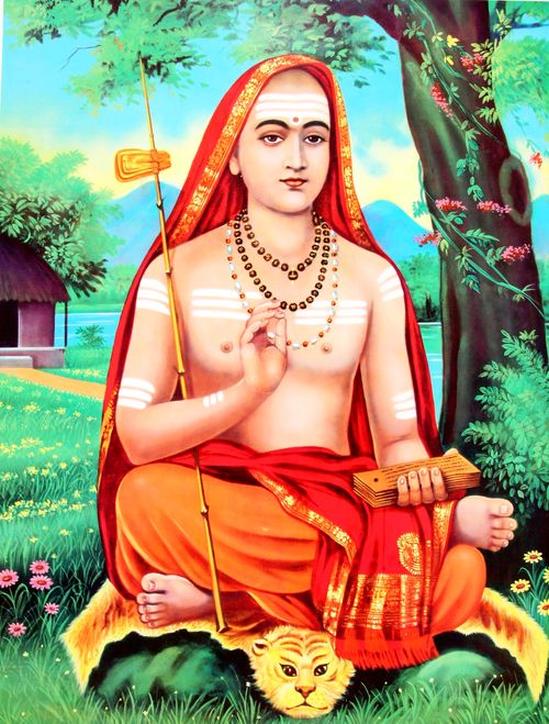
Here in a series of verses taken from Shankara’s masterpice Vivekachudamani, the Self is described and the basic technique of meditation is given. We can see we are to meditate upon ourselves as being Brahman, which is eternal, ever-present, timeless, beyond all names and forms and devoid of names and forms. It is the Source of all. It is unmoving, like the ocean without any waves. It, being formless, cannot be known by the intellect or sense organs. It is unmoving, unchanging, causeless, non-dual, needs no other support and has no parts or components.
Sri Shankara
254. That which is beyond caste and creed, family and lineage; devoid of name and form, merit and demerit; transcending space, time and sense-object – that Brahman art thou, meditate on this in thy mind.
255. That Supreme Brahman which is beyond the range of all speech, but accessible to the eye of pure illumination; which is pure, the Embodiment of Knowledge, the beginningless entity – that Brahman art thou, meditate on this in thy mind.
256. That which is untouched by the sixfold wave; meditated upon by the Yogi’s heart, but not grasped by the sense-organs; which the Buddhi [intellect] cannot know; and which is unimpeachable – that Brahman art thou, meditate on this in thy mind.
257. That which is the substratum of the universe with its various subdivisions, which are all creations of delusion; which Itself has no other support; which is distinct from the gross and subtle; which has no parts, and has verily no exemplar – that Brahman art thou, meditate on this in thy mind.
258. That which is free from birth, growth, development, waste, disease and death; which is indestructible; which is the cause of the projection, maintenance and dissolution of the universe – that Brahman art thou, meditate on this in thy mind.
259. That which is free from differentiation; whose essence is never non-existent; which is unmoved like the ocean without waves; the ever-free; of indivisible Form – that Brahman art thou, meditate on this in thy mind.
260. That which, though One only, is the cause of the many; which refutes all other causes, but is Itself without cause; distinct from Maya and its effect, the universe; and independent – that Brahman art thou, meditate on this in thy mind.
261. That which is free from duality; which is infinite and indestructible; distinct from the universe and Maya, supreme, eternal; which is undying Bliss; taintless – that Brahman art thou, meditate on this in thy mind.
262. That Reality which (though One) appears variously owing to delusion, taking on names and forms, attributes and changes, Itself always unchanged, like gold in its modifications – that Brahman art thou, meditate on this in thy mind.
263. That beyond which there is nothing; which shines even above Maya, which again is superior to its effect, the universe; the inmost Self of all, free from differentiation; the Real Self, the Existence-Knowledge-Bliss Absolute; infinite and immutable – that Brahman art thou, meditate on this in thy mind.
Here Sri Ramana not only outlines how we can discover for ourselves the truth of the world, but also he succinctly outlines the path to liberation:
If, on the contrary, you withdraw your mind completely from the world and turn it within and abide thus, that is, if you keep awake always to the Self, which is the substratum of all experience, you will find the world, of which alone you are now aware, just as unreal as the world in which you lived in your dream.
This is a wonderful book – it is one of my recommended books for liberation – that clearly shows the way to liberation and also nicely points out some of the many ways the ego tries to preserve itself. Its tone may not be for everyone, but it is well worth the time to read and put into practice.
The author has made this text freely available online but I encourage you to buy the latest edition of the book yourself in paperback to support the author of this text.
After reading ‘The Most Direct Means to Eternal Bliss’, the book ‘How to Practice the Teachings‘ should also then be read, as this 2nd book suggests additions and changes that further enhances and clarifies the teachings.
Click on the link below to download the book in PDF format.
The Seven Steps to Awakening is in particular one of the best books ever written on how to attain liberation, and you can download this free using the link above.
To find the Truth, turn inwards, attend to the subject that you are. Only then is it seen that ‘all is Truth’, ‘all is One’, ‘This is it already’, ‘there is no inner or outer’, ‘all is liberation’, and that any division or separation is just an illusion.
However, without turning inward first, it ends up being the ego-mind proclaiming ‘there is no inner/outer’ or ‘all is one’, etc.
How to tell the difference? How to know if you have genuinely seen truth or if the ego-mind is still in control?
SUFFERING
Well if you are still suffering, that means it is a mere proclamation of the ego-mind. Even if there is some kind of genuine insight there, it is the ego-mind’s insight.
If you are still suffering, it means ego-mind-thought is still in control. It means you are still operating predominantly on the superficial level of thought.
If you are still suffering, that means you have not succeeded in venturing inwards, turning within.
THINKING AND RATIONALISING
Perhaps you have rationalised away the ‘turn within’ teachings as being dualistic and ego-perpetuating? If so, logical as that sounds, it is actually the ego-thought-mind that has concluded this, and in doing so it preserves itself and suffering and confusion continues.
EGO-MIND DOES NOT WANT TO END
The ego-mind, thinking itself to be a real entity, does not want to turn within and end itself. It therefore finds numerous ways to not turn within and instead occupy itself with various gross and subtle objects (thoughts, feelings, sensations, imaginings, body, mind and worldly objects).
The ego-mind has come up with teachings such as ‘the ego-mind does not need to end’ or ‘there is no need to practice as all is already one’ or ‘this is already THAT’ and rationalises its position in order to defend itself and prevent its inevitable demise.
HOW THE EGO-MIND PERPETUATES ITSELF
Preoccupation with objects (defined anything that is perceived, or anything that arises in consciousness) perpetuates the ego-mind-ignorance-suffering. This is why these objects are collectively termed Maya – it is for the purposes of the teaching. True Self or Self is also a concept for the purposes of the teaching.
I’ll repeat that: preoccupation with objects perpetuates the ego-mind-ignorance-suffering.
The teaching’s aim is to turn within, to turn away from Maya towards Self. Only then is Maya also seen to be Self/One. Otherwise it is just the clever ego-intellect perpetuating both itself and the resultant suffering is the ego’s hallmark.
TRUE TEACHINGS
Think to yourself – why do all the true and effective traditional teachings state we must turn within? Why do all the great sages state we must turn within? Why did Ramana Maharshi teach self-enquiry? Why did Shankara, that great exponent of non-duality, tell us to attend to the Self? Why did Buddha stress meditation and turning towards the deathless?
Did these great souls not realise that though this teaching appears dualistic (to the ego-mind!!), it actually works? Why else did these teachings continue to thrive for thousands of years?
THE FATE OF MOST SEEKERS
My own experience is that most seekers, while they may find superficial and temporary relief from other paths/teachings or so-called non-teachings, they go round and round and continue to suffer and remain confused (note that alternating confusion and clarity is actually just more confusion) until they turn within, away from Maya-objects-illusion, towards the Subject-Self-Truth-Divine.
THE TRUE TEACHER
The True Teacher is within. All other teachers and teachings are Maya.
The true external teacher/teaching is also Maya, but it’s relative value is that it encourages you, by various methods, to turn within (that is to be uninvolved with various objects) and attend to the Subject-Self.
With respect to liberation, the false external teacher, even if they are honest and genuine, the false external teacher encourages attending to and involvement with objects and so maya-ego-suffering is perpetuated.
BE CARING AND KIND!
It is important to look after the body-mind, be an ethical person and discharge your social duties during this process. ie. be good! be kind! be responsible! look after your body-mind! look after other body-minds! minimise harm and negativity (ahimsa!)
THE PROBLEM WITH OTHER WAYS
There are many ways to this, but they all culminate or end up in this simple practice of inward Self-Attention or Self-Abidance or BEING devoid of objects. Why not take the short-cut and go straight there to the final practice?
All other practices rely on the ‘me’, the separate entity to carry out the practice, and eventually the question must be asked ‘who am i?’ or ‘what is the entity that is carrying out the practice?’. Only self-enquiry doesn’t admit of the separate ‘me’ in the first instance. You are That already! So abide as that and stop attending to objects, and be That Pure Invisible Formless Subjectivity that you already are!
THE ADVISED PRESCRIPTION
So here is one possible way forwards:
(1) pray to Bhagavan Sri Ramana for His Blessings and Grace
(2) let go of body-mind-world; surrender all to God; trust that Bhagavan will take care of everything
(3) do not take yourself to be the body-mind. Know you are pure consciousness/awareness. Take the body-mind-world to be a dream-like illusion.
(4) relax, be still. Allow the mind in its own natural way to become quiet and still. Use hatha yoga, chanting, a mantra or watching the breath, etc, as aids to this if you need them. This makes the mind subtle and fit for enquiry.
(4) happily and lovingly attend to (turn your attention to) the Subject-Self and let go of/turn away from objects
(5) abide as the Self, subjectivity/consciousness devoid of objects: ie. BE what you truly are until ego-mind-suffering is no more.
For a more in-depth understanding of the essential teaching see here: The Path of Sri Ramana
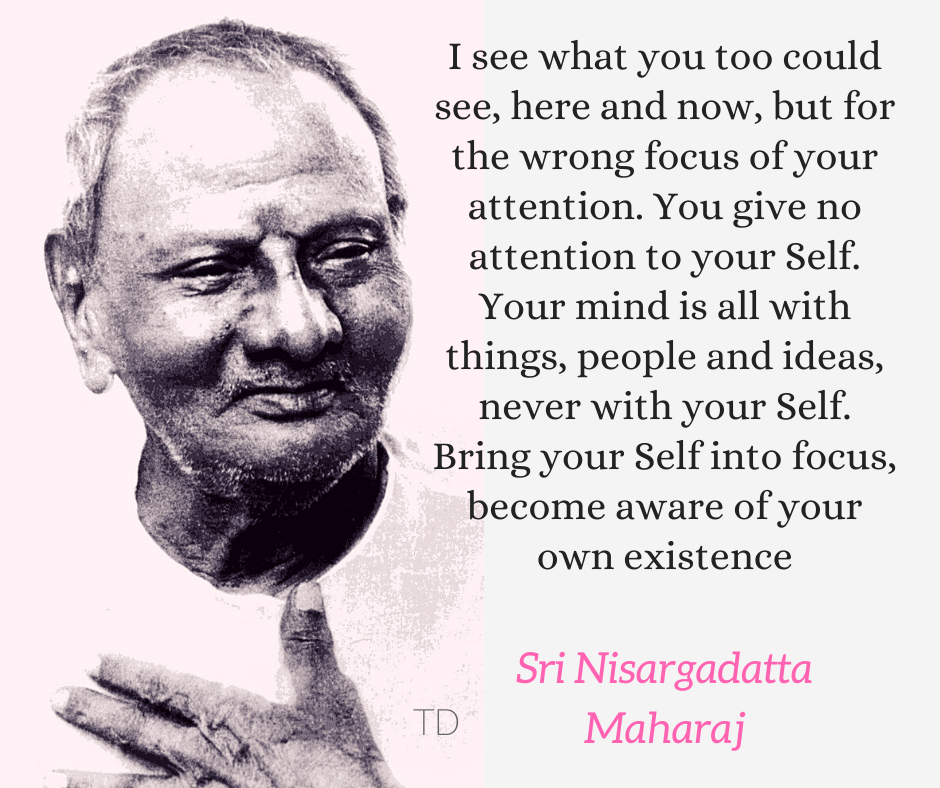
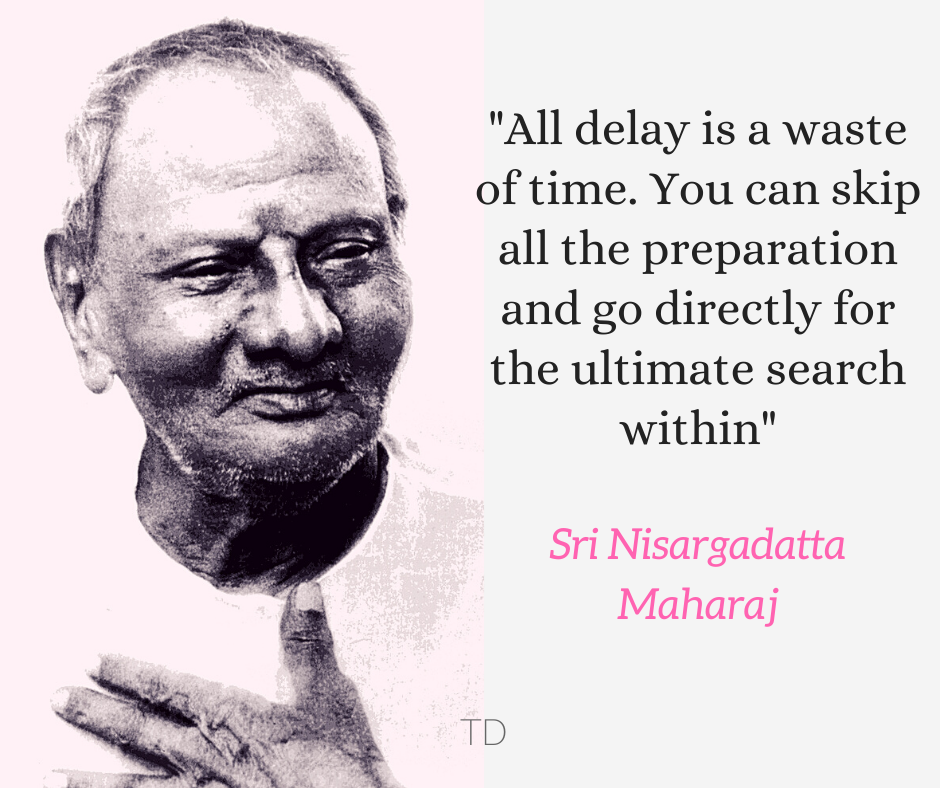
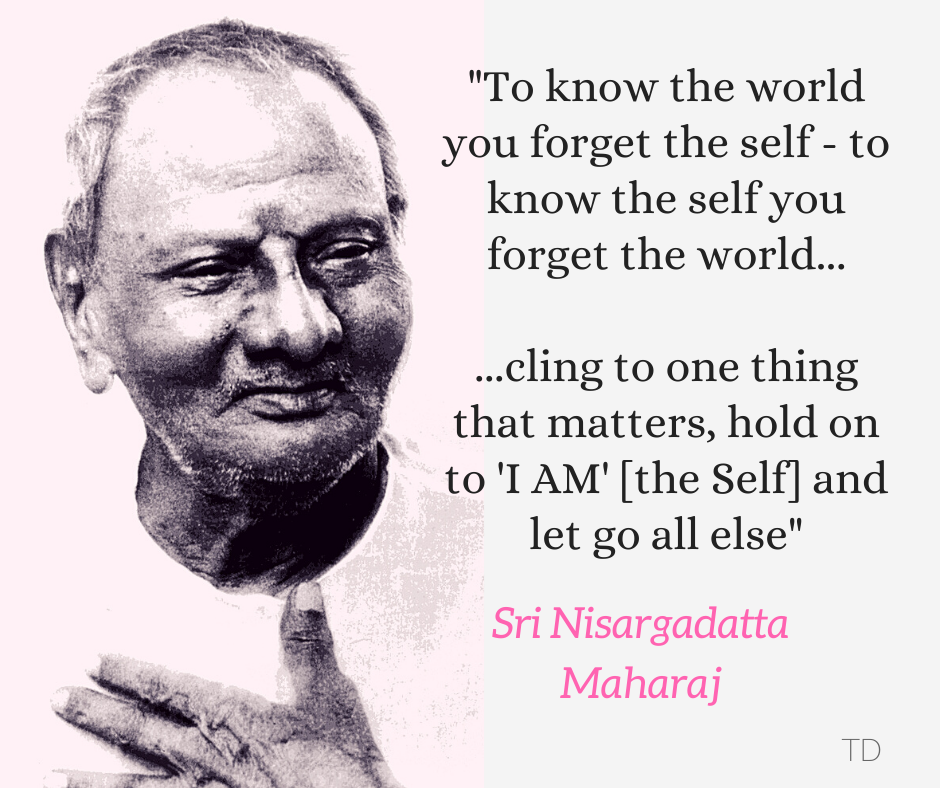
Here are four quotes of Sri Nisargadatta Maharaj that conveys the essence of his teachings. They are all taken from the book I Am That. Read them several times, contemplate what he is trying to convey, and put the teachings into practice.
What in brief is the means to know one’s own real nature? What is the effort that can bring about the sublime inner vision?
Sri Ramana Maharshi:
Strenuously withdrawing all thoughts from sense objects, one should remain fixed in steady, non-objective [ie. subjective] enquiry. This, in brief, is the means of knowing one’s own real nature; this effort alone bring about the sublime inner vision.
Sri Ramana Gita, Chapter 3, verses 4-6
For a more detailed description of the path to liberation see here: The Path of Sri Ramana
Here a seeker asks Sri Ramana Maharshi how to find or ‘see’ God. When Ramana gives his usual answer, the seeker objects with a very common objection, let us see. The following dialogue has been recorded in the book Conscious Immortality, page 125:
Questioner: How is God to be seen?
Ramana Maharshi: Within. If the mind is turned inwards, God manifests as the inner consciousness.
Questioner: But isn’t God in all the objects we see around us?
Ramana Maharshi: God is in everything and in the seer. Where can God be seen? He cannot be found outside. He should be felt within. To see the objects, mind is necessary, and to conceive God in them is only a mental operation. But that is not real. The consciousness within, purged of the mind, is felt as God.
We can see that Ramana states that to find God, or see God, one must turn within, away from objects and abide as the Consciousness within, the pure Subject, devoid of objects. The seeker responds with a philosophical argument that seems to make sense to the mind. The seeker’s reasoning is as follows: but if God is everywhere and everything, why must I turn within to find Him?
The problem is that while this seem philosophically correct and so makes sense (to the ego-mind!), it doesn’t work. Ramana Maharshi’s teaching is a practical guide. It actually works! Ramana does not simply say to us ‘All is God…All is Self…All is One’ or something similar and leave it at that. Ramana states that yes, God is All, but he cannot be found outside, only within.
What we see around us is also God, yes, but it is God as Maya, and is therefore unreal and gives rise only to suffering and confusion. Maya/the world may make us feel we are making progress by giving us superficial temporary realisations and insights together with philosophical platitudes and positive feelings, but this is simply ‘Maya’s way of ensnaring us’ and perpetuating the ego and suffering.
It is only when we turn within and attend to what is Real, namely our own very Self, that we then Abide as the Self and the above is seen for oneself. Only when we turn within, away from objects, do the Vedanta teachings come alive. They are transformed from mere concepts to first-hand Reality, and suffering finally comes to an end. Only then is the body-mind identification destroyed. Only then is the infinite divine nature of the Self truly seen. Only then do we truly experience the Ananda or Blissful aspect of the Self.
We see the same teaching given in Ramana’s text ‘Who Am I?’, and knowing the above teaching, namely that we need to turn within, explains what could be seen as a rather strange answer to a question by Ramana:
Question: Is not everything the work of God?
Ramana Maharshi: Without desire, resolve, or effort, the sun rises; and in its mere presence, the sun-stone emits fire, the lotus blooms, water evaporates; people perform their various functions and then rest. Just as in the presence of the magnet the needle moves, it is by virtue of the mere presence of God that the souls governed by the three (cosmic) functions or the fivefold divine activity perform their actions and then rest, in accordance with their respective karmas. God has no resolve; no karma attaches itself to Him. That is like worldly actions not affecting the sun, or like the merits and demerits of the other four elements not affecting all pervading space.
Again, we can see here that Ramana does not simply write ‘yes, all is God, God does all, all is One’, or something similar, but puts forward a different conception of the Self which will orientate our practice as above. He is stating God or the Self is Still, Whole, Unmoving, Unaffected, Self-Shining and Actionless (ie. God or Self does nothing). It is Pure Consciousness, the Subject, the Source of all, and we are to attend to That only. This is how we are to conceive of or think of the Self in order to orientate our practice. This is all beautifully explained in The Path of Sri Ramana.
So, how can we know this is the only way? Try other teachings if you want! You will eventually see they don’t work – despite all the concepts, practices and words your suffering will continue! All other teachings are based upon objects, Maya (ie. they are based upon thoughts, feelings, sensations, body, mind, world, etc): they are therefore based upon that which is transient and temporary and so do not serve to be a good foundation for firm Happiness.
Until you turn within, suffering will continue! Whenever you attend to (ie. attach to) objects, you tacitly strengthen the ego-notion, so turn within, abide as the Self! It is what you truly are, it is the only constant!
Q. Why turn within at all? Nonduality as I have experienced it is the actual disappearance of what is considered within and without. One seamless blending.
Tom: It’s fairly easy for many to realise there is no real within or without, ie. that what we consider inner, such as the mind and thoughts, are non-separate from the supposed outer world. It is all one movement. But it is usually the mind that realises this, in combination with some kind of a genuine seeing.
However these teachings I share here are to end suffering. Most people interested in non-duality do realise on some level the false dividing line between self and other (ie. inner and outer), but suffering still continues due to the habitual egoic tendencies (vasanas).
Basically, the false identity as the ego-mind entity remains intact at a deeper level, and the essential notion of individuality still survives and is believed in despite the ego-mind saying ‘all is one’ or ‘this is it’ or ‘there is already no ego’ or ‘there is already no duality’.
Without turning inward first, it ends up being the ego-mind proclaiming ‘there is no inner/outer’ or ‘all is one’, etc.
After turning inwards, it is then eventually seen that there is no inner/outer, but it is not the ego that sees this and co-opts this, but it is merely the absence of the ego which is itself the illusion of separation.
It is for this reason practice is almost always required – to end duality at its root and not just on a superficial level. Otherwise the ego-mind, and suffering, both continue.
For a more in-depth understanding of the path to liberation/moksha, please see here: The Path of Sri Ramana
Q. Don’t these traditional Vedanta teachings create an artificial duality where there actually is none? Why turn away from the world towards an apparent ‘True Self’? Why create this duality in the first place? All is already one!
Tom: For most, the ego-mind keeps on habitually coming back, causing suffering and perpetuating the illusion of duality until one finally turns to Self-Enquiry and Abides as the Self. You can say ‘all is one’, or ‘this is it already’, or ‘there is no duality’, but usually it is just the ego-mind saying that (ie. it is only on the level of concepts and belief) and so suffering and the illusion of duality continue. The infinite-love-bliss of the Self is not ‘experienced’ or ‘known’.
How to remove the illusion of separation, so it, and the resultant suffering never returns? The only way I know is to abide as the pure consciousness within. This is the teaching of the Vedanta scriptures and of all effective and true spiritual teachings that I have come across.
For most, unless this is done, suffering and peace alternate, which is itself suffering.
The purpose of Satsang/teachers/teachings is only for you to turn within and Be what You already Are. Other than that, no teacher or teaching is required.
‘The seat of Realisation is within and the seeker cannot find it as an object outside him. That seat is bliss and is the core of all beings. Hence it is called the Heart. The only useful purpose of the present birth is to turn within and realise it. There is nothing else to do.’
Sri Ramana Maharshi, Talks with Sri Ramana Maharshi, Talk no. 219
Q. Isn’t it unhealthy and inhumane to turn away from the world and turn within? No disrespect, but denial of the world did not work for me – integration is working. Who said God loved loved us any less for embracing neurosis? God loves us maybe even more.
Tom: I know what you mean, especially with such strong language like ‘vile ways’*. It can seem inhumane and even unhealthy to deny what we consider to be an aspect of ourself. The purpose of this teaching is liberation from suffering, and this turning within is the only way I know of to attain that aim. It is also the traditional way that has been taught in various cultures for millennia – in my view, the reason this simple but radical teaching has stuck around for so long is because it works, and it is the only one that works (it goes by different names in different traditions).
The strong language is only to encourage you to turn within. There are many other aspects of life, and integration as you put it can be wonderfully healing and positive, and that is good of course, but my experience is that positive and healing as it is, it is not ultimately liberating – that is, it improves the prison but does not free one from suffering in its totality. For that Self-Enquiry or Abiding as the Self is required, and that means to turn within to find the divine within. We do not need to suppress neurosis – that is unhealthy – but just allow it and all things to be, but turn our attention away from them and all other objects towards our self – then we discover the Kingdom of Heaven within – only then can we truly say that all is one, and it not be a belief or concept in the ego-mind. Only then does suffering end.
*A version of this question was originally asked after I posted the following verses on Facebook; they are teachings of Sri Ramana Maharshi taken from the wonderful text Guru Vachaka Kovai:
75. Only mad folk perplexed because
They deem the false world to be real
Find joy in this illusion.
The truly wise find joy in nothing
But Awareness which is Being.
76. Those well established in the Self,
True Being, will never pursue the world’s
Vile ways. For such descent into
The false allurements of the world
Is yielding to the animal weakness
For sense-pleasure.
77. What does one gain, you well may ask,
By giving up the wealth immense
Of worldly pleasure and seeking only
Mere Awareness?
The benefit of true Awareness
Is the unbroken prevalence
Of peace within the heart, the bliss
Of one’s own natural being.