Sri Ramana Maharshi on Kundalini and the Chakras | Self-Realisation

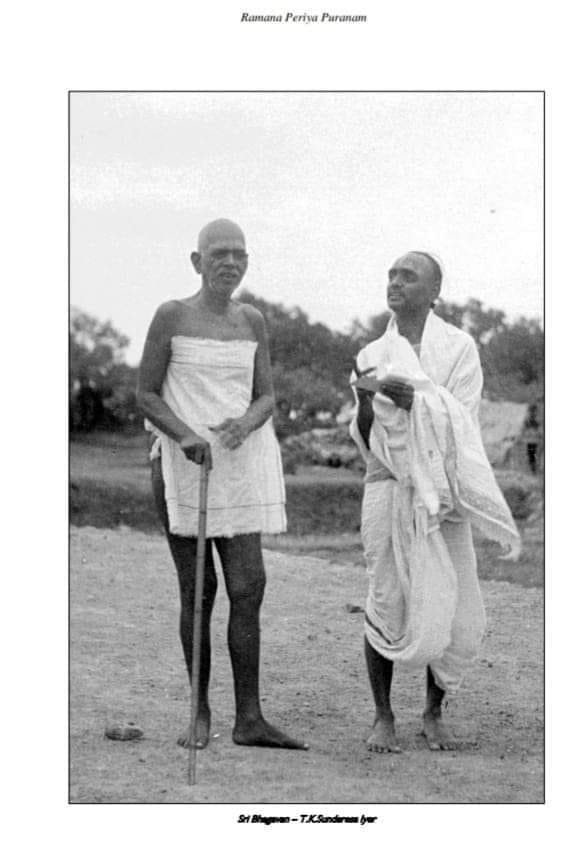
Because of his meagre income as a school teacher, T. K. Sundaresa Iyer (TKS) could afford to take only a small quantity of sugar candy or puffed rice as an offering to Bhagavan.

One day, he did not have even that much. Sad, he went empty handed and fell at the feet of Bhagavan, “Bhagavan, I am so unhappy. I do not have any money, so I could not bring you any offering.”

Bhagavan smiled and said, “Why, you brought the most important thing. Everything else is unimportant.”

TKS was puzzled.

“You brought yourself!” declared Bhagavan.

The case in point here is that you should never exclude yourself from the spiritual journey. It is very easy to extol the guru and his teachings. In the process, you should never exclude yourself – you are equally important.

As the days passed, he was often filled with doubts. Once, he asked Bhagavan, “What is that one thing Bhagavan, knowing which all doubts are resolved?”

Bhagavan replied, “Know the doubter; if the doubter be held, the doubts will not arise. Recognize for certain that all are jnanis, all are realized beings. Only a few are aware of this fact. Therefore, doubts arise. Doubts must be uprooted. This means, that the doubter must be uprooted. When the doubter ceases to exist, no doubts will rise. Here, the doubter means the mind.”

TKS asked, “What is the method, Bhagavan?”

Bhagavan answered sharply, “Enquire „Who am I?‟ This investigation alone will remove and uproot the doubter mind and thus establish one in the Self, the transcendental state.”

On another occasion, TKS had another doubt. He was a pundit, a traditional man, who had read many scriptures. Thus, the six chakras, the psychic centres, kundalini and so on, fascinated him.

He asked Bhagavan about them and Bhagavan replied,

The Self alone is to be realized. Kundalini shakti, visions of God, occult powers and their spell binding displays are all in the Self. Those who speak of these and indulge in these have not realized the Self. Self is in the Heart and is the Heart itself. All other forms of manifestations are in the brain. The brain itself gets its power from the Heart. Remaining in the Heart is realizing the Self. Instead of doing that, to be attracted by brain oriented forms of disciplines and methods is a sheer waste of time. Is it not foolish to hold on to so many efforts and so many disciplines that are said to be necessary for eradicating the non-existent ignorance?”

~ Excerpt from Ramana Periya Puranam (The Inner Journey of 75 Old Devotees) compiled by Sri V. Ganesan.

Multiplicity, plurality and polarity ARE duality | Non-duality | Sri Ramana Maharshi

Seeing multiplicity/plurality and seeing the underlying oneness within the plurality or multiplicity is not the real non-duality at all.

This false notion of non-duality, which is very commonplace, is actually an ego-preservation strategy where the notion of the ‘false-I’ is subtly continued, and suffering still continues in this state – seeking still continues too, as does a subtle sense of individuality.

Non-duality is that in which there is no duality/multiplicity/plurality/individuality whatsoever. Only then will seeking end. Only then will suffering end. Until this is discovered, seeking will continue, and with it the suffering and sense of individuality (ie. duality) will too. To discover the true non-duality one must turn within and discover the Self for oneself, which is indivisible Oneness-Love-Being-Bliss.

At least this is my experience.

This is why Bhagavan Sri Ramana Maharshi states in Guru Vachaka Kovai verse 931:

  1. “The mukta [liberated sage] like the rest of us perceives
    The world in all its vast variety
    And yet he sees non-difference in it”,
    So people say. This is not true.

Sri Sadhu Om comments upon the above verse as follows:
‘People have many wrong conceptions about the state of a Jnani or Jivanmukta, and one such misconception is refuted here. “What people see as water, the Jivanmukta also sees as water, and what they see as food, He also sees as food. Therefore, in His experience of sense-objects, the Jivanmukta is the same as other people. But even while the Jivanmukta thus sees these differences, He sees the non-difference in them” – are there not many pandits and lecturers who talk and write thus, even though they themselves have no experience of Advaita but have only read about it in books? But who is the proper authority to say what is the actual experience of a Jivanmukta? Only a real Jivanmukta! Thus Bhagavan Sri Ramana, who has actually experienced the reality and who is the true Loka Maha Guru, declares in this verse that such statements are wrong, and in the next verse He explains how and why they are wrong.’

In his commentary to the next verse Sri Sadhu Om continues, relating to us his own direct hearing of Sri Ramana’s teaching:
‘…Regarding this erroneous theory of bheda-abheda or unity in diversity, Sri Bhagavan used to say that if the least difference or diversity is perceived, it means that the ego or individuality is there, so if difference is experienced, non-difference or unity would merely be a theoretical proposition and not an actual experience.’

The perfect awakening into Self-knowledge happens in just a split second | Ramana Maharshi

The following is taken from Sadhana Saram, a wonderful text that explains the teachings of Sri Ramana Maharshi written by Sri Sadhu Om, a direct devotee of Sri Ramana’s:

48. The Manner of the Dawn of Knowledge (Janodaya Vidham)

268. Death happens in a split second. Awakening from sleep happens in a split second. Similarly, the destruction of the delusion of individuality happens in just a split second. True knowledge is not something that can be gained and then lost. If a person feels that true knowledge is coming and going, he is still only in the state of practice (or abhyasa). It cannot be said that such a person has attained true Self-knowledge.

The perfect awakening into the state of Self-knowledge happens in just a split second. That state is not attained gradually over a long period of time. All the sadhanas that are practiced over a period of many years are meant only for attaining blemishless maturity.

Listen to an apt illustration. After people have placed gunpowder in the iron barrel of a temple-cannon, after they have added broken pieces of brick, after they have packed it tight with a ramrod, after they have placed a wick in contact with the powder, and after they have plastered the open end of the barrel with clay, as soon as the charge is ignited it will explode in a split second with a blast that sounds like thunder.

Similarly, after one has learnt the truth about the real Self through hearing and reading, after one has practiced sadhana for a long time, after one has wept and prayed with heart-melting devotion, and after one has thereby attained purity of mind, the knowledge of the reality will instantaneously shine forth in a split second as “I am I”. As soon as the dawn of Self-knowledge thus takes place, due to the clear shining of the reality of this state, which is an empty space devoid of objective knowledge, will be spontaneously realized to be the state of true knowledge, which is our beginningless real nature.

Q. Why does Advaita Vedanta more commonly refer to ‘Self’ rather than ‘no-self’?

Q. Why does Advaita Vedanta more commonly refer to ‘Self’ rather than ‘no-self’?

Tom: it is because the Non-Dual Reality that we Truly Are is only discovered when we turn towards the sense of ‘I’ or ‘I AM’, otherwise known as ‘Self’. This is the single factor that leads to realisation.

The language of the teaching is there to facilitate the method of discovery of the Self that we truly are, and this discovery is Total Liberation.

How so?

By stating that we are the Self, we are encouraged to discover this for our self in our own experience, and so turn our attention selfwards, ie. towards the Subject or ‘I AM’. When that Self that we are is discovered, only then do notions of Self or no-self themselves become obsolete (ie. in self-realisation there is no concept of self or true self or even of self-realisation).

For those who are interested this is explained in detail in the book The Path of Sri Ramana – Part 1, especially in Chapter 8

Here are 2 verses from Sri Ramana Maharshi (taken from the text Guru Vachaka Kovai):

393.One who has wisely chosen the straight path
Of self-enquiry can never go astray;
For like the bright, clear Sun, the Self
Reveals itself direct to whoso
Turns towards it.

391. Those who do not dive into the Heart
And there confront the Self in the five sheaths hid
Are only students answering out of books
Clever questions raised by books,
And not true seekers of the Self.

Many more verses like this can be found here.

Also see:

Q. Why turn within? Nonduality as I have experienced it is the actual disappearance of what is considered within and without, one seamless blending

The importance of spiritual practice to attain liberation | Sri Ramana Maharshi | Sri Shankara

The following is from a text written by Shankara called Vivekachudamani, as translated by Sri Ramana Maharshi. We will see the following points being made:

  1. Merely stating ‘I am Brahman’ does not in itself lead to liberation. Similarly we can infer that by mere affirmation of other similar spiritual slogans such as saying ‘I am free’ or ‘I am already the Self’ or ‘there is no ego/self’ or ‘all is already one’, etc, mere affirmation of these does not lead to liberation.
  2. In order to attain liberation, ignorance must be removed and the Self must directly be experienced.
  3. Similarly, merely by hearing the truth ‘I am Brahman’ , liberation is not (usually) attained
  4. One must first hear the truth from someone who has experienced the truth first-hand (for only they will be able to tell you the way to truth)
  5. Then one must meditate upon the truth heard and experience the truth directly though constant meditation.
  6. Unless this practice is carried out, maya (aka ignorance) will not be removed and liberation will not be attained.
  7. Every effort must be made to root out ignorance for liberation to result

‘Just as a person’s sickness is not removed without taking medicine, so too his state of bondage is not removed by scriptural texts such as “I am Brahman” without his own direct experience of the Self. One does not become a king by merely saying, “I am a king”, without destroying one’s enemies and obtaining the reality of power.

Similarly, one does not obtain liberation as Brahman Itself by merely repeating the scriptural text “I am Brahman”, without destroying the duality caused by ignorance and directly experiencing the Self.

‘A treasure trove hidden under the ground is not obtained by merely hearing about it, but only by being told by a friend who knows it, and then digging and removing the slab that hides it and taking it out from below the ground.

Similarly, one must hear about one’s true state from a Guru who knows Brahman, and then meditate upon It and experience It directly through constant meditation.

‘Without this, the true form of one’s own Self, that is hidden by maya [“that which is not”], cannot be realised through mere argumentation. Therefore, those who are wise themselves make every effort to remove the bondage of individual existence and obtain liberation, just as they would to get rid of some disease.’

Also see: Sri Ramana Maharshi: the necessity of Meditation

Buddhism vs Vedanta | Self vs no-self | Nirvana vs Self-Realisation | The Unborn | The Deathless

This is one of a series of introductory articles – please see the homepage of tomdas.com for more introductory articles.

Here in this article we will explore the Buddhist teachings and contrast them to Vedanta or ‘Hindu-style’ teachings. We will look at notions of self and no-self, nirvana and self-realisation, and look at the earliest complete Buddhist teachings ie. as recorded in the Pali Suttas (Sutta is a Pali word meaning ‘thread’ and refers to a ‘string of verses’, ie. a text; Sutra is the equivalent word in Sanskrit)

Also see: Ramana Maharshi: was the Buddha self-realised?

Q. Arahant vs Bodhisattva – which is best? | Buddhism

Self-enquiry and Buddhism/ the Jhanas and Ramana Maharshi

Some people think that the teachings of the Buddha point in some fundamental way to something different to teachings of ‘Hinduism’ (Sanatana Dharma) and Vedanta. Most of these people are either only approaching the teachings in an intellectual way or are attached to a particular conceptual view; or perhaps they have not made a deep study of the teachings, or perhaps they have not developed a deeper insight into the teachings for themselves.

Let us see why this is the case, as if one reads the early recorded teachings of the Buddha for oneself, clarity on this issue arises:

The Unborn, the Unmanifest, the Uncreated, the Unconditioned

A closer reading of the Buddhist texts reveals that the Buddha did actually acknowledge in many places the existence of what in Vedanta would be called ‘The Self’ (Sanskrit: Atman) and what others may even call God. Here is just one example from the Nibbana Sutta verse 3 (Udana 8.3), which is from the Pali Canon:

There is, bhikkhus [monks], that which is unborn, that which is unmanifest [or has not come into being], that which is not fabricated/created, that which is unconditioned.

If there were not, bhikhus, that which is unborn, that which is unmanifest, that which is not fabricated/created, that which is unconditioned, there would not be escape from that which is born, from that which is manifest, from that which is fabricated/created, from that which is conditioned – that therefore would not have been clearly known/experienced/seen.

But because, bhikhus, there is indeed that which is unborn, that which is unmanifest, that which is not fabricated/created, that which is unconditioned, therefore escape from that which is born, from that which is manifest, from that which is fabricated, from that which is conditioned, is [or can be] clearly known/experienced/seen.

We can clearly see that the Buddha is categorically stating that there is something that is beyond birth and creation, beyond manifestation and that which is conditioned (ie. all objects).

He then goes on to sate that only because there is such a thing as this Unborn is it possible for liberation to occur. The Buddha even states that without the existence of ‘that which is unborn’ liberation would not be possible.

Negating vs affirming language

Note that the Buddha characteristically uses negating language – ie. NOT born, NOT manifest, NOT created, etc, rather than the combination of both negating and affirming language often used in the vedic literature.

I hope you will see that this is clearly analogous to descriptions of the Self in Vedic literature which is described as being that which is Unborn, Unmanifest, Unconditioned, etc.

Please note that the above verse and following verses are taken from the Pali canon which represents the earliest complete recorded teachings of the Buddha (rather that the writings of later schools).

Nirvana

Please also note that the word Nibbana is the Pali equivalent of the Sanskrit word Nirvana (sometimes spelt Nirbana), which is a word that is also used in pre-Buddhist Vedic texts such as the Bhagavad Gita as a synonym for liberation. This means that the Buddha chose to use the same word for liberation that the Vedic texts also used.

‘No Self’ means no ego or no Jiva, NOT no Brahman/Unborn principle

So what does the word ‘Nirvana’ mean? It literally means extinguishment or annihilation or ‘blown out’ (like extinguishing or blowing out a flame).

Why is this word used in both ‘Hinduism’ and Buddhism (and Jainism too) as a synonym for liberation? It is because in all these traditions, it is accepted that liberation is simply destruction or extinguishment of the ego-self, which is illusory or unreal. So when ‘no-self’ is proclaimed in Buddhism, it is only the denial of the Jiva (apparently separate self) or ego-illusion.

In Vedanta this is also known as manonasa or destruction (extinguishment) of mind (manas = mind; nasa = destruction or anihiliation). We will see later that the Buddha also conceived of liberation in the same way – ie. destruction of the thinking and desiring mind.

Anatman (Anatta in pali) vs Atman

The Sanskrit word atman means self, and anatman means not-self or no-self. The Pali equivalent of anatman is anatta.

The Buddha points to various phenomenal arisings and points out that in none of these can a self be found and that all of these phenomenal arisings are anatman or ‘not-self’. An example of this is the Buddhist teaching of the five skandas, which is clearly analogous to the Vedic teaching of the five koshas. In both these teachings it is pointed out that these five skandas or five koshas are not-self, meaning no self can be found in them.

It should be clear that he Buddha is not saying there is no Unborn Principle (quite the opposite as we can see from the Nibbana Sutta verse 3 above), but that the phenomenal appearance of a separate self (Jiva in Sanskrit) or ego is illusory and that only by coming into the Unborn we can attain liberation – see the next section for more on this as well as how to do this for oneself.

The Deathless – how to attain Nirvana & Sri Ramana Maharshi’s teachings

Earlier we saw how the Buddha referred to what called the Unborn, the Unmanifest, the Unfabricated. Elsewhere he referred to the same Unborn as ‘the Deathless’. See here for an example of this – in this post I also go more into the actual methodology of liberation as proposed by the Buddha and show how it is essentially the same method taught by Bhagavan Sri Ramana Maharshi.

The Unmanifest or Nirguna Brahman

In Vedanta teachings, two forms of Ultimate Reality or Brahman are spoken of: the manifest or saguna Brahman and the unmanifest or nirguna Brahman (sa = with; nir = without; guna = qualities).

According to Vedanta, in truth there is only one form of Brahman – the unmanifest or Nirguna Brahman, but is spoken of as being two purely for purposes of teaching. This Nirguna Brahman, which has no qualities that can be described in words and has no qualities that can be perceived by the senses, this nirguna Brahman is the only True Reality, and realisation of this Truth is tantamount to liberation.

The manifest or Saguna Brahman refers to the apparent world of phenomenal appearances and according to Vedanta these do not actually exist and are illusory. The Vedanta teachings encourage us to turn away from objective phenomena towards the Subject-Self which is then revealed to be Nirguna Brahman.

Unsurprisingly we see exactly the same teaching in the Buddhist Pali Suttas time and time again.

Extinguishing the Fire of Egotism

For example in the Fire Sermon, which was said to be the third sermon the Buddha gave, the Buddha explains that everything that we can perceive and imagine is just egotism which he likens to a flame or fire. It then makes sense that Nirvana is extinguishment of this flame or fire of egotism. He encourages us to ‘become disgusted’ with the various phenomenal arisings and turn away from them, and it is in this way liberation or nirvana, which is the end of egotism and suffering, occurs.

In Nirvana there is the cessation of all phenomenal appearances

How does the Buddha describe Nibbana? Where better to look than the Nibbana Sutta that was quoted above? Here is verse 1 (Udana 8.1):

There is, bhikkhus, that Base where there is no earth, no water, no fire, no air…neither this world nor another world nor both; neither sun nor moon. Here, bhikkhus, I say there is no coming, no going, no staying, no deceasing, no uprising. Not fixed, not movable, it has no support. Just this is the end of suffering.

We can see from the last phrase ‘just this is the end of suffering’ that the Buddha is describing Nirvana (which he defines as the end of suffering, and which is generally defined as the end of suffering) or what is Vedanta would be called The Self (Atman).

In his description the Buddha is also explaining that in Nirvana ‘there is no earth, no water, no fire, no air…‘, ie. by negating the appearance of the four classical elements he is stating that in nirvana there are no phenomenal arisings whatsoever. He continues this theme by stating ‘there is neither this world, not another world…neither sun nor moon… no coming, no going…

See the PDF file here to see this same process of cessation of all phenomenal arisings being described in Vedanta.

The ‘Unmoving’, that which requires ‘no support’, the ‘Unaffected’

The Buddha then goes on to describe what in Vedanta would be called the Self – the Buddha states it is ‘…not moveable, it has no support‘. In Vedanta it would be said to be immovable or unchanging (that which moves can change, that which doesn’t move does not change) and self-shining, meaning it supports itself. In Vedanta, the word ‘ananda’ which means happiness or bliss means the cessation of suffering. Hopefully it is fairly clear that the teachings are pointing to the same basic thing!

In verse two of the same Nibbana Sutta (Udana 8.2) The Buddha speaks of ‘the Unaffected‘, which is clearly another name for the Vedic notion of Self, by which craving and all phenomenal appearance (Maya in vedanta) is ended. Every phenomenal appearance is within the realm of ‘the affected’, so what is this ‘unaffected’ but the True Self?:

It’s hard to see the Unaffected,
for the Truth isn’t easily seen.
Craving is pierced
in one who knows;
For one who sees,
there is nothing.

In liberation there are no thoughts or desires

As we have already quoted from verse 3 at the top of the post, let us proceed to verse 4. In verse 4 of the Nibbana Sutta the Buddha explains that one who has not found the ‘Unaffected’ (ie. the True Self) remains dependent (on phenomenal objects) and so ‘wavers’. This wavering refers to the movements of the mind, ie. what we would call thoughts and desires. Here is verse 4 (Udana 8.4):

One who is dependent has wavering. One who is independent has no wavering. There being no wavering, there is calm. There being calm, there is no desire. There being no desire, there is no coming or going. There being no coming or going, there is no passing away or arising. There being no passing away or arising, there is neither a here nor a there nor a between-the-two. This, just this, is the end of suffering.

See how Sri Ramana Maharshi explains this here.

Cessation of time and space in Liberation

In the above verse 4 the reference to ‘there being no passing away or arising’ not only indicates no arising phenomena in liberation, but also the cessation of time itself. Similarly the reference to ‘there is neither a here nor a there nor a between-the-two’ refers to the cessation of perception of space.

We can see that the teachings are referring to what in Vedanta is known as ‘non-duality’, or advaita, Oneness beyond the illusions of ego, separation, time and space

See this described here in Vedanta teachings.

The ‘Stainless’, the ‘Sorrowless’, the ‘Blissful’

In verse 5, the final verse of this Nibbana Sutta, the Buddha states the following, continuing the theme of the need to efface all desires, wants and cravings. Note how he refers to ‘stainless’ and ‘sorrowless’ and ‘blissful’ – could be be referring to what in Vedanta would be called the Self? I think so!:

The sorrows, lamentations,
the many kinds of suffering in the world,
exist dependent on something dear.
They don’t exist
when there’s nothing dear.
And thus blissful & sorrowless
are those for whom nothing
in the world is dear anywhere.
So one who aspires
to be stainless & sorrowless
shouldn’t make anything
in the world dear
anywhere.

See how Sri Ramana Maharshi similarly describes the way to liberation here.

Some concluding remarks

I have only touched upon one Sutta here in any detail. If you read the Pali canon for yourself you will find countless references like these, eg. to the Unborn and the Deathless, again and again. You will also see references to the need to turn away from objective phenomena towards that which is unborn. You will also see references to the cessation of all arising phenomena. Again and again these references are made.

Surely the Buddha and Vedanta teachings are pointing to the same thing in their own way?

I hope you found this post of use. I have written it rather hastily in one quick sitting so apologies for any spelling or grammatical or other errors.

Namaste and best wishes!

Q. Why does Vedanta insist on there being a Self? No-self makes more sense to me | the I AM|

Qestioner: Why do you say that non-duality means ‘there is only you’? For me it makes more sense to say ‘there is no you’?

Tom: Yes, many people say it the way you do, but there is a specific reason why it is said in the traditional scriptures that ‘only I exist ‘ or ‘only you exist’ as opposed to ‘there is no I’ or ‘there is no you’.

The ‘I’ or ‘I AM’ is being pointed out as indicating the reality.

Why is this?

It is because only when we turn towards the ‘I Am’ or the Subject can the non-dual reality be intuited. Otherwise, as you say, the knowledge remains only on the conceptual level for the ego-mind. This is more fully explained in Chapter 8 of The Path of Sri Ramana.

I also explain this more here.

Why did we turn away from the Self? Why does ignorance arise? Why is there maya or illusion at all? Why do we suffer if we are really the Self? Advaita Vedanta | Sri Ramana Maharshi

Why did ignorance arise? Why is there maya or illusion at all? Why do we suffer if we are really the Self? What does Advaita Vedanta say about this? What was Sri Ramana Maharshi’s view? What does Tom think about this? The Law of attraction will also be mentioned and we will also hear a story from the Buddha about this…