Some say that all is One already, All is Divine, so no need to give anything up, no need to do anything. Whilst there is a truth in this, and whilst this type of teaching can provide us some limited time-bound relief (which is good as a start), it is almost always an ego-preservation strategy: the thinking mischief-causing mind is allowed to continue with its ideas and concepts and beliefs about ‘this’, and the genuine thought-free Blissful Realisation of That Which Always Is, is postponed yet again. Suffering and duality continue, apparently, and we remain stuck in illusion, apparently.
Why ‘apparently’? Because in Reality there was never any ignorance, any delusion, any duality or any suffering. Only Blissful Being ever really is.
‘This’ never was (referring to objective phenomena/maya).
There is only That (Divine Formless Spirit)… …and That Thou Art.
To realise this is very simple: (1) Surrender all to the Him (or Her or It), (2) allow the mind to become first happy, then very calm and still, and then (3) enquire into yourself as per instructions of Bhagavan Guru Sri Ramana Maharshi
Bhagavan Ramana summarises the teachings using the Biblical phrase ‘Be Still and Know I Am God’
Above is a nice presentation from Swami Sarvapriyananda, but this in my view this is actually a distortion of genuine vedanta teachings. I do want to be respectful towards Swamiji as I think he is doing a great job sharing Vedanta teachings – he is raising awareness of and popularising Vedanta in a very accessible and approachable way – and he is also a gifted teacher who is benefitting many – so I hope I will not offend anyone by merely stating an alternative view that I also hope will be of benefit to those seeking liberation (see the link above for more on my view of these types of teachings).
Imho these ‘Vedanta’ teachings are predominantly on the intellectual plane only and the genuinely infinite and blissful nature of the Self is not revealed with this type of teaching. The Jnana (knowledge) of the scriptures is not mere intellectual knowledge, as suggested by Swami Sarvapriyananda, but a synonym for Self-Realisation which is beyond any intellectual comprehension and does not depend on the mind/thought. Jnana is not merely a change in a point of view, but something much more radical and fundamental than this.
eg. there is a direct contrast between Swami S’s teaching in the video and with that of Sri Ramana Maharshi, who I consider to teach the genuine Vedanta teaching, as taught in the Upanishads and by Sri Shankaracharya. The following is taken from Sri Ramana’s text Who Am I? – can the teachings be any clearer? See how it contrasts to the exposition given, eg at around 23:40 mins into the video above where Swami S states the world/’what is seen’ need not be removed:
Questioner. When will the realization of the Self be gained? Sri Ramana Maharshi: When the world which is what-is-seen has been removed, there will be realization of the Self which is the seer.
Questioner: Will there not be realization of the Self even while the world is there? Sri Ramana Maharshi: There will not be.
Questioner: When will the world which is the object seen be removed? Sri Ramana Maharshi: When the mind, which is the cause of all cognition’s and of all actions, becomes quiescent, the world will disappear.
This teaching is given by Sri Ramana as ignorance is only removed when we turn away from Maya and towards the Subject-Self, and thus discover what we truly are beyond the mind and objective phenomena. Sri Ramana is also telling us that the entire world is in fact an illusory projection of the mind, something that he further explains in the text ‘Who am I?’.
Ironically, this teaching given by Swami Sarvapriyananda is also in direct contrast to Swami Vivekananda (the founder of the organisation Swami S is in) who again and again explained the need for Samadhi, eg:
‘The conclusion of the Vedanta is that when there is absolute [ie. nirvikalpa] samadhi and cessation of all modifications, there is no return from that state’
Or contrast this with Sri Shankara, the founder of ‘modern’ Advaita Vedanta, in his commentary on the Katha Upanishad 2.1.1:
‘…The group of sense organs, beginning with the ear, should be turned away from all sense-objects. Such a one, who is purified thus, sees the indwelling self. For it is not possible for the same person to be engaged in the thought of sense-objects and to have the vision of the Self as well‘
Guru Ramana gives a rather cutting teaching in Guru Vachaka Kovai verse 599:
599. The innocent girl-bride thinking that Betrothal is full conjugal union Is filled with joy. Even so the learned Who have yet to turn within and taste true bliss Claim that the verbal wisdom which they prattle Is advaita jnana.
People speak of knowing the Self, or Self-Realisation, but knowing the Self is just to Be the Self. To Be the Self is just Pure Being devoid of objective phenomena. In this there is no knowing or realising, just Being.
Here are some verses from Sr Ramana Maharshi’s Upadesa Saram (30 verses on the Essence of Spiritual Instruction):
25. Seeing oneself free of all attributes [objects] Is to see the Lord, For He shines ever as the pure Self.
26. To know the Self is but to be the Self, For it is non-dual. In such knowledge One abides as that.
27. That is true knowledge which transcends Both knowledge and ignorance, For in pure knowledge Is no object to be known.
28. Having known one’s nature one abides As being with no beginning and no end In unbroken consciousness and bliss.
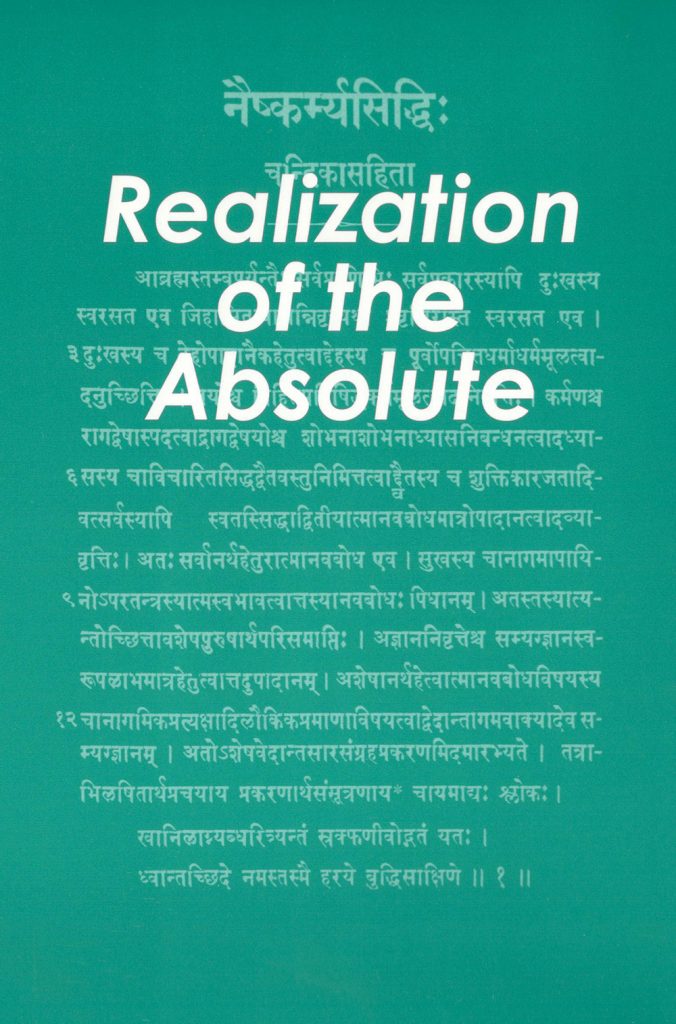
From performance of the daily rituals comes merit (dharma), from merit comes destruction of sin, from this comes purity of mind, from this comes a correct evaluation of transmigratory life, from this comes indifference to it, from this comes desire for liberation, from this comes a search for the means to the latter, from this comes the renunciation of all ritualistic action and its accessories, from this comes practice of yoga, from this the focusing of the mind within, from this a knowledge of the meaning of texts like ‘That thou art’, from this the eradication of nescience [ignorance], from this establishment in the Self alone, according to the texts ‘Verily, being the Absolute (Brahman), he attains the Absolute’* and ‘Released, he is released’**. ~Suresvara (Direct disciple of Adi Shankara) from the text Naishkarmya Siddhi 1.51
I chose this verse as it forms a concise summary of the Advaita Vedanta teaching presented in the text. (There are also many other important points made in the text). We can see the progession to liberation Sri Suresvara outlines is as follows:
Performance of selfless actions (daily rituals) leads to accrual of merit
Merit leads to a pure peaceful (Sattvic) mind
The pure mind is able to accurately reflect and understand that all objects are transient and temporary and so not lasting fulfillment or happiness can be derived from them
This leads to Vairagya or dispassion for sense-pleasures
Vairagya leads to desire for a lasting fulfilment that is not based on the temporary objects, ie. liberation
Desire for liberation leads to a search for a method to attain it
Which leads to renunciation of all action (becoming still) and focusing one’s attention on the Self within
This leads to an understanding of ‘Thou Art That’ as is written in the scriptures, or that our true nature is that of Pure Objectless Consciousness, the Eternal Subject. This is the same as the removal of ignorance
Many people find meditation and mindfulness difficult and sometimes it can even make them feel more anxious? Why is this? Tom explains why this can occur, using the teaching of the three gunas (Tamas, Rajas and Sattva).