Advaita Vedanta
Letting go of the desire to succeed | Effort vs letting go | Self-Surrender
Q. How can I or Atman be beyond the EXPERIENCER as well as the doer? | Nisargadatta Maharaj
Q. Hello Tom , Thank you for your efforts in helping us. I have a doubt: Sri Nisargadatta Maharaj says that YOU ARE BEYOND THE EXPERIENCER – I understand that experiences changes but the experiencer is constant, but what can be beyond the experiencer, and does that mean we avoid experiences of our lives and even spirtiual realisation is a sort of experience, as we feel more peaceful and joyful, please explain this to me.
Tom:
Great question. The ego is both the experiencer AND the doer. These are both Maya (ie. illusion or fiction) or part of the waking dream. What you are, the Self, is beyond this Maya or waking dream.
Sometimes the Self is said to be the Witness, but this is not actually true, for it is the (fictional) ego that witnesses things/objects, it is also the ego that thinks, that emotes, etc. The Self is devoid of all phenomena. This can only really be understood fully by doing Self-Enquiry, eg. as per Sri Ramana’s instructions in the text Who Am I? or as more fully and clearly explained in The Path of Sri Ramana.
eg. See here verse 7 from the Mandukya Upanishad which explains that the Self is not truly the witness/observer of objects and also the Self is devoid of phenomena (note Turiya is another name for the Self (Atman means Self), as is also explained in the verse):
‘Turiya is not that which is conscious of the inner (subjective) world, nor that which is conscious of the outer (objective) world, nor that which is conscious of both, nor that which is a mass of consciousness. It is not simple consciousness nor is It unconsciousness. It is unperceived, unrelated, incomprehensible, uninferable, unthinkable and indescribable. The essence of the Consciousness manifesting as the self in the three states, It is the cessation of all phenomena; It is all peace, all bliss and non—dual. This is what is known as the Fourth (Turiya). This is Atman and this has to be realised.‘
~Mandukya Upanishad, Verse 7
Shankara, in his commentary on this verse also supports this reading of verse 7, where he also states that in Self-realisation, which is also called ‘Turiya’, there are no phenomena present at all; all the 3 states of waking, dream and deep sleep are no longer present in the Self in Truth (and they only appear due to ignorance).
For more see here in this post and also follow the links cited in the post.
Best wishes and Namaste
Both thought and trying to get rid of thought are illusory mirages of separation
Objection:
The assumption that thought is an actual thing and that thought has a source, arises only in the realm of imaginary separation. There is, by definition, no way to determining the imaginary source of an imaginary thing.
Tom:
Whilst it is true that thought is ultimately an illusion, and trying to get rid of thought is also more of the same illusion, there is a logical flaw in this objection, as follows: thoughts may be imaginary, but that does not mean their source is imaginary. Fiction or imagination can have a real source. The teaching is to locate that Source (the Self) and abide there in Pure Being, which is devoid of thought, until the tendency to imagine duality (ie. thought) ceases.
Here are two quotes to illustrate the above points, one from Sri Shankara, and one from Sri Ramana:
‘The binding, and the getting rid of bondage, are both mirages. The belief that bondage of the Real, is, and the belief that it has ceased, are both mere things of thought‘
~Sri Shankara, Vivekachudamani verses 571 and 572
‘All doubts will cease only when the doubter and his source have been found. There is no use removing doubts. If we clear one doubt, another doubt will arise and there will be no end of doubts.‘
~Sri Ramana Maharshi, Day by Day with Bhagavan
Shankara: The Self or Brahman cannot be known!

A definition of Jnana by Shankara
The Brihadaranyaka Upanishad, verse 4.4.20, states the following:
20. It [Brahman] should be realised in one form only, (for) It is unknowable and eternal. The Self is taintless, beyond the (subtle) ether, birthless, infinite and constant.
Here we can see that the Upanishad is stating that Brahman is unknowable. So what of Self-Knowledge or knowledge of Brahman that is so often spoken about? Shankara explains this contradiction in his commentary on this verse:
The knowledge of Brahman too means only the cessation of the identification with extraneous things (such as the body). The relation of identity with It [Brahman] has not to be directly established, for it is already there. Everybody always has that identity with It, but it appears to be related to something else. Therefore the scriptures do not enjoin that identity with Brahman should be established, but that the false identification with things other than That should stop. When the identification with other things is gone, that identity with one’s own Self which is natural, becomes isolated; this is expressed by the statement that the Self is known. In Itself It is unknowable – not comprehended through any means. Hence both statements are consistent.
We can see that Shankara is stating that Brahman is indeed unknowable, and that Jnana, or knowledge, only signifies the cessation of identification with extraneous things, ie. loss of identification with objects, specifically the body-mind. Jnana is not of the mind and is not for the jiva or individual.
We do not need to affirm our identity as Brahman, as we already are and always have been and always will be Brahman. Any affirmation of Brahman would simply be on the level of thought or concepts, and so it would be Maya, or more ignorance. But once the false identification has been removed, then the Self naturally shines as itself, and this lack of wrong-knowledge, or lack of wrongly identifying as the body-mind, is what is called ‘Jnana’ or ‘knowledge’.
In Ulladu Narpadu verse 12, Sri Ramana Maharshi writes:
True Knowledge is being devoid of knowledge as well as ignorance of objects. Knowledge of objects is not true knowledge. Since the Self shines self-luminous, with nothing else for It to know, with nothing else to know It, the Self is Knowledge. Nescience It is not.
In Upadesa Saram verse 27, Sri Ramana Maharshi writes:
That is true knowledge which transcends
Both knowledge and ignorance,
For in pure knowledge
Is no object to be known.
The above is an excerpt from the following post which further explores this topic: What exactly is Jnana (knowledge) according to Shankara and Gaudapada and the scriptures?
Ramana Maharshi: There are not many Jivas/egos/people (Eka Jiva Vada)
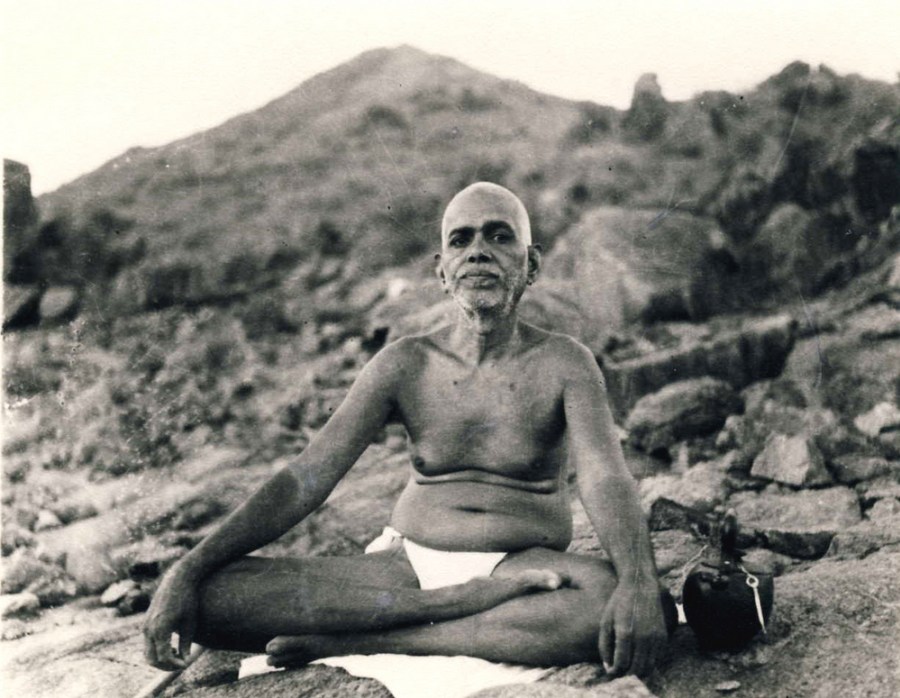
(Here a questioner asks are there not many jivas? Sri Ramana informs the questioner there is only one jiva)
A question was asked why it was wrong to say that there is a multiplicity of jivas. Jivas are certainly many. For a jiva is only the ego and forms the reflected light of the Self. Multiplicity of selves may be wrong but not of jivas.
Sri Ramana Maharshi: Jiva is called so because he sees the world. A dreamer sees many jivas in a dream but all of them are not real. The dreamer alone exists and he sees all. So it is with the individual and the world.
There is the creed of only one Self which is also called the creed of only one jiva*. It says that the jiva is only one who sees the whole world and the jivas therein.
~Talks 571
*Tom: This is called the doctrine of eka jiva vada (the view there is only a single jiva/ego/person). Our own body-mind, and the body-mind of apparent others are all projections of the Self. Like a dream, it appears we are many, but actually this entire dream world is an illusion, and there is only the Dreamer, the Self, the Consciousness from which all is projected. Tat Tvam Asi, You are That.
The above is an excerpt taken from this longer post that further explores this theme:
Ramana Maharshi: The world should be considered like a dream
Mind and Consciousness | Fully awake in Deep Sleep
Q. I have a question. If mind guides us while we are awake and in dream, and in sleep we are not conscious (because mind is switched off), doesn’t that imply mind is what we mistake for ‘consciousness’ or ‘awareness’?
Tom: Yes, that is correct. We consider ourselves to be awake/conscious in both the waking state and the dream (whilst we are dreaming) and asleep/unconscious in deep sleep.
Actually it is just the mind, ie. ignorance/duality, that is awake in ‘waking’ and dream and we are actually fully conscious in deep sleep – it is just the mind that is ‘asleep’.
This is why the in the Bhagavad Gita verse 2:69 it states: ‘What all [ignorant] beings consider as day is the night of ignorance for the wise, and what all [ignorant] creatures see as night is the day for the introspective sage.’
Also see:
Ramana Maharshi on Deep Sleep and Self-Realisation
Ramana Maharshi: the method of wakeful sleep (Jagrat Sushupti) to attain liberation
Is there really an ‘I’ to be found? Tracing back the ‘I’
To the jiva, the individual, a pointer to It is the word ‘I’. It’s like this – if you go into the woods and you take a ball of wool with you, as you walk through the woods, you unwind the wool to leave a trail so you know the way out again so you don’t get lost. The ‘I am’, the ‘I’, is like the ball of wool that you follow to lead you out of the dark forest of ignorance.
This video was recorded live during a Satsang meeting with Tom Das and put together by volunteers.
To attend satsang, see here: https://tomdas.com/events.
Intense fear during meditation, when staying with the I AM
Dealing with deep layers of fear and conditioning
Q: Sometimes when my meditation becomes very deep and I stay with the I Am, there comes a sense of the whole world becoming very dark together with a sense of losing myself into something really bad and dark. My body starts to react strongly as well, and it feels like some kind of primal fear arising.
This video was recorded live during a Satsang meeting with Tom Das and put together by volunteers.
To attend satsang, see here: https://tomdas.com/events.

