Tom: Here in Shankara’s introduction to his commentary on the Mandukya Upanishad and his commentary on Sri Gaudapada’s Karika (ie. Sri Gaudapadas commentary on the same Mandukya Upanishad), Shankara explains some fundamental teachings of vedanta which may (or may not) suprise you!
Throughout, Shankara’s writings are in black whilst my comments are in italicised red.
Shankara gives these same teachings throughout his commentaries, eg. in the Brihadaranyaka Upanishad but also in many other places too. However these teachings are often missed, glossed over or re-interpreted by many current so-called traditional teachers of Vedanta.
The following translation is my own, and I have simplified the language to aid understanding. Below I have also provided the PDF of a more literal translation of this commentary by Shankara on the Mandukya Upanishad from Swami Gambhirananda of Advaita Ashrama (this is the translation that I recommend as it is the most literal of the available translations in English, and so has the smallest amount of distortion and re-interpretation according to the prior beliefs and prejudices of the translator) which you can also read, which states the same as my translation but perhaps using more complex and at times archaic language.
Shankara’s Introduction to his commentary on Mandukya Upanishad
Translated by Tom Das
Invocatory Mantra
Om! O gods, may we hear auspicious words with
the ears; while engaged in sacrifices, may we see
auspicious things with the eyes; while praising the
gods with steady limbs, may we enjoy a life that is
beneficial to the gods.
May Indra of ancient fame be auspicious to us;
may the supremely rich and all-knowing Pisa, god
of the earth, be propitious to us; may Garuda, the
destroyer of evil, be well disposed towards us; may
Brihashpati ensure our welfare.
Om! Shanti! Shanti! Shanti!
(Om! May there be peace! May there be peace! May there be peace!)
Tom: Some say that the Mandukya Upanishad, which is the smallest of the Upanishads consisting only of 12 verses, has no mention of God within it. They clearly have not read the invocatory verses above! Devotion and worship has always been a part of the nondual tradition of Vedanta. Below Shankara will provide 2 more invocatory verses that he has written:
Invocation by Shankara
I bow to that Brahman,
which after having enjoyed the gross objects [in the waking state],
by pervading all the worldly objects through a diffusion of Its rays of unchanging consciousness that embraces all that moves or does not move;
Which after having ‘drunk’ [during the dream state] all the variety of objects, produced by desire and lighted up by the intellect,
And sleeps [in the deep sleep state] while enjoying bliss
and making us enjoy through Maya;
and which is [in liberation] counted as the Fourth from the point of view of Maya,
and is supreme, immortal, and birthless.
Tom: Shankara in his first invocatory verses states that liberation, or Turiya, is called the Fourth state, but that this is only from the point of view of Maya (or ignorance), which admits of the 3 states. In true liberation, the 3 states, which are superimpositions on the Self, do not exist in any way shape or form, so Turiya is actually the Singular Reality and not the Forth state at all. This is explained in more detail later in the text by both Shankara and Gaudapada, and Shankara also explains this in more detail here in the text he wrote called Upadesa Sahasri.
The structure of Shankara’s invocatory verses also mimics the structure of the actual Mandukya Upanishad, which first explains the nature of the 3 states of waking, dream and deep dreamless sleep, before lastly explaining the nature of liberation (see verse 7 of the Mandukya Upanishad here), also known as the Self or Turiya, Turiya literally meaning ‘the fourth’ in Sanskrit. Let us continue with Shankara’s second invocatory verse:
May that Fourth one protect us which,
after having [in the waking state] identified Itself with the universe,
enjoys the gross objects created by the merits (and demerits) of past deeds;
After having [in the dream state] experienced through its own light the subtle objects of enjoyment that are called up by its own intellect;
Which [in deep sleep] withdraws promptly all these into Itself;
and which lastly [in liberation] becomes free from all attributes,
by discarding every distinction and difference [ie. by discarding all phenomenal appearances/objects].
Tom: the implication is that in liberation, there are no appearances of any objects, for these have been cast out, and that the appearance of any objects is tantamount to duality. This is further explained below. Let us read Shankara’s introduction to both the Mandukya Upanishad and to Gaudapada’s Karika:
Introduction to the text by Shankara
The word [or letter] Om is everything [idam sarvam, literally meaning ‘all this’ or ‘all things’]. This will all be explained in the rest of this following text.
The four chapters of Sri Gaudapada’s commentary on the Mandukya Upanishad, that sum up the quintessence of Vedanta, starts with the phrase ‘The word Om is everything…’. Because Gaudapada starts with this phrase, the stated aim and purpose of this text, which we would usually state at the start of any text on Vedanta, should be obvious and need not be stated here. Clearly the aim and purpose of the text is the unfolding of Vedanta.
However, as I am giving a commentary here, I should briefly state the purpose of the text. The text, as it explains the spiritual disciplines that lead to a desired goal, will naturally have an aim and subject matter.
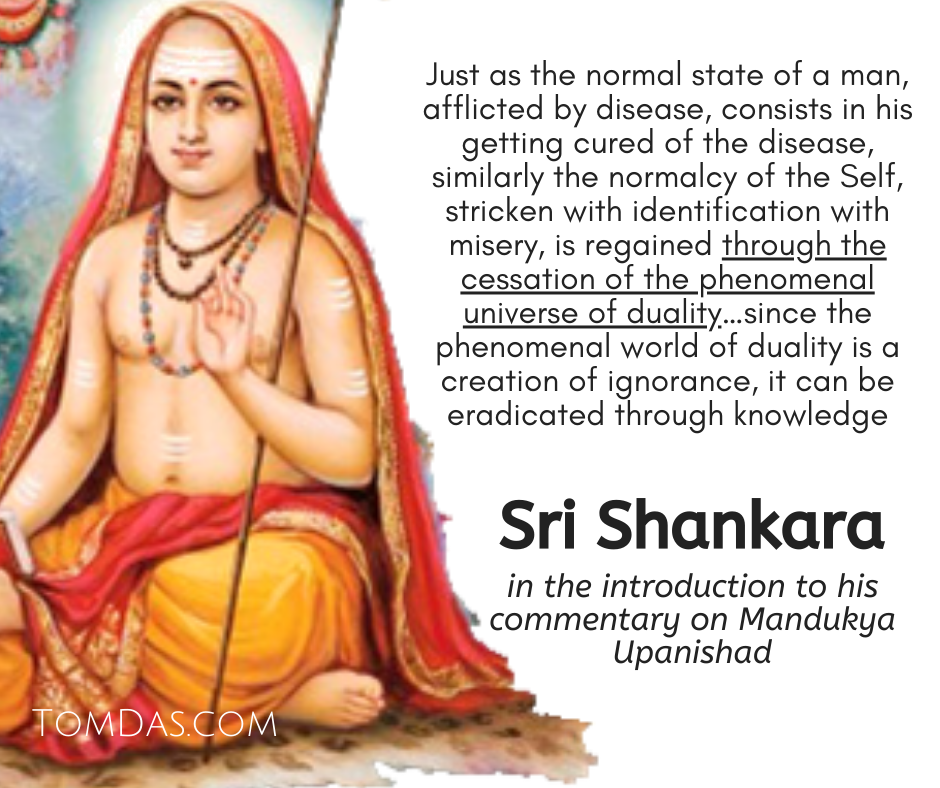
What is the aim of the text? Let me explain: just as a healthy person afflicted by disease will seek a cure for the disease in order to regain the natural state of health, the natural state of being the Self, when afflicted by suffering, will be returned to its ‘natural state of health’ through the cessation of the phenomenal universe of duality.
The aim therefore is the realisation of non-duality. Since the phenomenal world of duality is a creation of ignorance, it can be eradicated through knowledge.
Hence this text aims to reveal the knowledge of Brahman.
Tom: Shankara here is stating that the entire phenomenal world is a creation of ignorance, and that it needs to be eradicated for liberation to occur. This eradication of the phenomenal world can be attained through knowledge of Brahman, which is the same as liberation. The exact nature of knowledge of Brahman is explained later in this commentary here and how to attain this knowledge is explained by Gaudapada here and here.
Compare to Sri Ramana Maharshi when he says in the text Guru Vachaka Kovai in the following verses:
23. The Realised, who do not know anything as being other than Self, which is absolute Consciousness, will not say that the world, which has no existence in the view of the Supreme Brahman, is real.
28. O aspirants who hide yourselves away fearing this world, nothing such as a world exists! Fearing this false world which appears to exist, is like fearing the false snake which appears in a rope.
35. Since this world of dyads [knower-known] and triads [perceiver-perceiving-perceived] appears only in the mind, like the illusory ring of fire formed [in darkness] by whirling the single point of a glowing rope-end, it is false, and it does not exist in the clear sight of Self.
[Tom: The illusory ring of fire is a metaphor that Gaudapada himself uses throughout Chapter 4 of Gaudapada’s Karika].
87. Self appearing as the world is just like a rope seeing itself as a snake; just as the snake is, on scrutiny, found to be ever non-existent, so is the world found to be ever non-existent, even as an appearance.
Also compare also to Sri Ramana Maharshi when he writes in the beginning few paragraphs of his work entitled ‘Who Am I?’:
Q. When will the realization of the Self be gained?
A. When the world which is what-is-seen has been removed, there will be realization of the Self which is the seer.
Q. Will there not be realization of the Self even while the world is there?
A. There will not be.
Shankara will now justify his assertions by quoting from the highest scriptural authority in Vedanta, the Upanishads, let us see:
This fact is established by such Vedic texts as:
‘Because when there is duality, as it were, then one-smells something, one sees something…’ and so on (Brihadaranyaka Upanishad II. iv. 14);
‘When there is something else, as it were, then one can see something, on can know something’ (Brihadaranyaka Upanishad IV. iii. 31);
‘But when to the knower of Brahman everything has become the Self, then what should one see and through what? What should one know and through what?” (Brihadaranyaka Upanishad II. iv. 14).
Tom: we can see that Shankara is providing 3 quotes from the Brihadaranyaka Upanishad to back up this assertion, namely that appearances in the world, or perceiving things (apparently) through the senses, is the same as duality, and that all perceptions of the sense organs and all knowledge in the mind ceases with liberation. Now Shankara will summarise the contents of the 4 chapters of Gaudapa’s Karika (commentary) on the Mandukya Upanishad:
That being so, the first chapter explains the meaning of Om based on the traditional teachings [of Vedanta] and helps us to attain the reality that is the Self.
The second chapter aims to rationally prove the unreality of that phenomenal world of duality, on the cessation of which non-duality is attained, just as the reality of the rope is known on the elimination of the illusion of a snake imagined on it.
Tom: Shankara is again stating that non-duality or liberation is attained upon the cessation of the phenomenal world, which is duality, and Shankara gives the example of the rope and snake to justify his claim. We will only see the rope when the wrong-seeing or illusion of the snake (which causes fear and suffering) goes. Compare with Sri Ramana Maharshi when he writes in ‘Who Am I?’:
‘Just as the knowledge of the rope, which is the base, will not be obtained unless the knowledge of the snake, the superimposition, goes, so the realization of Self, which is the base, will not be obtained unless the perception of the world, which is a superimposition, ceases.’
Shankara continues to summarise the contents of the last 2 chapters of Gaudapa’s Karika, and thus ends Shankara’s introduction to the Mandukya Upanishad. If you wish, you can compare my translation of Shankara’s introduction to this wonderful text to the more scholarly translation below by Swami Gambhirananda:
The third chapter aims to rationally establish the truth of non-duality, and to prevent it too from being negated by a similar process of argument.
The fourth chapter seeks to logically refute all the non-Vedic points of view, which are counterproductive to attaining of the truth of non-duality, and which remain concerned with this unreal duality.
Tom: we can see that in the last sentence of his introduction, Shankara is stating that the false teachings, ie. the teachings that do not lead to liberation, keep on coming back to the unreal duality, ie. false teachings keep on wanting to come back to the world of names and form, also known as maya. There is no Maya in the Self, and in truth there never was. This is the doctrine of ajata vada (no creation or no birth) that is famously explained in Gaudapada’s commentary on this Mandukya Upanishad.
The two main ways that the truly liberating teaching is distorted is firstly by stating that we do not need to turn within in order to realise the self, and secondly by stating that once the self has been realised we must turn back towards the world and integrate our newly-found non-dual understanding/ knowledge/ realisation with the world of phenomenal appearances.
Click here to a PDF of the full text as translated by Swami Gambhirananda of Ramakrishna Mission (Advaita Ashrama)


 Tom Das