242. When we are lacking in earnestness or faith (sraddha), whatever practice (sadhana) we may take to will appear to be equally difficult. But if our earnestness is firm and one-pointed, no sadhana will be felt to be difficult, and without any aid we will be able to remain firmly established in the state of Self-abidance.
243. Where there is a will, there is a way. That is, if a sincere liking to attain something arises in one’s heart, a path whereby one can attain it will also be found, and because of that liking one’s mind will unceasingly seek the goal until it is attained. Only when the liking to attain that goal does not truly arise in one’s heart, will one experience difficulty in the practice (sadhana) or means adopted to attain it. Know that this is the secret underlying all methods of practice.
244. To the extent to which one approaches and lives close to true devotees, to that extent will the liking arise in one’s heart to attain salvation, the real goal of human life. By having more and more association with such true devotees, that liking will gradually increase until finally one will attain salvation by abiding firmly in Self.
The above are verses from the wonderfully clarifying text Sadhanai Saram, written by Sri Sadhu Om, a direct devotee of Bhagavan Sri Ramana Maharshi. You can read the full text here.
I have not written any commentary on the above verses as hopefully the meaning of the verses are self-evident, and any lack of clarity can hopefully be remedied by simply reading the verses more slowly and reflecting upon them.
Many say that (1) the mind (ie. thoughts) cannot be controlled and (2) the mind need not be controlled for liberation to result. Here is what is written in the Bhagavad Gita, chapter 6, verses 35 and 36:
Arjuna: The mind is very restless, turbulent, strong and obstinate, O Krishna. It appears to me that it is more difficult to control than the wind.
Lord Krishna said: O mighty-armed son of Kunti, what you say is correct; the mind is indeed very difficult to restrain. But by practice and detachment, it can be controlled.
Note the teaching here is clear – the mind can be controlled. Just practice is required. To find out more, please read Chapter 6 of the Bhagavad Gita which explains the meaning of ‘controlling the mind’, the method of doing so, and the result (Moksha)
84. Because the true Self is eternally perfect awareness-love-bliss and eternally free of all suffering, some people think there is no need for spiritual practice. Such a notion is an ego preservation strategy. The purpose of practice is not to gain the true Self. The purpose of practice is to remove the illusion of a body, a world, suffering, etc. so that what remains is only the eternal experience of the True Self.
85. In other words, those who have let the ego trick them into thinking there is no need for spiritual practice, because the True Self is eternally free of suffering, etc., are still having the experience of suffering, a body, a world, etc. Thus their experience is not consistent with their concept that the True Self is eternally free of suffering and perfectly blissful. This is an example of intellectual ‘spirituality’. This is an example of people confusing a journey through concepts, ideas, beliefs and opinions with an authentic spiritual journey. Practice leads to the direct experience of Infinite-Eternal-Awareness-Love-Bliss
86. A journey through spiritual concepts, ideas, beliefs, teachings and opinions is a journey through illusions.
87. Practice is what is essential. It must not be a spiritual practice that is creaed by the ego for the purpose of preserving the ego.
88. With the Awareness Watching Awareness Method, the practice is the progress. The habit has been developed of always looking outward towards the seen. The Awareness Watching Awareness Method reverses this. Every time a thought arises, or the tendency to look outward, the attention is taken away from the thought and turned towards the seer.
89. Thus with the Awareness Watching Awareness Method a new habit is developed and the practice is the progress…
The above is an excerpt from the book The Most Direct Means to Eternal Bliss by Michael Langford. You can download a copy of the entire book here.
Question: Why I don’t see Samadhi as a way to know Aham Brahmasmi [I Am Brahman, ie. Self Knowledge or liberation]. First of all let me discuss what is Samadhi and the types of Samadhi which are possible. Samadhi simply means having your mind concentrated. So Samadhi is of the following types. Savikalpa Samadhi and Nirvikalpa Samadhi. Savikalpa Samadhi means that our mind has become one with the object on which we concentrate. Nirvikalpa Samadhi means that all thoughts are rejected. This means that even Sushupti [deep sleep] is not present in Nirvikalpa Samadhi. What remains is the Pure “I” unassociated with anything. Now both Samadhis do not give the knowledge of Aham Brahmasmi, reason is this. Savikalpa Samadhi mind is merged with object. There is no recognition of “I am the universal”. In Nirvikalpa Samadhi there remains Pure “I” but however the only interpretation possible post coming out of the Nirvikalpa Samadhi is that “I am different from body and mind” this is very much possible. But it does not give the knowledge of Aham Brahmasmi I am the whole, the objects are not merged into the subject. But however the Samadhi is useful in Brahma Vidya, so Gaudapada suggests that as long as your mind works you see the world, if your mind does not think you see no world. Hence the world is Mithya. Hence practice of Samadhi makes the conviction of Vedanta stronger. But Samadhi per se will not give us knowledge of Aham Brahmasmi. Then what gives knowledge of Aham Brahmasmi is the methodology of superimposition of the Shastra and then removal by it. This helps is gain the knowledge of Aham Brahmasmi.
Response from Tom: A key scriptural method for the attainment of Moksha is superimposition and removal – but what does it mean? It is a technical way of saying using a thorn to remove a thorn and then throwing both away. The first thorn is ignorance, ie. that which causes duality and suffering – the scriptures tell us that this same ignorance is also known as Maya. The teaching/scripture is also a thorn, ie. a form of ignorance/maya, which is a form of superimposition. The difference is that it is the one part of Maya that if followed leads out of Maya. The scripture tells us to remove all superimposition by attending to the Self. This total removal of superimposition (ie. all objective phenomena), which also means eventually discarding the scripture/teaching itself, eventually leads to ‘Jnana’ or ‘Knowledge’. This total removal of superimpositions (ie. objects) is also called Nirvikalpa Samadhi. It is also called ‘Silence’. eg. from the Amritabindu Upanishad: ‘The mind severed from all connection with sensual objects, and prevented from functioning out, awakes into the light of the heart, and finds the highest condition [Brahman]. The mind should be prevented from functioning, until it dissolves itself in the heart. This is Jnana, this is Dhyana, the rest is all mere concoction of untruth.’ eg. from Gaudapada Karika: ‘When the mind…remains unshakable and does not give rise to appearances, it verily becomes Brahman.’ However the thinking mind cannot comprehend how such a ‘void-like’ state such as Nirvikalpa Samadhi can lead to ‘knowledge’, as all it knows is the subject-object knowledge of the thinking mind (ie. ego). ie. all the mind knows is duality, therefore it cannot understand how something like nirvikalpa samadhi can lead to realisation. The mind therefore creates a new version of the teaching that is non-scriptural and states there is no need for samadhi/total removal of objective phenomena from the mind, even though the scriptures clearly state time and time again this is needed. The mind’s new teaching, which doesn’t work, ie. it does not reveal the Self that we are, perhaps makes more sense to the mind but usually is more complex and has many more concepts than the simpler more direct original teaching that actually works. The scripture/true teaching is like a treasure map. We have to have faith in it and follow it and it will lead us to the treasure. But the mind, if it is not able to see how the map works, creates a new version of the map that makes sense to it (ie. makes sense to the ego-mind), but this version of the map only leads to more Maya, so suffering does not end and liberation is not ‘perceived’. In following the ego-made treasure map, the ego feels more secure, but the treasure of the Self that we already are is not revealed. From Katha Upanishad: ‘When the five organs of perception become still, together with the mind, and the intellect ceases to be active: that is called the Supreme State [Brahman]’ Shankara writes in his commentary on Katha Upanishad: ‘…One whose intellect has been withdrawn from all objects, gross and subtle, when this takes place, this is known as ‘inactivity of the sense organs’. Though this ‘inactivity of the sense organs’ one sees that glory of the Self. ‘Sees’ means he directly realises the Self as ‘I am the Self’ as thereby becomes free from suffering’ And again from Shankara’s commentary on Katha Upanishad: ‘…the perceiver sees the external objects which are not-Self/not the Atman, such as sound, etc., and not the Self within. Though this is the nature of the world, some (rare) discerning man, like turning back/ reversing the current of a river, sees the Self within…The group of sense organs, beginning with the ear, should be turned away from all sense-objects. Such a one, who is purified thus, sees the indwelling self. For it is not possible for the same person to be engaged in the thought of sense-objects and to have the vision of the Self as well.’ From Amritabindhu Upanishad: ‘As mind emptied of the objective leads to liberation, one desirous of liberation must always try to wipe off the objective from the plane of his mind.’ There are so many other quotes like this, but I hope you get the point. What is needed is faith in the scriptures and then to follow them. Only then, once the teaching is put into practice, is it realised how Nirvikalpa Samadhi can directly lead to Jnana or Realisation. Otherwise we are doing the equivalent just standing on the sidelines talking about playing tennis without ever picking up the racket! ‘Strenuously withdrawing all thoughts from sense objects, one should remain fixed in steady, non-objective [ie. subjective] enquiry. This, in brief, is the means of knowing one’s own real nature; this effort alone bring about the sublime inner vision.’ ~Sri Ramana Maharshi ‘…the natural and changeless state of Nirvikalpa samadhi is produced by unswerving vigilant concentration on the Self, ceaseless like the unbroken flow of oil. This readily and spontaneously yields that direct, immediate, unobstructed, and Universal perception of Brahman, which is at once knowledge and experience and which transcends time and space. This perception is Self-realisation.’ ~Sri Ramana Maharshi Wishing you well Namaste 🙏🕉
Tom: In the following quotes Sri Ramana Maharshi gives us a teaching on the correct relationship between Deep Sleep & Self-Realisation or Jnana:
Questioner:Sushupti [deep sleep] is often characterised as the state of ignorance.
Sri Ramana Maharshi:No, it is the pure state. There is full awareness in it [deep sleep] and total ignorance in the waking state. It is said to be ajnana [ignorance] only in relation to the false jnana prevalent in jagrat [the waking state].
Really speaking jagrat [the waking state] is ajnana [ignorance] and sushupti [the sleep state] prajnana [wisdom]. If sushupti is not the real state where does the intense peace come from to the sleeper?
It is everybody’s experience that nothing in jagrat can compare with the bliss and well-being derived from deep sleep, when the mind and the senses are absent. What does it all mean? It means that bliss comes only from inside ourselves and that it is most intense when we are free from thoughts and perceptions, which create the world and the body, that is, when we are in our pure being, which is Brahman, the Self. In other words, the being alone is bliss and the mental superimpositions are ignorance and, therefore, the cause of misery. That is why samadhi is also described as sushupti in jagrat [sleep in the waking state]; the blissful pure being which prevails in deep sleep is experienced in jagrat, when the mind and the senses are fully alert but inactive.
~ Guru Ramana, pp. 112-13
Tom: Here are some verses from Sri Ramana Maharshi taken from Guru Vachaka Kovai that make similar points, namely that deep sleep is not actually ignorance at all but actually the Self. It is only our belief that the waking state is Reality (and that we are the body-mind) that makes us feel that Deep Sleep is a state of total ignorance. It is actually Pure Knowedge:
455.
Having experienced fully the great bliss of the sublime state of sleep where no other object exists, it is sheer ignorance not to value that state and to regard it as one’s salvation, but instead to desire something else, imagining it to be one’s defence against the misery one experiences.
457.
The ignorance of forgetfulness which makes you say that the waking state is a state of illumination makes you [also] declare that sleep is a sheath [kosa] of ignorance. If the belief that the waking state is the illustrious and unique state of truth goes, then sleep will become, andshine as, pure non-duality.
461.
Only in an intellect that has developed a desire for the waking state will the eminent state of deep sleep, which is all bliss, be classified as a state of ignorance: ‘I did not know anything during sleep.’ By failing to enquire into and realise the true experience that exists and shines in the same way forever, one becomes deluded and thinks, ‘I am the one who woke up’. If that powerful sheath of the intellect, the ignorance that is experienced in the waking state, is destroyed by the sword of vichara [that leads to the knowledge] ‘I am not the one who woke up’, then the eminent state of sleep will shine, remaining as pure bliss, its ignorance destroyed.
Tom: We see the same teaching in Talks with Sri Ramana Maharshi. The following is from talk number 314:
Again, sleep is said to be ajnana [ignorance]. That is only in relation to the wrong jnana prevalent in the wakeful state. The waking state is really ajnana [ignorance] and the sleep state is prajnana [full knowledge].
Tom: Here Bhagavan Ramana explains that the waking and dream states are mere projections of the minds habitual tendencies (vasanas), and when these are removed, only Deep Sleep remains, and this Deep Sleep is nothing but the Self (here called Turiya, the ‘forth’ state.):
460.
If the beginningless, impure vasanas that remain as the cause for waking and dream leave and perish, the state of sleep [previously perceived as] void-like and dull, and which led us into a state of ignorance and suffering, will become the transcendent state of turiya.
Tom: What about if we fall asleep during Self-Inquiry, what then? Bhagavan Ramana reassures us as follows:
462.
If the illumination that is awareness of your being exists so firmly that it remains unshaken until sleep overpowers you, then there will be no need to feel jaded and disheartened, lamenting, ‘Oh, the forgetfulness of nescient sleep has come and unsettled me!’
Tom: Note that the word nescience in the above verse is just a synonym for ignorance, the root meanings of the words being the same, ie. not-knowing. Ignorance negates the Greek word ‘gnosis’, which means knowledge, and nescience negates the Latin word ‘scientia’ which also means knowledge.
The above verses allow us to more fully understand the somewhat cryptic but important verse in the Bhagavad Gita Chapter 2, verse 69. It also reveals to us the depth of knowledge present in the Bhagavad Gita:
What all [ignorant] beings consider as night, is the day for the wise,
And what all [ignorant] beings see as day, is the night for the sage.
Tom: We can see that the above verse from the Bhagavad Gita is saying that most people consider deep sleep as being total darkness and ignorance, whilst the Sage considers this to be Knowledge, ie The Self. Conversely, what most people consider to be the ‘waking state’ is actually considered by the Sage to be a state of pure ignorance and delusion.
The waking state is considered by most to be a state in which we know things (other objects) and in which we ‘live our life’ as a human being – this is the meaning of ‘day’ for most people. The sage considers this ‘day time’ or ‘waking state to be pure illusion and delusion, or ‘maya’.
Because most people identify as being the body-mind in the waking state, and because most people consider the waking state to be a worthy state in which we experience ‘real life’ and gain ‘worthy life-experiences’, they therefore consider deep dreamless sleep as being a dull dark state full of ignorance. However the sage, who has lost the ego-identification as body-mind, sees Deep Dreamless Sleep only as the Pure Self in which there is only Perfect Love-Being-Bliss devoid of space, time, creation, body, mind, thoughts and concepts.
This same teaching that Bhagavan Ramana has made so clear to us above is also given in the Brihadaranyaka Upanishad, see here for details
The world progresses by intellect. All that is great in this world is just a manifestation of the intellect. What is the goal towards which the world is moving? What is the world striving for? Careful observation will show that all are striving for happiness. From the smallest ant to the greatest emperor, everyone is tirelessly working. For what? For happiness, and happiness alone! Everyone is anxious that he or she should live in happier circumstances than those at present. It is this anxiety which impels man to work. This craving for happiness is not wrong; it is indeed desirable!
But since men are constantly endeavouring to obtain more happiness, it is evident that happiness in full has not yet been obtained. Man is constantly trying to accumulate such sources of pleasure as food, dress, house, employment, wife and children, because he believes that happiness will be derived from these sources.
But the happiness which man thus obtains is fleeting and impermanent. For a while there seems to be happiness, but then it fades away. It we analyse the various ways by which man obtains happiness, we will come to a general conclusion : the happiness sofar found by him is that which has been experiened through the five sense-organs, namely the eyes, ears, tongue, nose and skin. Thus, down through the ages, human effort has been directed only towards acquiring objects for the satisfaction of these five senses.
When his eyes see pleasurable things, man derives happiness; when those things vanish, he becomes gloomy.
When his ears hear pleasing music or words, man is happy; when those pleasurable sounds are denied him, he sinks into sorrow. Like sight and hearing, the sensations of touch, taste and smell are also experienced by man as either happiness or misery. Although these five senses seem to give happiness, they do not give it uninterruptedly.
By watching too many cinema shows, the eyes become impaired. Further, since the various other pleasing sights come to an end, it is impossible for man to watch them constantly. The same is the case with the happiness experienced through the sense of hearing. How long can a man listen to a concert? Either the concert will come to its natural end, or else the individual will have to leave the place on account of some other work. Thus there is an end to the happiness experienced through the sense of hearing.
Similar is the case with the sense of smell; in fact, the continuous enjoyment of strong and pleasant odours may at length produce a headache or bleeding from the nose.
Moreover, those things from which pleasant odours emanate lose them rapidly. We find the same to be true about the sense of taste. Can one stuff one’s stomach beyond its capacity with even the tastiest dish? Beyond a certain limit the tongue finds even that tastiest dish repulsive. Hence, even taste does not give permament happiness. Let us now consider the sense of touch. When a silky-soft flower touches the body, there is a sensation of pleasure, but the flower withers away rapidly. Moreover after a while we become accustomed to the sensation and it ceases altogether to give us pleasure. The same is also true of a cool breeze and other such things. Hence, the pleasure experienced through the sense of touch also cannot be permanent.
Therefore, the happiness acquired through anyone of these five senses cannot be enjoyed continuously; beyond a certain limit, they may actually become sources of pain instead of pleasure. Hence, the foregoing scrutiny can only lead us to the conclusion that the permanent and perfect happiness sought by man cannot be obtained through the five senses.
It is certain that everyone wants happiness in full, untainted by even an iota of sorrow. This can in no way be denied. However, no one has so far been able to obtain such happiness by gratifying the five senses. It is thus quite clear that up till now perfect happiness has not been obtained in spite of all the world’s progress and endeavours through the above-mentioned means. Yet, is such perfect happiness impossible? No! One can have it here and now. There is nothing wrong in all living beings aspiring for perennial and full happiness, untainted by sorrow. The desire for happiness is not wrong! Happiness must be obtained! It is in fact the Supreme goal (purushartha) for all human beings! But the means to obtain it which have been charted and followed by people up till now are wrong. The defect is only in the means and not in the goal. That is why man is not able to enjoy perfect happiness despite the herculean efforts he has made to achieve it.
The paths leading people to the perfect happiness which is desired by one and all are the religions that have come into existence on earth. Religion (mata) is the principle or path found by mind (mati). The purpose of all religions is to show mankind the best means for achieving perfect happiness. But unfortunately now-a-days, though various religions point out their own distinct roads towards this great objective, every man – regardless of his religion – is stopped on the way and is prevented from obtaining happiness on account of religious bigotry and also of not knowing the true significance of religious tenets.
“With true love and faith, follow that religion in which you have belief and turn within; do not jump outwards, criticising and arguing against other religions on account of bigotry for your own religion.”
Guru Vachaka Kovai, verse 991
At this juncture mankind needs a proper guide. Such guides, the Great Ones, are generally called by people Avatarapurushas, that is, God in human form. They are those who have achieved and are well settled in that perfect happiness which is the goal of mankind. They ever remain effortlessly in that blissful state, and also help others to obtain it. Among thoseJnana-Gurus, the most recent one is Bhagavan Sri Ramana Maharshi, who lived as the world Guru (jagat guru) on the southern slope of Arunachalam, the sacred Hill. What did Sri Ramana Bhagavan teach the world? What is the supreme benefit which mankind can derive from His Teaching? Let us see.
What is the ultimate objective for which man, by means of his intellect, has been ceaselessly working in different fields of endeavour throughout so many ages? Is it not for happiness? It is to achieve this very end that Sri Bhagavan has shown us a direct path which is His own unique discovery, and which is at the same time the quintessence of all the paths paved by those Great Ones who came before Him. It will be found at the end of this research how His Teaching is the direct path, like the hypotenuse of a right-angled triangle, and an easy one to folIow.
Now, who is fit to follow this path to bliss which Sri Bhagavan has shown? Are the brahmins alone fit to follow It? Or are Hindus alone qualified to follow it? Is Bhagavan Sri Ramana a Guru for Hindus only? Does He propagate a particular religious faith which is already in the world, or is it an altogether new religion? Such questions may arise in the mind of the reader.
The path of Sri Ramana is meant for anyone who craves for happiness. Is there anyone in the world who does not want happiness? Even one who denies the existence of God will not admit that he does not want happiness.
Therefore, an atheist can also obtain perfect happiness through the path of Sri Ramana. No human being is excluded from this path. Sri Ramana is not a preacher of any religion; He belongs to no religion or country! Since He shows the way to perfect bliss, which is the common aim of the whole world. He is the Jagat Guru, and since, unbound by the tenets and traditions of any religion, He teaches one and all the path to obtain the common aim, bliss eternal. He is indeed the ‘Loka Maha Guru’ – the Guru for the whole world! People of all religions have come to Him and have been benefited. Moreover, no matter to which religion one belongs, one feels in one’s heart, “Sri Ramana is the Guru of my own religion!”, and has devotion to Him.
Therefore, let us see what is the path of Sri Ramana.
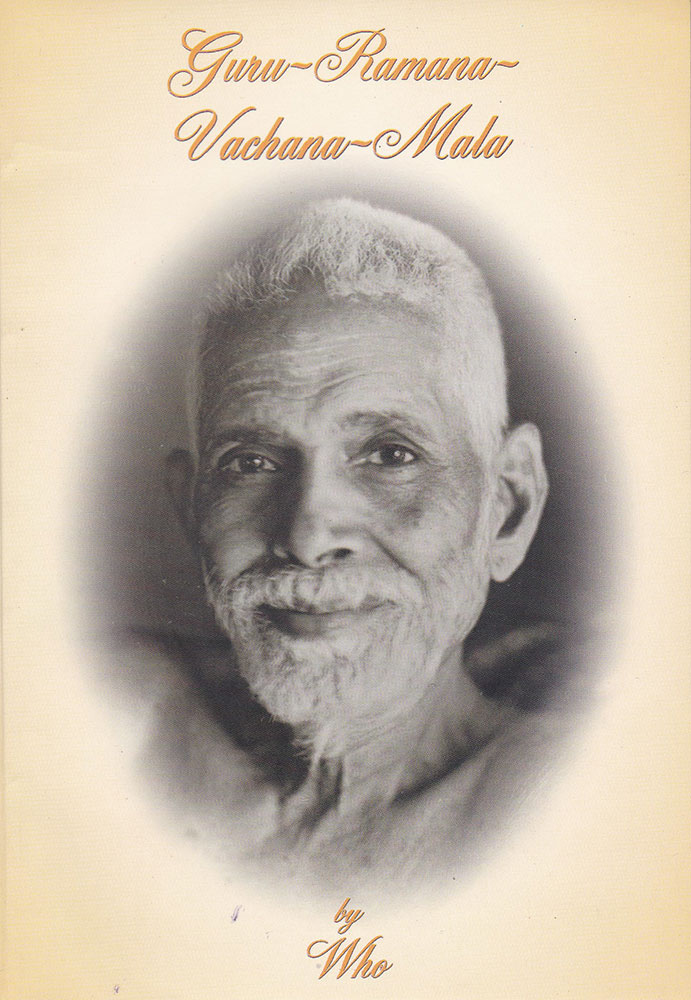
Guru Ramana Vachana Mala (‘A stringing together (mala) of Guru Ramana’s sayings (verbal teachings)’) is a small but wonderful text that concisely and accurately summarises the teachings of Sri Ramana Maharshi. It was compiled with the help of both Sri Ramana Maharshi and Sri Muruganar and clarifies areas of the teaching that may not be otherwise clear for the seeker. It also summarises the essential Vedanta teachings, as per verse 3 of the text.
Update 2024: Ramana Ashram have asked me to remove the PDF download of Guru Ramana Vachana Mala
Update 2026: My understanding is that the copyright for this text has now expired as of 31st December 2025. Given the text is no longer under copyright, I have re-uploaded it to this website
The text consists of 349 selected verses compiled together by Sri K. Lakshmana Sarma (who wrote under the pseudonym ‘Who?’), who was not only intimate with Sri Ramana’s teachings, but also a scholar in Vedantic studies and also fluent in the Tamil, Sanskrit and English languages – these verses are translated into English by Lakshmana Sarma himself, so we can be confident the translation is accurate with regards to both the accuracy and intention of the teaching. The verses are helpfully organised by topic and about 300 of these verses are taken from the text Guru Vachaka Kovai which is widely accepted as being the most authoritative text on Sri Ramana Maharshi’s verbal teachings.
Whilst the verses in Guru Ramana Vachana Mala do not go into great detail on the method of Self-Enquiry compared to other recommended texts, they are very illuminating nonetheless and give great clarity on areas of the teaching that may otherwise not be clear for the seeker. I therefore highly recommend this book, but I also recommend that you read this together another of the recommended texts pertaining to Sri Ramana, such as The Path of Sri Ramana which explains the process of Self-Enquiry in greater detail.
Sri Lakshmana Sarma was in close contact with Sri Ramana Maharshi for over 20 years and was also good friends with Sri Muruganar (who wrote Guru Vachaka Kovai). He was also one of only two people who received private tuition by Sri Ramana Maharshi on the true/deeper meaning of the teachings (the other person was Sri Muruganar), this private tuition extending over a period of many years, and he was known for constantly checking his understanding of the teachings with Sri Ramana to ensure that his understanding was accurate.
For example, Sri Ramana said that Lakshmana Sarma’s commentary on Ulladu Narpadu (40 verses on reality) was the best commentary available, which is unsurprising given that Sri Ramana himself taught Lakshmana Sarma the meaining of each verse in this text over a period of several years.
As stated above, Guru Ramana Vachana Mala was composed with the help of both Sri Ramana Maharshi and Sri Muruganar, as T.N. Venkataraman (the then president of Sri Ramana Ashram) writes in the preface to the 8th edition of Maha yoga:
‘Just as Lakshmana Sarma had composed Sri Ramana Hridayam with the help and guidance of Sri Bhagavan, he composed Guru Ramana Vachana Mala with the help of both Sri Bhagavan and Sri Muruganar, and in doing so he had a further opportunity to study Sri Bhagavan’s teachings deeply and to receive pertinent instructions from Him.’
These above factors, together with the fact that this text was first published during Sri Ramana’s lifetime means we can be confident that the teachings presented here are a true representation of Sri Ramana’s teachings.
“In the scriptures, the importance of effort is really driven home as being very important. This is because, what they don’t want is people to say you are Brahman, you are the absolute so you can do what you like”
This video was recorded live during a Satsang meeting with Tom Das and put together by volunteers.