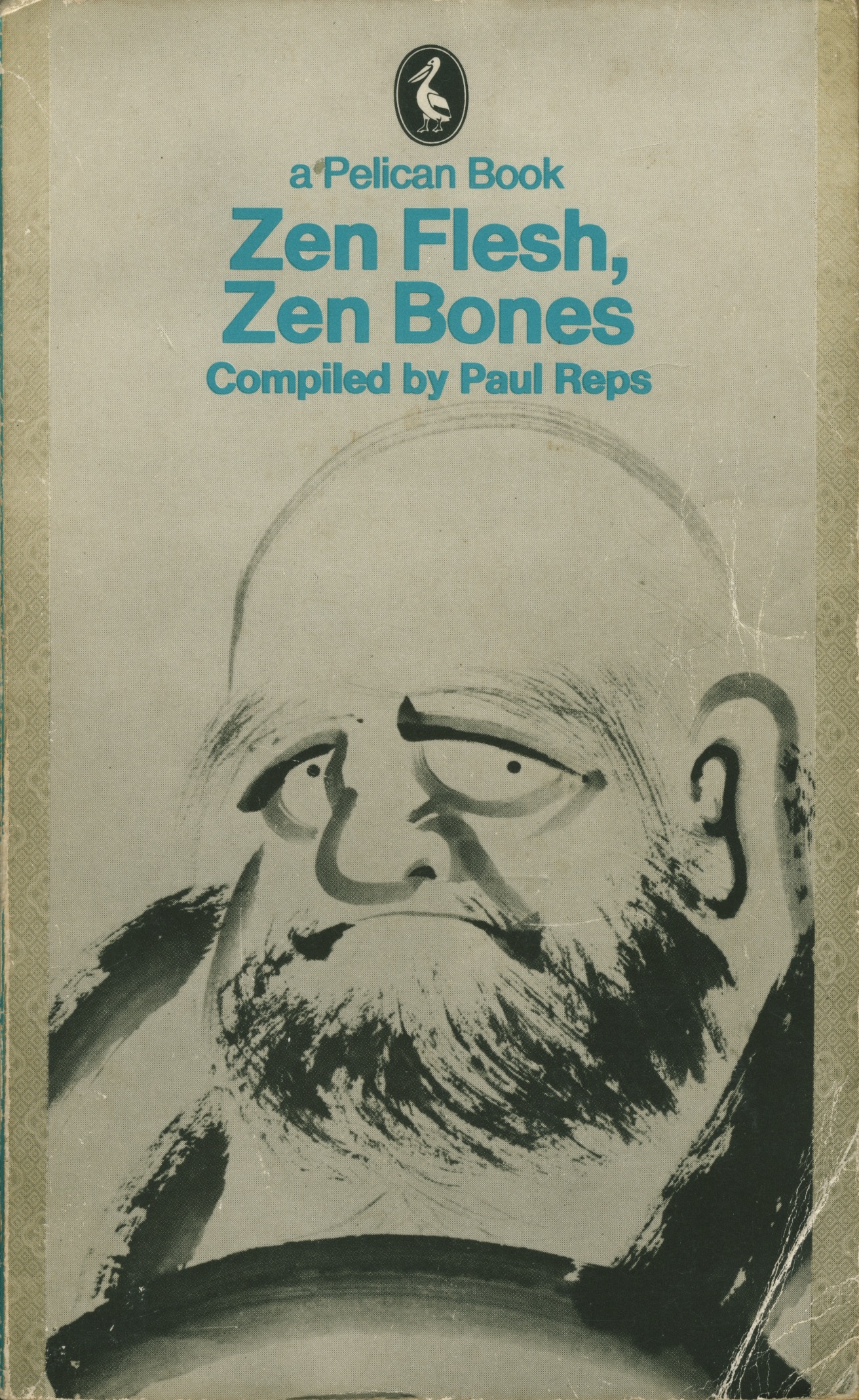
Another short story taken from the glorious little collection, Zen Flesh, Zen Bones:
The Thief Who Became a Disciple
One evening as Shichiri Kojun was reciting sutras (Buddhist scriptures) a thief with a sharp sword entered, demanding either his money or his life. Shichiri told him: ‘Do not disturb me. You an find the money in that drawer.’ Then he resumed his recitation.
A little while afterwards he stopped and called: ‘Don’t take it all. I need some to pay taxes with tomorrow.’
The intruder gathered up most of the money and started to leave. ‘Thank a person when you receive a gift,’ Shichiri added. The man thanked him and made off.
A few days afterwards the fellow was caught and confessed, among others, the offence against Shichiri. When Shichiri was called as a witness he said: ‘This man is no thief, at least as far as I am concerned. I gave him the money and he thanked me for it.’
After he had finished his prison term, the men went to Shichiri and became his disciple.
Here is another chapter from the book ‘The Most Direct Means to Eternal Bliss’. For my initial (and brief) opinion on this controversial but useful book click here. This chapter focuses on thought and how thought gets in the way of direct communion with that which lies beyond thought. Continue reading →
I was reading a passage from J. Krishnamurti’s slim book called meditations which reminded me of a passage from The Gospel According to Matthew. The language they use is strikingly similar. I’ll start with the biblical passage as it’s shorter:
But when you pray, go into your room, close the door and pray to your Father, who is unseen. Then your Father, who sees what is done in secret, will reward you.
Matthew 6:6
Questioner: When I look into myself, I find my strongest desire is to create a monument, to build something which will outlast me. Even when I think of a home, wife and child, it is because it is a lasting, solid, testimony to myself. Continue reading →
Tetsugen, a devotee of Zen in Japan, decided to publish the sutras (Buddhist texts), which at that time were available only in Chinese. The books were to be printed with wood block in an edition of seven thousand copies, a tremendous undertaking.
Tetsugen began by travelling and collecting donations for this purpose. Continue reading →
Questioner: As a child fairly often I experienced states of complete happiness, verging on ecstasy: later, they ceased, but since I came to India they reappeared, particularly after I met you. Yet these states, however wonderful, are not lasting. They come and go and there is no knowing when they will come back.
Nisargadatta Maharaj: How can anything be steady in a mind which itself is not steady?
Q: How can I make my mind steady?
M: How can an unsteady mind make itself steady? Of course it cannot. It is the nature of the mind to roam about. All you can do is to shift the focus of consciousness beyond the mind.
Q: How is it done?
M: Refuse all thoughts except one: the thought ‘I am’. The mind will rebel in the beginning, but with patience and perseverance it will yield and keep quiet. Once you are quiet, things will begin to happen spontaneously and quite naturally without any interference on your part.
Q: Can I avoid this protracted battle with my mind?
M: Yes, you can. Just live your life as it comes, but alertly, watchfully, allowing everything to happen as it happens, doing the natural things the natural way, suffering, rejoicing — as life brings. This also is a way.
Q: Well, then I can as well marry, have children, run a business… be happy.
M: Sure. You may or may not be happy, take it in your stride.
Q: Yet I want happiness.
M: True happiness cannot be found in things that change and pass away. Pleasure and pain alternate inexorably. Happiness comes from the self and can be found in the self only. Find your real self (swarupa) and all else will come with it.
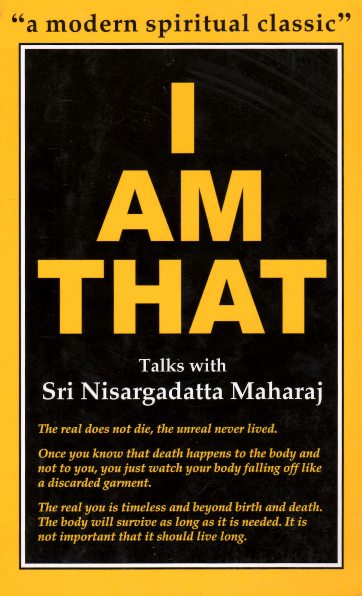
The above excerpt is from I Am That by Nisargadatta Maharaj
Tom’s comments:
There are so many gems in just this short passage! First Maharaj points out the mind need not be directly controlled and that the very nature of the mind is to roam, ruminate and be unsteady. Instead focus on something else: the sense ‘I AM’. Then the goal of a quiet mind will naturally arise.
Maharaj then gives us more: if we are not drawn to this sadhana (spiritual practice), then we can try an alternative. Instead we can surrender to whatever happens, keeping a watchfulness about ourselves whilst we do so. This, rather like the ‘I AM’ sadhana, also has the effect of quietening the mind and prevents the ego having room to manoevure. The ‘I’ which is always trying to meddle in things is cut off, restricted. There is much more to how these methods work and how they can be practised – I have written an article hereexplaining more on this.
Lastly Maharaj gives us a final nugget: ‘True happiness cannot be found in things that change and pass away.’
Experience, knowledge, insight and consciousness all come and go – so where does this leave us? Where can we seek if we do not seek in this world of impermanent things? Here we pass from the domain of the mind to that which is beyond words. Call it ‘true self’ (swarupa) or ‘no-self’, words do not apply.
The following is an excerpt from a book rather modestly titled ‘The Most Direct Means To Eternal Bliss’.
Despite some tendency towards grandiosity, this book is actually pretty amazing in my opinion. I think it was written as a labour of love and has been uploaded to the internet for free viewing by the author here. You can also buy a hard copy here which contains a single extra chapter (which was written later).
Be warned, this book and its tone may not be for everyone. It is radical, focused, in some ways quite narrow, and not at all modest. However the advice dispensed is actually very good in the context in which it was written and the teachings are made extremely clear. The initial chapters alone are worth the purchase price in my opinion (plus it’s free online anyway)
Another wonderful Zen story, also one of my favourites, taken from the book ‘Zen Flesh, Zen Bones’:
❤
When Banzan was walking through a market he overheard a conversation between a butcher and his customer.
“Give me the best piece of meat you have,” said the customer.
“Everything in my shop is the best,” replied the butcher. “You cannot find here any piece of meat that is not the best.”
At these words Banzan became enlightened.
❤
How can everything be the best? It makes no sense, yet all is the best, everything is divine, sparkling with effervescent magic.
This is one of my favourite Zen stories, taken from the amazing book ‘Zen Flesh, Zen Bones‘. It oozes with love and wonderment
❤
Ryokan, a Zen master, lived the simplest kind of life in a little hut at the foot of a mountain. One evening a thief visited the hut only to discover there was nothing to steal.
Ryokan returned and caught him. “You have come a long way to visit me,” he told the prowler, “and you should not return empty-handed. Please take my clothes as a gift.”
The thief was bewildered. He took the clothes and slunk away.
Ryoken sat naked, watching the moon. “Poor fellow,” he mused, “I wish I could have given him this beautiful moon.”
❤
Overflowing love, the moon is here for everyone, it cannot be stolen, it can never be possessed, and need not be possessed. Why bother with worldly items when the metaphorical Moon is here?
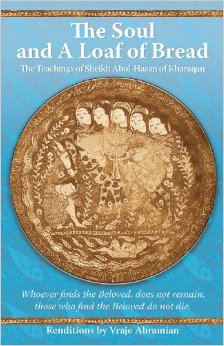
There are infinite ways to an infinite God; there are as many ways to God as there are people or beings: I have often thought this to myself, so whilst leafing through a newly purchased book (pictured above), I was pleasantly surprised to read a quote by Sheikh Abol-Hasan, a Sunni Muslim and Sufi from 10th century Persia, saying just this:
There are as many paths to the Lord as there are grains of sand and drops of rain…whomever seeks, eventually finds his way There
Sheikh Abol-Hasan, saying 141 from ‘The Soul and A Loaf of Bread’
These infinite ways are just variations of the One Way. And this One Way, for the purposes of exposition, can broadly be subdivided into two: one path for those who believe in God and one path for those who do not. Continue reading →


 Tom Das