Zen (Chan) master Yuanwu: No fixed teaching

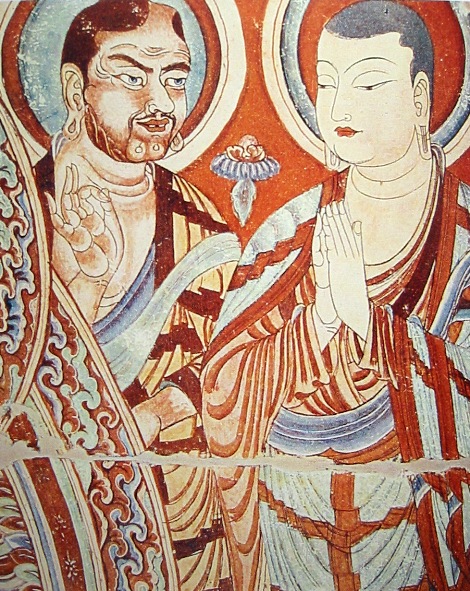
Central_Asian_Buddhist_Monks
A fresco from the Bezeklik Thousand Buddha Caves

All teachings are expedients

just for the purpose of breaking through obsessions, doubts,

intellectual interpretations & egocentric ideas

Yuanwu (1063-1135)

Tom’s comments:

If there was ever a dogma in Zen Buddhism* (and there is no dogma by the way) it is that there is no fixed Zen teaching. In Yuanwu’s letters, from which this quote was taken, Yuanwu gives us a no frills introduction and foray into the heart of Zen.

In this quote he gets straight to telling us how the Buddhist teachings work: the teachings are not necessarily  100% true in themselves, but are devices used to set us free. What is the correct teaching? It’s simply the teaching that works. This is what the word ‘expedient’ means: whatever works is the ‘correct teaching’.

And so we hear of zen teachings ranging from reading the scriptures to simply hearing the sound of a ringing bell; from seeing an object drop to the ground to the admittedly extreme physical blows that are often dished out (and received) by zen masters as a form of teaching – not a method I would advocate, I hasten to add.

So the teaching methods and expressions of truth may vary from person to person and from time and place, forged out of the cultures and characters of the moment. This is why the teaching reinvents itself from generation to generation, and varies from teacher to teacher, even when the core teaching and core ‘realisation’ is the same.

*Yuanwu was actually Chinese, so strictly speaking he is a Chan Master. When Chan Buddhism spread to Japan it became known as Zen, Zen simply being the Japanese word for Chan.
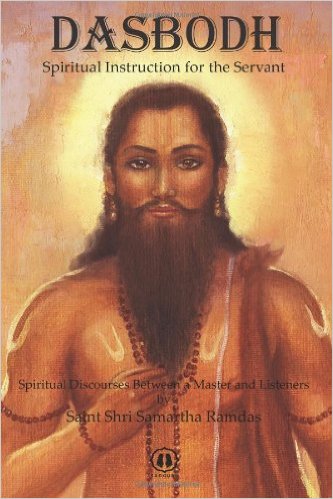
Dasbodh by Samartha Ramdas: The closest thing

Dasbodh

By the very act of looking

they are missing ‘That’

which is already the closest thing

Dasbodh 1.5.4

Tom’s comments:

Dasbodh, written by Sri Samartha Ramdas in 1654, has been long used as a source text for seekers of enlightenment within the Advaita Vedanta tradition. Nisargadatta Maharaj’s lineage, the Inchegarei Sampradaya, were hugely inspired by this text and Nisargadatta used to regularly read from it.

Here Samartha Ramdas is pointing us to something very profound, yet very simple once realised. For more, compare this verse with that of Zen master Han-Shan here.

Shunryu Suzuki: How to achieve perfect calm

blue mountains.png

The following is an excerpt from the book Zen Mind, Beginner’s Mind by Shunryu Suzuki:

If you want to obtain perfect calmness in your zazen, you should not be bothered by the various images you find in your mind. Let them come, and let them go. Then they will be under control. But this policy is not so easy. It sounds easy, but it requires some special effort. How to make this kind of effort is the secret of practice.

Suppose you are sitting under some extraordinary circumstances. If you try to calm your mind you will be unable to sit, and if you try not to be disturbed, your effort will not be the right effort. The only effort that will help you is to count your breathing, or to concentrate on your inhaling and exhaling. We say concentration, but to concentrate your mind on something is not the true purpose of Zen. The true purpose is to see things as they are, to observe things as they are, and to let everything go as it goes. This is to put everything under control in its widest sense.

The true purpose is to see things as they are, to observe things as they are, and to let everything go as it goes.

Zen practice is to open up our small mind. So concentrating is just an aid to help you realise ‘big mind’, or the mind that is everything.

If you want to discover the true meaning of Zen in your everyday life, you have to understand the meaning of keeping your mind on your breathing and your body in the right posture in zazen.

You should follow the rules of practice and your study should become more subtle and careful. Only in this way can you experience the vital freedom of Zen.

Jiddu Krishnamurti: True Meditation

Krishnamurti young.jpg

Meditation is never the control of the body. There is no actual division between the organism and the mind. The brain, the nervous system and the thing we call the mind are one, indivisible. It is the natural act of meditation that brings about the harmonious movement of the whole. To divide the body from the mind and to control the body with intellectual decisions is to bring about contradiction, from which arise various forms of struggle, conflict and resistance.

Every decision to control only breeds resistance, even the determination to be aware. Meditation is the understanding of the division brought about by decision. Freedom is not the act of decision but the act of perception. The seeing is the doing. It is not a determination to see and then to act. After all, will is desire with all it’s contradictions. When one desire assumes authority over another, that desire becomes will. In this there is inevitable division. And meditation is the understanding of desire, not the overcoming of one desire by another. Desire is the movement of sensation, which becomes pleasure and fear. This is sustained by the constant dwelling of thought upon one or the other.

And meditation is the understanding of desire, not the overcoming of one desire by another.

Meditation really is a complete emptying of the mind. Then there is only functioning of the body; there is only the activity of the organism and nothing else; then thought functions without identification as the me and the non-me. Thought is mechanical, as is the organism.

Meditation really is a complete emptying of the mind. Then there is only functioning of the body

What creates conflict is thought identifying itself with one of its parts which becomes the me, the self and the various divisions in that self. There is no need for the self at any time. There is nothing but the body, and freedom of the mind can only happen when thought is not breeding the me.

What creates conflict is thought identifying itself with one of its parts which becomes the me…

There is no self to understand but only the thought which creates the self. When there is only the organism without the self , perception, both visual and non-visual can never be distorted. There is only seeing ‘what is’ and that very perception goes beyond what is. The emptying of the mind is not an activity of thought or an intellectual process. The continuous seeing of what is without any kind of distortion naturally empties the mind of all thought and yet that very mind can use thought when it is necessary. Thought is mechanical and meditation is not.

There is only seeing ‘what is’ and that very perception goes beyond what is.

Excerpt taken from J. Krishnamurti, ‘The Beginnings of Learning’

My awakening experience whilst reading Krishnamurti:

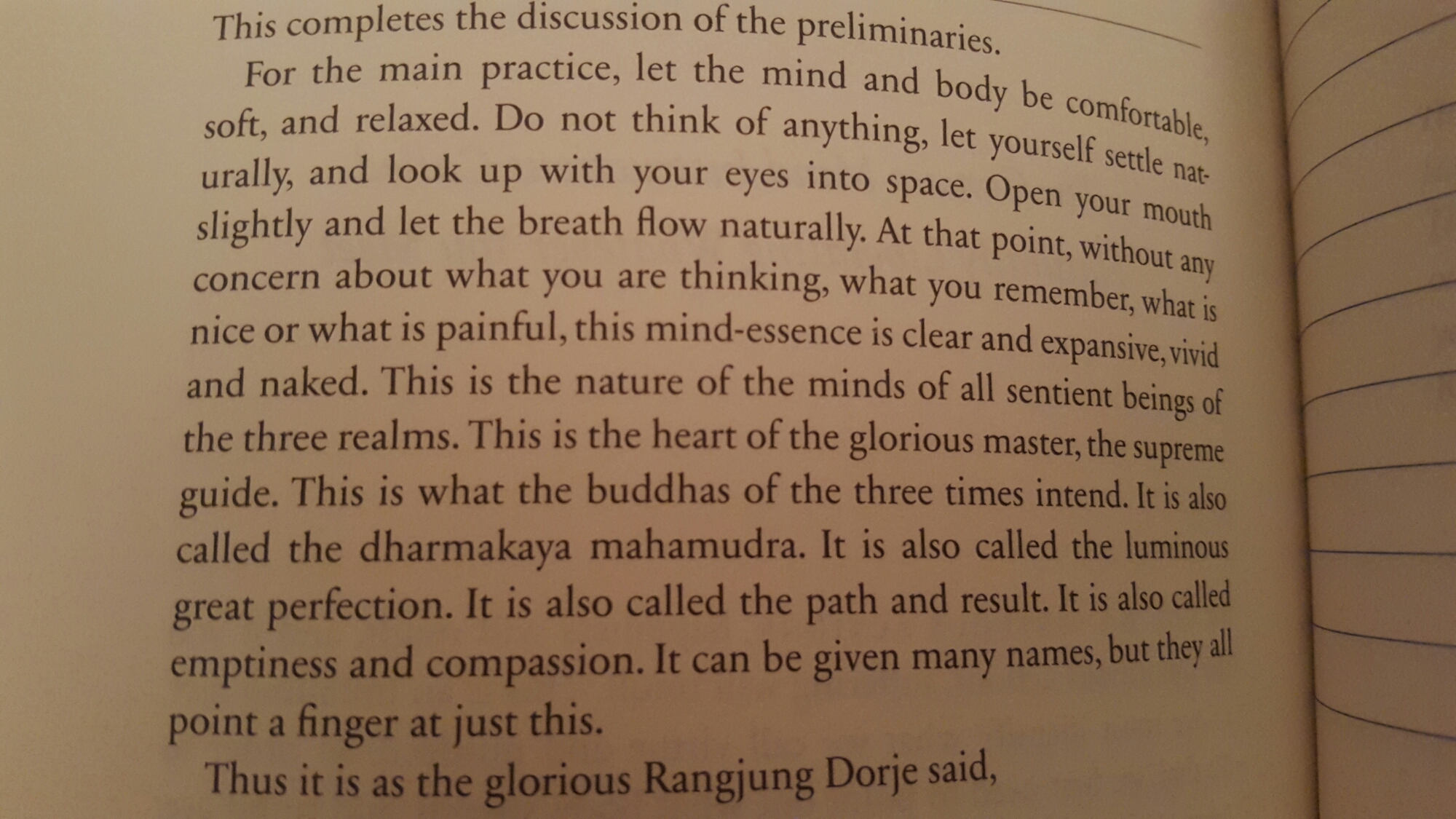
Tibetan Buddhism: The Mind Instructions of Khenpo Gangshar

image

Above is an excerpt from a text called ‘The Concise Mind Instructions Called Naturally Liberating Whatever You Meet’ by Khenpo Gangshar, as found in the book Vivid Awareness by Khenchen Thrangu.

In this short text Khenpo Gangshar goes on to say:

Directly, whatever arises, do not change it – rest naturally. This fulfils the essence of all creation stages, completion stages, mantra recitations, and meditations.

This is the heart of the highest Tibetan Buddhist teachings: to rest naturally and be vividly aware. Just be. I would add that in this no sense of self is being created, and this is the practice. To simply be, and not to take yourself as being a ‘self’ or ‘doer’. To use a commonly used phrase in vedanta: do not take yourself to be ‘this or that’.

Khenpo Gangshar goes on to give advice on how to deal with difficulties along the way:

You must take sickness as the path, afflictions as the path, the bardo as the path, and delusion as the path. The heart of all these applications is to rest naturally in the essence.

This advice is very much in line with most of traditional Tibetan Buddhist teachings, but here it is stated in very concise form. When difficulties come along, just rest in your natural being. Don’t identify as being ‘this or that’, don’t start to create or believe in the concept of being a doer. This is the false concept that is rooted out and seen through in this practice.

When life throws us a challenge, don’t simply fall back into your old habits of self-identification. It is from this creation of an imaginary doer/self that all other afflictions and suffering follows. Instead, just rest, just be. Let your awareness shine, let it shine brightly. If the thought ‘I’ arises, let it, notice it, notice that it is empty and does not describe or pertain to any reality. There is no ‘I’, there is no self. Only the bright expanse of phenomena.

One final thought from me, a question:
Does any of this have anything to do with Freedom? Does Freedom depend on any practice? Does Freedom depend on any of this?

Nisargadatta Maharaj: Ignore your thoughts

Nisargadatta_Maharaj

“It is the mind that tells you that the mind is there. Don’t be deceived. All the endless arguments about the mind are produced by the mind itself, for its own protection, continuation and expansion. It is the blank refusal to consider the convolutions and convulsions of the mind that can take you beyond it.”

Nisargadatta Maharaj, I Am That

My comments:

The word ‘mind’ in the above quote is synonymous with the false sense of individual separate self. This self, this ‘I’, is just a notion, an idea reinforced by the mind. The ‘I’ is a thought, and it is reinforced by thoughts.

Trying to figure this all out (ie. more thought) is a function of the same mind that is ultimately false, imaginary: it is a fruitless endeavour.

A particularly effective sadhana (spiritual practice) is to ignore the content of thoughts as they appear within our consciousness. The energy of the sense of ‘I’ then begins to loosen and its mechanics are exposed and revealed. We can then start to see things as they actually are.

There are broadly two ways this can be done:

1) by concentrating on something else such as a mantra, the breath, or by chanting, etc – ie. a distraction from thoughts;

2) by allowing thoughts to wash past you like clouds in the sky, and in so doing not paying attention to the content of thoughts, eg. a surrender, acceptance, gratitude or mindfulness practice.

When looking for a sadhana, you will naturally be able to find the one that works for you by looking to see which one gives you greatest sense of peace and relief, and by seeing which practice you are naturally inclined towards.

For more about spiritual practices and how they work click here

Nisargadatta Maharaj: In reality there is no person

Nisargadatta_Maharaj

The person is merely the result of a misunderstanding. In reality, there is no such thing.

Feelings, thoughts and actions race before the watcher in endless succession, leaving traces in the brain and creating an illusion of continuity.

A reflection of the watcher in the mind creates the sense of “I” and the person acquires an apparently independent existence.

In reality there is no person, only the watcher identifying himself with the ‘I’ and the ‘mine’.

Taken from I Am That by Nisargadatta Maharaj

Continue reading

Sufi mystic Abol-Hasan speaks

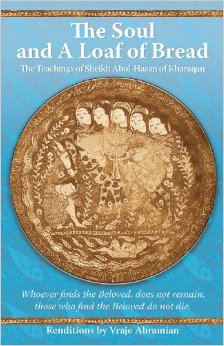
soul and loaf bread

Here are some gems from Sheikh Abol-Hasan, a Sufi mystic from the 11th century AD. His words continue to astound me. I have followed each quote with my commentary in italics and hope this does not detract from the quotes themselves.

One may speak of those absent,
but one who is Ever Present,
one can say nothing of
Sheikh Abol-Hasan, saying 92

How can we speak of Him? How can we talk of Him? All talk of Him is fanciful, all the more so if we take our descriptions and theories about Him seriously. Continue reading

Eckhart Tolle: Your true self

Lake sunset

‘You find peace not by rearranging the circumstances of your life, but by realizing who you are at the deepest level.’
Stillness Speaks by Eckhart Tolle p. 52

The truth is that you cannot know your true self. You are your true self – already. It’s difficult to put into words, but when you know who you really are, it is not the same as knowing how tall Mount Everest is or knowing what your favourite colour is. These worldly things are known with the mind, with thought, with the intellect. These things are known by ‘you’, the ego who knows, the false non-existent self. Your true self is not known in that way.
Continue reading