Q. Isn’t it unhealthy and inhumane to turn away from the world and turn within? No disrespect, but denial of the world did not work for me – integration is working. Who said God loved loved us any less for embracing neurosis? God loves us maybe even more.
Tom: I know what you mean, especially with such strong language like ‘vile ways’*. It can seem inhumane and even unhealthy to deny what we consider to be an aspect of ourself. The purpose of this teaching is liberation from suffering, and this turning within is the only way I know of to attain that aim. It is also the traditional way that has been taught in various cultures for millennia – in my view, the reason this simple but radical teaching has stuck around for so long is because it works, and it is the only one that works (it goes by different names in different traditions).
The strong language is only to encourage you to turn within. There are many other aspects of life, and integration as you put it can be wonderfully healing and positive, and that is good of course, but my experience is that positive and healing as it is, it is not ultimately liberating – that is, it improves the prison but does not free one from suffering in its totality. For that Self-Enquiry or Abiding as the Self is required, and that means to turn within to find the divine within. We do not need to suppress neurosis – that is unhealthy – but just allow it and all things to be, but turn our attention away from them and all other objects towards our self – then we discover the Kingdom of Heaven within – only then can we truly say that all is one, and it not be a belief or concept in the ego-mind. Only then does suffering end.
*A version of this question was originally asked after I posted the following verses on Facebook; they are teachings of Sri Ramana Maharshi taken from the wonderful text Guru Vachaka Kovai:
75. Only mad folk perplexed because
They deem the false world to be real
Find joy in this illusion.
The truly wise find joy in nothing
But Awareness which is Being.
76. Those well established in the Self,
True Being, will never pursue the world’s
Vile ways. For such descent into
The false allurements of the world
Is yielding to the animal weakness
For sense-pleasure.
77. What does one gain, you well may ask,
By giving up the wealth immense
Of worldly pleasure and seeking only
Mere Awareness?
The benefit of true Awareness
Is the unbroken prevalence
Of peace within the heart, the bliss
Of one’s own natural being.
‘Do not reject this teaching saying – ‘all is already one’, or ‘what is needed to be yourself?’ or ‘This is It, already – what practice is required and for who?’ or ‘There is no ego already’. This is the ego’s way of avoiding its own destruction.’
Some people, when they hear of the true teachings of Self-Enquiry, they attend to it straight away and realise the Self, the eternal happiness and bliss that is devoid of misery and suffering, the Kingdom of Heaven that is found within.
Others spend time roaming and suffering in the arid desert of other ways (or ‘non-ways’) and teachings first, teachings that pertain to gross and subtle objects (ie body, mind and world, thoughts, feelings, experiences, knowledge, etc). Only later do they realise that despite all their knowledge and insights and experiences, despite their proclamations of oneness, etc, their suffering still continues, and maybe they then find the motivation to try something else and turn within.
OBJECTION: WHY TURN WITHIN? ISN’T THAT DUALISTIC?
Q .But if all is one or non-dual, why turn within at all? Is this not creating an artificial duality between the inner and the outer, and do not all practices strengthen the ego?
A. Because only then is suffering removed and the bliss of the self realised. Without this practice of turning within, suffering continues. See this for yourself in your own experience – has your suffering ended? If not, turn within and abide as the Self. Suffering is the hallmark of ego/ignorance.
WHY IS THIS THE CASE?
Q.Why is it so?
A. Because without this specific practice, objects are continually attended to, and this nurtures the notion ‘I am a body-mind entity living in a world’. Or rather it doesn’t attack or destroy this ignorance, which is deep rooted, habitual and strong (seemingly). The habitual ignorance ‘I am the separate body-mind entity’ continues to intermittently rise and cause suffering. Out of habit, ignorance continues, and with it suffering too.
‘The ego-thief pretends to be the policeman who catches the thief’.
Without this practice of attending to the Self or pure consciousness within, ignorance and suffering both continue, in spite of superficial proclamations such as ‘all is one’ or ‘nothing needs to change’. Similarly, other practices which involve attending to gross or subtle objects also do not sever this ignorance, although they may weaken it (or strengthen it).
OBJECTION: DOES THIS PRACTICE NOT STRENGTHEN THE EGO?
A. This is the only practice that does not strengthen the ego. All practices, except Self-Enquiry or Self-Attention, need the identity ‘I am the body-mind’, ie. the ego, to practice them. In Self-Enquiry it is not accepted that you are the body-mind from the outset.
The mind, when attending to gross and subtle objects, is called the mind. When this same mind attends to the Subject, itself, it is no longer the mind but is simply Consciousness or Awareness Being Consciousness or Awareness, ie. Self Being Self. (Ramana Maharshi states In Day by Day with Bhagavan: ‘The mind turned inwards is the Self; turned outwards, it becomes the ego and all the world’. The traditional Advaita text Yoga Vasishta states: ‘Consciousness, which is undivided, imagines to itself desirable objects and runs after them. It is then known as the mind.’ )
This practice, unlike all others, is not a doing (ie. not an act by the body-mind entity), but BEING SELF.
It is only through BEING SELF and not through attending to various gross and subtle objects that the egoic vasanas/ignorance can be rooted out and suffering ended at its source. See for yourself how suffering continues otherwise, how without this practice the ego continues itself.
A TRUE TEACHING
This is why Sri Ramana Maharshi taught this teaching. This is why Shankara taught this teaching. This is why Buddha taught this teaching. This is why Krishna and Vasishta taught this teaching. This is why Shiva taught this teaching. Why else has this teaching been taught for millennia?
Hence this is the true teaching of Vedanta that has been handed down, generation to generation, for millennia, and it is the true teaching of all genuine and effective spiritual paths.
My gratitude to Sri Ramana Maharshi for revitalising this ancient teaching, purifying it of all dross and superstition and making it easily accessible for all.
DO NOT ALLOW THOUGHT/THE EGO TO PHILOSOPHISE THIS TEACHING AWAY
Discover this yourself, not with intellectualising or philosophising, but by trying and seeing for yourself. Do not reject this teaching saying – ‘all is already one’, or ‘what is needed to be yourself?’ or ‘This is It, already – what practice is required and for who?’ or ‘There is no ego already’. This is the ego’s way of avoiding its own destruction. You will know this is the case as suffering is the sign of the ego. Are you still suffering? If so, attend to the Self, the pure consciousness, the subject, within. If you do not, suffering will continue until you do.
Sri Ramana Maharshi states:
‘The seat of Realisation is within and the seeker cannot find it as an object outside him. That seat is bliss and is the core of all beings. Hence it is called the Heart. The only useful purpose of the present birth is to turn within and realise it. There is nothing else to do.’ (Talks 219)
JUST A LITTLE PRACTICE MAKES A DIFFERENCE
Whilst practice gradually increases over time an infiltrates into your entire being and all of the three states (waking, dreaming, deep sleep), even a small amount of practice, even when NOT performed with great skill, leads to immense reduction in suffering and egotism. What may take years through mental philosophising is cut through quickly with devoted practice. This will build your faith in the teachings and take you home.
So start small and allow the momentum to gradually build, like a snowflake becoming an avalanche.
Another quote from Sri Ramana Maharshi, this time from the Sri Ramana Gita, a small text that outlines the entire teaching of Ramana in concise form:
Q. What in brief is the means to know one’s own real nature? What is the effort that can bring about the sublime inner vision?
Sri Ramana Maharshi: Strenuously withdrawing all thoughts from sense objects, one should remain fixed in steady, non-objective [ie. subjective] enquiry. This, in brief, is the means of knowing one’s own real nature; this effort alone bring about the sublime inner vision.
‘The path of Sri Ramana is meant for anyone who craves for happiness…’
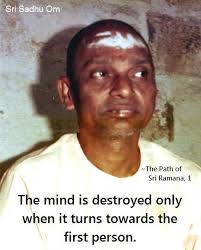
These texts, written by Sri Sadhu Om, himself a direct devotee of Sri Ramana Maharshi, clearly, unambiguously and thoroughly explain the path to Self-Realisation, which is the extinguishment of suffering, as taught by Sri Ramana Maharshi.
Part one focuses on Self-Enquiry (the path of knowledge or Jnana), which is the principal path for liberation/Moksha.
Part two focuses on Self-Surrender (the path of Bhakti or love/ devotion).
Together these texts summarise the entire Vedanta path, and are consistent with the Vedanta scriptures, but the teachings are arranged practically for those with a genuine yearning for liberation and not just philosophical study.
There is also a text which is considered to be ‘Part three’ called Sadhanai Saram, which means ‘The Essence of Spiritual Practice’, and this text further explains what is given in parts one and two, and goes into more detail about the nature of liberation itself as well as various other topics. Click on the link above to download this as a PDF file.
Sri Sadhu Om (1922-1985), sometimes known as Sri Sadhu Om Swamigal, spent 4 years with Sri Ramana Maharshi from 1946 until Ramana’s death in 1950. He was regarded by many other direct devotees as both Self-Realised and an authority on Ramana Maharshi’s teachings. Sri Muruganar, one of the few devotees of Sri Ramana Maharshi who Sri Ramana openly conceded to be Self-Realised, considered Sri Sadhu Om to be one of the few people who truly understood Sri Ramana Maharshi’s teachings.
We are indeed fortunate to have these clear and precise teachings to hand! All we have to do is understand them and put them into practice!
Click on the links below to download these precious texts, and then put them into practice:
UPDATE 2023: a new revised translation in a single volume is now available to purchase, eg. on Amazon, called ‘The Path of Sri Ramana’. There are 60 pages of new additional previously untranslated material, part 2 is now called the supplement, and the biographical section has been removed. Personally I find the older version, available as a PDF on this website, easier to read, however several people who attend satsang meetings with me have informed me they prefer the newer translation which they feel is more precise and more accurate.
Sri Sadhu Om
“We should not run after the world; we should not look outwards at the world, we should look inwards at Self. Those sannyasis who run after the world achieve neither the world nor Self (God). If we try to chase after our shadow, we will never catch it; but if we go towards the sun, our shadow will automatically come running behind us.
Those sannyasis who are always attending to the world with the aim of teaching the world became spoilt in the end. . . No Sage (jnani) who ever came on earth was the product of an ashramam, math or any such institution. Each one of them stood alone and realized the Truth by himself.
There is no rule that a man can attain true knowledge (jnana) only by becoming an inmate of a religious institution. Therefore, in the name of service to the world, let no one cheat himself and retard his spiritual progress by forming foundations and associations and by preaching, shouting slogans and running magazines”
~ Sri Sadhu Om
The entire path is also explained in more concise form in Ramana Maharshi’s text ‘Who Am I?’ (Nar Yar?). However I have found that many people actually miss the key teachings in ‘Who Am I?’ even though they are plainly written due to the ego’s distortion in interpreting what it hears/reads. After reading ‘The Path of Sri Ramana’, the teachings in ‘Who Am I?’ become crystal clear.
This is one of a series of introductory articles – please see the homepage of tomdas.com for more introductory articles. For more detailed explanations of the entire path to liberation please see this following link – I recommend you read and study the two texts found here and put them into practice: The Path of Sri Ramana
Ever-obsessed with the transient*, we suffer. Ever-involved with that which changes*, the Self remains (seemingly) covered** and unrealised, and so we, taking ourselves to be a separate body-mind entity, remain in bondage and illusion and continue to suffer and feel confused.
Our True Nature
What you truly are has never suffered, has never undergone change, has never been confused and never been subject to birth, death, illusion or delusion. It is beyond both happiness/peace and suffering/sorrow. It is that pure consciousness ‘within’, it is That which you truly are.
How to Attain Liberation (Moksha)
Release yourself from this suffering and destroy ignorance in its totality by turning away from transient things and attending to your Self, that Pure Consciousness which is You. Turn your attention to That Which You Are and in doing this Be What You Are. Know the Knower, attend to the Seer, that is, Be Your Self and abide as such, until illusion/suffering/ignorance/doubt is no more.
Why This Practice is Necessary
For most, without this sadhana (spiritual practice), ignorance will continue to rise up again and again due to the strength of the habitual tendencies (vasanas) to identify as a separate body-mind entity, and so confusion and suffering will continue as will the seeking and various doubts.
*’the transient’ or ‘that which changes’ refers to the body, mind (thoughts, feelings, imaginings, experiences, conceptual knowledge) and the world, also known as Maya or illusion.
**for practice purposes of the teaching, in this context it is said that the Self is covered by Maya, as this is how it seems to the suffering seeker of truth and liberation. This aspect of the teaching has a practical orientation and places instruction on the path to liberation above mere conceptual/intellectual notions such as ‘the Self is never covered’, etc. These intellectual notions are are often used by the ego to avoid spiritual practice and liberation, which is the ending of egotism, and perpetuate ignorance-ego-suffering.
***the True Self is symbolised by the symbol ‘Om’, the Pure Consciousness within, that which is beyond name, form, description, conceptualisation, knowledge or experience. It is beyond both suffering and happiness/peace. It is also the meaning of the terms ‘true knowledge’ (Jnana) and ‘direct experience’ (Aparokshanubhuti), Bliss (Ananda) and Peace (Shanti), and Non-Duality (Advaita). It is what is signified in the Mandukya Upanishad as Turiya or AUM
Also see
This first link, The Path of Sri Ramana, contains detailed descriptions and explanations of the entire path in an easy to read way. I recommend you read, study and put into practice these two texts:
Q. What in brief is the means to know one’s own real nature? What is the effort that can bring about the sublime inner vision?
Sri Ramana Maharshi: Strenuously withdrawing all thoughts from sense objects, one should remain fixed in steady, non-objective [ie. subjective] enquiry. This, in brief, is the means of knowing one’s own real nature; this effort alone bring about the sublime inner vision.
Sri Ramana Gita, Chapter 3, verses 4-6
If, on the contrary, you withdraw your mind completely from the world and turn it within and abide thus, that is, if you keep awake always to the Self, which is the substratum of all experience, you will find the world, of which alone you are now aware, just as unreal as the world in which you lived in your dream.
Ramana Maharshi, Maharshi’s Gospel
291. If one wants to be saved, one is given the following true and essential advice: just as the tortoise draws all its five limbs within its shell, so one should draw the five senses within and turn one’s mind Selfward. This alone is happiness.
Sri Ramana Maharshi, Guru Vachaka Kovai verse 291
Commentary from Sri Sadhu Om on the above verse:
This important advice, to withdraw the mind from the five senses and to turn it Selfward, is not given to one and all; it is given only for the benefit of those who wish to save themselves, and not for those who are still vainly hoping to save the world. Such people, who want to save the world, will find no taste for Self-attention, and thus they are not yet fit even to save themselves, let alone to save the world; unless one has first learnt to swim, it is vain and futile to jump into the water to save others.
The mind severed from all connection with sensual objects, and prevented from functioning out, awakes into the light of the heart, and finds the highest condition. The mind should be prevented from functioning, until it dissolves itself in the heart. This is Jnana, this is Dhyana, the rest is all mere concoction of untruth.
When the mind…remains unshakable and does not give rise to appearances, it verily becomes Brahman.
The controlled mind is verily the fearless Brahman.
When the mind, after realising the knowledge that Atman alone is real, becomes free from imaginations and therefore does not cognise anything, for want of objects to be cognised, it ceases to be the mind.
Dwelling on external objects will only increase evil propensities, so wisely recognising this fact, one should abandon external objects and and constantly attend to one’s true nature within, the Atman [the Self].
When the five organs of perception become still, together with the mind, and the intellect ceases to be active: that is called the Supreme State [Brahman]
Svetavastara Upanishad:
Be absorbed, through samadhi, in the eternal Brahman.
It is widely accepted that the text Guru Vachaka Kovai (Garland of Guru’s Sayings) presents the most precise, systematic and authoritative exposition of Sri Ramana Maharshi’s teachings; Here is what Ramana Ashram states about the Guru Vachaka Kovai in the foreword of their publication of it:
‘[Guru Vachaka Kovai] provides the most precise, systematic and authoritative exposition of Sri Bhagavan’s teaching, explaining step by step the theory, the practice and the experience of jnana, the Truth supreme which is Being as Life Eternal, Pure Awareness, Perfect Bliss. Thus, the most comprehensive collection of the Maharshi’s sayings is Guru Vachaka Kovai.’
Following my previous post, here are some more verses for you:
132. Why do people call me learned? What is the mark of real learning? Learning that all garnered knowledge Of things is empty ignorance And that true knowledge is the search For the Knower.
133. He, who by questing inward for The Knower, has destroyed the ego And transcended so-called knowledge, Abides as the Self. He alone Is a true knower, not one who has Not seen the Self and therefore has An ego still.
134. Those who, learning to forget Completely all objective knowledge, Turn inward firmly and see clearly The Truth, abide serene. Those who Try to recall forgotten things Pine bewildered, fretting over False phenomena.
The following is the introduction to the text as found in the Collected Works of Sri Ramana Maharshi published by Sri Ramanasramam:
Self-enquiry is the first work the Maharshi ever wrote. It was written about 1901, that is, when he was a young man of about twenty-two. He was already a Jnani (Sage) in perfect realization of the Self, in the resplendent bliss of Divine Knowledge. At that time he was living in Virupaksha Cave on the hill of Arunachala. A number of disciples had already gathered round him. Although he had not actually taken a vow of silence, he seldom spoke, and so wrote his replies to certain questions put to him by Gambhiram Seshayya, one of the earliest devotees. The latter copied them in his diary. After his death this diary was obtained from his brother. The questions and answers were edited by Natanananda and published with Bhagavan’s approval under the name of Vichara Sangraham, or Self-Enquiry. Subsequently they were changed into the form of an essay. The original form has been adopted in the present work.
There is no youthfulness or immaturity in the work. The Master wrote with the authority of full spiritual knowledge, just as in his later years. Like all his expositions, verbal as well as written, this is concerned with practical questions of the path to realization of the Self, never with barren theory. However, it does differ from later expositions in one important respect: that is, that it describes not only the path of Self- enquiry but others also; meditation on one’s identity with the Self and a yogic path based on breath-control. He himself prescribed only Self-enquiry or submission to the Guru. He would say: “There are two ways: ask yourself `Who am I?’ or submit.”
Why did he include the mention of less direct and more elaborate methods in this first exposition? The obvious contingent reason is that the disciple for whom it was written had been reading books about these various methods and asked questions about them. Perhaps also, in a wider sense, it is appropriate that there should first be a general exposition of various methods before the lifelong instruction in that which he prescribed. Certainly the other methods, although described, are scarcely recommended.
The breath control that is described is, of course, not mere physical exercise. It is the spiritual significance of the exercise that makes it an elaborate science. `Science’ is indeed the right word for it, for it is a traditional Indian science of self- purification. This makes it abstruse for the Western reader who has no previous grounding in it, especially as, like all sciences, it has its technical vocabulary which does not permit adequate translation without lengthy notes. One has to remember that in writing this exposition the Maharshi knew that he could count on a technical knowledge of the science in question in the person for whom he wrote. The consolation for Western readers is to remember that he neither recommended nor prescribed this path and in his later works scarcely mentioned it. It is not necessary for them to learn its technicalities.
The following are sayings of Sri Ramana Maharshi, taken from the text Guru Vachaka Kovai which is widely accepted as the most precise, systematic and authoritative exposition of Sri Ramana Maharshi’s teachings:
536.
O worldly folk who long for and run after
An endless series of unenduring things
’Tis wisdom true to seek and know
That one thing, on knowing which
All other things will cease to be.
537.
For those who see with insight keen
The subtle Truth, what is there to gain
From knowledge of gross material things?
What the imperishable inner sense
Perceives surpasses far the sight
Seen by the corporeal eye.
538.
Knowing aright the nature of the Self
And abandoning the non-self as void,
Unreal, is wisdom true.
All other knowledge is ignorance,
And not wisdom.
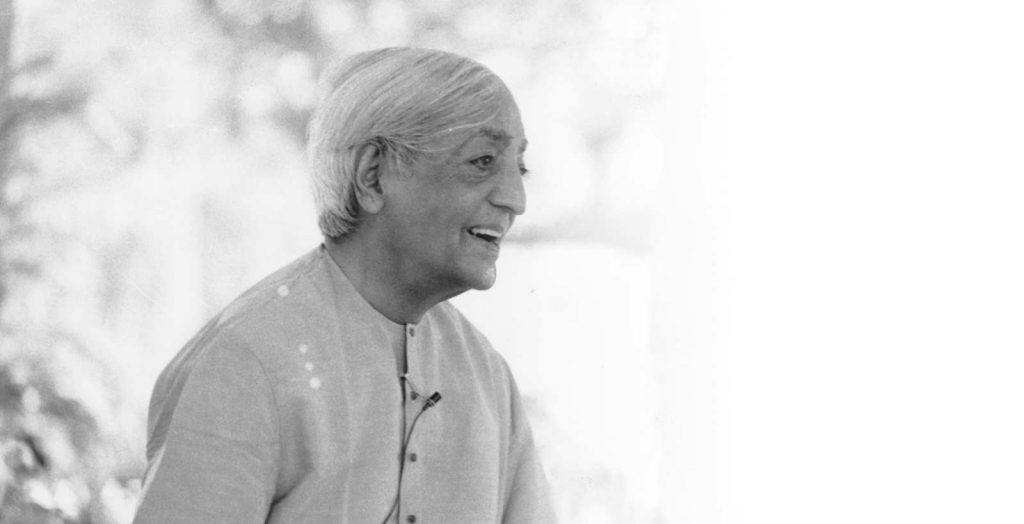
Here we have Jiddu Krishnamurti talking about ‘the now’. Many of you will have heard of Eckhart Tolle’s book ‘The Power of Now’, but less people seem to be aware of how influenced by J. Krishnamurti Eckhart Tolle’s teachings are. In fact Eckhart Tolle has spoken about this several times, eg. Eckhart Tolle says in an interview:
I feel actually that the work I do is a coming together of the teaching “stream,” if you want to call it that, of [J.] Krishnamurti and Ramana Maharshi. They seem very, very dissimilar, but I feel that in my teaching the two merge into one. It is the heart of Ramana Maharshi, and Krishnamurti’s ability to see the false, as such and point out how it works. So Krishnamurti and Ramana Maharshi, I love them deeply. I feel completely at One with them. And it is a continuation of the teaching.
Two spiritual teachers that I feel closely connected to, although I’ve never met them in person, are [J.] Krishnamurti and Ramana Maharshi. Their teachings seem very dissimilar at first. Krishnamurti taught mainly in negative terms just like the Buddha. By this I mean that he didn’t give you any inspiring words, ideas or concepts to believe in. He would tell you to investigate the workings of your own mind, in the same way that the Buddha taught us to investigate how suffering arises and by discovering the roots of suffering in our own minds arrive at a state of consciousness that he described as “the end of suffering.” Whereas Ramana Maharshi would often point to that which lies beyond the realm of thinking, a dimension of consciousness he called the self.
Is there – apart from the clock – time at all? We accept so many things; obedience has been so instilled into us that acceptance seems natural. But is there time at all, apart from the many yesterdays? Is time a continuity as yesterday, today and tomorrow, and is there time without yesterday? What gives to the thousand yesterdays a continuity?
Tom: Krishnamurti, like Eckhart Tolle, often differentiates between ‘time by the clock’ (or chronological time) as opposed to psychological time (ie. how the mind perceives itself as existing in a continuity of time which starts from the past, which proceeds into the future).
A cause brings its effect, and the effect in turn becomes the cause; there is no division between them, it is one movement. This movement we call time, and with this movement, in our eyes and in our hearts, we see everything. We see with the eyes of time, and translate the present in terms of the past; and this translation meets the tomorrow. This is the chain of time.
Tom: we can see that Krishnamurti is writing of how the mind sees through this lens or filter of time and interprets everything through this distorting lens.
Thought, caught in this process, asks the question: “What is time?” This very enquiry is of the machinery of time. So the enquiry has no meaning, for thought is time. The yesterday has produced thought and so thought divides space as yesterday, today and tomorrow. Or it says: “There is only the present”, forgetting that the present itself is the outcome of yesterday.
Our consciousness is made up of this chain of time, and within its borders we are asking: “What is time? And, if there is no time, what happens to yesterday?” Such questions are within the field of time, and there is no answer to a question put by thought about time.
Tom: Krishnamurti is stating that thought is a result of the past, ie. memories and concepts of things that were, and it is this thought that is asking the question. As this thought is itself the movement of psychological time, it cannot answer this question ‘what is time?’ and ‘what happens if there is no psychological time?’.
Or is there no tomorrow and no yesterday, but only the now? This question is not put by thought. It is put when the structure and nature of time is seen but with the eyes of thought.
Is there actually tomorrow? Of course there is if I have to catch a train; but inwardly, is there the tomorrow of pain and pleasure, or of achievement? Or is there only the now, which is not related to yesterday?
Tom: Here we can see Krishnamurti expand upon the difference between ‘time by the clock’, which is purely a practical things, and ‘psychological time’, which implies striving and seeking pleasure and achievement for the ‘me’. Basically, ‘psychological time’ is referring to the movement of the ego or idea of a separate ‘me’ entity.
In the following paragraphs Krishnamurti will seemingly make a few ‘jumps’ without really explaining how he got there, but you will see he is pointing to an immediate and direct perception of ‘what is’, without the mediating distorting lens of psychological time or thought or memory, ie. without the ego (as I have defined it above), which Krishnamurti here calls ‘yesterday’. See if you can follow him:
Time has a stop only when thought has a stop. It is at the moment of stopping that the now is. This now is not an idea, it is an actual fact, but only when the whole mechanism of thought has come to an end. The feeling of now is entirely different from the word, which is of time.
So do not let us be caught in the words yesterday, today and tomorrow. The realization of the now exists only in freedom, and freedom is not the cultivation of thought.
Then the question arises: “What is the action of the now?” We only know action which is of time and memory and the interval between yesterday and the present. In this interval or space all the confusion and the conflict begin.
What we are really asking is: If there is no interval at all, what is action? The conscious mind might say: “I did something spontaneously”, but actually this is not so; there is no such thing as spontaneity because the mind is conditioned.
The actual is the only fact; the actual is the now, and, unable to meet it, thought builds images about it. The interval between the image and what is, is the misery which thought has created.
To see what is without yesterday, is the now. The now is the silence of yesterday.
Tom: Does Krishnamurti mean that we don’t remember what happened yesterday and that we do not plan for tomorrow? No, he is not referring to ‘time by the clock’, ie. practical affairs that involve chronological time. By ‘yesterday’ he is referring to psychological time, ie. the remembrance of past hurts and pleasures that make a mark on our psyche, and we then interpret the present moment in order to recreate past pleasures or avoid past hurts, and this is the distorting view of psychological time or egoic desire, which Krishnamurti also here calls ‘thought’.
When this is immediately seen clearly, we are no longer trying to get anywhere. Then we are with ‘what is‘. This immediate or direct seeing itself is not the effect or outcome of the egoic mind – we cannot ‘try to see’ this, as this would be more ego, more trying to get somewhere nice. No, simply when this is all seen, then we are with what is already – no, we are not even with what is – there is only what is. Simple, direct, transcendent-immanent, beyond words.