This image is taken from a story in the Mahabharata and represents the situation we are in if we are ignorant.
Our past deeds (elephant) are chasing us, our future karma (snakes) and eventual death (snakes) awaits us, the present moment (the branch) is being eaten away by mice – our time is slowly running out as days (white mouse) and nights (black mouse) pass by.
Meanwhile Vishnu holds out his saving hand of Moksha (liberation) to us but we are too entranced by the honey (pleasure) dripping from Maya (honeycomb) that we endure the pains of life (bees stinging us) and we stay in this ridiculous and precarious situation rather than take Vishnu’s hand of Moksha.
Feel His Love,
Allow His Love and Light to fill up your entire body,
Rest in His Presence,
Christ Within.
Our Constant Companion,
Our Divine Shadow,
Unshakeable,
Ever-dependable,
I lean on Him.
Allow Him to Console you,
Pray to Him in Secret,
This is your Secret Prayer:
Your Love for Him.
Your love for Him,
Merging in His Love,
Filling up your body with Love and Light,
Filling the Universe,
Made of Love and Light,
My Heart overflows,
With Your Divine Love.
.
.
.
.
Where are you not?
.
.
.
.
Where am I?
.
.
.
. ❤️❤️❤️
Translated by Swami Vimuktananda, this version edited by Tom Das
Swami Vimuktananda: Shankara discusses the identity of the individual Self and the universal Self through the direct experience of the highest Truth.
Tom: the original text has no subheadings – I have added these. My brief comments and annotations are in square brackets. I have added bold type for emphasis of what I feel are key points. Occasionally I have removed some verses or I have changed the order of some verses where I have felt this makes sense thematically. I hope these additions are of benefit for sincere seekers of liberation.
Om Shanti, Shanti, Shanti
INITIAL VERSES
I bow down to Him – to Sri Hari (the destroyer of ignorance), the Supreme Bliss, the First Teacher, Ishwara, the All-pervading One and the Cause of all Lokas (the universe).
Herein is expounded (the means of attaining to) Aparokshanubhuti (Self-Realization) for the acquisition of final liberation. Only the pure in heart should constantly and with all effort meditate upon the truth herein taught.
FOUR PRELIMINARY QUALIFICATIONS
(Sadhana Chatushtaya)
[Q. Who is ‘pure in heart’?
A: He who has the 4 qualifications listed below
Q: How to become ‘pure in heart’?
A: Devotion to God, renunciation and karma yoga as per verse 3]
The four preliminary qualifications (the means to the attainment of knowledge), such as Vairagya (dispassion) and the like, are acquired by men by propitiating [gaining favour of] Hari (the Lord), through austerities and the performance of duties pertaining to their social order and stage in life.
The indifference with which one treats the excreta of a crow – such an indifference to all objects of enjoyment from the realm of Brahma to this world (in view of their perishable nature), is verily called pure [1] Vairagya.
Atman (the seer) in itself is alone permanent, the seen is opposed to it (ie., transient) – such a settled conviction is truly known as [2] discrimination [Viveka].
[[3] The 6 treasures]
Abandonment of desires at all times is called [3i] Shama and restraint of the external functions of the organs is called [3ii] Dama.
Turning away completely from all sense-objects is the height of [3iii] Uparati, and patient endurance of all sorrow or pain is known as [3iv] Titiksha which is conducive to happiness.
Implicit faith in the words of the Vedas and the teachers (who interpret them) is known as (3v) Shraddha, and concentration of the mind on the only object Sat (i.e., Brahman) is regarded as [3vi] Samadhana.
When and how shall I, O Lord, be free from the bonds of this world (i.e., births and deaths) – such a burning desire is called [4] Mumukshuta.
Only that person who is in possession of the said qualification (as means to Knowledge) should constantly reflect with a view to attaining Knowledge, desiring his own good.
VICHARA SUMMARISED
Knowledge is not brought about by any other means than Vichara [inquiry], just as an object is nowhere perceived (seen) without the help of light.
[Question]
Who am I ? How is this (world) created ? Who is its creator ? Of what material is this (world) made ? This is the way of that Vichara (enquiry).
[Answer – what I am not, neti-neti, via negativa]
I am neither the body, a combination of the (five) elements (of matter), nor am I an aggregate of the senses; I am something different from these. This is the way of that Vichara.
[The philosophical paradigm: all phenomena is a creation of thoughts/ignorance:]
Everything is produced by ignorance, and dissolves in the wake of Knowledge. The various thoughts must be the creator. Such is this Vichara.
[All is Brahman, what I am, via positiva]
The material (cause) of these two (i.e., ignorance and thought) is the One (without a second), subtle (not apprehended by the senses) and unchanging Sat (Existence), just as the earth is the material (cause) of the pot and the like. This is the way of that Vichara.
[What I am – I am Brahman]
As I am also the One, the Subtle, the Knower, the Witness, the Ever-Existent, and the Unchanging, so there is no doubt that I am “That” (i.e., Brahman). Such is this enquiry.
ATMAN (The Self)
Atman is verily one and without parts, whereas the body consists of many parts; and yet the people see (confound) these two as one ! What else can be called ignorance but this? [repeating refrain]
Atman is all consciousness and holy, the body is all flesh and impure; and yet, etc.,
Atman is the (supreme) Illuminator and purity itself; the body is said to be of the nature of darkness; and yet, etc.,
Atman is eternal, since it is Existence itself; the body is transient, as it is non-existence in essence; and yet etc.,
How strange is it that a person ignorantly rests contented with the idea that he is the body, while he knows it as something belonging to him (and therefore apart from him) even as a person who sees a pot (knows it as apart from him) !
I AM BRAHMAN
I am verily Brahman, being equanimous, quiescent, and by nature absolute Existence, Knowledge, and Bliss. I am not the body which is non-existence itself. This is called true Knowledge by the wise. [repeating refrain]
I am without any change, without any form, free from all blemish and decay. I am not, etc.,
I am not subjected to any disease, I am beyond all comprehension, free from all alternatives and all-pervading. I am not, etc.,
I am without any attribute or activity, I am eternal, ever free, and imperishable. I am not, etc.,
I am free from all impurity, I am immovable, unlimited, holy, undecaying, and immortal. I am not, etc.,
IGNORANCE
O you ignorant one ! Why do you assert the blissful, ever-existent Atman, which resides in your own body [ie. is your essence] and is (evidently) different from it, which is known as Purusha [The Person] and is established (by the Shruti as identical with Brahman), to be absolutely non-existent?
[ie. Why do you say ‘There is no Atman/Self’?]
O you ignorant one ! Try to know, with the help of [1] Shruti and [2] reasoning, your own Self, Purusha, which is different from the body, (not a void but) the very form of existence, and very difficult for persons like you to realize.
[This will be explained below]
1. REASONING
The Supreme (Purusha) known as “I” (ego) is but one, whereas the gross bodies are many. So how can this body be Purusha?
“I” (ego) is well established as the subject of perception whereas the body is the object. This is learnt from the fact that when we speak of the body we say, “This is mine.” So how can this body be Purusha?
It is a fact of direct experience that the “I” (Atman) is without any change, whereas the body is always undergoing changes. So how can this body be Purusha?
Even the subtle body [ie. mind] consists of many parts and is unstable. It is also an object of perception, is changeable, limited and non-existent by nature. So how can this be the Purusha?
The immutable Atman, the substratum of the ego, is thus different from these two bodies [ie. gross and subtle bodies], and is the Purusha, the Ishwara (the Lord of all), the Self of all; It is present in every form and yet transcends them all.
2. SHRUTI
[Shruti literally means ‘heard’ or ‘that which is heard’, and refers to revealed scripture, the highest form of scripture in Vedic tradition, and the examples are the Vedas and Upanishads. Traditionally Shruti is not of human origin but of Divine origin, as opposed to Smriti or ‘remembered’, which comes from the minds of human beings. This text, not being the Vedas or Upanishads would be considered to be Smriti. Most epics such as Ramayana, Mahabharata and Bhagavad Gita are all Smriti scriptures]
Wise men have ascertained the (real) nature of Purusha from that Shruti text, “(There is nothing) higher than He (Purusha),” etc. So how can this body be Purusha ?
Again the Shruti has declared in the Purusha Sukta that “All this is verily the Purusha”. So how can this body be Purusha ?
So also it is said in Brihadaranyaka that “The Purusha is completely unattached”. How can this body wherein inhere innumerable impurities be the Purusha ?
There again it is clearly stated that “the Purusha is self-illumined”. So how can the body which is inert (insentient) and illumined by an external agent be the Purusha ?
Moreover, the Karma-kanda also declares that the Atman is different from the body and permanent, as it endures even after the fall of the body and reaps the fruits of actions (done in this life).
The Shruti in the form of the Brihadaranyaka has declared that this Atman, which is the Self of all, is verily Brahman.
ADVAITA
[So far we have discerned the difference between Self and Not-Self (ie. the phenomenal world including the body and mind). Now we see this too is an artificial duality and now the focus is on Advaita, or non-duality:]
Thus the view that the body is the Atman has been denounced by the enunciation of the difference between the Atman and the body. Now is clearly stated the unreality of the difference between the two.
No division in Consciousness is admissible at any time as it is always one and the same. Even the individuality of the Jiva must be known as false, like the delusion of a snake in a rope.
As through the ignorance of the real nature of the rope the very rope appears in an instant as a snake, so also does pure Consciousness appear in the form of the phenomenal universe without undergoing any change.
There exists no other material cause of this phenomenal universe except Brahman. Hence this whole universe is but Brahman and nothing else.
From such declaration (of the Shruti) as “All this is Atman”, it follows that the idea of the pervaded and the pervading is illusory. This supreme truth being realized, where is the room for any distinction between the cause and the effect?
[The Mahavakya or great saying ‘Sarvam Khalvidam Brahma’ or ‘All this is Brahman’ is taken from the Chandogya Upanishad 3.14.1]
Certainly the Shruti has directly denied manifoldness in Brahman. The non-dual cause being an established fact, how could the phenomenal universe be different from It ?
Moreover, the Shruti has condemned (the belief in variety) in the words, “The person who”, being deceived by Maya, “sees variety in this (Brahman), goes from death to death”.
Inasmuch as all beings are born of Brahman, the supreme Atman, they must be understood to be verily Brahman.
The Shruti has clearly declared that Brahman alone is the substratum of all varieties of names, forms and actions.
Just as a thing made of gold ever has the nature of gold, so also a being born of Brahman has always the nature of Brahman.
Just as a jar is all earth, so also isthe body all consciousness. The division, therefore, into the Self and non-Self is made by the ignorant to no purpose.
SUFFERING
Fear is attributed to the ignorant one who rests after making even the slightest distinction between the Jivatman and the Paramatman.
[ie. duality causes fear]
When duality appears through ignorance, one sees another; but when everything becomes identified with the Atman, one does not perceive another even in the least.
In that state when one realizes all as identified with the Atman, there arises neither delusion nor sorrow, in consequence of the absence of duality.
[ie. lack of duailty, or nonduality, removes suffering]
THE THREE STATES
[ie. The 3 states change, they come and go, and so are without any enduring essence, as opposed to Atman]
This world, though an object of our daily experience and serving all practical purposes, is, like the dream world, of the nature of non-existence, inasmuch as it is contradicted the next moment.
The dream (experience) is unreal in waking, whereas the waking (experience) is absent in dream. Both, however, are non-existent in deep sleep which, again, is not experienced in either.
Thus all the three states are unreal inasmuch as they are the creation of the three Gunas [ie. tamas, rajas, sattva]; but their witness (the reality behind them) is, beyond all Gunas, eternal, one, and is Consciousness itself.
ILLUSION
[The illusion of duality: the illusion of the individual person or Jiva, the illusion of the manifold universe]
Just as (after the illusion has gone) one is no more deluded to see a jar in earth or silver [irridescence] in the nacre [mother of pearl], so does one no more see Jiva in Brahman when the latter is realized (as one’s own self).
Just as earth is described as a jar, gold as an ear-ring, and a nacre as silver, so is Brahman described as Jiva.
Just as blueness in the sky, water in the mirage, and a human figure in a post (are but illusory), so is the universe in Atman.
Just as the appearance of a ghost in an empty place, of a castle in the air, and of a second moon in the sky (is illusory), so is the appearance of the universe in Brahman.
Just as it is water that appears as ripples and waves, or again it is copper, that appears in the form of vessel so it is Atman that appears as the whole universe.
Just as it is earth that appears under the name of a jar, or it is threads that appear under the name of a cloth, so it is Atman that appears under the name of the universe. This Atman is to be known by negating the names.
MITHYA
Just as there ever exist the relation of cause and effect between earth and a jar, so does the same relation exist between Brahman and the phenomenal world; this has been established here on the strength of scriptural texts and reasoning.
METAPHORS FOR ILLUSION
(YOU ARE NOT THE BODY!)
[Note: If I think I am the body, then this is taking the Self (myself) to be the body]
Just as a rope is imagined to be a snake and a nacre to be a piece of silver, so is the Atman determined to be the body by an ignorant person. [repeating refrain]
Just as earth is thought of as a jar (made of it) and threads as a cloth, so is Atman, etc.,
Just as gold is thought of as an ear-ring and water as waves, so is the Atman, etc.,
Just as the stump of a tree is mistaken for a human figure and a mirage for water, so is the Atman, etc.,
Just as a mass of wood work is thought of as a house and iron as a sword, so is the Atman, etc.,
Just as one sees the illusion of a tree on account of water, so does a person on account of ignorance see Atman as the body.
Just as to a person going in a boat everything appears to be in motion, so does one, etc.,
Just as to a person suffering from a defect (jaundice) white things appear as yellow, so does one, etc.,
Just as to a person with defective eyes everything appears to be defective, so does one, etc.,
Just as a firebrand, through mere rotation, appears circular like the sun, so does one, etc.,
Just as all things that are really large appear to be very small owing to great distance, so does one, etc.,
Just as all objects that are very small appear to be large when viewed through lenses, so does one, etc.,
Just as a surface of glass is mistaken for water, or vice versa, so does one, etc.,
Just as a person imagines a jewel in fire or vice versa, so does one, etc.,
Just as when clouds move, the moon appears to be in motion, so does one, etc.,
Just as a person through confusion loses all distinction between the different points of the compass, so does one, etc.,
Just as the moon (when reflected) in water appears to one as unsteady, so does one, etc.,
THE END OF IGNORANCE
Thus, through ignorance, arises in Atman the delusion of the body, which, again, through Self-realization, disappears in the supreme Atman.
When the whole universe, movable and immovable, is known to be Atman, and thus the existence of everything else is negated, where is then any room to say that the body is Atman?
O enlightened one, pass your time always contemplating on Atman while you are experiencing all the results of Prarabdha [Fate or destiny]; for it ill becomes you to feel distressed.
PRARABDHA KARMA
The theory one hears of from the scripture, that Prarabdha does not lose its hold upon one even after the origination of the knowledge of Atman, is now being refuted.
After the origination of the knowledge of Reality, Prarabdha verily ceases to exist, inasmuch as the body and the like become non-existent; just as a dream does not exist on waking.
Just as the body in a dream is superimposed (and therefore illusory), so is also this body. How could there be any birth of the superimposed (body), and in the absence of birth (of the body) where is the room for that (i.e., Prarabdha) at all ?
The Vedanta texts declare ignorance to be verily the material (cause) of the phenomenal world just as earth is of a jar. That (ignorance) being destroyed, where can the universe subsist ?
Just as a person out of confusion perceives only the snake leaving aside the rope, so does an ignorant person see only the phenomenal world without knowing the reality.
The real nature of the rope being known, the appearance of the snake no longer persists; so the substratum being known, the phenomenal world disappears completely.
The body also being within the phenomenal world (and therefore unreal), how could Prarabdha exist ? It is, therefore, for the understanding of the ignorant alone that the Shruti speaks of Prarabdha.
“And all the actions [Karmas] of a man perish when he realizes that (Atman) which is both the higher and the lower”. Here the clear use of the plural by the Shruti is to negate Prarabdha as well.
If the ignorant still arbitrarily maintain this, they will not only involve themselves into two absurdities but will also run the risk of forgoing the Vedantic conclusion. So one should accept those Shrutis alone from which proceeds true knowledge.
FIFTEEN STEPS TO MEDITATION & LIBERATION
Now, for the attainment of the aforesaid (knowledge), I shall expound the fifteen steps by the help of which one should practice profound meditation at all times.
[The need for practice]
The Atman that is absolute existence and knowledge cannot be realized without constant practice. So one seeking after knowledge should long meditate upon Brahman for the attainment of the desired goal.
102-103. The steps, in order, are described as follows: the control of the senses, the control of the mind, renunciation, silence, space, time, posture [asana], the restraining root (Mulabandha), the equipoise of the body, the firmness of vision, the control of the vital forces, the withdrawal of the mind, concentration, self-contemplation and complete absorption.
[These above stages are similar to and include the classical 8 stages of Patanjali’s Raja Yoga. Shankara will redefine these steps in the next few verses giving them a non-dual spin]
The restraint of all the senses by means of such knowledge as “All this is Brahman” is rightly called Yama, which should be practiced again and again.
[Yama or self-control is usually defined as being ethical, truthful, not stealing, etc]
The continuous flow of only one kind of thought to the exclusion of all other thoughts, is called Niyama [discipline], which is verily the supreme bliss and is regularly practiced by the wise.
[The one kind of thought are those of the Mahavakyas such as ‘I am Brahman’, etc]
[Niyama, or discipline usually includes virtuous habits to externally and inwardly cleanse the body and mind respectively]
The abandonment of the illusory universe by realizing it as the all-conscious Atman is the real renunciation honored by the great, since it is of the nature of immediate liberation.
[as in verse 104, the underlying method utilised is the realisation that ‘All is Brahman-Atman’. The emphasis is on a shift of perspective rather than just taking yourself to be the body-mind and renouncing objects from that ignorant perspective]
The wise should always be one with that Silence wherefrom words together with the mind turn back without reaching it, but which is attainable by the Yogins.
[The Silence refers to the Self, Atman/Brahman, which is what we are. ‘Mind turns back without reaching it’ refers to Taittiriya Upanishad II.9]
108-109. Who can describe That (i.e., Brahman) whence words turn away ? (So silence is inevitable while describing Brahman). Or if the phenomenal world were to be described, even that is beyond words. This, to give an alternate definition, may also be termed silence known among the sages as congenital. The observance of silence by restraining speech, on the other hand, is ordained by the teachers of Brahman for the ignorant.
[True Silence is Self-Knowledge and not mere cessation of speech]
That solitude is known as space, wherein the universe does not exist in the beginning, end or middle, but whereby it is pervaded at all times.
[True solitude is Self-Knowledge, in which there is only One without a Second, the implication is that solitude is not the mere retiring to a forest in seclusion]
The non-dual (Brahman) that is bliss indivisible is denoted by the word ‘time’, since it brings into existence, in the twinkling of an eye all beings from Brahman downwards.
One should known that as real posture in which the meditation on Brahman flows spontaneously and unceasingly, and not any other that destroys one’s happiness.
[Shankara’s humour that the true Yogic asana/posture are not mere contortions of body that ‘destroy one’s happiness’ but meditation upon Brahman]
That which is well known as the origin of all beings and the support of the whole universe, which is immutable and in which the enlightened are completely merged … that alone is known as Siddhasana [a seated meditation pose] (eternal Brahman).
That (Brahman) which is the root of all existence and on which the restraint of the mind is based is called the restraining root (Mulabandha) which should always be adopted since it is fit for Raja-yogins.
Absorption in the uniform Brahman should be known as the equipoise of the limbs (Dehasamya). Otherwise mere straightening of the body like that of a dried-up tree is no equipoise.
Converting the ordinary vision into one of knowledge one should view the world as Brahman itself. That is the noblest vision, and not that which is directed to the tip of the nose.
Or, one should direct one’s vision to That alone where all distinction of the seer, sight, and the seen ceases and not to the tip of the nose.
The restraint of all modifications of the mind by regarding all mental states like the Chitta as Brahman alone, is called Pranayama.
119-120. The negation of the phenomenal world is known as Rechaka (breathing out), the thought, “I am verily Brahman”, is called Puraka (breathing in), and the steadiness of that thought thereafter is called Kumbhaka (restraining the breath). This is the real course of Pranayamafor the enlightened, whereas the ignorant only torture the nose [more humour from Shankara here].
The absorption of the mind in the Supreme Consciousness by realizing Atman in all objects is known as Pratyahara (withdrawal of the mind) which should be practiced by the seekers after liberation.
The steadiness of the mind through realization of Brahman wherever the mind goes, is known as the supreme Dharana (concentration).
Remaining independent of everything as a result of the unassailable thought, “I am verily Brahman”, is well known by the word Dhyana (meditation), and is productive of supreme bliss.
The complete forgetfulness of all thought by first making it changeless and then identifying it with Brahman is called Samadhi known also as knowledge.
[The method is to make thought changeless, which means to only have one thought such as ‘I am Brahman’ as per verses 119 and 123, and then to realise this thought as nothing else but Brahman or Atman (self), and then forget all thought. Shankara equates this Samadhi with Knowledge]
THE FRUIT OF PRACTICE
The aspirant should carefully practice this (meditation) that reveals his natural bliss until, being under his full control, it arises spontaneously, in an instant when called into action.
Then he, the best among Yogis having attained to perfection, becomes free from all practices. The real nature of such a man never becomes an object of the mind or speech.
OBSTACLES
127-128. While practicing Samadhi there appear unavoidably many obstacles, such as lack of inquiry, idleness, desire for sense-pleasure, sleep, dullness, distraction, tasting of joy, and the sense of blankness. One desiring the knowledge of Brahman should slowly get rid of such innumerable obstacles.
ENCOURAGEMENT AND A WARNING
While thinking of an object the mind verily identifies itself with that, and while thinking of a void it really becomes blank, whereas by the thought of Brahman it attains to perfection. So one should constantly think of (Brahman to attain) perfection.
Those who give up this supremely purifying thought of Brahman, live in vain and are on the same level with beasts.
Blessed indeed are those virtuous persons who at first have this consciousness of Brahman and then develop it more and more. They are respected everywhere.
[Against the intellectual approach:]
Only those in whom this consciousness (of Brahman) being ever present grows into maturity, attain to the state of ever-existent Brahman; and not others who merely deal with words.
Also those persons who are only clever in discussing about Brahman but have no realization, and are very much attached to worldly pleasures, are born and die again and again in consequence of their ignorance.
The aspirants after Brahman should not remain a single moment without the thought of Brahman, just like Brahma, Sanaka, Suka and others.
ANALYSIS OF ‘CAUSE’ AND ‘EFFECT’
The nature of the cause inheres in the effect and not vice versa; so through reasoning it is found that in the absence of the effect, the cause, as such also disappears.
[Cause and effect refers to karma and the phenomenal world. When this world is removed, only Brahman remains:]
Then that pure reality (Brahman) which is beyond speech alone remains. This should be understood again and again verily through the illustration of earth and the pot.
[ie. When the pot is destroyed, the earth from which it is made remains]
In this way alone there arises in the pure-minded a state of awareness (of Brahman), which is afterwards merged into Brahman.
One should first look for the cause by the negative method and then find it by the positive method, as ever inherent in the effect.
[Here the cause is Brahman and the effect is the world, ie. by removing all objects from perception through meditation (negative method 1) or by negating all objects of perception as being not-self (negative method 2) the Self should be discovered, but then the Self should be seen being in All Objects (positive method)]
One should verily see the cause in the effect, and then dismiss the effect altogether. What then remains, the sage himself becomes.
A person who meditates upon a thing with great assiduity and firm conviction, becomes that very thing. This may be understood from the illustration of the wasp and the worm.
UNITY OF FORMLESS AND FORM
The wise should always think with great care of the invisible, the visible, and everything else, as his own Self which is consciousness itself.
Having reduced the visible [objects of perception] to the invisible [formless Brahman], the wise should think of the universe as one with Brahman. Thus alone will he abide in eternal felicity with mind full of consciousness and bliss.
Thus has been described Raja-Yoga consisting of these steps (mentioned above). With this is to be combined Hatha-Yoga for (the benefit of) those whose worldly desires are partially attenuated.
[The above described Raja Yoga is purely mental, having been stripped of the more external practices. Therefore for those whose minds have not been purified, the external and physical aspects of yoga, denoted here as Hatha Yoga, should also be performed]
For those whose mind is completely purified this (Raja-Yoga) alone is productive of perfection. Purity of the mind, again, is speedily accessible to those who are devoted to the teacher and the Deity.
[Devotion to and faith in Guru and God are recommended methods of purification of mind. When the mind is sufficiently pure, then Shankara’s form of Raja Yoga on the mental levels alone leads directly to liberation]
Kashmir Shaivism is a non-dual tantric tradition in which Pratyabhijna or ‘recognition’ is the goal. In Kashmir Shaivism, the absolute is termed ‘Shiva’ and the relative world of people and objects is termed ‘Shakti’ (which means energy or power). Shiva and Shakti are given equal status and are said not to exist apart from each other – where one exists, the other also exists.
In Non-Dual (Advaita) Vedanta, the Self (Atman) is the Absolute (Brahman) and it is said to project Maya-Shakti which in turn projects the world of people and objects. Maya is said to be dependent on the Absolute Self and not vice-versa, so the two are not given equal status.
This obviously causes confusion in some seekers, so here Ramana explains them both:
The following is an excerpt from Talks with Sri Ramana Maharshi, Talk 288:
Explaining Maya of Vedanta and swatantra [tantra] of Pratyabhijna (independence of recognition), Sri Bhagavan said:
The Vedantins say that Maya is the sakti of illusion premised in Siva. Maya has no independent existence. Having brought out the illusion of the world as real, she continues to play upon the ignorance of the victims. When the reality of her not being is found, she disappears.
‘Recognition’ [ie. Kashmir Shaivism] says that Sakti (power) is coeval with Siva. The one does not exist without the other. Siva is unmanifest, whereas Sakti is manifest on account of Her independent will swatantra. Her manifestation is the display of the cosmos on pure consciousness, like images in a mirror.
The images cannot remain in the absence of a mirror.
So also the world cannot have an independent existence. Swatantra becomes eventually an attribute of the Supreme. Sri Sankara says that the Absolute is without attributes and that Maya is not and has no real being. What is the difference between the two? Both agree that the display is not real. The images of the mirror cannot in any way be real. The world does not exist in reality (vastutah).
Both schools mean the same thing. Their ultimate aim is to realise the Absolute Consciousness. The unreality of the cosmos is implied in Recognition (Pratyabhijna), whereas it is explicit in Vedanta. If the world be taken as chit (consciousness), it is always real. Vedanta says that there is no nana (diversity), meaning that it is all the same Reality.
There is agreement on all points except in words and the method of expression.
Tom: note that in both Advaita Vedanta and Kashmir Shaivism, the essential teaching is the same – ie. one is advised to turn within, that is turn away from objects, and realise the Pure Consciousness, the Self Within, devoid of objects. Only the conceptual framework and superficial aspects of the teachings vary.
Perfectionof Faith in God/Guru/Self is the same as Jnana (spiritual ‘knowledge’ or ‘enlightenment’).
You could say that one leads to another – faith and surrender leads to knowledge, or knowledge leads to surrender and faith – and these are both true on one level, but ultimately they are one and the same – where is the difference apart from on the conceptual level?
For me Faith in the Guru, my Beloved, Bhagavan Sri Ramana Maharshi, overcame me quite spontaneously, without my asking, and clinging to Him and Faith in his Word and dwelling in His Presence became the Way and the Law and my Self.
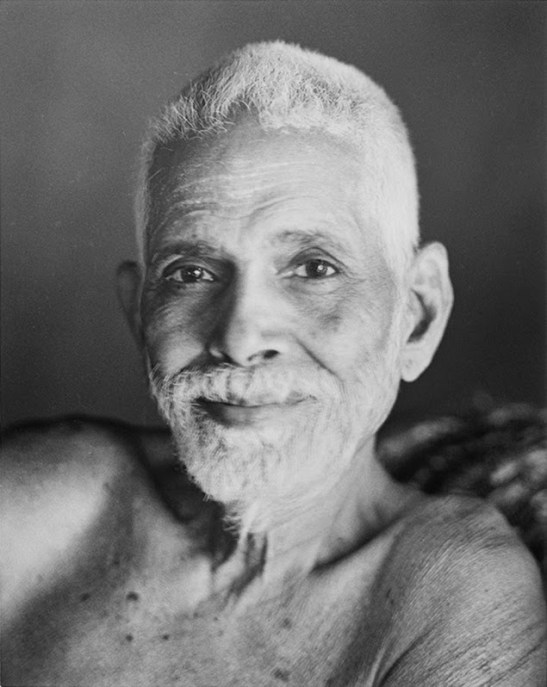
For me, whilst I like to learn a bit about Ramana’s life and I enjoy reading his teachings, gazing at His Image and feeling His Presence has often been more powerful than all the written teachings and all my efforts put together.
Someone recently approached me at the end of one of my Satsangs/meetings and asked me which book would I recommend as being the best one to understand Ramana’s teachings. I told him that Talks with Sri Ramana Maharshi and Be As You Are are two wonderful books, but when you open the book, the most important page is the one which has a photograph of Ramana on it (most of Ramana’s books contain a photograph of him in the first few pages).
Instead of reading all the teachings and trying to figure it all out, just look at His Image, feel His Presence!
We can read and listen to the teachings as much as we like, but I have found there is power in something else, something intangible – the Guru’s grace, the eyes of the Guru, His Divine Grace…
So, cling to the Guru, cling to His Teachings. For me, that means Sri Ramana Maharshi. If it suits you, if you are drawn to Him, Ramana, take Him up as your Guru. Look at His Image, give yourself to Him, if it feels right for you. Of if you have another Guru/God you are drawn to, do the same with him/her. Or if you cannot relate to a Guru or God, try relating to Life or the Universe or Universal Energy or something similar. See what happens and feel free to let me know too!
Ramana said that life often brings us to have faith in God, then God brings us a Guru, and the Guru then directs us back to our Self and we realise all is One. Of course, we do not really realise, rather the ‘we’ or the ‘me’ that is seeking Union disappears or ‘merges into Him’. There was only ever Him/Self/Guru/God/Oneness…use any word that suits you.
Ramana also said that if we are lucky enough to be blessed with faith in something, that is a blessing to us and we should seize that faith and lean on it with loving devotion, and not to allow it to wither away.
So I encourage you to look at His Image, surrender to Him, and let me know how it goes!
‘Perfection of Faith in God/Guru/Self is the same as Jnana’
Please subscribe for more videos like this coming soon!
Many find that as they progress on the Spiritual Path, they become more peaceful, happier, but also perhaps more boring too! What is Tom’s advice in this regard? 🙂
Tom: Is there even such a thing as Moksha? Even to speak of Moksha is more ignorance, as it implies some entity that can be liberated, or something to be liberated from.
However…In more conventional terms we could say there are no levels of Moksha (as there is only Moksha), but there are various levels of ignorance. So all apparent levels of realisation appear in maya/are illusory/are based in ignorance.
Gaudapada in his commentary of the Mandukya Upanishad hints at this: see the first 2 verses I quote from him here together with my commentary: Advaita Vedanta: Gaudapada’s Method
There are also different types of Moksha, apparently (meaning from the point of view of ignorance), such as jivanmukti and videhamukti and numerous other classifications in the scriptures. But in essence we don’t have to worry about these as this is just more book knowledge. The scriptures and sages (such as Ramana) remind us that this is really more ignorance for the mind. Instead, keep it simple and just keep on with your basic Sadhana:
1. Be still (raja yoga)
2. Know who you are (jnana yoga)
3. Adore your God-Guru-Self (bhakti yoga)
4. Give thanks for all that comes your way (karma yoga)
Note – all of the above leads to a peaceful open indestructible stillness (Mouna or Atman/Brahman)
5. Dissolve into Divine Love (Moksha/Advaita/Bhakti/Jnana)
Let us compare some Zen teachings with that of Advaita Vedanta and Sri Ramana Maharshi.
Hui Hai was one of the great Ch’an (Zen) masters from the 8th Century CE. This excerpt is taken from Hui Hai’s Text on the Importance of Sudden Enlightenment, Dialogue 2.
I have interspersed quotes from Ramana Maharshi and Shankara in red type to compare and contrast the teachings:
Question: what method must we practice in order to attain liberation?
Answer: It can be attained only through the gate of sudden illumination (or sudden enlightenment).
Q: What is a sudden illumination?
A: ‘Sudden’ means instantaneously ridding yourselves of deluded thoughts’. ‘Illumination’ or ‘Enlightenment’ means the realisation that illumination is not something to be attained.
[Tom – This can also be translated as ‘Enlightenment’ means the realisation there is no ‘Enlightenment’ to attain, there is nothing to attain’. Compare this with : ‘The benefit of this Light of Supreme Truth is the understanding that there is not the least thing such as ‘attainment’, since the Supreme Self is the Ever-Attained One Whole.’ Sri Ramana Maharshi, Guru Vachaka Kovai, Verse 8]
Q: From where do we start this practice?
A: You must start from the the beginning, the fundamental root.
Q: And what is that?
A: Mind is the fundamental root.
Q: How can this be known?
A: The Lankavatara Sutra says:
‘When mental processes (hsin) arise, then do all phenomena (dharmas) spring forth; and when mental processes cease, then do all dharmas cease likewise.’
[Tom – compare: ‘If the ego rises, all else will also rise; if it subsides all else will also subside.’ Sri Ramana Maharshi, Who Am I?]
The Vimalakirti Sutra says:
‘Those desiring to attain the Pure Land’ must first purify their own minds, for the purification of mind is the purity of the Buddha Land.’
The Sutra of the Doctrine Bequeathed by the Buddha says:
‘Just by mind control, all things become possible.’
[Tom – compare: ‘If only the mind is kept under control, what matters it where one may happen to be?’ Sri Ramana Maharshi, Who Am I?‘]
In another sutra it says:
‘Sages seek from [their own] mind, not from the Buddhas; fools seek from the Buddhas instead of seeking from [their own] mind.’
and
‘The Wise regulate their minds rather than their body; fools regulate their body rather than their minds.’
The Sutra of the Names of the Buddha states:
‘Evil/sin springs forth from the mind, and by the mind is evil/sin overcome.’
[Tom – compare ‘…man’s bondage is caused by the mind, and Liberation too is caused by that alone.’ Shankara, Vivekachudamani verse 172]
Thus, we may know that all good and evil proceed from our minds and that mind is therefore the fundamental root. If you desire liberation, you must first know all about the root, mind. Unless you can penetrate to this truth, all your efforts will be vain; for, while you are still seeking something from forms external to yourselves, you will never attain.
The Dhyana Paramita Sutra says:
‘For as long as you direct your search to the forms around you, you will not attain your goal even after aeon upon aeon; whereas, by contemplating your inner awareness, you can achieve Buddhahood in a single flash of thought.’
[Tom – compare: ‘Let people quote the Scriptures and sacrifice to the gods, let them perform rituals and worship the deities, but there is no Liberation without the realisation of one’s identity with the Atman, no, not even in the lifetime of a hundred Brahmas put together.’ Shankara, Vivekachudamani verse 6]
Q: By what means is the root-practice to be performed?
A: Only by sitting in meditation, for it is accomplished by Dhyana (Ch’an) and Samadhi (Ting). The Dhyana-Paramita Sutra says:
‘Dhyana and Samadhi are essential to the search for the sacred knowledge of the Buddhas; for, without these, the deluded thoughts remain in confusion and tumult, and the roots of goodness suffer damage.’
Q: Please describe Dhyana and Samadhi.
A: When wrong thinking does not arise, that is Dhyana.
When you sit and see your original nature, that is Samadhi, for indeed that original nature is your eternal unborn mind. In Samadhi, there is the natural situational response of no-mind, and the ‘eight winds’ do not function.
The ‘eight winds’ are gain and loss, calumny and eulogy, praise and blame, sorrow and joy. By practising in this way, even ordinary people may enter the state of Buddhahood. How can that be so? The Sutra of the Bodhisattva-Precepts says:
‘All beings who observe the Buddha-precept thereby enter Buddhahood.’
There are those who in this way have crossed over to the other shore and attained liberation, transcending the six rafts (the six Paramitas), and freeing themselves from the three worlds (greed, anger and delusion). The great power of the ‘Enlightened Ones’ is the infinite power of the Honoured, the Courageous, the ‘Conqueror’!
1. It’s best not to believe your thoughts when you are feeling sad/angry/emotional and also best not to talk or act or make decisions from this place.
2. Instead, find yourself a safe space where you can safely allow yourself to open up to the emotion.
3. Allow yourself to feel, fully feel, and allow emotion to flow through you. You may initially feel more angry, more sad, you may cry or scream, your body may contort or writhe, you may act out like a child, but this will pass.
4. Know that you are not the limited body-mind. You are transparent ever-present consciousness which nothing can touch or harm.
5. Give your emotions and feelings a voice. Allow them to speak, don’t hold back and feel free to use expletives… eg. ‘He/she/I/the system is such a fucking idiot…why does he/she/I have to act like such a fucking idiot?….why can’t he/she be more like x/y/z?…I am so pissed off…I am so fucking angry…I fucking hate you….I am feeling really hurt…I don’t want to be hurt….I feel so small…you make me feel so small…you are such a fucking idiot….there is so much pain…why is there so much pain?…I just want to be loved….why me?…why is my life like this?…I wish it wasn’t this way…this is too difficult…it shouldn’t be like this…it shouldn’t be so difficult….I don’t want to be here any more…I can’t do this any more….I just want peace….I do want to be here but I want the pain to stop…I want the pain to stop….I just want to be loved….woe is me…..I feel so hurt…I just feel so hurt….I… just… feel… so… so… hurt…’ etc, etc.
6. Don’t act on any of these thoughts, don’t take them seriously, allow them to be expressed and FELT and allow them to pass.
If at any time you feel unsafe or you feel you are compelled to act on your thoughts/feelings, then stop the process – see the warning/disclaimer below.
Eventually all of this passes and Peace is revealed. In this way emotions are healed, they are released and set free.
The more you have suppressed or avoided your feelings (as most of us have, unconsciously for the most part), the longer this will take, the harder it will be, and the more this process will need to be repeated.
The more loving and safer the environment is in which the above process the occurs, the safer you feel, the deeper and more effective the process will be.
Throughout the above, know that you are not the limited body-mind. You are transparent ever-present consciousness which nothing can touch or harm. Your nature is Peace. No emotions or feelings can harm you. You are one with all, everything is really just this Peace that you are.
When the emotion clears, our thoughts and judgement are often very different…so when your emotions are triggered, remember, don’t act or make decisions from this place.
Stop, relax, allow yourself to feel, fully feel, know no emotions/feeling can harm you and allow them to flow straight through you like coloured light through a transparent piece of glass. Imagine yourself to be transparent if that helps. The multi-coloured emotional light will eventually clear so only bright white light remains, and your Innate Natural Brilliance is re-revealed.
In reality there is only ever this Brilliant White Light, which is What You Are and always have been.
Ps. you may have noticed that the example thoughts I gave actually form a progression from blame to anger/resentment to hurt then to self-pity and despair and then back again to hurt…again and again we come to be in touch with the underlying hurt or pain that we have sought to avoid, and it is here that the healing really takes place
Warning and disclaimer: This post does not constitute or replace medical advice and does not replace the need for professional therapy and treatment. If you have had deep emotional trauma or if you have certain mental health issues, the feelings and sensations that may come up may be too overwhelming for you to do this above process alone, at least initially, and this process could even be harmful for you by unlocking deep emotions and sensations that you are unable to deal with by yourself. In this instance my advice is to seek professional help as there are many ways of safely being guided to heal trauma and resolve mental health issues. If you do not feel comfortable with the above process, again, seek professional guidance. It is important that you feel confident and safe throughout the above process as your safety is paramount. 🙏
Questioner: Hi Tom: is “dealing with” a negative emotion the same as “letting go?”
Tom: It means to resolve the emotional issue, if there is one, at the root so that it does not resurface needlessly and cause suffering
Questioner: do you recommend taking Ayahuasca with a shaman to see where these suppressions may lie?
Tom: No, there are more reliable and less potentially adverse ways as far as I can tell.
Questioner: Is Atma Vichara (Self-Enquiry) the answer or just part of that discovery of suppressions?
Tom: Atma Vichara is the answer, but it must be correctly understood
Questioner: That makes sense to me. Thank you! I will continue my practice with fervor
Questioner 2: Tom, whats your experience with plant medicine and entheogens? If its none, then unfortunately there is nothing you can bring to the table regarding such.
Tom: I am open to psychoactive drugs playing a role in the awakening process for some people (they clearly have played a role for many people), but I am nowhere near convinced enough of their need in the awakening process to actually RECOMMEND them, which was the specific question that was put to me.
As far as I can see, there are many other simpler, cheaper, safer, more reliable and more natural methods available that may not be so dramatic in their effects – often the results are more subtle – but have more lasting effects in the long term and are more reliable in transmitting a realisation that actually ends suffering. Of course this may not be true for everyone.
And this is just my personal experience of these substances in the seekers I meet. I fully admit this view may be based on lack of knowledge and expertise on my part and also the selection bias from the group of people that come to my meetings (as these people are presumably resonating with what I share).
I have seen a few negative health effects of such drugs too, so they are not without some physical and mental health risk, and I have seen that they can also foster attachment to and seeking of experiences such as ‘spiritual highs’ and while this can lead to openings, it often also reinforces and perpetuates of a sense of egoic self. Of course, this is not always the case.
At the end of the day, we each have our own unique path, and my hope is to be able to encourage, support and guide those who come my way whether or not they chose to take psychoactive drugs. If asked, I never recommend these drugs for the above reasons, but luckily people are free to chose for themselves, relatively speaking.
Thank you for your comment and contribution to this discussion! Namaste!






 Tom Das