If enlightenment is unconditioned and causeless, then how can a ‘spiritual practice’ lead you to it?

Q. If enlightenment is unconditioned and causeless, then how can a ‘spiritual practice’ lead you to it, as all practices are in the conditioned realm of cause and effect? I’ve heard teachers (some of whom claim not to be teachers) say that Enlightenment is uncaused: it either happens or it doesn’t, and there is nothing you can do about it because there is no you anyway. Does this sound right to you?

Tom: Hi _____, thanks for your question. It depends how you use the words. I actually think the more radical expression of non-duality that you describe is incredibly potent and hits right at the nub of the matter, but that it is not for everyone, and for many it can also be detrimental, at least initially, as it can lead to a premature hopelessness and despair. I say premature, as later on this may be exactly what is needed to stop the apparent seeker in their tracks and for realisation to beautifully dawn!

Enlightenment is a conditioned event in time

Regarding enlightenment, I would not say that enlightenment is unconditioned or causeless, in fact quite the opposite, but let me first explain what I mean by the word ‘enlightenment’ in this context. Enlightenment, as I use the word, is a phenomena or event that occurs ‘within the dream’, so to speak, in which, figuratively speaking, the dream character realises they are in a dream and that they are a dream. Note that I say figuratively speaking as I am not saying that life is actually a dream, but just using a dream as an imperfect analogy.

There is a before enlightenment and after enlightenment, so it is something that occurs in time. Sure, when enlightenment happens, it is also seen that the enlightenment was always fully present the whole entire time, even when it wasn’t realised, but that is only realised after enlightenment! For me, I don’t even know when exactly my enlightenment happened, as it was a slow burn, and I only realised what had happened sometime afterwards, but even in this example, we can see there was still a before enlightenment and after enlightenment, and in this way enlightenment could still be said to have been an event, albeit one that took place over a longer time-frame.

Prior to enlightenment, Freedom or Wholeness is not realised, even though it was always present. It is this realisation I am referring to here as ‘enlightenment’. So that’s the first thing, to realise that enlightenment is a conditioned phenomenal time-bound event in which ever-present unconditioned Freedom is recognised.

So that’s the first thing, to realise that enlightenment is a conditioned phenomenal time-bound event in which ever-present unconditioned Freedom is recognised. 

All events have (apparent) causes

Once we accept this, then we can start to look to see if there are any proximate causes of enlightenment. As all phenomena (apparently) exist in a world of cause and effect, in which there is the appearance of rule and laws, such as the law of gravity and so forth, we should be able to investigate and see if there are certain factors that can increase the chances of enlightenment happening. If we can find out what these factors are, then perhaps we can increase our own chances of enlightenment, and this is where various spiritual-type practices and activities can come into play.

Isn’t this all just reinforcing the false notion of a ‘me’?

At this point in the conversation, some people counter this by saying that there is nobody here who can do any of this, that there is no ‘I’. Enlightenment either happens or it doesn’t happen, and there is nothing you can do about it because the ‘I’ that thinks it can do something is actually an illusion.

Now this is true. These statements are directly pointing at the heart of the matter, pointing out to the apparent seeker the illusion of separation.

However, does relentlessly pointing this out actually help the apparent seeker break through the veil of illusion? Well, yes, it definitely can. Simple repetitive hammering home the essential point can eventually work, which is why at the start of this response I said that this type of teaching is incredibly potent.

However it is not the only way, and sometimes it is less effective than other ways (and of course sometimes is more effective than other ways too).

If someone asked you how to play tennis, would you say there is nothing you can do to play tennis? That playing tennis will either happen or not happen as the ‘I’ that thinks it can chose to learn to play tennis is an illusion? Or would you perhaps suggest tennis lessons or something similar, as you know that in the (apparent) world of cause and effect, tennis lessons increases the chances of being able to play tennis, even though this is not guaranteed?

Enlightenment is a phenomenon like any other – it has causes and effects

You see, once you have realised that enlightenment is an event like any other, that it occurs following an apparent set of causes and conditions, some of which can be determined and modified, then we can start to see how powerful practices can be along this path.

If we find a set of factors that increases the likelihood of enlightenment occurring, then we can start to put these factors into place, just like the person who wants to play tennis can book themselves onto tennis lessons, buy a decent tennis racket and a good pair of tennis shoes, and learn the rules of the game.

When looking at more traditional teachings, sages in centuries gone past have discovered a variety of these factors that increase the likelihood of enlightenment. I discuss some of them here.

The Grand Illusion

On one hand there is no choice, there is nobody here, and all there is is Freedom – yes – and there is nothing you can do about any of this. On the other hand, there are proximate causes to enlightenment, which, from the point of the (illusory) seeker who has not realised ‘there is nobody here’, can be utilised to their advantage in seeing this.

When it is seen, then it is also seen that all practices are also part of this Grand Illusion, often, at least initially, fuelling the ‘I’ and the suffering that goes alongside it.

See also: Can you teach enlightenment?


.


Why do so many people practice self inquiry by Ramana Maharshi incorrectly?

ramana maharshi

Q. Why do so many people practice self inquiry by Ramana Maharshi incorrectly? Ramana said the question ‘who am I’ should not be asked but one should put the attention on the “I” inner feeling. Sadhu Om and Sri Muruganar confirmed that that’s the correct way to practice.

Tom: Yes, true. Perhaps it was because Ramana gave slightly different instructions to different people. For some he said to ask the question verbally, to others he said be with the feeling ‘I’, to others he simply said ‘Summa iru’ (Be still).

A common instruction he gave was to dive into the heart…Anyway, all these methods culminate in the same place, and that is the key.

A living teacher can be very useful in finding how the living teaching interacts with the living seeker.

To confuse things more, Ramana also said there is no fixed teaching, and to some he prescribed work and chores, to others meditation, and so on.

That said, here is a collection of quotes from Ramana’s teachings that I compiled that may be helpful to some, with a brief summary at the end, best wishes:

Ramana Maharshi: the path to self-realisation

Here is one possible summary of the essence of Ramana’s teachings:

Ramana Maharshi: Self-abidance, the ‘vision of God’ and the end of suffering

How to meditate for spiritual enlightenment

buddha side

Meditation can serve many purposes: increased happiness, improved concentration and academic performance, clarity and insight into everyday issues, improved health and sleep, etc. This article’s meditation will likely help with all or most of these, but the end goal is none of the above. The goal here is total freedom, enlightenment, nirvana or moksha (all are used as synonyms here). I have included some Sanskrit words in brackets in case you are interested.

Contemplate this

No object, gross or subtle, can lead to lasting fulfillment.

I recommend you contemplate deeply on this.

For most of us, after a little contemplation, this becomes obvious to us. However,we can go further: if we continue on this contemplation, we can start to realise that even seeking momentary pleasure or momentary fulfillment in objects is a cause of suffering. Subtlely,  we still believe that our fulfillment lies in obtaining contact with the objects of our desire. Subtlely, we are reinforcing the sense of ‘I’ or ‘me’, also known as the ego, and the root cause of suffering is continued.

Contemplate deeply on this.

First, that objects cannot give us lasting fulfillment. Secondly, that getting involved in the world of objects in order to be psychologically fulfilled is already the path of ignorance and suffering.

Similarly, seeking enlightenment or liberation in the world of objects or using an object such as thought as a means of enlightenment is also futile. So, what to do?

‘Look within’

When this is realised at a deeper and deeper level within ourselves, dispassion (vairagya) arises. We ‘turn away’ from worldly objects, meaning we no longer look for happiness in objects.

Remember, that experiences are also objects – they are known to us, they are felt and perceived, and they, like other objects, come and go. Peace, love, oneness – all these can be experienced, and all experiences come and go. Insight into the impermanence of phenomena leads to not clinging to such experiences. This is called ‘turning inwards’ or ‘looking within’.

The role of a formal practice

For most people, I recommend a formal practice of spending as much time as you can each day without engaging with thoughts, whilst still remaining awake and aware (ie. not in trance and not asleep).

Formal practice is useful as ignorance, or taking yourself to be a separate self, is so deeply ingrained, that even when the mind is ordinarily quiet in everyday life, it is still stained with this ignorance that is merely dormant, and so insight does not manifest (unless the seeker is especially ripe/ready). A period everyday of being away from thoughts, upon which ignorance depends, is of a great benefit and can greatly quicken the spiritual search.

Actually doing a formal practice, as opposed to simply talking about silence and so on, is one of the best ways of taking the spiritual quest out of the mind or intellect, and transforming clever concepts into genuine spiritual understanding and insight.

Not doing a spiritual practice is one of the best ways of remaining caught in the clutches of the intellect and ego for years to come. Often the mind will come up with reasons and select teachings that say no practice is required, so beware the tendency of the ego to find a way to perpetuate itself rather than foster its own demise.

Sit in a comfortable position with your back upright. This is so you don’t fall asleep and are able to maintain a serene stability of mind for an extended period of time. Having a practice in the same place and the same time of day can be a useful aid to this, as the mind becomes trained to become quiet at that time and place over time.

‘But I don’t like to meditate’

Meditation is not for everyone, and my writings are tips for you to take on board and apply to your life as you feel is best. If you don’t like meditation, then I would recommend you try some other kind of formal practice, be it chanting, yoga or mindfulness, as you see fit. Over time the idea is that these practices will calm your mind, and purify and balance your energies and you will start to be naturally drawn to a more contemplative peaceful (sattvic) practice.

‘I want to meditate but my mind is too busy’

If you feel drawn to meditation, but your mind is too noisy, then, like the example above, I would try some preliminary practices first, such as light exercise, hatha (physical) yoga, chanting or breathing exercises. Try meditation immediately after one or more of these preliminary practices and your mind should be considerably quieter.

Follow your heart and intuition and do what you feel drawn to. Allow this to be your practice as long as it feel right for you. There are no strict rules and better to follow your own genuine path (swadharma) rather than someone else’s if it doesn’t feel right.

A method of meditation

  1. Prior to meditation, start by chanting for 3-5 minutes. This cleanses the energetic system and allows for a deeper and more awake meditation.
  2. Take your time to settle down and allow the mind to become calm. I find that spending 2-3 minutes allowing myself to sit with my eyes open and take in my surroundings is helpful in transitioning between being engaged with the world to meditation.
  3. Also take time to feel the body, allowing each part of the body to be experienced, and also allow each part of the body to relax. Pay particular attention to the forehead, jaw, and shoulders, where a lot of tension is often held. If you can, energetically allow the sense of you to drop down into your chest and belly area and feel relaxed.
  4. Allow the mind to become relaxed. Take up the attitude that everything is welcome here, and allow everything to come and go. Sensations, sounds, thoughts, all can come and go. Accept what is. Allow your mind to become light, carefree and happy. Happy acceptance is the general aim, not to be a state of mind that is forced, but to be allowed to arise.
  5. Now start to withdraw your  mind. Use an anchor if required: this can be a mantra (a sound that is repeated, such as ‘Om’, which can be repeated for example on every outbreath), an object (either real external object, or better still, a visualised object), or the breath. As the meditation progresses the anchor should become gradually more subtle, so I often start with counting my breaths, then I let go of counting and just stay with the breath, then I just stay with the feeling of peace and happiness for as long as I feel until I am ready for the next step:
  6. By now the mind should be relatively quiet and also stable in that quietude. There are several options of what you can do here, and as everyone is different, the exact method will vary from person to person. Essentially, notice that even peace and quietude are subtle objects. Either let them go or be aware of them whilst simultaneously knowing they are not you and that you and ‘your bliss’ do not depend on them. Here we are getting in touch with that which is not an object, that which is ever present, that which does not come and go, that which is the nature of presence-awareness-bliss (sat-chit-ananda), that which is the essence of who you are (atman), or pure subjectivity (drik). This process of separating the perceiver/subject (drik) from that which is perceived/objects (drisya) is technically known as discrimination (viveka), or discernment.
  7. Follow your intuition. The key is to not focus on objects, not to engage with the world of objects, not to identify with the body-mind and to also question this notion of ‘I’. You can rest in I AM and eventually you will see that this I AM is also an object that appears to the ‘real I’ which is not an object. This is the approach from the ‘sat‘ (being) aspect of sat-chit-ananda (reality) Or you can let yourself be aware of awareness, that which is not an object, that which you are, and allow the brightness of awareness to vividly shine and outshine all objects, consuming all objects in its dazzling light. This is the approach from the ‘chit‘ (consciousness-awareness) aspect of reality. Or you can bathe in the happiness that arises when there is no concern for objects and deriving happiness from the myriad phenomena that rise and fall – thus approaching reality from its ‘ananda’ (blissful/happiness) aspect. A fourth method is to ask ‘Who am I’, and search for the root of the ‘I thought’, as prescribed by Ramana Maharshi, and allow this to take you to the Source, which is none other than reality itself, and abide there until all tendencies to identify as a separate ‘I’ or ‘me’ are rooted out. See here for more details on this.
  8. Note that while it is important not to ultimately get caught up in feelings of bliss and peace, or get similarly locked into a trance state, it can be of benefit to linger here for a while. Why? Because it feels good and it is purifying. The effects of lingering in peace eventually do wear off, but they still have some provisional purifying effect and have value in countering negative tendencies and bad habits/psychological states we may be prone to entering into. Eventually, when the time is right, we can let go of peace and bliss too, but no rush is needed in all this. All in good time. ‘Good things come to those who wait.’
  9. Be happy, relax, do not cling, have faith

In summary

Contemplate how all objects, gross and subtle, cannot lead to enlightenment complete, and rest in your true nature, devoid of objects and full of peace and bliss.

Establish a daily practice and do not allow reasoning from the ego to convince you otherwise. Note how the the ego may resist this. The ego is prone to selecting teachings that lead to its continuance rather than its demise.

Use preliminary techniques relating to the world, body and mind as suits your disposition and take your time. Use an anchor if required, and eventually allow this to give way to a deeper silence in which you are fully awake and aware. There is no rush and this should be enjoyable and relaxing rather than hard work.

Play the long game rather than strive for short term gains. Relax.

Allow yourself to feel any phenomena – notice they are not the essence of you, the subject. Locate the sense of ‘me’, and notice this too is an object. Rest in that ‘placeless place’ where no objects are.

Trust your intuition and be careful not to fall asleep or get (too) caught up in experiences including peace and bliss.

Best wishes to you, practice, practice, practice, and please get in touch if you feel I can be of assistance

🙏


Some fundamentals of the path

meditation advaita om self-realisation

Rest for a while.
Allow your heart and feelings to lead you:

Gently,
Sink into your heart,
And be still.

Let that Silence overpower you,
Let that Presence stir and move you,
Both inwardly and outwardly,
Guiding your words, thoughts and actions,
Bringing you back to ever-present Stillness.

Know that Stillness as your Essential Being,
And be happy and well.

Let devotion, prayer and gratitude,
Naturally well up as they please,
Purifying the Heart-Mind.
Cleansing the system.

All experiences come and go,
And occur within the depths of awareness,
Which in itself in-essence remains ever-unchanged and unharmed,
Like the screen and the movie projected onto it.

Grounded in the firm knowledge of awareness,
There is no need to hold anything back.

These are some fundamentals of the path.

Many ways to Freedom

There are many ways that can lead an apparent individual person to freedom, a freedom that is already totally here and present and yet not always recognised or acknowledged.  There is the method of direct pointing, the path or understanding or knowledge, the path of devotion or surrender or love, the path of mindfulness, or through meditation. These are just some of the many ways, and eventually they all converge and are seen to be the same One Path (if taught correctly).

There are paths that require no belief and no faith, and others that are faith based. Some paths delve into the esoteric whereas others do not venture away from normal, direct, everyday experience. Some ways rely heavily on words, concepts and thought, (which are hopefully later dismantled) and others transmit  the teachings non-verbally.  Some (most) paths initially seem to reinforce the sense of a separate ‘I’ whereas others vehemently deny this appearance of separation from the outset.

There are countless other adjuncts that can also be useful, such as prayer, chanting, physical exercises and other ritualistic and more formal practices.

Or perhaps none of the above are required.

My view is that all these teachings and paths (including those that deny any teaching, path or way) can often play a valuable role in the journey of a seeker, and the exact shape of a seekers path varies considerably and is ultimately unique. However there are some general trends that generally apply, and understanding these tends to quicken the path as well as make it considerably easier. I summarise these trends in this article here.

In today’s spiritual market place, many teachings are available and the seeker can often find themselves somewhat confused and disillusioned with the teaching, teacher or path that was meant to lead them home, but for some reason didn’t live up to expectation. Many teachers only teach in the way that worked for them, and sometimes they denigrate other ways that are, superficially at least, contrary to what worked for them.

When I was seeking, my journey lead me to explore quite a lot of spiritual teachings, both traditional and non-traditional, and I began to see how they all potentially fitted together. I especially explored Yoga, Vedanta and Buddhist teachings, and have been studying each of these teachings for over 20 years now. My sense is this understanding of how this realisation can be shared in a number of different ways is particularly valuable in a world of plurality where seekers come from many different backgrounds with many different experiences and there are many seemingly contradictory teachings on offer. The result is the seeker is often left in confusion and perhaps even disillusionment about how to go forwards, and there is often a sense of isolation as how best to proceed.

I humbly offer you what I have learnt in order to facilitate your Jouney Back To Your-Self, to the Here/Now, in order to recognise this Freedom that already is here. My plea is that you approach what I have to offer with kindness and an open heart, be willing to look beyond the words I use and be open to what they may be pointing to, and also to be open to the non-verbal aspects of the teaching and transmission. This plea is not for my sake, but I think you will find that this open kindheartedness is a major key in unlocking the door which is always open, but apparently hides what is already fully present.

In ages gone by, as well as today, this perennial teaching has been expressed in a multiplicity of ways, and paradoxically, the most accurate verbal expression is not always the most conducive for a genuine and full transmission to occur. In fact I have found that in many cases that when a genuine realisation have been achieved, it often leads to a unique way of talking about and expressing this, a way that is not simply a parroting of myself or any other teacher, but a unique expression due to the unique body-mind it is being expressed through.

I express this Freedom in different ways at different times, and if you decide to spend time with this expression that occurs through me, I hope you will see how there is no real difference in these expressions. Seeing unity amidst this apparent diversity will surely go a long way to improving mutual respect and understanding between individuals and traditions, as well as allow the teachings to reach those whom it may not ordinarily reach.  We can also be aware of how not all teachings are equal, how some teachings are limited and even sometimes dangerous, and when certain teachings will be more effective in given circumstances.

If you feel I can be of any benefit to you, please contact me or attend one of my meetings

With best wishes

Tom


FACEBOOK LIVE Satsang this Thursday 8pm (UK time)

So following last week’s Facebook live event I’ve decided to hold another one this week:

When: This Thursday 7th December 2017 at 8pm (UK Time)
Where: just click on my facebook page at the time above. You can find it here: www.facebook.com/tomdas.nd

You can ask questions by posting comments in the comments bar. I hope to see you then!

With love

Tom

Here’s the link to my previous Facebook Live video last week, enjoy!

Q. How can one control the mind? Simple English please!

Insight wilderbeast non-duality nature

Q. Dear Tom, I hope you are well. How can one control the mind? Simple English please!

Tom: There are basically two ways of doing this. First of all by various practices to calm the mind and generate peace, of which there are different types (see the link below). Secondly by insight, which means seeing that there is no mind, or no thinker/doer entity, only a spontaneous succession of thoughts.

These two methods usually work together in tandem, like a virtuous circle, one helping the other which in turn helps the other, and so on.

Insight alone is usually not stable and leads to an ‘enlightenment’ that comes and goes, and calm/peace alone is not ultimately liberating, as peace also comes and goes. Both of these alone are not ultimately satisfactory. However the two together usually work wonderfully well.

I’ve written some blog posts here that goes into a bit more detail about some of this, so please take your time to read through these if you want to:

Roadmap to enlightenment: a (fairly) comprehensive guide to spiritual practices

Manifesting awakening in everyday life: purification and insight

Hsin Hsin Ming or Trust in Mind Sutra

The following is a translation of a poem attributed to Seng-ts’an, the Third Ch’an (zen) Patriarch. I could write more about it, but all I will say is that it is truly sublime and one of my favourites.

This version of the text has been translated by Richard B. Clarke

Enjoy

Hsin Hsin Ming or Trust in Mind Sutra

zen oxherding
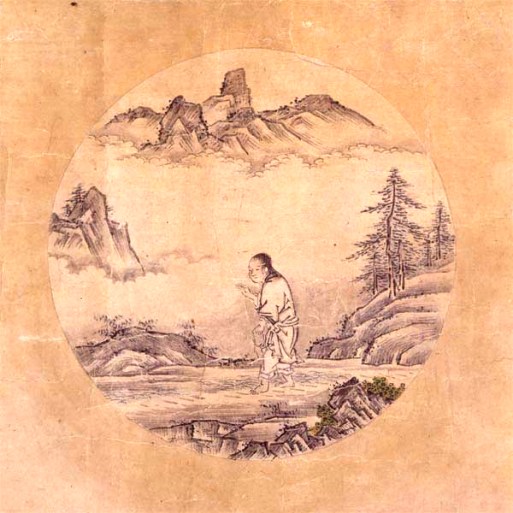
Oxherding picture number 2: noticing the footprints


The Great Way is not difficult
for those who have no preferences.
When love and hate are both absent
everything becomes clear and undisguised.
Make the smallest distinction, however,
and heaven and earth are set infinitely apart.

If you wish to see the truth
then hold no opinions for or against anything.
To set up what you like against what you dislike
is the disease of the mind.

When the deep meaning of things is not understood
the mind’s essential peace is disturbed to no avail.

The Way is perfect like vast space
where nothing is lacking and nothing is in excess.
Indeed, it is due to our choosing to accept or reject
that we do not see the true nature of things.
Be serene in the oneness of things
and such erroneous views will disappear by themselves.

When you try to stop activity to achieve passivity
your very effort fills you with activity.
As long as you remain in one extreme or the other,
you will never know Oneness.

Those who do not live in the single Way
fail in both activity and passivity, assertion and denial.
To deny the reality of things is to miss their reality;
to assert the emptiness of things is to miss their reality.

The more you talk and think about it,
the further astray you wander from the truth.
Stop talking and thinking
and there is nothing you will not be able to know.

To return to the root is to find the meaning,
but to pursue appearances is to miss the source.
At the moment of inner enlightenment,
there is a going beyond appearance and emptiness.
The changes that appear to occur in the empty world
we call real only because of our ignorance.
Do not search for the truth; only cease to cherish opinions.

Do not remain in the dualistic state; avoid such pursuits carefully.
If there is even a trace of this and that, of right and wrong,
the Mind-essence will be lost in confusion.
Although all dualities come from the One,
do not be attached even to this One.

When the mind exists undisturbed in the Way,
nothing in the world can offend,
and when a thing can no longer offend,
it ceases to exist in the old way.

When no discriminating thoughts arise,
the old mind ceases to exist.
When thought objects vanish, the thinking-subject vanishes,
and when the mind vanishes, objects vanish.

Things are objects because there is a subject or mind;
and the mind is a subject because there are objects.
Understand the relativity of these two
and the basic reality: the unity of emptiness.
In this Emptiness the two are indistinguishable
and each contains in itself the whole world.
If you do not discriminate between coarse and fine
you will not be tempted to prejudice and opinion.

To live in the Great Way
is neither easy nor difficult.
But those with limited views
are fearful and irresolute;
the faster they hurry, the slower they go.

Clinging cannot be limited;
even to be attached to the idea of enlightenment is to go astray.
Just let things be in their own way
and there will be neither coming nor going.

Obey the nature of things
and you will walk freely and undisturbed.
When thought is in bondage the truth is hidden,
for everything is murky and unclear.
The burdensome practice of judging
brings annoyance and weariness.
What benefit can be derived
from distinctions and separations?

If you wish to move in the One Way
do not dislike even the world of senses and ideas.
Indeed, to accept them fully
is identical with true Enlightenment.

The wise man strives to no goals
but the foolish man fetters himself.
There is one Dharma, not many;
distinctions arise from the clinging needs of the ignorant.
To seek Mind with discriminating mind
is the greatest of all mistakes.

Rest and unrest derive from illusion;
with enlightenment there is no liking and disliking.
All dualities come from ignorant inference.
They are like dreams of flowers in air: foolish to try to grasp them.
Gain and loss, right and wrong;
such thoughts must finally be abolished at once.

If the eye never sleeps,
all dreams will naturally cease.
If the mind makes no discriminations,
the ten thousand things are as they are, of single essence.

To understand the mystery of this One-essence
is to be released from all entanglements.
When all things are seen equally
the timeless Self-essence is reached.
No comparisons or analogies are possible
in this causeless, relationless state.
Consider motion in stillness
and stillness in motion;
both movement and stillness disappear.
When such dualities cease to exist
Oneness itself cannot exist.
To this ultimate finality
no law or description applies.

For the unified mind in accord with the Way
all self-centered striving ceases.
Doubts and irresolutions vanish
and life in true faith is possible.

With a single stroke we are freed from bondage;
nothing clings to us and we hold to nothing.
All is empty, clear, self-illuminating,
with no exertion of the mind’s power.
Here thought, feeling, knowledge, and imagination are of no value.
In this world of Suchness
there is neither self nor other-than-self.

To come directly into harmony with this reality
just simply say when doubt arises, “Not two.”
In this “not two” nothing is separate,
nothing is excluded.
No matter when or where,
enlightenment means entering this truth.
And this truth is beyond extension or diminution in time or space;
in it a single thought is ten thousand years.

Emptiness here, Emptiness there,
but the infinite universe stands always before your eyes.

Infinitely large and infinitely small;
no difference, for definitions have vanished
and no boundaries are seen.
So too with Being and non-Being.
Waste no time in doubts and arguments
that have nothing to do with this.

One thing, all things;
move among and intermingle,
without distinction.
To live in this realization
is to be without anxiety about nonperfection.
To live in this faith is the road to nonduality,
because the nondual is one with the trusting mind.

Words!
The Way is beyond language,
for in it there is no yesterday, no tomorrow, no today.

FACEBOOK LIVE Satsang tonight 8pm UK time

Please join me for a FACEBOOK LIVE satsang tonight at 8pm UK time.

You can ask me questions in writing via the comments section and I will do my best to respond. 

Click on this link to my Facebook page to join me: http://www.facebook.com/tomdas.nd

Find the time in your timezone here: https://goo.gl/Lz7jvm

See you soon

Best wishes

Tom