Krishnamurti: meditation is not an escape from the world

154552.jpg

Meditation is not an escape from the world; it is not an isolating self-enclosing activity, but rather the comprehension of the world and its ways. The world has little to offer apart from food, clothes and shelter, and pleasure with its great sorrows.

Meditation is wandering away from this world; one has to be a total outsider. Then the world has a meaning, and the beauty of the heavens and the earth is constant. Then love is not pleasure. From this all action begins that is not the outcome of tension, contradiction, the search for self-fulfillment or the conceit of power.

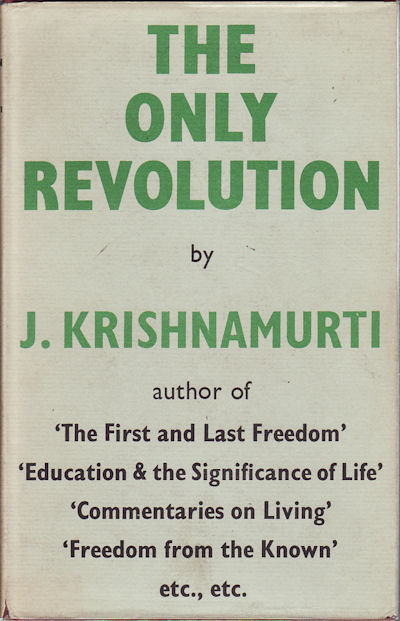
Jiddu Krishnamurti, taken from his book ‘The Only Revolution’

Q: Who sees there is no doer? (Self-Enquiry, Ramana, Who am I?)

Q: You say there is no doer, and that this is a key point in your teaching, but who or what sees there is no doer? 

Tom: Why do you ask? What do you hope to gain from that question? Do you think that knowing the answer to this question will set you free? Do you think the answer to this question can be found in words? Contemplate on these questions.

It’s easy to say that ‘I see’, or that ‘awareness sees’, but does this really get us anywhere? What is the concept of awareness but another way of verbalising that something is being perceived. When we say ‘awareness sees’ or ‘I am aware’, all we are really saying is that ‘something is seen’. It’s tautology, just a different way of saying the same thing.

wp-1474790287732.png

Q: So why do so many non-dual teachers prescribe self-inquiry as a method?

Tom: The real point of asking ‘who or what sees’ (ie. self enquiry) is to notice that what we commonly take ourselves to be is actually something that is seen, and is not the seer/doer at all.  What we, in ignorance or misapprehension, commonly take to be the subject is actually experienced as an object(s). This is also the point of the awareness teachings, to see through the doer – not to get caught up and identified with a concept of awareness.

We commonly take ourself to be the body-mind apparatus, but it can be seen that the body and mind are both objects that are perceived. The body and mind, as far as our direct experience goes, are parts of our experience, they are parts of ‘the perceived’. There is no evidence that they are perceivers of the experience. (That is not to say that they are not representations of the subject/perceiver within our consciousness, but just that there is no evidence either way).

Q: OK… (pause)

Tom: So, back to your question: what is it that sees?

Here’s the shorter answer: that which sees is that which sees. Why name it? Does naming it mean we know it any better? Are we any the wiser for naming it or calling it ‘awareness’ or ‘consciousness’ or ‘me’ or ‘I’?

Why settle for verbal explanations or spiritual-sounding slogans? Instead question these statements. Don’t get rid of one dogma and replace it with another. Be true to yourself, be true to what you know and your own experience:

Things are seen – that much I know. What sees? – I do not know…

wp-1474790287732.pngQ: But don’t we need to know exactly what it is that sees?

Tom: No. Not only do we not need to know what sees, we cannot know what sees (as an object). We only know that we see, and not what sees. That is enough. And that’s our actual experience, right? We don’t need to take on a new belief such as the belief that we are awareness. Sure, we are aware. or you could say awareness is here, but we don’t have to go further and say ‘I am awareness’. Let’s just stick to our experience and not pretend to know something that we don’t. As Ramana Maharshi says:

‘The state we call realization is simply being one’s self, not knowing anything or becoming anything.’

There are a few other aspects to the teachings too, which I’ll quickly summarise for you. I go into more detail on the group meetings, but briefly:

1. We need to stop mistaking certain objects (ie. the appearance of the body-mind organism) for being the subject. That is a key purpose of what I call the ‘awareness teachings’ that are found in Shankara’s Advaita Vedanta and in many schools of Mahayana Buddhism.

2. We need to notice and understand deeply that all objects are transient – they all come and go, and that no object brings lasting satisfaction. As this realisation deepens and takes root, this leads us to naturally turn away from depending on objects as a source of happiness. This leads to our addictive and suffering-causing desires (vasanas) to naturally fall away. Suffering dissolves away and joy naturally rises in its place, rearing its head from time to time as it pleases.

3. We need to see that all objects comes and go spontaneously, including thoughts and actions, and so realise that there is no doer-entity controlling it all. What we call the mind is just a spontaneous succession of thoughts, with no evidence of any entity controlling it. This is the real point of self-enquiry.

As Ramana Maharshi said when a questioner asked him about self-enquiry:

‘Reality is simply the loss of ego. Destroy the ego by seeking its identity.  Because the ego is no entity it will automatically vanish and reality will shine forth by itself.
This is the direct method. All other methods retain the ego. In those paths so many doubts arise, and the eternal question remains to be tackled. But in this method the final question is the only one and is raised from the very beginning.’

When we see the false to be false, meaning when we see the doer (ego) is an illusion, whatever remains is reality. It just is whatever is. It doesn’t have to be named, known or understood – it’s just what is.
A complete teaching: Relax. Listen to the beat of the drum.

water-drop

Relax.

Listen to the beat of the drum.

There’s no-one here!

Tom Das

This pithy statement actually encapsulates the entire teaching. How? Let me explain:

Relax…

This refers to generating peace, and relaxation primarily of the mind. Like a dense fog clearing in the heat of the morning sun, allowing the mind to calm and thoughts to lessen gives rise to the conditions in which clarity of seeing-understanding can arise.

As we practice being peaceful, we naturally become happier: a warmth in our heart naturally blossoms as our addictive pleasure-seeking desires weaken and fade. We learn to be happy where we are, and then we pass beyond the need for the body-mind to even be happy or at peace. Gradually compulsive desires fall away and we no longer suffer if we do not receive what we want. Our compulsive desires fade, and only preferences remain.

Listen…

This refers to the insight part of the teaching, the essence of the teaching. It is clear seeing-understanding. As the morning fog clears, things can be seen for what they are, as they are, brightly illuminated by the sun of knowledge/insight/understanding.

…to the beat of the drum.

What do we listen to? What are we looking at? The drum can represent the body-mind entity, an object in the world, or just a simple drum. The point is to see things as they are. As the drum beats, we can watch it, hear it, follow its mechanism.

We can see how there is nobody inside the drum making a noise. We can see how the sound is an automatic  reflexive response when the skin is struck with the striking implement. We can see how the drum is empty, and the resonance within the empty space (full of air) creates the reverberating sound.

We can see how this is true of all things, how all things act and function without there being a separate doer-entity that initiates and creates its actions. Rather there is a natural spontaneously self-expressing interdependence and non-separation.

There’s no-one here!

Like the drum, we are essentially empty, meaning there is no trace whatsoever of a separate individual doer/self. This is the essential realisation of freedom.

It is not that the appearance of the body-mind goes or changes, or that you lose the experiential perspective of being a particular body-mind. No. Perception from the apparent perspective of the body-mind remains.

The term ‘no-one’ refers specifically to no-doer. It is the seeing that there never was a separate doer-entity. It is seeing that this doer was created by thought, it was imagined by thought and believed to exist by thought.

A summary

Through generating peace (Relax…) the grip of thought was loosened, through observing (Listen…) things were examined with the intention of seeing things (…the drum…) as they are. Comparing what is seen against the content of our thoughts, it is revealed that the concept of doership does not accurately reflect the reality of what is perceived: there is no doer.

The concept of doership has been operating for so long within most of us. It is this concept that causes our suffering. The understanding that there is no-doer can then act to root out the concept of doership and remove suffering.

What we are left with is what was always here: this. It doesn’t have to be named, you don’t have to put it in words, you don’t have to carve it up using the knife of concepts (although you can if you want). It’s just whatever’s happening, spontaneously arising, however it arises.

This.


Can you know something is infinite?

the_center_galaxy_of_cats_eye

How can you know something is infinitely powerful or that it will last forever (ie. an infinite amount of time)? Just because it is very very powerful or has lasted a very very long time, doesn’t mean it is infinite in those dimensions. Similarly, just because something has been around for a very very long time or just because you can’t remember something beginning, doesn’t mean it was never born. Maybe it is very very old, but you have no way of knowing if it was infinitely old.

If you think something is infinite in some way, then I would say that’s a belief. Infinity is a concept, and we have no way of knowing if anything infinite actually exists at all.

This is an except from a larger article:  Can you know something is infinite, limitless, indestructible, eternal or unborn?

Ranjit Maharaj: use a thorn to remove a thorn, then throw them both away

Ranjit Maharaj

This passage below is taken from ‘Illusion vs. Reality’ (page 6) by Shri Ranjit Maharaj. Shri Ranjit’s guru (Shri Siddharameshwar Maharaj) was also the Guru of Nisardagatta Maharaj, making Ranjit and Nisargadatta ‘guru-brothers’, ie. contempories in the same teaching lineage.

The address is false but when you reach the goal, it is Reality. In the same way, all the scriptures and the philosophical books are meant only to indicate that point, and when you reach it they become non-existent, empty.

…For example, to remove a thorn in your finger you use another thorn; then you throw both of them away. But if you keep the second thorn which was used to remove the first one, you’ll surely be stuck again.

To remove ignorance, knowledge is necessary, but finally both must dissolve into Reality. Your Self is without ignorance, without knowledge.

…If you keep the second thorn, which means knowledge, even if it is a golden thorn, you’ll be stuck [by the second thorn].

…Knowledge is a great thing but it must be only a remedy. When the fever goes off thanks to the medicine you take, you must stop taking it. Don’t prolong the treatment or you will create more problems.

Knowledge is necessary only to remove the disease of ignorance. The doctor will always prescribe a limited dosage!

Also see here for more

Buddha: How to approach the teachings

buddha

Going back to the Pali suttas, the Buddha also repeatedly warned against being attached to any particular teaching or teaching tradition:

‘Do not go by oral tradition, by lineage of teaching, by hearsay, by a collection of texts, by logic, by inferential reasoning, by reasoned cogitation, by the acceptance of a view after pondering it, by the seeming competence of a speaker, or because you think, ‘This ascetic is our teacher.’
AN 3.65 Kesaputti [Kālāma] Sutta

This really is quite a stark warning, and we could see this as a very ‘modern’ and scientific way of approaching this search for freedom from suffering.

The above text is an except taken from a larger article: Buddhism: How enlightenment happens


Levels of reality

water oceanic
Are there levels of reality?

I have often seen people talk and write about various levels of reality. Typically, they talk of the level of the absolute and the level of the relative. On the level of the absolute, everything is one, so they say. Whereas on the relative level, the level of being a person different rules apply. On the relative level differentiation exists, we talk to each other, we love one another, we get annoyed and irritated, we buy fast-food from time to time, and yet ultimately, at the highest and truest level we are told this is all oneness.

Well let me start off by saying that I reject the notion of levels of reality. I think reality has various aspects, but not levels per se. Now this may seem like a minor difference, a play of semantics if you will, but let me explain the difference.

Talking about the same thing in different ways

When I say reality has various aspects, all I really mean is that there are various ways you can talk about reality – actually there are various ways you can talk about anything. That doesn’t mean there are different levels of reality.

Lets take a simple example: lets take a human body. You can talk about a human body  in different ways. You can talk about it in terms of its size: you can say it is big, small, medium. You can talk about its age: is it a young or older body. You can talk about it in terms of organ systems such as the cardiovascular system or digestive system and how they function and describe the body that way, or you can talk about its anatomy and how various parts of it fit together. You can talk about the body’s name and culture – eg. maybe it is called John and it comes from the United Kingdom, you can talk about its occupation. You could talk about its fashion sense, its muscularity…

…ok ok, hopefully you get the idea: there are different ways you can talk about things. There are different conceptual frameworks from where we can view the body. And this is true for anything. We can talk about a pebble in terms of its age, size, geology or how good it would be to skim on a lake’s surface. We can talk about a lake in terms of its scenic beauty, how choppy its water are, its phosphorus content, or remark how it is all made up (mainly) of water.

Now, how many levels does a body or a pebble have? It doesn’t actually have any levels at all – there is only one body or stone (in the above examples) – it’s just that we can talk about them in various ways. In the same way there are no levels in reality, just different ways of talking about it.

No particular conceptual framework is intrinsically higher than another

Also note that no particular way of talking about the body or a pebble is intrinsically better that any other way. It just depends on what you want the conceptual framework to achieve. For example, if you want to skim a stone on the surface of a lake, then it’s less useful to talk about the geology of the stone, and more useful to look at it in terms of its shape and size with respect to achieving your goal (skimming it across the lake). You can’t legitimately claim that one way of viewing something is intrinsically higher and another way is lower, which is something you often hear when talking about ‘ultimate reality’ or the ‘highest level’. It just depends on how well the way you are conceptualising and viewing the object(s) in question fits in with your goal.

It depends on what you want to achieve

Similarly, it is not necessarily better to talk about the body in terms on physiology or organ systems compared to it’s occupation or fashion sense. As previously stated, it just depends on what you want to achieve. If the body has a disease, then understanding the physiology and how to correct any imbalance or defect in this is useful. Conversely if you are going out on a first date, then perhaps a degree of fashion sense would be useful.

No paradoxes, no contradictions

Also there in no contradiction in talking about a single object in different ways depending on the context. There is no paradox that a stone has both an age and a shape, or that a river is a single system made up of a variety of different things, all of which are in motion. There is a consistent underlying reality that underpins the various ways we talk about it. No contradiction or paradox at all.

Different ways of talking about the same experience

Remember, what we are talking about here is our experience of reality. Our reality is our experience – that’s all we know. We can talk about how everything we perceive is non-different to our consciousness, and we can also talk of how things interact within this consciousness, and the rules and consequences thereof. These are just different ways of talking about our experience and our experiences. No particular way is higher or lower, and there are no actual ‘levels’ that exist apart from our conceptualisations.

The description is not the described

We can chose how to conceptually carve up and talk about our experiential reality in order to achieve certain specific aims. To that end these conceptual maps are useful and often necessary. However we must not mistake any particular conceptual map of (our experience of) reality for reality, just as no particular way of describing the body is the body itself.


Freedom, no doer, who sees there is no doer?

Q: But who sees there is no doer? Isn’t it the ego itself that sees through the illusion of self?

I use the word ‘ego’ to be synonymous with ‘doer’. Because there is a belief in being a doer, there is the notion that ‘I can change this’, ‘I can get somewhere better’, which is the seeking. This seeking is a subtle form of suffering.

When the doer is seen to be false, the seeking starts to collapse, and suffering fades.

To answer your question: who or what sees there is no ego? That which previously saw the ego is that which sees there is no ego. It is never the ego that sees: the ego is a construct of thought, which is always the seen.