Freedom is Absolute Total Forgiveness

(This question is continued from a prior post: Responsibility: if there is no doer and no-self…then what about responsibility?)

Question: OK, you mentioned total forgiveness? That’s confused me. Why do you say that?

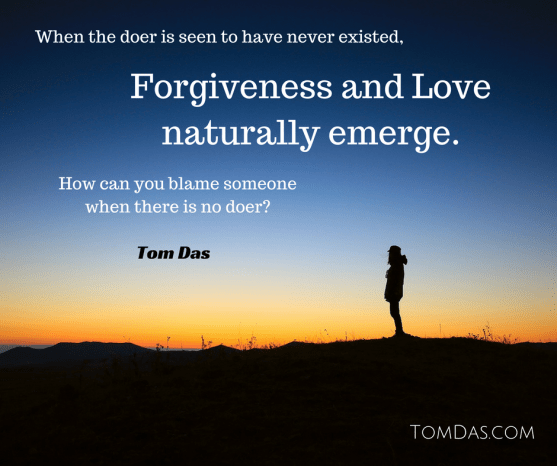
Tom: Well everything is just unconditionally accepted, choicelessly. That’s just the way things are. Whatever happens is whatever happens, and in that sense it is totally accepted regardless of what the body-mind thinks of it.

You could say our naturally awareness accepts and ’embraces’ everything within that happens within our awareness. In that sense there is constantly total forgiveness, or total  love, not the emotional love or forgiveness, though these phenomena tend to arise more frequently, but the choiceless acceptance/love/forgiveness of whatever is happening.

forgiveness-and-love-naturally-emerge

Poetry: Notice the tendency to cling

wheat-gold
Notice the tendency to cling,
Notice the suffering that ensues,
Clinging…suffering…
Suffering…clinging…
Be sensitive to any psychological discomfort,
See how subtle this suffering can be!
The clinging is the suffering
The suffering is the clinging.
Then, perhaps, notice how the mind sets up another ideal:
The ideal of not clinging.
The goal of no clinging,
And therefore no suffering.
– how wonderful that would be!
(so the mind thinks)
The mind is caught in the same trap!
Learn to see this trap,
Learn to sense this trap,
Learn to feel what this trap feels like,
Learn its taste, its weight,
In all its guises,
Learn the tune it plays in your body and mind.
In Freedom all is allowed:
Clinging, no clinging,
It’s all allowed.
There is no trying to get rid of anything,
No striving for perfection,
But seeing life for what it is,
Naturally emerges.
There is nothing wrong with striving for change,
For trying to achieve an ideal.
Nor is there an issue with letting go,
With allowing things to be as they are.
Both these movements have their role,
Both clinging and lettings go are parts of life.
Freedom doesn’t care,
Freedom doesn’t mind,
And so things naturally balance out,
Or not
– either is ok.

Heart-Opening, Non-Duality & Freedom

unafraid2

(Continued from a previous post: Responsibility: if there is no doer and no-self, and if there no nobody here doing anything, then what about responsibility?)

Question: You mentioned earlier that the heart opens? That sounds rather fluffy and vague to me – what does it mean?

Tom: Yes, I know, it’s a bit of a vague term, but I like it! What I call heart opening is not the same as Freedom – it’s important to realise that – but there is a relationship between the two. The heart can open to a large extent without Freedom being realised, and conversely Freedom can be realised and the heart not be open. However the heart can only really fully open when Freedom has been realised, and by that I mean when the notion and sense of doership has been seen through and seen to be false.

So what is heart opening? Well it happens differently with different people, depending on their conditioning, but essentially it is an openness of the emotional centre and a tendency towards feeling open, loving, peaceful and joyous.

Question: What do you mean by ‘openness of the emotional centre’?

Tom: I mean a willingness to feel one’s feelings, really feel what you’re feeling. When this happens, when we allow feelings to come and go, over time our emotions start to balance out and a feeling of wellbeing and love can start to naturally emerge.

We start to feel happier, more grateful, more loving, kinder, and more considerate. A sense of wellbeing becomes our norm. These are the characteristics of an open heart, a loving heart, and as I said, it can occur before of after enlightenment (realising Freedom), or not at all.

Q: Does that mean that you become unconditionally loving all the time?

Good question. Of course, like all subtle objects (such as emotions, feelings and mental states), emotional love and compassion also come and go. This is quite natural. You are not necessarily loving 100% of the time, far from it! You remain thoroughly human: you can get irritated by relatively superficial things, you may feel grumpy if you haven’t had enough sleep, but the tendency is more towards those loving emotions.

You see in Freedom it doesn’t matter: you are not trying to be loving or kind, you are not trying to open the heart. It’s something that can’t be forced, and the heart is naturally more open at some times compared to at other times. That is fine, and that’s just how it goes. Sometimes it’s good for the heart to be closed. But, when it’s safe to do so, we can allow ourselves to feel whatever we are feeling, not pushing ourselves, not forcing our heart open or becoming overly sentimental, but by just being real with who we are at this moment in time.

This willingness to feel is a form of fearlessness. We are unafraid to feel, we are unafraid to feel unhappy, we are unafraid to feel even fear. When we are essentially unafraid of our feelings, we start to become extraordinarily sensitive. Lots of emotions and feelings can flood in, feelings we may have held back and suppressed for many years. Energetically and emotionally this can be a time of great ups and downs in our ‘spiritual-emotional’ journey.

Our emotional apparatus, over time, becomes more sensitive and we learn who we are on an emotional level. Over time our emotions start to balance our and come into alignment with the body and the world. At this point we can learn to better trust our emotions as a source of intelligence and allow them to guide us in our actions and relationships.

Q: Did you say that heart opening can come before or after Enlightenment? (To be continued in a future post)

Q: I’ve noticed that I often feel less than I did before, for example I care less about some things now (To be continued in a future post)
Jesus: How to pray

15698065_234844103607729_878795965755353967_n.jpg

Alternative translation

“Whenever you pray, go into your room, close the door, and pray to your Father who is hidden. And your Father who sees from the hidden place will reward you.”

(International Standard Version)

Here is the context of the quote:

And when you pray, you shall not be like the hypocrites, for they love to pray standing in the synagogues and on the corners of the streets so that they might be seen by men. Truly I say to you, they have their recompense.
But you when you pray, enter into your inner room, and having shut your door, pray to your Father, the One in secret. And your Father, the One seeing in secret, will reward you.
And when you pray, do not babble on like pagans, for they think that by their many words they will be heard.
Do not be like them, for your Father knows what you need before you ask Him.

Matthew 6:5-8

Responsibility: if there is no doer and no-self, and if there no nobody here doing anything, then what about responsibility?

at-some-point-there-comes-a-realisation

Question: If there is no doer, then how does the notion of responsibility fit into this? If there is nobody here, then surely there can’t be anyone responsible?

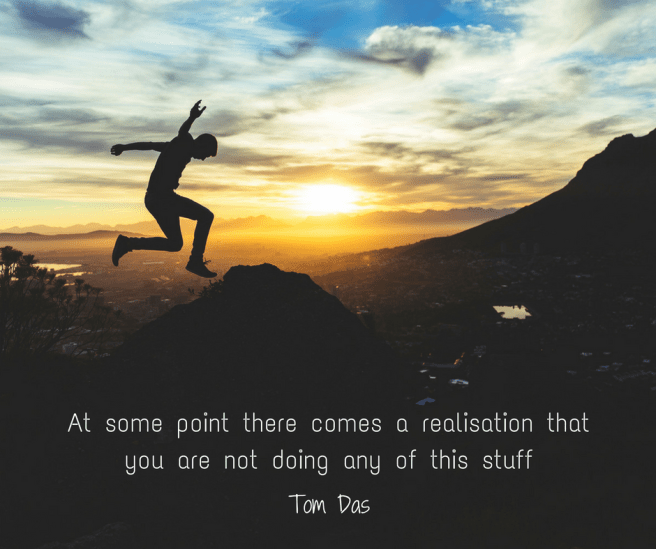
Tom: This teaching is not an excuse to act irresponsibly or unethically. Responsibility is an important part of being human, and it is a phenomena that arises by itself from time to time, like any other phenomena we experience.

By responsibility I mean a natural sense of caring, affection, consideration, thoughtfulness and desire to take care of the people, animals and world around us.

As far as I can see, when we free ourselves from illusions of a separate doer/self, the energies in the human organism naturally tend to balance out. This is because the distorting centripetal factor of egotism (I define ego as the belief in being a separate doer-entity who creates thoughts and actions) is no longer at play. And when the energies in the body are harmonious and in balance, the body-mind naturally tends to become responsible, kind and loving.

It’s just what tends to happen, and it takes time, depending on your conditioning which in turn depends on the culture, environment, genetics, etc.

And it’s not just responsibility, it’s true for a whole load of so-called positive qualities such as love, sensitivity, kindness, thoughtfulness, empathy, openness, being non-judgmental. These just tend to arise, by themselves, when the doer/ego is seen to be non-existent.

Q: So there is no doer, but these things happen by themselves?

Tom: Yes, exactly. Of course it doesn’t have to be like that. Perhaps the energies in the body don’t balance out and the heart doesn’t open and these loving qualities do not express themselves. In Freedom it doesn’t really matter. There is no attempt to be more loving or to be more responsible – that would just be the ego striving for an ideal. Freedom doesn’t care for these artificial ideals and does not try to conform to imaginary notions. But precisely because there is no self-motive, these qualities naturally tend to arise.

And if these qualities don’t arise that’s ok too. This is Freedom: whatever happens is whatever happens, no judgement, no motive, total forgiveness, and nobody doing any of it.


Q: OK, you mentioned total forgiveness? That’s confused me. Why do you say that? 

Q: You mentioned earlier that the heart opens? That sounds rather fluffy and vague to me – what does it mean?

Q. But I think there’s another type of responsibility, not just the sense of responsibility for others and caring for those around you, not just being responsible for the people and word, but a sense ‘I am responsible for my thoughts and actions’. And if you do something wrong, then you are ‘responsible’ and accountable for that. What about that? Does that exist if there is no doer? (To be continued in a future post)
Ramana Maharshi: Surrender and Jnana

ramana-neither-duality-or-nonduality

Question: I find surrender is easier. I want to adopt that path.

Ramana: By whatever path you go, you will have to lose yourself in the One. Surrender is complete only when you reach the stage ‘Thou art all’ and ‘Thy will be done’. The state is not different from jnana (knowledge or understanding).

In soham there is dvaita (duality). In surrender there is advaita (non-duality). In the Reality there is neither dvaita nor advaita, but That which is, is.

Surrender appears easy because people imagine that, once they say with their lips ‘I surrender’ and put their burdens on their Lord, they can be free and do what they like. But the fact is that you can have no likes or dislikes after your surrender and that your will should become completely non-existent, the Lord’s Will taking its place.

Such death of the ego is nothing different from jnana. So by whatever path you may go, you must come to jnana or oneness.

Taken from Day by Day with Bhagavan, p.85


Tom’s comments:

Ramana states that the path of surrender and the path of knowledge (Jnana) lead to the same goal.

They lead us not to some state of duality or non-duality, but to ‘that-which-is’, ie. what is already here. This place is simply what is beyond concepts such as duality or non-duality, or indeed other concepts such as self/no-self, consciousness or even oneness.

He states that Jnana is simply the death of the ego. This is not some knowledge of metaphysics or consciousness, but the loss of the ego-illusion. What is the exact illusion that is lost? It is the loss of the illusion of doership and the self-centred compulsive desires that flow from that illusion. This is what is meant by ‘death of the ego’.

This understanding can be ‘gained’ through the path of surrender, or through self-enquiry: either give yourself to the Lord (surrender) or see that the doer is a fiction (through self-enquiry) and end up with Understanding (Jnana).

❤ Om Namo Bhagavate Sri Ramanaya ❤