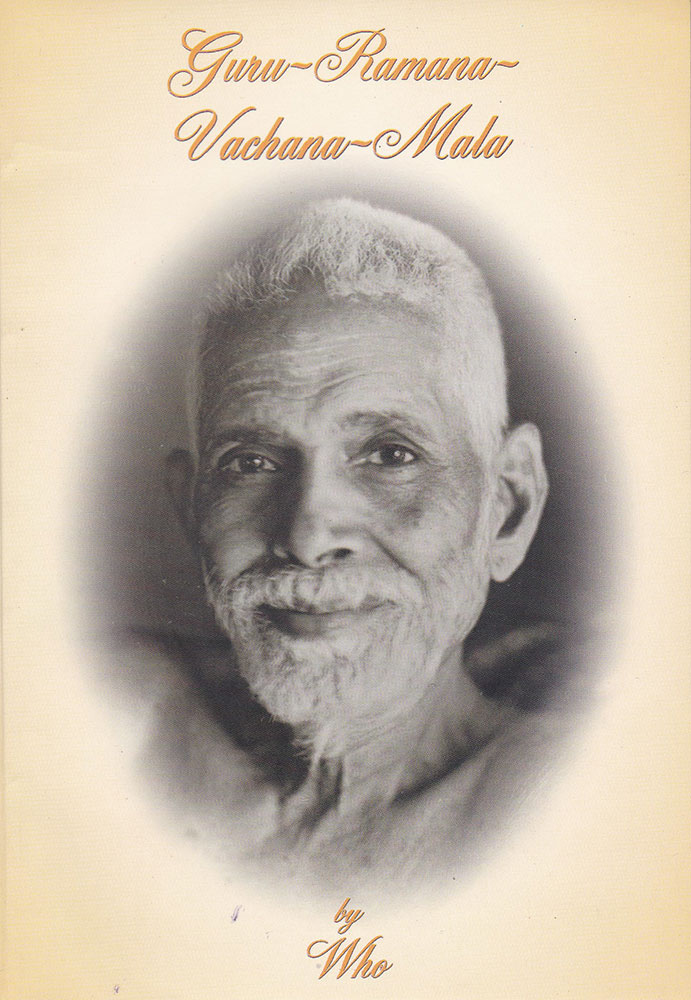
Guru Ramana Vachana Mala (PDF download)- a wonderful text on the teachings of Sri Ramana Maharshi

Guru Ramana Vachana Mala (‘A stringing together (mala) of Guru Ramana’s sayings (verbal teachings)’) is a small but wonderful text that concisely and accurately summarises the teachings of Sri Ramana Maharshi. It was compiled with the help of both Sri Ramana Maharshi and Sri Muruganar and clarifies areas of the teaching that may not be otherwise clear for the seeker. It also summarises the essential Vedanta teachings, as per verse 3 of the text.

Click here to download Guru Ramana Vachana Mala in PDF format

Update 2024: Ramana Ashram have asked me to remove the PDF download of Guru Ramana Vachana Mala

Update 2026: My understanding is that the copyright for this text has now expired as of 31st December 2025. Given the text is no longer under copyright, I have re-uploaded it to this website

The text consists of 349 selected verses compiled together by Sri K. Lakshmana Sarma (who wrote under the pseudonym ‘Who?’), who was not only intimate with Sri Ramana’s teachings, but also a scholar in Vedantic studies and also fluent in the Tamil, Sanskrit and English languages – these verses are translated into English by Lakshmana Sarma himself, so we can be confident the translation is accurate with regards to both the accuracy and intention of the teaching. The verses are helpfully organised by topic and about 300 of these verses are taken from the text Guru Vachaka Kovai which is widely accepted as being the most authoritative text on Sri Ramana Maharshi’s verbal teachings.

Whilst the verses in Guru Ramana Vachana Mala do not go into great detail on the method of Self-Enquiry compared to other recommended texts, they are very illuminating nonetheless and give great clarity on areas of the teaching that may otherwise not be clear for the seeker. I therefore highly recommend this book, but I also recommend that you read this together another of the recommended texts pertaining to Sri Ramana, such as The Path of Sri Ramana which explains the process of Self-Enquiry in greater detail.

Sri Lakshmana Sarma was in close contact with Sri Ramana Maharshi for over 20 years and was also good friends with Sri Muruganar (who wrote Guru Vachaka Kovai). He was also one of only two people who received private tuition by Sri Ramana Maharshi on the true/deeper meaning of the teachings (the other person was Sri Muruganar), this private tuition extending over a period of many years, and he was known for constantly checking his understanding of the teachings with Sri Ramana to ensure that his understanding was accurate.

For example, Sri Ramana said that Lakshmana Sarma’s commentary on Ulladu Narpadu (40 verses on reality) was the best commentary available, which is unsurprising given that Sri Ramana himself taught Lakshmana Sarma the meaining of each verse in this text over a period of several years.

As stated above, Guru Ramana Vachana Mala was composed with the help of both Sri Ramana Maharshi and Sri Muruganar, as T.N. Venkataraman (the then president of Sri Ramana Ashram) writes in the preface to the 8th edition of Maha yoga:

‘Just as Lakshmana Sarma had composed Sri Ramana Hridayam with the help and guidance of Sri Bhagavan, he composed Guru Ramana Vachana Mala with the help of both Sri Bhagavan and Sri Muruganar, and in doing so he had a further opportunity to study Sri Bhagavan’s teachings deeply and to receive pertinent instructions from Him.’

These above factors, together with the fact that this text was first published during Sri Ramana’s lifetime means we can be confident that the teachings presented here are a true representation of Sri Ramana’s teachings.

Self enquiry and Self surrender | Sri Ramana Maharshi

Self-enquiry is diving into the Self, Self-surrender is letting go of body, mind and world. Both these ways lead to Self-abidance and Liberation/ Self-Realisation.

This video was recorded live during an online meeting and put together by volunteers;

For further information visit: https://tomdas.com/events/

Why turn away from the world? The outer is a reflection of the inner

‘The mind is by nature restless. Begin liberating it from its restlessness; give it peace; make it free from distractions; train it to look inward; make this a habit. This is done by ignoring the external world and removing the obstacles to peace of mind’

~Sri Ramana Maharshi, Talks with Sri Ramana Maharshi, talk no. 26

Objection: I have a slightly different view then Ramana perhaps did on ignoring the external world. It seems to me that the external world is the reflection of the inner. Becoming conscious of the beauty in nature resonates with the inner. This is perhaps a more indigenous view and is much older then even Vedanta and goes back even to the time when humans were Neanderthals as well as Homo sapiens when everything in nature was animating in presence.

Tom: Yes, being with nature is one of many things that can bring us in tune with the Self and bring us genuine peace and genuine insight, but ultimately for realisation to occur (and thus for suffering to end) one must turn within and all thoughts must cease. Otherwise the illusion of time and space are not seen through and suffering (and duality) continue, even if in a subtle way.

This is why Sri Ramana Maharshi writes in Who Am I?:

Q. When will the realization of the Self be gained?
Sri Ramana: When the world which is what-is-seen [ie. objects] has been removed, there will be realization of the Self which is the seer.
Q. Will there not be realization of the Self even while the world is there?
Sri Ramana: There will not be.

~ Sri Ramana Maharshi, Who Am I?

Tom: What we call the world (ie. space and time and people) is actually a projection of mind/thought. Put simply, the world, space and time are simply thoughts. Again, this cannot be known unless we turn within, away from the world, towards the Self, and thoughts competely cease. From Sri Ramana Maharshi:

‘When the mind, which is the cause of all cognition’s and of all actions, becomes quiescent, the world will disappear…All the texts say that in order to gain release one should render the mind quiescent; therefore teaching is that the mind should be rendered quiescent.’

~ Sri Ramana Maharshi, Who Am I?

Tom: When thoughts completely cease, time and space disappear. If time and space are still appearing, it is because thought (namely the ‘I-thought’, which is the notion or thought or belief that ‘I am a body-mind’) still persists.

Therefore, when the world appears, the Self does not appear; and when the Self appears the world does not appear.

~ Sri Ramana Maharshi, Who Am I?

When the mind comes out of the Self, the world appears.

~ Sri Ramana Maharshi, Who Am I?

What does it really mean to ‘be still’? Summa Irru | Sri Ramana Maharshi

Now it is true that Sri Ramana often said that we should ‘be still’ [in Tamil – ‘Summa Irru’ which means ‘be still’ or ‘just be’] and that this is the practice, but what did he mean by ‘be still’? If we read and examine Sri Ramana’s written work ‘Who Am I?’, we will see what Sri Ramana means when he says ‘be still’ or ‘keep quiet’. Note that we can trust the teachings in ‘Who Am I?’ as an authentic rendition of Sri Ramana’s teachings as they were written by Sri Ramana himself.

Let us see: the first time we come across the notion of quieting the mind in ‘Who Am I?’ is as follows:

‘When the mind, which is the cause of all cognition’s and of all actions, becomes quiescent, the world will disappear.’

Now on the face of it this is quite a strange statement for Sri Ramana to make: that the world will disappear when the mind is still. Clearly, when Sri Ramana states that the mind is to be quiet, he is perhaps using these words in a different way to how they are normally used. How can it be that when the mind becomes quiet the world disappears?

Well earlier in ‘Who Am I?’ Sri Ramana explains that it is the mind is a power that creates or projects the entire body, mind and world*, so to ‘be quiet’ means not just to still the ordinary thinking mind, but to still this world-projecting power, ie. to remove all of Maya. Ramana repeats this, see here, also from ‘Who Am I?’:

Question: When will the realization of the Self be gained?

Sri Ramana Maharshi: When the world which is what-is-seen has been removed, there will be realization of the Self which is the seer

Question: Will there not be realization of the Self even while the world is there?

Sri Ramana Maharshi: There will not be.

I have a video here which explains the importance of this teaching. It fundamentally explains why some teachings are liberating and others are not:

Whilst some teachings may encourage us to still the mind, Sri Ramana is emphasising removing the entire body-mind-world from our consciousness. We can see that Sri Ramana’s teaching is far more extreme than many others – it is this extreme teaching that is needed to remove ignorance and realise the Self.

Sri Ramana emphasises Self-Enquiry as the only sadhana that will lead us to Liberation. Again, Sri Ramana’s teaching is more narrow and prescriptive in this way, as he maintains that Self-Enquiry is the only way. Let us see what else Sri Ramana writes in ‘Who Am I?’:

Question: Are there no other means for making the mind quiescent?

Sri Ramana Maharshi: Other than inquiry [Vichara; Self-Enquiry], there are no adequate means.

We can see that Sri Ramana is stating that sadhana or self-enquiry is essential to make the mind quiet, so that when Sri Ramana is asking us to ‘be still’ or ‘keep quiet’, he is actually asking us to do Self-Enquiry.

*What is called mind (manam) is a wondrous power existing in Self (atma-swarupam). It projects all thoughts…Other than thoughts, there is no such thing as the world….Just as the spider spins out the thread from within itself and again withdraws it into itself, so the mind projects the world from within itself and again absorbs it into itself. ~ from Who Am I? by Sri Ramana Maharshi


The above post is excerpted from a longer post entitled Is Papaji’s teaching the same as Sri Ramana Maharshi’s teaching?

Also see these videos here:

Sravana alone can result in Self-Realisation! Sri Ramana Maharshi on Sravana, Manana and Nididhyasana

Sri Ramana Maharshi

Tom: Traditionally Sravana refers to hearing the teaching. Manana refers to reflecting upon and thinking about the teaching which has been heard. Nididhyasana refers to prolonged meditation upon the Self, which culminates in Samadhi, which then leads to Moksha (Liberation).

The knot of the ignorance in the heart is broken completely only when one sees his Self as secondless through Nirvikalpa Samadhi

~Adhyatama Upanishad 1.17

Here is a quote from Sri Ramana Maharshi taken from Talks with Sri Ramana Maharshi, Talk no. 249 – all writing below in black type is from Sri Ramana, with my comments being in red:

The effects of sravana may be immediate and the disciple realises the truth all at once. This can happen only for the well-advanced disciple.

[Tom: later Sri Ramana explains that this means that the advanced/ripe seeker immediately goes into Samadhi, which is the same as abiding as the Self, as soon as the teaching is heard]

Otherwise, the disciple feels that he is unable to realise the truth, even after repeatedly hearing it. What is it due to? Impurities in his mind: ignorance, doubt and wrong identity are the obstacles to be removed.

(a) To remove ignorance completely, he has to hear the truth repeatedly, until his knowledge of the subject-matter becomes perfect

(b) to remove doubts, he must reflect on what he has heard; ultimately his knowledge will be free from doubts of any kind;

(c) to remove the wrong identity of the Self with the non-self (such as the body, the senses, the mind or the intellect) his mind must become one-pointed. All these things accomplished, the obstacles are at an end and samadhi results, that is, Peace reigns.

Some say that one should never cease to engage in hearing, reflection and one-pointedness. These are not fulfilled by reading books, but only by continued practice to keep the mind withdrawn.

The aspirant may be kritopasaka or akritopasaka. The former is fit to realise the Self, even with the slightest stimulus: only some little doubt stands in his way, it is easily removed if he hears the truth once from the Master. Immediately he gains the samadhi state. [Tom: Sri Ramana is stating that by listening alone, or by some other minimal stimulus, the ripe seeker spontaneously goes into samadhi without the need for the intermediary steps of reflecting upon the teachings or meditating upon them.] It is presumed that he had already completed sravana, reflection, etc. in previous births, they are no more necessary for him.

For the other all these aids are necessary; for him doubts crop up even after repeated hearing; therefore he must not give up aids until he gains the samadhi state. Sravana removes the illusion of the Self being one with the body, etc. Reflection makes it clear that Knowledge is Self. One-pointedness reveals the Self as being Infinite and Blissful.

An Enquiry: How to end Suffering

Q. Why do we seek?
Tom: Because we suffer.

Q. Why do we suffer?
Tom: Because we seek (something different to ‘what is’)

Q. Why do we both suffer and seek?
Tom: Because we take ourself to be a separate vulnerable body-mind entity. So long as we do so we are compelled to both suffer and seek.

Q. Why do we take ourself to be a separate body-mind entity?
Tom: Because we believe our thoughts that tell us so (ie. it is a belief that we are a body-mind entity – note that I call this belief ‘the ego’)

Q. What is the solution?
Tom: The solution is to stop this type of thinking.

Q. How can we do that?
A. We find, perhaps after much trial and error, there is only one essential method that consistently works, and that is to take one’s attention away from objective phenomena and place it upon the first person, the ‘I AM’, the Subject-Self. This practice is called Self-Enquiry. This process is explained in detail in the book The Path of Sri Ramana – Part 1

Q. My mind is too busy for this method
Tom: Then try another preliminary practice such as mantra recitation, devotion, chanting, watching the breath, hatha yoga, etc, as suits you – try another calming practice first – preferably a practice you are drawn to, and then when the mind is calm go straight back to Self-Enquiry.

Q. What about other teachings or methods?
Tom: You will find that other teachings methods (methods other than Self-Enquiry) at most only lead to a temporary effect that comes and goes. Don’t take my word for this, you can find out for yourself.

Q. Why do other methods not work?
Tom: Other methods, which involve attending to objects (gross or subtle objects such as thoughts, feelings, the breath, or other objects) invariably give rise to egoic ‘body-based’ thinking as the ego only survives when it can think of objective phenomena. And when we attend to objective phenomena you will see that the ego always finds a way to rise and ‘take control’ or ‘take the reins’ and posit itself as the true ‘I’.

Q. Isn’t this quite an extreme practice?
Tom: Yes, it is this extreme practice that is required, for most people, for the ego to end.

Q. Doesn’t this practice just perpetuate the separate ego-I?
Tom: No, that too is just another belief, that all practice necessarily perpetuates the ego-I. Try it – with consistent daily application results are quickly seen.

Q. Ok thanks!
Tom: You’re most welcome. Let me know how it goes!

Namaste

Tom

Loving and thinking of My Lord, Guru Bhagavan Ramana Maharshi | Muruganar

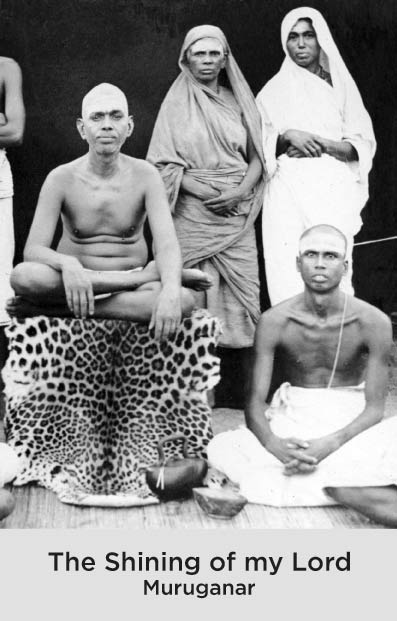
318. By thinking of my Lord, thought waves came to a complete rest. I was freed from attachment to action I performed. I separated from potential associations that approached me. I merged everywhere with mauna, the virtuous conduct of abiding as being.

319. Because thinking of my Lord yielded bliss for me, I realised that my Lord is the very form of bliss. By experiencing my lord through the mauna-consciousness in my heart, I too became, with delight, that [bliss]

320. Because the thought of our Lord destroys completely all other thoughts, devotees will come to experience the grace that is supreme tranquillity thought that thought of our Lord. The potency of the supreme power of our Lord’s mauna will destroy the ego of true devotees, bestowing on them the experience of our Lord’s very own real nature, the Self, jnana.

313. Why seek a tapas other than true love, the melting of the mind that comes from meditating on my Lord?

314. No other tapas is required for those whose minds have dissolved by meditating on the Lord.

315. Melting within by repeatedly thinking of him in a loving way became the cord with which the Lord tied me to himself. His ultimate real nature, existing as the unique pure being, surged forth as pure consciousness, absolutely blemishless grace.

The above verses are from The Shining of my Lord by Sri Muruganar


Guru Vachaka Kovai, Verse 659:

659. Those people who lack consciousness of being, the natural light [I am], and who consequently come, through ignorance, under the spell of karma and suffer, will have their delusion ended and reach the Self, the supreme reality, through meditation on a divine form that is dear to them.

THE NECESSITY OF SELF-ENQUIRY | Sri Ramana Maharshi


Sri Ramana Maharshi:

All the texts say that in order to gain release [Liberation] one should render the mind quiescent; therefore their conclusive teaching is that the mind should be rendered quiescent.
——–
Question:

Are there no other means for making the mind quiescent?


Sri Ramana Maharshi:

Other than [Self] inquiry, there are no adequate means.
——–
Above quotes taken from Nan Yar? (Who Am I?), written by Sri Ramana Maharshi

Pure sattva is the Self | Ramana Maharshi

Since sattva-guna [the constituent of prakriti which makes for purity, intelligence, etc.] is the nature of mind, and since the mind is pure and undefiled like ether, what is called mind is, in truth, of the nature of knowledge.

Tom: Often the Self is said to be beyond the three gunas (Tamas, Rajas and Sattva). Here Sri Ramana tells us that pure sattva, or pure mind, which is the utterly and totally peaceful mind in its natural state, is actually the Self.

When it stays in that natural [i.e. pure] state, it has not even the name “mind”. It is only the erroneous knowledge which mistakes one for another that is called mind.

Tom: This pure sattva, unlike mixed sattva, is completely devoid of any rajas and tamas, and so is beyond all the gunas.

What was originally the pure sattva mind, of the nature of pure knowledge, forgets its knowledge-nature on account of nescience, gets transformed into the world under the influence of tamo-guna [i.e. the constituent of prakriti which makes for dullness, inertness, etc.], being under the influence of rajo-guna [i.e. the constituent of prakriti which makes for activity, passions, etc.], imagines “I am the body, etc.; the world is real”, it acquires the consequent merit and demerit through attachment, aversion, etc., and, through the residual impressions [vasanas] thereof, attains birth and death.

~ Sri Ramana Maharshi, Vichara Sangraham (Self Enquiry), Question 11

Ramana Maharshi: ‘Those crazy-minded people…’ | The importance of dispassion towards sense-objects

Those crazy-minded people who do not know as real anything other than the objects of the senses, and who are thereby ruined, will term the jnana that flourishes luxuriantly through dispassion towards sense-objects ‘dry Vedanta’

Guru Vachaka Kovai, verse 148

Tom’s comments:

The way to the Truth Within (ie. jnana, meaning wisdom or knowledge), which, for practical purposes, is within each and everyone of us, has always meant we have to turn away from sense-objects, as well as mind-objects (ie. turn away from both gross and subtle objects).

However, for those tamasic and rajasic ones, who are attached to the sensory world of objects, they would call this type of teaching ‘dry’ or ‘life-opposing’ or ‘life denying’. However it is these so-called ‘life-affirming’ teachings that actually keep one in Maya-Samsara-Suffering, for the ‘life’ that is affirmed is simply ‘Maya’ (illusion) and continued suffering.

They who only know the sense-objects, and they who consider these as being real, they betray their underlying attachment to body-mind. How so? It is this underlying attachment to body-mind, and thinking body-mind to be real, that actually causes the world to also appear to be real, and for the sense-objects to thereafter gain so much importance.

These people are ‘crazy-minded’ and ‘thereby ruined’ according to Sri Ramana, his somewhat harsh tone driving the point home emphatically in a compassionate attempt to reveal the true path to liberation.

Let us take heed, and turn away from body-mind-world and discover the Treasure that lies deep within us. Let us reject the small, temporary life of Maya-suffering and instead let us come upon and merge into Life Eternal Within, wherein we become One with Him, Our Beloved.