Consider using this gentle Guided Self-Enquiry to facilitate your daily sadhana (spiritual practice)
Ramana Maharshi
Concise Instructions for Self Enquiry & Self-Realisation (Ramana Maharshi & Muruganar)
Once you start Self-Enquiry you can’t go wrong!
Self Enquiry: Am I doing it right? How to know?
Who or what does Self-Enquiry? Why still the mind? Isn’t this more mind? More beliefs? Neo-advaita | Radical non-duality vs Traditional teachings and practices

Question: There’s no one to purify the mind. Believing there’s a practice to attain a purified mind is just more mind…Considering you speak from the position of a teacher, come forward and explain who or what would do the practice you propose, who needs or benefits from a still mind, why does a mind need to be stilled and who or what (in time) initiates or ends the practice? We might find your answers are also beliefs.
Tom: ok, challenge accepted 🙂
First of all what I say cannot be proved by words alone, but it can be known through direct experience. So on the face of it, what I write below could seem to be just an elaborate set of beliefs. Hence I do not usually try to convince people what I say is correct, as most people will not accept what I share unless they themselves have had certain experiences/insights or are otherwise drawn to the teaching. What I say also doesn’t necessarily seem to make sense to the mind, at least not initially, but when it is put into practice, then it starts to make sense as one has a direct insight/seeing into the teachings and how they work.
As one more and more puts the teachings into practice, one starts to see the truth in the teachings for oneself, and so one’s faith in the teachings increases. This encourages the practice with greater zeal which eventually yields results (ie. ending of suffering, also called direct realisation) – suffering falls away and faith is no longer required.
Who or what practices Self-Enquiry?
To answer your questions: basically, the teachings are heard by and put into practice/ initiated by the ego-mind in most cases, although it can happen spontaneously too. This is true of any teaching or practice (or non-teaching) by the way. The ego-mind is actually a fictitious entity, but due to ignorance, it is taken to be ‘me’, and it is this fictitious ego-mind (that is taken to be real) that usually engages with the teaching and practice (or any teaching or practice). More on this below.
Maya
The true Self that you are is ever-realised, ever at peace and needs no teaching, but this is apparently not realised due to Maya. Maya is a mysterious projection of mind-ignorance that creates the illusion of multiplicity and of limitation, usually in the form of the belief ‘I am the body-mind’ and ‘I live in a real separate world that contains other things and other people’. This ignorance-belief or ego-mind creates suffering as the ‘me’ believes it is limited, vulnerable and so subject to birth, death, illness, etc, and that other people such as family and loved ones are also subject to the same. This inevitably causes repeated cycles of stress and suffering.
Suffering and its continuance
For most, as long as attention is directed to objects such as mind, body, world, thoughts, feelings, sensations, this sense of individuality or ‘me’ is perpetuated, and suffering and confusion keep on coming back despite perhaps having had insights into non-duality or other similar insights.
The remedy
The teaching proposes a remedy – in this teaching it is called self-enquiry. This teaching is the only remedy I know of that works, although it may go by other names. All other teachings/non-teachings/etc may give rise to temporary insights (for the mind) or temporary feeling states (for the body-mind), but the habitual egotism-ignorance tends to arise again and with it confusion and suffering also arise, leading to further cycles of dissatisfaction and further seeking. The essential teaching I share has remained unchanged for several thousand years, is recorded in the Upanishads and is the essence of all true spiritual teachings that lead to realisation/end of suffering. I think the reason it has stuck around for so long is because it actually works! The teaching may also arise spontaneously, as the entire teaching is actually inscribed upon each of our hearts, so to speak.
So Self Enquiry is usually initiated by the mind, but actually, because the mind turns in on itself during the practice, the mind disappears and what is left is True Self only. Over time, the ego-ignorance-mind is undercut and eventually withers and dies.
Ramana Maharshi states in Day by Day with Bhagavan: ‘The mind turned inwards is the Self; turned outwards, it becomes the ego and all the world’.
The traditional Advaita text Yoga Vasishta states: ‘Consciousness, which is undivided, imagines to itself desirable objects and runs after them. It is then known as the mind.’
Why bother?
You asked why this practice-teaching should be engaged with. The reason this is done is to end suffering – everyone naturally wants to be happy and without suffering, and my experience is that for most people, without this teaching-practice, or something very similar, suffering, confusions and egotism continue. Of course, it follows that if you are not suffering, then you don’t need the remedy, the teaching-practice.
Doesn’t this just perpetuate the mind?
A common objection is that any activity of the ego-mind will simply continue the ego-mind. Whist this is often true, it is not always true, and it is not true in Self-enquiry. Ie. the notion that any activity of the ego/mind will always lead to more ego/mind activity is actually an ideological belief that is not rooted in evidence or direct experience. This is because mind is actually a fiction, so when it is turned to attend to the true self, it disappears. This can be fairly easily experienced for oneself with a little practice and guidance.
A teaching that actually works!
Again, all this above could all just be an elaborate theory, a convoluted belief system, and unless one is genuinely open to the teaching, it may remain just that – another theory amongst other theories. But when put into practice, my contention, and that of many others over several centuries, is that it actually works.
Eventually it is seen that the teaching is also more illusion, as is the idea of a teacher or teaching or seeker, but the teaching is an illusion that leads one out of illusion. How so? A metaphor is given of someone who dreams of a lion, and the roar of the lion wakes him from the dream – the lion (the teacher-teaching-practice) was also a fiction/illusion but it led to ‘waking up’ or realisation. I hope this answers helps you understand what I share.
If you are interested, the path is explained in full here: The Entire Path Explained: the Path of Sri Ramana
It is also explained in brief here: IN BRIEF: HOW TO ATTAIN LIBERATION (MOKSHA)
How to discover the world is an illusion? Discovering the truth of the world.

Here Sri Ramana not only outlines how we can discover for ourselves the truth of the world, but also he succinctly outlines the path to liberation:
If, on the contrary, you withdraw your mind completely from the world and turn it within and abide thus, that is, if you keep awake always to the Self, which is the substratum of all experience, you will find the world, of which alone you are now aware, just as unreal as the world in which you lived in your dream.
~Ramana Maharshi, Maharshi’s Gospel
The above was an excerpt taken from the following post: Ramana Maharshi: ‘…unless you give up the idea that the world is real…’
Also see Ashtavakra Gita – all is illusion, I am the Self
How to know God. How to see God.
See also: IN BRIEF: HOW TO ATTAIN LIBERATION (MOKSHA)
Here a seeker asks Sri Ramana Maharshi how to find or ‘see’ God. When Ramana gives his usual answer, the seeker objects with a very common objection, let us see. The following dialogue has been recorded in the book Conscious Immortality, page 125:
Questioner: How is God to be seen?
Ramana Maharshi: Within. If the mind is turned inwards, God manifests as the inner consciousness.
Questioner: But isn’t God in all the objects we see around us?
Ramana Maharshi: God is in everything and in the seer. Where can God be seen? He cannot be found outside. He should be felt within. To see the objects, mind is necessary, and to conceive God in them is only a mental operation. But that is not real. The consciousness within, purged of the mind, is felt as God.
We can see that Ramana states that to find God, or see God, one must turn within, away from objects and abide as the Consciousness within, the pure Subject, devoid of objects. The seeker responds with a philosophical argument that seems to make sense to the mind. The seeker’s reasoning is as follows: but if God is everywhere and everything, why must I turn within to find Him?
The problem is that while this seem philosophically correct and so makes sense (to the ego-mind!), it doesn’t work. Ramana Maharshi’s teaching is a practical guide. It actually works! Ramana does not simply say to us ‘All is God…All is Self…All is One’ or something similar and leave it at that. Ramana states that yes, God is All, but he cannot be found outside, only within.
What we see around us is also God, yes, but it is God as Maya, and is therefore unreal and gives rise only to suffering and confusion. Maya/the world may make us feel we are making progress by giving us superficial temporary realisations and insights together with philosophical platitudes and positive feelings, but this is simply ‘Maya’s way of ensnaring us’ and perpetuating the ego and suffering.
It is only when we turn within and attend to what is Real, namely our own very Self, that we then Abide as the Self and the above is seen for oneself. Only when we turn within, away from objects, do the Vedanta teachings come alive. They are transformed from mere concepts to first-hand Reality, and suffering finally comes to an end. Only then is the body-mind identification destroyed. Only then is the infinite divine nature of the Self truly seen. Only then do we truly experience the Ananda or Blissful aspect of the Self.
We see the same teaching given in Ramana’s text ‘Who Am I?’, and knowing the above teaching, namely that we need to turn within, explains what could be seen as a rather strange answer to a question by Ramana:
Question: Is not everything the work of God?
Ramana Maharshi: Without desire, resolve, or effort, the sun rises; and in its mere presence, the sun-stone emits fire, the lotus blooms, water evaporates; people perform their various functions and then rest. Just as in the presence of the magnet the needle moves, it is by virtue of the mere presence of God that the souls governed by the three (cosmic) functions or the fivefold divine activity perform their actions and then rest, in accordance with their respective karmas. God has no resolve; no karma attaches itself to Him. That is like worldly actions not affecting the sun, or like the merits and demerits of the other four elements not affecting all pervading space.
Again, we can see here that Ramana does not simply write ‘yes, all is God, God does all, all is One’, or something similar, but puts forward a different conception of the Self which will orientate our practice as above. He is stating God or the Self is Still, Whole, Unmoving, Unaffected, Self-Shining and Actionless (ie. God or Self does nothing). It is Pure Consciousness, the Subject, the Source of all, and we are to attend to That only. This is how we are to conceive of or think of the Self in order to orientate our practice. This is all beautifully explained in The Path of Sri Ramana.
So, how can we know this is the only way? Try other teachings if you want! You will eventually see they don’t work – despite all the concepts, practices and words your suffering will continue! All other teachings are based upon objects, Maya (ie. they are based upon thoughts, feelings, sensations, body, mind, world, etc): they are therefore based upon that which is transient and temporary and so do not serve to be a good foundation for firm Happiness.
Until you turn within, suffering will continue! Whenever you attend to (ie. attach to) objects, you tacitly strengthen the ego-notion, so turn within, abide as the Self! It is what you truly are, it is the only constant!
See also:
IN BRIEF: HOW TO ATTAIN LIBERATION (MOKSHA)
and
The Path of Sri Ramana
The entire path explained: the Path of Sri Ramana (Parts 1 and 2; PDF downloads)
This is one of a series of introductory articles – please see the homepage of tomdas.com for more introductory articles.

See also:
IN BRIEF: HOW TO ATTAIN LIBERATION (MOKSHA)
Recommended Reading: books for Liberation & Self-Realisation
‘The path of Sri Ramana is meant for anyone who craves for happiness…’
These texts, written by Sri Sadhu Om, himself a direct devotee of Sri Ramana Maharshi, clearly, unambiguously and thoroughly explain the path to Self-Realisation, which is the extinguishment of suffering, as taught by Sri Ramana Maharshi.
- Part one focuses on Self-Enquiry (the path of knowledge or Jnana), which is the principal path for liberation/Moksha.
- Part two focuses on Self-Surrender (the path of Bhakti or love/ devotion).
Together these texts summarise the entire Vedanta path, and are consistent with the Vedanta scriptures, but the teachings are arranged practically for those with a genuine yearning for liberation and not just philosophical study.
There is also a text which is considered to be ‘Part three’ called Sadhanai Saram, which means ‘The Essence of Spiritual Practice’, and this text further explains what is given in parts one and two, and goes into more detail about the nature of liberation itself as well as various other topics. Click on the link above to download this as a PDF file.
Sri Sadhu Om (1922-1985), sometimes known as Sri Sadhu Om Swamigal, spent 4 years with Sri Ramana Maharshi from 1946 until Ramana’s death in 1950. He was regarded by many other direct devotees as both Self-Realised and an authority on Ramana Maharshi’s teachings. Sri Muruganar, one of the few devotees of Sri Ramana Maharshi who Sri Ramana openly conceded to be Self-Realised, considered Sri Sadhu Om to be one of the few people who truly understood Sri Ramana Maharshi’s teachings.
We are indeed fortunate to have these clear and precise teachings to hand!
All we have to do is understand them and put them into practice!
Click on the links below to download these precious texts, and then put them into practice:
The Path of Sri Ramana Part One (PDF file)
The Path of Sri Ramana Part Two (PDF file)
UPDATE 2023: a new revised translation in a single volume is now available to purchase, eg. on Amazon, called ‘The Path of Sri Ramana’. There are 60 pages of new additional previously untranslated material, part 2 is now called the supplement, and the biographical section has been removed. Personally I find the older version, available as a PDF on this website, easier to read, however several people who attend satsang meetings with me have informed me they prefer the newer translation which they feel is more precise and more accurate.
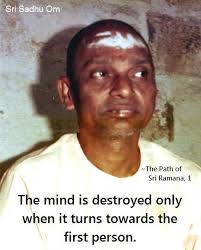
“We should not run after the world; we should not look outwards at the world, we should look inwards at Self. Those sannyasis who run after the world achieve neither the world nor Self (God). If we try to chase after our shadow, we will never catch it; but if we go towards the sun, our shadow will automatically come running behind us.
Those sannyasis who are always attending to the world with the aim of teaching the world became spoilt in the end. . . No Sage (jnani) who ever came on earth was the product of an ashramam, math or any such institution. Each one of them stood alone and realized the Truth by himself.
There is no rule that a man can attain true knowledge (jnana) only by becoming an inmate of a religious institution. Therefore, in the name of service to the world, let no one cheat himself and retard his spiritual progress by forming foundations and associations and by preaching, shouting slogans and running magazines”
~ Sri Sadhu Om
The entire path is also explained in more concise form in Ramana Maharshi’s text ‘Who Am I?’ (Nar Yar?). However I have found that many people actually miss the key teachings in ‘Who Am I?’ even though they are plainly written due to the ego’s distortion in interpreting what it hears/reads. After reading ‘The Path of Sri Ramana’, the teachings in ‘Who Am I?’ become crystal clear.
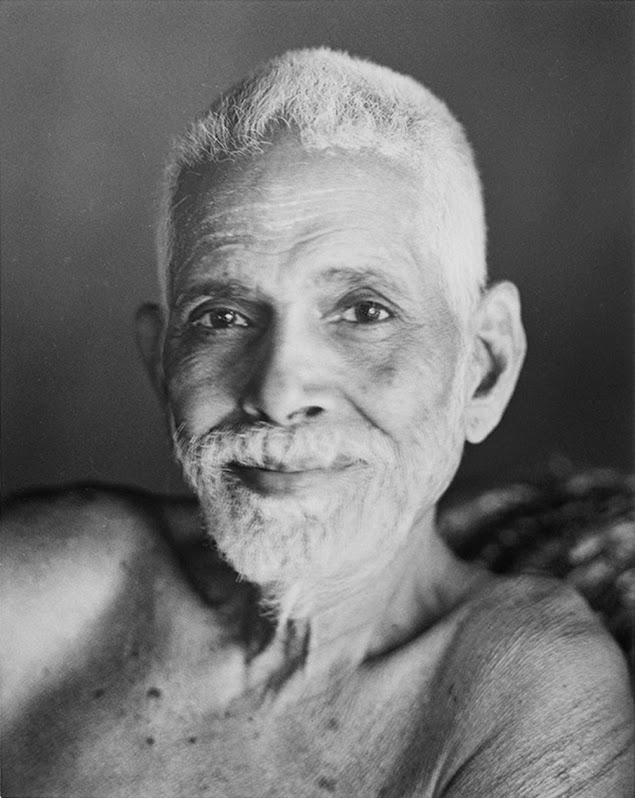
Ramana Maharshi: True Wisdom
The following are sayings of Sri Ramana Maharshi, taken from the text Guru Vachaka Kovai which is widely accepted as the most precise, systematic and authoritative exposition of Sri Ramana Maharshi’s teachings:
Download Guru Vachaka Kovai as a PDF file here
536.
O worldly folk who long for and run after
An endless series of unenduring things
’Tis wisdom true to seek and know
That one thing, on knowing which
All other things will cease to be.
537.
For those who see with insight keen
The subtle Truth, what is there to gain
From knowledge of gross material things?
What the imperishable inner sense
Perceives surpasses far the sight
Seen by the corporeal eye.
538.
Knowing aright the nature of the Self
And abandoning the non-self as void,
Unreal, is wisdom true.
All other knowledge is ignorance,
And not wisdom.

