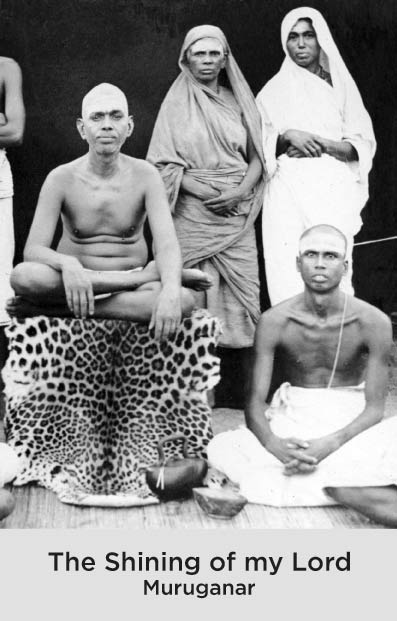
The following quotes, taken from the publication ‘The Shining of my Lord’ by Sri Muruganar, clearly and concisely explain the direct path to Self-Realisation.
In this context, the words ‘sadhana‘ and ‘tapas‘ both essentially mean spiritual practice.
‘Swarupa‘ means your own true nature, referring to the Self, the Ultimate Reality that you ARE.
The word ‘pure’ in the phrase ‘pure consciousness’ refers to consciousness devoid of any objects or arising phenomena, a reference again to the Self, your Swarupa.
I recommend you listen to this video in which the following quotes are read aloud for you, as this can often result in the same teachings being heard in a different and more powerful way:
502. The sadhana is to withdraw the mind from the sense objects of the world, which arise through the ignorance of taking the body to be ‘I’, and fix it in the feet of the Lord’s grace, pure consciousness. For those who are fully convinced of the efficacy of this sadhana, and who are able to practise it, there will be no need to abandon it to perform any other great tapas
503. Until everything shines wholly as swarupa, eschew all [perceived phenomena] as your enemies.
508. Those who abide as pure consciousness will experience the truth, the Self that exists as their own intimately close associate, but if the mind is allowed to move about among the senses through the pathways of the five senses, life will become shameful, losing its beauty.
509. If consciousness leaves the heart and manifests outwardly, it will experience perplexity through the false and deceitful sense objects. If it becomes extremely clear and remains firmly settled in consciousness-the-supreme, pure grace, and then merges with it, life will become blissful.
516. The ego deserves to be stigmatised whereas the Self alone deserves to be worshipped and saluted. Save and protect yourself completely from the treacherous maya, whose form is the ego, by the daily practice of abidance in the pure Self in order that the abidance may become firm and habitual.
492. For those who keenly desire as their principal priority a merger with the beauty of grace, the swarupa that abides in the heart as pure consciousness, it is not even slightly acceptable to have any connection with objects enjoyed by the senses, which are concepts of the fake entity, the deluding consciousness.
417. If we perform sadhana to the limit of our abilities, the Lord will accomplish for us that which is beyond our capabilities. If we fail to do even that which is within our capabilities, there is not the slightest fault in the grace of the Lord.
423. Devotion exists in many different forms, varying according to the quality of the devotee’s mind. However, only devotion to grace, the swarupa that shines as pure consciousness, enables one to reach directly the unsurpassed state of the supreme.
Here is what the Vedanta scriptures, such as the Upanishads and the writings of Sri Shankara and Sri Gaudapada say, together with quotes from Sri Ramana Maharshi:
The Lord created the senses out-going: therefore, one sees outside and not the Self within. Some intelligent man, with his senses turned away (from their objects), desirous of immortality, sees the Self within. ~ Katha Upanishad 2.1.1
In his commentary on this above verse (Katha Upanishad 2.1.1), Shankara writes:
‘…the perceiver sees the external objects which are not-Self/not the Atman, such as sound, etc., and not the Self within. Though this is the nature of the world, some (rare) discerning man, like turning back/ reversing the current of a river, sees the Self within…The group of sense organs, beginning with the ear, should be turned away from all sense-objects. Such a one, who is purified thus, sees the indwelling self. For it is not possible for the same person to be engaged in the thought of sense-objects and to have the vision of the Self as well.‘
Dwelling on external objects will only increase evil propensities, so wisely recognising this fact, one should abandon external objects and and constantly attend to one’s true nature within, the Atman [the Self]. ~ Shankara, Vivekachudamani
(Note, there are so many quotes from Shankara’s Vivekachudamani which advocate turning within/away from objects that they would ovewhelm this post, but you can find some of these quotes compiled together here in a separate post.)
The knot of the ignorance in the heart is broken completely only when one sees his Self as secondless through Nirvikalpa Samadhi
~Adhyatama Upanishad 1.17
By expelling (from the mind) without any remainder all objects which are superimposed on one’s Atma, one becomes himself Parabrahman the full, the secondless and the actionless
~Adhyatma Upanishad 1.21
Turiya is not that which is conscious of the inner (subjective) world, nor that which is conscious of the outer (objective) world, nor that which is conscious of both…It is the cessation of all phenomena…This is what is known as the Fourth (Turiya). This is Atman and this has to be realised. ~Mandukya Upanishad
In Shankara’s commentary on the Mandukya Upanishad, in his introduction to the text he writes:
Just as the normal state of a man, afflicted by disease, consists in his getting cured of the disease, similarly the normalcy of the Self, stricken with identification with misery, is regained through the cessation of the phenomenal universe of duality…since the phenomenal world of duality is a creation of ignorance, it can be eradicated through knowledge…
In his commentary on Katha Upanishad verse 1.2.20 Sri Shankara writes:
‘…One whose intellect has been withdrawn from all objects, gross and subtle, when this takes place, this is known as ‘inactivity of the sense organs’. Though this ‘inactivity of the sense organs’ one sees that glory of the Self. ‘Sees’ means he directly realises the Self as ‘I am the Self’ as thereby becomes free from suffering’
When the mind…remains unshakable and does not give rise to appearances, it verily becomes Brahman. ~ Gaudapada, Mandukya Upanishad Karika
When the mind, after realizing the knowledge that Atman alone is real, becomes free from imaginations and therefore does not cognize anything, for want of objects to be cognized, it ceases to be the mind. ~ Gaudapada, Mandukya Upanishad Karika
The mind severed from all connection with sensual objects, and prevented from functioning out, awakes into the light of the heart, and finds the highest condition. The mind should be prevented from functioning, until it dissolves itself in the heart. This is Jnana, this is Dhyana, the rest is all mere concoction of untruth. ~ Amritabindu Upanishad
As long as the objective universe is perceived one does not realise the Self. ~ Yoga Vasishta
The Self (Atman) is beyond all expression by words beyond all acts of mind; It is absolutely peaceful, it is eternal effulgence free from activity and fear and it is attainable by Samadhi ~ Gaudapada, Mandukya Upanishad Karika 3.37
Shankara’s commentary from the above verse from Gaudapada 3.37 states:
…The Self (Atman) is denoted by the word Samadhi as it can be realised only by the knowledge arising out of the deepest concentration (on its essence), Samadhi. Or the Self (Atman) is denoted by Samadhi because it is the object of concentration, the Jiva concentrates his mind on the Self (Atman)…
In the next verse Gaudapada writes in verse 3.38 of his Mandukya Karika:
There can be no acceptance or rejection where all mentation stops. Then knowledge is established in the Self and is unborn, and it becomes homogenous
Shankara’s commentary on this verse 3.38 is as follows:
…therefore there is no rejection or acceptance in It, where thought does not exist. That is to say, how can there be rejection or acceptance where no mentation is possible in the absence of the mind? As soon as there comes the realisation of the Truth that is the Self, then, in the absence of any object, knowledge (Jnanam) is established in the Self, like the heat of fire in fire. It is then birthless (ajati) and becomes homogenous.
In his commentary on the Katha Upanishad, verse 2.1.2, Shankara writes:
‘The natural tendency to see external objects, which are not-Self, is the cause of ignorance, the obstacle to the realisation of the Self. The desire of external/outward enjoyments pertaining to this world and the next, which are presented by ignorance, is another obstacle. The realisation of the Self being impeded by these two, ignorance and desire, men with little intelligence pursue only external objects of desire….This being so, the intelligent, knowing the certain immortality of concentration in the inner Self…
When the five organs of perception become still, together with the mind, and the intellect ceases to be active: that is called the Supreme State [Brahma-Vidya or Self Knowledge] ~Katha Upanishad 2.3.10
Shankara’s commentary on this above verse (Katha Upanishad, verse 2.3.10) states the following:
‘At the time when the five senses…, together with the mind…, which is now no longer functioning and thinking, are at rest in the Self alone, after turning away from objects, and with the intellect…no longer engaging with its functioning, that they call the highest state [Brahma-Vidya or Self-Knowledge].’
That which is not seen, though within us, is called the eternal and indestructible Self. ~ Yoga Vasishta
After knowing that by which you know this world, turn the mind inward, and then you will realise the effulgence of the Self. ~ Yoga Vasishta
Strenuously withdrawing all thoughts from sense objects, one should remain fixed in steady, non-objective [ie. subjective] enquiry. This, in brief, is the means of knowing one’s own real nature; this effort alone bring about the sublime inner vision. ~ Sri Ramana Maharshi, Sri Ramana Gita
If, on the contrary, you withdraw your mind completely from the world and turn it within and abide thus, that is, if you keep awake always to the Self, which is the substratum of all experience, you will find the world, of which alone you are now aware, just as unreal as the world in which you lived in your dream. ~ Sri Ramana Maharshi, Maharshi’s Gospel
So long as all objects are not renounced, the Self is not won. What remains after the renunciation of the entire objective manifold is said to be the Self. Therefore, in order to realize the Self, renounce everything. Having cast off all (objects), assimilate yourself to that which remains.
~ Annapurna Upanishad 1.45-1.46
Q. When will the realization of the Self be gained? Sri Ramana: When the world which is what-is-seen [ie. objects] has been removed, there will be realization of the Self which is the seer. Q. Will there not be realization of the Self even while the world is there? Sri Ramana: There will not be. ~ Sri Ramana Maharshi, Who Am I?
When the mind, which is the cause of all cognition’s and of all actions, becomes quiescent, the world will disappear…All the texts say that in order to gain release one should render the mind quiescent; therefore teaching is that the mind should be rendered quiescent. ~ Sri Ramana Maharshi, Who Am I?
Therefore, when the world appears, the Self does not appear; and when the Self appears the world does not appear. ~ Sri Ramana Maharshi, Who Am I?
When the mind comes out of the Self, the world appears. ~ Sri Ramana Maharshi, Who Am I?
When the mind that is subtle goes out through the brain and the sense organs, the gross names and forms appear; when it stays in the heart, the names and forms disappear. Not letting the mind go out, but retaining it in the Heart is what is called “inwardness” (antarmukha). Letting the mind go out of the Heart is known as “externalisation” (bahir-mukha). Thus, when the mind stays in the Heart, the ‘I’ which is the source of all thoughts will go, and the Self which ever exists will shine. ~ Sri Ramana Maharshi, Who Am I?
Desirelessness is wisdom. The two are not different; they are the same. Desirelessness is refraining from turning the mind towards any object. Wisdom [Jnana] means the appearance of no object. ~ Sri Ramana Maharshi, Who Am I?
Q. How long should inquiry be practised? Sri Ramana Maharshi: As long as there are impressions of objects in the mind, so long the inquiry “Who am I?” is required ~ Sri Ramana Maharshi, Who Am I?
According to Sri Ramana Ashram, the text Guru Vachaka Kovai ‘provides the most precise, systematic and authoritative exposition of Sri Bhagavan’s [Ramana Maharshi’s] teaching‘, and here is a definitive teaching given in verse 291:
291. If one wants to be saved, one is given the following true and essential advice: just as the tortoise draws all its five limbs within its shell, so one should draw the five senses within and turn one’s mind Selfward. This alone is happiness.
Compare with Bhagavad Gita 2.58:
‘One who is able to fully withdraw the senses from their objects, just as a tortoise withdraws its limbs into its shell, is established in Divine Knowledge’.
Here, once again, the method to attain Self-Realisation, which is perfect infinite eternal Happiness, is made clear by Sri Ramana Maharshi in verse 293 of Guru Vachaka Kovai:
293. Having known for certain that everything which is seen, without the least exception, is merely a dream, and that it [the seen] does not exist without the seer, turn only towards Self– Sat-Chit-Ananda – without attending to the world of names and forms, which is only a mental conception.
The following are the first 21 verses from Sadhanai Saram (The Essence of Spiritual Practice) by Sri Sadhu Om. This text contains very beautiful and deep teachings for those who are genuinely seeking liberation. We find this text not only summarises the teachings of Bhagavan Sri Ramana as well as Advaita Vedanta teachings, but goes into them in tremendous depth with a clarity that is often not found elsewhere.
These initial verses presented below beautifully display both devotion to Bhagavan and the path of Self-Enquiry.
I have created an additional List of Contents for Sadhanai Saram which you can download here
Invocation
O Sri Ramana, bestow Your Grace upon me so that I may in experience flawlessly attain the unequalled and unsurpassed essence of the practice (sadhana) of Self-knowledge, the excellent path “Who am I?” which you have discovered to be the central and foremost among all the various paths.
O Sri Ramana, the Heart, who through Your Grace protects me at every moment by guiding me along the correct path, rise from within and teach me the true import of Your divine and unequalled teachings so that I may know them in their undefiled pristine purity.
The Greatness of This Birth
Among countless births, one like this birth of ours is very rare to achieve. Ah! When Lord Ramana has assumed a sacred body on earth, we have attained the blessed boon of becoming slave to His Holy Feet.
However many crores of births they may take, it is indeed very difficult for anyone to have the opportunity of gaining such a great benefit as that which is gained in this birth of ours, in which we have come to the Feet of Bhagavan Ramana, who is a rare treasure for the world. So great is the benefit of this birth.
The Wealth of Sri Ramana
The wealth of the almighty Sri Ramana’s enlightenment (Jnana) is a treasure that is ever available to be plundered by all people who want it; and, however much it is plundered, it will never decrease even in the least. However, only good people who are true devotees know how to plunder it; and though other people who are too immature go near that treasure, they cannot see anything there.
The Grace of Sri Ramana
Sri Ramana, the Bestower of Grace, will never give the least dissatisfaction to those who weepingly pray to Him, “Make me Your possession.” I know that our Lord uses countless inexpressible tricks in order to protect and save those who have become His slaves.
What our Lord uses to save us are tricks of Grace. Even by the skill of our intellects, it is impossible for us to know all those tricks. If He wishes, even an ocean will enter and disappear into a mustard seed. Therefore, as soon as the glance of Sri Ramana’s Grace falls upon us, the Supreme Reality will be revealed.
Since He is not bound by time or even by the limitation of place, He will not wait for some suitable time or suitable place to bestow His Grace upon His devotees. He has far greater compassion than even a compassionate mother, who has no plan that she will give her baby milk to drink only when it cries (and hence, even without our crying for it, He will bestow His Grace upon us of His own accord).
O Bhagavan, innumerable are the wrongs (the mistakes and misfortunes) from which I, this poor creature, have escaped by Your Grace unknown to myself. You know all of them, but I do not know anything except enjoying the bliss of being saved by Your Grace.
O Sri Ramana, those who have taken refuge at Your Feet are protected perfectly not only on one or two occasions but on more than a crore of occasions. From many incidents that happen in their life, this is a truth that is clearly known to the hearts of Your devotees.
The state of abiding in the Heart as the Heart as it is (that is, as the adjunctless and thoughtfree existence-consciousness “I am”) is the ineffable and most excellent state. He, who nurtures the fruit of such Self-abidance by sowing the seed of clarity of mind and by watering it with divine Grace, is only our Self-realized or Celestial Preceptor (Sadgurudeva), Sri Ramana.
We and all our possessions, beginning with the body, are in truth only the possessions of Sri Ramana. When the responsibility of saving us and protecting our possessions is borne by Him alone, why should we worry about anything in our life on this earth thinking it to be either pleasure or pain? Where is any such thing as wrong, evil, harm or suffering now?
All That He Does is Happiness for Me
The almighty Sri Ramana, who exists within the heart of everyone, who unfailingly helps me at all times, and who cannot be banished from my mind even for a moment, has brought me close to Him only to take me as His slave. Therefore, whatever He now does with me is only happiness for me; how can anything that He does hereafter appear to me as something undesirable or painful?
Leave it to Him
He knows the best of all, Leave it to Him, be calm; Believe Him most of all, Then rests the mental storm.
Explanatory paraphrase: Our Sadguru (Selfrealized Guru, or guide) Sri Ramana, alone knows what is best for us. Therefore, entrusting all our burdens and cares to Him, we should always remain peaceful and calm. If we believe Him more than we believe anyone or anything else, knowing that He alone is the Supreme all-knowing, all-powerful and all-loving reality, then, at that very moment, we will attain that perfect pace in which the raging storm of thoughts will have come to an end, forever.
Grace Alone is of Prime Importance
The ego is only a trivial entity; besides, it is unreal (asat) and powerless (asakta). It is a mere adjunct which rises and subsides. Therefore, what foolishness it is to think, “The spiritual practice (sadhana) done by the strength of this ego will by itself bestow the goal of life; the supreme power of divine Grace is not of any consequence (and is not necessary in order for one to attain the goal)”!
Note: Not believing Grace, but thinking one’s own individual effort alone to be of very great consequence, is mere foolishness.
Is not the unreal help which one unreal man renders to another unreal man, experienced by everyone in this world as real? Therefore, O Sadguru, the embodiment of Grace, the sole reality, is it impossible for You to save me by dispelling the unreal ego? What doubt or wonder is there in Your being able to help me thus?
Note: A man or jiva is merely an unreal appearance, and hence whatever help he may seem to render to another man is also unreal. But when such unreal help rendered by an unreal man is experienced by everyone as real, why should we doubt the ability of the Sadguru, who alone is truly real, to render us the real help of destroying the unreal ego? Such help from the Sadguru will certainly be experienced by us as more real than the help that we feel is rendered to us by others.
Unless our Lord, Sri Ramana, who is the form of God, Himself bestows His divine Grace, who can by his own effort attain that heroic state of firmly abiding as Self, having clearly known one consciousness other than the body to be the real “I”?
What is Worthy to be Desired?
The great wealth that exists in enlightened sages (Jnanis) is only the subtle secret of how to be still, abiding in perfect peace as the mere thoughtfree existence-consciousness “I am.” Therefore, how wretched it will be if one greedily desires to attain from them mere worldly pleasures, such as gold, wealth or fame, which will only make one suffer in delusion.
Sense-Pleasures are Worthless
Instead of eating the fruit that is in your hand, why do you desire to eat the unreal fruit which is seen in a mirror and which is merely a reflection of the fruit in your hand? Is the reflected fruit an object which can be eaten and give real enjoyment? Similarly, instead of drowning deep within the heart by keenly attending to Self and thereby enjoying the bliss of Self which is ever shining there, why do you desire to enjoy the pleasures experienced through the five senses of this perishable body, which are merely an unreal reflection of the true happiness within you?
Endeavor and Result
For those who seek (and make effort to attain) Self, not only Self but also all other benefits will automatically be attained in full. But if one desires and makes effort to attain worldly objects (either through worldly endeavors or through spiritual practices), know that they will be attained only partially and to the extent of one’s endeavor, and that Self will not be attained at all.
The Goal
If we deeply ponder over the natural yearning of all living beings to remove their miseries (through some means or other), it will be decidedly known that the sole aim for which the whole world is striving is only to remain always in perfectly imperishable bliss.
In this post I would like to point out some differences between the so-called ‘Direct Path’ teachings of Rupert Spira on one hand, and the traditional Advaita Vedanta Teachings and the teachings of Sri Ramana Maharshi on the other. Whilst these teachings may all seem on the surface to be pointing to the same thing, and they may seem quite similar in many ways, they actually are quite different in many important aspects and do not lead to the same end in my view. ie. they do not both lead to liberation.
I usually do not write articles that may appear to be critical about other teachers/teachings as I do not want to detract others from their own path. So if you enjoy and benefit from the Direct Path teachings from those such as Rupert Spira and do not want to read about any potential flaws in them, or how they may be improved, please do not read any further. However in recent years I have had so many people come to me with erroneous notions from the Direct Path teachings that holds them back from proceeding further and deeper along their (apparent) spiritual path to Liberation. Once these erroneous notions have been dispelled, then I have seen first-hand how the teachings can flow much better, and this leads to more peace, understanding, clarity and direction in their spiritual practice.
Similarly, I would like to note that the purpose of this article is not to criticise anyone, but simply to point out differences that are present in the teachings and my view on these difference and the consequences thereof. I hope that this will provide benefit for those who are genuinely seeking liberation that is free from suffering.
I would also like to say that I am not some Advaita Vedanta fanatic either – I am simply interested in what actually works. I understand that everyone has their own unique journey, and their own relationship with teachers and teachings. I also acknowledge that many varied teachings and practices can be of help and assistance to us on our spiritual journey (please explore this blog for examples of this). However it is also useful to acknowledge that not all teachings are equally helpful and not all teachings point directly at liberation. Some can even steer us away, apparently at least.
Personally, I have found the traditional teachings of Advaita Vedanta, and especially Sri Ramana’s exposition of them, to give us everything we need on the path to genuine Liberation. Sri Ramana’s teachings fill in a ‘gap’ that is present in most other teachings. When this gap is filled, everything flows much better. You can find the teachings neatly summarised in this book which, in my view, explains clearly and unambiguously the true direct path in full (at least as much as can be explained in words).
Please also follow the embedded links below and throughout the article for more details.
When the ego-mind first hears a true teaching, meaning a truly liberating teaching, the first thing it tends to do is spew out dozens of thoughts, ideas and beliefs, that oppose that teaching, giving reasons why the teaching given is not true. This is because the ego-mind does not want to end in most cases, and often prefers to remain comfortable in what it thinks it knows.
Therefore when reading the below, please bear this in mind. To give yourself the best chance of receiving these teachings, try to suspend your own judgements that may arise and instead read the teachings with an open and inquiring mind.
Personally I find that Rupert Spira’s teachings may be useful for aspects of sravana (listening) and manana (contemplation/ thinking/ reflecting upon the teaching) phases of traditional Advaita in which the teachings are given and contemplated upon and realisation remains predominantly on the level of the mind, (although Rupert Spira’s teachings do introduce many distortions here too, as we will see in this article). However in my view they do not really engage fruitfully or deeply enough with the main part of the teachings of Sri Ramana and Advaita Vedanta, which is Nididhyasana (meditation), or turning away from objects in order to abide as the self and thereby attain liberation.
Traditional Vedanta and the teachings of Sri Ramana Maharshi teach that the purpose of Sravana and Manana are to teach the seeker how, and to convince the seeker to engage in the main practice of Nididhyasana, and this in turn leads to self-abidance (Samadhi) and it is this which results in knowlege (Jnana) or liberation (Moksha). Note there are some exceptions to this, see here.
Shankara makes this clear in verses 364 and 365 of Vivekachudamani:
364. Reflection (Manana) should be considered a hundred times superior to hearing (Sravana), and meditation (Nididhyasana) a hundred thousand times superior even to reflection (Manana), but the Nirvikalpa Samadhi is infinite in its results.
365. By the Nirvikalpa Samadhi the truth of Brahman is clearly and definitely realised, but not otherwise, for then the mind, being unstable by nature, is apt to be mixed up with other perceptions.
‘…the natural and changeless state of Nirvikalpa samadhi is produced by unswerving vigilant concentration on the Self, ceaseless like the unbroken flow of oil. This readily and spontaneously yields that direct, immediate, unobstructed, and Universal perception of Brahman, which is at once knowledge and experience and which transcends time and space. This perception is Self-realisation.’
Otherwise, without abiding as the Self, the teachings remain on the level of the mind, infinite nature of the Self is not revealed, and the ‘Ananda’ or blissful aspect of the self is not realised, meaning that suffering and the sense of duality and ego are not actually removed and ignorance continues. More on this below.
Here is another example from Sri Ramana Maharshi, taken from Talks with Sri Ramana Maharshi, Talk 226:
A visitor from Tirukoilur asked if the study of the sacred books will reveal the truth. Sri Ramana Maharshi.: That will not suffice. Devotee.: Why not? Sri Ramana Maharshi.: Samadhi alone can reveal it. Thoughts cast a veil over Reality and so it cannot be clear in states other than Samadhi. Devotee.: Is there thought in Samadhi? Or is there not? Maharshi.: There will only be the feeling ‘I am’ and no other thoughts. Devotee.: Is not ‘I am’ a thought? Maharshi.: The egoless ‘I am’ is not thought. It is realisation. The meaning or significance of ‘I’ is God. The experience of ‘I am’ is to Be Still.
Integration of teachings after realisation
In Advaita Vedanta teachings and with the teachings of Sri Ramana Maharshi, both are clear that once the Self or Pure Consciousness is fully realised through the process of turning away from objects and abiding as Self – what Rupert Spira terms the ‘inward-going’ path – ignorance is totally and completely gone, and that is the final end of duality, suffering and the spiritual path.
There is no need to integrate this thereafter according to Advaita Vedanta and Sri Ramana, as this would simply be more ego-ignoranceand would mean that the Self was not truly realised – ie. it would mean that duality was not really eradicated and the ego and the consequent suffering were still present, and that self-realisation had not really occurred. Once the Self is realised, the (apparent) ego-entity is no more, so there is no entity present that could ‘face outwards’ or re-integrate.
HoweverRupert Spira states what he calls the ‘inward path’ of Advaita Vedanta is only one half of the journey, and that we then have to ‘turn outwards’ and engage in what he calls some kind of ‘outward facing’ path to re-integrate this knowledge – see the quotes section below for an example of Rupert Spira saying this. This is a commonly held view among many contemporary teachers, but this view is seldom found in traditional teachings paths, and for good reason, so I hope it is useful to highlight the differences in the teachings for the seekers who are trying to wade through what’s on offer.
What about going back into the world after realisation?
If the going back into the market place/world does happen, automatically all will be seen as One, because the Self has truly been realised, meaning no ignorance/duality is left. There is no need to re-integrate. This is why the Advaita Vedanta texts emphasise self-enquiry/going within only, knowing that once that is done, that is all that needs to be done.
What about removing the vestiges of ignorance after Realisation?
Some people say that in order to root out the last remaining vestiges of ignorance, after Realisation once must turn out towards the world and re-integrate.
According to Advaita Vedanta, this simply means that ignorance is still present and so Realisation has not truly been attained. After non-duality is realised, what entity is present to turn outwards towards the world? The remedy is to pursue Self-Enquiry, the ‘inward-facing’ path until ignorance has truly been rooted out, and not to cease the primary practice and ‘turn outwards towards objects’ (See the quotes section below for examples of this teaching from both Sri Ramana and Traditional Advaita Vedanta).
Once Ignorance has truly been rooted out, the Self is genuinely realised, and all is spontaneously seen as One without the need for further practice or integration or any ‘outward-facing path’.
A summary of the respective teachings
A summary of Rupert Spira’s teachings could go something like this:
You are Consciousness; in essence you are not the body, mind or world but that Consciousness which is aware of them; however the body-mind and world are also simply made or fabricated from that very Consciousness that you are.
That’s the entire teaching basically.
Note that these are essentially the teachings that are found in paragraphs 2 and 3 of Ramana Maharshi’s Nan Yar (Who am I?), whereas the rest of Nan Yar? describes the main part of the actual teaching which is absent from the so-called ‘Direct Path’ teachings of Rupert Spira. The fact that most of the text written by Sri Ramana Maharshi goes on to describe the rest of the teaching is in itself instructive.
Rupert Spira teaches that meditation is a useful part of the path to calm the mind and to recognise the Consciousness that you are, but that meditation itself does not lead to realisation and this recognition of your true self as consciousness is only the first part of a much longer journey (see the quotes section from Rupert Spira below for examples of where he says this).
Traditional Advaita Vedanta and the teachings of Sri Ramana Maharshi, as found in these texts, also states you are Consciousness and that all objects are also Consciousness, but then go further. They state that in order to realise:
(1) your essential nature is consciousness…
(2) the nature of consciousness, which now, through ignorance, appears to be limited, is actually infinite and limitless, birthless and deathless, immortal and blissful…
(3) the entire phenomenal world, including the body and mind, is an illusion…
(4) the infinitely blissful nature (Ananda aspect) of the Self, ie. in order to remove suffering…
(5) and in order to remove all sense of duality and separation…
…in order to genuinely realise the above for oneself one must turn away from the world and abide as the Self, the Self being what you truly are. Once the Self has been realised, there is no entity left that could then progress on another phase of the journey such as re-integrating with the objective world. Self-Realisation is total extinguishment (ie. nirvana, the word ‘nirvana’ literally meaning extinguishment) of the ego and duality.
Without turning within, the limitless infinite birthless deathless nature of consciousness is not revealed, not truly – the so-called ‘knowledge’ of infinite consciousness remains only conceptual, intellectual, and consciousness still appears limited and associated with a body-mind. Similarly, without turning within, away from phenomenal objects, the ananda or blissful aspect of the Self does not manifest, and so consciousness appears dry and without love or bliss.
Why is this? Why the need to turn within to discover the Self? Please explore the introductory articles on the homepage of this site to find out more and see my response to common objections in the next sectioin below.
In the traditional Advaita Vedanta text, Vivekachudamani, we find that only the first part of the text describes what is in essence a form of Rupert Spira’s teaching, but with a few notable and important differences, such as the Self is more often than not emphasised as being the Subject rather that both subject and object. This is because the bulk of the text is focussed on Nididhyasana (Meditation) as this is the actual means to Liberation for most (see here for exceptions).
Again, similarly to Sri Ramana Maharshi’s ‘Who am I?’, the fact that most of Shankara’s text is also dedicated to something other that Rupert Spira’s style of teaching is in itself instructive. Thinking of the Self as being purely the Subject aids this mediation process which aims to turn one’s attention away from objects and towards the Subject and thus realise its infinite and blissful nature. Without this practice duality and suffering continue.
I highly recommend viewing this video below in which I go into further detail which perhaps makes the above clearer easier to understand:
Objections to turning within and further reading
See these posts which talk about this aspect of the path more, provide further quotes, and also answers common objections to this teaching of turning within to realise the Self:
Eg. see these quotes from Shankara’s Vivekachudamani, a very important text from the Advaita Vedanta tradition, that sternly illustrates this point. (Note that there are probably some better quotes than these from the Advaita scriptures – please let me know if you know any – I have just quickly put these together):
413. After the body has once been cast off to a distance like a corpse, the sage never more attaches himself to it, though it is visible as an appearance, like the shadow of a man, owing to the experience of the effects of past deeds.
414. Realising the Atman, the eternal, pure Knowledge and Bliss, throw far away this limitation of a body, which is inert and filthy by nature. Then remember it no more, for something that has been vomited excites but disgust when called in memory.
415. Burning all this, with its very root, in the fire of Brahman, the Eternal and Absolute Self, the truly wise man thereafter remains alone, as the Atman, the eternal, pure Knowledge and Bliss.
416. The knower of Truth does no more care whether this body, spun out by the threads of Prarabdha work, falls or remains – like the garland on a cow – for his mind-functions are at rest in the Brahman, the Essence of Bliss.
417. Realising the Atman, the Infinite Bliss, as his very Self, with what object, or for whom, should the knower of Truth cherish the body.
485. I neither see nor hear nor know anything in this. I simply exist as the Self, the eternal Bliss, distinct from everything else.
522. From the perception of unreal things there is neither satisfaction nor a cessation of misery. Therefore, being satisfied with the realisation of the Bliss Absolute, the One without a second, live happily in a state of identity with that Reality.
523. Beholding the Self alone in all circumstances, thinking of the Self, the One without a second, and enjoying the Bliss of the Self, pass thy time, O noble soul!
524. Dualistic conceptions in the Atman, the Infinite Knowledge, the Absolute, are like imagining castles in the air. Therefore, always identifying thyself with the Bliss Absolute, the One without a second, and thereby attaining Supreme Peace, remain quiet.
547. Similarly, ignorant people look upon the perfect knower of Brahman, who is wholly rid of bondages of the body etc, as possessed of the body, seeing but an appearance of it.
548. In reality, however, he rests discarding the body, like the snake its slough; and the body is moved hither and thither by the force of the Prana, just as it listeth.
Quotes – Sri Ramana Maharshi
Sri Ramana Maharshi also states many times that all one needs to do is turn inwards, and that no outward going path is thereafter required. The following are Ramana’s teachings as recorded in Guru Vachaka Kovai (Garland of Guru’s Sayings), a text which is widely regarded as the most authoritative collection of Sri Ramana’s verbal teachings. Here is what Ramana Ashram states about the text Guru Vachaka Kovai in the foreword of their publication of it:
‘[Guru Vachaka Kovai] provides the most precise, systematic and authoritative exposition of Sri Bhagavan’s teaching, explaining step by step the theory, the practice and the experience of jnana, the Truth supreme which is Being as Life Eternal, Pure Awareness, Perfect Bliss. Thus, the most comprehensive collection of the Maharshi’s sayings is Guru Vachaka Kovai.’
Here are the quotes:
630. Having felt the sun’s fierce heat The wise one tarries in the shade, And those who know the triple fire Raging in the world will never Leave the Heart and turn again Towards the world
949. Those who with ego dead have gained Being, transcending bliss, have nothing Further to attain, no effort To be made, no deed to do, For life’s fulfilment they have reached.
950. When one abides in one’s true state As effortless Eternal Goodness One has no further work to do. All deeds accomplished, such a one Enjoys the perfect peace of bliss.
1179. Diving within enquiring “Who Am I? Who sees between the creeds Some differences?” the Self alone Abides and the poor ‘I’ fades out. In that still silence can there be A sense of difference?
1180. In that great Silence there is no Sense of difference. But is there then A feeling of non-difference? No. The non-duality extolled By Seer’s is nothing but the absence Of all sense of difference.
1223. Firm, steady abidance in The peace serene gained by the quest For Self, the Awareness, the sole ground Supporting all appearances, And consequent relinquishment Of all objects as unreal, This alone is mukti.
1224. Unless there is a final end Of so called “knowledge” of things out there, One cannot gain release from bondage To the sense-created world. This “knowledge” being destroyed by firm Abidance in the Self, then what Remains is mukti, bliss supreme
1237. While brightly shining in the hearts Of sages who have left behind All treacherous triads and now abide As That alone, advaita’s grandeur Cannot be by the mind perceived, Like this false, trivial, dualistic, Thought-created world.
1238. Siva, who is Pure Awareness Transcending thought, is only known To seers heroic who with minds Extinct abide thought-free within The heart, and not to those whose minds Are still engaged in thought.
Also Bhagavan Sri Ramana’s teachings are recorded in Sri Ramanaparavidyopanishad:
411. Whoever obtains awareness of the real Self, for him this worldly life comes to an end. The others continue to wander here as before, remaining without awareness of the real Self.
554. These men do not know the truth of the transcendental state beyond time, in which the world has not come into being. Non-duality has neither beginning nor end. Duality, with space and time, is unreal, always.
569. In that state doubts do not arise since the sage is ever firm in his awareness of the true Self. There he remains without affirmations and vacillations, immersed in the depths of peace, the mind having become extinct.
585. By the dawn of right awareness of the real Self, the ego, the root cause of the appearance of forms, has been lost. Therefore for the sage, all forms are unreal, and hence this talk of forms is foolishness.
596 Our Guru, Sri Ramana, tells us that the real siddhi [special power][to be striven for] is to be firmly established in the natural state of the real Self, which is ever-present in the Heart; nothing else.
613. The true meditation on the supreme reality [the Self] is only to remain as the Self in the thought-free state. This ‘meditation’ can neither be given up, nor taken up by the sage.
663. The sage never comes back to samsara. Samadhi is his natural state. There is no moment when he is without samadhi. Hence it is called sahaja [natural].
664. The sage, remaining uninterruptedly in his natural state of samadhi, never swerving from it as a jivan mukta, is able to be active in the world, just as the sages of old such as Sri Sankaracharya did.
As long as there are impressions of objects in the mind, so long the enquiry ‘Who am I?’ is required.
Sri Ramana more fully explains his position here (please see the post for the full context) when he states:
In reality, saying ‘We must see Brahman in everything and everywhere’ is also not quite correct. Only that stage is final, where there is no seeing, where there is no time or space. There will be no seer, seeing and an object to see. What exists then is only the infinite eye.”
Lastly I would like to direct you to a very important chapter of the traditional text Advaita Bodha Deepika, as recommended by Sri Ramana Maharshi which explains aspects of this teaching in further detail. For most, without the understanding given in this chapter, liberation will be unlikely to result. Conversely, putting these teachings into practice sets one onto the true Direct Path.
Quotes – Rupert Spira
Contrast the tone and content of the above verses with Rupert Spira who states that once Self or Pure Consciousness is realised, that is only one half of the journey, and we then have to turn outwards again and ‘re-integrate this understanding with our objective experience’. This re-integration, according to Advaita Vedanta, is simply more ignorance, more suffering, more duality, and means that the genuine realisation of Self has not really occurred at all. Here is what Rupert Spira writes in his book ‘Being Aware of Being Aware’ on pages 9-11:
The inward-facing path, or Direct Path, in which the mind turns its attention away from objective experience towards its own essence or reality, is, in my experience, best elaborated in the Vedantic tradition, which details with great precision both the philosophy and the practice of this investigation. In this way the Vedantic tradition provides direct means for accessing the essential, irreducible nature of one’s mind and the source of lasting peace and happiness…
…However, it is important to recognise that the inward-facing path explored in this book is only half the journey. Once the essential, irreducible nature of the mind has been recognised, and its inherent peace and unconditional joy accessed, it is necessary to face ‘outwards’ again towards objective experience, realigning the way we think and feel, and subsequently act, perceive and relate, with our new understanding.
The culmination of the inward-facing path is the recognition of the presence, the primacy and the nature of awareness – or, in religious language, spirit or God’s infinite being – the intuition of happiness which transcends all knowledge and experience. However, it is not yet the full experiential understanding in which awareness itself, or God’s infinite being, is known and felt to pervade and saturate all knowledge and experience, and indeed to be its sole substance and reality. It is to recognise the transcendent nature of awareness but not its immanence.
If we do not reintegrate this understanding with our objective experience, then a fragile alliance will persist between our essential, irreducible nature of pure awareness and all objects and others. This often manifests as a denial or rejection of embodied life in the world and may readily become a refuge for any lingering sense of a separate self. The process by which this reintegration or establishment takes place, although implicit in the inward-facing or Vedantic tradition, is, in my opinion, best elaborated in the Tantric tradition, and is an exploration that lies beyond the scope of this book
Can you perhaps see how the ego and duality/separation is retained in this latter exposition of Rupert Spira’s? When there is no ego, what entity is left to re-integrate? Or to put it differently, what entity is going to face outwards again once the Self has been realised?
Prior to the quote I included a link to the full text from which the quote is taken so you can see the full context. The fact that Rupert Spira writes that the ‘outward facing’ aspect of the teaching is ‘beyond the scope of this book’ also implies, to me at least, that this aspect of the path cannot easily be dealt with in a few paragraphs.
Does this even matter?
Well for many this doesn’t really matter! If you are drawn to the so-called ‘Direct Path’ as per Rupert Spira or similar teachings, the chances are that these teachings will benefit you. They are not totally bad teachings, per se. I just do not find them to be ultimately liberating. But that doesn’t mean they are not good or beneficial. There are many teachings that are worse and some I may even recommend you avoid, but Rupert Spira’s ‘Direct Path’ is not one of these.
However the problem with stating that ‘turning inwards’ is only one part of the journey is that seekers ‘turn back’ towards the objective world too soon, without really having realised the Self, but only having a relatively superficial knowledge of ‘sat-chit’ (Being-Knowing or Being-Consciousness) without having ‘dived deep within’ to realise the Limitless Birthless Deathless Ananda that is true Moksha.
The True Teaching urges you to carry on turning inwards and sinking deeply within until your True Self is fully realised. Once this has occurred, there is no longer any duality, and no-entity remains which could ‘turn outwards’ again and reintegrate with the objective world.
As Sri Ramana writes in ‘Who Am I?’:
Q. How long should Inquiry [ie. turning inwards] be practised?
Sri Ramana Maharshi: As long as there are impressions of objects in the mind, so long the enquiry ‘Who am I?’ is required.
A teaching that teaches that ‘turning within’ is only half the path is likely a teaching that doesn’t encourage one to go within far enough to genuinely realise the Self.
Please note that I am not some fundamentalist Advaita-pushing, scripture pushing-pandit here – I am merely interested in which teachings actually work, and I have found the teachings of Sri Ramana to be fully liberating, and these teachings are in line with the Advaita Vedanta scriptures from what I can see.
What about Tantra and Kashmir Shaivism?
What does this mean about the Tantric path? Well, if by tantra you mean Pratyabhijna (recognition) or the system of Kashmir Shaivism, which is what Rupert Spira is referring to when he says tantra, when you read the Pratyabhijna scriptures you find that the method is essentially the same as the Vedanta Path and the Path of Sri Ramana – ie. one must turn within until the Self is realised. That is all! No need to re-integrate back into the world or turn outwards again. Note this is different to how many modern teachers of Tantra/ Kashmir Shaivism present the teachings, but if we read the original scriptures from where these traditions originate, we see the same need to turn within to realise the Unchanging Absolute.
The only difference is the philosophical or conceptual framework from which this is done. In essence it is the same path. Again, what is written in the scriptures is not always the same as what is taught by the teachers. I explain more about this here, and you will also find Sri Ramana’s view on Kashmir Shaivism in that same post.
How to know your essential nature is consciousness?
There is another issue with teachings, such as Rupert Spira’s ‘direct path’, and forms of Advaita Vedanta that do not emphasise nididhyasana/ meditation and samadhi or what Sri Ramana Maharshi calls Self-Enquiry (Atma Vichara): they do not give a genuine methodology with which one can discover one’s true nature to be Consciousness.
They only posit that ‘You are Consciousness’ and give philosophical reasons why this must be so, together with a rather superficial exploration of one’s own experience. Add in some dodgy logic and, hey presto, suddenly we are to believe that not only is our true nature consciousness, but the entire world is also the nature of consciousness.
However, it should be fairly obvious that it is impossible to either prove or disprove on philosophical grounds alone that your nature is consciousness, or that the ground/nature of the entire universe is consciousness.
Similarly, it is also impossible to know your own fundamental nature to be consciousness by a simple exploration of your own experience. Moreso,it is impossible to know the deathless/birthless/infinite/blissful nature of the Self through simply exploring your own experience.
Whilst it may seem that, experientially, all arises in consciousness, that doesn’t mean that everything actually does arise in consciousness. One thing that both daily experience and science teaches us is that things are not always as they appear. To use a rather simplistic example, just because it appears that there are lots of little people inside a TV screen, that doesn’t mean that there actually are lots of little people inside the TV screen. Or just because it appears that the moon changes shape over a twenty-eight day cycle, it doesn’t mean that the moon is actually changing shape on a daily basis in this way. There are countless more examples like this.
Similarly, just because it appears from our subjective viewpoint that everything appears in our consciousness, and that consciousness is all there is, and that the only constant in our experience is consciousness or ‘I AM’, that doesn’t mean that is how the universe is actually structured.
So, how to know your true nature as infinite unlimited deathless being-consciousness-bliss? Traditional Advaita Vedanta as recorded in scriptures such as Shankara’s Vivekachudamani and the teachings of Sri Ramana Maharshi give us an actual method that we can follow, and by which we can discover our True Nature for ourselves. Namely, through turning within and attending to the Subject-Self, we can discover for ourself the Truth, the One Reality. We discover this by losing ourselves and becoming only That which we always were.
Note, as we have mentioned above, whilst Rupert Spira and others with similar teachings do often advocate meditation and turning inwards, it is not emphasised as the main practice whereby realisation is fully gained. Compare this with the teachings of the Upanishads, for example. We have already noted that Rupert Spira cites turning inwards as being a part of a larger schema after which one has to again turn outwards and reintegrate with the objective world. This implies, to me at least, that the extent to which turning inwards is advocated is insufficient to gain a true realisation of Self, as once the Self is truly realised – full stop. It’s all done. Nothing else needed. And no entity present that could turn back towards objects and ‘reintegrate’.
Without going through this turning within type process and continuing and persevering with it until ignorance is rooted out, true realisation does not occur, and so the teachings reside predominantly on the level of the mind/concepts/beliefs, and suffering continues.
Without Abiding as Self and discovering for oneself what one truly is, Advaita becomes just a bunch of relatively superficial conceptual beliefs such as ‘I am consciousness’ or ‘I am Brahman’ – and ignorance, duality and suffering are not truly destroyed. We have not actually realised the infinite deathless blissful nature of Our Self. We must go beyond the mind and gain the True Experience for ourself of Pure Being in which there is no duality, no ‘me’, no body-mind-world. Then the Self is revealed as All and One and the ego-I that was seeking is no more.
In verse 356 of Vivekachudamani, Shankara writes:
356. Those alone are free from the bondage of transmigration who, attaining Samadhi, have merged the objective world, the sense-organs, the mind, nay, the very ego, in the Atman, the Knowledge Absolute – and none else, who but dabble in second-hand talks.
With this discovery of our True Self comes the immediate ending of suffering and duality, but this discovery does not occur if we remain purely on the conceptual level with the ego-mind-duality-ignorance-suffering remaining intact.
The Amritabindu Upanishads says:
The mind severed from all connection with sensual objects, and prevented from functioning out, awakes into the light of the heart, and finds the highest condition.
The mind should be prevented from functioning, until it dissolves itself in the heart. This is Jnana, this is Dhyana, all else is mere argumentation and verbiage
It is only through Nididhyasana/meditation, that the Ananda aspect of Sat-Chit-Ananda is revealed, as opposed to the emphasis on Sat and Chit aspects only, both of which self-evident without the need for meditation – ie. we already know we exist, sat, and that we are conscious, chit, without any great spiritual practice, but the Ananda or blissful and infinite/ birthless/ deathless nature of Atman- can only be genuinely discovered through attending to the Subject-Self(ie. Self Enquiry). This is also the culmination of the paths of Bhakti Yoga (the path of love and devotion) and the other Yogas too.
Understanding this we also start to understand why traditional scriptures are often worded differently and structured differently to these other contemporary teachings that ultimately teach something different. They are structured this way in order to effectively and efficiently guide us to the Truth that already IS, the Truth that we already ARE.
For supporting quotes relating to this from Advaita Vedanta see the section called ‘The need for Nirvikalpa Samadhi’ in this article: Shankara on the Mind, Samadhi and Liberation.
For supporting quotes from Sri Ramana Maharshi, see the section entitled ‘The only true practice/teaching’ in this article: Ramana Maharshi: how to abide as the Self
Here is this video are some quotes from Ashtavakra Gita which you may enjoy:
Modern Teachers of Advaita Vedanta
I was introduced to Advaita Vedanta teachings long before I came across the teachings of Sri Ramana Maharshi. It was only much later, having studied Vedanta texts for over 15 years, did I come to realise that Sri Ramana actually taught the true vedanta that is present in the vedanta scriptures.
By contrast, many of the most popular teachers of Advaita Vedanta actually, rather like the so-called Direct Path teachings explored here, deviate from the true Vedanta teaching in my view and in my experience. For those who are interested, I have given some examples of Advaita Vedanta teachers that in my view teach non-liberating teachings here, but there are several more. Some Vedanta teachers even say Sri Ramana is teaching false Vedanta teachings. Ultimately you will have to decide for yourself which of these are true, if any.
However, my advice is, if we wish to know the truly liberating Vedanta teachings, we should read the vedanta scriptures and see what they actually say, and not just believe a so-called vedanta teacher that claims to be part of a lineage (upon investigation often you find the so-called lineage is very spurious), but a short cut is to become familiar with Sri Ramana’s teachings. In my view and in my own experience, His Teachings are the True Vedanta, as well as the true Direct Path.
Let us see what Sri Ramana says about teachings that don’t advocate turning within in Guru Vachaka Kovai:
148. Those who know nothing but sense-pleasure, to ruin and destruction doomed, resent transcendence of the senses and call this fresh and fruitful wisdom Dry Vedanta!
599. [In the ancient custom of child marriage] a girl who has not attained the age of puberty feels very happy, thinking the grandeur of the celebration of her marriage to be conjugal union. Likewise, the learned who have not enquired within and known Self, feel very proud and happy about the verbal Vedanta they prattle, thinking it to be the non-dual knowledge [advaita jnana].
Conclusion
Of course, what you do with the above information is up to you. Have a look and see what teachings are right for you at this time in your journey. Just because teachings are not ultimately liberating, does not mean that you will not benefit from them – they may be right for you at a certain point in time – everything has its place, as it were. So I am not recommending you do not engage with the so-called ‘Direct Path’ teachings of Rupert Spira and similar teachings – if these teachings are something you are drawn to, then by all means explore them – the teachings probably have some role to play for you if you are drawn to them.
However if you ask me, as always, I recommend you follow the teachings of Bhagavan Sri Ramana Maharshi – my view is that we are so very lucky to have them – in my view they are a complete teaching that give us everything we need for liberation. You can find a complete exposition of his teachings here for free. Also see the recommended reading list which contains further resources for a truly liberating teaching. Other teachings may seem similar to Sri Ramana’s, but as we explore further and dive deeper into the teachings, we find subtle differences, and these differences can make all the difference!
So if you are able to and are so inclined, I encourage you to take Ramana as your Guru and follow his teachings.
!Sri Ramana’s teachings show us the true Advaita Vedanta!
!Sri Ramana’s teachings are the true ‘Direct Path’!
!Sri Ramana’s teachings guide us unfailingly to Liberation!
This is one of a series of introductory articles – please see the homepage of tomdas.com for more introductory articles.
Here the non-dual teachings of Jesus are succinctly presented.
The following are excerpts I have put together from the introduction of the book ‘Happiness and the Art of Being’ by Michael James. I felt there were so many gems and biblical quotes packed in tightly together in just the introduction of this book – someone else perhaps would have made the introduction alone into an entire book – I felt that it would be worthwhile to tease out some of the points about Jesus’s teachings and put them together into a post for the benefit of seekers. It very nicely sums up the inner teachings of Jesus in light of the teachings of Sri Ramana Maharshi and points to the core teachings of both.
You can read the entire book, ‘Happiness and the Art of Being’, online for free here, and I encourage you to make a donation to the author and/or buy a hard copy of the book in order to support the author.
Bold type and subheadings have been added by myself. I have also changed the paragraph structure of the text in places – I hope these aid the readability of the text and assimilation of the key points.
The inner aim of all religions and spiritual traditions is to free us from this illusory state in which we imagine that we are separate from God, the one unlimited and undivided reality.
Original Sin
For example, in Christianity this state in which we violate the oneness and wholeness of God by imagining ourself to be an individual separate from him is called the ‘original sin’, which is the root cause of all misery and unhappiness.
The Truth shall set you free
Because we can become free from this ‘original sin’ only by knowing the truth, Christ said,
‘[…] ye shall know the truth, and the truth shall make you free’ (John 8.32).
The truth that we must know in order to be made free is the truth that we are nothing but the adjunctless pure consciousness ‘I am’ – that ‘I am’ which is the true form of God, as disclosed by him when he revealed his identity to Moses saying,
‘I am that I am’ (‘ehyeh asher ehyeh’ – Exodus 3.14).
Die to your (individual) self
To ‘know the truth’ does not mean to know it theoretically, but to know it as a direct and immediate experience. In order to destroy the illusion that we are a limited individual consciousness, a person separate from the perfect whole which is called God, we must experience ourself as the unlimited and undivided pure consciousness ‘I am’.
Therefore, to know the truth and thereby be made free from the illusion called ‘original sin’, we must die and be born again – we must die to the flesh and be born again as the spirit. That is why Christ said,
‘Except a man be born again, he cannot see the kingdom of God. […] Except a man be born of […] the Spirit, he cannot enter into the kingdom of God. That which is born of the flesh is flesh; and that which is born of the Spirit is spirit’ (John 3.3 & 3.5-6).
That is, to experience and enter into the true state of God, we must cease to exist as a separate individual, a consciousness that identifies itself with the flesh and all the limitations of the flesh,and must rediscover ourself to be the unlimited and undivided spirit, the pure, unadulterated and infinite consciousness ‘I am’, which is the absolute reality that we call ‘God’.
When we identify ourself with a body made of flesh, we become that flesh, but when we cease to identify ourself with that flesh and know ourself to be mere spirit, we are born again as our original nature, the pure spirit or consciousness ‘I am’.
The need for us to sacrifice our individuality in order to be born anew as the spirit is a recurring theme in the teachings of Jesus Christ:
‘Except a corn of wheat fall into the ground and die, it abideth alone: but if it die, it bringeth forth much fruit. He that loveth his life shall lose it; and he that hateth his life in this world shall keep it unto life eternal’ (John 12.24-25).
‘Whosoever shall seek to save his life shall lose it; and whosoever shall lose his life shall preserve it’ (Luke 17.33).
‘And he that taketh not his cross, and followeth after me, is not worthy of me. He that findeth his life shall lose it: and he that loseth his life for my sake shall find it’ (Matthew 10.38-39).
‘If any [man] will come after me, let him deny himself, and take up his cross, and follow me. For whosoever will save his life shall lose it: and whosoever will lose his life for my sake shall find it. For what is a man profited, if he shall gain the whole world, and lose his own soul? or what shall a man give in exchange for his soul?’ (Matthew 16.24-26, and also Mark 8.34-37 and Luke 9.23-25).
That is, in order to rediscover our true and eternal life as the spirit, we must lose our false and transient life as an individual. If we seek to preserve our false individuality, we shall in effect be losing our real spirit. This is the price we have to pay to live as an individual in this world. Therefore, whatever we may gain or achieve in this world, we do so at the cost of losing our real self, the state of perfection and wholeness (which in this context is what Christ means by the term our ‘own soul’). In exchange for regaining our original and perfect state of wholeness, we have only to give up our individuality and all that goes with it. Which is truly profitable, to lose the whole and gain merely a part, or to give up a mere part in exchange for the whole?
Take up thy cross
In order to give up or lose our individuality, as Christ had done, he says that we must follow him by denying ourself and taking up our cross. To deny ourself means to refrain from rising as an individual separate from God, who is the whole – the ‘fullness of being’ or totality of all that is. To take up our cross means to embrace the death or destruction of our own individuality, because in the time of Christ the cross was a powerful symbol of death, being the usual instrument of execution. Thus, though he used somewhat oblique language to express it, Christ repeatedly emphasised the truth that in order to rediscover our real life as the spirit we must sacrifice our false life as an individual.
Christ’s resurrection
This sacrifice of our individuality or identification with the flesh, and our consequent resurrection or rebirth as the spirit, was symbolised by Christ through his own crucifixion and subsequent resurrection. By dying on the cross and rising again from the dead, Christ gave us a powerful symbolic representation of the truth that in order to become free from the ‘original sin’ of identification with the flesh and thereby to enter the ‘kingdom of God’, we must die or cease to exist as a separate individual, and thereby rise again as the pure spirit, the infinite consciousness ‘I am’.
The Kingdom of God
The ‘kingdom of God’ which we can see and enter only by being born again as the spirit is not a place – something that we can find externally in the material world of time and space, or even in some celestial world called heaven.
When Christ was asked when the kingdom of God would come, he answered,
‘The kingdom of God cometh not with observation: neither shall they say, Lo here! or, lo there! for, behold, the kingdom of God is within you’ (Luke 17.20-21).
The kingdom of God cannot be found by observation, that is, by any form of objective attention – by looking externally here or there. It cannot be found in any place outside us, either here in this world or there in heaven, nor indeed is it something that will come in the future. It exists within us even now.
To see and enter into it, we must turn our attention inwards, away from the external world of time and space that we observe by means of the limited flesh-bound consciousness that we call our ‘mind’, and towards our true consciousness ‘I am’, which is the underlying base and reality of the observing consciousness ‘I am so-and-so’.
The true teaching
The exhortation ‘behold’ that Christ used in the above passage is very important. He did not merely tell us the fact that the kingdom of God is within ourself, but exhorted us to look and see that it is within ourself. That is, he did not merely tell us the truth that he saw, but told us that we should each see it for ourself.
In more modern English, we would express the passage
‘[…] neither shall they say, Lo here! or, lo there! for, behold, the kingdom of God is within you’
as
‘[…] and they should not say, ‘Look here or look there’, because, see, the kingdom of God is within you’.
This exhortation that Christ makes to us not to look here or there but to see that the kingdom of God is within ourself, is the essence of the spiritual practice taught by Sri Ramana and all other true sages. We should give up attending to anything outside ourself, and should instead turn our attention inwards to see the reality that exists within us.
The kingdom of God is not a place but a state – our natural state of pure self-conscious being. When we see it within ourself by turning our attention towards the innermost core of our being, we enter into it and become one with it.
This is the state of being born again as the spirit – the state of mystical union with God that all Christian contemplatives seek to attain. In this state called the ‘kingdom of God’, the pure consciousness ‘I am’, which is the spirit or true form of God, exists and shines alone in all the splendour and glory of its undivided oneness and unlimited wholeness.
The teachings of Sri Ramana
The teachings of Sri Ramana thus throw a fresh light upon the spiritual teachings contained in the Bible. In the same manner, they also throw fresh light upon the spiritual teachings of all other religions.
Though his teachings are easily recognised as a fresh and clear expression of the ancient teachings of advaita vēdānta, they in fact clarify the inner essence not only of advaita vēdānta but also of all other spiritual traditions.
The truth that he taught is not a relative truth that is limited to any particular religion or human culture, but is the absolute truth which underlies all human experience, and which is the source and foundation of the spiritual teachings of all religions. For certain cultural or other reasons, in some religions this truth is expressed less openly and clearly than in others, but it is nevertheless the truth that lies at the heart of every religion.
Though this truth is not recognised by most of the followers of the various religions, particularly by the followers of those religions in which it is hidden more obscurely, it is nevertheless expressed in some form or other in the scriptures and the philosophical and mystical writings of every religion, and it can be discerned and recognised by all who have the eyes to see it. The teachings of Sri Ramana, if understood clearly and correctly, give us the eyes or insight required to discern and recognise it wherever it is expressed, no matter how seemingly obscure may be the words that are used to express it.
Dualistic vs non-dualistic teachings
All words are open to interpretation – and misinterpretation. This is particularly true of words that speak about the spirit – the reality that lies beyond the limitations of physical matter, and that therefore cannot be perceived by the five senses, or known as an object of consciousness. All interpretations of such words fall into two distinct categories – interpretations that are strictly non-dualistic, admitting no division of the one and only reality, and interpretations that are either completely dualistic, or that at least concede that within the one reality there are divisions and distinctions that are real.
Ultimately the interpretation that we each choose to accept depends not upon the truth itself – because the nature of the truth cannot be proved objectively – but upon our own personal preferences.
Most people – whether they hold religious beliefs or cherish a more materialistic outlook on life – prefer to take a dualistic view of reality, because such a view assures them of the reality of their own individuality, and of the world they perceive through their senses, and (if they choose to believe in God) of God as a separately existing entity. Therefore the only basis for a dualistic view of reality is the attachment that people have to their own individuality, to the world that they think gives them happiness, and to their idea of a God who they believe will give them the things that will make them happy….
One truth in all religions
…This non-dual reality is the one truth about which all religions speak. Though they do not always describe the non-dual nature of this truth in explicit terms, all religions do so implicitly in one way or another.
No religion has a monopoly on the truth. What is true in one religion is true in every religion. The truth can never be in any way exclusive, because if it were, it would only be a partial truth and not the whole truth – a relative truth and not the absolute truth. To be wholly and absolutely true, the truth must be all-inclusive – it must be the one whole that includes everything within itself.
The one whole truth that does include everything within itself is the infinite spirit, the single consciousness that we all know as ‘I am’. Everything that appears to exist does so only within this consciousness. Though the manifold forms in which things appear are unreal as such, the one real substance of all things is the consciousness in which they appear. Therefore the one truth about which all religions speak is the single, all-inclusive and non-dual whole, the spirit or consciousness in which all things appear and disappear.
The Universal Christ and the ‘I Am’
However, because they interpret the spiritual teachings of their religion in a dualistic manner, most of the followers of the various religions tend to believe that their own religion somehow has a monopoly or exclusive claim upon the truth, and is therefore the only means to salvation. For example, throughout the history of Christianity, most ordinary Christians have believed that true salvation can be attained only through the person of Jesus Christ, and that atheists, agnostics and the followers of other religions can be saved only by converting to Christianity. They have justified this unreasonable and arrogant belief by their dualistic interpretation of Christ’s saying,
‘I am the way, the truth, and the life: no man cometh unto the Father, but by me’ (John 14.6).
Because of their dualistic understanding of his spiritual teachings, they interpret the words ‘I am’ and ‘me’ that he used in this passage to denote only the individual person Jesus Christ, who was born at a certain time in a certain place called Bethlehem.
However, Christ did not mistake himself to be merely an individual person whose life was limited within a certain range of time and place. He knew himself to be the real and eternal spirit ‘I am’, which is unlimited by time and place. That is why he said,
‘Before Abraham was born, I am’ (John 8.58).
The person who was Jesus Christ was born long after the time of Abraham, but the spirit which is Jesus Christ exists always and everywhere, transcending the limits of time and place. Because that spirit is timeless, he did not say, ‘Before Abraham was born, I was’, but, ‘Before Abraham was born, I am’.
That timeless spirit ‘I am’, which Christ thus knew to be his own real self, is the same ‘I am’ that God revealed to be his real self when he said to Moses,
‘I am that I am’ (Exodus 3.14).
Therefore, though Christ appears to us to be a separate individual person, he and his Father God are in fact one and the same reality, the spirit that exists within each one of us as our fundamental consciousness ‘I am’. That is why he said,
‘I and the Father are one’ (John 10.30).
Therefore, when Christ said,
‘I am the way, the truth, and the life: no man cometh unto the Father, but by me’ (John 14.6),
by the words ‘I am’ and ‘me’ he was referring not merely to the time-bound individual called Jesus, but to the eternal spirit ‘I am’, which he knew to be his own real self. The inner meaning of his words can therefore be expressed by rephrasing them thus,
‘The spirit “I am” is the way, the truth, and the life: no man cometh unto the spirit “I am”, which is the Father or source of all things, but by this same spirit’.
True Salvation
The spirit ‘I am’ is not only the truth or reality of all things, the source from which they all originate, and the life or consciousness that animates every sentient being, but is also the only way by which we can return to our original source, which we call by various names such as ‘God’ or the ‘Father’.
Except by turning our attention within towards the spirit, the consciousness that we each experience as ‘I am’, there is no way by which we return to and become one with our source. Therefore true salvation can only be attained not merely through the person who was Jesus Christ, but through the spirit which is Jesus Christ – the eternal spirit ‘I am’ that exists within each one of us.
Not only did Christ affirm his oneness with God, his Father, he also wanted us to become one with him. Before his arrest and crucifixion, Christ prayed for us,
‘Holy Father, […] that they may be one, as we [are]. […] that they all may be one; as thou, Father, [art] in me, and I in thee, that they also may be one in us […] that they may be one, even as we are one: I in them, and thou in me, that they may be made perfect in one’ (John 17.11 & 21-23).
That is, the aim of Christ was that we should cease to mistake ourself to be an individual separate from God and should know ourself to be the one indivisible spirit, the pure fundamental consciousness ‘I am’, which is the reality of God.
Thus oneness or non-duality is the central aim of the spiritual teachings of Jesus Christ.
Differences between religions are only superficial
Every religion consists of a vital central core of non-dualistic truth, expressed either explicitly or implicitly, and a thick outer shell of dualistic beliefs, practices, doctrines and dogmas. The differences that we see between one religion and another – the differences that throughout the ages have given rise to so much conflict, intolerance and cruel persecution, and even to bloody wars and terrorism – lie only in the superficial forms of those religions, their outer shells of dualistic beliefs and practices.
All the disharmony, conflict and strife that exist between one religion and another arise only because most of the followers of those religions are too attached to a dualistic view of reality, which limits their vision and prevents them from seeing what all religions have in common, namely the one underlying truth of non-duality.
Therefore true peace and harmony would prevail among the adherents of the various religions only if they were all willing to look beyond the external forms of those religions and see the one simple and common truth of non-duality that lies at the heart of all of them.
Non-duality
If we accept and truly understand the truth of non-duality, we will have no cause to quarrel or fight with anyone. We will be happy instead to let each person believe what they want to believe, because if a person is so attached to their individuality that they are unwilling to doubt its reality, no amount of reasoning or argument will convince them of the truth of non-duality.
Therefore no one who truly understands this truth would ever try to convince the unwilling. If anyone does try to force the truth of non-duality upon someone who is unwilling to accept it, they are only displaying their own lack of correct understanding of that truth.
Non-duality is not a religion that needs evangelists to propagate it, or converts to join its ranks. It is the truth, and will remain the truth whether or not anyone chooses to accept and understand it. Therefore we can and should do no more than make this truth available to whomsoever is ready to understand it and apply it in practice.
The true blasphemy
Many religious people believe that it is blasphemy or sacrilege to say that we are one with God, because they mistake such a statement to mean that an individual is claiming himself to be God. But when we say that we are God, what we mean is not that we as a separate individual are God, which would be absurd, but that we are not an individual separate from God. By thus denying that we have any existence or reality separate from God, we are affirming that the reality we call God is one, whole and undivided.
If instead we were to claim that we are in reality separate from God, as most religious people believe us to be, that would be blasphemy or sacrilege, because it would imply that God is not the one and only reality. If we were to have any reality of our own separate from God, then he would not be the whole truth, but only a part or division of some larger truth.
If we believe that the reality that we call God is truly the infinite ‘fullness of being’, the one undivided whole, then we must accept that nothing can exist as other than or separate from him. He alone truly exists, and all else that seems to exist as separate from him is in fact nothing but an illusion or false appearance whose sole underlying reality is God.
Only in the state of perfect non-duality is the true glory, wholeness and fullness of God revealed.
So long as we experience a state of seeming duality by mistaking ourself to be an individual separate from God, we are degrading and demeaning him, denying his indivisible oneness, wholeness and infinity, and making him into something less than the only existing reality that he truly is.
The Truth is often unpalatable
Though the inner aim of all religions is to teach us the truth of non-duality, in their scriptures this truth is often expressed only in an oblique manner, and can be discerned only by people who are able to read between the lines with true insight and understanding. The reason why the truth is not expressed more openly, clearly and unambiguously in many of the scriptures of the various religions is that at any given point in time the majority of people have not yet reached a state of sufficient spiritual maturity to be able to digest and assimilate it if it is told as it is. That is why Christ said,
‘I have yet many things to say unto you, but ye cannot bear them now’ (John 16.12).
However, though most of us may be unable to bear and accept the raw and naked truth of non-duality now, with the passing of time we will each eventually gain the spiritual maturity required to understand and accept the truth as it is, and not merely as we would now like it to be.
Please can you explain what is meant by the last line in this quote from ‘Who am I?’ by Sri Ramana Maharshi?
‘By a steady and continuous investigation into the nature of the mind, the mind is transformed into That to which the ‘I’ refers; and that is in fact the Self.
Mind has necessarily to depend for its existence on something gross; it never subsists by itself. It is this mind that is otherwise called the subtle body, ego, jiva or soul.
That which arises in the physical body as ‘I’ is the mind. If one enquires whence the ‘I’ thought in the body arises in the first instance, it will be found that it is from hrdayam or the Heart. That is the source and stay of the mind.
Or again, even if one merely continuously repeats to oneself inwardly ‘I-I’ with the entire mind fixed thereon, that also leads one to the same source.’
Tom:
It means to turn away from objects towards the Self; the mantra ‘I-I’ just being a means to point your attention Selfwards.
‘I-I’ means ‘I am I’ or ‘I am that I am’. This is because in most Indian languages ‘I’ and ‘I am’ are essentially the same word.
The consciousness ‘I am’ when felt along with an adjunct (upadhi) as ‘I am so-and-so’ becomes a thought. Of all thoughts, this thought is the first. But the consciousness which shines alone as ‘I-I’ without any adjunct is Self (atman) or the Absolute (brahman). This is not a thought. It is our ‘being’ (that is, our true existence)
and on page 133 it states:
But as we have already said, it is to be understood that the consciousness mixed with adjuncts as ‘I am this’ or ‘I am that’ is the ego (ahankara) or the individual soul (jiva), whereas the unalloyed consciousness devoid of adjuncts and shining alone as ‘I-I’ (or ‘I am that I am’) is Self (atman), the Absolute (brahman) or God (iswara).
We can see that I-I (and the variants of this such as ‘I am that I am’, etc) simply refer to the Self, that is consciousness without any objects, as per the quote on page 133.
This is one of a series of introductory articles – please see the homepage of tomdas.com for more introductory articles.
Questioner: I meditate neti-neti (not this – not this).
Sri Ramana Maharshi: No – that is not meditation. Find the source. You must reach the source without fail. The false ‘I’ will disappear and the real ‘I’ will be realised. The former cannot exist apart from the latter.
~Talks with Sri Ramana Maharshi, talk no. 41
Neti-Neti (‘not this, not that’) is a traditional teaching that teaches us to negate all phenomenal objects as being not-self (anatman). This is also known as the via negativa (negative way) as it points to what we are NOT. The basic idea is that through negating or discarding what we are not, what we are, that which is Nameless and beyond concepts, is revealed.
This is in contrast to the via positiva (positive way), which points out what WE ARE and directs us to recognised THAT andabide as THAT.
Whilst many teachings contain both via negative and positiva, you will see that in Advaita Vedanta and the teachings of great sages like Sri Ramana Maharshi, the via positiva is often emphasised but the via negativa is also explained. In other teachings, such as in many Buddhist texts, the via negative is often emphasised, but the via positiva teachings are also present.
Why is this? I’ve noticed that the via-negativa teachings are more attractive to those with a more intellectual inclination – and that is because negation is an activity of the intellect or mind. It by itself can only take you so far. However it is the via positiva (only if done correctly) that leads one to transcend the mind. Let us see Bhagavan Ramana explain this:
Cease all talk of ‘I’ and search with inward diving mind whence the thought of ‘I’ springs up. This is the way of wisdom. To think, instead, ‘I am not this, but That I am,’ is helpful in the search, but it is not the search itself.
Sri Ramana Maharshi, Ulladu Narpadu (Forty Verses on Reality), Verse 29
When the Vedas have declared, ‘Thou art That’ – not to seek and find the nature of the Self and abide in It, but to think ‘I am That, not This’ is want of strength. Because, That abides forever as the Self.
Sri Ramana Maharshi,Ulladu Narpadu (Forty Verses on Reality), Verse 32
The above verses are more fully explained in the text The Path of Sri Ramana in Chapter 7. Here is an excerpt from page 126:
‘That is why it is impossible for the mind to negate anything by thinking ‘I am not this, I am not this’ (neti, neti).- On the other hand, if our (Self’s) attention is directed only towards ourself, our knowledge of our existence alone is nourished, and since the mind is not attended to, it is deprived of its strength…‘
Here on the next page, page 127, it states:
‘If we are told, ‘Abandon the east’, the practical way of doing so would be to do as if told, ‘Go to the west’! In the same manner, when we are told, ‘Discard the five sheaths, which are not Self’, the practical way of discarding the non-Self is to focus our attention on ourself. ‘What is this I?’ or ‘Who am I?’. ‘
Thinking ‘I am not this, not this’ (neti, neti) is a negative method. Knowing that this negative method is just as impractical as saying, ‘Drink the medicine without thinking of a monkey’. Sri Bhagavan has now shown us the practical way of drinking the medicine without thinking of a monkey, by giving us the clue, ‘Drink the medicine while thinking of an elephant’, that is, He has reformed the ancient negative method by giving us the positive method ‘Who am I?’…
…Thus Bhagavan Ramana has declared categorically that Self-attention alone is the correct technique of eliminating the five sheaths!
Now let us see Sri Ramana explain this to two seekers who have both read the traditional texts and have been practicing neti-neti but who have not been able to progress in their sadhana. This following is taken from the book Talks with Sri Ramana Maharshi, Talk 197:
Gul and Shirin Byramjee, two Parsi ladies of Ahmedabad, arrived this day. They spoke at night to Maharshi: “Bhagavan! We have been spiritually inclined from our childhood. We have read several books on philosophy, and are attracted by Vedanta. So we read the Upanishads, Yoga Vasishtha, Bhagavad Gita, etc. We try to meditate, but there is no progress in our meditation. We do not understand how to realise. Can you kindly help us towards realisation?”
Ramana Maharshi: How do you meditate?
Questioner: I begin to ask myself “Who am I?”, eliminate body as not ‘I’, the breath as not ‘I’, the mind as not ‘I’ and I am not able to proceed further.
Ramana Maharshi: Well, that is so far as the intellect goes. Your process is only intellectual. Indeed, all the scriptures mention the process only to guide the seeker to know the Truth. The Truth cannot be directly pointed out. Hence this intellectual process. You see, the one who eliminates all the ‘not I’ cannot eliminate the ‘I’. To say ‘I am not this’ or ‘I am that’ there must be the ‘I’. This ‘I’ is only the ego or the ‘I-thought’. After the rising up of this ‘I-thought’, all other thoughts arise. The ‘I-thought’ is therefore the root-thought. If the root is pulled out all others are at the same time uprooted. Therefore seek the root ‘I’, question yourself “Who am I?”; find out its source. Then all these will vanish and the pure Self will remain ever.
Questioner: How to do it?
Ramana Maharshi: The ‘I’ is always there – in deep sleep, in dream and in wakefulness. The one in sleep is the same as that who now speaks. There is always the feeling of ‘I’. Otherwise do you deny your existence? You do not. You say ‘I am’. Find out who is.
Questioner: Even so, I do not understand. ‘I’, you say, is the wrong ‘I’ now. How to eliminate this wrong ‘I’?
Ramana Maharshi: You need not eliminate the wrong ‘I’. How can ‘I’ eliminate itself? All that you need do is to find out its origin and abide there. Your efforts can extend only thus far. Then the Beyond will take care of itself. You are helpless there. No effort can reach it.