Bhagavan Sri Ramana Maharshi states in Guru Vachaka Kovai:
722. On scrutiny, supreme devotion [parabhakti] and Jnana are in nature one and the same. To say that one of these two is a means to the other is due to not knowing the nature of either of them.
731. Know that the path of Jnana and the path of Bhakti are inter-related. Follow these inseparable two paths without dividing one from the other.
B13. Attending to Self is devotion to the supreme Lord, because the Lord exists as Self.
Bhagavan Sri Ramana Maharshi states in his text ‘Who am I?’:
Question 26. What is the relation between desirelessness (nirasa) and wisdom (jnana)?
Sri Ramana Maharshi: Desirelessness is wisdom. The two are not different; they are the same. Desirelessness is refraining from turning the mind towards any object. Wisdom means the appearance of no object. In other words, not seeking what is other than the Self is detachment or desirelessness; not leaving the Self is wisdom.
The above was taken from the question and answer version of ‘Who am I?’. Note that the Sanskrit word Jnana, literally meaning knowledge or wisdom, is a synonym for Self-Realisation when used in spiritual texts. In the alternate essay version of ‘Who am I?’, which is the version Ramana wrote himself, the same essential teachings are given but phrased slightly differently. Here is this particular teaching from the essay version:
Not attending to what-is-other (anya, that is, to any second or third person object) is non-attachment (vairagya) or desirelessness (nirasa); not leaving Self is knowledge (jnana). In truth, these two (desirelessness and knowledge) are one and the same.
In Talks with Sri Ramana Maharshi, talk number 502, Ramana states the following:
There is room for kama (desire) so long as there is an object apart from the subject (i.e., duality). There can be no desire if there is no object. The state of no-desire is moksha.
In Guru Vachaka Kovai, verse 149, Ramana States:
149. The non-dual experience will only be attained by those who have completely given up desires. For those with desires, it is far, far away. Hence it is proper for those with desires to direct their desires towards God, who is desireless, so that through desire for God the desires that arise through the delusion that objects exist and are different from oneself will become extinct.
In verses 378-9 Ramana states:
378. Except for the one who has completely cut the tie of desires, the false appearance [that he is a suffering jiva] will not cease. Therefore, without any hesitation, one should cut even the desire for the great Divine Happiness.
379. O foolish mind who is suffering due to the desire for the petty pleasures of this world and of the next, if you remain quiet [i.e. without desire] you will certainly attain that State of Bliss which surely transcends the pleasures of these two.
As always, Ramana’s teachings are in line with the traditional Vedanta texts such as the writing of Shankara and the Upanishads. I have written some other posts that demonstrate this point, see below:
Here are some verse from Guru Vachaka Kovai, perhaps the most comprehensive and accurate record of Sri Ramana Maharshi’s spoken teachings. I have used this versionwhich contains comments from Sri Sadhu Om and Michael James. Much gratitude to them for making this wonderful text available. My comments are in italicised red:
71. Just as the goat’s beard wanders and wags for nothing, people roam about merrily but in vain, doing Karmas for the fulfillment of their worldly desires, while despising the disciplines [followed by aspirants] which lead to eternal Moksha in Self. Ah, what a pitiable spectacle is the condition of these worldly people!
Tom: Ramana states that people engaged in worldy actions (karmas; the work karma literally means ‘action’ in Sanskrit, often used to denote cause and effect, here just refers to action) are to be pitied, and notes the irony that those who are ignorant shun the very practice (ie. self enquiry) that leads to eternal Moksha (liberation)
72. Longing for a tiny grain of pleasure, people toil so hard using the mind to plough the field of the five senses, but they never wish for the flood of Bliss which is the fruit that comes by ploughing the Heart, the Source of the mind, with [simple] Self-attention. Ah, what a wonder!
Tom: Simple self-attention is all that is needed instead of chasing all these pleasures which not only takes so much effort, but also causes so much suffering.
73. The moon-like jiva [the mind], ever wedded to the sun-like Self, should always remain in her home, the Heart; to forsake the Bliss of Self and go astray for worldly pleasures, is like the madness of a wife who spoils her precious chastity.
Tom: note the seeker’s job here is to discern the teaching rather than be side-tracked by whether or not this verse is politically correct in today’s social landscape. Ramana equates seeking wordly pleasures with infidelity. Instead we are to remain faithful to ourselves and abide as the Self in the Heart.
74. Only when the world’s allurement is lost will true Liberation be possible [and its allurement cannot be lost unless it is found to be unreal]. Hence, to try to foist reality upon this world is to be just like an infatuated lover who tries to foist chastity upon a prostitute.
Sadhu Om: A lover foists chastity upon a prostitute only because of his infatuation with her, and similarly some schools of thought argue and try to insist upon the world’s reality, only because of their immense desire for the enjoyment of this world. Therefore Liberation, which is the fruit of desirelessness, is absolutely impossible for them.
75. Only for the mad folk who are deluded, mistaking this fictitious world as a fact, and not for the Jnani, is there anything to revel in except Brahman, which is Consciousness.
Tom: There is only Consciousness
76. Will those who are rooted in the Knowledge of Truth stray to worldly ways? Is it not the base and weak nature of animals that descends to the sensual pleasures of this unreal world?
77. If you ask, “What is the benefit of sacrificing the innumerable sensual pleasures and retaining mere Consciousness?”, [we reply that] the fruit of Jnana is the eternal and unbroken experience of the Bliss of Self.
Sadhu Om: Any experience of worldly pleasure is small and interrupted, whereas the Bliss of Self attained through Jnana is eternal and unbroken, and is therefore the greatest benefit.
78. Truly there is not the least happiness in any single worldly objects, so how then is the foolish mind deluded into thinking that happiness comes from them?
79. Fools are now so proud and happy of the wealth and pleasure of this world, which may at any time abandon them in disappointment and distress.
80. Suffering from the heat of the three-fold desires, all living beings wander in the empty and arid desert of this dream-world, which is created by the whirl of past tendencies. The shade of the Bodhi-tree which can completely cool this heat is only Self, which shines as Turiya [the fourth state].
Michael James: The three-fold desires are for women, wealth and fame.
Tom: do not wander into the arid desert of the world, or ‘dream-world’ as is written above, instead be still, abide as the Self, That which you already are in your very Being.
Disciple: Is the aforesaid Self-experience possible, even in the state of empirical existence, for the mind which has to perform functions in accordance with its prarabdha (the past karma which has begun to fructify)?
Ramana Maharshi: A Brahmin may play various parts in a drama; yet the thought that he is a Brahmin does not leave his mind. Similarly, when one is engaged in various empirical acts there should be the firm conviction “I am the Self”, without allowing the false idea “I am the body, etc.” to rise.
If the mind should stray away from its state, then immediately one should enquire, “Oh! Oh! We are not the body etc.! Who are we?” and thus one should reinstate the mind in that (pure) state. The enquiry ‘Who am I?’ is the principal means to the removal of all misery and the attainment of the supreme bliss. When in this manner the mind becomes quiescent in its own state, Self-experience arises of its own accord, without any hindrance. Thereafter sensory pleasures and pains will not affect the mind. All (phenomena) will appear then, without attachment, like a dream. Never forgetting one’s plenary Self-experience is real bhakti (devotion), yoga (mind-control), jnana (knowledge) and all other austerities. Thus say the sages.
Disciple: When there is activity in regard to works, we are neither the agents of those works nor their enjoyers. The activity is of the three instruments (i.e., the mind, speech, and body). Could we remain (unattached) thinking thus?
Ramana Maharshi: After the mind has been made to stay in the Self which is its Deity, and has been rendered indifferent to empirical matters because it does not stray away from the Self, how can the mind think as mentioned above? Do not such thoughts constitute bondage? When such thoughts arise due to residual impressions (vasanas), one should restrain the mind from flowing that way, endeavour to retain it in the Self-state, and make it turn indifferent to empirical matters. One should not give room in the mind for such thoughts as: “Is this good? Or, is that good? Can this be done? Or, can that be done?” One should be vigilant even before such thoughts arise and make the mind stay in its native state. If any little room is given, such a (disturbed) mind will do harm to us while posing as our friend; like the foe appearing to be a friend, it will topple us down.
Is it not because one forgets one’s Self that such thoughts arise and cause more and more evil? While it is true that to think through discrimination, “I do not do anything; all actions are performed by the instruments”, is a means to prevent the mind from flowing along thought vasanas, does it not also follow that only if the mind flows along thought vasanas that it must be restrained through discrimination as stated before?
Can the mind that remains in the Self-state think as ‘I’ and as ‘I behave empirically thus and thus’? In all manner of ways possible one should endeavour gradually not to forget one’s (true) Self that is God. If that is accomplished, all will be accomplished.The mind should not be directed to any other matter. Even though one may perform, like a mad person, the actions that are the result of prarabdha-karma, one should retain the mind in the Self-state without letting the thought ‘I do’ arise. Have not countless bhaktas (devotees) performed their numerous empirical functions with an attitude of indifference?
Is there any way of adoring the Supreme which is all, except by abiding firmly as that!
Neo-Advaita (or ‘new advaita’), itself a modern-day term, is used to refer to teachings or communications that do not accept the existence of separation or duality in any way shape or form: there is no seeker, no separation, and therefore no need for a teaching or practice or communication even.
The term ‘neo-advaita’ is often used pejoratively by more traditional Advaita Vedantins, who do advocate teachings and practices, in order to discredit the neo-style ‘communications’. I use the word ‘communications’ when describing neo-advaita rather than teachings as often neo-advaita ‘speakers’ do not like to refer to themselves as teachers or as having teachings, as ‘teaching’ can imply a separation between a seeker who needs to be taught and a teacher who knows something and is teaching something to someone.
Below is a wonderfully instructive excerpt from Talks with Sri Ramana Maharshi that addresses the apparent conflict between the two types of teaching in talk number 57. It is well worth reading. See if you can see some of the parallels and issues that are raised. This excerpt also explains in brief the method of Advaita Vedanta but is also heavily littered with Sanskrit words which may obstruct the understanding for some. I therefore have added some comments in italicised red which I hope are helpful in fully explaining the text’s meaning:
Ramana Maharshi:Some people think that there are different stages in jnana. The Self is nitya aparoksha, i.e., ever-realised, knowingly or unknowingly. Sravana [hearing the teachings], they argue, should therefore be aparoksha jnana (directly experienced) and not paroksha jnana (indirect knowledge). But jnana should result in duhkha nivriti (loss of misery) whereas sravana alone does not bring it about. Therefore they say, though aparoksha, it is not unshaken; the rising of vasanas is the cause of its being weak (not unchanging); when the vasanas are removed, jnana becomes unshaken and bears fruit.
In the first sentence of the above paragraph Ramana hints that there are no stages in Jnana. He then goes on to state that The Self is ever-realised. Sometimes the mind ‘knows’ this, sometimes it doesn’t. Either way the Self is ever-realised as it is what we are, already and always.
The argument that is therefore proposed by some is that because we are already the Self – limitless, whole and complete – just by hearing the teachings that point this out to us (sravana in Sanskrit), we will now knowingly ‘be the Self’ and have a direct experiential understanding of this (aparoksha jnana: ‘direct knowledge’ aparoksha means umediated or direct; jnana means knowledge or understanding and in a spiritual context means liberation or self-realisation), ie. through hearing the teachings alone self-realisation will result. This view is essentially stating that practices such as meditation and contemplation are not required for liberation as we are already fully realised and so no progressive path is required. Only direct pointing out alone is required and all else is illusion.
Ramana then points out the flaw in this argument. He states that the problem with this teaching is that liberation must lead to the cessation of suffering (duhkha nivriti in Sanskrit: duhkha means hurt or pain or suffering; nivriti in this context means cessation) and merely listening to teachings alone does not yield this result. Essentially, whilst mere sravana or listening to the direct teachings can yield direct insight (aparoksha jnana), this insight is weak and not stable, and therefore suffering does not end and the ananda (blissful) aspect of the Self does not materialise, so seeking (which is fuelled by suffering) continues.
This is also my experience with seekers who have been exposed to these teachings. Whilst the can be direct and profound and trigger a realisation of sorts, the effects are often short lived and do not end suffering. This can, in some cases, lead to flip-flopping, in which the sense of liberation seems to come and go, alternating with confusion, seeking and suffering. In many it can also lead to an over-emphasis on concepts, although I am sure this is not the intent.
Ramana explains that the reason why insight is weak is due to the vasanas. Vasanas is a Sanskrit word that I often use in my teachings. It refers to habitual egoic tendencies that, through the force and momentum of ingrained habit, cause us to seemingly re-identify and re-immerse ourselves back into egotism, separation, illusion and suffering. It is the energy and momentum of the egoic vasanas that prevent liberation from appearing to be stable and lasting, even though liberation or the Self is all there is already and always.
Lastly, Ramana states that once the vasanas are removed, then realisation becomes stable and bears the fruit of cessation of suffering, or Ananda (bliss). This is the point of spiritual practices – not to bring liberation about – as that is all there is already and ‘we are That’ – but to remove the habitual wrong notions/beliefs or vasanas that create suffering.
Ramana continues:
Others say sravana is only paroksha jnana [ie. hearing the teachings, sravana, leads only to indirect or intellectual knowledge, paroksha jnana]. By manana (reflection) it becomes aparoksha [direct knowledge] spasmodically. The obstruction to its continuity is the vasanas: they rise up with reinforced vigour after manana. They must be held in check. Such vigilance consists in remembering = “I am not the body” and adhering to the aparoksha anubhava (direct experience) which has been had in course of manana (reflection).
Such practice is called nididhyasana and eradicates the vasanas. Then dawns the sahaja state. That is jnana, sure.
Ramana here explains an alternative theory which in practical terms is a the same argument I explained above as the vasanas have to be removed, but with some technical differences. Here Ramana explains that another view is that listening to the direct teachings (sravana) leads only to intellectual understanding (indirect understanding or paroksha jnana). In order to have a direct understanding or genuine experiential understanding (aparoksha jnana), one has then to reflect on the conceptual teachings (manana) and see the truth of them for oneself in one’s own direct experience. This then leads to spasmodic direct realisation which comes and goes.
We can see that the only difference between this second theory and the first one is that the first theory states that listening to the teachings (sravana) alone leads to direct realisation where as this second theory adds in another stage in which sravana leads to indirect or mere intellectual understanding and this intellectual understanding is converted into direct experiential understanding through reflection (manana). In both cases what results from sravana or sravana-manana is spasmodic unstable direct realisation which comes and goes and alternates with confusion and suffering.
Ramana proceeds to point out that once we have attained a genuine direct insight, the egoic suffering-causing vasanas rise up with a newfound vigor and so the realisation we ‘attained’ is quickly dispelled.
How to dispel the suffering-causing vasanas? Through Nididhyasana, the 3rd stage of the traditional teaching in Advaita Vedanta (the first two stages are Sravana and Manana). The literal translation of Nididhyasana is ‘meditation’ and there are different forms and aspects of this part of the teaching. Here Ramana explains two aspects of Nididhyasana, firstly a conceptual aspect: knowing ‘I am not the body’ or ‘I am not the body-mind’. The second aspect is to remember the experiential insight or direct realisation-experience that was obtained from sravana-manana and remain there.
What then results is removal of the wrong notion ‘I am the limited body-mind’ and removal of the associated habitual tendencies (vasanas) that obstruct suffering. This then results in what is usually termed Samadhi (the 4th and last stage of the traditional Advaita Vedanta teachings), and the culmination of Samadhi is Sahaja Samadhi, what Ramana here calls the Sahaja state. Sahaja means ‘easy’ or ‘natural’ in Sanskrit, so this is the Easy State or Natural State, a synonym for Liberation itself (ie. ‘Jnana sure’ in the text).
I have written several more posts on this and done a few videos that go into this in more detail, so feel free to take a look:
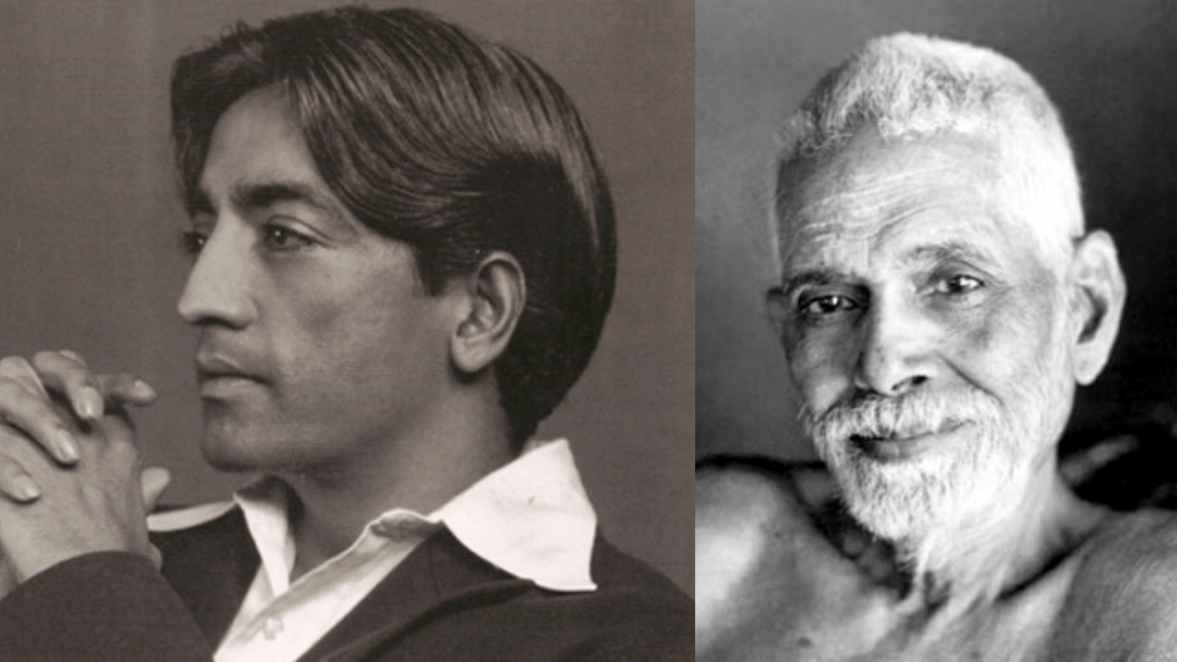
A young man from Colombo, Ceylon, said to Bhagavan:
J. Krishnamurti teaches the method of effortless and choiceless awareness as distinct from that of deliberate concentration. Would Sri Bhagavan be pleased to explain how best to practise meditation and what form the object of meditation should take?
Ramana Maharshi: Effortless and choiceless awareness is our real nature. If we can attain that state and abide in it, that is all right. But one cannot reach it without effort, the effort of deliberate meditation.
All the age-old vasanas (inherent tendencies) turn the mind outwards to external objects. All such thoughts have to be given up and the mind turned inwards and that, for most people, requires effort. Of course, every teacher and every book tells the aspirant to keep quiet, but it is not easy to do so. That is why all this effort is necessary.
Even if we find somebody who has achieved this supreme state of stillness, you may take it that the necessary effort had already been made in a previous life. So effortless and choiceless awareness is attained only after deliberate meditation.
That meditation can take whatever form most appeals to you. See what helps you to keep out all other thoughts and adopt that for your meditation.
D.: Is intellectual knowledge enough?
M.: Unless intellectually known, how to practice it? Learn it intellectually first, then do not stop with that. Practise it.
Talks with Sri Ramana Maharshi, Talk 40
Questioner: Is a teacher necessary for instructions?
Ramana Maharshi: Yes, if you want to learn anything new. But here you have to unlearn.
Questioner: Yet a teacher is necessary.
Ramana Maharshi: You have already got what you seek elsewhere. So no teacher is necessary.
Questioner: Is there any use of the man of Realisation for the seeker?
Ramana Maharshi: Yes. He helps you to get rid of your delusion that you are not realised.
Talks with Sri Ramana Maharshi, Talk 434
Questioner: Is an intellectual understanding of the Truth necessary?
Ramana Maharshi: Yes. Otherwise why does not the person realise God or the Self at once, ie. as soon as he is told that God is all or the Self is all? That shows some wavering on his part. He must argue with himself and gradually convince himself of the Truth before his faith becomes firm.
Talks with Sri Ramana Maharshi, Talk 596
Question: Is the study of science, psychology, physiology, etc., helpful for attaining Yoga-liberation or for intuitive understanding of the unity of Reality?
Ramana Maharshi: Very little. Some theoretical knowledge is needed for Yoga and may be found in books, but practical application is what is needed. Personal example and instruction are the most helpful aids. As for intuitive understanding, a person may laboriously convince himself of the truth to be grasped by intuition, of its function and nature, but the actual intuition is more like feeling and requires practical and personal contact. Mere book learning is not of any great use. After Realisation all intellectual loads are useless burdens and are to be thrown overboard.
Talks with Sri Ramana Maharshi, Talk 28
It is those who are not learned that are saved rather than those whose ego has not yet subsided in spite of their learning. The unlearned are saved from the relentless grip of the devil of self-infatuation; they are saved from the malady of a myriad whirling thoughts and words; they are saved from running after wealth. It is from more than one evil that they are saved.
Reality in forty verses – Supplement, verse 36
‘Eventually, all that one has learnt will have to be forgotten’
From ‘Who am I?’
Tom comments: Intellectual understanding has a certain importance – it gives the seeking mind direction and structure. This enables one to peel back the illusion of egotism or Maya, the cause of apparent separation and suffering. Then, theoretical knowledge, once it has fully served its purpose, can be discarded, like the metaphorical thorn used to remove a thorn.
I have taken and arranged the following quotes from Ramana Maharshi’s two works Who Am I? (Nan Yar?) and Self Enquiry (Vichara Sangraham) with a focus on Self Enquiry and how to actually put the method into practice.
In order to do this, we will also look at some of the underpinning theory and also some practical points as to how this can be put into practice in daily life. Bold type and headings have been added by myself
Best wishes
Tom
Enquiry is the way
Ramana Maharshi: As all living beings desire to be happy always, without misery, as in the case of everyone there is observed supreme love for one’s self, and as happiness alone is the cause for love, in order to gain that happiness which is one’s nature and which is experienced in the state of deep sleep where there is no mind, one should know one’s self. For that, the path of knowledge, the inquiry of the form ‘Who am I?’, is the principal means.
Disciple: Master! What is the means to gain the state of eternal bliss, ever devoid of misery?
Ramana Maharshi: Apart from the statement in the Veda that wherever there is body there is misery, this is also the direct experience of all people; therefore, one should enquire into one’s true nature which is ever bodiless, and one should remain as such. This is the means to gaining that state.
Disciple: What is meant by saying that one should enquire into one’s true nature and understand it?
Ramana Maharshi: Experiences such as “I went; I came; I was; I did” come naturally to everyone. From these experiences, does it not appear that the consciousness ‘I’ is the subject of those various acts? Enquiry into the true nature of that consciousness, and remaining as oneself is the way to understand, through enquiry, one’s true nature
How to perform Self-Enquiry – The Theory
Disciple: How is one to enquire: ‘Who am I?’
Ramana Maharshi: Actions such as ‘going’ and ‘coming’ belong only to the body. And so, when one says “I went, I came”, it amounts to saying that the body is ‘I’.
But, can the body be said to be the consciousness ‘I’, since the body was not before it was born, is made up of the five elements, is non-existent in the state of deep sleep, and becomes a corpse when dead? Can this body which is inert like a log of wood be said to shine as ‘I-I’? Therefore, the ‘I’ consciousness which at first arises in respect of the body is referred to variously as self-conceit (tarbodham), egoity (ahankara), nescience (avidya), maya, impurity (mala), and individual soul (jiva) .
Can we remain without enquiring into this? Is it not for our redemption through enquiry that all the scriptures declare that the destruction of ‘self-conceit’ is release (mukti)?
Disciple. Who am I ?
Ramana Maharshi: The gross body which is composed of the seven humours (dhatus), I am not; the five cognitive sense organs, viz. the senses of hearing, touch, sight, taste, and smell, which apprehend their respective objects, viz. sound, touch, colour, taste, and odour, I am not; the five cognitive senseorgans, viz. the organs of speech, locomotion, grasping, excretion, and procreation, which have as their respective functions speaking, moving, grasping, excreting, and enjoying, I am not; the five vital airs, prana, etc., which perform respectively the five functions of in-breathing, etc., I am not; even the mind which thinks, I am not; the nescience too, which is endowed only with the residual impressions of objects, and in which there are no objects and no functioning’s, I am not.
Disciple. If I am none of these, then who am I?
Ramana Maharshi: After negating all of the above-mentioned as ‘not this’, ‘not this’, that Awareness which alone remains – that I am
Disciple: What is the nature of the Self?
Ramana Maharshi: What exists in truth is the Self alone. The world, the individual soul, and God are appearances in it. like silver in mother-of-pearl, these three appear at the same time, and disappear at the same time. The Self is that where there is absolutely no ‘I’ thought. That is called ‘Silence’ The Self itself is the world; the Self itself is ‘I’; the Self itself is God; all is Siva, the Self.
Disciple: Is it not possible for God and the Guru to effect the release of a soul?
Ramana Maharshi: God and the Guru will only show the way to release; they will not by themselves take the soul to the state of release.
Disciple: Is it any use reading books for those who long for release?
Ramana Maharshi: All the texts say that in order to gain release one should render the mind quiescent; therefore their conclusive teaching is that the mind should be rendered quiescent; once this has been understood there is no need for endless reading.
In order to quieten the mind one has only to inquire within oneself what one’s Self is; how could this search be done in books? One should know one’s Self with one’s own eye of wisdom. The Self is within the five sheaths; but books are outside them. Since the Self has to be inquired into by discarding the five sheaths, it is futile to search for it in books. There will come a time when one will have to forget all that one has learned.
How to perform Self-Enquiry – The Method
Therefore, making the corpse-body remain as a corpse, and not even uttering the word ‘I’, one should enquire keenly thus: ‘Now, what is it that rises as ‘I’’. Then, there would shine in the Heart a kind of wordless illumination of the form ‘I’ ‘I’. That is, there would shine of its own accord the pure consciousness which is unlimited and one, the limited and the many thoughts having disappeared. If one remains quiescent without abandoning that (experience), the egoity, the individual sense, of the form ‘I am the body’ will be totally destroyed, and at the end the final thought, viz. the ‘I’-form also will be quenched like the fire that burns camphor [ie. without leaving any sediment]. The great sages and scriptures declare that this alone is release.
Disciple: How will the mind become quiescent?
Ramana Maharshi: By the inquiry ‘Who am I?’. The thought ‘who am I?’ will destroy all other thoughts, and like the stick used for stirring the burning pyre, it will itself in the end get destroyed. Then, there will arise Self-realization.
Disciple What is the means for constantly holding on to the thought ‘Who am I?’
Ramana Maharshi: When other thoughts arise, one should not pursue them, but should inquire: ‘To whom do they arise?’ It does not matter how many thoughts arise. As each thought arises, one should inquire with diligence, ‘To whom has this thought arisen?’. The answer that would emerge would be ‘To me’. Thereupon if one inquires ‘Who am I?’, the mind will go back to its source; and the thought that arose will become quiescent.
With repeated practice in this manner, the mind will develop the skill to stay in its source.
When the mind that is subtle goes out through the brain and the sense-organs, the gross names and forms appear; when it stays in the heart, the names and forms disappear. Not letting the mind go out, but retaining it in the Heart is what is called ‘inwardness’ (antarmukha). Letting the mind go out of the Heart is known as ‘externalisation’ (bahir-mukha).
Thus, when the mind stays in the Heart, the ‘I’ which is the source of all thoughts will go, and the Self which ever exists will shine.
Whatever one does, one should do without the egoity ‘I’. If one acts in that way, all will appear as of the nature of Siva (God).
Even if one thinks constantly ‘I’ ‘I’, one will be led to that place.
The mind should not be allowed to wander towards worldly objects and what concerns other people.
The world should be considered like a dream.
Disciple: How long should inquiry be practised?
Ramana Maharshi: As long as there are impressions of objects in the mind, so long the inquiry ‘Who am I?’ is required.
As thoughts arise they should be destroyed then and there in the very place of their origin, through inquiry.
If one resorts to contemplation of the Self unintermittently, until the Self is gained, that alone would do. As long as there are enemies within the fortress, they will continue to sally forth; if they are destroyed as they emerge, the fortress will fall into our hands.
But thoughts still arise…
Disciple: When one enquires into the root of ‘self conceit’ which is of the form ‘I’, all sorts of different thoughts without number seem to rise; and not any separate ‘I’ thought.
Ramana Maharshi: …Whatever thoughts arise as obstacles to one’s sadhana (spiritual discipline) – the mind should not be allowed to go in their direction, but should be made to rest in one’s self which is the Atman; one should remain as witness to whatever happens, adopting the attitude ‘Let whatever strange things happen, happen; let us see!’ This should be one’s practice. In other words, one should not identify oneself with appearances; one should never relinquish one’s self.
This is the proper means for destruction of the mind (manonasa) which is of the nature of seeing the body as self, and which is the cause of all the aforesaid obstacles.
This method which easily destroys egoity deserves to be called devotion (bhakti), meditation (dhyana), concentration (yoga), and knowledge (jnana).
Disciple: The residual impressions (thoughts) of objects appear wending like the waves of an ocean. When will all of them get destroyed?
Ramana Maharshi: As the meditation on the Self rises higher and higher, the thoughts will get destroyed.
Disciple: Is it possible for the residual impressions of objects that come from beginningless time, as it were, to be resolved, and for one to remain as the pure Self?
Ramana Maharshi: Without yielding to the doubt “Is it possible, or not?”, one should persistently hold on to the meditation on the Self. Even if one be a great sinner, one should not worry and weep “O! I am a sinner, how can I be saved?”; one should completely renounce the thought “I am a sinner”; and concentrate keenly on meditation on the Self; then, one would surely succeed.
Disciple: Are there no other means for making the mind quiescent?
Ramana Maharshi: Other than inquiry, there are no adequate means. If through other means it is sought to control the mind, the mind will appear to be controlled, but will again go forth. Through the control of breath also, the mind will become quiescent; but it will be quiescent only so long as the breath remains controlled, and when the breath resumes the mind also will again start moving and will wander as impelled by residual impressions.
Can we do enquiry in daily life in the world?
Disciple: Is the aforesaid Self-experience possible, even in the state of empirical existence, for the mind which has to perform functions in accordance with its prarabdha (the past karma which has begun to fructify)?
Ramana Maharshi: A Brahmin may play various parts in a drama; yet the thought that he is a Brahmin does not leave his mind. Similarly, when one is engaged in various empirical acts there should be the firm conviction “I am the Self”, without allowing the false idea “I am the body, etc.” to rise.
If the mind should stray away from its state, then immediately one should enquire, “Oh! Oh! We are not the body etc.! Who are we?” and thus one should reinstate the mind in that (pure) state. The enquiry ‘Who am I?’ is the principal means to the removal of all misery and the attainment of the supreme bliss. When in this manner the mind becomes quiescent in its own state, Self-experience arises of its own accord, without any hindrance. Thereafter sensory pleasures and pains will not affect the mind. All (phenomena) will appear then, without attachment, like a dream. Never forgetting one’s plenary Self-experience is real bhakti (devotion), yoga (mind-control), jnana (knowledge) and all other austerities. Thus say the sages.
Disciple: When there is activity in regard to works, we are neither the agents of those works nor their enjoyers. The activity is of the three instruments (i.e., the mind, speech, and body). Could we remain (unattached) thinking thus?
Ramana Maharshi: After the mind has been made to stay in the Self which is its Deity, and has been rendered indifferent to empirical matters because it does not stray away from the Self, how can the mind think as mentioned above? Do not such thoughts constitute bondage? When such thoughts arise due to residual impressions (vasanas), one should restrain the mind from flowing that way, endeavour to retain it in the Self-state, and make it turn indifferent to empirical matters. One should not give room in the mind for such thoughts as: “Is this good? Or, is that good? Can this be done? Or, can that be done?” One should be vigilant even before such thoughts arise and make the mind stay in its native state. If any little room is given, such a (disturbed) mind will do harm to us while posing as our friend; like the foe appearing to be a friend, it will topple us down.
Is it not because one forgets one’s Self that such thoughts arise and cause more and more evil? While it is true that to think through discrimination, “I do not do anything; all actions are performed by the instruments”, is a means to prevent the mind from flowing along thought vasanas, does it not also follow that only if the mind flows along thought vasanas that it must be restrained through discrimination as stated before?
Can the mind that remains in the Self-state think as ‘I’ and as ‘I behave empirically thus and thus’? In all manner of ways possible one should endeavour gradually not to forget one’s (true) Self that is God. If that is accomplished, all will be accomplished.The mind should not be directed to any other matter. Even though one may perform, like a mad person, the actions that are the result of prarabdha-karma, one should retain the mind in the Self-state without letting the thought ‘I do’ arise. Have not countless bhaktas (devotees) performed their numerous empirical functions with an attitude of indifference?
Is there any way of adoring the Supreme which is all, except by abiding firmly as that!
Here are some quotes I have arranged by theme: they are all taken from Ramana Maharshi’s masterpiece Who Am I? (Nan Yar? in Tamil).
It is a short text and should ideally be read in full. You can find a version on this website here which is truer to the original Ramana himself wrote and where I have also introduced the text more fully, and you can find another version from Ramanashramam here, from where the quotes below were taken.
Throughout you can see that the emphasis is on stilling the mind to bring about Self-Realisation. The method for doing this is Self-Enquiry. See if you can see all the different ways that Ramana points to making the mind still in each of his answers. The Bold Type Headings are my own additions and my comments are in italicised red.
See here for an audio version of the text below:
How can I attain realisation? By removing the world and making the mind still.
Q. When will the realization of the Self be gained?
A. When the world which is what-is-seen has been removed, there will be realization of the Self which is the seer.
Q. Will there not be realization of the Self even while the world is there?
A. There will not be.
Q. When will the world which is the object seen be removed?
A. When the mind, which is the cause of all cognition’s and of all actions, becomes quiescent, the world will disappear.
Tom: Ramana is stating that realisation appears when the mind is still. Many people avoid these kinds of teachings which advocate turning away from the world, and give various seemingly logical reasons for this philosophical stance (note that it is a philosophical stance for the most part, based on logical reasoning, belief and a certain ideology), but for most people, without prolonged stillness of mind, egotism finds a way to perpetuate itself and suffering, separation and ignorance also continue.
Breath control, mantra, devotional practice are aids but are not the true practice.
Like the practice of breath-control, meditation on the forms of God, repetition of mantras, restriction on food, etc., are but aids for rendering the mind quiescent.
Through meditation on the forms of God and through repetition of mantras, the mind becomes one-pointed.
Just as when a chain is given to an elephant to hold in its trunk it will go along grasping the chain and nothing else, so also when the mind is occupied with a name or form it will grasp that alone.
Why make the mind one-pointed?
When the mind expands in the form of countless thoughts, each thought becomes weak; but as thoughts get resolved the mind becomes one-pointed and strong; for such a mind Self-inquiry will become easy.
Tom: Note that here Ramana defines a strong and weak mind: a strong mind is one that is one-pointed, a weak mind is one that is not one-pointed, ie. a scattered mind. It is a strong one-pointed mind that can undergo self-enquiry effectively for most. Therefore the practices above such as breath control, devotion and mantra practice can form a spiritual foundation for those who are not able to effectively perform self-enquiry straight away.
But thoughts keep on coming. Will thoughts ever end?
Q. The residual impressions (thoughts) of objects appear unending like the waves of an ocean. When will all of them get destroyed?
A. As the meditation on the Self rises higher and higher, the thoughts will get destroyed.
Q. Is it possible for the residual impressions of objects that come from beginningless time, as it were, to be resolved, and for one to remain as the pure Self?
A. Without yielding to the doubt “Is it possible, or not?”, one should persistently hold on to the meditation on the Self. Even if one be a great sinner, one should not worry and weep “O! I am a sinner, how can I be saved?”; one should completely renounce the thought “I am a sinner”; and concentrate keenly on meditation on the Self; then, one would surely succeed.
Tom: To worry about whether or not thoughts can end is itself a thought and so is moving away from stillness of mind. See how tricky the mind is?
What about my worldly problems and other people?
The mind should not be allowed to wander towards worldly objects and what concerns other people.
However bad other people may be, one should bear no hatred for them.
Tom: Again, the above teachings are all about the mind becoming still.
What about desire and hatred?
Both desire and hatred should be eschewed.
Tom: Hatred and desire are more agitations of the mind.
How can I stop worrying about worldly affairs?
Whatever burdens are thrown on God, He bears them. Since the supreme power of God makes all things move, why should we, without submitting ourselves to it, constantly worry ourselves with thoughts as to what should be done and how, and what should not be done and how not? We know that the train carries all loads, so after getting on it why should we carry our small luggage on our head to our discomfort, instead of putting it down in the train and feeling at ease?
Tom: One solution for an agitated mind is to have faith in the Supreme God, for the mind that trusts and has faith in God naturally becomes still. This is made clearer in the next quote.
Is there room for devotion and surrender on this path?
He who gives himself up to the Self that is God is the most excellent devotee. Giving one’s self up to God means remaining constantly in the Self without giving room for the rise of any thoughts other than that of the Self.
Tom: ie. be still. If you do have thoughts, they should only be about the Self, meaning the mind is strong and one-pointed, as referenced in an earlier quote above.
Maybe I should find a guru who will help me? Perhaps I need their grace or transmission?
God and the Guru will only show the way to release; they will not by themselves take the soul to the state of release.
Each one should by his own effort pursue the path shown by God or Guru and gain release.
Tom: The Guru only tells you to be still. Seeking a Guru is entering more delusion/illusion/ignorance and merely perpetuates ignorance and mental agitation/movement. See how skilfully Ramana steers us away from this mistake? This same teaching is also given at the start of Shankara’s Vivekachudamani (verses 51-55).
Which scriptures and books will help me on this path?
All the texts say that in order to gain release one should render the mind quiescent; therefore their conclusive teaching is that the mind should be rendered quiescent; once this has been understood there is no need for endless reading.
Where in the world can I find lasting happiness and fulfillment?
There is no happiness in any object of the world. We imagine through our ignorance that we derive happiness from objects. When the mind goes out, it experiences misery. In truth, when its desires are fulfilled, it returns to its own place and enjoys the happiness that is the Self.
Tom: Seeking happiness in the world or in objects is more mental agitation. Ceasing to do this is making the mind still. This is elaborated upon and emphasised in the next two quotes.
How does a wise one act?
Under the tree the shade is pleasant; out in the open the heat is scorching. A person who has been going about in the sun feels cool when he reaches the shade. Someone who keeps on going from the shade into the sun and then back into the shade is a fool. A wise man stays permanently in the shade. Similarly, the mind of the one who knows the truth does not leave Brahman. The mind of the ignorant, on the contrary, revolves in the world, feeling miserable, and for a little time returns to Brahman to experience happiness. In fact, what is called the world is only thought. When the world disappears, i.e. when there is no thought, the mind experiences happiness; and when the world appears, it goes through misery.
What about Spiritual Knowledge (Jnana) or Wisdom?
Q. What is wisdom-insight (jnana-drsti)?
A. Remaining quiet is what is called wisdom-insight.
Q. What is the relation between desirelessness and wisdom?
A. Desirelessness is wisdom. The two are not different; they are the same. Desirelessness is refraining from turning the mind towards any object. Wisdom means the appearance of no object.
SOME CONCLUDING WORDS:
Tom: Gratitude to Sri Ramana for his teachings that skilfully and in numerous ways tell us to still the mind. Bhagavan Ramana writes:
‘All the texts say that in order to gain release one should render the mind quiescent; therefore their conclusive teaching is that the mind should be rendered quiescent; once this has been understood there is no need for endless reading.’
If you are not able to take up self-enquiry and still the mind, take up the auxiliary practices at once and devote yourself fully to them. Bhagavan Ramana writes:
‘Through meditation on the forms of God and through repetition of mantras, the mind becomes one-pointed…the mind becomes one-pointed and strong; for such a mind Self-inquiry will become easy.’
So devote yourself to God, devote yourself to Sri Ramana, chant the mantra with unceasing and unending devotion, and then go deep deep into stillness wielding the question ‘Who am I?’ as your weapon of choice, eventually letting go of this weapon too, drowning in Effulgent Grace in the formless form of Realisation. Bhagavan Ramana writes:
‘By the inquiry ‘Who am I?’. The thought ‘who am I?’ will destroy all other thoughts, and like the stick used for stirring the burning pyre, it will itself in the end get destroyed. Then, there will arise Self-realization.’
Q: When will the realization of the Self be gained?
Ramana Maharshi: When the world which is what-is-seen has been removed, there will be realization of the Self which is the seer.
Q: Will there not be realization of the Self even while the world is there?
Ramana Maharshi: There will not be.
Q: When will the world which is the object seen be removed?
Ramana Maharshi: When the mind, which is the cause of all cognition’s and of all actions, becomes quiescent, the world will disappear.
TOM’S COMMENTS:
Many people avoid these kinds of teachings which advocate turning away from the world and stilling the mind, and give various seemingly logical reasons for this philosophical stance (note that it is a philosophical stance for the most part, based on logical reasoning, belief and a certain ideology), but for most people, without prolonged stillness of mind, egotism finds a way to perpetuate itself and suffering, separation and ignorance also continue. Don’t just take my word for it. Step outside of your mind, look into your heart and know this to be true for yourself




 Tom Das