The evolution of Tony Parsons | Radical non-duality | Neo-Advaita | Advaita Vedanta

Also see here for part 2: The evolution of Tony Parsons 2

Tony Parsons has a relatively unique expression of non-duality. His uncompromising message (which I’m sure he would point out is not his), has influenced many and now there are numerous other people who speak in a way very similar to him – apparently (the word ‘apparently’ is one of Tony’s hallmarks).

However his expression has changed significantly over the years, and for me this is quite interesting, and I hope my comments will be of benefit to the seeker who is trying to plough through all the teachers and teachings now on offer. He has now revised his oldest writings, so the extent of the change may not be apparent to those reading his older works now, but I found both an older and newer version of his first book, The Open Secret, and present some of the differences below. For those of you more familiar with Tony’s current expression, you may be surprised to read the following, which I presume he no longer agrees with:

If, however inadequately, enlightenment could be described in terms of qualities, I see them as unconditional love, compassion, stillness, and joy without cause.’

Tony Parsons, from an earlier edition of The Open Secret (this text has now removed from newer editions)

There are many more quotes like this later on in the post. Please note that my intention here is not to criticise or condemn, but to discuss how Tony’s expression has changed and offer my view on this, whilst also acknowledging that this is speculation on my part. My hope is that this may be interesting to seekers who are trying to find their way through all the various teachings and communications on offer.

Radical Non-Duality/ Neo-Advaita

Tony shares what his proponents refer to as Radical Non-Duality: in short, there is no acceptance of the reality of a separate individual seeker, a teaching, a path or an enlightened person, all of which are dualistic concepts that keep the apparent ‘me’ ensnared – apparently. There is no need to cultivate anything such as awareness or presence, there is no need to discover who you really are or be kinder, more compassionate, more loving, etc, etc, these all being dualistic illusions in the egoic game of becoming. In Tony’s own words from his website:

‘This is a communication which illuminates the paradoxical nature of non-duality and exposes the deluded idea that it is something that can be acquired and experienced….Life is not a task. There is absolutely nothing to attain except the realisation that there is absolutely nothing to attain.’

This same communication is also referred to as Neo-Advaita, a derogatory term used by his detractors. Tony says he is not a teacher, for that implies duality and separation – the teacher and the taught – and there is no duality or separation. For the same reason there is no teaching – but Tony suggests this could be spoken of as a ‘communication’ for want of a better word.

The evolution of Tony Parsons’ mode of expression

I understand from people that have met him and know him that he is open about the fact that his expression and language has changed over the years. I understand he now openly admits that when he first started to share this non-dual communication there was actually a bit of ‘me’ (ego/separation) left, and that has now since completely dissolved away, apparently.

A couple of years ago I bought Tony’s first book, The Open Secret, after having some conversations with some people who had met him. On the front cover I noted that it was first published in 1995, but that it had been revised multiple times in 1998, 1999, 2000, 2005 and 2011. At the time I thought it would be interesting to see how the teaching expression had changed over the years, but at that time I couldn’t really be bothered and this was just an interesting thought that did not spur on any action.

For some reason today, I find myself writing this post. I found an earlier version of The Open Secret and compared it to my newer version and noticed that many of the older teachings have now been removed, and also in both versions there are many aspects of the teachings that are somewhat different from how he expresses himself now.

I have also looked at another book of Tony’s called ‘All There Is’ published in 2003. So, as The Open Secret was first published in 1995, the quotes below span at least the first 8 years of ‘him communicating’ this message, if not more.

Summary of my analysis

I have decided to place my summary at the start but I recommend you read the quotes below and come to your own conclusions. Is what I am surmising correct? There are also many quotes of Tony’s that I have not included as this post is already quite long, but if you are not familiar with him, just by listening to 10-20 minutes of one of his YouTube videos you will get a flavour of what he is stating.

For me, when I read how Tony’s expression has changed over the years, it seems to fit in very nicely – almost too nicely – with the classical progression of teachings in Advaita (non-dual) Vedanta. In fact, the gradual change in Tony’s expression that occurs over many years can be even found within single texts, such as Shankara’s Vivekachudamani. This is some ways is quite shocking, but in other ways is a testament to a teaching tradition which has centuries of experience underlying its teachings.

In Vedanta the teachings start off coarse and dualistic and then become increasingly more subtle and less dualistic, the idea being this will gradually but surely and effectively lead one to liberation with the least amount of suffering along the way. (This can sometimes be in direct contrast to the neo-advaita teachings which can often trigger anxiety and confusion and even worse – I have met many people like this who have come to my meetings over the years who are often very confused and anxious as their sense of self is falling away, like the rug being pulled out from under their feet. Of course, there are many advantages of the more radical expression too – see the next section in the post for links where I write about these.)

We see a similar progression with Tony’s mode of expression, with his earlier teachings being much more dualistic and a gradual progression to being less dualistic over many years. This is so strongly the case that we can see how it mirrors teachings found in single Advaita Vedanta texts. It is as if he is updating his teaching expression as his own ‘understanding’ progresses, and it is interesting how closely this mirrors the traditional progression of the teachings. I present some evidence below. Here is the basic step-wise progression that I infer from Tony’s writings.

(Of course, this is just my own theory, my speculation. I understand that Tony maintains that none of the spiritual-type activities he underwent himself had anything to do with an apparent liberation).

Step (1) Traditional spirituality, emotional healing and good works based on the notion ‘I am the body-mind’:

At the start of the Vedanta teachings, the teaching is highly dualistic – there is talk about the need for more traditional forms of Religion/Spirituality such as devotion and surrender to God and performing good works in society to purify coarser emotional and behavioural disturbances and this allows the mind to become open and receptive to higher less dualistic teachings, and also means when the rug of egotism is pull out from under you, there is much less anxiety and confusion. Tony writes in The Open secret about how he himself went through all of this, although he later says that this had nothing to do with liberation which happened later (apparently – as liberation itself is not real – we will see that the Vedanta teachings also state this, eg. at the end of Shankara’s Vivekachudamani).

Tony’s earlier writings also occasionally describe the use of ‘letting go’, something that was removed from later edits.

This stage is characterised by identification with the body-mind and practice done for the apparent body-mind.

Step (2): You are the Absolute

Now we come to what Vedanta calls Jnana Yoga or the teachings on Self-Knowledge. They state that your true nature is not that of the body-mind, but that you are sat-chit-ananda (see my section below on this) which is unchanging, eternal, ever-present, the nature of awareness and bliss. The emphasis now is on your identity – this is not something you need to acquire or attain – it is ever-attained and is already your true nature – you just have to realise this.

We can see this teaching very clearly in Tony’s earlier writings. This sat-chit-ananda is not an object – it is no-particular-thing – or ‘no thing’ as Tony refers to it – and it is also one with everything and the source of everything – again all ideas that Tony used to ‘teach’. Tony also emphasises that this awareness is who we really are, that it is the only constant and that it never changes. He goes on to say this awareness is the source of all manifestation.

It should be noted that this is still a dualistic teaching, although this duality is more subtle than in the previous step. Even though relative and absolute are One, they are also expressed as being two, with the emphasis on the absolute in this part of the teaching. Also there is still a ‘me’ entity, albeit one that is now primarily identified with the absolute.

This step is characterised by identification with the absolute as opposed to the body-mind-world.

Step (3): The relative is the absolute

In this step there is no duality whatsoever – you could say there is no relative or absolute. Again we see this progression in both Tony’s verbal expression and also in texts such as Vivekachudamani and other ‘more advanced’ Advaita texts such as the Ribhu Gita and Ashtavakra Gita. Now there is no emphasis on the absolute as there was in Step 2, the relative is the absolute, beyond ideas of oneness or two-ness or any other conceptual formulation.

eg. Vivekachudamani verse 467:

Verse 467: There is only Brahman, the One without a second, which is neither to be shunned nor taken up nor accepted, and which is without any support, there is no duality whatsoever in It.

Verse 469: There is only Brahman, the One without a second, whose real nature is incomprehensible…

Before the emphasis was on knowledge – knowing your true nature – now it is stated that this is beyond all comprehension, from Vivekachudamani:

481. My mind has vanished…I do not know either this or not-this; nor what or how much the boundless Bliss (of Samadhi) is

484 …what is to be shunned and what accepted, what is other (than oneself) and what different?

485. I neither see nor hear nor know anything in this…

Traditionally texts such as the Ashtavakra Gita, Ribhu Gita and Avadhuta Gita are to be read at this point in the teaching, and you will see the same trend in these scriptures, with the latter verses removing concepts that were used in earlier verses. Even strongly helpful Vedantic concepts such as Brahman are also negated in the ‘final analysis’.

This stage is characterised by lack of identification. We can see that step (2) – identification with a (dualistic) concept of the absolute – is there to remove the idenfitication with the body-mind found in step (1). Both are for the ‘me’

This is now Tony’s predominant mode of expression, but he has retrospectively gone back and removed some of the modes of expression from step (1) and (2) from his earliest work, as we shall see.

Step (4): There is no liberation, no teaching, no seeker

Again, we see the same progression in Tony’s expression and in Vivekachudamani. Previously Vivekachudamani spoke of liberation and how to attain it, now it speaks of these as being illusions (Maya), fantasies for the mind:

eg. in the later verses of Vivekachudamani:

Verse 569: Bondage and Liberation, which are conjured up by Maya, do not really exist in the Atman, one’s Reality…

Verse 573: Hence this bondage and Liberation are created by Maya, and are not in the Atman [ie. reality]. How can there be any idea of limitation with regard to the Supreme Truth…?

Verse 574: There is neither death nor birth, neither a bound nor a struggling soul, neither a seeker after Liberation nor a liberated one [ie. no seeker or guru]…

This step (4) goes hand in hand with step (3) and is not really a separate step, but I have just separated it out to make the above point.

The illusion of a spiritual path in Traditional Advaita Vedanta

I just wanted to make a note that whilst traditional Advaita Vedanta states there is a path to liberation, it is also clear that this path is actually an illusion, as per Step (4) above. To put it into neo-advaita style language, we could say there is an apparent path.

One of the most authoritative texts in Advaita Vedanta is the commentary on the Mandukya Upanishad written 1500-1600 years ago by Sri Gaudapada, the Guru of Shankara’s Guru. In this text Gaudapada outlines the path to liberation – you can find a summary of the method he outlines here, but he also makes it clear that this spiritual path is actually an illusion, this fact being seen only upon liberation. Liberation is also an illusion, as liberation is the removal of ignorance and suffering, and when this happens, it is realised that there never was any ignorance or Maya (illusion), and so there is no need for liberation or any such conception.This is what he writes in Chapter 4, verse 90:

IV 90. One should be conversant, at the very outset, with four things. These are as follows: the things to be avoided, the goal to be realised, the disciplines to be cultivated and the tendencies to be rendered ineffective. Of these four, all except the goal to be realised ie. the Supreme Reality, exist only as products of the imagination.

Essentially Gaudapada is saying there appears to be a spiritual path with a seeker and a goal and things to do and things to not do, but actually all there is is Reality. The spiritual path is an illusion.

He makes this clearer in this famous oft quoted verse from Chapter 2 verse 32:

II 32. There is neither dissolution nor creation, none in bondage and none practicing disciplines. There is none seeking Liberation and none liberated. This is the absolute truth.

The pros and cons of radical Non-duality/Neo-Advaita

I will not go into this too much here, but as with all modes of expression, there are both advantages and disadvantages. I have nothing against these types of more radical expression, and yes, they certainly do have advantages, but I offer my view on them in these articles (links below):

Are spiritual teachings prescriptions or descriptions? Sudden vs. gradual teachings.
3 stories of awakening: no path vs sudden path vs gradual paths to enlightenment
Ramana Maharshi on Neo-Advaita
The problem with radical non-duality or neo-advaita
Essential teachings for liberation | The ‘two wings’ of the teaching

What is lacking from Radical Non-duality/neo-advaita and Tony Parson’s ‘teaching’

There are two main aspects of the traditional vedanta style teachings that are lacking from radical non-duality, and these two omissions account for why whilst these types of ‘radical’ teachings can feel so liberating in the moment, but the sense of separation and suffering keep on returning thereafter.

Firstly there is a notable absence of any meditation or stillness type teachings in Tony Parsons’ expression, which of course is one of the hallmarks of ‘neo-advaita’. Traditionally, without this deep stillness happening, either through deliberate practice or through spontaneous occurrence, eg. after insights or ‘awakening’, then the ananda (blissful) aspect of liberation-reality (sat-chit-ananda) and the morality aspect of the teaching (which happens when addiction/attachment to sense objects goes) will not manifest fully, and suffering will continue accordingly.

Therefore I would expect this radical non-duality style of teaching/communication to be more attractive to those with rajasic (ie. active, outgoing, passionate) mindsets. People who have predominantly tamasic (dull, low energy, low self-esteem, depressive) mental energy may also be attracted to the teaching but they will find it to have little benefit. (See here for more on these energies and how an understanding of this can be helpful for liberation).

Similarly, the nirvikapla aspect of the teaching is also absent. This is a huge ommission, as traditionally it is this aspect of the teaching that leads directly to liberation.

Please take the time to watch this video where I go into more detail about this aspect of the teaching, ie. the teaching that both traditionally and actually leads to liberation:

Quotes from Tony Parsons’ Older Works

Love, Compassion, Stillness, Joy and Presence

In the earlier version of The Open Secret, there is an entire chapter called ‘Presence’, which was completely removed from the later versions of the book. Interestingly it is one of the longer chapters of this relatively short book. For that reason I thought it would be interesting to quote extensively from it. As I said, these quote are no longer present in the newer revised version of The Open Secret:

If, however inadequately, enlightenment could be described in terms of qualities, I see them as unconditional love, compassion, stillness, and joy without cause.’

This kind of expression is quite interesting and is notably absent from Tony’s current (apparent) expression. In fact he is openly dismissive now of these kinds of sentiments, eg. Tony states in All There Is page 175 he states ‘The idea that an enlightened person walks around in something which is totally blissful is complete bullshit. It comes from either a deep ignorance or a wish to manipulate.’ and on page 21 of the same he states ‘In the old conditioned idea of enlightenment we all wanted to believe, enlightenment happens and there is no character there at all – there’s just total bliss and utter goodness. It is nonsense born out of the ignorance of the mind. Awakening has nothing to do with goodness or bliss…

Here are some more quotes (bold type added by myself). We will see how the concept of there being a true self which has to be known, which here is called presence, is still there, in the expression at least, and there is also a subtle teaching of letting go, another subtlely dualistic practice for a separate ‘me’. There is also the notion that presence is the source of the manifestation. This, again, is typical of aspects of more traditional teachings.

Whilst I do not know who I am, I am bereft.’

‘Enlightenment, however, has another quality, which is the bridge between the timeless and my illusory sense of separation. That quality is presence. Presence is our constant nature but most of the time we are interrupting it by living in a state of expectation, motivation or interpretation. We are hardly ever at home. In order to rediscover our freedom we need to let go of these projections and allow the possibility of presence.’

Here above we have the notion of an ever-existing presence which we seem to interrupt, so the solution naturally is to let go or stop this interruption. Ramana Maharshi says something quite similar: ‘Peace is our true nature. We spoil it. What is required is we cease to spoil it’. Again, this is something that Tony would later criticise as a subtle form of duality. Here are some more quotes from the same chapter ‘Presence’:

‘To live passionately is to let go of everything for the wonder of timeless presence. When we are courageous enough to allow this we suddenly rediscover that we are the sole source of all and everything.’

‘At first it is enough to allow dedicated awareness to what is. Letting go of the one who is aware can easily follow, but it can never be a task.’

I cannot ‘do’ presence, simply because I am presence. So there is no process to learn because I cannot learn or achieve something that I already am.’

‘Presence is totally effortless and is nearer to me than breathing. Presence can only be allowed and recognised. What I tend to do most of the time is sidestep it or interrupt it.’

‘Existence would not be if it were not for presence. I am presence and you are presence. If we were not present, existence would not be.’

‘Presence emanates from the source of all and everything known or unknown. And that is what we are. We are the sole source of our own unique creation.’

One moment of presence brings more light to the world than a thousand years of “good works”. In presence all action is uncluttered and unsullied. It is spontaneity born from stillness.’

‘When there is presence there is awareness and this is the light that enters the darkness. The light enters the darkness and dissipates those illusions that appear to interrupt oneness. Awareness does not divide or suppress and thereby give energy to the unreal. It simply sees what is and brings the light which allows that which is illusory to evaporate.’

‘When there is presence there is total intimacy and the senses are heightened to a degree previously unrecognised … I see and touch in innocence, I taste and smell for the first time, and hear a new sound that is vital, fresh and unknown.’

You are That!

Here we have Tony proclaiming ‘You are That!’, one of the great sayings of traditional Advaita Vedanta, and clearly from Step (2) in my proposed schema above. This is from page 90 of ‘All There Is’. You can see that he is quite confident and sure in the way that he expresses himself, abruptly cutting off the questioner mid-sentence:

Tony: Awareness simply is, and you are that. It has nothing to do with great depth or great sacrifice or great intelligence. You are already that.
Questioner: Theoretically, yes, but.. .
Tony: No, you are already that. You know that you are the one that sees, that you are joy without cause.

Tony even stated above that ‘you are the one that sees’, ie. the seer or the Self, and ‘you are joy without a cause’, ie. ananda in Sanskrit.

From ‘All There Is’ page 45:

‘And there is nothing out there that says, ‘You will be enlightened’, because there is no one who will ever be enlightened. You are enlightenment – you are that.’

From ‘All There Is’ page 67:

‘So how can anyone tell you to meditate or sing mantras or be serious or be honest or any of those things? How can anyone tell you that, when already you are that? All that’s going on here is that I’m telling you it’s already like that; you already are oneness; you are already that. That’s the difference. And there are a handful of people in the world who are talking like that’

From page 97:

Q. Could you say we’re the screen on which the film is projected?

Tony: You are the light that allows the film to be. And if you see it all from another point of view, you begin to open up to the possibility of dropping the idea of a journey towards somewhere that you’ll never get to. You’ll never get there – you already are there. And so in a way, the film is sacred. It’s telling you that you are that. I want to get you out of the idea – or rather I don’t, but something wants to get you out of the idea that you’re on a journey. When there is simply presence, all meaning ends. Meaning is always attached to a story – ‘We are going somewhere’.

In the earlier version of The Open Secret we find the following from the Chapter called ‘The Park’. This was subsequently removed from the later editions:

‘It is my birthright. It is my home. It is already that which I am.’

Sat-Chit-Ananda

Here is this excerpt from All There Is, page 87, we can see that Tony is essentially talking about Sat (Tony calls this ‘presence’) Chit (Tony calls this ‘awareness’) Ananda (Tony calls this ‘joy without a cause’), Sat-Chit-Ananda being a traditional way of speaking of liberation and the absolute. This Sat-Chit-Ananda is our true nature (‘what you already are’ according to Tony) and is not a thing or a person or an object (‘no thing…) but is the Source of all manifestation (…out of which everything arises’). It is not something to attain, for it already is, as per the traditional teachings. This is very much a step (2) teaching in my stages above. See if you agree with my analysis:

Q. Tony, when you talk about the presence, is that an illusion too? There isn’t a presence?

Tony: Well, there is only no thing, out of which everything arises. When there is no one and there is only presence, then you can come and tell me that it certainly wasn’t illusory, it isn’t illusory.

The joy without cause is the only thing that isn’t illusory. It’s the only constant. Awareness is the only constant, presence is the only constant. Everything else arises out of that. Without presence, there can be nothing.

Q. What about recognition? The word ‘recognition’ came to my mind you recognise the presence.

Tony: Yes, you remember, there is a recognition of what you already are. That’s it. It’s directly behind you now – it’s just back there, watching you watching me. You are the one that sees that looking at this.

You can see in the above the questioner is asking if the notion of Presence is actually itself an illusion. Tony states that this is not the case, that presence and awareness are the only constants.

Self-Knowledge

One feature of how the teaching expression has changed is that in the earlier days there was a teaching reminiscent of Vedanta-style self-knowledge teachings, things such as ‘knowing who you really are’ or ‘what you really are’. These notions are now often criticised by Tony, and he openly dismisses many traditional Advaita and Buddhist teachings. This is from an earlier version of The Open Secret, from the chapter ‘Context’:

‘Part of that realisation was that enlightenment is absolutely beyond my effort to change the way I live, or even of changing life at all. It has to do with a total shift in the realisation of who it is that lives. For I am already that which I seek.

We can see here that Tony is using the language of identity, knowing who you are or being that which is sought. In a later version of The Open Secret the same passage reads:

‘…It has to do with a total shift in the realisation of what it is that lives.’

You can see this is a subtle change, implying that our true nature is not personal but impersonal. Of course later Tony would go on to say that there is no true nature at all, but back in the 1990s and early 2000s he spoke differently. Here is another example from the same Chapter called Context:

‘For the sake of clarity, the terms enlightenment, liberation, fulfilment, freedom, oneness, and so on, are all seen here as being the same as the absolute realisation by anyone of what they really are.

Again, the language of self-identity and self-knowledge is being used, ie. the notion of knowing what you really are. In the later version of The Open Secret this passage now reads:

‘For the sake of clarity, the terms enlightenment, liberation, fulfilment, freedom, oneness, and so on, are all seen here as being the same as what I call liberation.

We can see that the emphasis on self-knowledge has been removed entirely in the later edit. Here is a quote from the chapter called ‘The Park’, which was later removed from later versions:

‘It is my birthright. It is my home. It is already that which I am.’

From the Chapter called ‘Fear’:

‘Until I recognise who I really am, my life can be largely driven by that which I fear.’

From the Chapter called ‘Relationships’:

‘When I have rediscovered who I am, however, there is no longer any question of relationships. In this open and welcoming presence there is no need for memory or repetition, comparison or expectation. No place for one part meeting another. There is no distance between the two and therefore nothing needs to relate.’

Letting Go

Letting go could be thought of being a Step (1) type teaching according to my schema above, in that it is dualistic and equates the person to be the body-mind rather than presence-awareness (which is step (2)). The last chapter in both the earlier and later versions of The Open Secret is called ‘Seen and Unseen’. Here is an excerpt from the earlier version:

This is a book declaring that enlightenment is a sudden, direct and energetic illumination that is continuously available to anyone who is ready to let go and allow it. It is the open secret which reveals itself in every part of our lives. No effort, path of purification, process or teaching of any kind can take us there. For the open secret is not about our effort to change the way we live. It is about the rediscovery of who it is that lives.

In the later version of The Open Secret the notion of needing ‘to let go and allow’ has been removed and the in last line the word ‘who’ has been changed to ‘what’.

Neti Neti

In the Chapter entitled ‘I Am Not…’, Tony writes the following:

I am not …

. . . my life story, the mind, the body, feelings, experiences of pain or pleasure, struggle, success or failure. I am not loneliness, stillness, frustration or compassion. I am not even what I think is my purpose, the seeking, the finding, or anything which is called a spiritual experience.

When I don’t know what I am I sanctify these experiences, take ownership of them and give them great significance. I believe they mean something which, once understood, will give me answers and provide formulas. But these experiences are only consciousness concealing and revealing itself in order to be recognised. When I know what I am I discover that I am not existence, I am the presence which allows existence to be. Existence either blossoms in that presence or reflects back my sense of separation.

We can see here a typical traditional ‘neti neti’ style in which various phenomena are pointed out as being ‘not me’. Interestingly at the end we can see that Tony has used several concepts, one of presence which seems to allows another concept, existence, to be. I’m not sure exactly what he is referring to but now this kind of expression is no longer used by Tony.

You are Divine

Tony: You are that, you are divine, and so what is there to find?

Q. Fine. I know that. We are all divine.

Tony: But knowing this intellectually is nothing. You believe you are Bill who is trying to find something. Be ready to be adventurous. Be ready to chop off all the heads that you have looking at you over the fence telling you how you should be. Be ready to drop all of it.

You know traditions talk about freedom, but this is the freedom – not something written on paper. Forget Buddha – chop Buddha’s head off.

Q.They say, if you find Buddha on the road, kill him.

Tony: Absolutely. And Buddha – or Buddhism – is apparently on the road telling you that you need to meditate, you need to have right mindfulness, wise action. Chop off its head and rest in the arms of the beloved.

Realisation

In The Open Secret, Tony also speaks of a realisation of some kind at times. This is from the Chapter called ‘No Achievement’, which has not been changed in subsequent edits:

‘There is absolutely nothing to attain except the realisation that there is absolutely nothing to attain.’

This sounds remarkably similar to many Zen Buddhist texts and also to Sri Ramana Maharshi who said ‘Realisation is nothing to be gained afresh; it is already there.’ (Talks with Sri Ramana Maharshi, Talk number 245).

From the same Chapter ‘No Achievement’ in The Open Secret:

‘All that is needed is a leap in perception, a different seeing, already inherent but unrecognised.

This last quote, which was completely removed from the later edits, admits there is some kind of recognition, some kind of different seeing – you can see this is Step (2) in my analysis above. This will become clearer in later quotes below. In the next quote we also see that Tony is almost giving credence to conceptual understanding and also uses a concept of Stillness which is implied as being our true nature, rather like the vedanta concept of being-consciousness (sat-chit):

‘No amount of thinking will tell me who I am, but understanding can take me to the river’s edge. Stillness is not brought about by not thinking. Stillness is absolutely beyond the presence or absence of thought. I cannot make myself still, but when that which appears not to be still is seen, then that seeing emanates from stillness.’

Presence-Awareness-Stillness

From Tony’s book ‘All there is’, published in 2003 we can read the following on page 49:

‘What we’re talking about here is something that actually already is the case. What we’re talking about here is something that has never come and never goes away It is presence, it is stillness . . . The words don’t express it, but it’s not a state and it’s not something that is here and then isn’t here. It is actually all there is.

Again, Tony is expressing something very similar to traditional Advaita teachings, pointing out the unchanging eternal presence in which all occurs and which is all there is. We see the same kinds of teachings from page 10 of the same book. Tony even uses the phrase ‘I-thought’, which is often used in traditional Advaita:

‘When separation takes place, the ‘I’ thought comes along and, like a cuckoo bird, lands in the nest and sits on present awareness. From then on, ‘me’ thinks that it is the entirety of the universe, and everything that arises is apparently seen from ‘me’.
So when we see a tree, we think ‘me’ is seeing a tree over there, whereas the tree is arising in present awareness. That which you have always thought of as ‘me’ is, in reality, present awareness. It never went away but was only misidentified. This is the one and only constant, and everything else is transient – including the cuckoo bird.’

We can see this is a typical Advaita style teaching, in which the ever-present presence-awareness (sat-chit), our ‘true self’ is being mis-identified as a small separate ‘me’ (jiva). We see the same idea on page 1 of ‘All There Is’:

‘And in some way or other, the mind – the ‘I’ thought, the identity, the idea that ‘I am a person’ – takes over the energy of being and identifies it as Bill or Mary or whatever. It takes over being and gives it a name. Words begin, labels begin, and the whole idea of ‘me’ becomes the main investment of living.’

From page 4 of ‘All There Is’, Tony is subtly stating that our true nature is Being-Stillness which is the source (‘from which that comes’) of the appearance of duality:

‘Awakening has absolutely nothing to do with you. You are just a character in a play. Tony Parsons is simply a set of characteristics – that’s what is sitting here, a set of characteristics and a body/mind. But what you are is the being, the stillness, from which that comes. All that’s actually sitting there is stillness, being, present awareness – call it what you like.’

On Page 6 Tony responds to a question, firstly stating that ‘no one sees’ but then states that this ‘no-one’ is in fact ‘present awareness:

Q. So is it the mind that wakes up to see that you are that? Is it the mind that sees it? Tony: No, it is no one who sees it; it is present awareness that sees it.

On page 16 of All There Is Tony talks about being ‘established in presence’, again, very Advaita style language:

Q. OK, there was a recognition that at that moment there was no one but after that the ‘me’ comes back?

Tony: Not necessarily – there can be an immediate establishment in presence. But for most people it’s a flip-flop in and out at first.

Here is more of an awareness-style teaching in which Tony appears to be describing innate consciousness or awareness. Specifically Tony states it is always present, always seeing whatever is happening, it is what we are, it is all that is, and it is what he means by the word ‘being’, taken from ‘All There Is’ p.93:

All it is is a seeing. It’s a seeing that’s beyond you looking at me. All it is is sensing that which watches you looking at me . . . in this. In this there is that which knows what is happening. All your lifetime there has always been that which knows what is happening, which sees what’s happening. And always that is there. You know that’s there; you know that there is something watching you sitting there watching me. It is what you are – it is what is – it is all that is – it is being.

The Law of Attraction

From the Chapter called ‘My World’, we have notions of attraction and things being perfectly right in terms of a spiritual journey, together with the notion of self-knowledge or knowing who/what I really am. This is all part of Step (1) in my proposed schema above:

‘When I look back at my life as openly as possible, I see how I have attracted to me the people, the events and the patterns that have been perfectly appropriate to the kinds of influences and images that my particular belief systems have been broadcasting.

Many people have become very excited about this concept and have suggested and taught that if we can change our thought patterns and our belief systems, then we can change the way we experience life. It seems this could be so, but they also entirely miss the point. For who we really are is beyond the limitation of experience and belief.

Until I have rediscovered who I am, what kind of existence am I trying to create?’

A new chapter – ‘Nothing being everything’

In the later version of The Open Secret, a new chapter called ‘Nothing Being Everything’ has been inserted which was not present before. It, being a later addition, contains many inherent criticisms and clarifications of the mode of expression found throughout the earlier version of The Open Secret. This is now step (3) in my proposed schema. In it Tony writes:

‘That which the seeker longs for cannot be known as a something and so cannot be described. Putting a word to it turns it into an object and the seeking energy will then inevitably try to find, grasp, attain or become worthy of what it believes is a something that it can possess.’

This indeed is a very useful clarification, and help the reader understand why Tony moved away from using words such as presence and awareness. Throughout the earlier version of The Open Secret, Tony has referred to the importance of knowing who you truly are, that you are really presence and awareness, but here in the newer version he writes that this has no connection to discovering my true nature:

‘However, what is referred to here has no connection to the current popular ideas of ‘being here now or ‘living in the moment’ or ‘everything being consciousness’ or ‘discovering my true nature’ and so on.

Tony’s Spiritual Journey has all the classic hallmarks of a Modern Spiritual Journey

In The Open Secret Tony write about his seeking journey. It appears he passed through all the classic stages of formal religion, meditation, self-help, psychological development, etc, ie. Step (1):

I decided to try to become a Christian. Considering the information I had at the time, it seemed that this approach was appropriate….I felt I was doing my best with what at the time I understood and sanctified, and what I anticipated and expected would give meaning to my spiritual life…

…I involved myself in the deepest and most illuminating meditations, consumed the most recent and significant books, and of course threw myself with much enthusiasm into the latest therapies. They burst out of the ground like new fruits, to be sucked and digested, or tasted and thrown away…this breathing method, that affirmation, this integration, that special and significant energy…all had a fascination for me in those early days.

I spent a year doing an intensive residential course experiencing many key contemporary therapies mixed with eastern meditations.

After a while I settled on those therapies or methods I felt suited me and brought me most benefit.

I experienced considerable movement of previously held inhibitions, and came to recognise belief systems and patterns that had strongly influenced much of my early behaviour.

Jiddu Krishnamurti Influence

As I read through the above material, another thing I noticed, more in the earlier writings of Tony’s, was a similarity of expression in some ways at some times to that of J. Krishnamurti. For anyone who has read J Krishnamurti (JK) extensively, as I have, it is very easy to see when people have been influenced by him. J Krishnamurti had a very unusual and distinct style that many others have copied and adopted, knowingly or unknowingly.

Because J Krishnamurti’s use of words is so distinctive, those familiar with it can often see when others are using similar language. Phrases in a spiritual context such as ‘what is’, ‘becoming’, and ‘choiceless awareness’ are a few key Krishnamurti phrases. I am not sure if Tony read J Krishnamurti or not, but I do know Tony was into Osho for a while, and Osho’s used to attend J Krishnamurti’s talks and the influence of J Krishnamurti can be strongly seen in the way Osho writes, with Osho often using the same phrases as J Krishnamurti.

In The Open Secret Tony narrates a story that was told frequently by J Krishnamurti, and as far as I know J Krishnamurti was the first person to tell this story. Here is Tony’s version. Click here to read J Krishnamurti’s version, as he said it way back in 1911:

I like the story of God and the Devil watching man as he discovered something beautiful in a desert. “Aha” said God to the Devil, “now that man has found truth you will have nothing to do”. “On the contrary” replied the Devil, “I am going to help him organise it”.

Here Tony uses the phrase ‘The first and last step’. This was a very famous phrase that J Krishnamurti used to use. Here is Tony in The Open Secret:

‘There is a subtle feeling of risk and serenity in presence. It is the first and last step. It moves beyond time and self-identity and provides the ground in which the discovery of what I am is made immediately and directly available.’

We have other phrasings which are also similar to JK’s: eg. what Tony writes here from The Open Secret could easily be a JK statement:

‘For life is its own purpose and doesn’t need a reason to be. That is its beauty.’

Even Tony’s use of the phrase ‘what is‘ is a phrase that, as far as I am aware, was coined by J Krishnamurti in the spiritual context. Same with the use of the word ‘becoming’ in a spiritual context. Here is a typical quote from JK demonstrating both of the above, taken from ‘The First and Last Freedom’:

‘But the real is near, you do not have to seek it; and a man who seeks truth will never find it. Truth is in what is – and that is the beauty of it. But the moment you conceive it, the moment you seek it, you begin to struggle; and a man who struggles cannot understand.’

Other Krishnamurti style language used includes the phrase ‘beyond measure’. From Tony’s Website (theopensecret.com) you can find the following:

‘Never found, never lost, never knowable, being is the consummate absence that is beyond measure.’

Here is a passage from J Krishnamurti, again from ‘The First and Last Freedom’:

‘Surely knowledge is always of the known; and with the known we are trying to understand the unknown, something which is beyond measure

In some ways there are other similarities between these two (there are many differences too!). One similarity is that earlier on in their ‘teaching careers’ both used much more traditional language in expressing themselves. Both had encountered various traditional teachings and expressed themselves in this traditional language. Later on, they both have developed very distinct styles, which has been imitated widely by others around them.


Concluding remarks

Anyway, this is what I have written so far. There is more I could write, as it seems there have been more changes in his expression in the last 10 years or so that may also be interesting to explore, but I would have to do more digging around for that, and they are pretty much among the same themes we have already mentioned of the teachings becoming progressively less dualistic in their expression.

Please note that none of this is meant to be a criticism of Tony Parsons or anyone else, just some commentary and observations, which I hope are of help to the seeker trying to find their way through all of this. Perhaps you found the above interesting, perhaps not! To read what Tony Parsons currently states please see his website and read his essays there. You will also find many clips of him on YouTube – I recommend you have a listen. And feel free to let me know your thoughts…

Namaste.

For part 2 of this article see here: The evolution of Tony Parsons 2
The Truth of Vedanta (Ramana Maharshi, Guru Vachaka Kovai) | ‘Dry Vedanta’

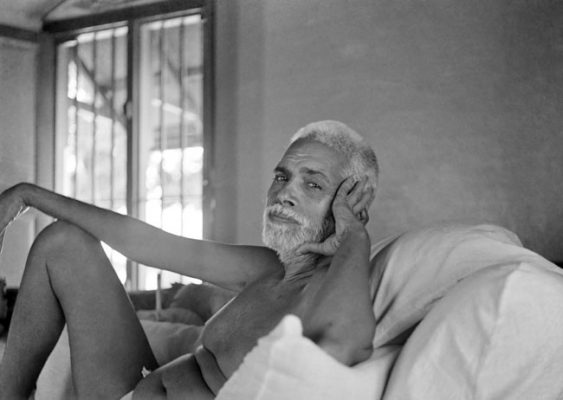
42-reclining-on-the-sofa-h-563x400

In the text Guru Vachaka Kovai are recorded some of the most important teachings of Sri Ramana Maharshi. Here are verses 148 and 149 which come under the heading ‘The Truth of Vedanta’ in the text. I have also included commentary from Sri Sadhu Om, a direct disciple of Sri Ramana Maharshi’s:

THE TRUTH OF VEDANTA

148. Those who know nothing but sense-pleasure,
To ruin and destruction doomed,
Resent transcendence of the senses
And call this fresh and fruitful wisdom
Dry Vedanta!

Tom’s comments: many seekers often resent the idea of turning away from sense pleasures, saying this is a dry or repressive path that is ‘anti-life’. Here Ramana calls this path ‘fresh and fruitful’ instead!

149. The experience of Vedanta comes
Only to those who are utterly
Without desire. Far, far it is
From those who still retain desires.
For such the penance is prescribed
Of longing for the Lord who knows
No desire, so as to end
Forever all desire.

Commentary from Sri Sadhu Om:

The term Vedanta is commonly understood to mean a particular system of philosophy, but its true meaning is the experience of Jnana which is gained as the conclusion [anta] of the Vedas.

The desire for sense objects, which are all 2nd or 3rd persons, is directly opposed to the desire for God, and so it is quite clear that God is not merely one among the many 2nd and 3rd personal objects, but that He must be the Reality of the 1st person. Therefore, we should understand that discarding all desires for 2nd and 3rd personal objects and having love for Self alone is the true devotion towards God.

Verse B 13 [which comes after verse 731] also asserts this same point.

731. The way of knowledge and the way of love
Are interwoven close. Don’t tear
Asunder these inseparables.
But practise both together holding
In the heart the two as one.

SRI BHAGAVAN 13: Meditation on the Self
Is devotion to the Lord
Supreme, since He abides as this,
Our very Self.

Tom: we see a similar teaching to verse 149 above from Sri Shankara, when he emphasises that the sage/jnani truly has no desires; this is from his commentary on the Brihadaranyaka Upanishad 2.4 (I have written a post on this here which explains the method of self-realisation outlined by both Shankara and the Brihadaranyaka Upanishad):


But there are some who hold that even a knower of Brahman has desires. They have certainly never heard the Brihadaranyaka Upanishad, nor of the distinction made by the Shruti that the desire for a son and so forth belongs to an ignorant man, and that with regard to the domain of knowledge, the statement, ‘What shall we achieve through children, we who have attained this Self, this world?’ and so on, is applicable. They do not also know the contradiction, based on incongruity, between the attainment of knowledge, which obliterates all action with its factors and results, and ignorance together with its effects [Tom: ie. all objects, duality, actions and suffering are removed with liberation, so there is no possibility of either desire or an object to desire in liberation].

Q. WHAT IS THE BEST & MOST DIRECT PATH?

WHAT IS THE BEST & MOST DIRECT PATH?

When we find a way/teacher/path/’non-path’/’no-path’ that is right for us, it is natural to want to share that with others…but what is right for us is not necessarily right for others…ultimately we each find our own unique way…

Let us remain humble, acknowledge what works for us but not assume we know what is best for someone else or what will work for someone else…

By listening to others we allow them to teach us too, we allow the Divine to teach us through everyday interactions…

We learn from others, we allow others to become our teacher…

For everything and all are expressions of the Divine…

Each and everyone we meet is our True Guru…

All is Guru!

This is my experience at least


What do you think?

🙏

‘Life is a dream…’

We have been given such a gift to have dreams. In the dream entire reality is created and projected by our minds, by our consciousness, and everything we see in the dream is our mind.

In this video Tom explains how taking on this conceptual view regarding waking life can help you to see your body mind as a projection and not what we truly are. The Guru is a projection, the teaching is a projection, the seeker is a projection – they are all ‘part of the dream’.

Please subscribe, like and share!

Ulladu Narpadu (Reality in Forty Verses) by Sri Ramana Maharshi and the supplement

Also see: Recommended Reading: Books for Enlightenment, Liberation and Self-Realisation

Some say this is the most important original text that Sri Ramana Maharshi wrote, so I wanted to present you a standalone version of the text here without commentary. Below are links to a PDF version and also  PDF versions with commentary. Bhagavan reportedly said that K. Lakshmana Sarma’s commentary was the best of the commentaries that was available at that time.

Sri Bhagavan [Sri Ramana Maharshi] once remarked that of all the commentaries on Ulladu Narpadu which then existed, Lakshmana Sarma’s Tamil commentary was the best.

T. N.  Venkataraman (former president of Sri Ramana Ashram)

I have also included the Supplement to the Forty Verses on Reality (Ulladu Narpadu Anubandham). For me, these texts, together with Who Am I? and Upadesa Saram (both of which were also directly written by Sri Ramana Maharshi), contain all you need to know in order to attain liberation. Ramana has, in concise form, laid it all out for us.

I also highly recommend reading The Path of Sri Ramana which explains in detail the entire path to liberation.

So read and study these works to find the true teaching, the true practice and the genuine result!

All praise to Ramana!

Download PDF Version – Ulladu Narpadu with Supplement

PDF Version with commentary by K. Lakshmana Sarma

PDF Version with synopsis and commentary from SS Cohen

Ramana_3_sw

Introduction

Once Bhagavan composed twenty Tamil stanzas containing his important teachings. They were not written in any particular order to form a poem. Sri Muruganar therefore suggested that Bhagavan should write twenty stanzas more to make it the conventional forty. Accordingly, Bhagavan composed twenty more stanzas. Out of these forty, Kavyakanta Ganapati Muni selected two as the invocatory stanzas. Then Bhagavan wrote two more to complete the forty. Some of the stanzas were translations from Sanskrit, but as devotees wanted all the forty verses to be original they were eliminated and new stanzas composed in their place. The verses were all arranged in a continuous order to form a poem. Later, a supplement consisting of a second forty verses was added. So indifferent to authorship was Bhagavan that he did not write all those supplementary verses himself. When he came upon a suitable one he used it – mostly translations from Sanskrit – and when not, he made one. The verses eliminated from the original forty verses were included in the supplement.

These eighty verses are the most comprehensive exposition of the Maharshi’s teaching. A number of translations have been made and commentaries written on them. They have been published as separate books by the ashram under the titles Ulladu Narpadu, Sad Vidya and Truth Revealed. Bhagavan translated these verses into Telugu prose under the name of Unnadi Nalubadi and into Malayalam verse under the name of Saddarsanam.

Ulladu Narpadu

(Forty Verses on Reality)

Invocation

1. Unless Reality exists, can thought of it arise? Since, devoid of thought, Reality exists within as Heart, how to know the Reality we term the Heart? To know That is merely to be That in the Heart.

2. When those who are in dread of death seek refuge at the feet of the deathless, birthless Lord Supreme, their ego and attachments die; and they, now deathless, think no more of death.

The Text

1. Since we know the world, we must concede for both a common Source, single but with the power of seeming many. The picture of names and forms, the onlooker, the screen, the light that illumines – all these are verily He.

2. On three entities – the individual, God and the world – every creed is based. That ‘the One becomes the three’ and that ‘always the three are three’, are said only while the ego lasts. To lose the ‘I’ and in the Self to stay is the State Supreme.

3. ‘The World is true’; ‘No, it is a false appearance’; ‘The World is Mind’; ‘No, it is not’; ‘The World is pleasant’; ‘No, it is not’ – What avails such talk? To leave the world alone and know the Self, to go beyond all thought of ‘One’ and ‘Two’, this egoless condition is the common goal of all.

4. If Self has form, the world and God likewise have form. If Self is without form, by whom and how can form (of world and God) be seen? Without the eye, can there be sight or spectacle? The Self, the real Eye, is infinite.

5. The body is made up of the five sheaths; in the term body all the five are included. Without the body the world is not. Has one without the body ever seen the world?

6. The world is made up of the five kinds of sense perceptions and nothing else. And those perceptions are felt as objects by the five senses. Since through the senses the mind alone perceives the world, is the world other than the mind?

7. Though the world and mind rise and fade together, the world shines by the light of the mind. The ground whence the world and mind arise, and wherein they set, that Perfection rises not nor sets but ever shines. That is Reality.

8. Under whatever name or form we worship It, It leads us on to knowledge of the nameless, formless Absolute. Yet, to see one’s true Self in the Absolute, to subside into It and be one with It, this is the true Knowledge of the Truth.

9. ‘Twos’ and ‘threes’ depend upon one thing, the ego. If one asks in one’s Heart, ‘What is this ego?’ and finds it, they slip away. Only those who have found this know the Truth, and they will never be perplexed.

10. There is no knowledge without ignorance; and without knowledge ignorance cannot be. To ask, ‘Whose is this knowledge? Whose this ignorance?’ and thus to know the primal Self, this alone is Knowledge.

11. Without knowing the Self that knows, to know all objects is not knowledge; it is only ignorance. Self, the ground of knowledge and the non-Self, being known, both knowledge and ignorance fall away.

12. True Knowledge is being devoid of knowledge as well as ignorance of objects. Knowledge of objects is not true knowledge. Since the Self shines self-luminous, with nothing else for It to know, with nothing else to know It, the Self is Knowledge. Nescience It is not.

13. The Self that is Awareness, that alone is true. The knowledge which is various is ignorance. And even ignorance, which is false, cannot exist apart from the Self. False are the many jewels, for apart from gold, which alone is true, they cannot exist.

14. ‘You’ and ‘he’ – these appear only when ‘I’ does. But when the nature of the ‘I’ is sought and the ego is destroyed, ‘you’ and ‘he’ are at an end. What shines then as the One alone is the true Self.

15. Past and future are dependent on the present. The past was present in its time and the future will be present too. Ever-present is the present. To seek to know the future and the past, without knowing the truth of time today, is to try to count without the number ‘One’.

16. Without us there is no time nor space. If we are only bodies, we are caught up in time and space. But are we bodies? Now, then and always – here, now and everywhere – we are the same. We exist, timeless and spaceless we.

17. To those who do not know the Self and to those who do, the body is the ‘I’. But to those who do not know the Self the ‘I’ is bounded by the body; while to those who within the body know the Self the ‘I’ shines boundless. Such is the difference between them.

18. To those who do not know and to those who do, the world is real. But to those who do not know, Reality is bounded by the world; while to those who know, Reality shines formless as the ground of the world. Such is the difference between them.

19. The debate, ‘Does free will prevail or fate?’ is only for those who do not know the root of both. Those who have known the Self, the common source of freewill and of fate, have passed beyond them both and will not return to them.

20. To see God and not the Self that sees is only to see a projection of the mind. It is said that God is seen by him alone who sees the Self; but one who has lost the ego and seen the Self is none other than God.

21. When scriptures speak of ‘seeing the Self’ and ‘seeing God’, what is the truth they mean? How to see the Self? As the Self is one without a second, it is impossible to see it. How to see God? To see Him is to be consumed by Him.

22. Without turning inwards and merging in the Lord – it is His light that shines within the mind and lends it all its light – how can we know the Light of lights with the borrowed light of the mind?

23. The body says not it is ‘I’. And no one says, “In sleep there is no ‘I’.” When ‘I’ arises all (other) things arise. Whence this ‘I’ arises, search with a keen mind.

24. The body which is matter says not ‘I’. Eternal Awareness rises not nor sets. Betwixt the two, bound by the body, rises the thought of ‘I’. This is the knot of matter and Awareness. This is bondage, jiva, subtle body, ego. This is samsara, this is the mind.

25. Holding a form it rises; holding a form it stays; holding and feeding on a form it thrives. Leaving one form, it takes hold of another. When sought, it takes to flight. Such is the ego-ghost with no form of its own.

26. When the ego rises all things rise with it. When the ego is not, there is nothing else. Since the ego thus is everything, to question ‘What is this thing?’ is the extinction of all things.

27. ‘That’ we are, when ‘I’ has not arisen. Without searching whence the ‘I’ arises, how to attain the self-extinction where no ‘I’ arises? Without attaining self-extinction, how to stay in one’s true state where the Self is ‘That’?

28. Controlling speech and breath, and diving deep within oneself – like one who, to find a thing that has fallen into water, dives deep down – one must seek out the source whence the aspiring ego springs.

29. Cease all talk of ‘I’ and search with inward diving mind whence the thought of ‘I’ springs up. This is the way of wisdom. To think, instead, ‘I am not this, but That I am,’ is helpful in the search, but it is not the search itself.

30. When the mind turns inward seeking ‘Who am I?’ and merges in the Heart, then the ‘I’ hangs down his head in shame and the One ‘I’ appears as Itself. Though it appears as ‘I-I’, it is not the ego. It is Reality, Perfection, the Substance of the Self.

31. For him who is the Bliss of Self arising from extinction of the ego, what is there to do? He knows nothing other than this Self. How to conceive the nature of his state?

32. When the Vedas have declared, ‘Thou art That’ – not to seek and find the nature of the Self and abide in It, but to think ‘I am That, not This’ is want of strength. Because, That abides forever as the Self.

33. To say ‘I do not know myself’ or ‘I have known myself’ is cause for laughter. What? Are there two selves, one to be known by the other? There is but One, the Truth of the experience of all.

34. The natural and true Reality forever resides in the Heart of all. Not to realise It there and stay in It but to quarrel ‘It is’, ‘It is not’, ‘It has form’, ‘It has not form’, ‘It is one’, ‘It is two’, ‘It is neither’, this is the mischief of maya.

35. To discern and abide in the ever-present Reality is true attainment. All other attainments are like powers enjoyed in a dream. When the sleeper wakes, are they real? Those who stay in the state of Truth, having cast off the unreal – will they ever be deluded?

36. If we think we are the body, then to tell ourselves, ‘No, I am That’, is helpful to abide as That. Yet – since ever we abide as That – why should we always think, ‘I am That?’ Does one ever think, ‘I am a man’?

37. ‘During the search, duality; on attainment, unity’ – This doctrine too is false. When eagerly he sought himself and later when he found himself, the tenth man in the story was the tenth man and none else (ten men crossed a stream and wanted to make sure they were all safe. In counting, each one left himself out and found only nine. A passer-by gave each a blow and made them count the ten blows).

38. If we are the doers of deeds, we should reap the fruits they yield. But when we question, ‘Who am I, the doer of this deed?’ and realise the Self, the sense of agency is lost and the three karmas slip away. Eternal is this Liberation.

39. Thoughts of bondage and of freedom last only as long as one feels, ‘I am bound’. When one inquires of oneself, ‘Who am I, the bound one?’ the Self, Eternal, ever free, remains. The thought of bondage goes; and with it goes the thought of freedom too.

40. If asked, ‘Which of these three is final liberation: With form, without form, or with-and-without-form?’ I say, Liberation is the extinction of the ego which enquires ‘With form, without form, or with-and-without-form?’

Translated by Professor K. Swaminathan

Ulladu Narpadu Anubandham

Reality in Forty Verses: Supplement

Italicised verses are the verses written by Sri Ramana Maharshi, the others are verses he incorporated into the text from other texts.

Invocation

That which is the Support, the Soul, the Source, the Purpose and the Power of all this world, the Reality behind all this Appearance, That indeed exists. Let That, the Truth, abide in our Heart. (Yoga Vasishta, 8, v.12)

The Text

1. In the company of sages, attachment vanishes; and with attachment, illusion. Freed from illusion, one attains stability, and thence liberation while yet alive. Seek therefore the company of sages. (from Bhajagovindam, the “Mohamudagaram Hymn,” by Shankaracharya)

2. Not by listening to preachers, nor by study of books, not by meritorious deeds nor by any other means can one attain that Supreme State, which is attainable only through association with the sages and the clear quest of the Self. (a verse from the Yoga Vasishta, 5 – 12 – v.17)

3. When one has learned to love the company of sages, wherefore all these rules of discipline? When a pleasant, cool southern breeze is blowing, what need is there for a fan? (a verse from the Yoga Vasishta)

4. Fever is overcome by the cool light of the moon; want, by the good wish-yielding tree; and sin by the Holy Ganges. Those three – fever and want and sin – all flee at the august sight of the peerless sage. (Subhashita Ratna Bhandargara, chapt. 3, v. 6)

5. Holy rivers, which are only water, and idols, which are made of stone and clay, are not as mighty as the sages. For while they make one pure in course of countless days, the sage’s eyes by a mere glance purify at once. (from Srimad Bhagavatam, chapt. 48, v. 31, tenth canto)

6. Disciple: Who is God?

Master:Hewho knows the mind.

D:MySelf, the Spirit, knows my mind.

M: Therefore you are God; and also the sruti declares that there is only one God, the Knower.

M: By what light do you see?

D: The sun by day, the lamp by night.

M: By what light do you see these lights?

D: The eye.

M: By what light do you see the eye?

D: The mind.

M: By what light do you know the mind?

D: My Self.

M: You then are the Light of Lights.

D: Yes, That I am.(from Ekasloki, by Shankaracharya)

8. In the centre of the Heart-Cave there shines alone the one Brahman as the `I, I’, the Atman. Reach the Heart by diving deep in quest of the Self, or by controlling the mind with the breath, and stay established in the Atman.

9. In the lotus of the Heart is pure and changeless Consciousness in the form of the Self. When the ego is removed, this Consciousness of Self bestows liberation of soul. (Devikalottaram, v. 46)

10. The body is like an earthen pot, inert. Because it has no consciousness of `I’, and because daily in bodiless sleep we touch our real nature, the body is not `I’. Then who is this `I’? Where is this `I’? In the Heart-cave of those that question thus, there shineth forth as `I’, Himself, the Lord Siva of Arunachala.

11. Who is born? It is only he who asks `Whence am I born?’ that is truly born in Brahman, the Prime Source. He indeed is born eternally; He is the Lord of saints; He is the ever-new. (On celebrating Sri Bhagavan’s jayanti))

12. Cast off the notion, `This vile flesh am I,’ and seek the ceaseless bliss of Self. To seek the Self while cherishing this perishing flesh is like trying to cross a stream by clinging to a crocodile.

13. The way of charity, penance, sacrifice, dharma, yoga and Bhakti; and the Goal of Heaven, Reality, Peace, Truth, Grace, Silence, Stability, Deathless Death, Knowledge, Renunciation, Liberation, Bliss – all this is only ceasing to think that the body is the Self.

14. What is action, or devotion, or union, or knowledge? It is to inquire, `Whose is this action, or indifference, or separateness, or ignorance?’ Inquiring thus, the ego vanishes. To abide as the Self, wherein these eight have never been, this is True existence.

15. Not realizing that they themselves are moved by an energy not their own, some fools are busy seeking miraculous powers. Their antics are like the boasting of a cripple who says to his friends: `If you raise me to my feet, these enemies are nothing before me.’

16. Since the stilling of the mind is true liberation and miraculous powers are unattainable without an act of the mind, how can they whose mind is set on such powers enter the bliss of liberation which is the ending of all activity of the mind?

17. While God sustains the burden of the world, the spurious ego assumes its burden, grimacing like an image on a tower, seeming to support it. If the traveller in a carriage, which can carry any weight, does not lay his luggage down but carries it painfully on his head, whose is the fault?

18. Between the two paps, below the chest, above the stomach, there are six organs of various colours. Of these, one, looking like a lily bud, is the Heart, at two digits’ distance to the right of the centre. (from Ashtanga Hridayam, Malayalam)

19. Its mouth is closed. Within its cavity is seated a heavy darkness, filled with all desires; all the great nerves are centred there; the home it is of breath, mind, light of knowledge. (from Ashtanga Hridayam, Malayalam)

20. The Lord whose home is the interior of the Heart-Lotus is extolled as Lord of the Cave. If by force of practice the feeling `I am He, I am the Lord of the Cave’ becomes firmly established, as firmly as your present notion that you are the ego is established in the body, and thus you stand forth as that Lord of the Cave, the illusion that you are the perishable body will vanish like darkness before the rising sun. (composed by Bhagavan, employing the ideas of two verses found in the Prabhulinga Leela, v. 45, 46, Kannada)

21. When Rama asked, `Which is the great mirror in which we see these images of things? What is it that is called the Heart of all the beings in the world?’ Vasishta answered, `When we reflect we see that all the beings in the world have two different hearts.’ (Yoga Vasishta, 5 – 78 – v. 32, 33)

22. One of these is worth acceptance, the other worth rejection. Listen how they differ. The organ called the heart placed somewhere in the chest of the physical body is worth rejection. The Heart which is of the form of Pure Awareness is worth acceptance; it is both within and without — it has no inside or out. (Yoga Vasishta, 5 – 78 – v. 34, 35)

23. That indeed is the essential Heart and in it all this world abides. It is the mirror in which all things are seen.It is the source of all wealth. Hence Awareness may be termed the Heart of all beings. The Heart is not a part of the perishable body inert like a stone. (Yoga Vasishta, 5 – 78 – 36, 37)

24. Therefore by the practice of merging the ego in the pure Heart which is all-Awareness, the tendencies of the mind as well as the breath will be subdued. (Yoga Vasishta, 5 – 78 – v. 38)

25. By constantly meditating in the Heart, `That pure unconditioned Awareness that is Siva, That am I,’ remove all attachment of the ego. (Devikalottara, v. 47)

26. Having investigated the various states of being, and seizing firmly by the mind that State of Supreme Reality, play your part, O hero, ever in the world. You have known the Truth which is at the Heart of all kinds of appearances. Without ever turning away from that Reality, play in the world, O hero, as if in love with it. (Yoga Vasishta, 5 – 18 – v. 20 to 23)

27. Seeming to have enthusiasm and delight, seeming to have excitement and aversion, seeming to exercise initiative and perseverance, and yet without attachment, play, O hero, in the world. Released from all bonds of attachment and with equanimity of mind, acting outwardly in all situations in accordance with the part you have assumed, play as you please, O hero, in the world. (Yoga Vasishta, 5 – 18 – v. 24 to 26)

28. He who by Knowledge of the Atman is established in the Truth, he who has vanquished the five senses — call him the fire of knowledge, the wielder of the thunderbolt of Knowledge, the Conqueror of Time and the Hero who has slain death. (a verse from the Yoga Vasishta)

29. Just as on the earth with the coming of spring the tree shines in fresh beauty of foliage, even so he who has seen the Truth will shine with growing lustre, intelligence and power. (Yoga Vasishta, 5 – 76 – v. 20)

30. Like one to whom a tale is told while his thoughts are wandering far away, the mind which is free from attachment is inactive while it acts. But the mind immersed in attachments is active, though it does not act, like the sleeper lying motionless here, who in his dream climbs a hill and tumbles down. (Yoga Vasishta, 5 – 56 – v. 13, 14)

31. As the movement of the cart, its standing still and its being unyoked are to the passenger asleep in the cart, even so are action, contemplation and sleep to the Sage asleep in the cart of his body.

32. For one who seeks waking, dreaming or sleep there is a state beyond these three, a wakeful sleep, a fourth state called the turiya. But because this turiya state alone is real and the three apparent states are illusory, the `fourth’ state is indeed the transcendental state.

33. The statement that the jnani retains prarabdha while free from sanchita and agami is only a formal answer to the questions of the ignorant. Of several wives none escapes widowhood when the husband dies; even so, when the doer goes, all three karmas vanish.

34. For unlearned folk there is only one family consisting of wife, children and dependants. But in the mind of those with much learning there are many families of books, theories and opinions as obstacles to yoga(Subhashita Ratna Bhandagara, Prakarana VI, Shanta Rasa Nirdesha, v. 13)

35. What is the use of letters to those lettered folk who do not seek to wipe out the letters of fate by inquiring, `Whence are we born?’ What else are they but gramaphones, O Lord of Arunachala? They learn and repeat words without realizing their meaning.

36. The unlettered are easier saved than those who are learned but unsubdued. The unlettered are free from the clutches of the demon Pride, they are free from the malady of many whirling thoughts and words; they are free from the mad pursuit of wealth; they are free from many, many ills.

37. Though a man looks on the world as a wisp of straw and holds all sacred lore in his hand, it is hard for him to escape from thralldom if he has yielded to vile Flattery, the harlot. (from Sadhaka Avasta, by Sri Sadasiva Brahmendra)

38. Without thinking of oneself as apart from others,without swerving from one’s true state, if one abides always in one’s Self, who is there alien to one? What matters it what people say of one? What matters it if one praises or blames oneself?

39. Keep advaita within the Heart. Do not ever carry it into action. Even if you apply it to all the three worlds, O Son, it is not to be applied to the Guru. (Tattvopadesa, v. 87, by Shankaracharya)

40. I shall declare truly the essence of the final doctrine of the Vedanta: when the ego dies and becomes That, the Self of Pure Awareness, That alone abides.

Translated by Prof. K. Swaminathan

Q. Can you briefly define Jnana Yoga vs Bhakti Yoga and how they relate to Advaita and Vedanta?

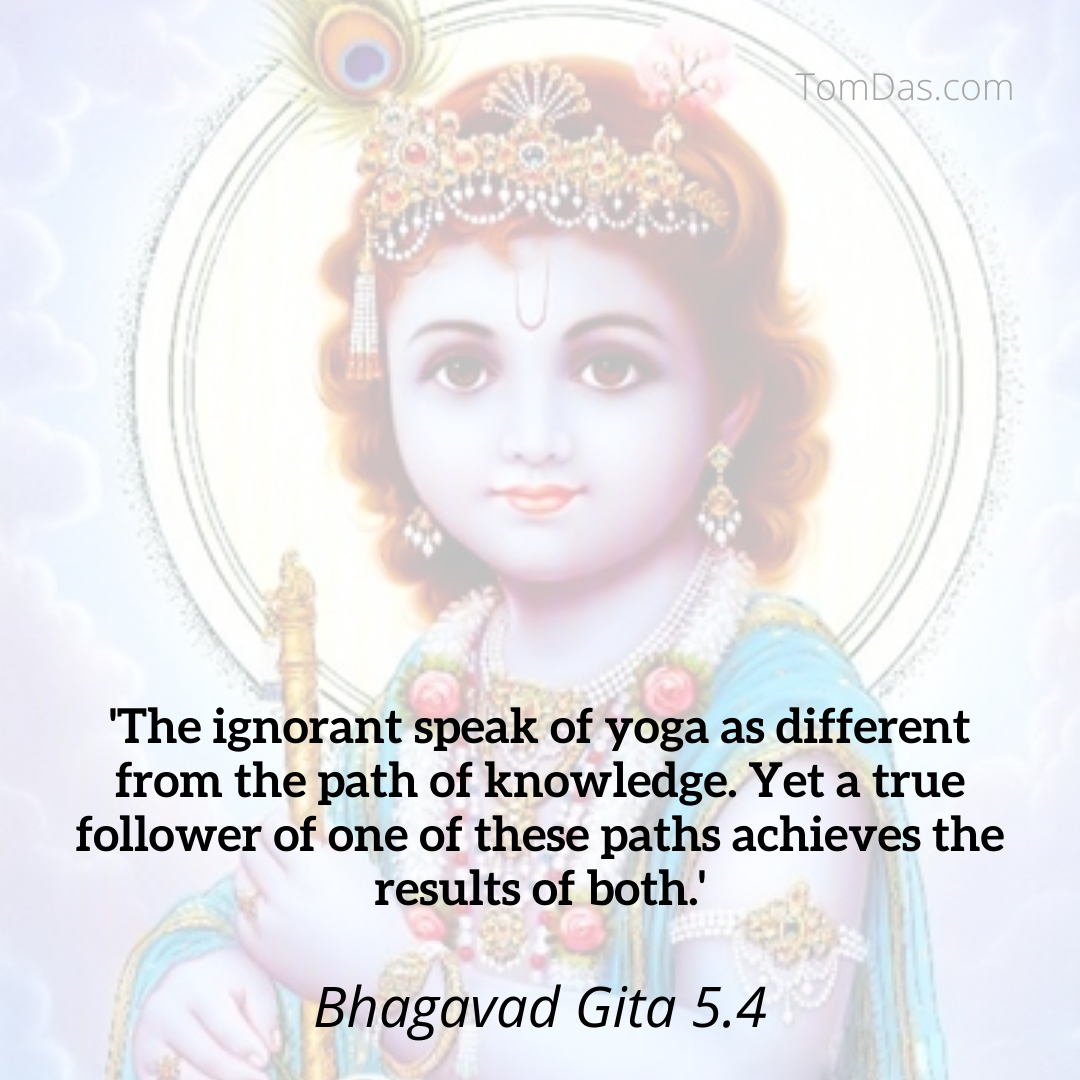
Krishna The ignorant speak of yoga as different from the path of knowledge

Q. Can you briefly define Jnana Yoga vs Bhakti Yoga and how they relate to Advaita and Vedanta?

Tom: Jnana yoga usually refers to the use of (intellectual) knowledge in the mind used to remove ignorance, a thorn to remove a thorn, and then the thorn of ‘knowledge’ is itself allowed to fall away; Bhakti yoga is faith, love and devotion from the heart to Self/Guru/God. These 2 yogas seem different at first, but then they quickly merge together to remove ignorance and end suffering, which is what the word ‘yoga’ means of course. Both of the above are part and parcel of Advaita Vedanta as per the Upanishads, Gita, etc.

Q. What about Advaita vs. Jnana?

Tom: Advaita Vedanta, as a traditional teaching is the general term used to refer to the teachings of the Upanishads, Bhagavad Gita, Brahma Sutras and a few other traditional texts. Jnana yoga refers to one part of the teachings of Advaita Vedanta. Other aspects of Advaita Vedanta include Bhakti Yoga, Raja Yoga and several other teachings found in the above aforementioned texts.

Advaita, literally means not-two. Jnana means knowledge. Jnana can either mean relative knowledge in the mind, which is the means of jnana yoga, or it can refer to the Absolute, which is not really knowledge per se as it is beyond ideas/conceptualisation, but the word Jnana is sometimes used nonetheless. This ‘absolute Jnana’ is synonymous with Advaita and points to that which is beyond both Advaita and Jnana, ie. God or True Self! It is also known as Parabhakti (divine love), Aparokshanubhuti (direct experience), Moksha (freedom) and various other terms, none of which fully capture what is spoken of!

Ashtavakra Gita – all is illusion, I am the Self

Janaka ashtavakra

The following verses are read on this video here (a couple of the verses are in a slightly different order):

Sage Ashtavakra, the young boy with contorted limbs, teaches King Janaka, and the result is the Song of Ashtavakra, or Ashtavakra Gita. Here are some selected verses, enjoy:

2.1. Oh, I am spotless, tranquil, Pure Consciousness, and beyond Nature. All this time I have been mocked by illusion.

Tom – Now the triad of knower/knowing/known are said not to exist. Note that this triad essentially encompasses all arising or objective phenomena:

2.15. Knowledge, knower and the known – these three do not exist in reality. I am that stainless Self in which this triad appears through ignorance.

Tom – here the remedy is prescribed:

2.16. Oh, the root of misery is duality. There is no other remedy for it except the realisation of the unreality of all objects of experience and that I am One, Pure Consciousness, and Bliss.

2.18. I am neither bound nor free. My illusion has ended. The world, though appearing to exist in me, has in reality no existence.

2.19. My conviction is that the Universe and the body have no reality. The Self is Consciousness alone. How can the world be imagined in it?

2.20. I am the Self, and my nature is pure Consciousness. The body, heaven, hell, bondage, freedom, and fear are merely imagined, and I have no relationship with them.

3.13. Knowing the object of perception to be naught by nature, that steady-minded one neither accepts this nor rejects that.

5.3. Though the Universe is perceptible by the senses, it has no factual existence, like the snake in the rope. Therefore, enter into Laya, the state of dissolution.

Tom – Again the essential teaching is dispensed:

11.8. He who is convinced that this manifold and wonderful Universe has no real existence, becomes free from desire, is pure Consiousness, and finds peace in the Knowledge that nothing is real.

15.16. The world is the result of ignorance of your own nature. In reality, you alone exist. There is neither jiva (the individual person) nor Ishvara (God), nothing other than thyself.

15.17. He who has fully realised that the Universe is a pure illusion, becomes desireless and Consciousness Itself – such a one abides in peace.

16.11. Even though Shiva, Vishnu, or Brahma instruct you, unless you regard the world as unreal, and dismiss all sense of egotism, you will not become established in your own nature (the Self).

17.19. Devoid of the feeling of ‘This is mine’ and ‘This I am’ and knowing for certain that nothing objective exists in reality, the knower of Truth is at peace within himself, his desires have subsided. Though appearing to act, in fact he does not engage in action.

18.14. Where is delusion, where is the universe, where is renunciation, moreover where is liberation for the great-souled one who rests beyond the world of desires?

Tom – the implication in verse 18.14 above is that all the items listed – namely ignorance, the universe, renunciation and liberation – all of these are illusion.

18.28. That man of peace, beyond distraction and contemplation, is neither an aspirant for liberation, nor is he bound. Knowing the Universe to be an illusion, though perceiving it, he remains in the absolute state.

18.70. The pure one knows for certain that this universe is nothing but the product of illusion and that nothing exists. The Imperceptible Self is revealed to him, and he naturally enjoys peace.


Tom – As if the above verses were not enough, here, in the last chapter, chapter 20, the point is driven home again. Everything in the phenomenal world is negated as being mere dream-like illusion, a product of imagination, from the scriptures, to the seeker, from the teacher to the teaching. Even notions of liberation, bondage, knowledge, ignorance, time and space and lastly even duality and non-duality – all these are said to be mere illusion.

20.1. In my Perfect Self (Atman), neither the elements, nor the body, nor the sense-organs, nor the mind, nor the void, nor despair, exist.

20.2. Where are the scriptures, where is Self-Knowledge, where is the mind not attached to sense-objects, where is contentment, and where is desirelessness for me who am ever devoid of the sense of duality?

Tom – ie. scriptures, self-knowledge, the unattached mind, happiness and desirelessness are all illusory

20.3. Where is knowledge and where is ignorance; where is ‘I’, where is ‘this’, and where is ‘mine’; where is bondage and where is liberation? Where is an attribute to the nature of my self?

Tom – ie. knowledge, ignorance, bondage, liberation, subject and object are all illusory. And so the verses continue in the same fashion:

20.6. Where is the world and where is the seeker of liberation; where is the Yogi and where is the Jnani; where is bondage and where is liberation for me who am non-dual by nature?

20.7. Where are creation and destruction; where is the end and where the means; where is the seeker and success for me abiding in my non-dual nature?

20.8. Where is the knower, the means to knowledge, the object of knowledge or knowledge itself; where is anything, and where is nothing for me who am ever pure?

20.9. Where is distraction, where is concentration; where is knowledge, where is delusion; where is joy and where is sorrow for me who am ever actionless?

20.13. Where are instruction and scriptural injunction, where is the disciple and where is the guru; where, indeed, is the object of life for me who am absolute good and free from limitation?

20.14. Where is existence, where is non-existence; where is unity, where is duality? What need is there to say more? Nothing emanates from me.

Ramana Maharshi: The world should be considered like a dream

ramana umbrella


The following are explained in this post:

  1. The world should be considered like a dream
  2. The external guru that appears as an external form is a dream-guru
  3. The world is simply thought; the universe is made up of thought
  4. The guru does not need to teach others or ‘spread the word’
  5. The false ideas ‘I do not want liberation’ and ‘Let all others be liberated before me first’ are discussed
  6. Other people do not need to be saved, ie. the focus should be on your own realisation
  7. There is only one jiva (seperate ego-self) – ie. eka jiva vada

The Dream

Here is an essential instruction from Ramana Maharshi:

‘The world should be considered like a dream’
Who Am I?


The following are supportive quotes:

Waking is long and a dream short; other than this there is no difference
Who Am I?

The present waking state is no more than a dream
Talks 244

The so-called waking state is itself an illusion
Talks 199


The Dream Guru

In the following two quotes we see that Ramana is describing the Guru or Teacher or Teaching as a mere dream-guru or dream-teaching, a part of the illusion. There is no real teaching, no real teacher, no real seeker, no real liberation. These are all illusion. The example given is that we dream the guru up, rather like dreaming of a tiger that then causes us to awake from the dream:

A man dreams of a tiger, takes fright and wakes up
Talks 473

It is said that awaking from ignorance is like awaking from a fearful dream of a beast
Talks 627

In the following dialogue this is also made clear:

A Swami asked: I feel toothache. Is it only a thought?
Ramana Maharshi: Yes.
Questioner: Why can I not think that there is no toothache and thus cure myself?
Ramana Maharshi: When engrossed in other thoughts one does not feel the toothache. When one sleeps toothache is not felt.
Questioner: But toothache remains all the same.
Ramana Maharshi: Such is the firm conviction of the reality of the world that it is not easily shaken off. The world does not become, for that reason, any more real than the individual himself.
Questioner: Now there is the Sino-Japanese war. If it is only in imagination, can or will Sri Bhagavan imagine the contrary and put an end to the war?
Ramana Maharshi: The Bhagavan of the questioner [ie. Sri Ramana Maharshi] is as much a thought as the Sino Japanese war. (Laughter.)

Talks 451


The Guru does not need to teach others

In the following excerpt Ramana points some flawed reasoning. Firstly why does a liberated sage not need to go out and preach to the world?

People often say that a mukta purusha [ie. liberated person; mukta = liberated, purusha = person] should go out and preach his message to the people. They argue, how can anyone be a mukta so long as there is misery by his side?

True. But who is a mukta? Does he see misery beside him? They want to determine the state of a mukta without themselves realising the state.

From the standpoint of the mukta their contention amounts to this: a man dreams a dream in which he finds several persons. On waking up, he asks, ‘Have the dream individuals also wakened?’ It is ridiculous.

Talks 498


Two false teachings

Secondly, the flawed thinking in those who say to themselves:

a) ‘I don’t mind if I don’t get mukti’ or

b) ‘Let me be the last person to be liberated and instead help all others become liberated first’. (ie. what in Mahayana Buddhism is known as the Bodhisattva ideal)

Again, a good man says, “It does not matter even if I do not get mukti. Or let me be the last man to get it so that I shall help all others to be muktas before I am one.” It is all very good. Imagine a dreamer saying, “May all these wake up before I do”. The dreamer is no more absurd than the amiable philosopher aforesaid.

Talks 498


Others do not need to be saved

Does a man who sees many individuals in his dream persist in believing them to be real and enquire after them when he wakes up?
Talks 571


There are not many jivas/egos/people

Here a questioner asks are there not many jivas? Ramana informs the questioner there is only one jiva:

A question was asked why it was wrong to say that there is a multiplicity of jivas. Jivas are certainly many. For a jiva is only the ego and forms the reflected light of the Self. Multiplicity of selves may be wrong but not of jivas.

M.: Jiva is called so because he sees the world. A dreamer sees many jivas in a dream but all of them are not real. The dreamer alone exists and he sees all. So it is with the individual and the world.

There is the creed of only one Self which is also called the creed of only one jiva*. It says that the jiva is only one who sees the whole world and the jivas therein.

Talks 571

*This is called the doctrine of eka jiva vada (the view there is only a single jiva/ego/person). Our own body-mind, and the body-mind of apparent others are all projections of the Self. Like a dream, it appears we are many, but actually this entire dream world is an illusion, and there is only the Dreamer, the Self, the Consciousness from which all is projected. Tat Tvam Asi, You are That.


Ramana Maharshi:

The world should be considered like a dream’

Waking is long and a dream short; other than this there is no difference.
Who Am I?

The present waking state is no more than a dream.
Talks 244

The so-called waking state is itself an illusion
Talks 199

Yoga Vasishta clearly defines Liberation as the abandonment of the false and remaining as Being.
Talks 442

A man dreams of a tiger [the guru], takes fright and wakes up
Talks 473

It is said that awaking from ignorance is like awaking from a fearful dream of a beast.
Talks 627

A Swami asked: I feel toothache. Is it only a thought?
Ramana Maharshi: Yes.
Talks 451

The Bhagavan of the questioner [ie. Sri Ramana Maharshi] is as much a thought as the Sino Japanese war.
Talks 451

Does a man who sees many individuals in his dream persist in believing them to be real and enquire after them when he wakes up?
Talks 571

Jiva is called so because he sees the world. A dreamer sees many jivas in a dream but all of them are not real. The dreamer alone exists and he sees all. So it is with the individual and the world.
Talks 571

There is the creed of only one Self which is also called the creed of only one jiva. It says that the jiva is only one who sees the whole world and the jivas therein.
Talks 571


Also see:

Sri Ramana Maharshi: Solipsism and the shock of hearing the Ajata teachings

How to attain Brahman according to Advaita Vedanta (Sri Gaudapada’s Mandukya Karika)

The following summarises the spiritual method advised by Sri Gaudapada, the great-guru of the more famous Sri Shankara. It is taken from Chapter 3 of Gaudapada’s Karika (Gaudapada’s commentary on the Mandukya Upanishad),  one of the earliest, most authoritative and most-influential of Advaita Vedanta Scriptures.

om1
42. The mind distracted by desires and enjoyments should be brought under control by proper means; so also the mind enjoying pleasure in inactivity (laya). For the state of inactivity is as harmful as the state of desires.

43. Turn back the mind from the enjoyment of desires, remembering that they beget only misery. Do not see the created objects, remembering that all this is the unborn Atman.

44. If the mind becomes inactive, arouse it from laya [inactivity]; if distracted, make it tranquil. Understand the nature of the mind when it contains the seed of attachment. When the mind has attained sameness, do not disturb it again.

45. The yogi must not taste the happiness arising from samadhi; he should detach himself from it by the exercise of discrimination. If his mind, after attaining steadiness, again seeks external objects, he should make it one with Atman through great effort.

46. When the mind does not lapse into inactivity [laya] and is not distracted by desires, that is to say, when it remains unshakable and does not give rise to appearances, it verily becomes Brahman.

I have written a short commentary on the above verses entitled Advaita Vedanta: Gaudapada’s Method which further explains the above verses.

You can read the entire text of Gaudapada’s Karika here: Mandukya Upanishad with Gaudapada’s Karika