Levels of reality

water oceanic
Are there levels of reality?

I have often seen people talk and write about various levels of reality. Typically, they talk of the level of the absolute and the level of the relative. On the level of the absolute, everything is one, so they say. Whereas on the relative level, the level of being a person different rules apply. On the relative level differentiation exists, we talk to each other, we love one another, we get annoyed and irritated, we buy fast-food from time to time, and yet ultimately, at the highest and truest level we are told this is all oneness.

Well let me start off by saying that I reject the notion of levels of reality. I think reality has various aspects, but not levels per se. Now this may seem like a minor difference, a play of semantics if you will, but let me explain the difference.

Talking about the same thing in different ways

When I say reality has various aspects, all I really mean is that there are various ways you can talk about reality – actually there are various ways you can talk about anything. That doesn’t mean there are different levels of reality.

Lets take a simple example: lets take a human body. You can talk about a human body  in different ways. You can talk about it in terms of its size: you can say it is big, small, medium. You can talk about its age: is it a young or older body. You can talk about it in terms of organ systems such as the cardiovascular system or digestive system and how they function and describe the body that way, or you can talk about its anatomy and how various parts of it fit together. You can talk about the body’s name and culture – eg. maybe it is called John and it comes from the United Kingdom, you can talk about its occupation. You could talk about its fashion sense, its muscularity…

…ok ok, hopefully you get the idea: there are different ways you can talk about things. There are different conceptual frameworks from where we can view the body. And this is true for anything. We can talk about a pebble in terms of its age, size, geology or how good it would be to skim on a lake’s surface. We can talk about a lake in terms of its scenic beauty, how choppy its water are, its phosphorus content, or remark how it is all made up (mainly) of water.

Now, how many levels does a body or a pebble have? It doesn’t actually have any levels at all – there is only one body or stone (in the above examples) – it’s just that we can talk about them in various ways. In the same way there are no levels in reality, just different ways of talking about it.

No particular conceptual framework is intrinsically higher than another

Also note that no particular way of talking about the body or a pebble is intrinsically better that any other way. It just depends on what you want the conceptual framework to achieve. For example, if you want to skim a stone on the surface of a lake, then it’s less useful to talk about the geology of the stone, and more useful to look at it in terms of its shape and size with respect to achieving your goal (skimming it across the lake). You can’t legitimately claim that one way of viewing something is intrinsically higher and another way is lower, which is something you often hear when talking about ‘ultimate reality’ or the ‘highest level’. It just depends on how well the way you are conceptualising and viewing the object(s) in question fits in with your goal.

It depends on what you want to achieve

Similarly, it is not necessarily better to talk about the body in terms on physiology or organ systems compared to it’s occupation or fashion sense. As previously stated, it just depends on what you want to achieve. If the body has a disease, then understanding the physiology and how to correct any imbalance or defect in this is useful. Conversely if you are going out on a first date, then perhaps a degree of fashion sense would be useful.

No paradoxes, no contradictions

Also there in no contradiction in talking about a single object in different ways depending on the context. There is no paradox that a stone has both an age and a shape, or that a river is a single system made up of a variety of different things, all of which are in motion. There is a consistent underlying reality that underpins the various ways we talk about it. No contradiction or paradox at all.

Different ways of talking about the same experience

Remember, what we are talking about here is our experience of reality. Our reality is our experience – that’s all we know. We can talk about how everything we perceive is non-different to our consciousness, and we can also talk of how things interact within this consciousness, and the rules and consequences thereof. These are just different ways of talking about our experience and our experiences. No particular way is higher or lower, and there are no actual ‘levels’ that exist apart from our conceptualisations.

The description is not the described

We can chose how to conceptually carve up and talk about our experiential reality in order to achieve certain specific aims. To that end these conceptual maps are useful and often necessary. However we must not mistake any particular conceptual map of (our experience of) reality for reality, just as no particular way of describing the body is the body itself.


Enlightenment: is a teacher required?

buddha-lights

For many a teacher is essential.

For some no human teacher is required.

For some a teacher/teaching can even be detrimental.

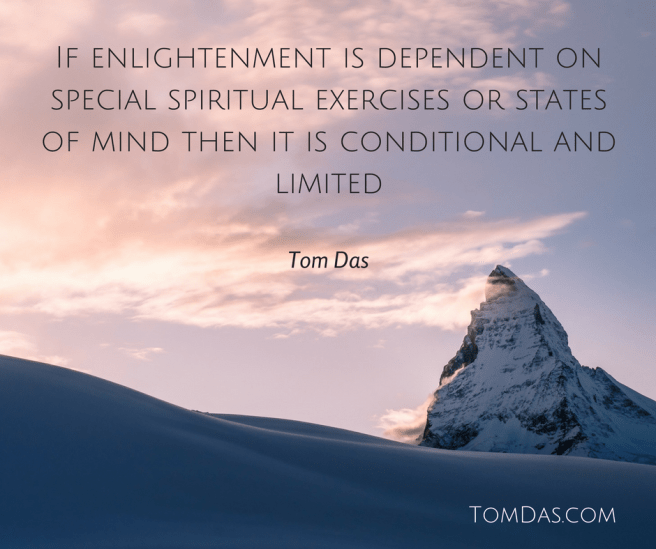
Without the drive for truth, even with a good teacher you can get caught up in the teaching and never break free from its concepts and modes of expression.

Buddhism: How enlightenment happens

Buddha statue.jpg

If you read the earlier Buddhist texts (the Pali Suttas) you get a very different feel of the Buddha’s teachings compared to the systematised versions of Buddhism that are often more prominently on display today. It becomes apparent that the Buddha taught in different ways to different people and that the true Dhamma (teaching) cannot be grasped.

The eight-fold path that we most often hear about was very probably a central and important part of the Buddha’s teaching, and a truly wonderful teaching in my view, but it is clear that many people came to enlightenment in various ways according to the suttas (Buddhist texts).

We read that some attained enlightenment without practising, and some attained enlightenment simply upon hearing the Buddha speak. Some had a great awakening before practice, and then a practice naturally developed afterwards. Others followed the more traditional way of engaging with spiritual practises first and then attaining arahantship (full enlightenment) afterwards. The fact that arahantship was preceded by many years of practice for the Buddha himself may have affected the way he taught. However the suttas indicate that the Buddha realised that not all came to the Dhamma in the same way. In the Yuganaddha Sutta, Ananda explains the 4 main ways arahantship can arise:

Venerable Ananda said: “Friends, whoever — monk or nun — declares the attainment of arahantship in my presence, they all do it by means of one or another of four paths. Which four?
“There is the case where a monk has developed insight preceded by tranquility…He follows the path, developing it & pursuing it — his fetters are abandoned, his obsessions destroyed.
“Then there is the case where a monk has developed tranquility preceded by insight…He follows that path…his fetters are abandoned, his obsessions destroyed.
“Then there is the case where a monk has developed tranquility in tandem with insight…He follows that path…his fetters are abandoned, his obsessions destroyed.
“Then there is the case where a monk’s mind has its restlessness concerning the Dhamma well under control. There comes a time when his mind grows steady inwardly, settles down, and becomes unified & concentrated. In him the path is born. He follows that path, develops it, pursues it. As he follows the path, developing it & pursuing it — his fetters are abandoned, his obsessions destroyed.”
“Whoever — monk or nun — declares the attainment of arahantship in my presence, they all do it by means of one or another of these four paths.”

You can see here that two aspects of the teaching become very prominent, namely that of achieving tranquility and that of insight. The key is that both are required, but the order in which they are achieved varies. Some naturally are drawn towards becoming more tranquil and insight comes later. Others are more drawn to understanding and insight first and it is this insight that leads to tranquility as ‘fetters are abandoned’ and ‘obsessions destroyed’.

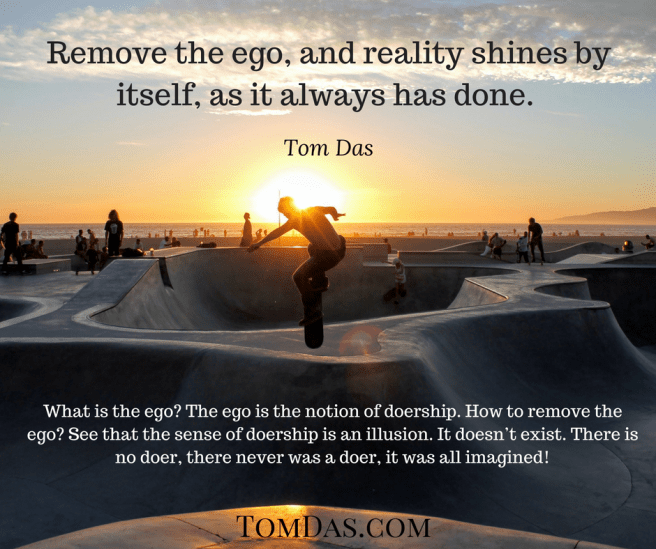
I explain in more detail what is meant by tranquility and insight here, but briefly insight is seeing there is no separate self (anatta in Pali), specifically that there is no separate doer entity. Tranquility when it is cultivated before insight usually refers to the lessening of thoughts and increasing of peace which in turn paves the way for insight. Tranquility after insight usually means a purification of the mind which naturally happens after insight; rather than reducing thoughts, this is the tranquility of freedom, of not being bothered by thoughts or circumstances and not depending on the mind, body or world (ie. anything) for one’s happiness.

In later Buddhist developments many schools developed ‘enlightenment first, practice later’ schools of teaching, notably in the Mahayana traditions, a prime example being Korean Zen master Chinul (1158-1210):

‘There are many avenues of entry into the Way…Sages since time immemorial have all first awakened then cultivated practice, attaining experiential proof based on practice.’
Chinul, Secrets of Cultivating the Mind, verses 19-20
‘If a real teacher points out a way of entry for you, and for a single instant you turn your attention around, you see your own original essence. This essence originally has no afflictions; uncontaminated wisdom is inherently complete in it. Then you are no different from the Buddhas; thus it is called sudden enlightenment.
As for gradual practice, having suddenly realised fundamental essence, no different from Buddha, beginningless mental habits are hard to get rid of all at once. Therefore one cultivates practice based on enlightenment, gradually cultivating the attainment to perfection, nurturing the embryo of sagehood to maturity. Eventually, after a long time, one becomes a sage; therefore it is called gradual practice. It is like an infant, which has all the normal faculties at birth, but as yet undeveloped; only with the passage of years does it become an adult.
Question: By what expedient means can we turn our minds around instantly to realise our inherent essence?
Answer: It is just your own mind; what further expedient means would you apply?’
Chinul, Secrets of Cultivating the Mind, verses 27-30

Chinul talks about the importance of first recognising your true original essence first (insight) before using this insight to purify the mind (tranquility after insight).

Going back to the Pali suttas, the Buddha also repeatedly warned against being attached to any particular teaching or teaching tradition:

‘Do not go by oral tradition, by lineage of teaching, by hearsay, by a collection of texts, by logic, by inferential reasoning, by reasoned cogitation, by the acceptance of a view after pondering it, by the seeming competence of a speaker, or because you think, ‘This ascetic is our teacher.’
AN 3.65 Kesaputti [Kālāma] Sutta

This really is quite a stark warning, and we could see this as a very ‘modern’ and scientific way of approaching this search for freedom from suffering. Again in the Atthaavagga, perhaps the earliest of all the Buddhist texts we know of, the Buddha warns about having any fixed views:

Atthaavagga, Chapter 6
5. Having abandoned what was acquired, not taking up anything, he would not be in dependence even upon knowledge. He truly is not a partisan among the schoolmen; he does not fall back on any view at all.
Atthaavagga, Chapter 10
7. He does not train himself through desire of gain, and he is not upset at lack of gain. He is not opposed to craving, nor is he greedy for savory stimulations.
8. An indifferent onlooker, always mindful, He imagines nothing in the world to be equal, nor superior, nor lower. For him there are no distinguished positions.
14. He for whom there is nothing his own in the world, and who does not sorrow over what is not there, And who does not go by philosophies— He truly is said to be “at peace.”

The Buddha stresses non-clinging, including non-clinging to doctrines, teachings, knowledge and points of view. In fact the Atthaavagga goes even further. Most of the very earliest Buddhist texts do not even mention the four noble truths, let alone the eight-fold path (which is the fourth truth of the four noble truths).

The Atthaavagga appears to go further here by denying much of what is commonly taught. We are not to find this deeper ‘truth’ through seeing, hearing or by any kind of knowledge. We are not to cling to morality or purity, nor their opposites. We are to depend on nothing. Of course, reading the following lines and having insight into them reveals a core ‘truth’, a more sublime Dhamma that is not opposed to the classic eight-fold path at all:

3. [The Buddha said:] There is nothing of which I say, “I declare this,”…But looking among the views, not taking hold of anything, examining, I saw inner peace.
4. [The questioner responds:]…This “inner peace,” whatever it means, How is it made known by the wise?
5. [The Buddha said:] Not by what is viewed, not by what is heard, not by inner knowledge…nor by morality and observances is purity said to be; by absence of what is viewed, by absence of what is heard, by non-knowledge, by amorality, by nonobservance—also not by that. So having let go of these, not taking hold of anything, A peaceful one, not being dependent, would not have longings for existence.
6. [The questioner responds:] Then I imagine that to be a confused philosophy indeed. Some do rely on purity by view.
7. [the Buddha responds:]And having depended upon view, enquiring…you have become confounded by what you have seized upon; And so you have not seen the slightest sense in this. Therefore you hold it to be confused.

So where does this leave us? Should we practice according to a path, or instead cultivate insight and wisdom? I answer this in more detail in this article, but for now, let’s go back to the Korean Zen Master Chinul for the last word:

To practice spontaneous concentration and insight is the sudden approach, using effortless effort, both operative yet both tranquil, spontaneously cultivation intrinsic essence, naturally fulfilling the Way of Buddhas.
To practice formal concentration and insight is the gradual approach taken before enlightenment by those of lesser potential, using curative work, striving to direct each thought toward cutting off confusion and grasping quietude.
…Among those who are suited to the sudden approach, there are also those whose potentials are superior and those whose potentials are inferior. Thus their practice cannot be judged by the same standard.
As for those whose afflictions are slight, who are light and easy in body and mind, who are detached from good in the midst of good and detached from evil in the midst of evil…they rely on spontaneous concentration and insight, which they cultivate simultaneously without effort, naturally real and uncontrived, always in meditation whether active or still, and fulfill the design of nature. Why should they pursue formal practices for curative purposes? When there is no illness, one does not seek medicine.
As for those who, in spite of having first realised sudden awakening, have deep afflictions and rigid mental habits…it is appropriate for them to make provisional use of formal concentration and insight.
Chinul, Secrets of Cultivating the Mind, verses 88-92

Buddha: Why do spiritual people fight with each other?

buddha side.jpg

“Why is it that, Master Kaccana, that ascetics fight with ascetics?”
“It is, brahmins, because of attachment to views, adherence to views , fixation on views, addiction to views, obsession with views, holding firmly to views that ascetics fight with ascetics.”
Anguttara Nikaya

Today’s spiritual scene is in many ways the same as it has always been: while some people wake up to things as they are and go beyond words and scripture, others stay fixed in their views, cling to their scriptures and concepts, and in doing so remain stuck in suffering and samsara.

So, why are so many spiritual people arguing with each other? Master Kaccana was one of the Buddha’s main disciples and was said to be the most skilled in espousing the dhamma (the teaching). He says it simply: people are wedded to their concepts, their views, their scriptures and their ideas, and that is why they fight with each other.

The true dhamma cannot be spoken. The true teacher knows their words are ultimately untrue and that words are merely conceptual pointers, indicators, and not descriptions of what is. The true teacher is not wedded to a particular teaching method, or a particular form of words, and naturally adapts the teaching to the situation at hand. A single word, a prescription for practice, a gesture, a glance, a lecture: the teaching comes to us in many forms.

If we truly listen, the living teacher constantly teaches the living teaching. The teaching is inseparable from our hearts and the life we find ourselves living: it is none other than daily life.

The teaching is here, already. Are we open to it?


Ramana Maharshi: Laugh and cry!

ramana umbrella.jpg

The realized person weeps with the weeping,

laughs with the laughing,

plays with the playful,
sings with those who sing,
keeping time to the song.

What does he lose?

Tom’s comments:

Many truth seekers suppose that the ‘fully self-realised guru’ would act in a certain way:

speak, walk, dress in certain ways,
never angry, always kind,
never unhappy, ever-blissful
pure and faultless

What a prison!
Freedom does not care for that!

In Freedom our humanity naturally shines

Also see All exist in me