What is the role of the Guru and of God in spiritual liberation? What about devotion, bhakti and surrender? Faith in Jesus, faith in Ramana… This video was recorded live during a Satsang meeting with Tom Das
Please subscribe to my YouTube Channel and support these videos!
Q. Can you briefly define Jnana Yoga vs Bhakti Yoga and how they relate to Advaita and Vedanta?
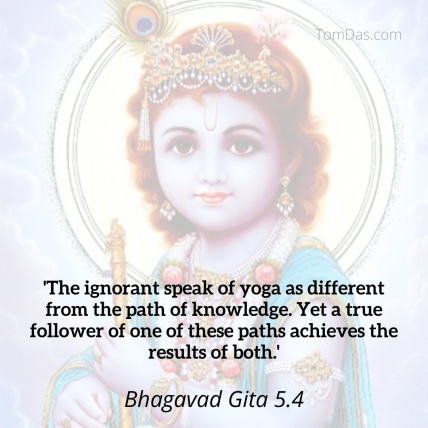
Tom: Jnana yoga usually refers to the use of (intellectual) knowledge in the mind used to remove ignorance, a thorn to remove a thorn, and then the thorn of ‘knowledge’ is itself allowed to fall away; Bhakti yoga is faith, love and devotion from the heart to Self/Guru/God. These 2 yogas seem different at first, but then they quickly merge together to remove ignorance and end suffering, which is what the word ‘yoga’ means of course. Both of the above are part and parcel of Advaita Vedanta as per the Upanishads, Gita, etc.
Q. What about Advaita vs. Jnana?
Tom: Advaita Vedanta, as a traditional teaching is the general term used to refer to the teachings of the Upanishads, Bhagavad Gita, Brahma Sutras and a few other traditional texts. Jnana yoga refers to one part of the teachings of Advaita Vedanta. Other aspects of Advaita Vedanta include Bhakti Yoga, Raja Yoga and several other teachings found in the above aforementioned texts.
Advaita, literally means not-two. Jnana means knowledge. Jnana can either mean relative knowledge in the mind, which is the means of jnana yoga, or it can refer to the Absolute, which is not really knowledge per se as it is beyond ideas/conceptualisation, but the word Jnana is sometimes used nonetheless. This ‘absolute Jnana’ is synonymous with Advaita and points to that which is beyond both Advaita and Jnana, ie. God or True Self! It is also known as Parabhakti (divine love), Aparokshanubhuti (direct experience), Moksha (freedom) and various other terms, none of which fully capture what is spoken of!
Here, in the Sri Ramana Gita, Bhagavan Sri Ramana Maharshi speaks of Bhakti (devotion towards God or Guru or Self) as a complete path to the Divine and a complete path to Spiritual Liberation.
May we have gratitude to Sri Ramana for his teachings!
May we love Sri Ramana for His Presence in Our Hearts!
All praise to Ramana!
All praise to Him who is God!
All praise to Him in our Hearts!
SRI RAMANA GITA
CHAPTER 16: ON BHAKTI
1. Then, questioned regarding Bhakti, the best of men, the highly auspicious Bhagavan Ramana Maharshi, spoke thus:
2. The Self is dear to all. Nothing else is as dear. Love, unbroken like a stream of oil, is termed Bhakti.
3. Through Love the Sage knows that God is none other than his own Self. Though the devotee, on the other hand, regards Him as different from himself, yet he too merges and abides in the Self alone.
4. The Love which flows (unbroken) like a stream of oil, towards the Supreme Lord, leads the mind infallibly into pure Being, even without one’s desiring it.
5 & 6. When the devotee, regarding himself as a separate, limited individual of poor understanding, and desirous of deliverance from suffering, takes the omnipresent Supreme Reality to be some deity and worships it, even then he attains in the end That (alone).
7. Oh best of men, one who attributes names and forms to the deity, through those very names and forms, transcends all name and form.
8. When Bhakti has grown perfect, then hearing once (about Reality) is enough, for it confers perfect Knowledge.
9. Bhakti not continuous like a stream is called intermittent Bhakti. Even this is bound to result in supreme Bhakti.
10. One who practises Bhakti for a desired end finds no fulfillment on attaining it and then again worships God for the sake of eternal happiness.
11. Bhakti, even when accompanied by desire, does not cease with the achievement of the desire. Faith in the Supreme Person develops and goes on increasing.
12. Growing thus, Bhakti in course of time becomes perfect.
By means of this perfect and supreme Bhakti, even as by jnana, one crosses (the ocean of) Becoming.
This is the sixteenth chapter entitled ‘ON BHAKTI’ in Sri Ramana Gita, the Science of Brahman, and the Scripture of Yoga composed by Ramana’s disciple Vasishta Ganapati.
Tom:
May we praise Sri Ramana for his words!
May we have gratitude to Sri Ramana for his teachings!
May we love Sri Ramana for His Presence in Our Hearts!
Just a reminder that there will be an ONLINE SATSANG tonight at 8pm GMT (UK time). This is instead of the usual Kingston meeting. Due to the current coronavirus situation all face-to-face or in-person meetings are being cancelled and we will be meeting online on Thursdays until further notice.
Perfectionof Faith in God/Guru/Self is the same as Jnana (spiritual ‘knowledge’ or ‘enlightenment’).
You could say that one leads to another – faith and surrender leads to knowledge, or knowledge leads to surrender and faith – and these are both true on one level, but ultimately they are one and the same – where is the difference apart from on the conceptual level?
For me Faith in the Guru, my Beloved, Bhagavan Sri Ramana Maharshi, overcame me quite spontaneously, without my asking, and clinging to Him and Faith in his Word and dwelling in His Presence became the Way and the Law and my Self.
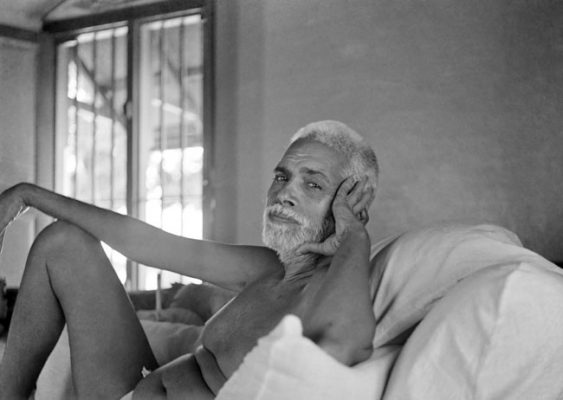
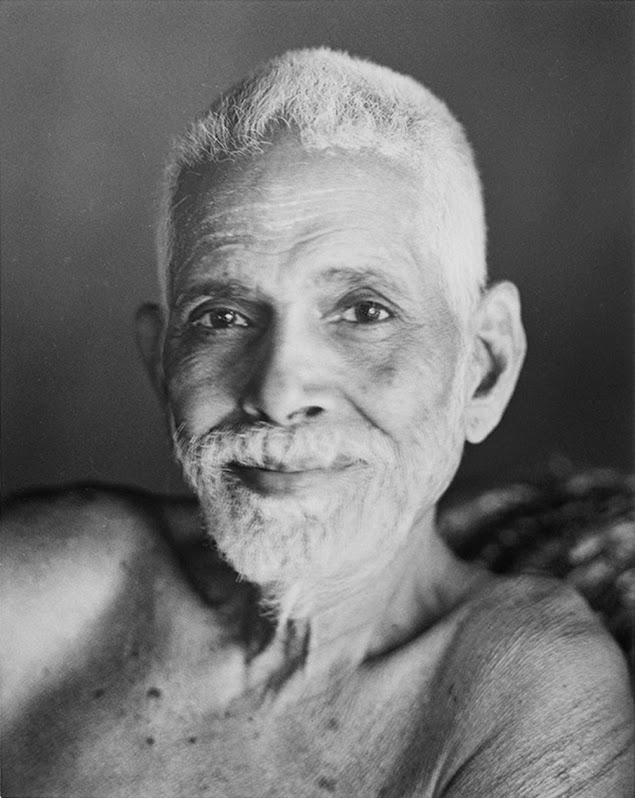
For me, whilst I like to learn a bit about Ramana’s life and I enjoy reading his teachings, gazing at His Image and feeling His Presence has often been more powerful than all the written teachings and all my efforts put together.
Someone recently approached me at the end of one of my Satsangs/meetings and asked me which book would I recommend as being the best one to understand Ramana’s teachings. I told him that Talks with Sri Ramana Maharshi and Be As You Are are two wonderful books, but when you open the book, the most important page is the one which has a photograph of Ramana on it (most of Ramana’s books contain a photograph of him in the first few pages).
Instead of reading all the teachings and trying to figure it all out, just look at His Image, feel His Presence!
We can read and listen to the teachings as much as we like, but I have found there is power in something else, something intangible – the Guru’s grace, the eyes of the Guru, His Divine Grace…
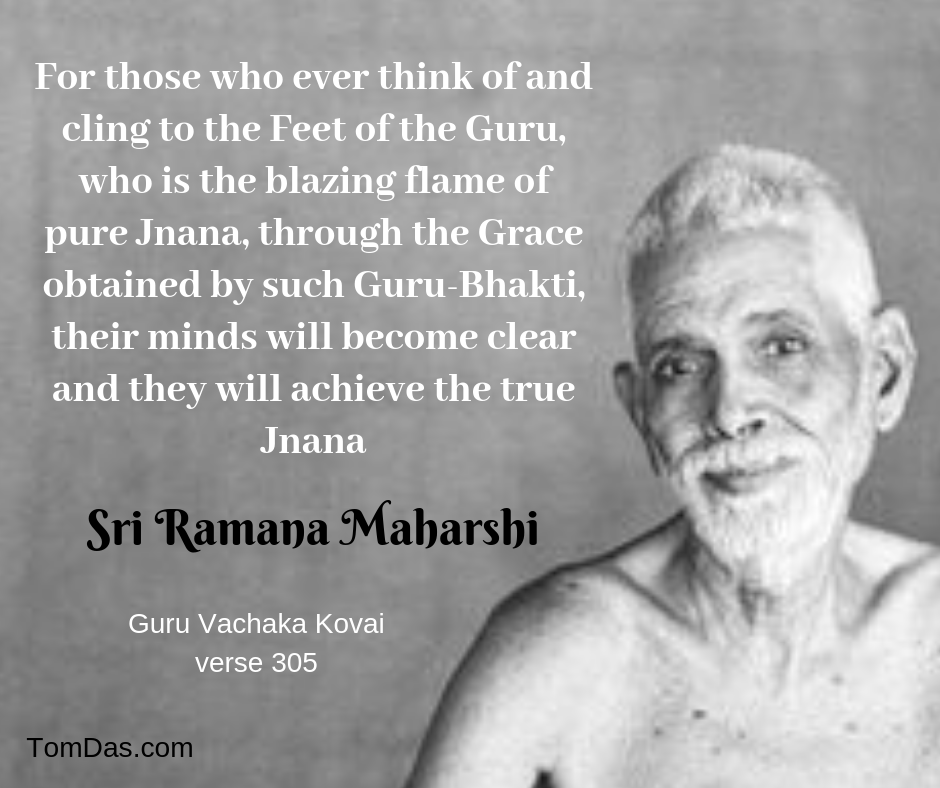
So, cling to the Guru, cling to His Teachings. For me, that means Sri Ramana Maharshi. If it suits you, if you are drawn to Him, Ramana, take Him up as your Guru. Look at His Image, give yourself to Him, if it feels right for you. Of if you have another Guru/God you are drawn to, do the same with him/her. Or if you cannot relate to a Guru or God, try relating to Life or the Universe or Universal Energy or something similar. See what happens and feel free to let me know too!
Ramana said that life often brings us to have faith in God, then God brings us a Guru, and the Guru then directs us back to our Self and we realise all is One. Of course, we do not really realise, rather the ‘we’ or the ‘me’ that is seeking Union disappears or ‘merges into Him’. There was only ever Him/Self/Guru/God/Oneness…use any word that suits you.
Ramana also said that if we are lucky enough to be blessed with faith in something, that is a blessing to us and we should seize that faith and lean on it with loving devotion, and not to allow it to wither away.
So I encourage you to look at His Image, surrender to Him, and let me know how it goes!
‘Perfection of Faith in God/Guru/Self is the same as Jnana’
In Guru Vachaka Kovai, Bhagavan Sri Ramana Maharshi tells us:
734. Those who have one-pointed devotion towards God, like the magnetic needle [of a ship’s compass] which always stands facing towards the north, will never be perplexed and go astray in the ocean of attachment of this world.
735. Those who live in the world, clinging whole-heartedly to God, are like children who whirl round and round a pillar holding it firmly. Since they have a strong and unshakeable hold on God, they are devoid of ego [anava] and therefore will never fall a prey to the delusion of the world.
736. If one fixes one’s mind firmly on that pure Supreme Reality which pervades all activities, one will not be affected by any number of activities that are done.
Bhagavan Sri Ramana Maharshi states in Guru Vachaka Kovai:
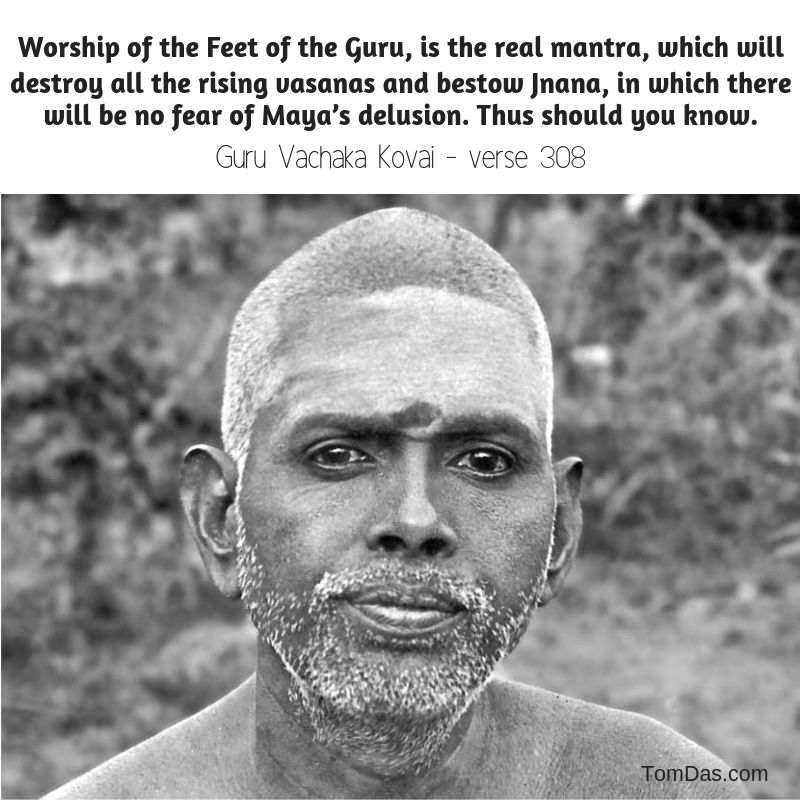
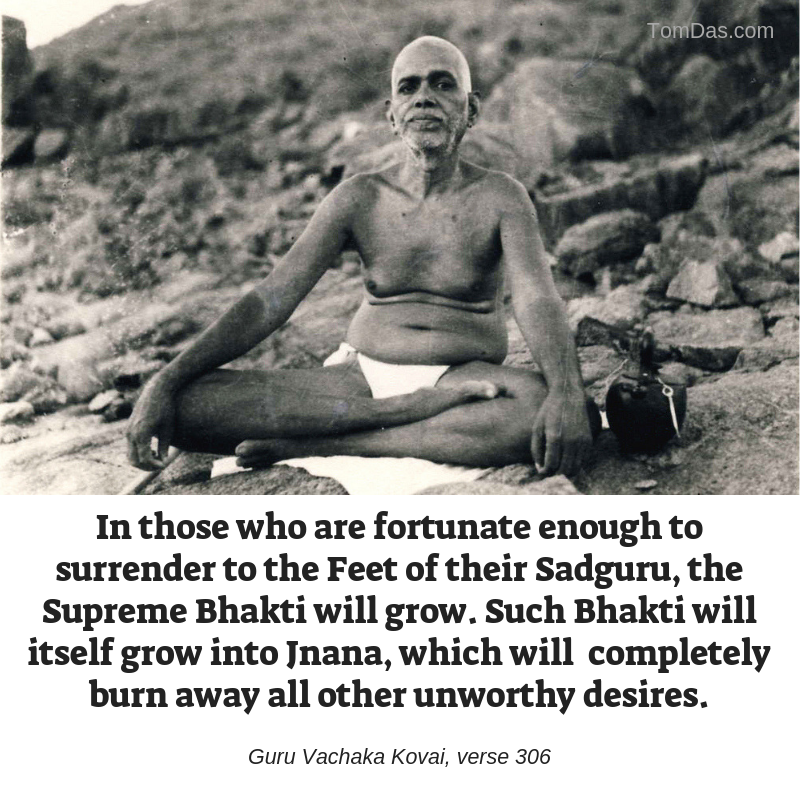
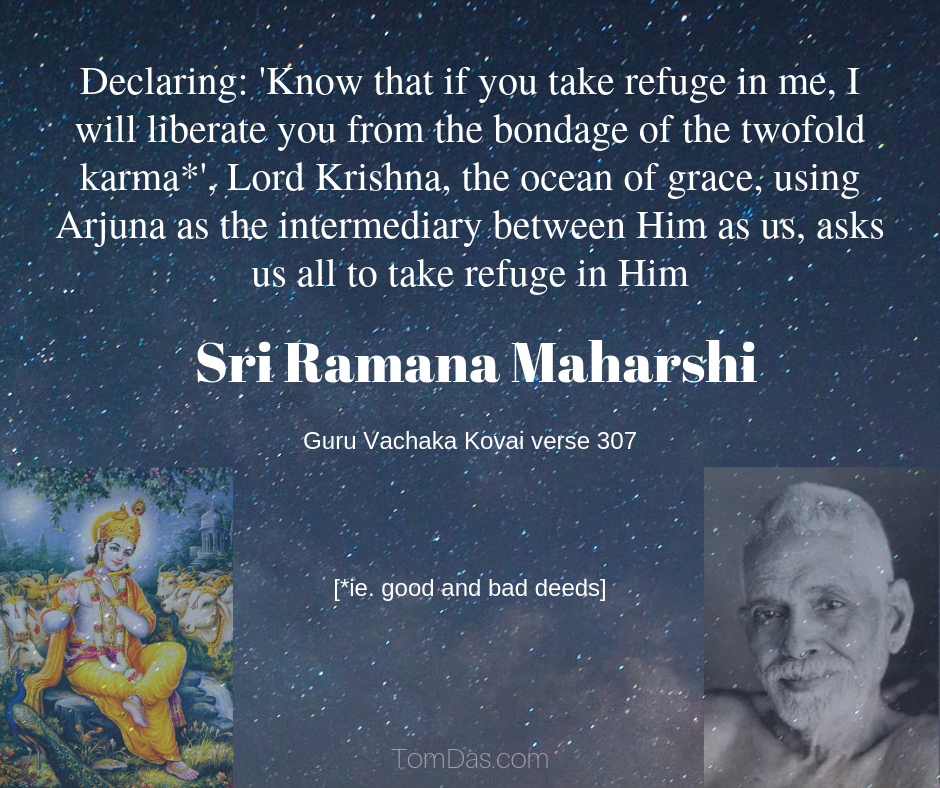
722. On scrutiny, supreme devotion [parabhakti] and Jnana are in nature one and the same. To say that one of these two is a means to the other is due to not knowing the nature of either of them.
731. Know that the path of Jnana and the path of Bhakti are inter-related. Follow these inseparable two paths without dividing one from the other.
B13. Attending to Self is devotion to the supreme Lord, because the Lord exists as Self.
Here are some quotes I have arranged by theme: they are all taken from Ramana Maharshi’s masterpiece Who Am I? (Nan Yar? in Tamil).
It is a short text and should ideally be read in full. You can find a version on this website here which is truer to the original Ramana himself wrote and where I have also introduced the text more fully, and you can find another version from Ramanashramam here, from where the quotes below were taken.
Throughout you can see that the emphasis is on stilling the mind to bring about Self-Realisation. The method for doing this is Self-Enquiry. See if you can see all the different ways that Ramana points to making the mind still in each of his answers. The Bold Type Headings are my own additions and my comments are in italicised red.
See here for an audio version of the text below:
How can I attain realisation? By removing the world and making the mind still.
Q. When will the realization of the Self be gained?
A. When the world which is what-is-seen has been removed, there will be realization of the Self which is the seer.
Q. Will there not be realization of the Self even while the world is there?
A. There will not be.
Q. When will the world which is the object seen be removed?
A. When the mind, which is the cause of all cognition’s and of all actions, becomes quiescent, the world will disappear.
Tom: Ramana is stating that realisation appears when the mind is still. Many people avoid these kinds of teachings which advocate turning away from the world, and give various seemingly logical reasons for this philosophical stance (note that it is a philosophical stance for the most part, based on logical reasoning, belief and a certain ideology), but for most people, without prolonged stillness of mind, egotism finds a way to perpetuate itself and suffering, separation and ignorance also continue.
Breath control, mantra, devotional practice are aids but are not the true practice.
Like the practice of breath-control, meditation on the forms of God, repetition of mantras, restriction on food, etc., are but aids for rendering the mind quiescent.
Through meditation on the forms of God and through repetition of mantras, the mind becomes one-pointed.
Just as when a chain is given to an elephant to hold in its trunk it will go along grasping the chain and nothing else, so also when the mind is occupied with a name or form it will grasp that alone.
Why make the mind one-pointed?
When the mind expands in the form of countless thoughts, each thought becomes weak; but as thoughts get resolved the mind becomes one-pointed and strong; for such a mind Self-inquiry will become easy.
Tom: Note that here Ramana defines a strong and weak mind: a strong mind is one that is one-pointed, a weak mind is one that is not one-pointed, ie. a scattered mind. It is a strong one-pointed mind that can undergo self-enquiry effectively for most. Therefore the practices above such as breath control, devotion and mantra practice can form a spiritual foundation for those who are not able to effectively perform self-enquiry straight away.
But thoughts keep on coming. Will thoughts ever end?
Q. The residual impressions (thoughts) of objects appear unending like the waves of an ocean. When will all of them get destroyed?
A. As the meditation on the Self rises higher and higher, the thoughts will get destroyed.
Q. Is it possible for the residual impressions of objects that come from beginningless time, as it were, to be resolved, and for one to remain as the pure Self?
A. Without yielding to the doubt “Is it possible, or not?”, one should persistently hold on to the meditation on the Self. Even if one be a great sinner, one should not worry and weep “O! I am a sinner, how can I be saved?”; one should completely renounce the thought “I am a sinner”; and concentrate keenly on meditation on the Self; then, one would surely succeed.
Tom: To worry about whether or not thoughts can end is itself a thought and so is moving away from stillness of mind. See how tricky the mind is?
What about my worldly problems and other people?
The mind should not be allowed to wander towards worldly objects and what concerns other people.
However bad other people may be, one should bear no hatred for them.
Tom: Again, the above teachings are all about the mind becoming still.
What about desire and hatred?
Both desire and hatred should be eschewed.
Tom: Hatred and desire are more agitations of the mind.
How can I stop worrying about worldly affairs?
Whatever burdens are thrown on God, He bears them. Since the supreme power of God makes all things move, why should we, without submitting ourselves to it, constantly worry ourselves with thoughts as to what should be done and how, and what should not be done and how not? We know that the train carries all loads, so after getting on it why should we carry our small luggage on our head to our discomfort, instead of putting it down in the train and feeling at ease?
Tom: One solution for an agitated mind is to have faith in the Supreme God, for the mind that trusts and has faith in God naturally becomes still. This is made clearer in the next quote.
Is there room for devotion and surrender on this path?
He who gives himself up to the Self that is God is the most excellent devotee. Giving one’s self up to God means remaining constantly in the Self without giving room for the rise of any thoughts other than that of the Self.
Tom: ie. be still. If you do have thoughts, they should only be about the Self, meaning the mind is strong and one-pointed, as referenced in an earlier quote above.
Maybe I should find a guru who will help me? Perhaps I need their grace or transmission?
God and the Guru will only show the way to release; they will not by themselves take the soul to the state of release.
Each one should by his own effort pursue the path shown by God or Guru and gain release.
Tom: The Guru only tells you to be still. Seeking a Guru is entering more delusion/illusion/ignorance and merely perpetuates ignorance and mental agitation/movement. See how skilfully Ramana steers us away from this mistake? This same teaching is also given at the start of Shankara’s Vivekachudamani (verses 51-55).
Which scriptures and books will help me on this path?
All the texts say that in order to gain release one should render the mind quiescent; therefore their conclusive teaching is that the mind should be rendered quiescent; once this has been understood there is no need for endless reading.
Where in the world can I find lasting happiness and fulfillment?
There is no happiness in any object of the world. We imagine through our ignorance that we derive happiness from objects. When the mind goes out, it experiences misery. In truth, when its desires are fulfilled, it returns to its own place and enjoys the happiness that is the Self.
Tom: Seeking happiness in the world or in objects is more mental agitation. Ceasing to do this is making the mind still. This is elaborated upon and emphasised in the next two quotes.
How does a wise one act?
Under the tree the shade is pleasant; out in the open the heat is scorching. A person who has been going about in the sun feels cool when he reaches the shade. Someone who keeps on going from the shade into the sun and then back into the shade is a fool. A wise man stays permanently in the shade. Similarly, the mind of the one who knows the truth does not leave Brahman. The mind of the ignorant, on the contrary, revolves in the world, feeling miserable, and for a little time returns to Brahman to experience happiness. In fact, what is called the world is only thought. When the world disappears, i.e. when there is no thought, the mind experiences happiness; and when the world appears, it goes through misery.
What about Spiritual Knowledge (Jnana) or Wisdom?
Q. What is wisdom-insight (jnana-drsti)?
A. Remaining quiet is what is called wisdom-insight.
Q. What is the relation between desirelessness and wisdom?
A. Desirelessness is wisdom. The two are not different; they are the same. Desirelessness is refraining from turning the mind towards any object. Wisdom means the appearance of no object.
SOME CONCLUDING WORDS:
Tom: Gratitude to Sri Ramana for his teachings that skilfully and in numerous ways tell us to still the mind. Bhagavan Ramana writes:
‘All the texts say that in order to gain release one should render the mind quiescent; therefore their conclusive teaching is that the mind should be rendered quiescent; once this has been understood there is no need for endless reading.’
If you are not able to take up self-enquiry and still the mind, take up the auxiliary practices at once and devote yourself fully to them. Bhagavan Ramana writes:
‘Through meditation on the forms of God and through repetition of mantras, the mind becomes one-pointed…the mind becomes one-pointed and strong; for such a mind Self-inquiry will become easy.’
So devote yourself to God, devote yourself to Sri Ramana, chant the mantra with unceasing and unending devotion, and then go deep deep into stillness wielding the question ‘Who am I?’ as your weapon of choice, eventually letting go of this weapon too, drowning in Effulgent Grace in the formless form of Realisation. Bhagavan Ramana writes:
‘By the inquiry ‘Who am I?’. The thought ‘who am I?’ will destroy all other thoughts, and like the stick used for stirring the burning pyre, it will itself in the end get destroyed. Then, there will arise Self-realization.’
Sri Ramana Maharshi is better known for his teachings on Self-Inquiry. As a general rule he did not encourage guru worship and usually directed seekers towards Silence and Self-inquiry. However, he did speak about Bhakti (the path of devotion and love) on many occasions, and here are a few quotes:
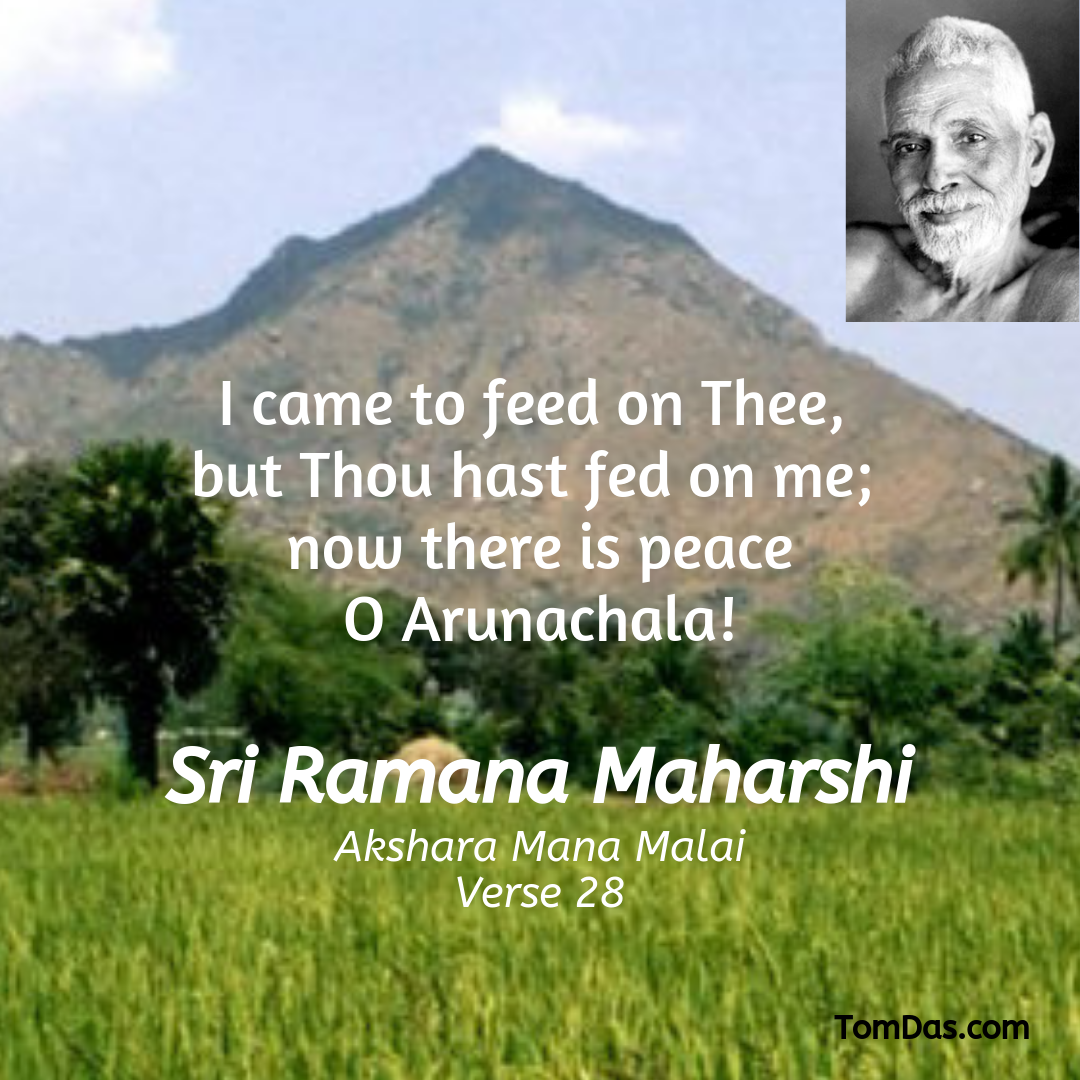
Bhagavan Sri Ramana Maharshi was often said to have had no guru, but he himself considered the mountain-hill Arunachala to be his Guru.
Ramana considered the actual form of Arunachala to be the divine Self, the Pure Consciousness dwelling in the Heart. This is a very strange notion for the rational Western mind, but for those who have tasted Bhakti, or devotional love, it makes complete sense.
Maybe some of you have experienced this: the Guru grips you, magnetically pulls you towards Him (or Her or It) and showers you with His Grace – you have no choice but to Obey. You somehow become convinced that the Guru’s form is itself the Absolute, the Pure Consciousness that Alone Is, and have no choice but to fall at His feet in Loving Devotion.
Ramana wrote very little himself, but of his written works he did write several devotional poetic works effusively praising and thanking Arunachala, his Guru, for bestowing the Guru’s Grace and swallowing him whole.
Oh Arunachala!
Grant us the good fortune to fall in Love with Thee!
To experience your Grace!
Oh Ramana!
I am blessed with knowledge of your form!
May I spend my days contemplating your form!
May your Grace continue to pull me towards you and consume me in Divine Love!
May I attain that Great Peace, my Own Very Self, in your Loving Embrace!
Oh Ramana!
You are Arunachala!
You are the True Guru!
You Dwell in me as Me,
Unchanging Pure Consciousness Love!
Om Namo Bhagavate Sri Ramanaya Om
❤️🙏❤️
Here is a video in which the above post is read by a devotee:




 Tom Das