Q. Is it really true that I am not this body? Physical pain & liberation, How to elminate wordly attachment? Sri Ramana Maharshi | Aham Sphurana book excerpt | Advaita Vedanta

The following is a teaching excerpt from a large unedited manuscript, well over 1000 pages long, called ‘Aham Sphurana’.

Aham Sphurana [‘I Shining’ or ‘I vibration’ or ‘I Am shining’ or ‘Shining of the I AM’] claims to contain a collection of previously unpublished talks with Sri Ramana Maharshi as apparently recorded by a visitor to Sri Ramana Ashrama, Sri Gajapathi Aiyyer, in 1936.

The authenticity of the teachings as being genuinely from Sri Ramana Maharshi cannot be confirmed, a fact acknowledged in the manuscript preamble itself, but I share these teachings here in case they are of interest to you.

17th July 1936

Questioner: Is it really true that I am not this body?

Sri Ramana Maharshi: Yes.

Questioner: If so, when some damage is suffered by the body, why do I feel pain? If, say, a piece of burning coal falls on somebody near me, I do not feel anything, but that person alone feels the pain. Likewise if a thorn pricks my foot I alone feel the pain, but not the one walking by my side.

Sri Ramana Maharshi: Does the body cry out, saying, ‘I am feeling pain!’? You associate yourself with your body and speak of it as your “I”. The body is only in the mind. All pain apparently suffered by the body is as imaginary as the body itself. The body cannot know anything. It is insentient flesh and bone. Notions of pain spring from our own imagination only. Thus, in deep slumber, the mind being inactive, there is no pain.

Questioner: Suppose I have a piece of metal wire in my hand. If I cut it into pieces, the metal cannot be aware that it is being cut, because it is insentient. Whereas, if a living body were to so much as be scratched, it explodes with agony. In what sense, therefore, does Bhagavan mean that the body is insentient?

Sri Ramana Maharshi: True, the body experiences the physical stimulus of pain if it is injured, but why should that fact create a thought in the mind, “I am feeling pain.”?

Physical pain creates mental agony because of the following reason – the mind assumes itself to be the body and appropriates to itself the bodily identity, because in the absence of such false self-objectification it cannot survive or thrive. If the idea “I am the body” is abandoned, everything, including pain suffered by the body, is only Bliss.

Questioner: But I am aware of the pain if the body is injured!

Sri Ramana Maharshi: When the body is injured, in the case of the unenlightened one, the following happens – his body feels the physical stimulus of pain, and his mind spontaneously manifests the thought, “I am injured”, causing him to become mentally agitated; the reason for the manifestation of such thought is the underlying erroneous idea “I am the body”. In one who is free from the mistaken idea of accepting the body for the Self, injury of the body causes no disturbance to his peace. Each one is indeed the Self, but absurdly confounds himself with the not-Self and so needlessly suffers on account of such dehatma-buddhi.

Questioner: The question still remains – if, as postulated by Sri Bhagawan, the body is insentient, how can it and why does it feel pain at all?

Sri Ramana Maharshi: The word “pain” is employed because there is a prejudice in the mind against such stimuli. When the mind is dissolved in Pure Consciousness, its prejudices also disappear. For the enlightened one, therefore, pain and pleasure are physical stimuli that stand on an equal footing. He does not covet the one and abhor the other; nor does he abhor the one and covet the other. Mind gone, there remains no yardstick by means of which one sensation is to be regarded as pain and another as pleasure.

Questioner: Sri Bhagavan seriously means to say he is unable to tell the difference between the sensation that ensues when an insect bites his leg and the one that ensues when someone is massaging it?

Sri Ramana Maharshi: That they are different sensations is self-evident; that the one is abhorrent and the other agreeable is mere mental judgement from which the Jnani is quite free. He himself seeks out neither pain nor pleasure, but accepts what comes his way without resisting; in Jnana only automatic acceptance remains.

Questioner: For Jnanis it is different; what of the common man?

Sri Ramana Maharshi: You also are a Jnani; only, you think otherwise!

Questioner: How could that be?

Sri Ramana Maharshi: The option of turning inwards and quietly allowing the mind to plunge and dissolve in the Self is equally available for all. It is not the fiefdom of a select few. All are verily only the Self.

Questioner: That does not satisfy me. I am unable to Realise it for myself.

Sri Ramana Maharshi: So long as worldly attachments are present the mind cannot be succesfully turned inwards.

Questioner: How to eliminate worldly attchment?

Sri Ramana Maharshi: By turning the mind inwards.

Questioner: Really!

Sri Ramana Maharshi: The more you hold on to the Self or retain the mind in its native state of subjective-awareness-sustained-effortlessly-and-volitionlessly, the more the mental tendancies and worldly attachments wither off; the lesser the mental tendancies and worldly attachments, the easier does become retention of the mind in its native state of subjective-awareness-sustained-effortlessly-andvolitionlessly.

Questioner: Which comes first?

Sri Ramana Maharshi: The sadhaka recognises and reflects upon the ephemeral nature of the objective world and the transient nature of his own body. He gets fed up with material pleasures, because they eventually lead only to sorrow, when their enjoyment becomes, for any reason, impossible. He asks himself if a more permanent experience of life might not be possible. Then he discovers the Ajata-advaita doctrine. Initially he is not convinced, and argues that if it were a dream there would be no possibility of corroboration, but that here his relatives and friends are able to confirm the evidence provided by his senses; he also asks why the same dream should be repeated everyday, were it all only a dream – according to him, here he sees the same sun, moon and earth everyday, whereas in his dreams he finds himself in new worlds moment to moment. Eventually it dawns upon him that everything he thinks he knows, including an understanding of the apparent permanency of the world he believes himself to live in, is only thought or imagination.

Then at the intellectual level he understands the truth – that the names and forms constituting the world are fictitious. This sparks a search for the substratum said to be underlying them, which alone is said to be Real by the wise.

He hears the teaching that the source of the mind, Beingness, is the gateway to the Real Self. Then he begins the practice of quietening the mind by vichara or any other method, tackling various distractions as and when they arise, by withdrawing attention from them and fixing it on Beingness or the Self. The beginning is only becoming fed-up with the evanescent nature of the world and the fugacious attractions it has to offer.

Questioner: The boubts Bhagavan mentioned – they are my doubts also. Why is everyone witnessing the same dream? The sun moon etc. are seen by all.

Sri Ramana Maharshi: In turn those “all” are seen by you only. In deep slumber when there is no mind, nothing is available to be seen, but your existence is a constant.

Questioner: Why do I dream the same dream everyday? For instance yesterday I came to the ashram and had darshan of Bhagawan; he was sitting on the same sofa in exactly the same manner. Today I am seeing Bhagawan and tomorrow also it is going to be the same Bhagawan.

Sri Ramana Maharshi: The future is a mere mental projection. The past is a mere memory. Have you not had dreams where the places you visit look extremely familiar?

Questioner: At least is the present real?

Sri Ramana Maharshi: Anything seen cannot be Real. What is seen is not Pratyaksha. It is not self-evident, because there is a subject-object relationship involved. It is merely sensory information that is fed into the mind by the strength of its own evil faculty of avidya maya. That alone is Real which shines by its own light.

You are asking about the objects of the world. Can such objects exist without a YOU, a perceiver? When there is no perceiver, as in swoon or deep slumber, is there anything to be perceived? No. What is the inference? The objects owe the appearance of their apparent existence to you only. They are merely mental creations. The appearance of this enormous cosmos around you is merely a mental information. The mind is fiction. Therefore the ‘objects’ manufactured by it are also fictitious. Have not the least doubt about it.

Questioner: If everything is unreal, can we conclude that bondage and liberation are also unreal?

Sri Ramana Maharshi: Yes.

Questioner: Then why should I try to obtain Liberation? Let me remain as I am.

Sri Ramana Maharshi: Exactly!

Questioner: I do not understand.

Sri Ramana Maharshi: Remaining as you are is the loftiest Sadhana.

Questioner: How can remaining in ignorance be sadhana?

Sri Ramana Maharshi: You think that you are in ignorance. When you do not think at all, what remains is only wisdom. Removal of the screen of thought is all that is required for Reality to be revealed. Since you want a sadhana by means of which you may reach this thought-free state, vichara is suggested. Actually there is no need for any sadhana for one who has mastered the art of remaining as he is – the art of Being. That is the import of the advice Summa Iru [Tom: ‘Be Still’]. People generally misunderstand it. It does not mean keeping the body idle. It means keeping the mind still or free from thought. Remain perpetually absorbed in the thought-free I-Current. This will automatically lead you to the Sahaja-stithi [Tom: the natural state, ie. liberation or self-realisation] without requirement for further effort.

Questioner: Is even desire for Liberation an obstacle to Liberation?

Sri Ramana Maharshi: Yes
Shankara: Absolute separation from the body is liberation | Bliss (Ananda) and the Self | Advaita Vedanta | Commentary on Upanishads

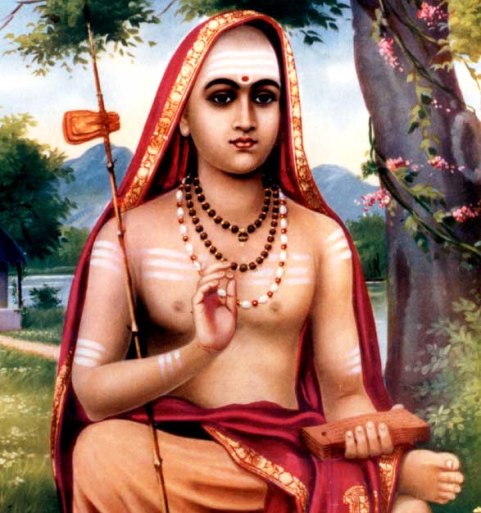
Tom: Shankara writes the following in his commentary of Brihadaranyaka Upanishad 3.9.29.7. My comments are interspersed in italicised red with Shankara’s writings in black.

Here Shankara is making the point that strictly speaking there is no knowing or knowledge in Self-Knowledge/Self-Realisation/The Self, meaning there is no existence of or involvement of the mind in Self. He gives the analogy of water being thrown into a larger tank of water – that initial water does not retain its separateness by which it can know the larger body of water into which it was thrown. Self-knowledge is just a phrase used to point to That which cannot be put into words.

If there was an entity that could know Brahman or know of Brahman, then that would imply 2 entities, Brahman and and knower of Brahman. Or it would imply differentiation of Brahman. Either of these would contradict shruti (revealed scripture/revealed knowledge).

Similarly, Shankara states that bliss is not cognised in Self-Realisation for the same reasons. Rather Bliss is the nature of Self, not something experienced by the Self or by some self-realised entity or person (which is another illusion).

Incidentally, Shankara also reveals just how radical liberation is, stating that in liberation there is no body, no organs, no mind, no knowledge:

Also see: What exactly is Jnana (knowledge) according to Shankara and Gaudapada and the scriptures?

[Shankara:] Absolute separation from the body is liberation, and when there is no body there can be no organs, for they will have no support . Hence too there will be no knowledge, there being no body and organs. If knowledge could arise even in the absence of the body and organs, there would be no necessity for any one to possess them. Moreover (if Brahman as Knowledge Absolute cognises the bliss in liberation), it will contradict the oneness of Brahman.

Tom: Shankara clearly states in liberation there is total or absolute separation from Body, and then says there is no body in liberation. Without a body, there can be no mind and without a mind there can be no cognition or knowledge (in the ordinary sense of these words).

We see similar teachings from Sri Ramana Maharshi: in Ulladu Narpadu verse 12, Sri Ramana Maharshi writes:

True Knowledge is Being, devoid of knowledge as well as ignorance of objects. Knowledge of objects is not true knowledge. Since the Self shines self-luminous, with nothing else for It to know, with nothing else to know It, the Self is Knowledge. Nescience [ignorance] It is not.

In Upadesa Saram verse 27, Sri Ramana Maharshi writes:

That is true knowledge which transcends
Both knowledge and ignorance,
For in pure knowledge
Is no object to be known
.

OBJECTION: Suppose we say that the Supreme Brahman, being eternal Knowledge, ever knows Itself as Bliss Absolute?

REPLY: No, (this has just been answered). Even the person under bondage, when freed from relative existence, would regain one’s real nature (Brahman). (So the same argument would apply also) .

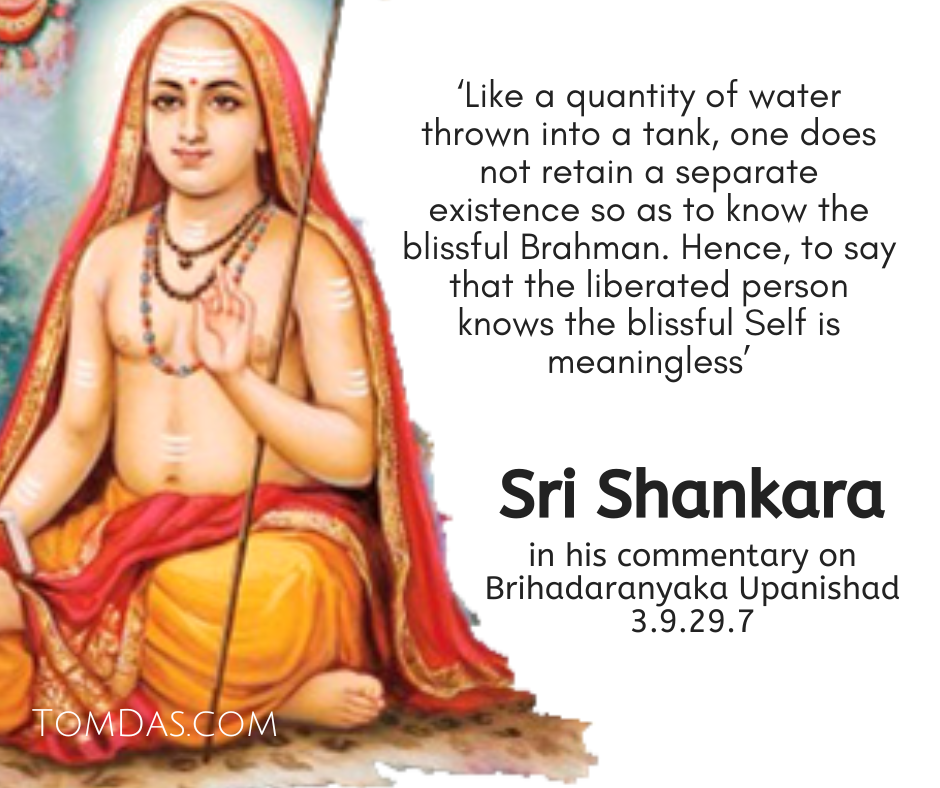
Like a quantity of water thrown into a tank, one does not retain a separate existence so as to know the blissful Brahman. Hence, to say that the liberated person knows the blissful Self is meaningless. If, on the other hand, the liberated one, being different from Brahman, knows the bliss of Brahman and the individual self as, “I am the Bliss Absolute”, then the oneness of Brahman is contradicted, which would be against all Srutis; and there is no third alternative.

Tom: See my explanation in the introduction above

Moreover, if Brahman ever knows Its own bliss, it is superfluous to distinguish between awareness and unawareness. If It is constantly aware of this bliss, then that is Its nature; hence there is no sense in maintaining that It cognises Its own bliss.

Tom: the point here is that if Brahman is ‘constantly aware of it’s own bliss’, then this bliss is simply the nature of the Self, as Self is One, and it doesn’t make sense to think of an entity that cognises or perceives bliss in some way in Self-Realisation.

Such a view would be tenable if ever there was the possibility of Its not knowing that bliss, as for instance one knows oneself and another (by an act of will). There is certainly no sense in distinguishing between a state of awareness and one of unawareness in the case of one whose mind is uninterruptedly absorbed in making an arrow, for instance.

Tom: Shankara’s argument here is saying that to speak of ‘constantly knowing bliss’ during self-realisation would only make sense if there would be a possibility of not knowing bliss during self-realisation, which is not possible, so again, bliss is the nature of Self and not a cognised object.

If, on the other hand, Brahman or the Self is supposed to be knowing Its bliss interruptedly, then in the intervals when It does not cognise Itself, It must know something else; and the Self would become changeful, which would make It non-permanent.

Tom: If the bliss of Brahman came and went, or increased and decreased, then that would mean the Self is subject to change (which it isn’t) and is therefore impermanent (which it isn’t).

Hence the text, ” Knowledge , Bliss “, etc, must be interpreted as setting forth the nature of Brahman, and not signifying that the bliss of the Self is cognised.

Tom: Regarding the initial statement of Shankara’s above, namely that there is no body in Liberation, here are some quotes of Sri Ramana Maharshi’s that say the same, taken from Guru Vachaka Kovai:

86 Don’t ask, “How did this error rise,
Why this ignorance that the Self
Itself is as the world transformed?”
Seek rather and find out to whom
This happened, and the error [Tom: of the world appearance] will
Persist no more
.

87 What is the Self’s self-transformation
As the world? A coil of straw
Appearing as a snake? Look hard,
You see no snake at all. There is
No transformation, no creation, none,
No world at all
.
[Tom: ie. ajata vada]

97 Only the mind, by maya’s might
Deluded, and looking outward sees
The body. The true Self knows no body.
To call the Self of Pure Awareness
The body’s owner or indweller
Is an error.

[Tom: This is reference to Chapter 13 of the Bhagavad Gita where Krishna states the Self is the knower of the body, and various other scriptures which advise that the Self is somewhere deep within the body, dwelling in each and everyone’s body, here Bhagavan Ramana is saying even this is not true, pointing us to a deeper teaching]

1230 The things you think of as existing
Do not exist
. But That of which
You know not if it does exist
Or does not [Tom: ie. the supreme birthless deathless unchanging ever-pure blissful Self], That alone exists.

Liberation has nothing to do with the body or mind

If liberation or self-knowledge was something to do with the mind, then a firm and swift blow to the head could put an end to that liberation.

Luckily, liberation has nothing to do with the body or the mind.

It is beyond time and space.

🙏❤️

Q. Why do the Upanishads repeatedly state the Self is located ‘within the body’ in the ‘Heart’ or ‘Cavern of the Heart’? | Advaita Vedanta

Tom: Why do the Upanishads constantly repeat and say the Self is located within the body, in the ‘heart’ or ‘cavern of the heart’ within the body? Why is this repeated time and time again? At the same time it is said the the Self is nothing to do with the body? And at the same time it is said the Self is All, everywhere?

Answer (also from Tom): It is because the Upanishads and vedanta scriptures again and again tell us to turn our attention away from objective phenomena and towards the Divine Within, which is nothing but Our True Self, the I Am, the Subject.

ie. It is only to help us turn within that the scriptures say ‘it is in the heart, located in the body, the size of a thumb’, etc, etc.

eg. from the Katha Upanishad:

2.1.12 The Puruṣa (Self), of the size of a thumb, resides in the middle of the body as the lord of the past and the future, (he who knows Him) fears no more. This verily is That.

and

2.3.17. The Purusha of the size of a thumb, the internal atman, is always seated in the heart of all living creatures; one should draw him out from one’s own body boldly, as stalk from grass; one should know him as pure and immortal; one should know him as pure and immortal.

See this post where Sri Ramana makes the teaching clear: Remove Nama-Rupa (Name & Form) to reveal Sat-Chit-Ananda (the Self)

Am I the Subject, or am I beyond both subject and object?

Question: Am I the Subject, or am I beyond both subject and object? Some teachers will say, ‘you are not the object, nor are you the subject, you are beyond that which is both.’ Could you explain please?

Tom: The essential teaching is that You – the Absolute, the Self, the Divine – You are beyond all objects, that is, you are beyond body-mind-world.

If a teaching says what you are is beyond both subject and object, then subject refers to the body-mind and object refers to the world, and you are That Pure Consciousness which is beyond both.

If a teaching states you are the Pure Subject beyond all phenomenal objects, then You refers to Pure Consciousness beyond all objects, ie. body-mind-world.

Don’t forget the purpose of the teaching is not to have merely an intellectual understanding of the above, but to turn your attention selfwards and abide as the Self, for this is the key/clue that leads to self-realisation – otherwise it is just theoretical talk.

Namaste

Tom

The four types of Liberated Sage (Jnani) | Advaita Vedanta |Kaivalya Navaneeta

Kaivalya Navaneeta front cover ramana

In the text Kaivalya Navaneeta (The Cream of Liberation; a 16th century traditional advaita text that was often recommended by Sri Ramana Maharshi), four types of liberated sages are described starting at verse 94.

Understanding these descriptions can help explain and reconcile the different views of liberation one may come across, such as whether or not the body and world appear after liberation, what type of lifestyle a liberated sage would exhibit and whether or not they would experience any kind of afflictive or suffering-causing emotions at all. My comments are in italicised red:


94. The wise, remaining like ether and liberated even here, are of four classes, namely Brahmavid (i.e. a knower of Brahman), vara, varya, and varishta, in order of merit.

Tom: The four types of liberated sage are called Brahmavid, Vara, Varya and Varishta. First we will discuss the Brahmavid or or ‘knower or Brahman’ (Vidya is Sanskrit for knowledge). The phrase ‘remaining like ether’ refers to the previous verse 93 and means the wise sage abides as consciousness, fully liberated.

95. The Brahmavids who by steadfast practice have gained clear realization of Brahman, continue to perform even the hard duties of their caste and stage in life, exactly as prescribed by the shastras for the benefit of others, without themselves swerving from their supreme state.

96. Should passions rise up they disappear instantly and cannot taint the mind of the Brahmavids who live in society detached like water on a lotus leaf. They look ignorant, not showing forth their knowledge, and remain mute owing to intensity of inward Bliss.

Tom: the first type of liberated sage is called the Brahmavid. They continue to be fully engaged in society and the world whilst simultaneously being liberated. Occasionally afflictive emotions and passions arise but they are short lived and do not affect the Brahmavid. They may seem like an ordinary person with nothing particularly special about them, but they are often outwardly quiet.

97. Prarabdha, i.e., karma which is now bearing fruit, differs according to the actions in past incarnations. Therefore the present pursuits also differ among jnanis, who are all, however, liberated even here. They may perform holy tapas; or engage in trade and commerce; or rule a kingdom; or wander about as mendicants.

Tom: Prarabdha essentially refers to the destiny of the particular body-mind based on its previous actions, ie. its karma . This verse states that the actions of the (body of the) jnani  or sage (jnani literally means ‘knower’, ie. ‘knower of truth’ or ‘knower of Self’) varies depending on what the activities the body did prior to realisation. So the sage may, for example, perform holy penance, or engage in the world, or be a ruler, or a wandering monk. Basically there is no fixed description of what a sage would do in daily life in terms of their ‘occupation’.

98. They would not think of the past or future; would partake of what comes unsolicited; would not wonder, even if the sun turned into the moon, or at any other marvel, whether the sky were to spread its shoots down like a banyan tree or a corpse were to be revived; nor would they distinguish good and bad, for they always remain as the unchanging Witness of all.

Tom: the last point on the Brahmavid is that they are unaffected by whatever appears to happen, no matter how marvelous, calamitous or ridiculous. Why? Because they are liberated, ‘fixed’ as the Self, remaining as the ever-unchanging ‘Witness of all’.

Now let us look at the other three classes of Jnani or Liberated Sage:

99. Among the other three classes, the vara and the varya remain settled in samadhi. The vara feels concern for the maintenance of the body; the varya is reminded of it by others; the varishta never becomes aware of the body, either by himself or through others.

Tom: Here the vara and varya are both aware of the body at times whilst the fourth type of Jnani, the varishta, is not even ever aware of the body at all, even though others may perceive him or her as a body. The vara has a desire to maintain the body, whilst the varya occasionally becomes aware of their body if someone else prompts them.

So which of these types of liberation is best? Let us see…

100. Although there are distinguishing characteristics in the lives of the different Sages, who are themselves very rare in the world, yet there is absolutely no difference in the experience of Liberation. What can be the use of the hard-won samadhi? The Brahmavid, who is outwardly active, seems sometimes to feel the misery of calamities, whereas the others remain in unbroken Bliss.

Tom: Here it is made clear: all of these four types of sage are rare, and all are the same in that they are all fully liberated. They all in themselves have the same essential experience of Liberation, the differences being only superficial and present from the point of view of other non-liberated people, ie. from the point of view of ignorance.

However a point is raised that is dealt with in the next verse. The Brahmavid may appear to suffer and stress like the unliberated, whereas the other three categories of liberated sage are lost in eternal Peace and Bliss. How can this be? How can the Brahmavid be said to be truly liberated?

101. Now if the Brahmavids live like the ignorant, how are they free from the cycle of births, and how is their ignorance gone? The all-pervading ether remains untainted by anything; the other four elements are tainted by contact with objects. So it is with the Brahmavid and the ignorant.

Tom: The answer given is that, as Consciousness, the Brahmavid remains unaffected and untouched by whatever seems to happen in the world of objects that we ordinarily call life.


Tom’s summary: So we can see there are various types of liberated sage that are all fully and totally liberated, but appear different to each other only from the point of view of ignorance or the ‘unliberated’. Some jnanis are active in the world and appear to stress and suffer, some are immersed in constant experiential bliss, some are totally unaware of their body or only aware of it to some degree, and others seem to have a need to look after their body. Some appear to be holy sages, other just ordinary mundane people int he world.  However, all of this does not matter from the point of view of Liberation – Liberation is only One. Know Thy Self!

Ramana Maharshi on the two types of liberation: (1) liberation in this life (Jivanmukti) and (2) liberation after death (Videhamukti)


ramana all that we need do is to keep quiet

The following dialogue is taken from Talks with Sri Ramana Maharshi, Talk number 265, my additions are in red:

Questioner: There are said to be sadeha mukta (liberated in body) and videha mukta (liberated without body).

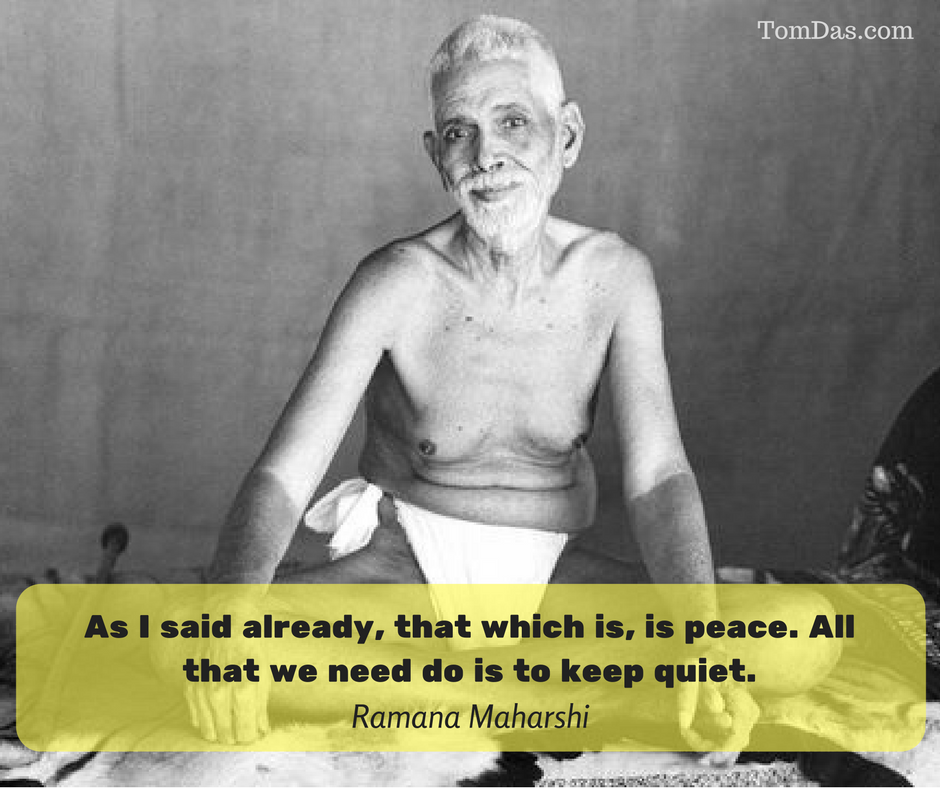
Sri Ramana Maharshi: There is no liberation, and where are muktas [the liberated ones]?

Questioner: Do not Hindu sastras [scriptures] speak of mukti [liberation]?

Sri Ramana Maharshi: Mukti is synonymous with the Self. Jivan mukti (liberation while alive) and videha mukti (liberation after the body falls) are all for the ignorant. The Jnani  [liberated one] is not conscious of mukti or bandha (bondage).

Bondage, liberation and orders of mukti are all said for an ajnani [ignorant or unliberated one] in order that ignorance might be shaken off.

There is only mukti and nothing else.


The following is the taken from Vichara Shangraham, a text attributed to Sri Ramana Maharshi. Vichara Sangraham is often translated simply as ‘Self Enquiry’ and literally means ‘A compendium of (Self) Enquiry’. This excerpt is very the last section of the text:

Question: What are the characteristics of the jivan-mukta (the liberated in life) and the videha-mukta (the liberated at death)?

Sri Ramana Maharshi: ‘I am not the body; I am Brahman which is manifest as the Self. In me who am the plenary [absolute] Reality, the world consisting of bodies etc, are mere appearance, like the blue of the sky’. He who has realized the truth thus is a jivan-mukta.

Yet so long as his mind has not been resolved, there may arise some misery for him because of relation to objects on account of prarabdha (karma which has begun to fructify and whose result is the present body) [ie. due to destiny], and as the movement of mind has not ceased there will not be also the experience of bliss.

The experience of Self is possible only for the mind that has become subtle and unmoving as a result of prolonged meditation. He who is thus endowed with a mind that has become subtle, and who has the experience of the Self is called a jivan-mukta. It is the state of jivan-mukti that is referred to as the attributeless Brahman and as the Turiya.

When even the subtle mind gets resolved, and experience of self ceases, and when one is immersed in the ocean of bliss and has become one with it without any differentiated existence, one is called a videha-mukta. It is the state of videha-mukti that is referred to as the transcendent attributeless Brahman and as the transcendent Turiya. This is the final goal.

Because of the grades in misery and happiness, the released ones, the jivan-muktas and videha- muktas, may be spoken of as belonging to four categories — Brahmavid, vara, variyan and varishtha. But these distinctions are from the standpoint of the others who look at them; in reality, however, there are no distinctions in release [liberation] gained through jnana [self-knowledge].

FALSE VEDANTA – a warning from Shankara (Vivekachudamani)

5bcbc2e6adc6ac9dfb690a3edcb64ab2_l
Sri Shankara

Perhaps the most important single text that traditionally outlines the Jnana Marga (Path of Knowledge) is Shankara’s Vivekachudamani.  This text has been used for centuries as a step by step manual to take one from (apparent) ignorance to Moksha (liberation) in which there is no suffering and it has been recommended by all the great Advaita sages including Sri Ramana Maharshi.

There are many gems littered throughout the text, and here is one of them which you may have missed:

160. The stupid man thinks he is the body, the book-learned man identifies himself with the mixture of body and soul, while the sage possessed of realisation due to discrimination looks upon the eternal Atman as his Self, and thinks, “I am Brahman”.

In verse 160 Shankara tells us that the one who is book-learned in Vedanta considers himself to be a mix of ‘body and soul’. In doing so, the one with mere book-learning still retains identification with the body, and so remains in ignorance and continues to suffer. In verse 162 Shankara, as is characteristic of the writing in Vivekachudamani, repeats his point and elaborates on it to make the meaning clear and beyond doubt:

162. As long as the book-learned man does not give up his mistaken identification with the body, organs, etc., which are unreal, there is no talk of emancipation for him, even if he be ever so erudite in the Vedanta philosophy.

There are many who know the scriptures, know the teachings, but still identify with the body in some way. These verses are a warning against this view. Shankara concludes this small section as follows, dispensing his sagely advice:

163. Just as thou dost not identify thyself with the shadow-body, the image-body, the dream-body, or the body thou hast in the imaginations of thy heart, cease thou to do likewise with the living body also.
164. Identifications with the body alone is the root that produces the misery of birth etc, of people who are attached to the unreal; therefore destroy thou this with the utmost care. When this identification caused by the mind is given up, there is no more chance for rebirth [ie. liberation is attained].

So don’t take yourself to be the body, just as you do not take your shadow to be yourself, do not take your body to be your-Self. Also, do not take yourself to be both the body and something else and in doing so retain a sense of limitation. You are That alone, you are the Self.

You are That alone,

You are the Self.