Ramana Maharshi: Self-inquiry (atma vichara) and doership

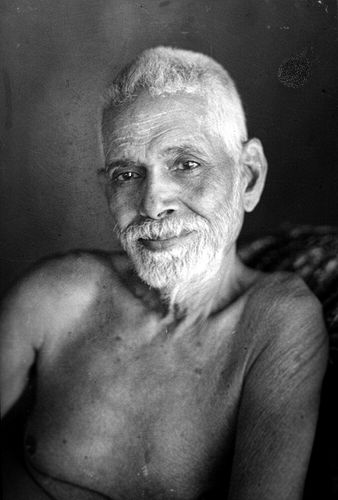
Ramana Maharshi sitting

“The differences are the result of the sense of doership.

The fruits will be destroyed if the root is destroyed.

So relinquish the sense of doership.

The differences will vanish and the essential reality will reveal itself.

In order to give up the sense of doership one must seek to find out who the doer is.

Inquire within. The sense of doership will vanish.

Vichara (inquiry) is the method.”

Taken from Talks with Sri Ramana Maharshi, talk no. 429

Tom’s comments:

The root of suffering is the sense of doership, the sense that there is a doer-entity, the sense that you are a doer. The root is the notion ‘I am a doer’, the fruit is suffering and duality.

Let go of this sense of doership, either by simply relaxing and letting go, or, as suggested above, look and find out what the doer is. Look at your own direct experience: can you see the doer? Can you feel the doer? What does the doer look and feel like exactly? Where does the doer begin and end? How big is the doer? Where is the doer located?

When you look, as you keep on noticing, you may start to realise/see that there is no actual experience of a doer at all. All there are are sensations, feelings and thoughts. Specifically there may be the thought ‘I am the doer’ or ‘this is the doer’, but no actual doer is seen/experienced apart from the thought. The doer is seen to be an imagined entity. The doer (ie. ego) is revealed to be a fiction.

Ramana uses the word ‘reality’ above. What is reality? It’s just what’s left over when the sense of doership is seen through. It’s just what’s left over when false illusions are seen for what they are: false.

Who cares about Freedom/Enlightenment/Nirvana?

flowers purple.jpg

Who cares about Freedom/Enlightenment/Nirvana?

Who is it that cares? What is it that cares? Why do you want it?

Notice that this very teaching is pointing out that the entity that wants these things is itself a fiction. It is the false ego that cares. And the false ego does not exist. (Note that I use the word ‘ego’ as a synonym for ‘the doer’)

What do you imagine Freedom/Enlightenment/Nirvana to be?

How do you imagine it will benefit you? Any benefit you imagine enlightenment will give you is only temporary at best. What comes can also go. Freedom means that you are free from the need for any improvements to what is.

Will enlightenment make you happy?

Happiness can come, and it will also eventually go. Happiness and all states of mind are necessarily transient. Enlightenment is already present, and is not dependent on happiness or on your state of mind. Enlightenment doesn’t need to be happy.

Maybe you think enlightenment will give you the unshakable knowledge that you are immortal?

The problem here is that all knowledge is uncertain and can be doubted. Yes, all knowledge. If you think that you are Pure Consciousness, if you think it’s all about no-mind or no-ego, if you think it’s all about Jesus or Krishna, all of these are within the field of knowledge.

You may have cleverly deduced and convinced yourself that you are immortal using some kind of conceptual construct loosely based on your experience, but the truth is that you don’t actually know.

So, what happens when you die?

How can you know what happens when you die? No matter how you justify it, no matter how many psychic intuitions or spiritual experiences you have, the truth is that you don’t know for sure what happens after death. This question may perhaps be answered by science in the future, but we are not there yet.

Think of a time when you were utterly convinced something was true, but now you look back and realise how wrong you were. Knowledge also comes and goes. Perspectives change as we grow and mature and experience different things.

Enlightenment is beyond knowledge. Enlightenment does not depend on knowledge or the mind. Unlike knowledge and states of mind, Enlightenment cannot be attained – it is already here.

OK, then what’s left?

If enlightenment is not about attaining a particular state of mind or gaining some kind of knowledge, then what’s left? What’s left is simply what’s happening. That’s all. Enlightenment/freedom/nirvana is not about attaining anything at all. All we ‘know’ is whatever is happening is whatever is happening. Or, to be more accurate, whatever we perceive (to be happening) is what we perceive.

Pointing out mistakes

We can go a little further too: we can also point out mistakes in our thinking. If we think Father Christmas is real, we can notice and point out there is no conclusive evidence to support that, despite appearances to the contrary (eg. presents appearing beneath the tree on Christmas Day). Any happiness or pleasure we derive from believing in Father Christmas is similarly based on our wrong notions/illusion.

Similarly, if someone takes themselves to be a doer, an entity that is free to choose and take credit and blame for its actions, then we can point out that there is no evidence to support this position, despite appearance to the contrary. All suffering that results from belief in doership is similarly based on illusion.

Be honest and humble

So, we can ‘know’ (ie. perceive) whatever’s happening right now, and we can know what we don’t know.

Basically, let’s be honest and humble and not pretend we know things that we don’t. Let’s not pretend we are this or that, let’s not strive towards spiritual ideals which are just mental projections  – it’s all fear based, ego-based.

No need to strive

Instead of striving towards projected notions of Enlightenment, why not look at where we are. Why not stay with what is?

The movement away from what is is based on aversion and fear. Can you see that? This movement away is the fear. This movement away is the suffering. It is all based on the notion ‘I am the doer’ or ‘I am the ego’.

When we stop striving, we become available to see things as they are, we become free to understand. When we see there is no ego/doer, there is no striving/desire. Even if there is desire, there is no identification with it, so there is no suffering.

Natural relaxation, emotions and intelligence

When we see that there is nothing to attain, we naturally relax. It happens by itself. As we relax, positivity and well-being flow into our system. We are free to be ourselves, which means we are free to let whatever happens happen – we have no choice in this anyway as there is no doer!

Emotions come and go: they are free to be felt and experienced.

The body-mind starts to balance itself, regulate itself and develop its natural sensitivity and intelligence.

Insights and understanding pours through, illusion falls away as it is seen through. Love starts to blossom.

Or maybe it doesn’t. It’s for you to find out for yourself, in freedom, if what I am saying is true.

The ‘miracle’ of life

Relax, notice and discover.

What are we left with? Just what’s happening. So simple, and beyond words. Just life, living, simply, spontaneously. The fact that it or anything is here at all is the ‘miracle’.
The Drama

Here’s an article I wrote for naturalhealthstar.com about the stories we tell and how to deal with ‘drama’:

www.naturalhealthstar.com/general-wellness/the-drama/

[Update: the above link no longer works so I have posted the article in full below:]

I remember a great piece of advice a friend gave to me: “Drama” she said “Don’t go there. Just don’t go there. Always stay out of the drama!”.

And it was good advice. Another word that could have been used instead of drama is the word story. It’s easy to get caught up in someone else’s story or narrative. We often tell each other stories: in our interpersonal relationship, in the workplace and in the media where it is often exaggerated as spin. I’ve seen so many relationship issues that are caused by the stories people tell about each other. There is the story of blame, the how could she/he do that to me story. There is the you are a bad person story. There is the I am a bad person story, the nobody could like/love me story and the once I get promoted I’ll be happy story. Of course you could replace promoted with a few hundred other things. There is the story of victimhood , the story of perpetration, and the story of being a helper or rescuer.  I could go on.

Now, that is not to say that there are never perpetrators or victims, or that people are never to blame. There clearly are victims sometimes and sometimes people are incompetent and need to be held responsible for their actions. But being a victim, for example, is different to the drama or story of victimhood. These stories we so often tell ourselves and each other serve no useful purpose, but we can sometimes feel a sense of strength and certainty when we cling to them.

Who would we be without those stories? Would people walk all over me? Would anyone pay any attention to me? Would anyone love me?

Are any of these stories true? If so, where is the evidence, and if there evidence then is this evidence just another story? (Maybe it isn’t a story – only you know the correct answers to these questions)

So let me ask you: who would you be without your stories? Can you spot the times that you enter into other people stories about you and, for example, start to defend yourself? What stories do you tell about other people? What stories do you have about yourself?

Join us! Regular Non-Duality & Spirituality Meetings Online and In Person

tom-das-meetings-heart-flower

Why not join us? We meet online twice a week to discuss non-duality and spirituality. All are welcome, no prior knowledge is required.
Click here for more details or click on the ‘meetings tab above.

Transforming pleasure into joy

Please click here to read my second article for naturalhealthstar.com. It’s called ‘Transforming pleasure into joy’.

[Update – the above link no longer works so I have posted the article below in full; the first article called ‘The Two types of Happiness’ can be read here.]

In a previous article I wrote about joy as opposed to pleasure. Joy, as I defined it, is a natural feeling of warmth and connectedness we feel when we are with someone we love, when we are doing something we love, or when we are with nature. Pleasure on the other hand, I defined as being to do with acquisition, such as acquiring possessions, or even more subtle ‘objects’ such as acquiring pride, power, sex, certain experiences or respect.

With joy, our sense of self or ego is dimished and so we feel whole. The barrier and resistance of the ego is lessened allowing joy to emerge. With pleasure our sense of self is reinforced and strengthened, and whilst this feels initially positive, it is actually trying to cover up a deeper sense of lack or emptiness and it ultimately destructive and self-isolating. Pleasure becomes addictive whilst joy is deeply soothing.

It’s worth pointing out that in different situations joy goes by different names. When we feel joy whilst looking at a piece of art or listening to music we call it Beauty. When we are with someone we call it Love. When it is through our work we call it Service or Vocation. It is all Joy. It is all Love. These all happen when the sense of self is no longer at play.

So if you want to explore this further I suggest the first thing to do is to simply notice this. Not change it, but just gently notice it. Notice what pleasure feels like, notice how it comes about, notice your thoughts, notice how your body feels, notice the circumstances that gave rise to it, notice how you feel afterwards – you get the idea. The same with joy. Don’t accept my descriptions, but discover for yourself what these two types of experience are like.

The tendency when hearing a teaching like this is to shun pleasure and try to do more joyous things. Whilst this is on the one hand commendable, I would also advise caution. The very desire to maximise joy is actually the same drive for pleasure only in a different guise. Now joy has become an object to be acquired, and this acquisitive desire is the characteristic of pleasure. If you have spent time exploring what joy and pleasure actually feel like in your body you will get an immediate sense of this. So in trying to seek joy, the naturalness of joy is transformed into seeking pleasure. Notice how subtle this is.

On the other hand, if you don’t try to seek or repress pleasure, and instead just look at it, just being with the feeling is actually a form of love, self-love. We can love ourselves, embrace ourselves and not judge or chastise ourselves for seeking pleasure. We can embrace and be with our pleasure seeking. We can accept ourselves for who we are right now, just as we may accept a child or pet animal who is playing up. We are no longer trying to acquire something, we are no longer trying to be joyous. We are also no longer judging ourselves as being good or bad. Instead we are loving ourselves as we are, we are being tender with ourselves and our emotions, and in doing so we transform pleasure into Joy.

Experiment with this if you want, and let me know how it goes.

Love and blessings to you

Bulldozer spirituality

malet egg

To verbally espouse and preach spiritual things can be deeply inappropriate:
Do you tell someone who is suicidal,
That their problems are due to a false notion of self?
Or that all phenomena are insubstantial, formless and everchanging?
Or that like the desert mirage, life and its problems are a dream?

It would be like telling someone who is choking that ‘ALL IS ONE‘. Continue reading