Q.: Why is man born, only to die? Why does God create, only to destroy? Is it not absurd? If one is going to die one day, why is he born? If everything is going to be destroyed one day, why create anything?
B.: All creation is mental hallucination or delusion. In Reality there is no creator and no creation.
Q.: I desire to know the reason for the existence of the world I see around me.
B.: The apparent perceiver is the reason for the apparent perceptions.
Q.: I do not understand.
B.: Perceiver perceived and perception are all completely fictitious.
Q.: For Bhagavan it might be so. I see a solid world around me. I desire an explanation for it.
B.: What of your own apparent existence in the form of this perishable body?
Do you desire no explanation for that?
Q.: Yes, that too.
B.: Any number of theoritical explanations may be given to satisfy the craving of the intellect for the time being; but there will be no permanency in your satisfaction. Soon new doubts will arise and your old intellectual standpoint or belief will collapse. Then you will set about searching for a new explanation.
This goes on happening until the mind becomes disgusted with temporal life as a whole; then, it plunges into the Heart and loses itself there – that is the final dawn of wisdom.
Q.: So, the world is something that appears to exist only because I am engaged or involved in perceiving?
B.: Quite so.
Q.: So, now, if I close my eyes for two minutes, during those two minutes do Bhagavan, the sofa he is sitting on, this Hall and Tiruvannamalai, all totally disappear or vanish into thin air? [closes his eyes seriously for sometime] There, now, was Bhagavan not there in this Hall, were the other people in this Hall not present, even whilst my eyes remained closed? If I ask anyone, ‘Excuse me, did you exist whilst my eyes were closed, or not?’ will they not think I have gone mad?
What is the explanation?
B.: You are confusing implicit existence with implied existence. No doubt corroboration is available from the ‘others’ seated in this Hall including Bhagavan, but naturally in a dream everything is in spontaneous synchronisation. It is [your] one mind that has become all this. So, naturally confirmation is available. What is the surprise in it? You think you are taking corroboration from others, and therefore asking this question. The one whom you are asking is [also] your own mind only. Of course he would corroborate.
The idea that things exist, and then you perceive them, is implied exixstence.
It derives its strength from the principle of intellection, which in turn from the buddhi [faculty of reasoning], which in turn from the mind. Implicit existence is swayam-pratyaksham. It shines by its own light, not by any borrowed light.
Therefore it is the one thing Real.
Q.: Will sriramanamasmaranam [Tom: repetition of the Holy Lord’s name ‘Sri Rama’] help me Realise?
B.: If and only if it be accompanied by intense devotion. The devotion must be so intense that even the thought ‘I am engaging in sriramanamasmaranam’ must not find it possible to arise
The above excerpt is taken from Aham Sphurana, 20th July 1936, see here for more information on this text.
The following is from Talks with Sri Ramana Maharshi, Talk no. 244:
Question: How is God to be seen?
Sri Ramana Maharshi: Within. If the mind is turned inward God manifests as inner consciousness.
Tom: here Bhagavan Sri Ramana gives us the essential teaching – God is to be found within – not outside, meaning not in the body, mind or world, but within, meaning in the non-conceptual Self that is the Subject. As Ramana himself wrote in the text ‘Who Am I?’:
Question: When will the realization of the Self be gained? Answer: When the world which is what-is-seen has been removed, there will be realization of the Self which is the seer.
And in the same text, Who Am I?, in the answer to question 16 it is written:
‘the Self itself is God’
However, the questioner poses a seemingly logical question, namely that if God is everywhere, why cannot be see God everywhere? Why the need to look within when we can just as easily look outside at ‘God’s creation’, through our senses and see God there? Let us see:
Q: God is in all – in all the objects we see around us. They say we should see God in all of them.
Sri Ramana Maharshi: God is in all and in the seer. Where else can God be seen? He cannot be found outside. He should be felt within. To see the objects, mind is necessary. To conceive God in them is a mental operation. But that is not real. The consciousness within, purged of the mind, is felt as God.
Tom: here Sri Ramana is stating that to see God outside is merely to see a projection of the mind, for according to Sri Ramana, as we shall see shortly, all objective phenomena are mere thoughts, or projections of the mind, much like a dream objects are projection of the mind. An alternative explanation is that to see God in objective phenomena is actually a subtle act of the mind, a conceptual framework we are overlaying onto objects.
However, the questioner persists in pursuing their line of enquiry by challening Sri Ramana – are not various objects beautiful? Are not colours lovely to look at? Can we not see God in these objects too? Let us see:
Q: There are, say, beautiful colours. It is a pleasure to watch them. We can see God in them. Sri Ramana Maharshi: They are all mental conceptions. Q: There are more than colours. I mentioned colours only as an example. Sri Ramana Maharshi: They are also similarly mental.
Tom: the questioner states that we can see God in objects and through the senses, but Sri Ramana dismisses this as mere concepts. The questioner, having raised objective qualities such as colour, then having raised other senses, not just colour now goes onto the body and the mind:
Q: There is the body also – the senses and the mind. The soul makes use of all these for knowing things. Sri Ramana Maharshi: The objects or feelings or thoughts are all mental conceptions. The mind rises after the rise of the I-thought or the ego. Wherefrom does the ego rise? From the abstract consciousness or Pure intelligence.
Tom: Here Sri Ramana again states that the body, senses and mind are all mental conceptions (or mental projections), as are all objects, feelings and thoughts.
He then goes on to give a teaching given in the aforementioned text ‘Who Am I?’, that the first though is the ‘I-thought’ also known as the ego, and only once this has risen can other thoughts or objective phenomena arise such as the body, the mind and the world. In this way Bhagavan Sri Ramana is repeating his teaching, a teaching also taught in the Upanishads and by Sri Shankara, that the body-mind-world is actually a projection of ego or ignorance.
What is the source of this ego or I-thought? It is the Self, or Pure Consciousness as he refers to it here. The word ‘pure’ denotes the absence of arisising objective phenomena, which is consistent with the teaching explained in my above paragraph.
Later in the same dialogue (Talk 244) Sri Ramana explains that the ego or ‘I-thought’ gives rise to (or projects out) the mind, and the mind then projects out a body:
Sri Ramana Maharshi: The sense of body is a thought; the thought is of the mind, the mind rises after the ‘I-thought’, the ‘I-thought’ is the root thought. If that is held, the other thoughts will disappear. There will then be no body, no mind, not even the ego. Q: What will remain then? Sri Ramana Maharshi: The Self in its purity.
Tom: We can see that Sri Ramana is re-iterating that the body and mind are both projections of thought, and that their root is the ego, also known as the I-thought. When this ego-root (ie. ignorance) is cut down, by self-enquiry, all thoughts cease and the Self remains in its purity. As the body, mind and ego are all thoughts, Bhagavan Sri Ramana here explicitly states that in Self-Realisation there is no body, mind or ego. All that remains is the pure Self, again ‘pure’ denoting the lack of objective phenomena such as body, mind, world, feelings, sensations, etc.
As always, please do not simply accept teachings at face value. It is always good to read teachings in their proper context, so I encourage you to not just accept my commentary above, but to read the full talk for yourself so you can see it in its context. You will find many other valuable teachings in this talk too, such as Sri Ramana’s exposition of the three states and how he equates deep sleep with the Self, how he says that the world is a mere dream, his insistence that Self-Enquiry is the easiest path, and that Happiness or Pleasure or God can only truly be found Within.
The following is taken from the wonderful text Sadhanai Saram (The Essence of Spiritual Practice) written by Sri Sadhu Om, a direct devotee of Sri Ramana’s. This text not only gives us the essence of Sri Ramana Maharshi’s teaching, but also directs us to the true Vedanta teachings. The notes are written by Sri Sadhu Om himself. The sub-headings have been added by myself to aid readability. You can download the full text as a PDF using the above link.
Introduction
If we did not have the good fortune of having attained a human body, which enables us to experience daily the three states of waking, dream and sleep, how could we have the fitness to do Selfinquiry? Therefore, this human birth is indeed superior to all other births.
Except in this human body, all these three states are not experienced in one lifetime by any soul, whether deva (divine), animal or plant. Therefore, a very great boon indeed is the boon God has bestowed upon us in the form of this human birth, which is such a good opportunity enabling us to inquire and know the Self.
Note: Celestial beings (devas) experience only the waking state; animals experience only sleep and a dream-like waking state; plants experience only sleep**; and insentient objects like stones are always in a state like swoon. Only in the human birth, does one experience all the three states of waking, dream and sleep. Hence, even devas must take birth as human beings if they wish to attain Selfknowledge, the state of liberation.
**Note: Compare Talks, no. 617, p. 580.
The three states of waking, dream and dreamless deep sleep are experienced daily by all human beings, are they not? If we keenly scrutinize the nature of these three states, knowledge of the state of liberation, which is the reality of these three states, will be attained by us as a direct experience.
The I AM
In the waking state we exist as “I am”; but in this state, beside us, so many second and third person objects of various kinds are also known by the mind. How have all these come here?
In dream also we exist as “I am”, having become the one who sees everything there; but in that state also so many second and third person objects of various kinds are again known by the mind. How did all those come there?
In sleep also we exist as “I am”; however, in that state we do not see anything appearing as other than us. Therefore, our state of existing as “I am” alone shines always without ever slackening or being obstructed, whereas our state of knowing objects other than us undergoes change. Hence, our state of existing as “I am” is alone the one unchanging state.
The state of our existing as “I am”, which shines in all the three states continuously and without ever coming to an end, is our exalted state of real knowledge; it is the state of purna (the Whole). Objects other than “I” do not exist in all the three states. Hence our own nature, the Self-existence “I am,” alone is the reality which ever exists.
Objects
Since objects other than “I,” such as the body and world, do not exist unceasingly in all the three states, but rise and appear to exist only in between in the waking and dream states, they cannot be the reality, which exists always and without being obstructed. This conclusion arrived at by scrutinizing our experience in these three states, is the foundation for the practice of Self-inquiry.
These objects other than “I,” which exist at one time and do not exist at another time, are truly non-existent even at the time when they appear to exist. When scrutinized, waking and dream are both found to be only one in nature, because the objects, which appear to exist in each of these states, unfailingly cease to exist in any other state.
Duality
That state, in which any object seen is not experienced as other than the one who sees, is alone the state of reality. If the seer, who is an unreal ego, rises, then only will all the unreal objects other than “I” rise, and seem to exist.
The waking dream
The dream-world – and the one who, living there identifying a dream-body as “I,” and sees that dream-world – both together constitute the dream. The waking state is also like that; that is, not only this seemingly vast world that is perceived in front of us, as if existing as other than us, and also we, the jiva who sees this waking world, both together constitute the appearance of this dream, which is called the waking state.
In practice, waking and dream are only one and the same. Just as in waking the mind thinks, “I am this body,” so in dream also the mind projects a body by its creative power of imagination and functions there, feeling “I am this body.”
Ending the dream
Until the root-tendency (mula-vasana) to identify a body as “I” ceases to exist, the appearances of the waking and dream states that arise due to delusion (maya) will not come to an end. If you, with a one-pointed mind keenly and incessantly attend to the consciousness of your existence, which shines as pure “I am,” the root-tendency “I am the body,” and all its products and other tendencies, will cease to exist.
Ignorance and deep sleep
To remain inactive forgetting the feeling “I am the body,” is sleep. In the dense ignorance of this sleep, arises a creative imagination of the mind (mana-kalpana), and this alone is the cause for the appearance of dream. Therefore, it is the mind alone that projects a dream.
Similarly, in the long sleep of ignorance (ajnana), which has engulfed us due to our forgetfulness of our true state of pure Self-consciousness, an imagination in mind (mana-kalpana) rises identifying a contemptible fleshy body as “I”, and this alone is the cause for the rising and appearance of this despicable waking state, which we are now experiencing.
Samsara (the cycle of birth and death)
Just as sleep alone is the cause for the appearance of dream, so the sleep of forgetfulness of our true Self-Knowledge is alone the cause for the appearance of this waking state. In this long sleep of Self-forgetfulness, many dreams in the form of countless births come and go.
Know that just like a person who without coming to the waking state, merges in deep sleep after the dream he was seeing has come to an end, if the dream of the present birth that this person has taken is brought to an end by death, before he attains the true waking state of Self-knowledge, he will merge again into the underlying ancient sleep of Self-forgetfulness.
Just like a person who was seeing a dream and who then leaves that dream and falls into deep sleep without coming to the waking state, if the waking-body dies before we attain the state of Selfknowledge, we will fall into a state like deep sleep. Just as a dream appears as soon as the mind of a person immersed in sleep rises and begins to wander, so after the death of this waking-body, as soon as the mind rises and begins to wander on account of its former tendencies, a waking state will again arise in which a body will seemingly exist as if “I”.
Taking birth again, having come out of the delusion-enfolded state of death, and living a life of whirling about in this waking state, and finally dying without attaining Self-knowledge, is just like a person rising as “I” from deep sleep, seeing a dream again, and finally once again merging in sleep. You will not take birth again only if you awaken into the true state of Self-knowledge. Awaken thus.
Awakening: Waking up from the dream & Turiya
If a person who has fallen asleep and is seeing a dream suddenly wakes up, by his awakening he will attain a state in which sleep and dream have both been dispelled. Similarly, if a person awakens from the present so-called waking state by attaining the exalted state of Self-knowledge, the dream of birth and death and the underlying sleep of Self-forgetfulness will both be dispelled, and he will thereafter never again undergo either birth or death. The state of real awakening (turiya), which he thus attains, and which transcends the three ordinary states of waking, dream and sleep, is the state of liberation.
The method of Sadhana (spiritual practice) – Self-enquiry
If the power of attention, which sees the second and third person objects existing in dream, turns to attend to itself, both the first person (who sees the dream) and the dream will disappear; the sleep that is the cause for the rising of that first person will be dispersed, and the worthy state of true awaking will be experienced.
Similarly, if the power of attention, which knows the second person objects existing in the waking state, turns to attend to itself (the “I” who sees this waking state), the waking state will disappear; the long sleep of Self-forgetfulness which is the cause for the rising of the individual sense of “I” will be dispersed and the true waking state of Self-knowledge will be attained. Therefore, attend only to yourself, the first person consciousness “I.”
Karma and Self-Realisation
Even before the experience of the current destiny (prarabdha karma) which caused the appearance of a dream has come to an end, if the mind is struck by intense fear, joy or suffering, its power of attention will be driven Selfwards and return to the heart, whereupon waking will result.
Note: Prarabdha is that part of one’s destiny (or karma) that has to be worked out in this life. Sanchita is one’s karma accumulated in former lives that has not yet taken effect.
Similarly, even before all the accumulated sanchita karmas have been exhausted by being experienced in the form of prarabdha, if in this present life, which was started by prarabdha, the mind either gains firm dispassion (vairagya), being unable to bear the severe sufferings of life, or experiences intense fear of death, it will turn Selfwards and merge in the heart; whereupon the true awakening of Selfknowledge will result.
Fear, suffering and self-realisation
When such intense fear or suffering are experienced, if the mind with mature discrimination (viveka) at once earnestly scrutinizes, “To whom does this fear or suffering arise?” then the extroverted power of attention, which was till then being dragged out towards objects other than itself, will turn inwards to face itself, whereupon the truly awakened life of Self-abidance will immediately be attained.
Self-knowledge: ending the dream
Just as all that happens in dream is experienced as real so long as one is seeing that dream, so all that is now happening in this waking state is experienced as real. If the dream comes to an end, all that was seen there will be known to be unreal. Similarly, for those who have awakened from this so-called waking state by attaining Self-knowledge, all the happenings in this state are clearly known to be unreal.
As soon as the inwardly awakened state of Self-abidance is attained, all the adjuncts in the form of the wrong identification that the actions of the body are one’s own actions will become devoid of reality, being found to be mere superimpositions upon one’s nameless and formless nature, just like the blue color superimposed upon the colorless sky; and the truth, that one is only the adjunct-free Self, will clearly shine forth.
Ajata
Only in this real waking state of Self-abidance will true knowledge blossom in the form of the ajata experience, “No mundane dual activity such as birth and death has ever touched me; I am Self, the existence-consciousness which is ever devoid of the body and the senses.”
The pure consciousness “I,” which exists in sleep devoid of all adjuncts, is the Supreme Reality (Brahman). If we do not slip down from that state of pure consciousness due to attachment to the body (dehabhimana), that itself is the Supreme Abode (parandhama). If we remain, without leaving Self, that itself is liberation.
Do you exist in deep sleep?
Though we think sleep to be a state of darkness, because no other objects are known there, know that it is not possible for anyone to deny his own existence in sleep. When you are able to affirm your experience in sleep, “It was darkness,” “There were no thoughts” and “It was a happy state,” is it not clear that you existed in sleep? To be able to affirm thus, who was that “you” who existed in sleep? Tell me.
Your ability to affirm all the three experiences mentioned above shows not only that you existed in sleep, but also that you knew these experiences there, does it not? This existence-knowledge, which existed and was known in sleep, is indeed the peerless existence-consciousness (sat-chit), your own state, and the real nature of self.
Deep sleep and bliss (ananda)
In sleep, in which you existed solitarily as the mere existence-consciousness (sat-chit), you were the experiencer of sublime happiness devoid of even a single petty misery, even though you were separated from all the possessions and all the objects which you seek in the waking state for happiness, were you not? That happiness which you experienced in sleep is indeed bliss (ananda), your true nature.
Outro
To become a hero who abides as Self, the infinite reality (paripurna Brahman) whose nature is existence-consciousness-bliss (sat-chit-ananda), devoid of the experience of any body or any world, is the fruit to be gained by proper scrutiny of the three states of waking, dream, and sleep.
The supreme Guru Sri Ramana has given the above clues so that, having thoroughly scrutinized the three states, we may finally abide blissfully forever as Self, our own true nature which transcends the three states.
(Here a questioner asks are there not many jivas? Sri Ramana informs the questioner there is only one jiva)
A question was asked why it was wrong to say that there is a multiplicity of jivas. Jivas are certainly many. For a jiva is only the ego and forms the reflected light of the Self. Multiplicity of selves may be wrong but not of jivas.
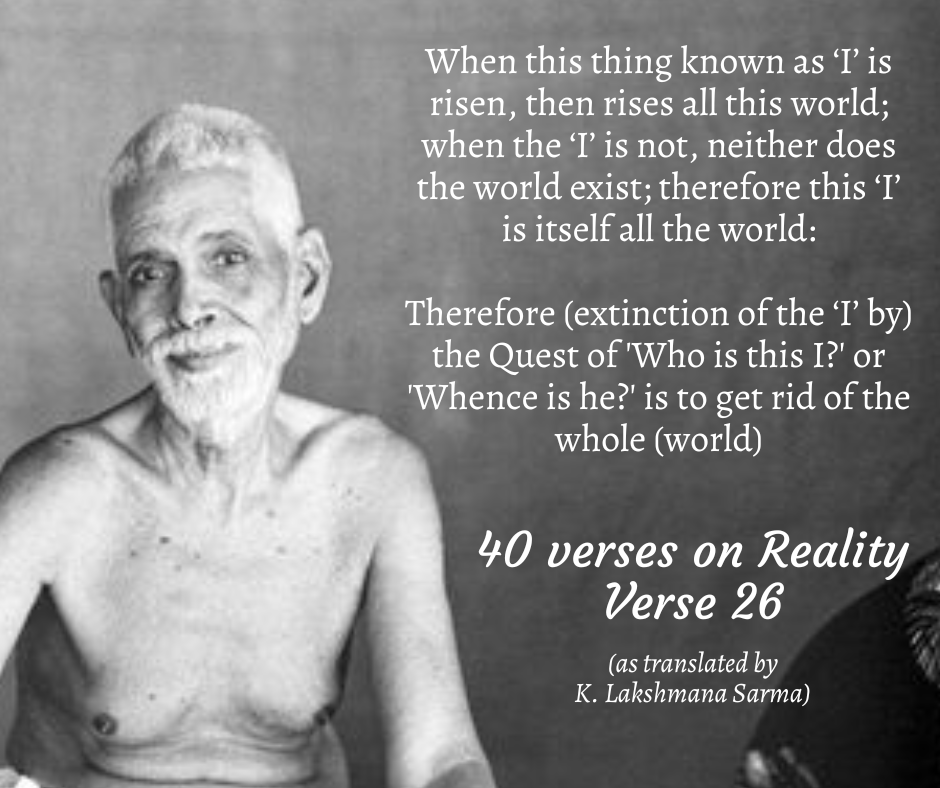
Sri Ramana Maharshi: Jiva is called so because he sees the world. A dreamer sees many jivas in a dream but all of them are not real. The dreamer alone exists and he sees all. So it is with the individual and the world.
There is the creed of only one Self which is also called the creed of only one jiva*. It says that the jiva is only one who sees the whole world and the jivas therein.
~Talks 571
*Tom: This is called the doctrine of eka jiva vada (the view there is only a single jiva/ego/person). Our own body-mind, and the body-mind of apparent others are all projections of the Self. Like a dream, it appears we are many, but actually this entire dream world is an illusion, and there is only the Dreamer, the Self, the Consciousness from which all is projected. Tat Tvam Asi, You are That.
The above is an excerpt taken from this longer post that further explores this theme:
Q. I have a question. If mind guides us while we are awake and in dream, and in sleep we are not conscious (because mind is switched off), doesn’t that imply mind is what we mistake for ‘consciousness’ or ‘awareness’?
Tom: Yes, that is correct. We consider ourselves to be awake/conscious in both the waking state and the dream (whilst we are dreaming) and asleep/unconscious in deep sleep.
Actually it is just the mind, ie. ignorance/duality, that is awake in ‘waking’ and dream and we are actually fully conscious in deep sleep – it is just the mind that is ‘asleep’.
This is why the in the Bhagavad Gita verse 2:69 it states: ‘What all [ignorant] beings consider as day is the night of ignorance for the wise, and what all [ignorant] creatures see as night is the day for the introspective sage.’
Here we will see, using quotes from Gaudapada, Shankara, the Upanishads and Sri Ramana Maharshi that the same essential teaching is taught regarding the reality of the waking and dream states – namely that they are both equally unreal, that both waking and dream are dream!
Gaudapada
Tom: Here is verse 1 from chapter 2 of Gaudapada’s Mandukya Karika (Gaudapada’s four chapter commentary on the Mandukya Upanishad – you can read the full text here), my comments are in red:
2.1. Harih Aum. The wise declare the unreality of all entities seen in dreams, because they are located within the body and the space therein is confined.
Tom: Gaudapada is essentially stating something we already know, namely that we dream of many things, but all these things we dream of are not actually real. They are all projections of the mind, which is what Gaudapa means by ‘located within the body and the space therein is confined’
2.2. The dreamer, on account of the shortness of the time involved, cannot go out of the body and see the dream objects. Nor does he, when awakened, find himself in the places seen in the dream.
Tom: Again, Gaudapada is stating what we already know about dreams. Shankara in his commentary on this verse explains this means that if we dream of going to a far away land many hundreds of miles away that would take several months to travel to, there is not enough time in dream, which only lasts a few hours, to actually travel there. Similarly, when we wake from the dream, we do not find ourself in this dream location far away.
2.3. Scripture, on rational grounds, declares the non-existence of the chariots etc. perceived in dreams. Therefore the wise say that the unreality established by reason is proclaimed by scripture.
Tom: Gaudapada in verses 2.1 and 2.2 has shown that the many things perceived in dreams are not real on the basis of our own experience. Now he is stating the same based on scripture, referring to Brihadaranyaka Upanishad 4.3.10, which states, referring to a dream about chariots:
‘There are no chariots, nor animals to be yoked to them, nor roads there, but he creates the chariots, animals and roads. There are no pleasures, joys, or delights there, but he creates the pleasures, joys and delights. There are no pools, tanks, or rivers there, but he creates the pools, tanks and rivers. For he is the agent’.
The idea from Gaudapada is that if we dream of a chariot, that chariot is not real, as confirmed by scripture. Note that the teaching that is given in the next two verses is essentially the same as the teaching given in Brihadaranyaka Upanishad 4.3(please see this link for more).
2.4. The different objects seen in the confined space of dreams are unreal on account of their being perceived. For the same reason, ie. on account of their being perceived, the objects seen in the waking state are also unreal. The same condition ie. the state of being perceived exists in both waking and dreaming. The only difference is the limitation of space associated with dream objects.
Tom: Gaudapada is now equating the dream and waking states, stating that just as dream objects are perceived but not real, the same is with the waking state objects – they are also perceived yet utterly unreal. Does this mean we are to consider the waking state as unreal as a dream? The answer is yes, let us see:
2.5. Thoughtful persons speak of the sameness of the waking and dream states on account of the similarity of the objects perceived in both states on the grounds already mentioned.
Tom: The translation used thus far is that of Swami Nikhilanananda of the Ramakrishna Order. Swami Gambhirananda, also of the Ramakrishna Order, translates the last line of verse 2.5 as ‘the wise say that the dream and the waking states are one’.
Shankara
In his commentary on Gaudapada Karika verse 2.5 (above) Shankara states ‘…therefore discriminating people speak of the sameness of the states of waking and dream.’
We can see that Gaudapada and Shankara are both explicitly stating that the waking state is another form of the dream state, and whilst we often distinguish between waking and sleep, they are actually both dream states, and all that is perceived within waking and dream are equally unreal.
Again, note that this teaching is also given in Brihadaranyaka Upanishad 4.3
We see the same teaching given much more concisely in Shankara’s masterpiece, Vivekachudamani:
170. In dreams, when there is no actual contact with the external world, the mind alone creates the whole universe consisting of the experiencer etc. Similarly in the waking state also; there is no difference. Therefore all this (phenomenal universe) is the projection of the mind.
Tom: We can see that Shankara is saying that the mind projects both the dream state and the waking state. Note that this is essentially equating the mind with maya. Shankara goes on to reiterate this view in subsequent verses:
171. In dreamless sleep, when the mind is reduced to its causal state, there exists nothing (for the person asleep), as is evident from universal experience. Hence man’s relative existence is simply the creation of his mind, and has no objective reality.
177. The mind continually produces for the experiencer all sense-objects without exception, whether perceived as gross or fine, the differences of body, caste, order of life, and tribe, as well as the varieties of qualification, action, means and results.
Tom: Above we can see that Shankara has equated Mind with Maya. Now he will equate Mind with Ignorance. We can deduce that all three, Mind-Maya-Ignorance, are just three names for the same phenomenon:
180. Hence sages who have fathomed its secret have designated the mind as Avidya or ignorance, by which alone the universe is moved to and fro, like masses of clouds by the wind.
Sri Ramana Maharshi
Like Shankara and Gaudapada, Sri Ramana also equates ignorance and maya, and he further says the same phenomenon is also called ego, jiva, conceit, and impurity – ie. all these various words mean the same thing, and that this ignorance is essentially the ‘I am the body idea’ – see here, taken from the text Vichara Sangraham (Self-Enquiry) in the answer to question 3:
Sri Ramana Maharshi:…Therefore, the ‘I-consciousness’ which at first arises in respect of the body is referred to variously as self-conceit (tarbodham), egoity (ahankara), nescience (avidya), maya, impurity (mala), and individual soul (jiva).
In question 10 of the same text, Vichara Sangraham (Self Enquiry), Sri Ramana says the following:
Question: If the entire universe is of the form of mind, then does it not follow that the universe is an illusion? If that be the case, why is the creation of the universe mentioned in the Vedas?
Sri Ramana Maharshi: There is no doubt whatsoever that the universe is the merest illusion. The principal purport of the Vedas is to make known the true Brahman, after showing the apparent universe to be false. It is for this purpose that the Vedas admit thecreation of the world and not for any other reason…this world arose like a dream on account of one’s own thoughts induced by the defect of not knowing oneself as the Self…That the world is illusory, everyone can directly know in the state of Realisation which is in the form of experience of one’s bliss-nature.
In the text Nan Yar? (Who Am I?), Sri Ramana writes:
Sri Ramana Maharshi:…The world should be considered like a dream.
Question: Is there no difference between waking and dream?
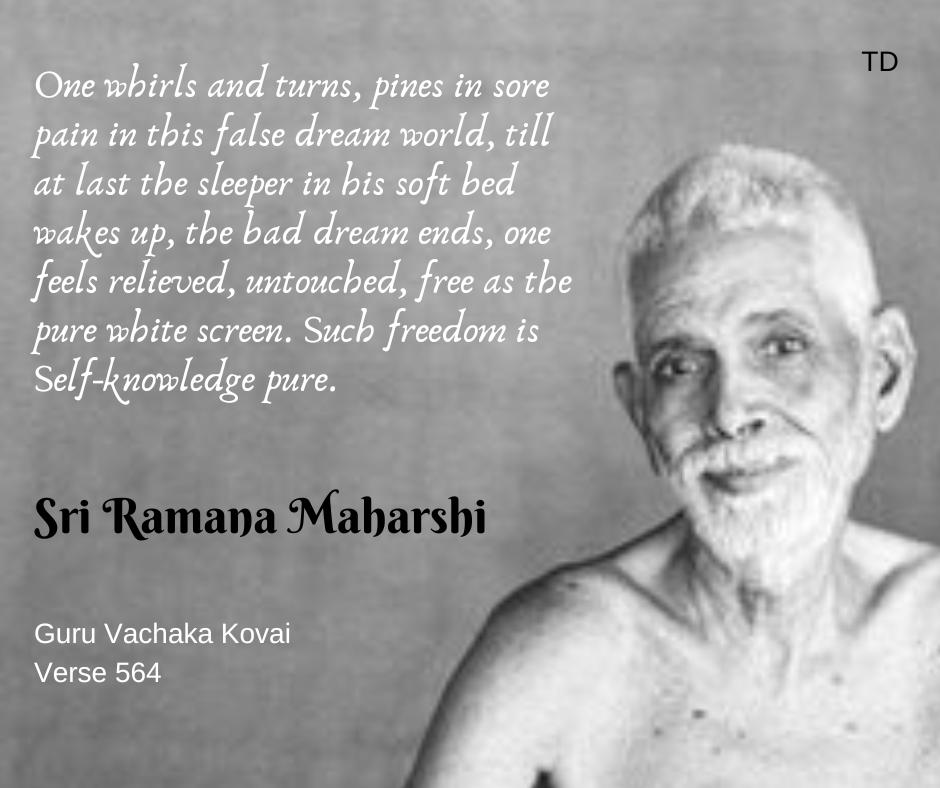
Sri Ramana Maharshi: Waking is long and a dream short; other than this there is no difference. Just as waking happenings seem real while awake, so do those in a dream while dreaming.
So, what now? Now we must put the teachings into practice to realise the truth of them:



 Tom Das