The following is an excerpt from the book Zen Mind, Beginner’s Mind by Shunryu Suzuki:
If you want to obtain perfect calmness in your zazen, you should not be bothered by the various images you find in your mind. Let them come, and let them go. Then they will be under control. But this policy is not so easy. It sounds easy, but it requires some special effort. How to make this kind of effort is the secret of practice.
Suppose you are sitting under some extraordinary circumstances. If you try to calm your mind you will be unable to sit, and if you try not to be disturbed, your effort will not be the right effort. The only effort that will help you is to count your breathing, or to concentrate on your inhaling and exhaling. We say concentration, but to concentrate your mind on something is not the true purpose of Zen. The true purpose is to see things as they are, to observe things as they are, and to let everything go as it goes. This is to put everything under control in its widest sense.
The true purpose is to see things as they are, to observe things as they are, and to let everything go as it goes.
Zen practice is to open up our small mind. So concentrating is just an aid to help you realise ‘big mind’, or the mind that is everything.
If you want to discover the true meaning of Zen in your everyday life, you have to understand the meaning of keeping your mind on your breathing and your body in the right posture in zazen.
You should follow the rules of practice and your study should become more subtle and careful. Only in this way can you experience the vital freedom of Zen.
Who is it that cares? What is it that cares? Why do you want it?
Notice that this very teaching is pointing out that the entity that wants these things is itself a fiction. It is the false ego that cares. And the false ego does not exist. (Note that I use the word ‘ego’ as a synonym for ‘the doer’)
What do you imagine Freedom/Enlightenment/Nirvana to be?
How do you imagine it will benefit you? Any benefit you imagine enlightenment will give you is only temporary at best. What comes can also go. Freedom means that you are free from the need for any improvements to what is.
Will enlightenment make you happy?
Happiness can come, and it will also eventually go. Happiness and all states of mind are necessarily transient. Enlightenment is already present, and is not dependent on happiness or on your state of mind. Enlightenment doesn’t need to be happy.
Maybe you think enlightenment will give you the unshakable knowledge that you are immortal?
The problem here is that all knowledge is uncertain and can be doubted. Yes, all knowledge. If you think that you are Pure Consciousness, if you think it’s all about no-mind or no-ego, if you think it’s all about Jesus or Krishna, all of these are within the field of knowledge.
You may have cleverly deduced and convinced yourself that you are immortal using some kind of conceptual construct loosely based on your experience, but the truth is that you don’t actually know.
So, what happens when you die?
How can you know what happens when you die? No matter how you justify it, no matter how many psychic intuitions or spiritual experiences you have, the truth is that you don’t know for sure what happens after death. This question may perhaps be answered by science in the future, but we are not there yet.
Think of a time when you were utterly convinced something was true, but now you look back and realise how wrong you were. Knowledge also comes and goes. Perspectives change as we grow and mature and experience different things.
Enlightenment is beyond knowledge. Enlightenment does not depend on knowledge or the mind. Unlike knowledge and states of mind, Enlightenment cannot be attained – it is already here.
OK, then what’s left?
If enlightenment is not about attaining a particular state of mind or gaining some kind of knowledge, then what’s left? What’s left is simply what’s happening. That’s all. Enlightenment/freedom/nirvana is not about attaining anything at all. All we ‘know’ is whatever is happening is whatever is happening. Or, to be more accurate, whatever we perceive (to be happening) is what we perceive.
Pointing out mistakes
We can go a little further too: we can also point out mistakes in our thinking. If we think Father Christmas is real, we can notice and point out there is no conclusive evidence to support that, despite appearances to the contrary (eg. presents appearing beneath the tree on Christmas Day). Any happiness or pleasure we derive from believing in Father Christmas is similarly based on our wrong notions/illusion.
Similarly, if someone takes themselves to be a doer, an entity that is free to choose and take credit and blame for its actions, then we can point out that there is no evidence to support this position, despite appearance to the contrary. All suffering that results from belief in doership is similarly based on illusion.
Be honest and humble
So, we can ‘know’ (ie. perceive) whatever’s happening right now, and we can know what we don’t know.
Basically, let’s be honest and humble and not pretend we know things that we don’t. Let’s not pretend we are this or that, let’s not strive towards spiritual ideals which are just mental projections – it’s all fear based, ego-based.
No need to strive
Instead of striving towards projected notions of Enlightenment, why not look at where we are. Why not stay with what is?
The movement away from what is is based on aversion and fear. Can you see that? This movement away is the fear. This movement away is the suffering. It is all based on the notion ‘I am the doer’ or ‘I am the ego’.
When we stop striving, we become available to see things as they are, we become free to understand. When we see there is no ego/doer, there is no striving/desire. Even if there is desire, there is no identification with it, so there is no suffering.
Natural relaxation, emotions and intelligence
When we see that there is nothing to attain, we naturally relax. It happens by itself. As we relax, positivity and well-being flow into our system. We are free to be ourselves, which means we are free to let whatever happens happen – we have no choice in this anyway as there is no doer!
Emotions come and go: they are free to be felt and experienced.
The body-mind starts to balance itself, regulate itself and develop its natural sensitivity and intelligence.
Insights and understanding pours through, illusion falls away as it is seen through. Love starts to blossom.
Or maybe it doesn’t. It’s for you to find out for yourself, in freedom, if what I am saying is true.
The ‘miracle’ of life
Relax, notice and discover.
What are we left with? Just what’s happening. So simple, and beyond words. Just life, living, simply, spontaneously. The fact that it or anything is here at all is the ‘miracle’.
Meditation is never the control of the body. There is no actual division between the organism and the mind. The brain, the nervous system and the thing we call the mind are one, indivisible. It is the natural act of meditation that brings about the harmonious movement of the whole. To divide the body from the mind and to control the body with intellectual decisions is to bring about contradiction, from which arise various forms of struggle, conflict and resistance.
Every decision to control only breeds resistance, even the determination to be aware. Meditation is the understanding of the division brought about by decision. Freedom is not the act of decision but the act of perception. The seeing is the doing. It is not a determination to see and then to act. After all, will is desire with all it’s contradictions. When one desire assumes authority over another, that desire becomes will. In this there is inevitable division. And meditation is the understanding of desire, not the overcoming of one desire by another. Desire is the movement of sensation, which becomes pleasure and fear. This is sustained by the constant dwelling of thought upon one or the other.
And meditation is the understanding of desire, not the overcoming of one desire by another.
Meditation really is a complete emptying of the mind. Then there is only functioning of the body; there is only the activity of the organism and nothing else; then thought functions without identification as the me and the non-me. Thought is mechanical, as is the organism.
Meditation really is a complete emptying of the mind. Then there is only functioning of the body
What creates conflict is thought identifying itself with one of its parts which becomes the me, the self and the various divisions in that self. There is no need for the self at any time. There is nothing but the body, and freedom of the mind can only happen when thought is not breeding the me.
What creates conflict is thought identifying itself with one of its parts which becomes the me…
There is no self to understand but only the thought which creates the self. When there is only the organism without the self , perception, both visual and non-visual can never be distorted. There is only seeing ‘what is’ and that very perception goes beyond what is. The emptying of the mind is not an activity of thought or an intellectual process. The continuous seeing of what is without any kind of distortion naturally empties the mind of all thought and yet that very mind can use thought when it is necessary. Thought is mechanical and meditation is not.
There is only seeing ‘what is’ and that very perception goes beyond what is.
Excerpt taken from J. Krishnamurti, ‘The Beginnings of Learning’
My awakening experience whilst reading Krishnamurti:
Since starting to hold regular non-duality and spirituality meetings in London, it has been truly wonderful to meet many of you in person and share this message with you. I’d like to take this opportunity to express my thanks and gratitude for your presence and support.
It’s also been fascinating for me to see how this simple yet dynamic teaching has the potential to alleviate suffering and liberate those who come in to contact with it, and often in a relatively short space of time.
I’ve also been amazed at how many people are thirsting for this message and are really serious about finding true answers, true resolution, not just on the level of concepts and mere explanations, but on a much deeper ‘experiential’ level.
However there are some people who find it difficult to attend the twice monthly meetings in person at the Druids Head, London, so I have now scheduled online meetings via Skype. These will be in addition to the regular meetings in person in Kingston, London. Details of how to join us can be found here or here. Dates of forthcoming meetings can be found here.
I hope this allows more people to be able to hear these wonderful teachings.
For further information on other ways you can meet with me click here.
So perhaps I will see you soon, in person or via Skype.
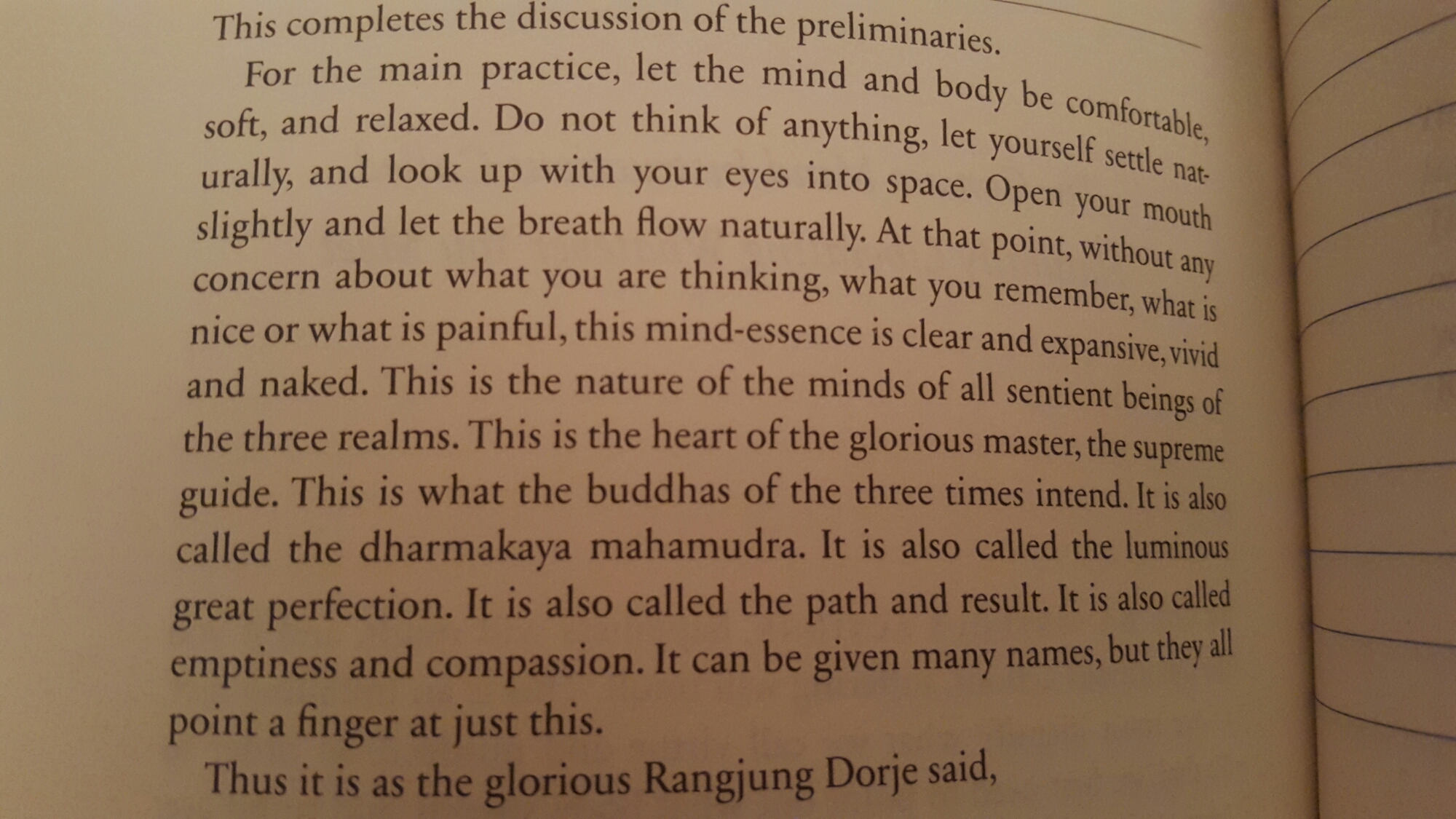
Above is an excerpt from a text called ‘The Concise Mind Instructions Called Naturally Liberating Whatever You Meet’ by Khenpo Gangshar, as found in the book Vivid Awareness by Khenchen Thrangu.
In this short text Khenpo Gangshar goes on to say:
Directly, whatever arises, do not change it – rest naturally. This fulfils the essence of all creation stages, completion stages, mantra recitations, and meditations.
This is the heart of the highest Tibetan Buddhist teachings: to rest naturally and be vividly aware. Just be. I would add that in this no sense of self is being created, and this is the practice. To simply be, and not to take yourself as being a ‘self’ or ‘doer’. To use a commonly used phrase in vedanta: do not take yourself to be ‘this or that’.
Khenpo Gangshar goes on to give advice on how to deal with difficulties along the way:
You must take sickness as the path, afflictions as the path, the bardo as the path, and delusion as the path. The heart of all these applications is to rest naturally in the essence.
This advice is very much in line with most of traditional Tibetan Buddhist teachings, but here it is stated in very concise form. When difficulties come along, just rest in your natural being. Don’t identify as being ‘this or that’, don’t start to create or believe in the concept of being a doer. This is the false concept that is rooted out and seen through in this practice.
When life throws us a challenge, don’t simply fall back into your old habits of self-identification. It is from this creation of an imaginary doer/self that all other afflictions and suffering follows. Instead, just rest, just be. Let your awareness shine, let it shine brightly. If the thought ‘I’ arises, let it, notice it, notice that it is empty and does not describe or pertain to any reality. There is no ‘I’, there is no self. Only the bright expanse of phenomena.
One final thought from me, a question: Does any of this have anything to do with Freedom? Does Freedom depend on any practice? Does Freedom depend on any of this?
The following are excepts I’ve compiled from the Zen Teaching of Bodhidharma (the founder of Zen Buddhism) as translated by Red Pine. What do you think?
————–
The way is basically perfect. It doesn’t require perfecting.
The way has no form or sound. It’s subtle and hard to perceive.
It’s like when you drink water: you know how hot or cold it is but you can’t tell others.
————–
The ultimate Truth is beyond words.
Doctrines are words. They are not the Way.
The Way is wordless.
————–
If you see your nature, you don’t need to read sutras or invoke Buddhas.
Erudition and Knowledge are not only useless but also cloud your awareness.
Doctrines are only for pointing to the mind. Once you see your mind, why pay attention to doctrines?
————–
People, though, are deluded. They’re unaware that their own mind is the Buddha. Otherwise they wouldn’t look for a Buddha outside the mind.
Buddhas don’t ferry Buddhas to the shore of liberation. If you use your mind to look for a Buddha, you won’t see the Buddha.
As long as you seek Buddhas outwards, you’ll never see that your own Heart is the Buddha.
————–
To find a Buddha, you have to see your nature. Whoever sees his nature is a Buddha.
————–
If you don’t see your nature and run outwards to seek for external objects, you’ll never find a buddha.
The truth is there’s nothing to find.
————–
If you attain anything at all, it’s conditional.
————–
Defilement and attachment, subject and object don’t exist.
————–
All phenomena are empty. They contain nothing worth desiring.
————–
A buddha is free of karma, free of cause and effect.
————–
To attain enlightenment you have to see your nature.
————–
It has never lived or died, appeared or disappeared, increased or decreased. It’s not pure or impure, good or evil, past or future. It’s not true or false. It’s not male or female. It doesn’t appear as a monk or a layman, an elder or a novice, a sage or a fool, a buddha or a mortal. It strives for no realisation and suffers no karma. It has no strength or form. It’s like space. You can’t possess it and you can’t lose it. Its movements can’t be blocked by mountains, rivers, or rock walls….No karma can restrain this real body. But this mind is subtle and hard to see. It’s not the same as the sensual mind.
————–
Everything that has a form is an illusion.
————–
Those who hold onto appearances are devils. They fall from the Path.
————–
All appearances are illusions.
————–
That which is free of all form is the Buddha.
————–
Wherever you find delight, you find bondage.
————–
I only talk about seeing your nature. I don’t talk about creating karma.
————–
The buddha is your real body, your original mind. This mind has no form or characteristics, no cause or effect, no tendons or bones.
————–
Detachment is enlightenment because it negates appearances.
————–
The appearance of appearance as no appearance can’t be seen visually, but can only be known by means of wisdom.
————–
All practices are impermanent.
————–
The sutras say, “Go beyond language. Go beyond thought.”
————–
Basically, seeing, hearing, and knowing are completely empty.
————–
Your anger, joy, or pain is like that of puppet.
————–
Trying to find a Buddha or enlightenment is like trying to grab space. Space has a name but no form.
It’s not something you can pick up or put down. And you certainly can’t grab it.
————–
Whoever realizes that the six senses aren’t real, that the five aggregates are fictions, that no such things can be located anywhere in the body, understands the language of buddhas.






 Tom Das