Tao Te Ching: Before you learnt to smile

mountain river

…Other people are joyous,
as though they were at a spring festival.
I alone am unconcerned and expressionless,
like an infant before it has learned to smile.

Other people have more than they need;
I alone seem to possess nothing.
I am lost and drift about with no place to go.
I am like a fool, my mind is in chaos.

Ordinary people are bright;
I alone am dark.
Ordinary people are clever;
I alone am dull.
Ordinary people seem discriminating;
I alone am muddled and confused.

I drift on the waves on the ocean,
blown at the mercy of the wind.
Other people have their goals,
I alone am dull and uncouth.

I am different from ordinary people.
I nurse from the Great Mother’s breasts.

Tao Te Ching, verse 20

Tom’s comments:

This is one of my favourite verses of this wonderful text. I remember when I first read it as a university student in the 90s, I was particularly struck by the phrase ‘like an infant before it has learned to smile’. We can be free of needing to be happy, to smile, to conform, and we can simply be true to ourselves.

This world can seem so confusing. It can feel like everyone else seems to know what they want and where they are going. Of course, it’s such an illusion! How can anyone know what this is all about? If you think you know, you have surely missed the mark!

The Sage sees through all illusions, she sees through the faux-intelligence, goals and make-believe of people around her. The Sage knows he is but Nature expressing herself: he is dependent on her, as a child is on his mother’s breast milk, and he is also Her.

He sees the inherent unfathomable mystery at the heart of life and lovingly pities those who think ‘they understand’.

Tao Te Ching: How ridiculous!

lotus leaf waterStop thinking, and end your problems.
What difference between yes and no?
What difference between success and failure?
Must you value what others value, avoid what others avoid?
How ridiculous!

Tao Te Ching, verse 20

Tom’s comments:

Free of thoughts, where are your problems?

We do not need to shun thought in its entirety, just not buy into the suffering it creates through comparison and moral judgement.

We can see through the values, ideals and standards that other people and society dictate to us. We can see through the received wisdom of the day.

We can let go and be real, discover who we truly are – we can discover what it is to be human for ourselves and not simply force ourselves to fit into an ideological mould, no matter how reasonable it sounds. We can be who we are.

And who are we? Are we separate from the world that gave birth to us? Are we separate from the environment that shaped and influences us? Are we wholly good or bad? 0r can good come from bad and vice versa? Can failure lead to success?

I put it to you: all things are interdependent, and no things exist by themselves.

Onwards, children of God, onwards! 🙂


Zen (Chan) master Yuanwu: No fixed teaching

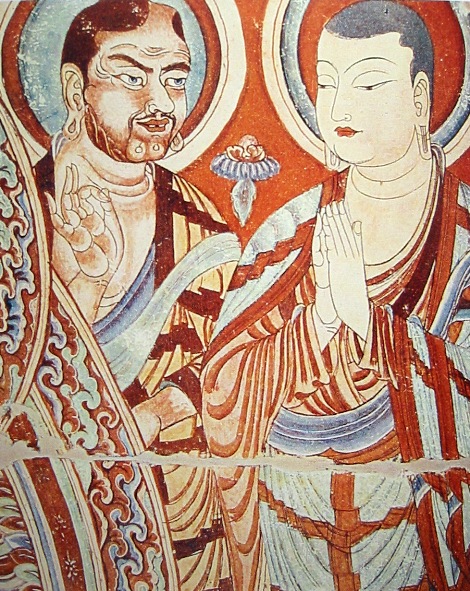
Central_Asian_Buddhist_Monks
A fresco from the Bezeklik Thousand Buddha Caves

All teachings are expedients

just for the purpose of breaking through obsessions, doubts,

intellectual interpretations & egocentric ideas

Yuanwu (1063-1135)

Tom’s comments:

If there was ever a dogma in Zen Buddhism* (and there is no dogma by the way) it is that there is no fixed Zen teaching. In Yuanwu’s letters, from which this quote was taken, Yuanwu gives us a no frills introduction and foray into the heart of Zen.

In this quote he gets straight to telling us how the Buddhist teachings work: the teachings are not necessarily  100% true in themselves, but are devices used to set us free. What is the correct teaching? It’s simply the teaching that works. This is what the word ‘expedient’ means: whatever works is the ‘correct teaching’.

And so we hear of zen teachings ranging from reading the scriptures to simply hearing the sound of a ringing bell; from seeing an object drop to the ground to the admittedly extreme physical blows that are often dished out (and received) by zen masters as a form of teaching – not a method I would advocate, I hasten to add.

So the teaching methods and expressions of truth may vary from person to person and from time and place, forged out of the cultures and characters of the moment. This is why the teaching reinvents itself from generation to generation, and varies from teacher to teacher, even when the core teaching and core ‘realisation’ is the same.

*Yuanwu was actually Chinese, so strictly speaking he is a Chan Master. When Chan Buddhism spread to Japan it became known as Zen, Zen simply being the Japanese word for Chan.

Shunryu Suzuki: How to achieve perfect calm

blue mountains.png

The following is an excerpt from the book Zen Mind, Beginner’s Mind by Shunryu Suzuki:

If you want to obtain perfect calmness in your zazen, you should not be bothered by the various images you find in your mind. Let them come, and let them go. Then they will be under control. But this policy is not so easy. It sounds easy, but it requires some special effort. How to make this kind of effort is the secret of practice.

Suppose you are sitting under some extraordinary circumstances. If you try to calm your mind you will be unable to sit, and if you try not to be disturbed, your effort will not be the right effort. The only effort that will help you is to count your breathing, or to concentrate on your inhaling and exhaling. We say concentration, but to concentrate your mind on something is not the true purpose of Zen. The true purpose is to see things as they are, to observe things as they are, and to let everything go as it goes. This is to put everything under control in its widest sense.

The true purpose is to see things as they are, to observe things as they are, and to let everything go as it goes.

Zen practice is to open up our small mind. So concentrating is just an aid to help you realise ‘big mind’, or the mind that is everything.

If you want to discover the true meaning of Zen in your everyday life, you have to understand the meaning of keeping your mind on your breathing and your body in the right posture in zazen.

You should follow the rules of practice and your study should become more subtle and careful. Only in this way can you experience the vital freedom of Zen.

Who cares about Freedom/Enlightenment/Nirvana?

flowers purple.jpg

Who cares about Freedom/Enlightenment/Nirvana?

Who is it that cares? What is it that cares? Why do you want it?

Notice that this very teaching is pointing out that the entity that wants these things is itself a fiction. It is the false ego that cares. And the false ego does not exist. (Note that I use the word ‘ego’ as a synonym for ‘the doer’)

What do you imagine Freedom/Enlightenment/Nirvana to be?

How do you imagine it will benefit you? Any benefit you imagine enlightenment will give you is only temporary at best. What comes can also go. Freedom means that you are free from the need for any improvements to what is.

Will enlightenment make you happy?

Happiness can come, and it will also eventually go. Happiness and all states of mind are necessarily transient. Enlightenment is already present, and is not dependent on happiness or on your state of mind. Enlightenment doesn’t need to be happy.

Maybe you think enlightenment will give you the unshakable knowledge that you are immortal?

The problem here is that all knowledge is uncertain and can be doubted. Yes, all knowledge. If you think that you are Pure Consciousness, if you think it’s all about no-mind or no-ego, if you think it’s all about Jesus or Krishna, all of these are within the field of knowledge.

You may have cleverly deduced and convinced yourself that you are immortal using some kind of conceptual construct loosely based on your experience, but the truth is that you don’t actually know.

So, what happens when you die?

How can you know what happens when you die? No matter how you justify it, no matter how many psychic intuitions or spiritual experiences you have, the truth is that you don’t know for sure what happens after death. This question may perhaps be answered by science in the future, but we are not there yet.

Think of a time when you were utterly convinced something was true, but now you look back and realise how wrong you were. Knowledge also comes and goes. Perspectives change as we grow and mature and experience different things.

Enlightenment is beyond knowledge. Enlightenment does not depend on knowledge or the mind. Unlike knowledge and states of mind, Enlightenment cannot be attained – it is already here.

OK, then what’s left?

If enlightenment is not about attaining a particular state of mind or gaining some kind of knowledge, then what’s left? What’s left is simply what’s happening. That’s all. Enlightenment/freedom/nirvana is not about attaining anything at all. All we ‘know’ is whatever is happening is whatever is happening. Or, to be more accurate, whatever we perceive (to be happening) is what we perceive.

Pointing out mistakes

We can go a little further too: we can also point out mistakes in our thinking. If we think Father Christmas is real, we can notice and point out there is no conclusive evidence to support that, despite appearances to the contrary (eg. presents appearing beneath the tree on Christmas Day). Any happiness or pleasure we derive from believing in Father Christmas is similarly based on our wrong notions/illusion.

Similarly, if someone takes themselves to be a doer, an entity that is free to choose and take credit and blame for its actions, then we can point out that there is no evidence to support this position, despite appearance to the contrary. All suffering that results from belief in doership is similarly based on illusion.

Be honest and humble

So, we can ‘know’ (ie. perceive) whatever’s happening right now, and we can know what we don’t know.

Basically, let’s be honest and humble and not pretend we know things that we don’t. Let’s not pretend we are this or that, let’s not strive towards spiritual ideals which are just mental projections  – it’s all fear based, ego-based.

No need to strive

Instead of striving towards projected notions of Enlightenment, why not look at where we are. Why not stay with what is?

The movement away from what is is based on aversion and fear. Can you see that? This movement away is the fear. This movement away is the suffering. It is all based on the notion ‘I am the doer’ or ‘I am the ego’.

When we stop striving, we become available to see things as they are, we become free to understand. When we see there is no ego/doer, there is no striving/desire. Even if there is desire, there is no identification with it, so there is no suffering.

Natural relaxation, emotions and intelligence

When we see that there is nothing to attain, we naturally relax. It happens by itself. As we relax, positivity and well-being flow into our system. We are free to be ourselves, which means we are free to let whatever happens happen – we have no choice in this anyway as there is no doer!

Emotions come and go: they are free to be felt and experienced.

The body-mind starts to balance itself, regulate itself and develop its natural sensitivity and intelligence.

Insights and understanding pours through, illusion falls away as it is seen through. Love starts to blossom.

Or maybe it doesn’t. It’s for you to find out for yourself, in freedom, if what I am saying is true.

The ‘miracle’ of life

Relax, notice and discover.

What are we left with? Just what’s happening. So simple, and beyond words. Just life, living, simply, spontaneously. The fact that it or anything is here at all is the ‘miracle’.

Love, happiness and non-duality

tulips red.jpg

When the ego is seen through, all there is is what is. This is actually love, this is the real love.

Q. What is the relationship between love and non-duality?

A. Non-duality, as you call it, when it is fully seen, has nothing to do with trying to become more loving. But when the intrinsic-Freedom-that-already-exists is recognised, there is a tendency to become more loving, more open. Not that that actually matters. Openness and love are just what tend to happen when the illusion of a separate doer-entity is seen to be illusory. They are side effects.

Q. If in seeing this Freedom one tends to become more loving, then why do you say non-duality has nothing to do with being more loving?

A. This is about what is true, not what you want to be true. You may want to be more loving, more ethical or more whatever, but so-called ‘non-duality’  is about seeing what already is, right now. It is the ego or person that wants to become more loving, more ethical, more radiant, more popular, and so on. So the desire to be more loving is actually a subtle form of ego. ‘Non-duality’, or whatever you want to call it, is not about a continuation of the ego, but seeing that this ego is a fiction, that the sense of doership is an imagined belief without any evidence to underpin it.

It is the ego or person that wants to become more loving, more ethical, more radiant, more popular, and so on.

Who cares about love? Who cares about being ethical? It’s the ego of course. The ego cares, the doer-entity cares and it is the ego that wants to improve itself and therefore perpetuate itself. Ask yourself, ‘what is this entity that cares about being loving, being ethical?’. If you really are interested and you look, then it can become obvious that there is no ego there, it was all just a belief all along, a false belief. The story of doership is false.

Then all there is is what’s happening. Nobody doing anything, just what’s happening. I call this Freedom, but it doesn’t really have a name. It is simply what’s happening. It is simply the way things actually are, not they way you want things to be based on your projection which is in turn based on beliefs and concepts. It is the simplicity of life stripped clean of false notions and narratives, in which false notions are seen through as they arise.

I call this Freedom, but it doesn’t really have a name. It is simply what’s happening.

In Freedom, you don’t care about love, or any other projected ideal. You don’t try to be more ethical. Maybe you are more loving, maybe you are not. That’s why this automatically tends towards love – because there is no motive, because the ego is not at play. It may go against intuition but love does not care about love. Love just is when things are seen for what they are. To put it more poetically, in seeing truth (of no-self), love is.

In seeing truth, love is

Q. What about happiness?

A. Again, who cares about happiness? It’s the ego! The ego cares, and the ego is a fiction. Relax your mind and look for the ego – where is it? It is just empty thoughts, there is no entity there! But you have to really want to know the truth to see this: by that I mean that you have to be willing to drop all your ideas and concepts about yourself and your life. Then you really have to actually look – at least most people do. Some people just see this spontaneously, but all you have to do is notice what is already true.

When this is seen, that there is no ‘self-entity’, the neurotic drive for happiness naturally dissipates, and then Joy naturally arises. Why? Because the (neurotic) drive for happiness is actually a form of suffering. When there is no concern for happiness, then Joy naturally tends to manifest. A feeling of wellbeing may not always be there, but who cares? That’s just the way things are. No feeling-state or mind-state is permanent. Everything changes. Nothing lasts forever. Who cares? That’s the freedom.

Investigate the present reality instead of chasing a future projection.

When you are trying to get somewhere, you are chasing a projected ideal, something conceptual, not something actual. Instead of chasing the conceptual, why not remain with the actual, with what is actually happening now? Investigate the present reality instead of chasing a future projection. When the ego is seen through, all there is is what is. This is actually love, this is the real love. The lack of a centre, the lack of a doer, that’s what love really is. It’s not an emotion at all. It’s not necessarily even feeling loving, although that may happen when it’s appropriate.

When the ego is seen through, all there is is what is. This is actually love, this is the real love.

Without the ego at play, all there is is natural functioning. Emotions then act accordingly when they are required. It’s not healthy to be happy all the time, nor is it likely to be physiologically possible. Our varied  emotions, fears and mental states are there to guide us as we navigate the world.

So, when the ego is seen through, this is what we could call love, although love is just a label for this as it actually is. This ‘love’ is not what most people mean by ‘love’. It is not an emotion, it includes everything that is happening, and it is not dependent on what is happening. It is un-conditional you could say. It is always here because it is none other that what is here. It is universal motion seeing through illusion. It is what is recognising what actually is.

Still just me

sun-19814_1920.jpg

I remember:

My life being lit up,
Without the sun shining any brighter.

Things appeared clearer,
But the same spectacles perched on my nose.

My body became just a wisp,
But I weighed the same.

Wholeness was there,
But I was still just me.