Sadhanai Saram (the essence of spiritual practice): Devotion and Self-Enquiry | Ramana Maharshi | Advaita Vedanta | PDF download

The following are the first 21 verses from Sadhanai Saram (The Essence of Spiritual Practice) by Sri Sadhu Om. This text contains very beautiful and deep teachings for those who are genuinely seeking liberation. We find this text not only summarises the teachings of Bhagavan Sri Ramana as well as Advaita Vedanta teachings, but goes into them in tremendous depth with a clarity that is often not found elsewhere.

These initial verses presented below beautifully display both devotion to Bhagavan and the path of Self-Enquiry.

You can download the full text of Sadhanai Saram here as a PDF file

I have created an additional List of Contents for Sadhanai Saram which you can download here

Invocation

  1. O Sri Ramana, bestow Your Grace upon me so that I may in experience flawlessly attain the unequalled and unsurpassed essence of the practice (sadhana) of Self-knowledge, the excellent path “Who am I?” which you have discovered to be the central and foremost among all the various paths.
  2. O Sri Ramana, the Heart, who through Your Grace protects me at every moment by guiding me along the correct path, rise from within and teach me the true import of Your divine and unequalled teachings so that I may know them in their undefiled pristine purity.

The Greatness of This Birth

  1. Among countless births, one like this birth of ours is very rare to achieve. Ah! When Lord Ramana has assumed a sacred body on earth, we have attained the blessed boon of becoming slave to His Holy Feet.
  2. However many crores of births they may take, it is indeed very difficult for anyone to have the opportunity of gaining such a great benefit as that which is gained in this birth of ours, in which we have come to the Feet of Bhagavan Ramana, who is a rare treasure for the world. So great is the benefit of this birth.

The Wealth of Sri Ramana

  1. The wealth of the almighty Sri Ramana’s enlightenment (Jnana) is a treasure that is ever available to be plundered by all people who want it; and, however much it is plundered, it will never decrease even in the least. However, only good people who are true devotees know how to plunder it; and though other people who are too immature go near that treasure, they cannot see anything there.

The Grace of Sri Ramana

  1. Sri Ramana, the Bestower of Grace, will never give the least dissatisfaction to those who weepingly pray to Him, “Make me Your possession.” I know that our Lord uses countless inexpressible tricks in order to protect and save those who have become His slaves.
  2. What our Lord uses to save us are tricks of Grace. Even by the skill of our intellects, it is impossible for us to know all those tricks. If He wishes, even an ocean will enter and disappear into a mustard seed. Therefore, as soon as the glance of Sri Ramana’s Grace falls upon us, the Supreme Reality will be revealed.
  3. Since He is not bound by time or even by the limitation of place, He will not wait for some suitable time or suitable place to bestow His Grace upon His devotees. He has far greater compassion than even a compassionate mother, who has no plan that she will give her baby milk to drink only when it cries (and hence, even without our crying for it, He will bestow His Grace upon us of His own accord).
  4. O Bhagavan, innumerable are the wrongs (the mistakes and misfortunes) from which I, this poor creature, have escaped by Your Grace unknown to myself. You know all of them, but I do not know anything except enjoying the bliss of being saved by Your Grace.
  5. O Sri Ramana, those who have taken refuge at Your Feet are protected perfectly not only on one or two occasions but on more than a crore of occasions. From many incidents that happen in their life, this is a truth that is clearly known to the hearts of Your devotees.
  6. The state of abiding in the Heart as the Heart as it is (that is, as the adjunctless and thoughtfree existence-consciousness “I am”) is the ineffable and most excellent state. He, who nurtures the fruit of such Self-abidance by sowing the seed of clarity of mind and by watering it with divine Grace, is only our Self-realized or Celestial Preceptor (Sadgurudeva), Sri Ramana.
  7. We and all our possessions, beginning with the body, are in truth only the possessions of Sri Ramana. When the responsibility of saving us and protecting our possessions is borne by Him alone, why should we worry about anything in our life on this earth thinking it to be either pleasure or pain? Where is any such thing as wrong, evil, harm or suffering now?

All That He Does is Happiness for Me

  1. The almighty Sri Ramana, who exists within the heart of everyone, who unfailingly helps me at all times, and who cannot be banished from my mind even for a moment, has brought me close to Him only to take me as His slave. Therefore, whatever He now does with me is only happiness for me; how can anything that He does hereafter appear to me as something undesirable or painful?

Leave it to Him

  1. He knows the best of all,
    Leave it to Him, be calm;
    Believe Him most of all,
    Then rests the mental storm.

Explanatory paraphrase: Our Sadguru (Selfrealized Guru, or guide) Sri Ramana, alone knows what is best for us. Therefore, entrusting all our burdens and cares to Him, we should always remain peaceful and calm. If we believe Him more than we believe anyone or anything else, knowing that He alone is the Supreme all-knowing, all-powerful and all-loving reality, then, at that very moment, we will attain that perfect pace in which the raging storm of thoughts will have come to an end, forever.

Grace Alone is of Prime Importance

  1. The ego is only a trivial entity; besides, it is unreal (asat) and powerless (asakta). It is a mere adjunct which rises and subsides. Therefore, what foolishness it is to think, “The spiritual practice (sadhana) done by the strength of this ego will by itself bestow the goal of life; the supreme power of divine Grace is not of any consequence (and is not necessary in order for one to attain the goal)”!

Note: Not believing Grace, but thinking one’s own individual effort alone to be of very great consequence, is mere foolishness.

  1. Is not the unreal help which one unreal man renders to another unreal man, experienced by everyone in this world as real? Therefore, O Sadguru, the embodiment of Grace, the sole reality, is it impossible for You to save me by dispelling the unreal ego? What doubt or wonder is there in Your being able to help me thus?

Note: A man or jiva is merely an unreal appearance, and hence whatever help he may seem to render to another man is also unreal. But when such unreal help rendered by an unreal man is experienced by everyone as real, why should we doubt the ability of the Sadguru, who alone is truly real, to render us the real help of destroying the unreal ego? Such help from the Sadguru will certainly be experienced by us as more real than the help that we feel is rendered to us by others.

  1. Unless our Lord, Sri Ramana, who is the form of God, Himself bestows His divine Grace, who can by his own effort attain that heroic state of firmly abiding as Self, having clearly known one consciousness other than the body to be the real “I”?

What is Worthy to be Desired?

  1. The great wealth that exists in enlightened sages (Jnanis) is only the subtle secret of how to be still, abiding in perfect peace as the mere thoughtfree existence-consciousness “I am.” Therefore, how wretched it will be if one greedily desires to attain from them mere worldly pleasures, such as gold, wealth or fame, which will only make one suffer in delusion.

Sense-Pleasures are Worthless

  1. Instead of eating the fruit that is in your hand, why do you desire to eat the unreal fruit which is seen in a mirror and which is merely a reflection of the fruit in your hand? Is the reflected fruit an object which can be eaten and give real enjoyment? Similarly, instead of drowning deep within the heart by keenly attending to Self and thereby enjoying the bliss of Self which is ever shining there, why do you desire to enjoy the pleasures experienced through the five senses of this perishable body, which are merely an unreal reflection of the true happiness within you?

Endeavor and Result

  1. For those who seek (and make effort to attain) Self, not only Self but also all other benefits will automatically be attained in full. But if one desires and makes effort to attain worldly objects (either through worldly endeavors or through spiritual practices), know that they will be attained only partially and to the extent of one’s endeavor, and that Self will not be attained at all.

The Goal

  1. If we deeply ponder over the natural yearning of all living beings to remove their miseries (through some means or other), it will be decidedly known that the sole aim for which the whole world is striving is only to remain always in perfectly imperishable bliss.
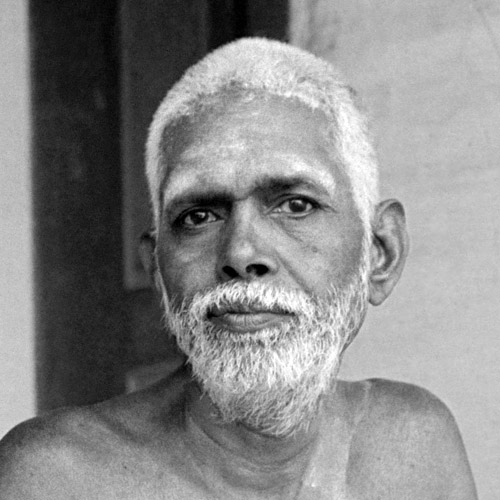
Ramana Maharshi: True Wisdom

ramana-maharshi.asr_12.crop

The following are sayings of Sri Ramana Maharshi, taken from the text Guru Vachaka Kovai which is widely accepted as the most precise, systematic and authoritative exposition of Sri Ramana Maharshi’s teachings:

Download Guru Vachaka Kovai as a PDF file here

536.
O worldly folk who long for and run after
An endless series of unenduring things
’Tis wisdom true to seek and know
That one thing, on knowing which
All other things will cease to be.

537.
For those who see with insight keen
The subtle Truth, what is there to gain
From knowledge of gross material things?
What the imperishable inner sense
Perceives surpasses far the sight
Seen by the corporeal eye.

538.
Knowing aright the nature of the Self
And abandoning the non-self as void,
Unreal, is wisdom true.
All other knowledge is ignorance,
And not wisdom.

Q. WHAT IS THE BEST & MOST DIRECT PATH?

WHAT IS THE BEST & MOST DIRECT PATH?

When we find a way/teacher/path/’non-path’/’no-path’ that is right for us, it is natural to want to share that with others…but what is right for us is not necessarily right for others…ultimately we each find our own unique way…

Let us remain humble, acknowledge what works for us but not assume we know what is best for someone else or what will work for someone else…

By listening to others we allow them to teach us too, we allow the Divine to teach us through everyday interactions…

We learn from others, we allow others to become our teacher…

For everything and all are expressions of the Divine…

Each and everyone we meet is our True Guru…

All is Guru!

This is my experience at least


What do you think?

🙏

Q. Can you briefly define Jnana Yoga vs Bhakti Yoga and how they relate to Advaita and Vedanta?

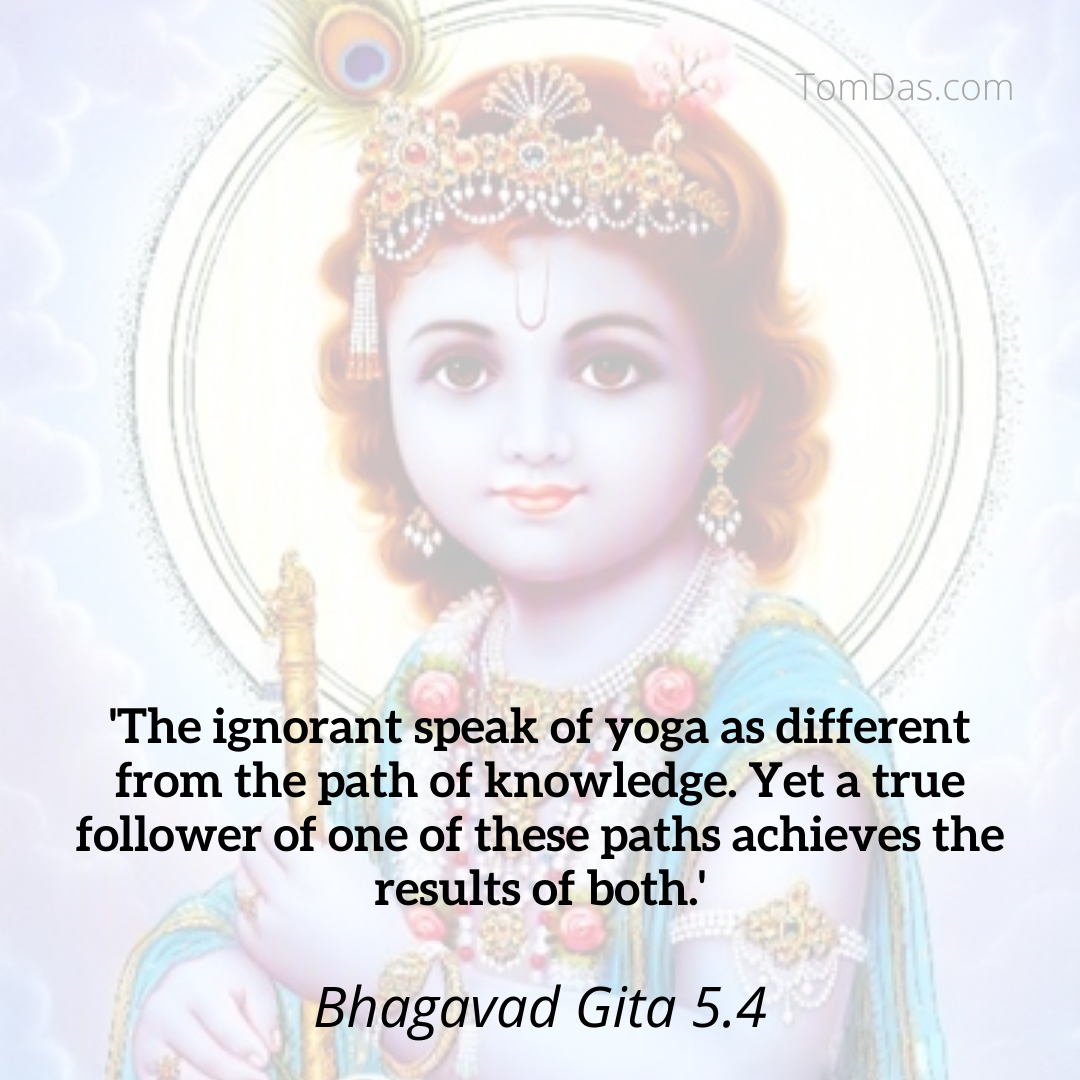
Krishna The ignorant speak of yoga as different from the path of knowledge

Q. Can you briefly define Jnana Yoga vs Bhakti Yoga and how they relate to Advaita and Vedanta?

Tom: Jnana yoga usually refers to the use of (intellectual) knowledge in the mind used to remove ignorance, a thorn to remove a thorn, and then the thorn of ‘knowledge’ is itself allowed to fall away; Bhakti yoga is faith, love and devotion from the heart to Self/Guru/God. These 2 yogas seem different at first, but then they quickly merge together to remove ignorance and end suffering, which is what the word ‘yoga’ means of course. Both of the above are part and parcel of Advaita Vedanta as per the Upanishads, Gita, etc.

Q. What about Advaita vs. Jnana?

Tom: Advaita Vedanta, as a traditional teaching is the general term used to refer to the teachings of the Upanishads, Bhagavad Gita, Brahma Sutras and a few other traditional texts. Jnana yoga refers to one part of the teachings of Advaita Vedanta. Other aspects of Advaita Vedanta include Bhakti Yoga, Raja Yoga and several other teachings found in the above aforementioned texts.

Advaita, literally means not-two. Jnana means knowledge. Jnana can either mean relative knowledge in the mind, which is the means of jnana yoga, or it can refer to the Absolute, which is not really knowledge per se as it is beyond ideas/conceptualisation, but the word Jnana is sometimes used nonetheless. This ‘absolute Jnana’ is synonymous with Advaita and points to that which is beyond both Advaita and Jnana, ie. God or True Self! It is also known as Parabhakti (divine love), Aparokshanubhuti (direct experience), Moksha (freedom) and various other terms, none of which fully capture what is spoken of!

Sri Ramana Gita PDF Download | Ramana Maharshi: Bhakti Yoga as a complete path to Final Liberation

This is one of a series of introductory articles – please see the homepage of tomdas.com for more introductory articles. Also see: Recommended Reading: Books for Enlightenment, Liberation and Self-Realisation

Here, in the Sri Ramana Gita, Bhagavan Sri Ramana Maharshi speaks of Bhakti (devotion towards God or Guru or Self) as a complete path to the Divine and a complete path to Spiritual Liberation.

May we praise Sri Ramana for his words!

May we have gratitude to Sri Ramana for his teachings!

May we love Sri Ramana for His Presence in Our Hearts!

All praise to Ramana!

All praise to Him who is God!

All praise to Him in our Hearts!

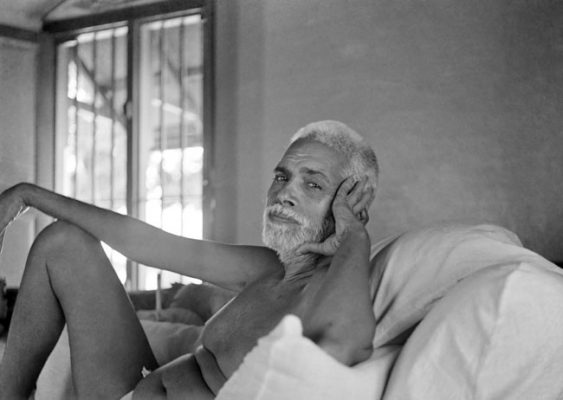
42-reclining-on-the-sofa-h-563x400

SRI RAMANA GITA

CHAPTER 16: ON BHAKTI

1. Then, questioned regarding Bhakti, the best of men, the highly auspicious Bhagavan Ramana Maharshi, spoke thus:

2. The Self is dear to all. Nothing else is as dear. Love, unbroken like a stream of oil, is termed Bhakti.

3. Through Love the Sage knows that God is none other than his own Self. Though the devotee, on the other hand, regards Him as different from himself, yet he too merges and abides in the Self alone.

4. The Love which flows (unbroken) like a stream of oil, towards the Supreme Lord, leads the mind infallibly into pure Being, even without one’s desiring it.

5 & 6. When the devotee, regarding himself as a separate, limited individual of poor understanding, and desirous of deliverance from suffering, takes the omnipresent Supreme Reality to be some deity and worships it, even then he attains in the end That (alone).

7. Oh best of men, one who attributes names and forms to the deity, through those very names and forms, transcends all name and form.

8. When Bhakti has grown perfect, then hearing once (about Reality) is enough, for it confers perfect Knowledge.

9. Bhakti not continuous like a stream is called intermittent Bhakti. Even this is bound to result in supreme Bhakti.

10. One who practises Bhakti for a desired end finds no fulfillment on attaining it and then again worships God for the sake of eternal happiness.

11. Bhakti, even when accompanied by desire, does not cease with the achievement of the desire. Faith in the Supreme Person develops and goes on increasing.

12. Growing thus, Bhakti in course of time becomes perfect.

By means of this perfect and supreme Bhakti, even as by jnana, one crosses (the ocean of) Becoming.

This is the sixteenth chapter entitled ‘ON BHAKTI’ in Sri Ramana Gita, the Science of Brahman, and the Scripture of Yoga composed by Ramana’s disciple Vasishta Ganapati.


Tom:

May we praise Sri Ramana for his words!

May we have gratitude to Sri Ramana for his teachings!

May we love Sri Ramana for His Presence in Our Hearts!

All praise to Ramana!

All praise to Him who is God!

All praise to Him in our Hearts!

What is True Self-Knowledge (Atma-Jnana)? Yoga Vasistha and the source of the River Ganges

The true meaning of Jnana (Self-Knowledge) is revealed by Sage Vasistha, taken from the wonderful and highly authoritative traditional Advaita text, the Yoga Vasistha.


At Rama’s request, VASISTHA narrated the following story:

Once upon a time there was a king named Bhagiratha who was devoted to dharma. He gave liberal gifts to the pious and holy ones and he was terror to the evildoers. He worked tirelessly to eradicate the very causes of poverty. When he was in the company of the holy ones his heart melted in devotion.

Bhagiratha brought the holy river Ganga from the heavens down to the earth. In this he had to encounter great difficulties and propitiate the gods Brahma and Siva and also the sage Jahnu. In all this he suffered frequent frustrations and disappointments.

He, too, was endowed with discrimination and dispassion even at an early age, O Rama. One day while remaining alone he reflected thus: “This worldly life is really essenceless and stupid. Day and night chase each other. People repeat the same meaningless actions again and again. I regard only that as proper action which leads to the attainment beyond which there is nothing to be gained; the rest is repeated foul excretion (as in cholera).” He approached his guru Tritala and prayed, “Lord, how can one put an end to this sorrow and to old age, death and delusion which contribute to repeated birth here?”

Tom – here below the first teaching will be dispensed. The teaching says that suffering will end when the self is known. How to know the self? One has to abide as the Self for a long time:

TRITALA said: Sorrow ceases, all the bondages are rent asunder and doubts are dispelled when one is fully established in the equanimity of the self for a long time, when the perception of division has ceased and when there is the experience of fullness through the knowledge of that which is to be known. What is to be known? It is the self which is pure and which is of the nature of pure consciousness which is omnipresent and eternal.

BHAGIRATHA asked: I know that the self alone is real and the body, etc., are not real. But how is it that it is not perfectly clear to me?

Tom – how often we have heard the teaching, we have heard the words, we may know the theory, but still we do not know! Let us listen to Tritala’s response, in which he will tell us the true nature of Knolwedge and the means to it:

TRITALA said: Such intellectual knowledge is not knowledge! Unattachment to wife, son and house, equanimity in pleasure and pain, love of solitude, being firmly established in self-knowledge—this is knowledge, all else is ignorance! Only when the ego-sense is thinned out does this self­-knowledge arise.

BHAGIRATHA asked: Since this ego-sense is firmly established in this body, how can it be uprooted?

TRITALA replied: By self­-effort and by resolutely turning away from the pursuit of pleasure. And by the resolute breaking down of the prison-­house of shame (false dignity), etc. If you abandon all this and remain firm, the ego-sense will vanish and you will realise that you are the supreme being!

VASISTHA continued: Having heard the teachings of his teacher, Bhagiratha decided to perform a religious rite as a prelude to total renunciation of the world. In three days he had given away everything to the priests and to his own relatives, whether they were endowed with good nature or not. His own kingdom he handed over to his enemies living across the borders. Clad in a small piece of loin-­cloth, he left the kingdom and roamed in countries and forests where he was totally unknown.

Very soon, he had attained the state of supreme peace within himself. Accidentally and unknowingly Bhagiratha entered his own previous kingdom and solicited alms from the citizens there. They recognised him, worshipped him and prayed that he should be their king. But he accepted from them nothing but food. They bewailed, “This is king Bhagiratha, what a sad plight, what an unfortunate turn of events!” After a few days he left the kingdom again.

Tom – in the following paragraphs we will see some hints, in bold type, as to how life is for the apparently self-realised sage:

Bhagiratha once again met his teacher and the two of them roamed the country all the time engaged in spiritual dialogue: “Why do we still carry the burden of this physical body? On the other hand, why should it be discarded? Let it be as long as it will be!” They were devoid of sorrow and of rejoicing, nor could they be said to adhere to the middle path. Even if the gods and sages offered them wealth and psychic powers, they spurned them as blades of dry grass.

In a certain kingdom the king had died without an heir and the ministers were in search of a suitable ruler. Bhagiratha, clad in a loincloth, happened to be in that kingdom. The ministers decided that he was the person fit to ascend the throne, and surrounded him. Bhagiratha mounted the royal elephant. Soon he was crowned king.

While he was ruling that kingdom, the people of his previous kingdom approached him once again and prayed that he should rule that kingdom also. Bhagiratha accepted. Thus he became the emperor of the whole world. Remaining at peace within himself, with his mind silenced, free from desires and jealousy, he engaged himself in doing appropriate action in circumstances as they arose.

Once he heard that the only way to please the souls of his departed ancestors was to offer libation with the waters of the Ganga. In order to bring the heavenly Ganga down to earth, he repaired to the forest to perform austerities, having entrusted the empire to his ministers. There he propitiated the gods and the sages and achieved the most difficult task of bringing the Ganga down to earth so that all the people for all time to come might offer libations to their ancestors with the waters of the holy Ganga. It is only from that time that this sacred Ganga which adorned the crown of lord Siva’s head began to flow on the earth.

Tom – traditionally the river Ganges, here called the Ganga, its Sanskrit name, springs from the head of Lord Shiva. In the picture below we can see the out-shoot of water from the crown of his head which is the source of the Ganga:

Lord Shiva Ganges Ganga Om

VASISTHA continued: Even so, Rama, remain in a state of equanimity like king Bhagiratha. And, like Sikhidhvaja, having renounced everything, remain unmoved. I shall narrate to you the story of Sikhidhvaja. Pray, listen. Once there were two lovers who were re­born in a later age on account of their divine love for each other…[and so the wonderful Yoga Vasistha continues with its interweaving stories all explaining in different ways to paths to Realisation…]

My Love. Faith & Jnana.

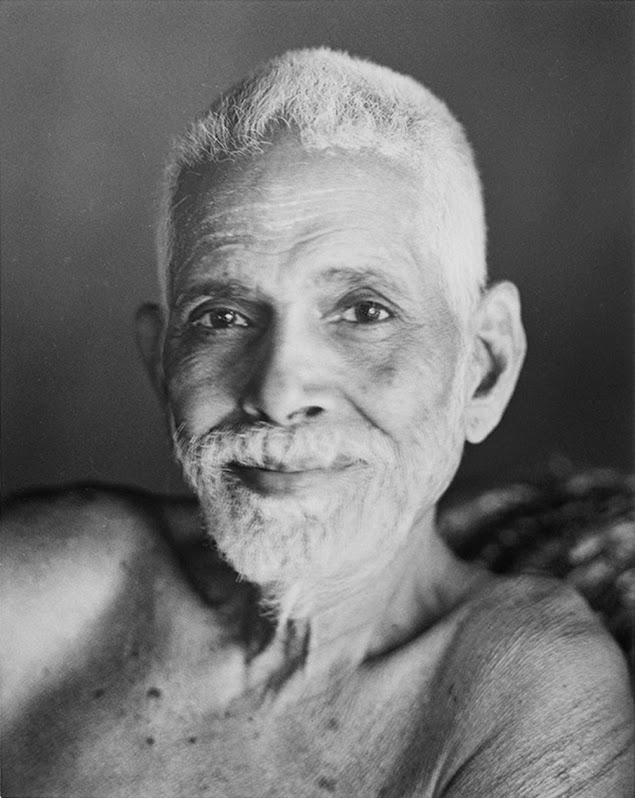
ramana-maharshi face
Sri Ramana Maharshi

Perfection of Faith in God/Guru/Self is the same as Jnana (spiritual ‘knowledge’ or ‘enlightenment’).

You could say that one leads to another – faith and surrender leads to knowledge, or knowledge leads to surrender and faith – and these are both true on one level, but ultimately they are one and the same – where is the difference apart from on the conceptual level?

For me Faith in the Guru, my Beloved, Bhagavan Sri Ramana Maharshi, overcame me quite spontaneously, without my asking, and clinging to Him and Faith in his Word and dwelling in His Presence became the Way and the Law and my Self.

For me, whilst I like to learn a bit about Ramana’s life and I enjoy reading his teachings, gazing at His Image and feeling His Presence has often been more powerful than all the written teachings and all my efforts put together.

Someone recently approached me at the end of one of my Satsangs/meetings and asked me which book would I recommend as being the best one to understand Ramana’s teachings. I told him that Talks with Sri Ramana Maharshi and Be As You Are are two wonderful books, but when you open the book, the most important page is the one which has a photograph of Ramana on it (most of Ramana’s books contain a photograph of him in the first few pages).

Instead of reading all the teachings and trying to figure it all out, just look at His Image, feel His Presence!

We can read and listen to the teachings as much as we like, but I have found there is power in something else, something intangible – the Guru’s grace, the eyes of the Guru, His Divine Grace…

So, cling to the Guru, cling to His Teachings. For me, that means Sri Ramana Maharshi. If it suits you, if you are drawn to Him, Ramana, take Him up as your Guru. Look at His Image, give yourself to Him, if it feels right for you. Of if you have another Guru/God you are drawn to, do the same with him/her. Or if you cannot relate to a Guru or God, try relating to Life or the Universe or Universal Energy or something similar. See what happens and feel free to let me know too!

Ramana said that life often brings us to have faith in God, then God brings us a Guru, and the Guru then directs us back to our Self and we realise all is One. Of course, we do not really realise, rather the ‘we’ or the ‘me’ that is seeking Union disappears or ‘merges into Him’. There was only ever Him/Self/Guru/God/Oneness…use any word that suits you.

Ramana also said that if we are lucky enough to be blessed with faith in something, that is a blessing to us and we should seize that faith and lean on it with loving devotion, and not to allow it to wither away.

So I encourage you to look at His Image, surrender to Him, and let me know how it goes!

‘Perfection of Faith in God/Guru/Self is the same as Jnana’

With love and best wishes

Tom

🙏🙏🙏

FALSE VEDANTA – a warning from Shankara (Vivekachudamani)

5bcbc2e6adc6ac9dfb690a3edcb64ab2_l
Sri Shankara

Perhaps the most important single text that traditionally outlines the Jnana Marga (Path of Knowledge) is Shankara’s Vivekachudamani.  This text has been used for centuries as a step by step manual to take one from (apparent) ignorance to Moksha (liberation) in which there is no suffering and it has been recommended by all the great Advaita sages including Sri Ramana Maharshi.

There are many gems littered throughout the text, and here is one of them which you may have missed:

160. The stupid man thinks he is the body, the book-learned man identifies himself with the mixture of body and soul, while the sage possessed of realisation due to discrimination looks upon the eternal Atman as his Self, and thinks, “I am Brahman”.

In verse 160 Shankara tells us that the one who is book-learned in Vedanta considers himself to be a mix of ‘body and soul’. In doing so, the one with mere book-learning still retains identification with the body, and so remains in ignorance and continues to suffer. In verse 162 Shankara, as is characteristic of the writing in Vivekachudamani, repeats his point and elaborates on it to make the meaning clear and beyond doubt:

162. As long as the book-learned man does not give up his mistaken identification with the body, organs, etc., which are unreal, there is no talk of emancipation for him, even if he be ever so erudite in the Vedanta philosophy.

There are many who know the scriptures, know the teachings, but still identify with the body in some way. These verses are a warning against this view. Shankara concludes this small section as follows, dispensing his sagely advice:

163. Just as thou dost not identify thyself with the shadow-body, the image-body, the dream-body, or the body thou hast in the imaginations of thy heart, cease thou to do likewise with the living body also.
164. Identifications with the body alone is the root that produces the misery of birth etc, of people who are attached to the unreal; therefore destroy thou this with the utmost care. When this identification caused by the mind is given up, there is no more chance for rebirth [ie. liberation is attained].

So don’t take yourself to be the body, just as you do not take your shadow to be yourself, do not take your body to be your-Self. Also, do not take yourself to be both the body and something else and in doing so retain a sense of limitation. You are That alone, you are the Self.

You are That alone,

You are the Self.