maya
What is the nature of Maya? | Sri Ramana Maharshi | Upadesa Manjari (Spiritual Instruction)
Question 5. What is the nature of maya?
Sri Ramana Maharshi: Maya is that which makes us regard as nonexistent the Self, the Reality, which is always and everywhere present, all-pervasive and Self-luminous, and as existent the individual soul (jiva), the world (jagat), and God (para) which have beenconclusively proved to be nonexistent at all times and places.
~Sri Ramana Maharishi, Upadesa Manjari (Spiritual Instruction)
Tom’s comments:
ie. Maya is that which makes you think there is no Self or Ultimate Reality, but makes you think there are individual persons (jivas), there is a world (jagat), and there is a force that governs these…When in fact the opposite is true.
What happens to the mind whilst realising the Self? | Clarity of mind during realisation | Maya
Is the Self a witness? Or is it everything? Or both? How to realise the Self? Advaita Vedanta | Atman | Self-Realisation

This is one of a series of introductory articles – please see the homepage of tomdas.com for more introductory articles. Also see:
Recommended Reading: Books for Enlightenment, Liberation and Self-Realisation
Question: Hi Tom, it is often said that the Self is the Witness, meaning that which sees or perceives all objects. In other places it is said the Self is everything. I’m not sure what to make of this. Can you give me some clarity please?
Tom: Hi, yes, this can cause lots of confusion for many. Even many Vedanta teachers do not really understand this point. As ever, Bhagavan Sri Ramana Maharshi points us to the true vedanta, the truly liberating way, in his teachings.
In truth the Self is not a witness (Sanskrit: sakshi) at all, but as long as we think we are a body-mind entity, and as long as we see a world outside of or apart from our self, the Self is indicated or pointed out as being the Subject or the Witness.
When in Self-Enquiry (the path of Knowledge) we turn our attention away from the objects, which means the various gross and suble phenomena that are perceived, and towards the Subject or Self (‘Witness’), eventually the ego-mind which takes itself to be a body-mind entity dissolves or dies and all that is left is the Subject-Witness-Self. This Self can no longer truly be said to be either a Subject (for there are no objects present), nor can it be said to be a Witness, as there is nothing to witness. It is All, it is the Sole Reality, ‘One without a second’, as it is often described as being in the Upanishads.
Sri Ramana Maharshi has taught us in Guru Vachaka Kovai verse 98 (Guru Vachaka Kovai is the most authoritative record of Sri Ramana Maharshi’s verbal teachings according to Sri Ramana Ashram):
98. Unless the body is taken to be ‘I’, otherness – the world of moving and unmoving objects – cannot be seen. Hence, because otherness – the creatures and their Creator – does not exist, it is wrong to call Self the Witness.
Sri Sadhu Om, a direct devotee of Sri Ramana Maharshi, writes in his commentary on this verse:
Descriptions of self as the ‘witness of the individual soul’ (jiva sakshi) or the ‘witness of everything’ (sarva sakshi), which can be found in some sacred texts, are not true but are only figurative (upacara), because only when other things are known would the one who knows them be a ‘witness’ of them. Since self does not know anything in the state of absolute oneness, which is devoid of any other thing, to what can it be a witness? Therefore describing self as a ‘witness’ is incorrect.
What both Sri Ramana Maharshi and Sri Sadhu Om are saying is that objects only appear when the ego/ignorance is present. In Self-realisation, there are no objects, only the Self, so in truth the Self cannot be said to be a witness.
In verse 869 of Guru Vachaka Kovai Sri Ramana teaches us:
869. ’Tis a foolish fancy to ascribe the role of ‘witness’ to the Self, the luminous Sun, the mighty sky of Pure Awareness. In the Self Immutable there is no room for maya’s darkness void. The Self is one sole whole without a second.
Here is an alternative translation of the same verse, with Sri Sadhu Om’s commentary, which essentially states in truth, ie. in realisation, there is no Maya in the Self. It is only for ajnani’s, ie. the ignorant, that consider the Self to be a witness of phenomena/maya:
869. The role [dharma] of seeing is ascribed to Self – the space of consciousness, the sun – only in the imagination of ajnanis, [because] maya, the empty ignorance [of seeing otherness], never exists in Self, the support [sthanu], [and also because] Self is without a second.
Sri Sadhu Om’s comments: Since Self is in truth that which transcends all roles and all qualities, and since It exists as one without a second, to glorify It as the ‘witness of all’ [sarva-sakshi] or as the ‘knower of all’ [sarvajna] is merely the folly of ignorant people.
This teaching is explained in detail in The Path of Sri Ramana and Sadhanai Saram (the essence of spiritual practice)
Q. Why then is the Self said to be a witness at all?
Tom: it is only to point out where to direct your attention towards. That apparent Subject, the I AM is what we truly are and all there truly is. All else is illusion, maya. The problem is that we think that we are the body-mind, which is actually a part of maya. Only through Self-Knowledge can we realise what we truly are, and to that end the Self is pointed out as being a Witness or being the Subject. Why? So we can turn towards it and thereby realise our/the Self.
Q. Why then is the Self said to be everything?
Tom: When we are under the spell of illusion, meaning when we take ourself to be a body-mind entity living in an apparently external world, we can say that everything is the Self, that all comes from the Self, and the Self pervades all. What can be apart from the Self? Nothing! However, at this point, we are still under the spell of illusion or maya or ignorance (all are synonyms). When, through self-enquiry, we discover the Reality, our Self, as it truly is, there is no Maya/ignorance/illusion at all and we realise there never was ever any illusion/ignorance at any point in time ever (actually we also realise there was never any time either, which is simply a part of the illusion). This is the Self. This is self-realisation.
There is actually no realisation of anything in self-realisation, for realisation implies a mind that realises something, and neither the ‘mind’ nor ‘something’ are in the self, both being aspects of Maya (illusion). There is only the Self.
Q. So does the Self pervade everything, all objects?
Tom: Why worry about objects, maya? The ego-mind is always concerned about maya. Discover the Self and find out! You will no longer be interested in maya (ie. there is/will be no maya in realisation). To discover the self, consider all objects to be maya and turn your attention lovingly towards the Subject, the I AM, what you actually are
Renouncing this phenomenal world
Which seems to, but does not, exist
We gain (the great ones say) the Self,
The Awareness shining all unseen.
Sri Ramana Maharshi, Guru Vachaka Kovai, Verse 835
Q. Why in some places does it say objects are not-Self and in other places it says objects are Self?
Tom: Contrary to what many think it is the lower teachings that say all is Self, to convince the seeker that there is only the Self. The higher teachings say that objects are not-Self, ie. maya or illusion, thus encouraging the sincere seeker to turn away from objects towards the Subject, whose true nature is Eternal Love and Bliss. The Eternal and Blissful nature of the Self is seemingly lost due to pre-occupation with the dream-like maya. Therefore the only way out is to attend to the Eternal and discover what you truly are!
Note that in both cases, whether you consider objects to be the Self or non-Self, that is a conceptual position for the mind. And liberation has nothing to do with the mind, the mind itself being ignorance.
Q. Don’t the scriptures state that the mind leads the way to liberation? Isn’t the way to liberation through knowledge, as isn’t knowledge to do with the mind?
Tom: It is true that some scriptures say that through the mind we can reach liberation. That means that it is the mind that hears the teachings (sravana), reflects upon them (manana), and then this naturally leads to meditation upon the Self (Self Enquiry or Nididhyasana) which in turn leads to manonasa (destruction of mind, or destruction of ignorance) which is the same as liberation (Mukti or Moksha), which is also the same as Jnana (knowledge) or Atma Jnana (Self-knowledge).
In Self knowledge, there is only the Self. There is no mental knowledge in Jnana at all, Jnana or Knolwedge just being another name for the Self. See here for more on this:
What is true Wisdom? What is Jnana? Sri Ramana Maharshi (Upadesa Saram)
Q. So in that case does that mean that all we have to do for realisation is to remain as the witness, watching phenomena as they come and go?
Tom: No, that is not correct at all. Whilst remaining as the witness is a lovely teaching in many ways that can be a wonderful practice for some people at some points on their journey, merely remaining a witness is (1) not liberating and (2) is also not possible for most, as the mind keeps on getting drawn back into thoughts of body, mind or world. Merely remaining as the witness to objective phenomena as they come and go is merely attending to maya, as all objective phenomena are maya, and so the ego-illusion and suffering continue. For realisation, we must attend to the Subject-Self, the I Am, until the ego-mind (which is duality) is no more, ie. until self-realisation, ie. until be discover what we truly are.
For more see here: In Brief: how to attain Liberation and HOW TO END EGO-SUFFERING (and why other spiritual paths tend not to ultimately work
If you refrain from looking at this
Or that or any other object
Then by that overpowering look
Into absolute Being you become
Yourself the boundless space of pure
Awareness which alone is Real Being.
Sri Ramana Maharshi, Guru Vachaka Kovai, Verse 647
Question: What is it that discovers the Self?
Tom: There is no entity that discovers the Self. It is only the Self that ‘discovers’ the Self. It is the total absolute removal or total absense of ignorance. It is merely the Self being the Self, One without and second (maya), no more, no less.
!Om Namo Bhagavate Sri Ramanaya Om!
Maya & Ignorance – how and why did they arise and how to remove them? | Sadhana Saram | Sri Sadhu Om
The following verses are taken from the excellent text ‘Sadhanai Saram‘ by Sri Sadhu Om. My (Tom’s) comments are written in italiscised red:

Question: How has ignorance or illusion (maya) come about?
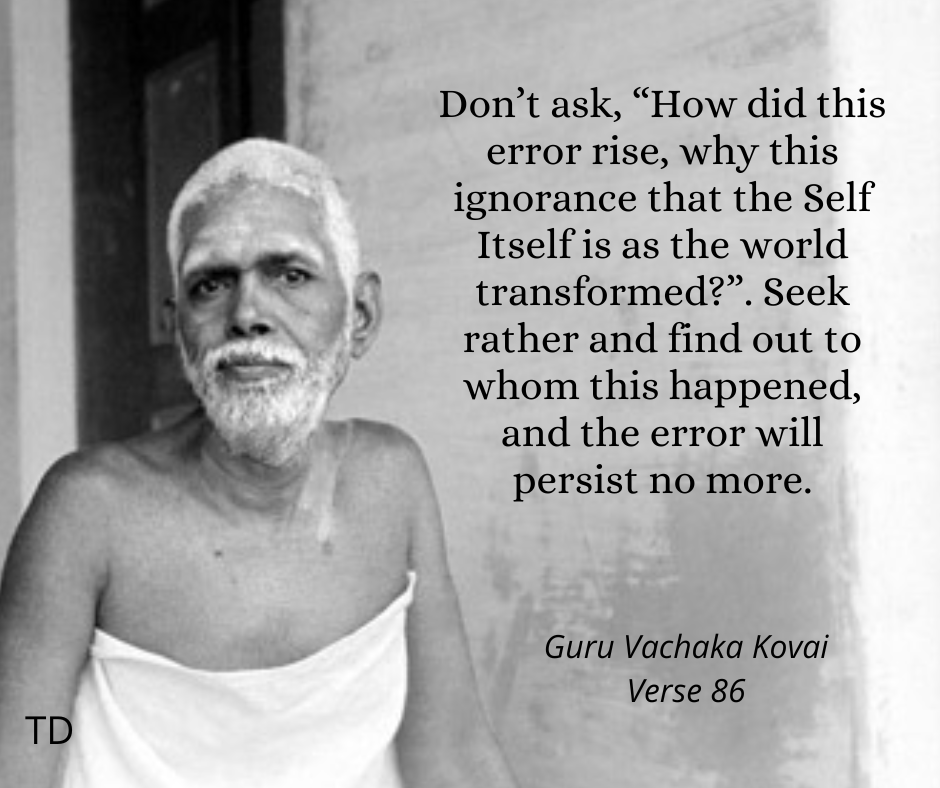
- Listen now to the proper reason why, in answer to those people who asked due to bewilderment of thought, “Why has this illusion or phenomenal appearance (maya) come? How has it come?” Lord Ramana did not give a direct reply by telling why or how, but instead said, “See to whom illusion (maya) has come.”
Answer:
- He who says that phenomenal existence (maya) has come into being is only you, whereas enlightened Sages (Jnanis), who have attained the great experience of Self, never accept that maya has come or that it now exists. Therefore, you, who assert that maya has come and exists, alone are the one who has the duty to investigate the truth in that assertion in order to prove its validity. Investigate thus.
How to remove this ignorance?
- If you first attend to yourself, by investigating within yourself “To whom has this illusory appearance of the world (maya) come? To whom does it exist?” then in the mind that has merged in the state of Silence due to such Self-attention, the truth that you exist as the mere consciousness ‘I am’, devoid of any differentiation, diversity or imagination (vikalpa), will spontaneously reveal itself to you.
Maya never existed, not even as an appearance:
- When the truth is known that you, the person who identifies the body as ‘I’, and who raises doubts and asks questions about phenomenal existence (maya), do not exist even in the least, then you will know as a matter of direct experience that in no place, at no time and in no way did phenomenal existence (maya) ever come or exist, and that the existence of the illusory world (maya) cannot be accepted even as a false appearance.
The questioner is itself illusion (maya):
- He (the mind) who says that the illusion of phenomenal existence (maya) has come into existence is himself an illusion (maya). Therefore, the one path of Self-attention, which puts an end to the mind, is alone the means that the pure Jnana-Guru, Sri Ramana Bhagavan, has bestowed upon us as the apt medicine to put an end to all the arguments that arise about phenomenal existence (maya).
Instead of asking ‘why is this world as it is?’, etc, we should ask ‘Who am I?’ and discover the Truth-Self:
- Even though our Guru has instructed us, “See ‘Who am I’?”, people of dull intellect ask, “Why has this world and the pleasures and pains herein come into existence?” instead of investigating “Who am I?” within themselves; only for such dull-minded people who ask thus, the Guru and the scriptures say, “Ah! That is all illusion (maya).”
Concluding verse in this section:
- But since people of pure faith who sincerely engage in the practice of Self-attention as instructed by the Guru, drown in the true consciousness ‘I’ by turning their attention again and again towards the false self (the mind) whenever it rises, to raise any kind of further questions, this talk of maya is not intended for them.
Also see this video for more on this topic:
How did ignorance, maya, illusion, duality and suffering arise? Don’t ask! Sri Ramana Maharshi
The perceived world is the ego! Do thoughts and desires create the Universe? How can physical objects be thoughts? Advaita | Non-duality
Is everything I see ego? Do thoughts create the world? What is ego? What is duality?
This video was recorded live during a Satsang meeting with Tom Das and put together by volunteers.
To attend satsang, see here: https://tomdas.com/events
For guided meditations see the ‘guided meditation’ playlist here: https://www.youtube.com/c/TomDasNonduality/playlists
For recommended reading for liberation see here: https://tomdas.com/2020/10/19/recommended-reading-books-for-enlightenment-liberation-and-self-realisation/
To book a 1 to 1 session with Tom see here: https://tomdas.com/nondual-spiritual-counsellor
Why did we turn away from the Self? Why does ignorance arise? Why is there maya or illusion at all? Why do we suffer if we are really the Self? Advaita Vedanta | Sri Ramana Maharshi
Why did ignorance arise? Why is there maya or illusion at all? Why do we suffer if we are really the Self? What does Advaita Vedanta say about this? What was Sri Ramana Maharshi’s view? What does Tom think about this? The Law of attraction will also be mentioned and we will also hear a story from the Buddha about this…
 Tom Das