
nirvana
The fire of suffering

Believing the narrative of ‘me’,
Buying into this notion of self,
Projecting this notion of self onto another,
Indulging in the 3 judgements of pride, praise and blame,
We pile log upon log upon log,
Onto the fire of suffering.
The importance of suffering and seeking

So many people cling to beliefs, either knowingly or unknowingly, caught up in confusion, sometimes teaching it to others.
If you really want truth, would you accept a belief, a concept, an idea? Would you accept second-hand words, teachings and phrases uttered by others? Would you worry about what others think and get preoccupied in puerile semantic debate?
Or would you continue to seek, genuinely investigate, until you have genuinely found, in your own direct experience, the end to your suffering, an end to your seeking?
The mind, no doer and action
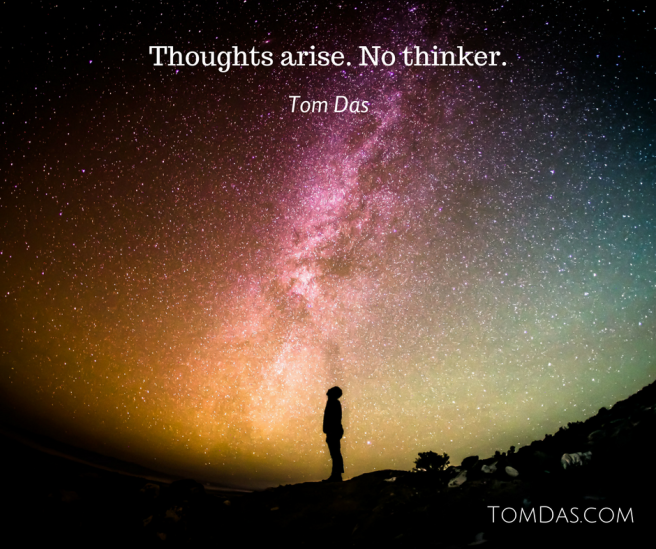
The key way the teaching works is upon the mind by removing the belief in the notion of doership. This belief is the key source of suffering, and when this belief is seen through then the suffering which is dependent on it dissolves away.
Often there is a process by which the habitual tendencies that cause suffering gradually fall away over time as the understanding of ‘no-doer’ infiltrates and has its effect on the mind’s conditioning.
Note that the notion of a doer is a false belief – there is no evidence for a doer being present, just as there is no evidence for a volcano god that erupts volcanos or a sea god that ravages the seas. The lack of belief in a doer does not mean there is no action, just as lack of belief in the above mentioned gods does not render the volcano or seas impotent.
Action and movement continues as they have always done. They happen seemingly by themselves, spontaneously you could say. Live goes on, and it feels much the same, the whole range of feelings and emotions continue, just without the suffering.
Pointing out mistakes
The following is an excerpt from: Who cares about Freedom?
We can go a little further too: we can also point out mistakes in our thinking. If we think Father Christmas is real, we can notice and point out there is no conclusive evidence to support that, despite appearances to the contrary (eg. presents appearing beneath the tree on Christmas Day). Any happiness or pleasure we derive from believing in Father Christmas is similarly based on our wrong notions/illusion.
Similarly, if someone takes themselves to be a doer, an entity that is free to choose and take credit and blame for its actions, then we can point out that there is no evidence to support this position, despite appearance to the contrary. All suffering that results from belief in doership is similarly based on illusion.
POETRY: TAKE A REST, MY FRIEND

Turn away from thought.
Turn away from that web of chatter,
from that activity of apparent separation and all the existential pain it brings.
Turn away from all that self-imposed suffering.
Rest a while, my friend:
You deserve it, you deserve that much.
Take a rest…
…be that space in which all things appear but on which nothing leaves a mark.
…know yourself as that.
(you are already that)
Integrating the understanding of no-doer
This post follows on from my previous post: Why seeing/understanding alone may not be enough
This understanding of no doer may initially take time to become embedded, and you may have to ‘practice’ it to start with. It’s just like many other forms of knowledge:
Take the example of a child learning his (or her) name. At first he doesn’t know his name. Upon his parents repeating his name to him multiple times, he finally starts to realise that his name is ‘Tom’. Maybe at first he forgets his name a few times and doesn’t respond when someone calls him. After sometime it becomes ingrained and embedded into his mind and he no longer has to think about it.
Eventually he can’t help but know his name. When someone calls out ‘Tom’, he automatically knows someone is calling him, whether he like it or not.
It’s the same with the understanding ‘there is no doer’. Initially the understanding may be a bit shaky, but after sometime, after repeated practice, after going through the logic behind it a few times and seeing the truth of it, it becomes more ingrained. Eventually it becomes effortless as knowing your name.
To be continued in my next post: Problems with utilising conceptual tools
Freedom, no doer, who sees there is no doer?
Q: But who sees there is no doer? Isn’t it the ego itself that sees through the illusion of self?
I use the word ‘ego’ to be synonymous with ‘doer’. Because there is a belief in being a doer, there is the notion that ‘I can change this’, ‘I can get somewhere better’, which is the seeking. This seeking is a subtle form of suffering.
When the doer is seen to be false, the seeking starts to collapse, and suffering fades.
To answer your question: who or what sees there is no ego? That which previously saw the ego is that which sees there is no ego. It is never the ego that sees: the ego is a construct of thought, which is always the seen.
Buddha: Unexcelled perfect enlightenment
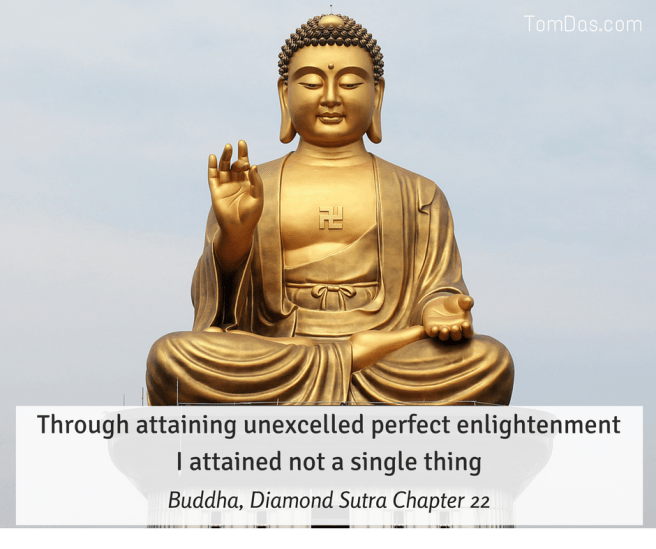
How yoga leads to Enlightenment

In my previous two posts (here and here) I’ve described the aims of the of yoga as being twofold:
- Knowledge: to see/know/realise that the notion of being a separate doer-entity is an illusion
- Peace: to become peaceful (sattvic) and remove compulsive desires
Each of these two aims of yoga are there to solve a basic problem. First, as long as you take yourself to be a doer, you suffer. This is corrected with Knowledge as defined above. Note that this Knowledge is not knowledge of something new (additive or positive knowledge) but it is realising something is false (negative knowledge).
And second, as long as you are a slave to compulsive desires, right action (ethical and intelligent action in accordance with natural law or dharma) will not fully manifest, and the flow of the innate natural intelligence will be impeded and distorted by these addictive and compulsive tendencies (vasanas). This is corrected by becoming sattvic (peaceful).
There are many forms of yoga and some can be very technical and detailed. However in general, some yogas work upon the body, others on the breath/voice, and some focus more on the mind. However the main purpose of yoga is to affect the mind, as this is where the core problems described above lie. Those yogas that work primarily upon the body, voice or breath do so in order to directly or indirectly effect the mind to which they are connected.
Each type of yoga strives to achieve the two points mentioned above in a slightly different way. Often there is a conceptual framework within which the yoga operates. When the aim of the yoga has been achieved (ie. by achieving the two points above), then the conceptual framework within which the yoga operated can be dismantled and left behind.
Improving your posture
Let’s give a simple example of how concepts, even when false, can aid us. If you want to improve your posture an expert may recommend you imagine a length of string attached to the crown of your head, pulling the top of your head upwards towards the sky/ceiling. When you imagine this, you naturally straighten your posture in line with the visualised imaginary piece of string.
After practicing this for sometime, your posture improved and now you no longer have to imagine a piece of string. At no point did you actually thinks there was a piece of string actually there, but you can see how this concept was useful to correct your posture.
Concepts in Yoga
Lets take a look at some of the main traditional forms of yoga to see how this works. In the sections below there are many aspects of the yoga I have not gone into, as the purpose of this text is to demonstrate how yoga can use concepts to achieve the two goals mentioned above, and then the concepts can be thrown away, to be picked up again only when this needs to be taught to someone else.
Jnana Yoga
Jnana means knowledge in Sanskrit, and Jnana Yoga is the Yoga of Knowledge.
In this yoga the concept of Brahman is introduced and is initially equated as being being-consciousness-bliss (sat-chit-ananda). Brahman is initially defined as being our basic sense of presence-awareness and the teachings show this to be (apparently) Unchanging, Ever-Present/Permanent, Eternal, Infinite and Indestructible. This is stark contrast to the subtle and gross objects that appear within it which are ever-changing, temporary, transient, limited and subject to creation and destruction.
The Jnana yogi is taught to identify him/herself as that Unchanging Absolute Brahman and not to identify as the ephemeral objects. Through this process of de-identification with the body-mind and identification with that which does not change, insight into experience occurs.
We start to realise that the body-mind entity that we formerly took ourself to be actually is not us at all. We thought that we we responsible for our thoughts and action, whereas from the point of view of Brahman or Absolute Consciousness, it is seen that there is no doer and the body-mind-entity functions by itself. At this point the doer-entity is seen to be non-existant, and Knowledge as defined above in objective (1) arises.
At this point the essential job of jnana yoga has been completed, and the concepts of Brahman as being an unchanging essence can then be dropped and life goes on, living itself. There is no attachment to concepts such as the relative and absolute or concepts of the infinite, all of which are ultimately unverifiable in our experience.
Incidentally, once the doer has seen to be non-existent, sattva tends to arise over time as the processes that fuel compulsive desires are slowly wiped away, and so objective (2) is also indirectly achieved.
We can see that in Jnana yoga the concept of an Absolute Brahman has been useful to us to serve a purpose. However ultimately we cannot know for sure from our experience alone that there is such as thing as the Absolute Unchanging Brahman. Because Knowledge, ie. seeing through the doer, has occurred, Freedom is innately realised, and concepts are not clung to, and no beliefs are required.
Karma Yoga
Karma means action in Sanskrit, and Karma Yoga is the Yoga of Action.
There are a few ways karma yoga can be performed according to the traditional scriptures, but one of them is to set up the concept of a personal God, an all-powerful entity that is responsible for everything and every action in the universe. The Karma yogi is taught to realise that it is this God that ultimately has control and not the limited body-mind that it thinks itself to be.
The karma yogi therefore practices gladly accepting everything that comes his or her way as a gift from God, working to the best of their ability, but not being attached to the results of their actions.
As the Karma yogi starts to learn to be happy regardless of what is happening, this has the direct result of eroding away compulsive desires, converting them into non-compulsive desires, and so eventually objective (2) is achieved.
Thereafter, over time, the sense of identification with the body-mind entity loosens and is seen through. It can become apparent to the Karma yogi that actions happen by themselves: thoughts happen by themselves, but there is no thinker, just a spontaneous thought occurring, one by one, in quick succession. Similarly actions happen by themselves: limbs move, lips speak in the same way that dogs bark, leaves rustle and clouds float by – all happens spontaneously, and there is no doer. Here Knowledge arises.
Now the yoga has completed its aims: Freedom has been realised and we are seen to be free from suffering – we are seen to have always been free from suffering and the world. Now we no longer have to worry about concept of an infinite all-powerful personal God that is ultimately unknowable and unverifiable.
Again, the concept of the infinite God, as with the concept of the Unchanging Indestructible Brahman for Jnana yoga, can be seen to have been a useful tool, aiding the seeker to attain Liberation, but now no longer needs to be believed in.
So here are just two examples of how concepts are utilised in yoga to achieve a greater end than perhaps could have been achieved without them.
Remember, don’t cling to concepts, beliefs and ideas. Use them by all means, but when you no longer need them, let them go. Ultimately, stay with what you know, stay with what’s true, question your beliefs, be unafraid to admit if you’re wrong, and don’t pretend to know something you don’t. Keeping to these guidelines will safeguard you from dogma, and the suffering that results from it.
Also see:
How spiritual teachings work
The essence of yoga
The paradox of yoga
Can you know something is infinite?
 Tom Das