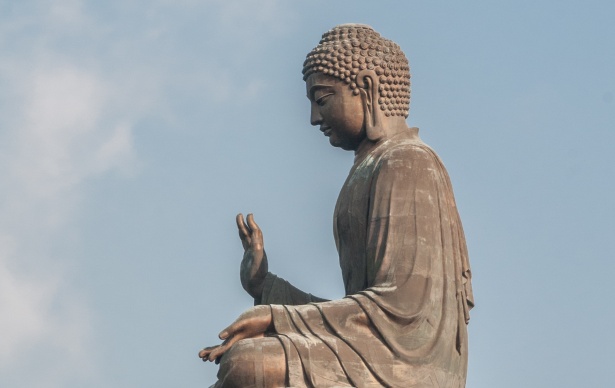
Buddha: Why do spiritual people fight with each other?

buddha side.jpg

“Why is it that, Master Kaccana, that ascetics fight with ascetics?”
“It is, brahmins, because of attachment to views, adherence to views , fixation on views, addiction to views, obsession with views, holding firmly to views that ascetics fight with ascetics.”
Anguttara Nikaya

Today’s spiritual scene is in many ways the same as it has always been: while some people wake up to things as they are and go beyond words and scripture, others stay fixed in their views, cling to their scriptures and concepts, and in doing so remain stuck in suffering and samsara.

So, why are so many spiritual people arguing with each other? Master Kaccana was one of the Buddha’s main disciples and was said to be the most skilled in espousing the dhamma (the teaching). He says it simply: people are wedded to their concepts, their views, their scriptures and their ideas, and that is why they fight with each other.

The true dhamma cannot be spoken. The true teacher knows their words are ultimately untrue and that words are merely conceptual pointers, indicators, and not descriptions of what is. The true teacher is not wedded to a particular teaching method, or a particular form of words, and naturally adapts the teaching to the situation at hand. A single word, a prescription for practice, a gesture, a glance, a lecture: the teaching comes to us in many forms.

If we truly listen, the living teacher constantly teaches the living teaching. The teaching is inseparable from our hearts and the life we find ourselves living: it is none other than daily life.

The teaching is here, already. Are we open to it?


Nisargadatta Maharaj: Ignore your thoughts

Nisargadatta_Maharaj

“It is the mind that tells you that the mind is there. Don’t be deceived. All the endless arguments about the mind are produced by the mind itself, for its own protection, continuation and expansion. It is the blank refusal to consider the convolutions and convulsions of the mind that can take you beyond it.”

Nisargadatta Maharaj, I Am That

My comments:

The word ‘mind’ in the above quote is synonymous with the false sense of individual separate self. This self, this ‘I’, is just a notion, an idea reinforced by the mind. The ‘I’ is a thought, and it is reinforced by thoughts.

Trying to figure this all out (ie. more thought) is a function of the same mind that is ultimately false, imaginary: it is a fruitless endeavour.

A particularly effective sadhana (spiritual practice) is to ignore the content of thoughts as they appear within our consciousness. The energy of the sense of ‘I’ then begins to loosen and its mechanics are exposed and revealed. We can then start to see things as they actually are.

There are broadly two ways this can be done:

1) by concentrating on something else such as a mantra, the breath, or by chanting, etc – ie. a distraction from thoughts;

2) by allowing thoughts to wash past you like clouds in the sky, and in so doing not paying attention to the content of thoughts, eg. a surrender, acceptance, gratitude or mindfulness practice.

When looking for a sadhana, you will naturally be able to find the one that works for you by looking to see which one gives you greatest sense of peace and relief, and by seeing which practice you are naturally inclined towards.

For more about spiritual practices and how they work click here

Dzogchen: Self-liberation in the fundamental nature

supreme-source

Here are some more verses from the Kunjed Gyalpo (The Supreme Source), one of the most important texts in Tibetan Buddhism and Dzogchen. These words point the reader directly towards Enlightenment. See my earlier posts on the Kunjed Gyalpo here and here.

In the except below the first section initially directs us to listen to these teachings and realise the inherent liberation that is already present ‘without needing to alter anything’.

The second section indicates there is no need for special practices, or to speak or act in a particular way in order to get this.

In fact, as per the third section below, in trying to find your ‘authentic condition’ (which is self-liberation), you deny it and prevent liberation manifesting itself.

Listen!
As I am in the authentic condition,
all phenomena self-liberate in the fundamental nature.
Without needing to alter anything,
the teacher self-liberates in the fundamental nature.
Without needing to alter anything,
the teacher self-liberates in the fundamental nature.
Without needing to alter anything,
the retinue of disciples, too, self-liberates in the fundamental nature.

Listen!
As all self-liberates,
there is no need to correct the body posture or visualise a deity.
There is no need to correct the voice or speech.
There is no need to correct the mind through meditation.

By correcting oneself,
it is not possible to find the authentic condition,
and without finding the authentic condition,
one cannot self-liberate.
In this way one does not achieve the state of equality of the fundamental nature.

Excerpt from The Supreme Source (Kunjed Gyalpo), Chapter 29

So, what are we to do? We are essentially told that ‘you are already realised’ or ‘you are already whole’, but perhaps we don’t feel realised or whole.

We are told that no practice can take us to where we already are, but then what do we do?

The Kunjed Gyalpo exhorts us to listen to these teachings, absorb them, and see their truth directly!

But how to do this, the spiritual seeker asks.

There is no how, for in asking how you have already posited and given reality to the separate self that is looking for answer, that is looking to get somewhere. By asking how, there is already the implication that this is not it. But this is it!

The Supreme Truth and the way to it cannot be described. Only wrong ways can be described, hence the language is of negation – ‘no need to correct’….’By correcting oneself…one does not achieve’. The scripture tells us what not to do, not what to do.

The ancient method is to first listen (sravana) to the teachings repeatedly, then secondly to contemplate them and think them over (manana). This helps to develop an intellectual understanding of the teachings first, following which meditation and integration of the teachings (nididhyasana) can occur. This can occur gradually, or perhaps suddenly, without warning, a moment of clear seeing arises and the teachings that were once theoretical suddenly spring to life.

Being fearless

eagle

Being fearless,
The body becomes wide open,
The heart sensitive and vast:
All thoughts, feelings and sensations are welcome here,
Even fear.

Completely open
We truly feel.

Willing to feel,
We are truly alive.

Not resisting,
We feel whole, connected.

Not knowing what will happen next,
Isn’t this true freedom?

Zen Teachings: The Four Kinds of Spiritual People

buddha silver

“There are four kinds of people who study.
The highest are those with practice, with understanding, and with realization.
Next are those with understanding, and with realization but without practice.
Next are those with practice and understanding but without realization.
Lowest are those with practice, but without understanding or realization.”

Zen Dawn, J. C. Cleary

Practice, understanding and realisation are all important, but we can deduce from the quote above that of these realisation is the most important. Next in importance is understanding, and least important is practice.

How can this be? How can understanding be more important than practice? Isn’t it often said that an drop of practice is worth an ocean of theory?
Continue reading

What is non-duality anyway?

lotus flower

This website is sub-titled ‘Spirituality and Non-Duality’. But what exactly is non-duality (advaita in Sanskrit)? Even in spiritual circles only a few people will ever come across the notion of non-duality and fewer still seem to be interested. From my point of view that’s a real shame as as far as I can see, non-duality is where spirituality gets real and freedom can become reality. Continue reading