
Quote: YOU STILL ARE
This post is continued from a prior post: Integrating knowledge, spontaneous action
Q. I’ve been reading Ramana Maharshi recently and he keeps on saying ‘I’m not the body’.
Tom: Yes, that’s right.
Q: But I don’t really hear you talk about not being the body.
Tom: Yes, that’s because it’s a ‘thorn’. Remember the phrase I’ve mentioned: ‘Use a thorn to remove and thorn and throw them both away’?
Q: Yes, I’ve heard you say that. Please can you explain it again?
Tom: Sure. The first thorn represents a wrong concept that is active in your mind and causes suffering, just as a thorn in your foot causes suffering. You then take a second thorn and use it as a tool to remove the first thorn, but then you throw them both away. If you don’t throw away the second thorn, then you now have a new thorn (concept) that will cause you to suffer.
Ramana often talks about rooting out the ‘I-am-the-body’ concept, and the concept ‘I-am-not-the-body’ is just to negate the initial thorn. But then you throw it away too.
Q: So I am not the body is not true either?
Tom: Exactly. Or, lets put it like this: for a moment just forget what Ramana says, forget what I say – for all you know we could both be talking a load of rubbish! Afterall, lots of intelligent people believe strange and silly things, and we could be no different, right? So forget what we say.
So let me ask you a question: do you know for sure that you are a body?
Q: Well it often seems like I am a body…
Tom: But do you know for sure?
Q: No, not for sure.
Tom: Good. Now, do you know for sure that you are not the body?
Q: No, not for sure.
Tom: Good. That’s our basic experience. We don’t know either way. The body appears and follows us around, as it were, but we don’t know exactly what it means. Is the body me? Is it not me? The truth is I don’t know. That’s it. That’s the truth. We don’t know. Isn’t that right?
Q: But when I say to myself ‘I am not the body’, it feels so good, it just feels really nice.
Tom: Yes, of course, because you are negating the concept (I-am-the-body) that causes so much suffering. It’s a good thing to practice, it’s a great practice in fact. If it works for you I recommend you practice it.
Q: Oh, I see, so it’s a practice.
Tom: Exactly. We are not saying don’t practice. We may need the second thorn, that’s why it is there, that’s why it is taught. So use that thorn, use that tool, practice ‘I am not the body’. When it has done its work, when it has weeded out the ‘I am the body’ concept, then you won’t need it any more and you can throw it away too.
Q: OK, I got it now. Wow, there are so many thorns, aren’t there?
Tom: Yes!
Q: I often get confused about whether or not the world is a dream or illusion or not, but that’s just another thorn too, right?
Tom: Exactly. ‘The world is an illusion’ – it’s a very powerful thorn, one that benefited me a lot whilst I was seeking. But again, do you know for sure if the world is an illusion?
Q: No, not for sure…I know what you’re going to ask next…
Tom: …And do you know for sure that the world is not an illusion?
Q: No, not for sure . I knew you’d say that.
Tom: (laughing) That’s it! We don’t know either way! It’s so simple – Got it?
Q: (laughing) Got it.
Tom: so you can practice these, all these thorns. All these thorns are concepts. Use them – they are most definately useful – use them if you need them. The concepts are used to weed out the beliefs. You may need to practice them for weeks or months, but when their work is done, and the suffering has dissipated, throw them away.
❤
Also see Ranjit Maharaj talk about this.
The following are adapted from recent Facebooks posts of mine
http://www.facebook.com/tomdas.nd
The body-mind entity can accept, reject or be indifferent to things. This is relative acceptance and is an action that can be performed. Awareness is all-accepting, always embracing ‘what is’. This is total/absolute acceptance and is not something that you can do, but something that can be recognised as already being here.
Awareness cannot accept or reject anything, as it does nothing. It just is: present and aware. All actions occur at the level of the body and mind (and world).
Awareness could be said to unconditonally/choicelessly ‘accept’ everything that occurs within it, in the same way a mirror ‘choicelessly accepts’ the reflection within it.
…but actually, as this example illustrates, the mirror-like awareness is not actually doing anything apart from ‘being itself’.
In the way I speak about this, awareness cannot identify with anything. It is only the mind that identifies with/as the mind.
Or to put it differently, thought imagines it’s a thinker and believes itself.
Awareness is ever-free, just like the mirror in the example above
Through identifying with choiceless awareness/consciousness for sometime, the ego/doer is seen through and no longer identified with. Then the identification as being choiceless awareness/consciousness also can be dropped.
What we are left with is ‘just this’: simple, direct, beyond words. This is the ‘realm beyond verbal teachings’.
Here the apparent duality conceptualised by differentiating (viveka) between that-which-changes (objects) and that which doesn’t change in our experience (the subject, I) is resolved into non-duality.

This passage below is taken from ‘Illusion vs. Reality’ (page 6) by Shri Ranjit Maharaj. Shri Ranjit’s guru (Shri Siddharameshwar Maharaj) was also the Guru of Nisardagatta Maharaj, making Ranjit and Nisargadatta ‘guru-brothers’, ie. contempories in the same teaching lineage.
The address is false but when you reach the goal, it is Reality. In the same way, all the scriptures and the philosophical books are meant only to indicate that point, and when you reach it they become non-existent, empty.
…For example, to remove a thorn in your finger you use another thorn; then you throw both of them away. But if you keep the second thorn which was used to remove the first one, you’ll surely be stuck again.
To remove ignorance, knowledge is necessary, but finally both must dissolve into Reality. Your Self is without ignorance, without knowledge.
…If you keep the second thorn, which means knowledge, even if it is a golden thorn, you’ll be stuck [by the second thorn].
…Knowledge is a great thing but it must be only a remedy. When the fever goes off thanks to the medicine you take, you must stop taking it. Don’t prolong the treatment or you will create more problems.
Knowledge is necessary only to remove the disease of ignorance. The doctor will always prescribe a limited dosage!
Also see here for more
Tom’s comments:
The master speaks: because, as a child, we ‘listened’ to those around us, through absorbing their words we came to believe that we are a separate individual, a doer, a separate entity responsible for everything that this body-mind does. This is the basic ignorance.
Now, we can listen to the Master dispense his words. While his words, like ignorance, are also conceptual these concepts are there to remove ignorance.
The master’s words are like anti-matter: just as when anti-matter and matter collide they both disappear in a flash of energy leaving nothing behind, the master’s teachings nullify the suffering caused by our wrong notions of doership. Then the master’s teachings are also seen to be false.
We are left with no concepts at all, neither our original ignorant concepts, nor the concepts of the teaching. Only reality remains. It was always here.
Tom’s comments:
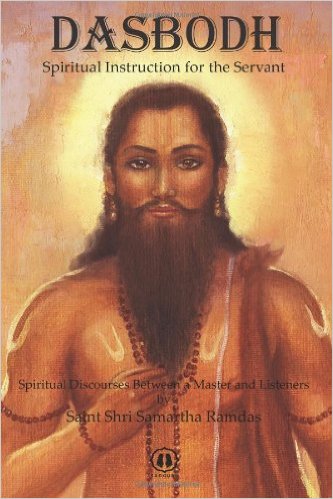
Dasbodh, written by Sri Samartha Ramdas in 1654, has been long used as a source text for seekers of enlightenment within the Advaita Vedanta tradition. Nisargadatta Maharaj’s lineage, the Inchegarei Sampradaya, were hugely inspired by this text and Nisargadatta used to regularly read from it.
Here Samartha Ramdas is pointing us to something very profound, yet very simple once realised. For more, compare this verse with that of Zen master Han-Shan here.
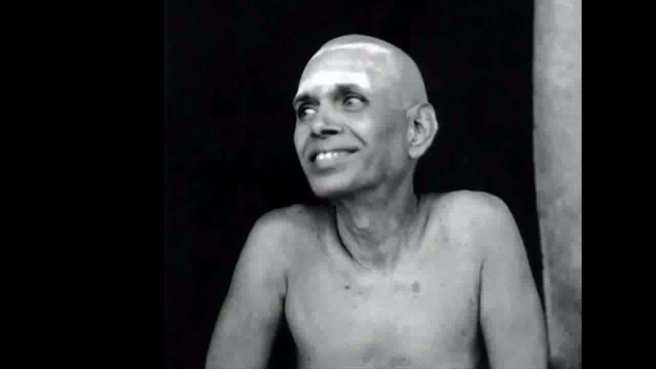
The state we call Realisation is simply being one’s self, not knowing anything or becoming anything.
If one has realised, one is that which alone is and which alone has always been. One cannot describe that state, but only be That.
Of course, we talk loosely of Self-Realisation for want of a better term.
Ramana Maharshi
(taken from the book Day by Day with Bhagavan, p. 296)
Tom’s comments:
Notice that the search for ‘understanding’ and the search for becoming ‘enlightened’ or ‘self-realised’ are both pursuits of the ego. The ego is looking for security and pleasure and has projected/created these fantasies which it tries to attain.
Instead of trying to attain a projected fantasy, why not instead look at what is actually happening? Look at yourself, look at the ego, the ‘I’. Ask yourself ‘what is this ego? Who am I?’ Investigate for yourself repeatedly and you will see that the ego, the ‘you’ is illusory – it’s just a bundle of thoughts that occur by themselves, spontaneously. ‘Your thoughts’ are not yours at all: note how you cannot chose to stop thinking, stop worrying, stop your addictions. You cannot chose to believe something you don’t. You cannot chose to not believe something you do believe. You cannot stop your ‘bad thoughts’. In fact you probably do not even know what exactly you will be thinking in 5 minutes time let alone tomorrow or 5 days from now.
Another point: if you happen to think you are a dinosaur, it doesn’t necessarily make you one. Similarly if you think that you are an ego (a doer, a thinker, an agent who has authorship over his/her actions), it doesn’t make it true. Yes, the idea of being a doer is just that: it is an idea, a belief that has been tacitly repeated to us and drummed into us since childhood. An oft-repeated lie is then (mistakenly) taken to be true.
In seeing this first-hand, there is no specific intellectual understanding or state of mind gained. It’s just that an illusion has been seen through, like seeing that a frightening snake is in fact just a harmless rope in poor light (or like realising that you are not in fact a dinosaur after all!).
No dogmas, no metaphysics, no complex body-twisting acrobatics, no beliefs and no rituals are necessary (although they may be a part of the apparent journey).
Then all there is is ‘what’s happening’, and what you thought was you is actually just a part of that happening. Or as Bhagavan puts it, all there is is ‘simply being one’s self’.

“It is the mind that tells you that the mind is there. Don’t be deceived. All the endless arguments about the mind are produced by the mind itself, for its own protection, continuation and expansion. It is the blank refusal to consider the convolutions and convulsions of the mind that can take you beyond it.”
Nisargadatta Maharaj, I Am That
My comments:
The word ‘mind’ in the above quote is synonymous with the false sense of individual separate self. This self, this ‘I’, is just a notion, an idea reinforced by the mind. The ‘I’ is a thought, and it is reinforced by thoughts.
Trying to figure this all out (ie. more thought) is a function of the same mind that is ultimately false, imaginary: it is a fruitless endeavour.
A particularly effective sadhana (spiritual practice) is to ignore the content of thoughts as they appear within our consciousness. The energy of the sense of ‘I’ then begins to loosen and its mechanics are exposed and revealed. We can then start to see things as they actually are.
There are broadly two ways this can be done:
1) by concentrating on something else such as a mantra, the breath, or by chanting, etc – ie. a distraction from thoughts;
2) by allowing thoughts to wash past you like clouds in the sky, and in so doing not paying attention to the content of thoughts, eg. a surrender, acceptance, gratitude or mindfulness practice.
When looking for a sadhana, you will naturally be able to find the one that works for you by looking to see which one gives you greatest sense of peace and relief, and by seeing which practice you are naturally inclined towards.
For more about spiritual practices and how they work click here
The person is merely the result of a misunderstanding. In reality, there is no such thing.
Feelings, thoughts and actions race before the watcher in endless succession, leaving traces in the brain and creating an illusion of continuity.
A reflection of the watcher in the mind creates the sense of “I” and the person acquires an apparently independent existence.
In reality there is no person, only the watcher identifying himself with the ‘I’ and the ‘mine’.
Taken from I Am That by Nisargadatta Maharaj
 Tom Das