reality
Life is an illusion?
What we truly desire
What we desire…
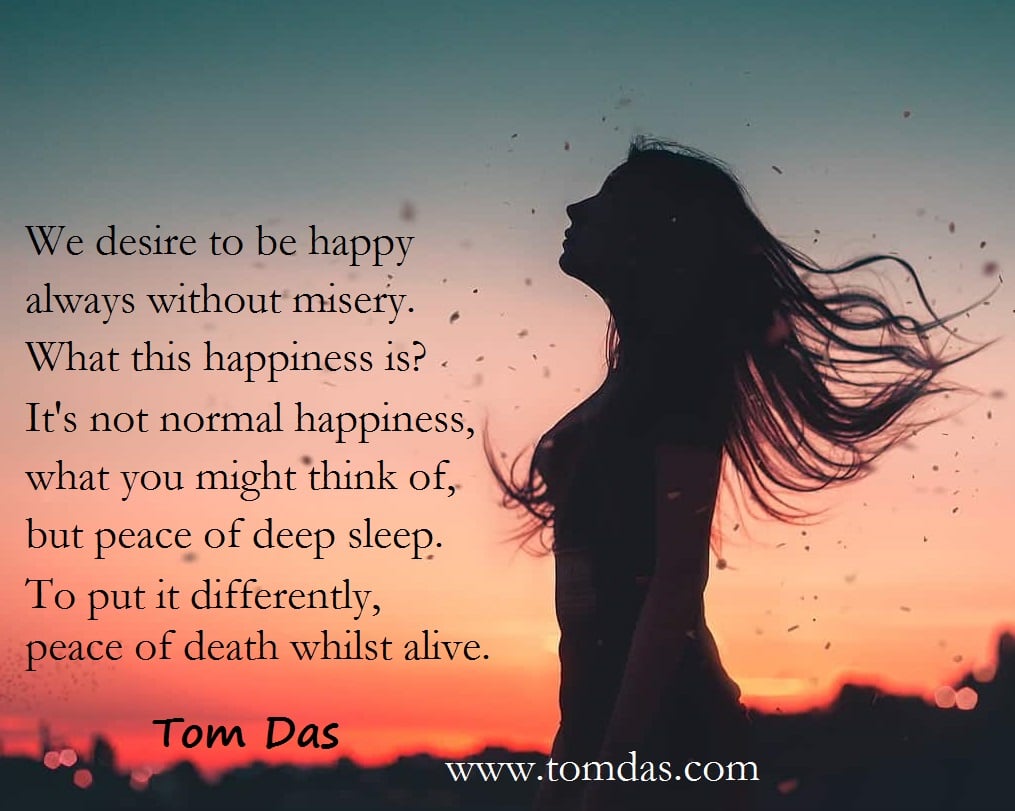
We desire to be happy always without misery. What is this happiness? It’s not normal happiness, what you might think of, but the peace of deep sleep. To put it differently, it’s the Peace of death whilst alive.
It’s when there is no mind. This is what we search for, we search for the mind to end. That’s what we really want.
When mind ends what you are is.
When you let go of everything…what is true, what is unchanging, what will never be destroyed, will be there fully.
When you let go of everything, that which is true, which cannot be destroyed, which is pure, that which always is…that God, that Divine, that One, that holiness, that will be there. Always…
So why worry?
If we can have faith in that, just let go of everything and That will be there. You don’t have to look for it, because it’s real. Everything else that is false will fall away. That which is real will be there.
And in your life you’ve got to do, what you’ve got to do. You have your responsibilities, you have to do those responsibilities. You just get on with it. They are not an obstacle. You look after your body, mind, you look after other body minds. Be as good person as you can be in this society. Knowing that this Divinity is always there.
‘Life is a dream…’
We have been given such a gift to have dreams. In the dream entire reality is created and projected by our minds, by our consciousness, and everything we see in the dream is our mind.
In this video Tom explains how taking on this conceptual view regarding waking life can help you to see your body mind as a projection and not what we truly are. The Guru is a projection, the teaching is a projection, the seeker is a projection – they are all ‘part of the dream’.
Please subscribe, like and share!
It all looks totally real!
Please support these videos by subscribing to the YouTube Channel, liking and sharing
Namaste!
Ashtavakra Gita – all is illusion, I am the Self

The following verses are read on this video here (a couple of the verses are in a slightly different order):
Sage Ashtavakra, the young boy with contorted limbs, teaches King Janaka, and the result is the Song of Ashtavakra, or Ashtavakra Gita. Here are some selected verses, enjoy:
2.1. Oh, I am spotless, tranquil, Pure Consciousness, and beyond Nature. All this time I have been mocked by illusion.
Tom – Now the triad of knower/knowing/known are said not to exist. Note that this triad essentially encompasses all arising or objective phenomena:
2.15. Knowledge, knower and the known – these three do not exist in reality. I am that stainless Self in which this triad appears through ignorance.
Tom – here the remedy is prescribed:
2.16. Oh, the root of misery is duality. There is no other remedy for it except the realisation of the unreality of all objects of experience and that I am One, Pure Consciousness, and Bliss.
2.18. I am neither bound nor free. My illusion has ended. The world, though appearing to exist in me, has in reality no existence.
2.19. My conviction is that the Universe and the body have no reality. The Self is Consciousness alone. How can the world be imagined in it?
2.20. I am the Self, and my nature is pure Consciousness. The body, heaven, hell, bondage, freedom, and fear are merely imagined, and I have no relationship with them.
3.13. Knowing the object of perception to be naught by nature, that steady-minded one neither accepts this nor rejects that.
5.3. Though the Universe is perceptible by the senses, it has no factual existence, like the snake in the rope. Therefore, enter into Laya, the state of dissolution.
Tom – Again the essential teaching is dispensed:
11.8. He who is convinced that this manifold and wonderful Universe has no real existence, becomes free from desire, is pure Consiousness, and finds peace in the Knowledge that nothing is real.
15.16. The world is the result of ignorance of your own nature. In reality, you alone exist. There is neither jiva (the individual person) nor Ishvara (God), nothing other than thyself.
15.17. He who has fully realised that the Universe is a pure illusion, becomes desireless and Consciousness Itself – such a one abides in peace.
16.11. Even though Shiva, Vishnu, or Brahma instruct you, unless you regard the world as unreal, and dismiss all sense of egotism, you will not become established in your own nature (the Self).
17.19. Devoid of the feeling of ‘This is mine’ and ‘This I am’ and knowing for certain that nothing objective exists in reality, the knower of Truth is at peace within himself, his desires have subsided. Though appearing to act, in fact he does not engage in action.
18.14. Where is delusion, where is the universe, where is renunciation, moreover where is liberation for the great-souled one who rests beyond the world of desires?
Tom – the implication in verse 18.14 above is that all the items listed – namely ignorance, the universe, renunciation and liberation – all of these are illusion.
18.28. That man of peace, beyond distraction and contemplation, is neither an aspirant for liberation, nor is he bound. Knowing the Universe to be an illusion, though perceiving it, he remains in the absolute state.
18.70. The pure one knows for certain that this universe is nothing but the product of illusion and that nothing exists. The Imperceptible Self is revealed to him, and he naturally enjoys peace.
Tom – As if the above verses were not enough, here, in the last chapter, chapter 20, the point is driven home again. Everything in the phenomenal world is negated as being mere dream-like illusion, a product of imagination, from the scriptures, to the seeker, from the teacher to the teaching. Even notions of liberation, bondage, knowledge, ignorance, time and space and lastly even duality and non-duality – all these are said to be mere illusion.
20.1. In my Perfect Self (Atman), neither the elements, nor the body, nor the sense-organs, nor the mind, nor the void, nor despair, exist.
20.2. Where are the scriptures, where is Self-Knowledge, where is the mind not attached to sense-objects, where is contentment, and where is desirelessness for me who am ever devoid of the sense of duality?
Tom – ie. scriptures, self-knowledge, the unattached mind, happiness and desirelessness are all illusory
20.3. Where is knowledge and where is ignorance; where is ‘I’, where is ‘this’, and where is ‘mine’; where is bondage and where is liberation? Where is an attribute to the nature of my self?
Tom – ie. knowledge, ignorance, bondage, liberation, subject and object are all illusory. And so the verses continue in the same fashion:
20.6. Where is the world and where is the seeker of liberation; where is the Yogi and where is the Jnani; where is bondage and where is liberation for me who am non-dual by nature?
20.7. Where are creation and destruction; where is the end and where the means; where is the seeker and success for me abiding in my non-dual nature?
20.8. Where is the knower, the means to knowledge, the object of knowledge or knowledge itself; where is anything, and where is nothing for me who am ever pure?
20.9. Where is distraction, where is concentration; where is knowledge, where is delusion; where is joy and where is sorrow for me who am ever actionless?
20.13. Where are instruction and scriptural injunction, where is the disciple and where is the guru; where, indeed, is the object of life for me who am absolute good and free from limitation?
20.14. Where is existence, where is non-existence; where is unity, where is duality? What need is there to say more? Nothing emanates from me.
Ramana Maharshi: The world should be considered like a dream

The following are explained in this post:
- The world should be considered like a dream
- The external guru that appears as an external form is a dream-guru
- The world is simply thought; the universe is made up of thought
- The guru does not need to teach others or ‘spread the word’
- The false ideas ‘I do not want liberation’ and ‘Let all others be liberated before me first’ are discussed
- Other people do not need to be saved, ie. the focus should be on your own realisation
- There is only one jiva (seperate ego-self) – ie. eka jiva vada
The Dream
Here is an essential instruction from Ramana Maharshi:
‘The world should be considered like a dream’
Who Am I?
The following are supportive quotes:
Waking is long and a dream short; other than this there is no difference
Who Am I?
The present waking state is no more than a dream
Talks 244
The so-called waking state is itself an illusion
Talks 199
The Dream Guru
In the following two quotes we see that Ramana is describing the Guru or Teacher or Teaching as a mere dream-guru or dream-teaching, a part of the illusion. There is no real teaching, no real teacher, no real seeker, no real liberation. These are all illusion. The example given is that we dream the guru up, rather like dreaming of a tiger that then causes us to awake from the dream:
A man dreams of a tiger, takes fright and wakes up
Talks 473
It is said that awaking from ignorance is like awaking from a fearful dream of a beast
Talks 627
In the following dialogue this is also made clear:
A Swami asked: I feel toothache. Is it only a thought?
Ramana Maharshi: Yes.
Questioner: Why can I not think that there is no toothache and thus cure myself?
Ramana Maharshi: When engrossed in other thoughts one does not feel the toothache. When one sleeps toothache is not felt.
Questioner: But toothache remains all the same.
Ramana Maharshi: Such is the firm conviction of the reality of the world that it is not easily shaken off. The world does not become, for that reason, any more real than the individual himself.
Questioner: Now there is the Sino-Japanese war. If it is only in imagination, can or will Sri Bhagavan imagine the contrary and put an end to the war?
Ramana Maharshi: The Bhagavan of the questioner [ie. Sri Ramana Maharshi] is as much a thought as the Sino Japanese war. (Laughter.)
Talks 451
The Guru does not need to teach others
In the following excerpt Ramana points some flawed reasoning. Firstly why does a liberated sage not need to go out and preach to the world?
People often say that a mukta purusha [ie. liberated person; mukta = liberated, purusha = person] should go out and preach his message to the people. They argue, how can anyone be a mukta so long as there is misery by his side?
True. But who is a mukta? Does he see misery beside him? They want to determine the state of a mukta without themselves realising the state.
From the standpoint of the mukta their contention amounts to this: a man dreams a dream in which he finds several persons. On waking up, he asks, ‘Have the dream individuals also wakened?’ It is ridiculous.
Talks 498
Two false teachings
Secondly, the flawed thinking in those who say to themselves:
a) ‘I don’t mind if I don’t get mukti’ or
b) ‘Let me be the last person to be liberated and instead help all others become liberated first’. (ie. what in Mahayana Buddhism is known as the Bodhisattva ideal)
Again, a good man says, “It does not matter even if I do not get mukti. Or let me be the last man to get it so that I shall help all others to be muktas before I am one.” It is all very good. Imagine a dreamer saying, “May all these wake up before I do”. The dreamer is no more absurd than the amiable philosopher aforesaid.
Talks 498
Others do not need to be saved
Does a man who sees many individuals in his dream persist in believing them to be real and enquire after them when he wakes up?
Talks 571
There are not many jivas/egos/people
Here a questioner asks are there not many jivas? Ramana informs the questioner there is only one jiva:
A question was asked why it was wrong to say that there is a multiplicity of jivas. Jivas are certainly many. For a jiva is only the ego and forms the reflected light of the Self. Multiplicity of selves may be wrong but not of jivas.
M.: Jiva is called so because he sees the world. A dreamer sees many jivas in a dream but all of them are not real. The dreamer alone exists and he sees all. So it is with the individual and the world.
There is the creed of only one Self which is also called the creed of only one jiva*. It says that the jiva is only one who sees the whole world and the jivas therein.
Talks 571
*This is called the doctrine of eka jiva vada (the view there is only a single jiva/ego/person). Our own body-mind, and the body-mind of apparent others are all projections of the Self. Like a dream, it appears we are many, but actually this entire dream world is an illusion, and there is only the Dreamer, the Self, the Consciousness from which all is projected. Tat Tvam Asi, You are That.
Ramana Maharshi:
‘The world should be considered like a dream’
Waking is long and a dream short; other than this there is no difference.
Who Am I?
The present waking state is no more than a dream.
Talks 244
The so-called waking state is itself an illusion
Talks 199
Yoga Vasishta clearly defines Liberation as the abandonment of the false and remaining as Being.
Talks 442
A man dreams of a tiger [the guru], takes fright and wakes up
Talks 473
It is said that awaking from ignorance is like awaking from a fearful dream of a beast.
Talks 627
A Swami asked: I feel toothache. Is it only a thought?
Ramana Maharshi: Yes.
Talks 451
The Bhagavan of the questioner [ie. Sri Ramana Maharshi] is as much a thought as the Sino Japanese war.
Talks 451
Does a man who sees many individuals in his dream persist in believing them to be real and enquire after them when he wakes up?
Talks 571
Jiva is called so because he sees the world. A dreamer sees many jivas in a dream but all of them are not real. The dreamer alone exists and he sees all. So it is with the individual and the world.
Talks 571
There is the creed of only one Self which is also called the creed of only one jiva. It says that the jiva is only one who sees the whole world and the jivas therein.
Talks 571
Also see:
Sri Ramana Maharshi: Solipsism and the shock of hearing the Ajata teachings
Shankara: the world or universe is a projection of the mind

From Shankara’s Vivekachudamani:
170. In dreams, when there is no actual contact with the external world, the mind alone creates the whole universe consisting of the experiencer etc. Similarly in the waking state also; there is no difference. Therefore all this (phenomenal universe) is the projection of the mind.
171. In dreamless sleep, when the mind is reduced to its causal state, there exists nothing (for the person asleep), as is evident from universal experience. Hence man’s relative existence is simply the creation of his mind, and has no objective reality.
Ramana Maharshi – three theories of reality of the world (shristi-dristi vada, dristi-shristi vada/vivarta vada, ajata vada) – the 3 levels of the teaching
This is one of a series of introductory articles – please see the homepage of tomdas.com for more introductory articles. Also see: For those attached to the world, the world is considered to be a divine manifestation. For the advanced seeker, the world is considered to be an illusion
And The Suprising Meaning of ‘Real’ and ‘Unreal’ in Advaita Vedanta
In classical Advaita (Non-Dual) Vedanta, there are three main theories or viewpoints of reality, called shristi-dristi vada, dristi-shristi vada and lastly ajata vada. Whilst these Sanskrit words may appear complex, the idea is actually very simple, and Bhagavan Sri Ramana Maharshi explains the meaning of these terms below.
It may be helpful to note that ‘vada’ means ‘theory’ or ‘viewpoint’, ‘shristi’ means ‘the world’ or ‘creation’, ‘dristi’ literally means ‘sight’ but in this context refers to consciousness, and ‘jata’ means ‘birth’ (or creation). Adding ‘a’ as a prefix to ‘jata’ negates the meaning so that ‘ajata’ means ‘unborn’ or ‘no creation’.
Therefore:
1) Shristi-dristi vada is the view that the world is primary and gives rise to consciousness, which is the most commonplace model of the universe, ie. that first there was a universe in which life gradually evolved on planet Earth and eventually human life and human consciousness evolved. In Western philosophy this is known as the Realist view of reality. This view also broadly corresponds to the waking state and to the Dvaita (dualistic) world view.
2) Dristi-shristi vada is the view that consciousness is primary and gives rise to the world appearance, ie. like in a dream, consciousness exists first and then this consciousness manifests the apparent dream-world and dream-subject/object duality. In Western philosophy this is known as the Idealist view of reality. This view broadly corresponds to the dream state and the view of Vasistadvaita (qualified non-duality or partial non-duality as I like to call it). This view is also known as, or at least is very similar to vivarta vada, which is the view that the world and individual are both projected illusions that simultaneously appear, and that the world and individual appear to appear but do not actually appear, rather like a dream. Vivarta vada could therefore be considered to be a sub-type of Drist-Shristi-Vada.
and
3) Ajata vada is the radical view that there never was any creation at all, and that there is only The Absolute, and that there never has even been the appearance of creation. This view broadly corersponds to the deep sleep state and also to Turiya, the ‘fourth’ state. This is the true Advaita (non-duality). In Vivarta-vada, it is said that Maya (the entire phenomenal appearance) appears to exist, but actually doesn’t, but in ajata vada it is almost imcomprehensibly stated that Maya never even came into existence, not even as an appearance. Hence the difference between Vivarta Vada and Ajata Vada. Vivarta vada states the snake appears to exist in the dimly lit rope, but that it isn’t real, whereas ajata vada states that the snake never even appeared to exist at ‘any time’ (‘any time’ is in quotes as the notion of time and space are also ‘seen’ to never have existed).
Note that whilst (1) and (2) can be understood conceptually with the mind, Ajata vada is an advanced and highly radical teaching that is very difficult to comprehend and it makes little sense to the mind. This is why liberation is said to be unfathomable. Ajata Vada is usually associated with Gaudapada’s commentary on the Mandukya Upanishad but also features in several other scriptures such as Ribhu Gita, Yoga Vasishtha, the final few verses of Shankara’s Vivekachudamani, the Ashtavakra Gita and Avadhuta Gita to name a few. Shankara’s commentaries on the Upanishads also commonly point to the radical ajata teachings.
Vedanta teachings often start by working in a Realist framework, which is the default conceptual framework of reality for most seekers especially at the start of their journey. Then the Idealist conceptual framework is introduced, and later the Ajata or no-creation viewpoint is brought in when the seeker is ready, in step-wise progression depending on how the seeker is progressing with the teachings. The nature and content of teachings differ depending on what framework of reality is being used. Note the purpose of the teachings is not that they are true, but the view is to be adopted in order to remove ignorance and reveal THAT which cannot be taught, explained or expressed in words – THAT which you – THAT which is all there is – beyond words.
Note that the stronger the ego (ie. the identification with being a body-mind), the stronger the attachment to the belief-concept that the world is real, and this means that the higher teachings are more likely to be rejected by the ego-mind. Conversely, the weaker the attachment to body-mind, the weaker the attachment to the belief in the world being real, and the more likely the higher teachings are to be accepted. This in turn facilitates Self-Enquiry and ‘attainment’ of Moksha (liberation).
Similarly, whenever we come across a teaching, it can be very helpful to see which of the 3 levels the teaching belongs to – this can be very helpful to avoid unnecessary confusion in what can otherwise seem to be contradictory teachings.
To explain further, here is an excerpt from Day by Day with Bhagavan from 15th March, 1946:
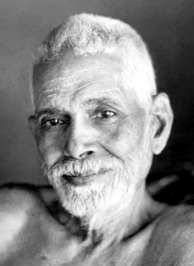
[Ramana Maharshi:] I do not teach only the ajata doctrine. I approve of all schools. The same truth has to be expressed in different ways to suit the capacity of the hearer. The ajata doctrine says, “Nothing exists except the one reality. There is no birth or death, no projection or drawing in [of the world], no sadhaka [no seeker], no mumukshu [no one seeking liberation], no mukta [no liberated person], no bondage, no liberation. The one unity alone exists ever.”
‘To such as find it difficult to grasp this truth and who ask. “How can we ignore this solid world we see all around us?” the dream experience is pointed out and they are told, “All that you see depends on the seer. Apart from the seer, there is no seen.”
Tom: Note here how Sri Ramana is distinguishing and differentiating vivarta vada/drist-sristi vada from ajata vada. Many people erroneously think that ajata vada states that world appears as a dream and non-creation means that the world is merely a dream-like appearance (as a dream appears, but is not real, and in that sense has not been created) – ie. many people erroneously equate ajata vada with vivarta vada/dristi-sristi vada. However here in the section above, if we read carefully, we can see that Sri Ramana is stating the Ajata vada is actually different to the idea that ‘all appears as the Self’. See here and here for more on this.
In Sri Ramana Paravidyopanishad we also see this same teaching in verses 147 and 330:
147. Creation is not other than seeing; seeing and creating are one and the same process. Annihilation is only the cessation of seeing and nothing else, for the world comes to an end by the right awareness of oneself.
330. There is no creation apart from seeing; seeing and creation are one and the same. And because that seeing is due to ignorance, to cease seeing is the truth of the dissolution (of the world).
‘This is called the drishti-srishti vada, or the argument that one first creates out of his mind and then sees what his mind itself has created.
‘To such as cannot grasp even this and who further argue, “The dream experience is so short, while the world always exists. The dream experience was limited to me. But the world is felt and seen not only by me, but by so many, and we cannot call such a world non-existent,” the argument called srishti-drishti vada is addressed and they are told, “God first created such and such a thing, out of such and such an element and then something else, and so forth.” That alone will satisfy this class. Their mind is otherwise not satisfied and they ask themselves, “How can all geography, all maps, all sciences, stars, planets and the rules governing or relating to them and all knowledge be totally untrue?” To such it is best to say, “Yes. God created all this and so you see it.”’
Dr. M. said, ‘But all these cannot be true; only one doctrine can be true.’
Bhagavan said, ‘All these are only to suit the capacity of the learner. The absolute can only be one.’
In Guru Vackaka Kovai (Garland of Guru’s Sayings), Ramana says the following (with a comment by Sri Sadhu Om):
100. Although Guru Ramana taught various doctrines according to the level of understanding of those who came to Him, we heard from Him that ‘Ajata’ alone is truly His own experience. Thus should you know.
Sri Sadhu Om’s comments: ‘Ajata’ is the knowledge that nothing – neither the world, soul nor God – ever comes into existence, and that ‘That Which Is’ ever exists as IT is.
Tom: here in Sri Sadhu Om, we have a close and direct devotee of Sri Ramana’s clearing stating what Ajata Vada actually is.
114. When the limited light [which is used to project pictures on the cinema screen] is dissolved in the bright sunlight [which enters the cinema], the pictures also will disappear instantaneously. Similarly, when the limited consciousness [chittam] of the mind is dissolved in supreme Consciousness [Chit], the picture show of these three prime entities [God, world and soul] will also disappear.
Here Sri Ramana explains why the teachings may initially concede the existence of the three primal entities (the individual or jiva, the world or jagat, and God the ordainer or Isvara):
115. Thus, since the Truth of the Source is One, why do all religions [and sometimes even Sages] start their teachings by at first conceding that these three prime entities are real? Because the mind, which is tossed about by objective knowledge, would not agree to believe in the One unless the Sages condescended to teach It as three.
122. Whatever high and wonderful state of tapas one may have attained, if one still identifies oneself with an individuality, one cannot be a Sahaja-Jnani [i.e. One in the State of Effortlessness]; one is only an aspirant of, perhaps, an advanced stage.
Here it is explained that for the teaching to ‘condescend’ to vivartha vada is the most practical method for seekers:
83. From his condescending opening words, “Because we see the world”, it is to be understood that the Great Master, Bhagavan Sri Ramana, who gives the most practical assistance to aspirants, sets aside all other doctrines and teaches that only the ‘Doctrine ofVivartha’is suitable to be taken as true.
Sri Sadhu Om’s comments: Though His experience of the Truth can only be adequately expressed by the ‘Doctrine of Ajata’, Bhagavan Sri Ramana uses only the ‘Doctrine of Vivartha’ for His Teachings…The ‘Doctrine of Vivartha’ is recommended to explain the standpoint of Advaita, ie. to explain how the world-appearance, its seer, and the seer’s knowledge of the appearance all come into existence simultaneously, unconditioned by cause and effect. However, since this accepts the appearance of the world, souls and God, it is only a working hypothesis to help aspirants. The‘Doctrine of Ajata’, on the other hand, never accepts even the appearance of this trinity, but proclaims that the One Self-shining Reality alone exists eternally and without modification; Ajata is therefore the highest of all doctrines and it is only suitable for the fully-ripened aspirants. Bhagavan Sri Ramana therefore comes down condescendingly and, setting aside ‘Ajata’ and the two lower doctrines He advocates through His Forty Verses on Reality the ‘Doctrine of Vivartha’ which is suitable for the ripe aspirants who have no faith in the lower doctrines, yet do not have the maturity to grasp the highest, ‘Ajata’.
Also see Ramana Maharshi: how to abide as the Self, the world is not real, attend to yourself
and How spiritual teachings work and Ramana Maharshi on those who claim to have surpassed the traditional notion of enlightenment
and Manonasa and The nature of Liberation | Ramana Maharshi | PDF download
Ajata Vada as taught in the Bhagavad Gita
REAL MEANINGS
When it is said ‘all is full’ or ‘all is whole’,
All that is really meant is nothing is required for liberation.
When it is said ‘nothing is real’,
All that is really meant is nothing is required for liberation.
When it is said ‘nothing is required for liberation’,
What is meant is that there is no separate ‘me’ that could require anything.
…JUST THIS…
Too simple for words!
 Tom Das