Self-enquiry
When should I stop reading books and just do the practice? | Self-Enquiry | Sravana and Manana
The Purpose behind the Various and Diverse Theories of Creation in the Vedas | Advaita Vedanta | Sri Ramana Maharshi
Why do the different portions of the Vedas describe creation in different ways? Their sole intention is not to proclaim a correct theory of creation, but to make the aspirant enquire into the Truth which is the Source of creation.
~ Sri Ramana Maharshi, Guru Vachaka Kovai, Verse 102
Here, in one of the earliest texts Sri Ramana authored he wrote the following in response to the following question:
Question: If the entire universe is of the form of mind, then does it not follow that the universe is an illusion? If that be the case, why is the creation of the universe mentioned in the Veda?
Sri Ramana Maharshi: There is no doubt whatsoever that the universe is the merest illusion. The principal purport of the Veda is to make known the true Brahman, after showing the apparent universe to be false. It is for this purpose that the Vedas admit the creation of the world and not for any other reason.
Moreover, for the less qualified persons creation is taught, that is the phased evolution of prakriti (primal nature), mahat-tattva (the great intellect), tanmatras (the subtle essences), bhutas (the gross elements), the world, the body, etc., from Brahman: while for the more qualified simultaneous creation is taught, that is, that this world arose like a dream on account of one’s own thoughts induced by the defect of not knowing oneself as the Self. Thus, from the fact that the creation of the world has been described in different ways it is clear that the purport of the Vedas rests only in teaching the true nature of Brahman after showing somehow or other the illusory nature of the universe.
That the world is illusory, every one can directly know in the state of realization which is in the form of experience of one’s bliss-nature.
~ Sri Ramana Maharshi, Self Enquiry (Vichara Sangraham)
Sri Sadhu Om also wrote a commentary on the above verse of Guru Vachaka Kovai (verse 102), as follows:
‘If creation were true, the scriptures would describe it in only one manner, but their diverse theories make it clear that creation is not the truth. To enable ripe aspirants to discover the falsity of the notion of creation, the Vedas purposely teach contradictory theories. However, such contradictions are found only in the descriptions of creation, they never occur when the Vedas attempt to describe the nature of Self, the Supreme. Concerning Self, they all agree and speak in one voice, saying ‘Self is One, Perfect, Whole, Immortal, Unchanging, Self-shining etc., etc.’ From this we should understand that the deep intention behind such conflicting theories of creation is to indirectly show aspirants the necessity of enquiring into Self, which is the Source of all ideas of creation.’
Am I ready to practice self-enquiry? | How to know when to start turning within? Ramana Maharshi
Work, daily life and self-enquiry – an exploration | Ramana Maharshi | The path of Sri Ramana | Sri Sadhu Om
How do we withdraw from the senses? | How to go towards the ‘I AM’ | Self-Enquiry | Sri Ramana Maharshi
If God is everywhere, why do we have to turn within? Why can’t we see God in the World? How is God to be seen? Sri Ramana Maharshi
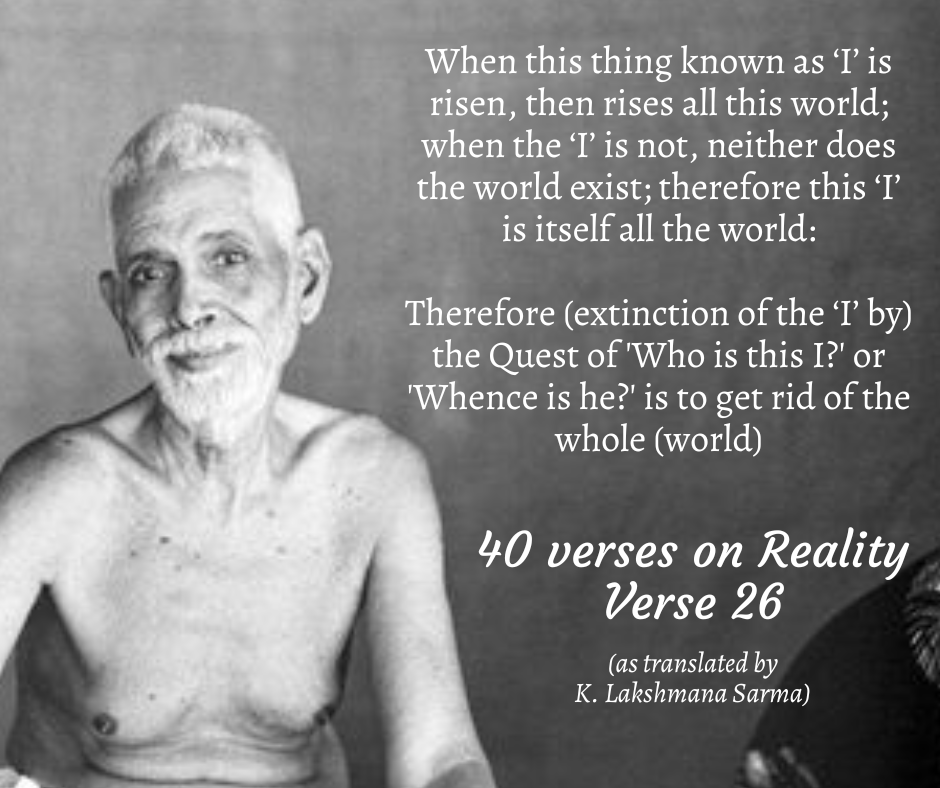
Also see:
Ramana Maharshi: how to abide as the Self
The need to turn within according to Advaita Vedanta
‘We must see Brahman in everything and everywhere’ is also not quite correct
The following is from Talks with Sri Ramana Maharshi, Talk no. 244:
Question: How is God to be seen?
Sri Ramana Maharshi: Within. If the mind is turned inward God manifests as inner consciousness.
Tom: here Bhagavan Sri Ramana gives us the essential teaching – God is to be found within – not outside, meaning not in the body, mind or world, but within, meaning in the non-conceptual Self that is the Subject. As Ramana himself wrote in the text ‘Who Am I?’:
Question: When will the realization of the Self be gained?
Answer: When the world which is what-is-seen has been removed, there will be realization of the Self which is the seer.
And in the same text, Who Am I?, in the answer to question 16 it is written:
‘the Self itself is God’
However, the questioner poses a seemingly logical question, namely that if God is everywhere, why cannot be see God everywhere? Why the need to look within when we can just as easily look outside at ‘God’s creation’, through our senses and see God there? Let us see:
Q: God is in all – in all the objects we see around us. They say we should see God in all of them.
Sri Ramana Maharshi: God is in all and in the seer. Where else can God be seen? He cannot be found outside. He should be felt within. To see the objects, mind is necessary. To conceive God in them is a mental operation. But that is not real. The consciousness within, purged of the mind, is felt as God.
Tom: here Sri Ramana is stating that to see God outside is merely to see a projection of the mind, for according to Sri Ramana, as we shall see shortly, all objective phenomena are mere thoughts, or projections of the mind, much like a dream objects are projection of the mind. An alternative explanation is that to see God in objective phenomena is actually a subtle act of the mind, a conceptual framework we are overlaying onto objects.
However, the questioner persists in pursuing their line of enquiry by challening Sri Ramana – are not various objects beautiful? Are not colours lovely to look at? Can we not see God in these objects too? Let us see:
Q: There are, say, beautiful colours. It is a pleasure to watch them. We can see God in them.
Sri Ramana Maharshi: They are all mental conceptions.
Q: There are more than colours. I mentioned colours only as an example.
Sri Ramana Maharshi: They are also similarly mental.
Tom: the questioner states that we can see God in objects and through the senses, but Sri Ramana dismisses this as mere concepts. The questioner, having raised objective qualities such as colour, then having raised other senses, not just colour now goes onto the body and the mind:
Q: There is the body also – the senses and the mind. The soul makes use of all these for knowing things.
Sri Ramana Maharshi: The objects or feelings or thoughts are all mental conceptions. The mind rises after the rise of the I-thought or the ego. Wherefrom does the ego rise? From the abstract consciousness or Pure intelligence.
Tom: Here Sri Ramana again states that the body, senses and mind are all mental conceptions (or mental projections), as are all objects, feelings and thoughts.
He then goes on to give a teaching given in the aforementioned text ‘Who Am I?’, that the first though is the ‘I-thought’ also known as the ego, and only once this has risen can other thoughts or objective phenomena arise such as the body, the mind and the world. In this way Bhagavan Sri Ramana is repeating his teaching, a teaching also taught in the Upanishads and by Sri Shankara, that the body-mind-world is actually a projection of ego or ignorance.
What is the source of this ego or I-thought? It is the Self, or Pure Consciousness as he refers to it here. The word ‘pure’ denotes the absence of arisising objective phenomena, which is consistent with the teaching explained in my above paragraph.

Later in the same dialogue (Talk 244) Sri Ramana explains that the ego or ‘I-thought’ gives rise to (or projects out) the mind, and the mind then projects out a body:
Sri Ramana Maharshi: The sense of body is a thought; the thought is of the mind, the mind rises after the ‘I-thought’, the ‘I-thought’ is the root thought. If that is held, the other thoughts will disappear. There will then be no body, no mind, not even the ego.
Q: What will remain then?
Sri Ramana Maharshi: The Self in its purity.
Tom: We can see that Sri Ramana is re-iterating that the body and mind are both projections of thought, and that their root is the ego, also known as the I-thought. When this ego-root (ie. ignorance) is cut down, by self-enquiry, all thoughts cease and the Self remains in its purity. As the body, mind and ego are all thoughts, Bhagavan Sri Ramana here explicitly states that in Self-Realisation there is no body, mind or ego. All that remains is the pure Self, again ‘pure’ denoting the lack of objective phenomena such as body, mind, world, feelings, sensations, etc.
As always, please do not simply accept teachings at face value. It is always good to read teachings in their proper context, so I encourage you to not just accept my commentary above, but to read the full talk for yourself so you can see it in its context. You will find many other valuable teachings in this talk too, such as Sri Ramana’s exposition of the three states and how he equates deep sleep with the Self, how he says that the world is a mere dream, his insistence that Self-Enquiry is the easiest path, and that Happiness or Pleasure or God can only truly be found Within.
Which method of self-enquiry is best? The best form or type of self-enquiry | Ramana Maharshi
Does Jnana (or Self-Enquiry) lead to Bhakti (or Self-Surrender) or the other way round? Sri Ramana Maharshi
This is one of a series of introductory articles – please see the homepage of tomdas.com for more introductory articles.
Some say that self-enquiry eventually culminates in surrender, and others say the opposite. Which is true? By the way, Self-Enquiry can also be referred to the path of Jnana (Knowledge or Wisdom) and Self-Surrender is also known as the path of Bhakti (love or devotion).
Ramana Maharshi has sometimes said it one way, and other times another, and other times said they are the same path. Again, which of these is true?
Let us see definitively what Sri Ramana says about this (surrender = Bhakti; Self-enquiry = jnana) in Guru Vachaka Kovai*, a text that is widely considered to be the most authoritative, reliable and comprehensive collection of the verbal teachings of Sri Ramana Maharshi:
722. When scanned, bhakti supreme and jnana
Shine as in their essence one.
Saying that one of them is but
A means to the other is only due
To understanding neither.
723. Even those who know may sometimes seem
To honour this saying and so prefer
One or the other of these paths.
This is in order to prevent
Some seeker half-way on one path
From giving it up and choosing the other.
724. When one adopting self-enquiry
Reaches the journey’s end and gains
Samadhi’s bliss, it is solely due
To the grace of God, one’s inmost Self,
Life of one’s life.
725. Unless the Self, the God within,
By power of grace pulls in the mind,
Who has the strength through his own effort
To stop the rogue mind’s outward drift
And merge it in the Heart and so
Gain peace?
728 To tell the truth, God’s grace supreme
And the keen quest “Who am I?”,
Which means abidance in the Heart,
Will work together as mutual aids
And bring one to the state of oneness
With the Self supreme.
729 This maya world-dream will not end
Unless the Self within speaks out.
The enquiry, “Who is the dreamer
Of this dream?” is prayer addressed
To Him to speak and wake us up.
730. It is said that meditation
On one’s own being [Tom: ie. Self-enquiry] is supreme
Devotion to all-transcending God,
Because, though spoken of as two,
They are in substance one.
731. The way of knowledge and the way of love
Are interwoven close. Don’t tear
Asunder these inseparables.
But practise both together holding
In the heart the two as one.
Meditation on the Self
Is devotion to the Lord
Supreme, since He abides as this,
Our very Self.
– SRI BHAGAVAN 13
*Guru Vachaka Kovai, or The Garland of Guru’s sayings, is widely considered to be the most authoritative, reliable and comprehensive collection of the verbal teachings of Sri Ramana Maharshi. Here is what Ramana Ashram states about the Guru Vachaka Kovai in the foreword of their publication of it:
‘[Guru Vachaka Kovai] provides the most precise, systematic and authoritative exposition of Sri Bhagavan’s teaching, explaining step by step the theory, the practice and the experience of jnana, the Truth supreme which is Being as Life Eternal, Pure Awareness, Perfect Bliss. Thus, the most comprehensive collection of the Maharshi’s sayings is Guru Vachaka Kovai.’
The paths of knowledge and love are more fully explained in the text The Path of Sri Ramana which you can download for free here. This is one of the few texts that goes into detail into both the paths of knowledge and love.
Also see:
Non-dual devotion, worship and prayer
Ramana Maharshi on those who ridicule idol-worship or image-worship
The paths of Devotion and Knowledge – Bhakti vs Jnana | Advaita Vedanta
Bhakti Yoga as a complete path to Final Liberation
Sri Ramana Maharshi: the necessity of Meditation
Is the Self a witness? Or is it everything? Or both? How to realise the Self? Advaita Vedanta | Atman | Self-Realisation

This is one of a series of introductory articles – please see the homepage of tomdas.com for more introductory articles. Also see:
Recommended Reading: Books for Enlightenment, Liberation and Self-Realisation
Question: Hi Tom, it is often said that the Self is the Witness, meaning that which sees or perceives all objects. In other places it is said the Self is everything. I’m not sure what to make of this. Can you give me some clarity please?
Tom: Hi, yes, this can cause lots of confusion for many. Even many Vedanta teachers do not really understand this point. As ever, Bhagavan Sri Ramana Maharshi points us to the true vedanta, the truly liberating way, in his teachings.
In truth the Self is not a witness (Sanskrit: sakshi) at all, but as long as we think we are a body-mind entity, and as long as we see a world outside of or apart from our self, the Self is indicated or pointed out as being the Subject or the Witness.
When in Self-Enquiry (the path of Knowledge) we turn our attention away from the objects, which means the various gross and suble phenomena that are perceived, and towards the Subject or Self (‘Witness’), eventually the ego-mind which takes itself to be a body-mind entity dissolves or dies and all that is left is the Subject-Witness-Self. This Self can no longer truly be said to be either a Subject (for there are no objects present), nor can it be said to be a Witness, as there is nothing to witness. It is All, it is the Sole Reality, ‘One without a second’, as it is often described as being in the Upanishads.
Sri Ramana Maharshi has taught us in Guru Vachaka Kovai verse 98 (Guru Vachaka Kovai is the most authoritative record of Sri Ramana Maharshi’s verbal teachings according to Sri Ramana Ashram):
98. Unless the body is taken to be ‘I’, otherness – the world of moving and unmoving objects – cannot be seen. Hence, because otherness – the creatures and their Creator – does not exist, it is wrong to call Self the Witness.
Sri Sadhu Om, a direct devotee of Sri Ramana Maharshi, writes in his commentary on this verse:
Descriptions of self as the ‘witness of the individual soul’ (jiva sakshi) or the ‘witness of everything’ (sarva sakshi), which can be found in some sacred texts, are not true but are only figurative (upacara), because only when other things are known would the one who knows them be a ‘witness’ of them. Since self does not know anything in the state of absolute oneness, which is devoid of any other thing, to what can it be a witness? Therefore describing self as a ‘witness’ is incorrect.
What both Sri Ramana Maharshi and Sri Sadhu Om are saying is that objects only appear when the ego/ignorance is present. In Self-realisation, there are no objects, only the Self, so in truth the Self cannot be said to be a witness.
In verse 869 of Guru Vachaka Kovai Sri Ramana teaches us:
869. ’Tis a foolish fancy to ascribe the role of ‘witness’ to the Self, the luminous Sun, the mighty sky of Pure Awareness. In the Self Immutable there is no room for maya’s darkness void. The Self is one sole whole without a second.
Here is an alternative translation of the same verse, with Sri Sadhu Om’s commentary, which essentially states in truth, ie. in realisation, there is no Maya in the Self. It is only for ajnani’s, ie. the ignorant, that consider the Self to be a witness of phenomena/maya:
869. The role [dharma] of seeing is ascribed to Self – the space of consciousness, the sun – only in the imagination of ajnanis, [because] maya, the empty ignorance [of seeing otherness], never exists in Self, the support [sthanu], [and also because] Self is without a second.
Sri Sadhu Om’s comments: Since Self is in truth that which transcends all roles and all qualities, and since It exists as one without a second, to glorify It as the ‘witness of all’ [sarva-sakshi] or as the ‘knower of all’ [sarvajna] is merely the folly of ignorant people.
This teaching is explained in detail in The Path of Sri Ramana and Sadhanai Saram (the essence of spiritual practice)
Q. Why then is the Self said to be a witness at all?
Tom: it is only to point out where to direct your attention towards. That apparent Subject, the I AM is what we truly are and all there truly is. All else is illusion, maya. The problem is that we think that we are the body-mind, which is actually a part of maya. Only through Self-Knowledge can we realise what we truly are, and to that end the Self is pointed out as being a Witness or being the Subject. Why? So we can turn towards it and thereby realise our/the Self.
Q. Why then is the Self said to be everything?
Tom: When we are under the spell of illusion, meaning when we take ourself to be a body-mind entity living in an apparently external world, we can say that everything is the Self, that all comes from the Self, and the Self pervades all. What can be apart from the Self? Nothing! However, at this point, we are still under the spell of illusion or maya or ignorance (all are synonyms). When, through self-enquiry, we discover the Reality, our Self, as it truly is, there is no Maya/ignorance/illusion at all and we realise there never was ever any illusion/ignorance at any point in time ever (actually we also realise there was never any time either, which is simply a part of the illusion). This is the Self. This is self-realisation.
There is actually no realisation of anything in self-realisation, for realisation implies a mind that realises something, and neither the ‘mind’ nor ‘something’ are in the self, both being aspects of Maya (illusion). There is only the Self.
Q. So does the Self pervade everything, all objects?
Tom: Why worry about objects, maya? The ego-mind is always concerned about maya. Discover the Self and find out! You will no longer be interested in maya (ie. there is/will be no maya in realisation). To discover the self, consider all objects to be maya and turn your attention lovingly towards the Subject, the I AM, what you actually are
Renouncing this phenomenal world
Which seems to, but does not, exist
We gain (the great ones say) the Self,
The Awareness shining all unseen.
Sri Ramana Maharshi, Guru Vachaka Kovai, Verse 835
Q. Why in some places does it say objects are not-Self and in other places it says objects are Self?
Tom: Contrary to what many think it is the lower teachings that say all is Self, to convince the seeker that there is only the Self. The higher teachings say that objects are not-Self, ie. maya or illusion, thus encouraging the sincere seeker to turn away from objects towards the Subject, whose true nature is Eternal Love and Bliss. The Eternal and Blissful nature of the Self is seemingly lost due to pre-occupation with the dream-like maya. Therefore the only way out is to attend to the Eternal and discover what you truly are!
Note that in both cases, whether you consider objects to be the Self or non-Self, that is a conceptual position for the mind. And liberation has nothing to do with the mind, the mind itself being ignorance.
Q. Don’t the scriptures state that the mind leads the way to liberation? Isn’t the way to liberation through knowledge, as isn’t knowledge to do with the mind?
Tom: It is true that some scriptures say that through the mind we can reach liberation. That means that it is the mind that hears the teachings (sravana), reflects upon them (manana), and then this naturally leads to meditation upon the Self (Self Enquiry or Nididhyasana) which in turn leads to manonasa (destruction of mind, or destruction of ignorance) which is the same as liberation (Mukti or Moksha), which is also the same as Jnana (knowledge) or Atma Jnana (Self-knowledge).
In Self knowledge, there is only the Self. There is no mental knowledge in Jnana at all, Jnana or Knolwedge just being another name for the Self. See here for more on this:
What is true Wisdom? What is Jnana? Sri Ramana Maharshi (Upadesa Saram)
Q. So in that case does that mean that all we have to do for realisation is to remain as the witness, watching phenomena as they come and go?
Tom: No, that is not correct at all. Whilst remaining as the witness is a lovely teaching in many ways that can be a wonderful practice for some people at some points on their journey, merely remaining a witness is (1) not liberating and (2) is also not possible for most, as the mind keeps on getting drawn back into thoughts of body, mind or world. Merely remaining as the witness to objective phenomena as they come and go is merely attending to maya, as all objective phenomena are maya, and so the ego-illusion and suffering continue. For realisation, we must attend to the Subject-Self, the I Am, until the ego-mind (which is duality) is no more, ie. until self-realisation, ie. until be discover what we truly are.
For more see here: In Brief: how to attain Liberation and HOW TO END EGO-SUFFERING (and why other spiritual paths tend not to ultimately work
If you refrain from looking at this
Or that or any other object
Then by that overpowering look
Into absolute Being you become
Yourself the boundless space of pure
Awareness which alone is Real Being.
Sri Ramana Maharshi, Guru Vachaka Kovai, Verse 647
Question: What is it that discovers the Self?
Tom: There is no entity that discovers the Self. It is only the Self that ‘discovers’ the Self. It is the total absolute removal or total absense of ignorance. It is merely the Self being the Self, One without and second (maya), no more, no less.
 Tom Das