The Following teaching statements of Sri Ramana Maharshi are taken from the text Guru Vachaka Kovai (Garland of Guru’s sayings). This text is widely consider to be the most authoritative text on Sri Ramana’s verbal teachings – you can download it using the link below.
In the following video I have read the quotes to form a guided meditation/guided contemplation. You are invited to sit comfortably and allow these soothing words to wash over you and guide you to the Self.
393.One who has wisely chosen the straight path Of self-enquiry can never go astray; For like the bright, clear Sun, the Self Reveals itself direct to whoso Turns towards it.
391. Those who do not dive into the Heart And there confront the Self in the five sheaths hid Are only students answering out of books Clever questions raised by books, And not true seekers of the Self.
835. Renouncing this phenomenal world Which seems to, but does not, exist We gain (the great ones say) the Self, The Awareness shining all unseen.
755. If without wasting time one starts And keeps up steady self-enquiry, One’s life becomes at once ennobled, One is no more this wretched body, And there wells up within one’s heart A sea of bliss supreme.
647. If you refrain from looking at this Or that or any other object Then by that overpowering look Into absolute Being you become Yourself the boundless space of pure Awareness which alone is Real Being.
432. …If you observe Awareness steadily, this Awareness Itself as Guru will reveal The Truth.
291. For those who seek eternal life The assurance stands: the senses five Retracted tortoise-like, the mind Turned homeward to the Self and there Abiding is pure bliss.
130. When will the fool, who thinks the body And the world are permanent and clings To them, find peace? Only when this Folly leaves him and he trusts And like a limpet clings to That, The Self within. Thenceforward he Shall never more know pain.
390. Without abiding in calm solitude As the Being-Awareness shining in the heart, To tear oneself away and look for truth Fussing everywhere without, Is like searching with a lighted torch For a diver in deep water sunk.
420. The knowledge that ignores the Self, The knower, and holds as true the field Perceived, is but illusive folly…
293. Know that these countless things are pictures In a dream and none is real Apart from the beholder. Shun This phantom world of names and forms And dwell in the pure, blissful being Of Awareness.
697. …Not an iota of the past can touch Those who dwell unceasingly In the firmament of Self-Awareness, Vast, boundless, frontierless and full.
921. None can confront and overcome The mind. Ignore it, then, as something False, unreal. Know the Self As the real ground and stand firm-rooted In it. Then the mind’s movements will Gradually subside.
898. When we with mind serene and still Experience pure unbroken Being, That is samadhi. In this state The mind, abiding as the Self Supreme, shares God’s own Being.
399. If in this manner day after day Practice is maintained, the mind Is rendered flawless, pure, the quest Becomes so easy that the moment It begins the Heart is reached.
877. Only when the world-illusion goes Does the blissful light of Self arrive. Life lived in this bright, blissful light Is our true, natural life. Other ways Of life are full of trouble and fear.
974. Unbroken Self-awareness is The true, bright path of devotion or love. Knowledge of our inherent nature As indivisible Bliss supreme Wells up as Love
418. The only true and full awareness Is awareness of awareness. Till awareness is awareness Of itself, it knows no peace at all.
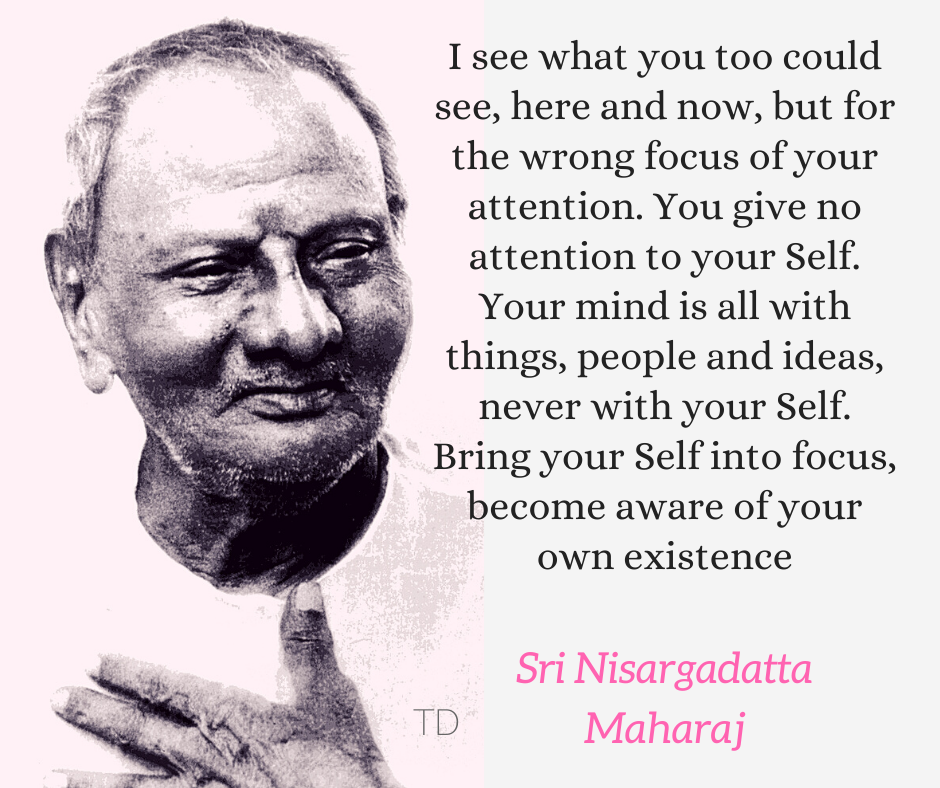
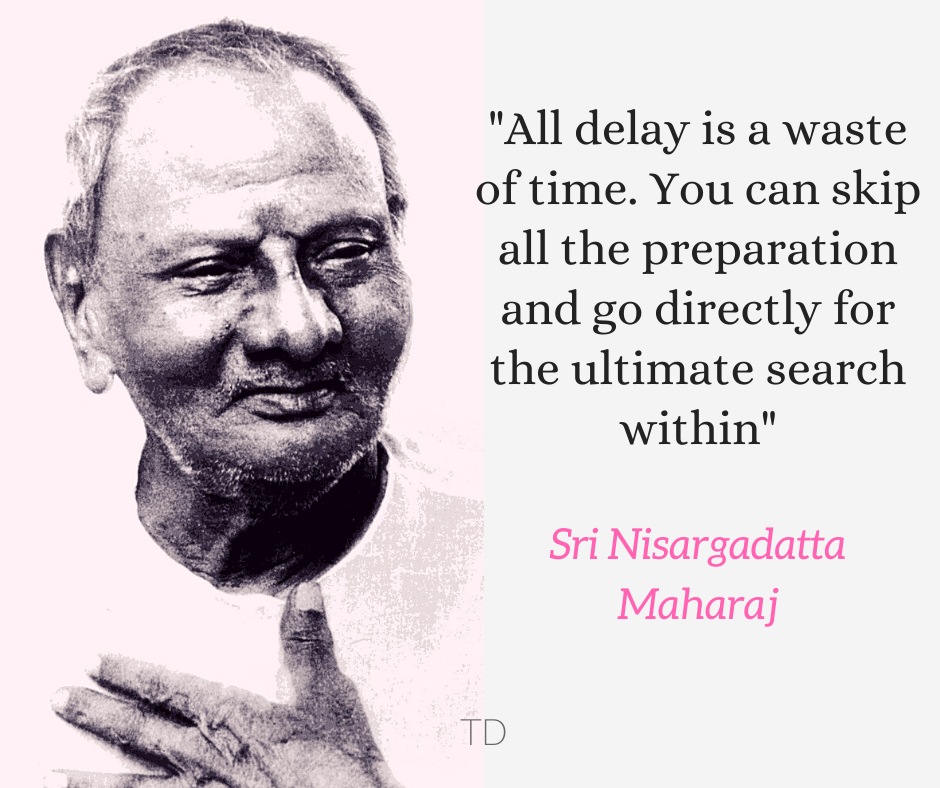
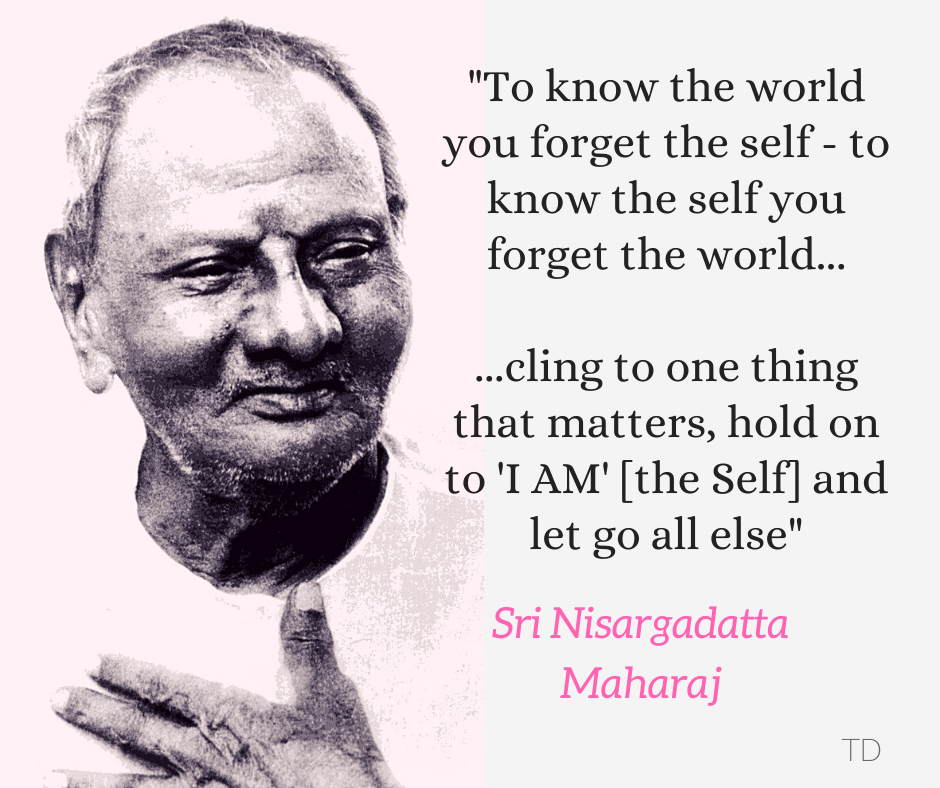
Here are four quotes of Sri Nisargadatta Maharaj that conveys the essence of his teachings. They are all taken from the book I Am That. Read them several times, contemplate what he is trying to convey, and put the teachings into practice.
Tom: the following text is from Letters from Sri Ramanasramam, 21st May 1947. In the first part Ramana will tell us the basic theory. In the second part he will tell us how to realise this truth for ourselves:
Yesterday morning at 8 o’clock, Dr. Syed who is a worker for Arya Vignana Sangha and one of the disciples of Bhagavan, came here for Bhagavan’s darshan and asked “Bhagavan says the whole world is the swarupa of Atma. If so, why do we find so many troubles in this world?”
Tom: Swarupa, literally meaning form of the self (Swa = self; rupa = form), usually is translated as ‘essential nature’ or ‘true nature’. Atma or Atman means Self. The questioner above is therefore asking about the true nature of the Self – “if all is Atma Swarupa, then why all this trouble in the world?”
With a face indicating pleasure, Bhagavan replied “That is called Maya. In Vedanta Chintamani, that Maya has been described in five ways. One by name Nijaguna Yogi wrote that book in Canarese. Vedanta has been so well dealt with in it, it can be said to be an authority on the Vedanta language.
There is a Tamil translation. The five names of Maya are, Tamas, Maya, Moham, Avidya and Anitya.
Tamas is that which hides the knowledge of life.
Maya is that which is responsible for making one who is the form of the world appear different from it.
Moha is that which makes a different one look real: sukti rajata bhranthi — creating an illusion that mother-of-pearl is made of silver.
Avidya is that which spoils Vidya (learning).
Anitya is transient, that which is different from what is permanent and real.
On account of these five Mayas troubles appear in the Atma like the cinema pictures on the screen. Only to remove this Maya it is said that the whole world is mithya (unreal).
Atman is like the screen. Just as you come to know that the pictures that are shown are dependent on the screen and do not exist otherwise, so also, until one is able to know by Self-enquiry that the world that is visible is not different from Atma, it has to be said that this is all mithya.
But once the reality is known, the whole universe will appear as Atma only. Hence the very people who said the world is unreal, have subsequently said that it is only Atma swarupa. After all, it is the outlook that is important. If the outlook changes, the troubles of the world will not worry us. Are the waves different from the ocean?
Why do the waves occur at all? If asked, what reply can we give? The troubles in the world also are like that. Waves come and go. If it is found out that they are not different from Atma this worry will not exist.”
Tom: How many times have we heard the above metaphor about the movie and the screen? But do we truly understand? Are we truly free? The questioner therefore asks the following:
That devotee said in a plaintive tone, “However often Bhagavan teaches us, we are not able to understand.”
“People say that they are not able to know the Atma that is all-pervading. What can I do? Even the smallest child says, ‘I exist. I do; and this is mine’. So, everyone understands that the thing ‘I’ is always existent. It is only when that ‘I’ is there, the feeling is there that you are the body, he is Venkanna, this is Ramanna and the like. To know that the one that is always visible is one’s own self, is it necessary to search with a candle? To say that we do not know the Atma swarupa which is not different but which is in one’s own self is like saying ‘I do not know myself ’,” said Bhagavan.
Tom: Ramana above is stating that the Self is always realised – it is the knowledge ‘I am’. Everyone knows they exist! This is self-knowledge or self-realisation! However the problem is when you identify as being the body the trouble starts. Now the questioner has figured out the path laid out before him, and Ramana confirms the way forwards in order to secure removal of this wrong identification with the body. There is no need to gain self-knowledge, just to remove wrong identification (ignorance):
“That means that those who by sravana (hearing) and manana (repeating within oneself) become enlightened and look upon the whole visible world as full of Maya, will ultimately find the real swarupa by nididhyasana [meditation],” said the devotee.
“Yes, that is it. Nidi means swarupa; nididhyasana is the act of intensely concentrating on the swarupa with the help of sravana and manana of the words of the Guru. That means to meditate on that with undeflected zeal. After meditating for a long time, he merges in it. Then it shines as itself. That is always there. There will be no troubles of this sort if one can see the thing as it is. Why so many questions to see one’s own self that is always there?” said Bhagavan.
Yesterday, two pandits came from Kumbakonam. This morning at 9 o’clock, they approached Bhagavan and said, “Swami, we take leave of you. We pray that you may be pleased to bless us that our mind may merge or dissolve itself in shanti [peace]”
Bhagavan nodded his head as usual. After they had left, he said, looking at Ramachandra Iyer,
“Shanti is the original state. If what comes from outside is rejected what remains is peace. What then is there to dissolve or merge? Only that which comes from outside has to be thrown out.
“If people whose minds are mature are simply told that the swarupa itself is shanti, they get jnana. It is only for immature minds that sravana (listening to the teachings) and manana (reflecting upon the teachings) are prescribed, but for mature minds there is no need of them. If people at a distance enquire how to go to Ramana Maharshi, we have to tell them to get into such and such a train or take such and such a path, but if they come to Tiruvannamalai, reach Ramanasramam and step into the hall, it is enough if only they are told, here is that person. There is no need for them to move any farther.”
“Sravana and manana mean only those described in Vedanta, don’t they?” asked some one. “Yes,” Bhagavan replied, “but one thing, not only are there outward sravana and manana but there are also inward sravana [listening] and manana [thinking]. They must occur to a person as a result of the maturity of his mind. Those that are able to do that antara sravana (hearing inwardly) do not have any doubts.”
Whenever any one asked what those antara sravanas are, he used to say, “Antara sravana means the knowledge of that Atma which is in the cave of the heart always illuminated with the feeling ‘aham, aham’ (‘I, I’), and to get that feeling to be in one’s heart is manana, and to remain in one’s self is nididhyasa [meditation].”
In this connection, it is worth while remembering the sloka [verse] written by Bhagavan bearing on this subject. In that sloka mention is made not only to Atma sphurana [the vibration of the Self] but also how to secure it. Securing means only remaining in one’s own self:
Brahman is glowing lustrously in the middle of the cave of the Heart in the shape of the Self, always proclaiming ‘I am, I am’. Become an Atmanishta, a Self-realised person, either by making the mind absorbed in the search of the Self or by making the mind drown itself through control of the breath.
Vivekachudamani contains 580 verses. Ramana Maharshi evidently placed this text in high regard, so much so that he translated the entire text into Tamil for those who could not read or understand the original Sanskrit. He also selected what he felt were the ten most important verses, which are as follows:
The ten most Significant Verses From Sri Sankara’s Vivekachudamani
As selected by Sri Ramana Maharshi
1. Among things conducive to Liberation, devotion (Bhakti) holds the supreme place. The seeking after one’s real nature is designated as devotion. (Verse 31)
2. The Supreme Self, the eternal, indivisible, non-dual Consciousness, the Witness of buddhi and the rest, is other than the real (Sat) and the unreal (asat), and is the ultimate significance of the notion conveyed by the term ‘I’. It is the immediate Reality, the embodiment of Bliss. (Verse 351)
3. Different from matter (prakriti) and its modifications is the Supreme Self, of the nature of pure Knowledge. It is Absolute and directly manifests the entire gross and subtle universe, in waking and other states, as the substratum of the steady sense of egotism. It manifests Itself as the Witness of the intellect (buddhi). (Verse 135)
4. That which clearly manifests itself in the waking, dream and deep sleep states; that which shines inside uniformly and continuously as I-I; witnesses the ego, the intellect etc, which are of different forms and modifications; which shines as Eternal bliss (nitya ananda) and consciousness (chit), know this, within your heart, as your own Self. (Verse 217)
5. With a regulated mind and a purified intellect, directly know yourself as the essential Self, in the form ‘This I Am’. Cross the shoreless ocean of worldy existence (samsara) with its waves of births and deaths. Firmly established as Brahman, which is your own true essence, be blessed (Verse 136)
6. The self-shining witness (sakshi) of everything, this Atman shines eternally, in the sheath of the intellect (vijnanakosha). Making this Atman, which is distinct from the unreal, the aim of contemplation, meditate upon It as your own Self, eliminating all other thoughts (Verse 380)
7. Extremely subtle is the Truth of the Self Supreme, and it is not discernible to the gross vision (of the mind). It is knowable to the noble-minded of very pure intellect, through samadhi, brought about by an extraordinarily subtle mind. (Verse 360)
8. Thus purified by constant practice when the mind merges with Brahman, then Samadhi passes from the Savikalpa stage [where objects still arise] to the Nirvikalpa stage [where no objects arise], leading directly to the experience of the Bliss of Brahman, the Non-dual. (Verse 362)
9. By this [Nirvikalpa] Samadhi are destroyed all the knots of vasanas and all karma is destroyed. One‘s Real Nature (swarupa) manifests spontaneously and effortlessly, forever, everywhere and always, within and without. (Verse 363)
10. In the cave of the intellect, there is the Brahman, the Supreme non-dual Reality, distinct from [relative] truth (sat) and untruth (asat). One who dwells in this cave as Brahman has no rebirth*. (Verse 266)
*Tom: The literal rendering of this last line of verse 266 is a play on the word ‘cave’ and states ‘One who dwells in this cave as Brahman does not enter into the cave of the body’. The ‘word ‘cave’ is used in the Upanishads to describe the location of Brahman, whilst ‘cave of the body’ refers to the mother’s womb, which in turn refers to rebirth in samsara and continued suffering.
Sri Ramana Maharshi also said that the entirety of Advaita Vedanta can be found in in verse 170 of Vivekacudamani:
170. In dreams, when there is no actual contact with the external world, the mind alone creates the whole universe consisting of the experiencer, etc. Similarly in the waking state also, there is no difference. Therefore all this [phenomenal universe] is the projection of the mind.
A learned Telugu visitor, who had composed a song in praise of Sri Bhagavan, read it out, placed it at His feet and saluted. After a time he asked for upadesa.
[Tom: Upadesa means spiritual teaching or instruction. The text Ramana refers to below, Upadesa Saram, means ‘The Essential Teaching’, and was written by Sri Ramana Maharshi himself. You can find the full text on the link below, together with a PDF version for download.]
Sri Ramama Maharshi: The upadesa is contained in Upadesa Saram.
Questioner: But oral and personal instruction is valuable.
Sri Ramama Maharshi: If there be anything new and hitherto unknown upadesa will be appropriate. Here it happens to be stilling the mind and remaining free from thoughts.
Questioner: It looks impossible.
Sri Ramama Maharshi: But it is precisely the pristine and eternal state of all.
Questioner: It is not perceived in our everyday active life.
Sri Ramama Maharshi: Everyday life is not divorced from the Eternal State. So long as the daily life is imagined to be different from the spiritual life these difficulties arise. If the spiritual life is rightly understood, the active life will be found to be not different from it.
Can the mind be got at by the mind on looking for it as an object? The source of the mental functions must be sought and gained. That is the Reality.
One does not know the Self owing to the interference of thoughts. The Self is realised when thoughts subside.
Questioner: “Only one in a million pursues sadhanas to completion.” (Bhagavad Gita, VII, 3).
Sri Ramama Maharshi: “Whenever the turbulent mind wavers, then and there pull it and bring it under control.” (Bhagavad Gita, VI, 26.) “Seeing the mind with the mind” (manasa mana alokya), so proclaim the Upanishads.
Questioner: Is the mind an upadhi (limiting adjunct)?
Sri Ramama Maharshi: Yes.
Questioner: Is the seen (drisya) world real (satya)?
Sri Ramama Maharshi: It is true in the same degree as the seer (drashta), subject, object and perception form the triad (triputi). There is a reality beyond these three. These appear and disappear, whereas the truth is eternal.
[Tom: Triputi here refers to the triad of subject/ object/ verb, or perceiver/ perceived/ perceiving or knower/ known/ knowing]
Questioner: These triputi sambhava are only temporal.
Sri Ramama Maharshi: Yes, if one recognises the Self even in temporal matters these will be found to be non-existent, rather inseparate from the Self; and they will be going on at the same time.
I have taken and arranged the following quotes from Ramana Maharshi’s two works Who Am I? (Nan Yar?) and Self Enquiry (Vichara Sangraham) with a focus on Self Enquiry and how to actually put the method into practice.
In order to do this, we will also look at some of the underpinning theory and also some practical points as to how this can be put into practice in daily life. Bold type and headings have been added by myself
Best wishes
Tom
Enquiry is the way
Ramana Maharshi: As all living beings desire to be happy always, without misery, as in the case of everyone there is observed supreme love for one’s self, and as happiness alone is the cause for love, in order to gain that happiness which is one’s nature and which is experienced in the state of deep sleep where there is no mind, one should know one’s self. For that, the path of knowledge, the inquiry of the form ‘Who am I?’, is the principal means.
Disciple: Master! What is the means to gain the state of eternal bliss, ever devoid of misery?
Ramana Maharshi: Apart from the statement in the Veda that wherever there is body there is misery, this is also the direct experience of all people; therefore, one should enquire into one’s true nature which is ever bodiless, and one should remain as such. This is the means to gaining that state.
Disciple: What is meant by saying that one should enquire into one’s true nature and understand it?
Ramana Maharshi: Experiences such as “I went; I came; I was; I did” come naturally to everyone. From these experiences, does it not appear that the consciousness ‘I’ is the subject of those various acts? Enquiry into the true nature of that consciousness, and remaining as oneself is the way to understand, through enquiry, one’s true nature
How to perform Self-Enquiry – The Theory
Disciple: How is one to enquire: ‘Who am I?’
Ramana Maharshi: Actions such as ‘going’ and ‘coming’ belong only to the body. And so, when one says “I went, I came”, it amounts to saying that the body is ‘I’.
But, can the body be said to be the consciousness ‘I’, since the body was not before it was born, is made up of the five elements, is non-existent in the state of deep sleep, and becomes a corpse when dead? Can this body which is inert like a log of wood be said to shine as ‘I-I’? Therefore, the ‘I’ consciousness which at first arises in respect of the body is referred to variously as self-conceit (tarbodham), egoity (ahankara), nescience (avidya), maya, impurity (mala), and individual soul (jiva) .
Can we remain without enquiring into this? Is it not for our redemption through enquiry that all the scriptures declare that the destruction of ‘self-conceit’ is release (mukti)?
Disciple. Who am I ?
Ramana Maharshi: The gross body which is composed of the seven humours (dhatus), I am not; the five cognitive sense organs, viz. the senses of hearing, touch, sight, taste, and smell, which apprehend their respective objects, viz. sound, touch, colour, taste, and odour, I am not; the five cognitive senseorgans, viz. the organs of speech, locomotion, grasping, excretion, and procreation, which have as their respective functions speaking, moving, grasping, excreting, and enjoying, I am not; the five vital airs, prana, etc., which perform respectively the five functions of in-breathing, etc., I am not; even the mind which thinks, I am not; the nescience too, which is endowed only with the residual impressions of objects, and in which there are no objects and no functioning’s, I am not.
Disciple. If I am none of these, then who am I?
Ramana Maharshi: After negating all of the above-mentioned as ‘not this’, ‘not this’, that Awareness which alone remains – that I am
Disciple: What is the nature of the Self?
Ramana Maharshi: What exists in truth is the Self alone. The world, the individual soul, and God are appearances in it. like silver in mother-of-pearl, these three appear at the same time, and disappear at the same time. The Self is that where there is absolutely no ‘I’ thought. That is called ‘Silence’ The Self itself is the world; the Self itself is ‘I’; the Self itself is God; all is Siva, the Self.
Disciple: Is it not possible for God and the Guru to effect the release of a soul?
Ramana Maharshi: God and the Guru will only show the way to release; they will not by themselves take the soul to the state of release.
Disciple: Is it any use reading books for those who long for release?
Ramana Maharshi: All the texts say that in order to gain release one should render the mind quiescent; therefore their conclusive teaching is that the mind should be rendered quiescent; once this has been understood there is no need for endless reading.
In order to quieten the mind one has only to inquire within oneself what one’s Self is; how could this search be done in books? One should know one’s Self with one’s own eye of wisdom. The Self is within the five sheaths; but books are outside them. Since the Self has to be inquired into by discarding the five sheaths, it is futile to search for it in books. There will come a time when one will have to forget all that one has learned.
How to perform Self-Enquiry – The Method
Therefore, making the corpse-body remain as a corpse, and not even uttering the word ‘I’, one should enquire keenly thus: ‘Now, what is it that rises as ‘I’’. Then, there would shine in the Heart a kind of wordless illumination of the form ‘I’ ‘I’. That is, there would shine of its own accord the pure consciousness which is unlimited and one, the limited and the many thoughts having disappeared. If one remains quiescent without abandoning that (experience), the egoity, the individual sense, of the form ‘I am the body’ will be totally destroyed, and at the end the final thought, viz. the ‘I’-form also will be quenched like the fire that burns camphor [ie. without leaving any sediment]. The great sages and scriptures declare that this alone is release.
Disciple: How will the mind become quiescent?
Ramana Maharshi: By the inquiry ‘Who am I?’. The thought ‘who am I?’ will destroy all other thoughts, and like the stick used for stirring the burning pyre, it will itself in the end get destroyed. Then, there will arise Self-realization.
Disciple What is the means for constantly holding on to the thought ‘Who am I?’
Ramana Maharshi: When other thoughts arise, one should not pursue them, but should inquire: ‘To whom do they arise?’ It does not matter how many thoughts arise. As each thought arises, one should inquire with diligence, ‘To whom has this thought arisen?’. The answer that would emerge would be ‘To me’. Thereupon if one inquires ‘Who am I?’, the mind will go back to its source; and the thought that arose will become quiescent.
With repeated practice in this manner, the mind will develop the skill to stay in its source.
When the mind that is subtle goes out through the brain and the sense-organs, the gross names and forms appear; when it stays in the heart, the names and forms disappear. Not letting the mind go out, but retaining it in the Heart is what is called ‘inwardness’ (antarmukha). Letting the mind go out of the Heart is known as ‘externalisation’ (bahir-mukha).
Thus, when the mind stays in the Heart, the ‘I’ which is the source of all thoughts will go, and the Self which ever exists will shine.
Whatever one does, one should do without the egoity ‘I’. If one acts in that way, all will appear as of the nature of Siva (God).
Even if one thinks constantly ‘I’ ‘I’, one will be led to that place.
The mind should not be allowed to wander towards worldly objects and what concerns other people.
The world should be considered like a dream.
Disciple: How long should inquiry be practised?
Ramana Maharshi: As long as there are impressions of objects in the mind, so long the inquiry ‘Who am I?’ is required.
As thoughts arise they should be destroyed then and there in the very place of their origin, through inquiry.
If one resorts to contemplation of the Self unintermittently, until the Self is gained, that alone would do. As long as there are enemies within the fortress, they will continue to sally forth; if they are destroyed as they emerge, the fortress will fall into our hands.
But thoughts still arise…
Disciple: When one enquires into the root of ‘self conceit’ which is of the form ‘I’, all sorts of different thoughts without number seem to rise; and not any separate ‘I’ thought.
Ramana Maharshi: …Whatever thoughts arise as obstacles to one’s sadhana (spiritual discipline) – the mind should not be allowed to go in their direction, but should be made to rest in one’s self which is the Atman; one should remain as witness to whatever happens, adopting the attitude ‘Let whatever strange things happen, happen; let us see!’ This should be one’s practice. In other words, one should not identify oneself with appearances; one should never relinquish one’s self.
This is the proper means for destruction of the mind (manonasa) which is of the nature of seeing the body as self, and which is the cause of all the aforesaid obstacles.
This method which easily destroys egoity deserves to be called devotion (bhakti), meditation (dhyana), concentration (yoga), and knowledge (jnana).
Disciple: The residual impressions (thoughts) of objects appear wending like the waves of an ocean. When will all of them get destroyed?
Ramana Maharshi: As the meditation on the Self rises higher and higher, the thoughts will get destroyed.
Disciple: Is it possible for the residual impressions of objects that come from beginningless time, as it were, to be resolved, and for one to remain as the pure Self?
Ramana Maharshi: Without yielding to the doubt “Is it possible, or not?”, one should persistently hold on to the meditation on the Self. Even if one be a great sinner, one should not worry and weep “O! I am a sinner, how can I be saved?”; one should completely renounce the thought “I am a sinner”; and concentrate keenly on meditation on the Self; then, one would surely succeed.
Disciple: Are there no other means for making the mind quiescent?
Ramana Maharshi: Other than inquiry, there are no adequate means. If through other means it is sought to control the mind, the mind will appear to be controlled, but will again go forth. Through the control of breath also, the mind will become quiescent; but it will be quiescent only so long as the breath remains controlled, and when the breath resumes the mind also will again start moving and will wander as impelled by residual impressions.
Can we do enquiry in daily life in the world?
Disciple: Is the aforesaid Self-experience possible, even in the state of empirical existence, for the mind which has to perform functions in accordance with its prarabdha (the past karma which has begun to fructify)?
Ramana Maharshi: A Brahmin may play various parts in a drama; yet the thought that he is a Brahmin does not leave his mind. Similarly, when one is engaged in various empirical acts there should be the firm conviction “I am the Self”, without allowing the false idea “I am the body, etc.” to rise.
If the mind should stray away from its state, then immediately one should enquire, “Oh! Oh! We are not the body etc.! Who are we?” and thus one should reinstate the mind in that (pure) state. The enquiry ‘Who am I?’ is the principal means to the removal of all misery and the attainment of the supreme bliss. When in this manner the mind becomes quiescent in its own state, Self-experience arises of its own accord, without any hindrance. Thereafter sensory pleasures and pains will not affect the mind. All (phenomena) will appear then, without attachment, like a dream. Never forgetting one’s plenary Self-experience is real bhakti (devotion), yoga (mind-control), jnana (knowledge) and all other austerities. Thus say the sages.
Disciple: When there is activity in regard to works, we are neither the agents of those works nor their enjoyers. The activity is of the three instruments (i.e., the mind, speech, and body). Could we remain (unattached) thinking thus?
Ramana Maharshi: After the mind has been made to stay in the Self which is its Deity, and has been rendered indifferent to empirical matters because it does not stray away from the Self, how can the mind think as mentioned above? Do not such thoughts constitute bondage? When such thoughts arise due to residual impressions (vasanas), one should restrain the mind from flowing that way, endeavour to retain it in the Self-state, and make it turn indifferent to empirical matters. One should not give room in the mind for such thoughts as: “Is this good? Or, is that good? Can this be done? Or, can that be done?” One should be vigilant even before such thoughts arise and make the mind stay in its native state. If any little room is given, such a (disturbed) mind will do harm to us while posing as our friend; like the foe appearing to be a friend, it will topple us down.
Is it not because one forgets one’s Self that such thoughts arise and cause more and more evil? While it is true that to think through discrimination, “I do not do anything; all actions are performed by the instruments”, is a means to prevent the mind from flowing along thought vasanas, does it not also follow that only if the mind flows along thought vasanas that it must be restrained through discrimination as stated before?
Can the mind that remains in the Self-state think as ‘I’ and as ‘I behave empirically thus and thus’? In all manner of ways possible one should endeavour gradually not to forget one’s (true) Self that is God. If that is accomplished, all will be accomplished.The mind should not be directed to any other matter. Even though one may perform, like a mad person, the actions that are the result of prarabdha-karma, one should retain the mind in the Self-state without letting the thought ‘I do’ arise. Have not countless bhaktas (devotees) performed their numerous empirical functions with an attitude of indifference?
Is there any way of adoring the Supreme which is all, except by abiding firmly as that!

 Tom Das