Discarding knowledge as ignorance

This post is continued from my previous post: Practicing knowledge

Discarding knowledge as ignorance

Once the purpose of the tool has been fulfilled, then the tool can be dispensed with. There are two main problems with this. Firstly, you can dispense with the tool too quickly, before it has done its work of rooting out ignorance. Secondly, you can cling onto the tool for too long, which essentially means that you have started to believe in it.

I see both of these errors happening all the time. People often dismiss the need for practice completely. While there are different paths to follow (including no-path ‘paths’), that does not mean that for some a path or teaching cannot be of benefit. All teachings are provisional which means that they produce limited results. This is true of all teachings and all actions/practices – they are all limited and produce limited results. But these limited results can still be of use to us in recognising what is already (and always was) present , ie. Freedom. 

Other people believe the conceptual tool. They have merely substituted one concept for another, one ignorance for another.

Hence the traditional advice is to liken these conceptual tools as being thorns, to remind you not to hold onto the second thorn, useful as it was:

Then, like the thorn used to remove a thorn, throw them both away.

See Ranjit Maharaj discuss this here.

This post is continued in the next article: Integrating knowledge/spontaneous action
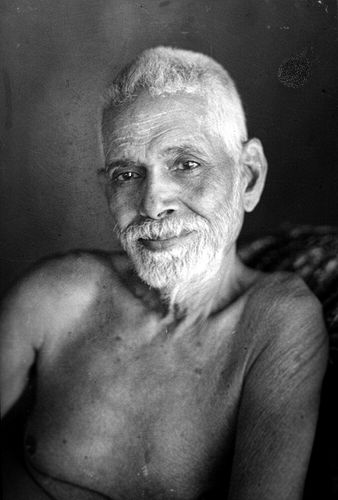
Ramana Maharshi: remaining quiet and aware is the state of mind to aim at

Ramana Maharshi sitting

Questioner:  There are times when persons and things take a vague, almost transparent form, as in a dream. One ceases to observe them as outside, but passively conscious of their existence, while not actively conscious of any kind of selfhood.  There is a deep quietness in the mind.

Is it at such times that one is ready to dive into the Self? Or is this condition unhealthy, the result of self hypnotism? Should it be encouraged as yielding temporary peace?

Ramana Maharshi:  There is Consciousness along with quietness in the mind.  This is exactly to be aimed at.  The fact that the question has formed on this point, without realizing that it is the Self, shows that the state is not steady but casual.

The word ‘diving’ is appropriate when there are outgoing tendencies, and when, therefore, the mind has to be directed and turned within, there is a dip below the surface of externalities.  But when quietness prevails without obstructing the Consciousness, where is the need to dive?

Taken from Talks with Ramana Maharshi, Talk 348


Tom’s comments:

The sadhana (spiritual practice) that Bhagawan recommends above is to simply remain quiet (in mind and thought) and also to remain aware.

This is self-knowledge. This is the Self.

When thoughts can come and go without disturbing this essential quality of mind, there is no need to ‘dive’ using the tools of Self Inquiry (ie. the question ‘Who am I?’). With time it may be seen that nothing ever disturbs this ‘peace that passeth all understanding’, and that nothing ever did.

It was always here, fully manifest, right under our noses.

Here is the gateway to Self-knowledge or liberation.

J. Krishnamurti: If you listen completely, there is no listener

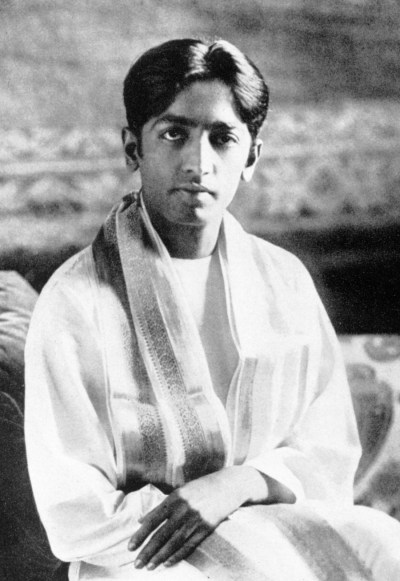
Krishnamurti young

Listen to those crows. Do listen. If you listen completely, is there a centre from which you are listening? Your ears are listening. There is the noise, there is the vibration and all the rest of it, but there is no centre from which you are listening. There is attention.
Therefore if you listen completely, there is no listener; there is only the fact of that noise. To listen completely you must be silent, and that silence is not something in thought, created by thought.
When you listen to that crow that is making the noise before it goes to sleep, so completely that there is no listener, you will see that there is no entity that says, ‘I am listening.’
Jiddu Krishnamurti, The Collected Works, Vol. XVI, p.59 ‘Choiceless Awareness’ Bombay 1966


Tom’s Comments:

Listening is the same as seeing. It goes to the heart of the teachings, it is a complete teaching in itself. If this one teaching is fully understood, penetrated through and through, then that is the entire teaching.

When you truly listen, you are simple seeing things as they actually are, not as you project or interpret them to be. Without the verbiage of your mind with all its opinions and judgements, you see life as it truly is.

This is the living truth. And in that truth it can be seen there is no doer or thinker. The entity that we take ourselves to be can be directly seen to be false – it never existed apart from in our thoughts and imagination.

Not mine

nataraj.png

Nothing is mine.
I did not create
This world,
This body,
Or this mind,
With its thoughts.

They were all given to me.
Yes – even my thoughts were given to me.

None of it has anything to do with me.

Then I look at the ‘me’:
There is no me.
Only this,
None of it mine,
All of it moving.

Direct ‘perception’

landscape-192987_1280.jpg

The mind cannot get this,
Just as it cannot deduce the existence of a tree.

The tree is perceived directly,
This is perceived directly.
Whatever is perceived is this.

Perception is just an idea,
That implies the existence of a perceiver,
A perceiver with some physiological apparatus.

There is no experience of perception,
Only an inference,
An inference based on the idea of a perceiver,
For which there is no direct evidence.

So,
There is only this,
Just this.

Perception is just another name
For our experience of life,
ie. this

Life,
Naked,
Is without conceptual overlay.

Unadorned,
It adorns itself,
creating its own beauty.

Life,
Unadorned by concepts,
But including concepts as they rise and fall:
– No thinker can be found.

Forget words, definitions, theories and beliefs:
– They are all useless here;
Just more conceptual overlay:
– It could all be entirely mistaken.

Satsang

meditation lake stones

If you have no questions,
We can sit here,
Selfless,
Self seen through,
And be.
This is the real sadhana:
Just an unforced appreciation of the way things are.

If you have questions, ask them, do not hold back.
The true answer is when the question disappears.
Do not cling to knowledge.
This is the advanced path for advanced seekers.

Eckhart Tolle: Your true self

Lake sunset

‘You find peace not by rearranging the circumstances of your life, but by realizing who you are at the deepest level.’
Stillness Speaks by Eckhart Tolle p. 52

The truth is that you cannot know your true self. You are your true self – already. It’s difficult to put into words, but when you know who you really are, it is not the same as knowing how tall Mount Everest is or knowing what your favourite colour is. These worldly things are known with the mind, with thought, with the intellect. These things are known by ‘you’, the ego who knows, the false non-existent self. Your true self is not known in that way.
Continue reading

Ramana Maharshi: How to get peace

Ramana Maharshi downward gaze

Questioner: …how to get peace?

Ramana Maharshi: As I said already, that which is, is peace. All that we need do is to keep quiet.

Peace is our real nature. We spoil it. What is required is that we cease to spoil it. We are not going to create peace anew. There is space in a hall, for instance. We fill up the place with various articles. If we want space, all that we need do is to remove all those articles, and we get space.

Similarly if we remove all the rubbish, all the thoughts, from our minds, the peace will become manifest. That which is obstructing the peace has to be removed. Peace is the only reality.

Excerpt taken from Day by Day with Bhagavan