[Tom: The following verses were written by Sri Shankara. First he explains that the entire universe is a projection of the mind, and then he will go on to explain that this projection veils the self and therefore needs to be removed in total silence of the mind, also known as self-knowledge or nirvikalpa samadhi:]
170. In dreams, when there is no actual contact with the external world, the mind alone creates the whole universe consisting of the experiencer etc. Similarly in the waking state also; there is no difference. Therefore all this (phenomenal universe) is the projection of the mind.
342. Even wise men cannot suddenly destroy egoism after it has once become strong, barring those who are perfectly calm through the Nirvikalpa Samadhi. Desires are verily the effect of innumerable births.
344. …But the victory is undoubtedly (complete and) free from obstacles when there is no oscillation of the mind due to the unreal sense-objects.
[Tom: The term Samadhi refers to a state of mind that is completely stilled but also aware and not asleep, it is attained only through self-enquiry and is synonymous with self-knowledge (Jnana):]
353. When the Atman, the One without a second, is realised by means of the Nirvikalpa Samadhi, then the heart’s knot of ignorance is totally destroyed.
354. Such imaginations as “thou”, “I” or “this” take place through the defects of the Buddhi. But when the Paramatman, the Absolute, the One without a second, manifests Itself in Samadhi, all such imaginations are dissolved for the aspirant, through the realisation of the truth of Brahman.
355. The Sannyasin, calm, self-controlled, perfectly retiring from the sense-world, forbearing, and devoting himself to the practice of Samadhi, always reflects on his own self being the Self of the whole universe. Destroying completely by this means the imaginations which are due to the gloom of ignorance, he lives blissfully as Brahman, free from action and the oscillations of the mind.
[Tom: Shankara again stresses the importance of Samadhi, stating those alone are free or liberated.]
356.Those alone are free from the bondage of transmigration who, attaining Samadhi, have merged the objective world, the sense-organs, the mind, nay, the very ego, in the Atman, the Knowledge Absolute – and none else, who but dabble in second-hand talks.
[Tom: The above verse is a rendering of a verse from the Amritabindu Upanishad]
357. Through the diversity of the supervening conditions (Upadhis), a man is apt to think of himself as also full of diversity; but with the removal of these he is again his own Self, the immutable. Therefore the wise man should ever devote himself to the practice of Nirvikalpa Samadhi, for the dissolution of the Upadhis.
[Tom: Again, Shankara uses the word ‘only’ to drive home the importance of Samadhi:]
360. The truth of the Paramatman is extremely subtle, and cannot be reached by the gross outgoing tendency of the mind. It is only accessible to noble souls with perfectly pure minds, by means of Samadhi brought on by an extraordinary fineness of the mental state.
361. As gold purified by thorough heating on the fire gives up its impurities and attains to its own lustre, so the mind, through meditation, gives up its impurities of Sattva, Rajas and Tamas, and attains to the reality of Brahman.
[Tom: Nirvikalpa Samadhi refers to the complete absence of ‘mind waves’ or modifications of consciousness, in which there is only pure awareness or consciousness present devoid of thoughts and perceptions. Again and again Shankara states that it is Samadhi of the Nirvikalpa variety (ie. no thoughts and no objects) that leads directly to self-realisation:]
362. When the mind, thus purified by constant practice, is merged in Brahman, then Samadhi passes on from the Savikalpa to the Nirvikalpa stage, and leads directly to the realisation of the Bliss of Brahman, the One without a second.
363. By this Samadhi are destroyed all desires which are like knots, all work is at an end, and inside and out there takes place everywhere and always the spontaneous manifestation of one’s real nature.
[Tom: How much clearer can Shankara make the case for the essential practice of Nirvikalpa Samadhi?]
364. Reflection should be considered a hundred times superior to hearing, and meditation a hundred thousand times superior even to reflection, but the Nirvikalpa Samadhi is infinite in its results.
[Tom: Shankara continues to stress the importance of the thoughtless aware state of samadhi, or, to put it more simply, being still of mind:]
365. By the Nirvikalpa Samadhi the truth of Brahman is clearly and definitely realised, but not otherwise, for then the mind, being unstable by nature, is apt to be mixed up with other perceptions.
398. When the mind-functions are merged in the Paramatman, the Brahman, the Absolute, none of this phenomenal world is seen.
[Tom: the Jnani does not see the phenomenal world]
407. This apparent universe has its root in the mind, and never persists after the mind is annihilated. Therefore dissolve the mind by concentrating it on the Supreme Self, which is thy inmost Essence.
408. The wise man realises in his heart, through Samadhi, the Infinite Brahman, which is something of the nature of eternal Knowledge and absolute Bliss, which has no exemplar, which transcends all limitations, is ever free and without activity, and which is like the limitless sky, indivisible and absolute.
409. The wise man realises in his heart, through Samadhi, the Infinite Brahman, which is devoid of the ideas of cause and effect, which is the Reality beyond all imaginations, homogeneous, matchless, beyond the range of proofs, established by the pronouncements of the Vedas, and ever familiar to us as the sense of the ego.
410. The wise man realises in his heart, through Samadhi, the Infinite Brahman, which is undecaying and immortal, the positive Entity which precludes all negations, which resembles the placid ocean and is without a name, in which there are neither merits nor demerits, and which is eternal, pacified and One.
411. With the mind restrained in Samadhi, behold in thy self the Atman, of infinite glory, cut off thy bondage strengthened by the impressions of previous births, and carefully attain the consummation of thy birth as a human being.
[Tom: Shankara again makes it clear that when he speaks of Samadhi, he is speaking of that aware state in which there are no objects or ‘limiting adjuncts’ present:]
412. Meditate on the Atman, which resides in thee, which is devoid of all limiting adjuncts [Tom: ie. objects], the Existence-Knowledge-Bliss Absolute, the One without a second, and thou shalt no more come under the round of births and deaths.
[Tom: Manonasa (destruction of the mind), a synonym for moksha, is declared by this scripture. As Shankara has already explained that the mind projects the entire world as well as thoughts, this means, and you will see this if you read the verses carefully, that no thoughts or phenomenal objects appear in the self in truth:]
481. My mind has vanished, and all its activities have melted, by realising the identity of the Self and Brahman; I do not know either this or not-this; nor what or how much the boundless Bliss (of Samadhi) is
502. How can there be merits and demerits for me, who am without organs, without mind, changeless, and formless – who am the realisation of Bliss Absolute? The Shruti also mentions this in the passage “Not touched”, etc.!
~ All the above verses were written by Sri Shankara, taken from his masterpiece ‘Vivekachudamani’
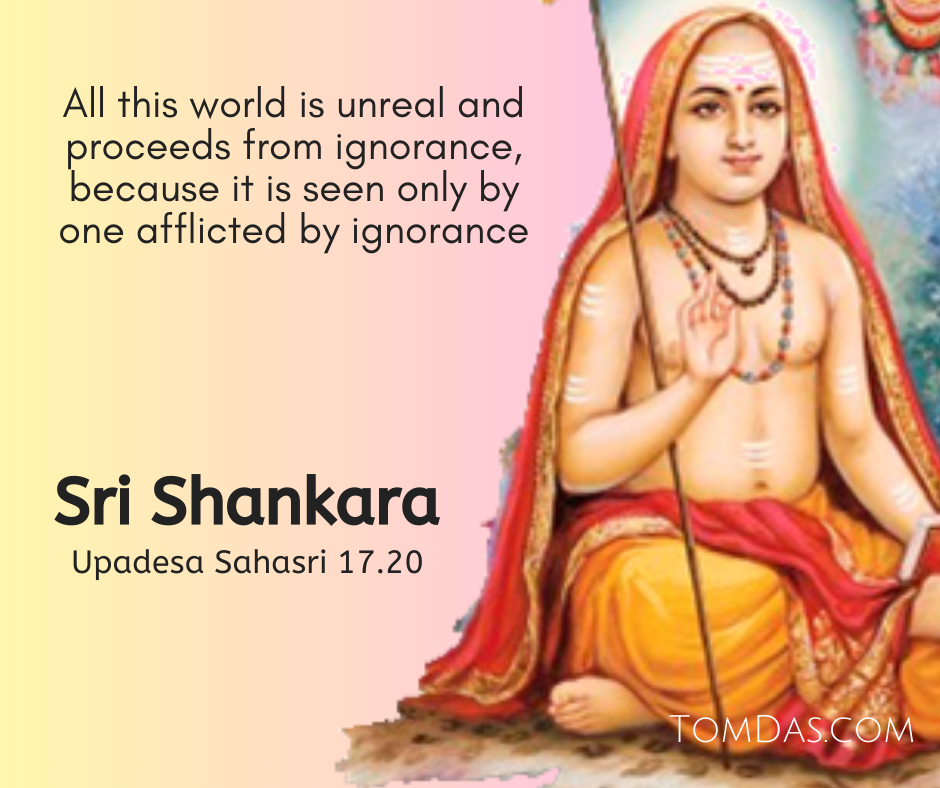
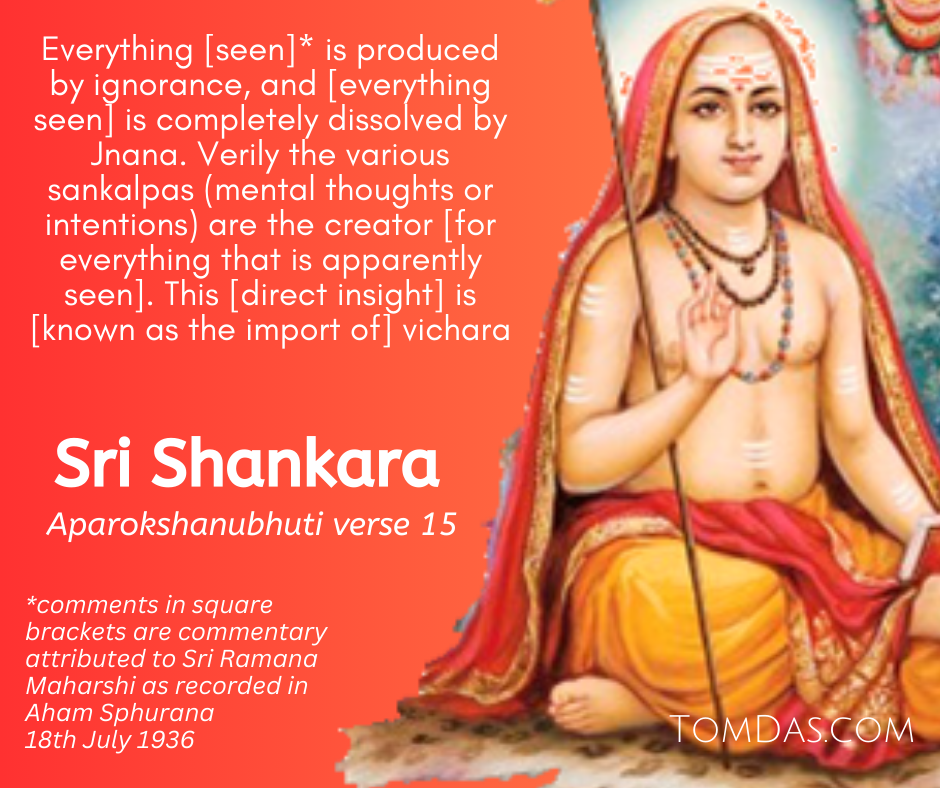
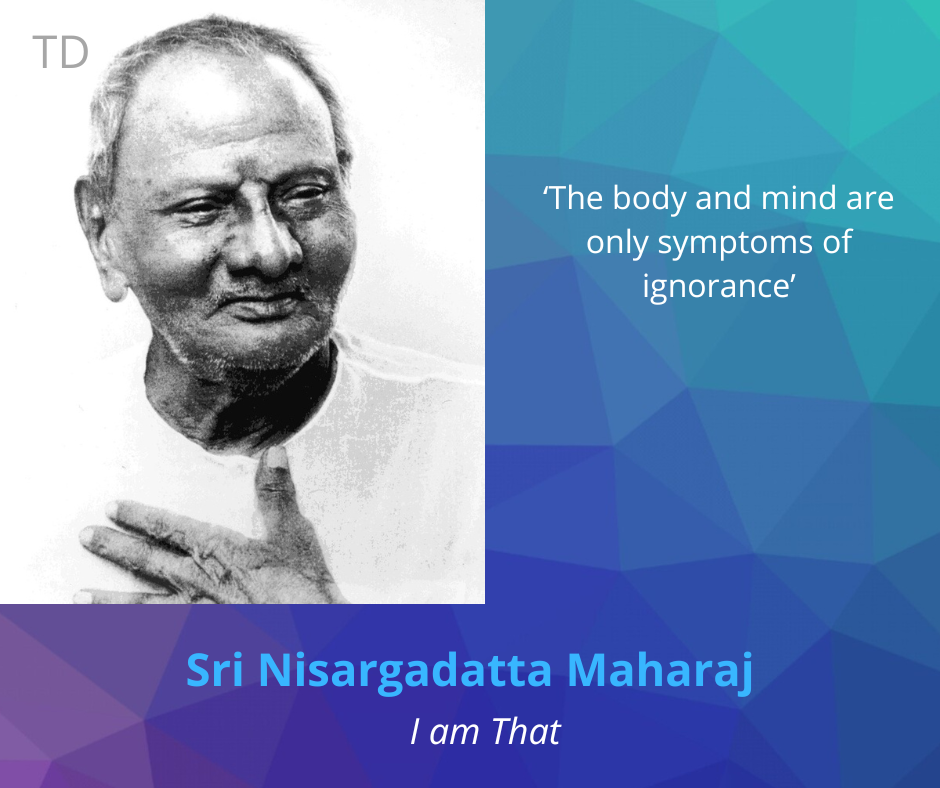
Sri Shankara, both in his commentaries and in his shorter works, often writes that the body and mind are symptoms (or effects) of ignorance, and when ignorance goes, the symptoms or effects of ignorance also go.
He also writes that the body, mind and world can never have any connection whatsoever with What You Truly Are, the Self, Pure Consciousness – and that only through ignorance can a connection between the two appear to be there.
eg. In Vivekachudamani Shankara writes:
195. But for delusion there can be no connection of the Self – which is unattached, beyond activity and formless – with the objective world, as in the case of blueness etc., with reference to the sky.
196. The Jivahood of the Atman, the Witness, which is beyond qualities and beyond activity, and which is realised within as Knowledge and Bliss Absolute – has been superimposed by the delusion of the Buddhi, and is not real. And because it is by nature an unreality, it ceases to exist when the delusion is gone.
197. It exists only so long as the delusion lasts, being caused by indiscrimination due to an illusion. The rope is supposed to be the snake only so long as the mistake lasts, and there is no more snake when the illusion has vanished. Similar is the case here.
198-199. Avidya or Nescience and its effects are likewise considered as beginningless. But with the rise of Vidya or realisation, the entire effects of Avidya, even though beginningless, are destroyed together with their root – like dreams on waking up from sleep. It is clear that the phenomenal universe, even though without beginning, is not eternal – like previous non-existence.
200-201. Previous non-existence, even though beginningless, is observed to have an end. So the Jivahood which is imagined to be in the Atman through its relation with superimposed attributes such as the Buddhi, is not real; whereas the other (the Atman) is essentially different from it. The relation between the Atman and the Buddhi is due to a false knowledge.
202. The cessation of that superimposition takes place through perfect knowledge, and by no other means. Perfect knowledge, according to the Shrutis, consists in the realisation of the identity of the individual soul and Brahman.
205. When the unreal ceases to exist, this very individual soul is definitely realised as the eternal Self. Therefore one must make it a point completely to remove things like egoism from the eternal Self.
Bhagavan Sri Ramana Maharshi explains the nature of self-realisation, also known as sahaja samadhi, or ‘the natural state’. He explains that in the natural state of self knowledge, the body, mind, world and three states of waking, dream and deep sleep are not perceived by the liberated sage (jnani), but only the ignorant onlookers see the sage with an apparent body and a mind:
Ramana Maharshi: ‘So also a Jnani in sahaja samadhi is unaware of the happenings, waking, dream and deep sleep…In sahaja samadhi the activities, vital and mental, and the three states are destroyed, never to reappear.
‘However, others notice the Jnani active e.g., eating, talking, moving etc. He is not himself aware of these activities, whereas others are aware of his activities. They pertain to his body and not to his Real Self, swarupa.
‘For himself, he is like the sleeping passenger – or like a child interrupted from sound sleep and fed, being unaware of it. The child says the next day that he did not take milk at all and that he went to sleep without it. Even when reminded he cannot be convinced. So also in sahaja samadhi.’
Tom: Many people say ‘I know that I am not the body-mind’, not realising that:
1) if that were truly known, genuinely known, then that is full liberation, and there would be no more questions (or answers) possible, and that is the end of the spiritual journey/search, that is unending bliss and the end of all suffering forever*, transcendence of time and space and the sense of individuality.
2) when someone says ‘I know I am not the body-mind BUT…’ (and then goes on to ask a question/express some kind of doubt or dissatisfaction), this means the entity that (thinks it) knows it is not the body-mind is in fact the mind. ie. it is the mind that is stating ‘I know I am not the body-mind’. This is essentially conceptual knowledge for the mind, even if it is based in some deeper intuitive knowing. This means the basic reference point for knowledge is still the mind, ie. we are still looking to our mind/thoughts for knowledge, and this indicates ongoing identification with the (body-)mind.
3) it is not truly or actually possible for the mind to understand ‘I am not the body-mind’. It is not something the mind can ever understand or know. The mind can repeat the phrase ‘I know I am not the body-mind’ and convince itself it knows something but this is not the true understanding at all.
TRUE UNDERSTANDING
The true understanding is not of the mind at all. It is beyond the mind. The true understanding is not of the mind at all. The true understanding is simply being the Self, also known as Silence.
HOW TO KNOW TRUTH?
How to know or be the Self? And are we not already always the self?
Yes, we are already the self. We are always the self. This self-knowledge we are looking for is always and already here. We already know, in our hearts, not in our minds, all we need for the spiritual journey. Self-knowledge is always and already here with us. There is never a need to discover anything new. Never.
THE PROBLEM
So what is the problem, and why does it appear that ‘I am not liberated’?
The issue is we ignore our self knowledge, and instead we pay attention to our thoughts, our mind, and we believe the contents of our thoughts. All we have to do is come back to our own inner self knowing.
Again, the issue is that we pay attention to our thoughts and we believe the contents of our thoughts.
**READ THIS PART CAREFULLY**
Now here is an important point that many people miss: it is not possible to pay attention to thoughts and not eventually start to believe the contents of the thoughts. I repeat, it is not possible to pay attention to thoughts and not eventually get involved in the contents of the thoughts.
This is an important point which many people miss. Try this for yourself and see.
You may feel you can dispassionately observe or witness your thoughts for a short time, but they will always draw you back in again. For placing attention to thoughts is ALREADY believing their content at the root level. Placing attention to thoughts means the root thought, ‘I am the body-mind’ is ALREADY there.
For it is not possible to dispassionately pay attention to thoughts and not believe already in the concept ‘I am the body mind’.
AS SOON AS YOU PAY ATTENTION TO THOUGHTS, THE ROOT THOUGHT, THE ROOT IGNORANCE ‘I AM THE BODY-MIND’ IS ALREADY THERE.
Yes, the root thought is the thought ‘I am the body mind’. It is this root concept or thought that gives rise to all other thoughts. This root thought, also known as ignorance, also gives rise to all perception of all objects, but more on this another time perhaps.**
As soon as we pay attention to thought, this root thought ‘I am’ or ‘I am the body mind’ is already fully there.
The same goes for gross and subtle objects. As soon as we are aware of objects, even gross objects such as cars and trees or the body, the root thought ‘I am the body mind’ is ALREADY fully there. Ignorance is ALREADY fully there.
If you are not sure about this, you can try it for yourself. You can try to remain aware of objects without the idea that you are a person and see how that goes!
AS SOON AS YOU PAY ATTENTION TO THOUGHTS, OR ANY OBJECT, INCLUDING GROSS OBJECTS SUCH AS A CAR OR A TREE, THE ROOT THOUGHT, THE ROOT IGNORANCE ‘I AM THE BODY-MIND’ IS ALREADY THERE.
If this is not understood, then the solution to this ignorance, which is outlined below, may not be accepted by the mind, and liberation may not ensue.
To remove ignorance we must turn away from all gross and subtle objects, meaning all names and forms and external objects, as well as all internal objects such as thoughts and feelings.
The only way to do this is to attend to the subject, your very own self, your own inner self knowing, that which always is, and that which is always known. The clear way to do this becomes clear through the practice, which I explain more about below.
See Sri Ramana’s teaching in Guru Vachaka Kovai verse 291. Note he says that this is the ‘essential’ advice. Notice also the use of the word ‘alone’:
291. ‘If one wants to be saved, one is given the following true and essential advice: just as the tortoise draws all its five limbs within its shell, so one should draw the five senses within and turn one’s mind Selfward. This alone is happiness.’
Compare with Bhagavad Gita 2.58:
2.58 ‘One who is able to fully withdraw the senses from their objects, just as a tortoise withdraws its limbs into its shell, is established in Divine Knowledge’.
Many people try to distort the meaning of these verses, but the imagery of the tortoise is used to make the meaning clear. There are many more verses like this I could cite, and with these other verses, again the true meaning of these verses is very clear (see here for many more of these verses, and follow the links within that post for even more).
Please note THIS IS NOT A PATH OF SUPPRESSION OR REPRESSION OR AVOIDANCE. THIS IS NOT A PATH OF SPIRITUAL BYPASSING. It is actually a path of love, a flowering of love and self-knowledge. I touch upon this further below, and have written on this topic on tomdas.com (use the search bar). there are also many videos on this on my YouTube channel, explaining how this can be the case.
This is why all genuine spiritual traditions and teachings (ie. teachings that genuinely lead to liberation) tend towards introversion, meditation and silence in some way shape or form.
This is why, historically, many traditions across geography and time all end up in some form of silent contemplation or meditation.
It is also why, if we look inwards to our own hearts, we already intuitively know that the Truth (of ourselves) arises only in Silence, deep within our very own selves, and NOT through words, concepts or the mind.
This self-attention is also known as devotion or bhakti, for the true form of your self is God absolute, it is pure holiness, pure divinity, pure oneness devoid of ignorance and duality.
A PRACTICAL WAY FORWARD
How to practically put these teachings into practice? My suggestion, as this is what worked for me (you will need to find out what works for you!), is to listen to the teachings of Sri Ramana Maharshi. Personally I have not found another teacher or teaching that comes close, even though some other teachers and teachings sound very similar, as you go deeper you will start to see the differences more and more.**** At least this is my experience.
If you are lucky, you will feel some love and devotion and connection with Him. If this love, devotion and connection occurs, it is very wonderful and in my opinion this is something you should nurture and treasure. This connection and love and devotion is a very important part of the teaching in my experience. Unfortunately this aspect of the teaching cannot be taught and spontaneously arises when the time is right.
For most of my ‘seeking career’, not only did I NOT feel love and devotion for Ramana, but this is something I was not actively looking for, and something I actively looked down upon in fact. I never wanted a guru, I never wanted to follow another human being, I wanted to figure out for myself, like the Buddha or like J Krishnamurti. I share this as if you do not feel love or devotion in your hearts, please do not be deterred or discouraged, as this is how it was for me for many years.
But as the fates would have it, this was not to be my path, and the teachings I share are coloured by my own personal experience, so this is what I will share with you:
1) Allow the love and connection with Bhagavan Sri Ramana to develop and grow. Think about him, perhaps learn a little about his life, pray to him, praise him, adore him, prostrate yourself to him, bow to him, etc etc, as you please, find your way in this regard to connect with him and love him and, very importantly, surrender to him. This surrender is very important and often missed by some devotees. This is my view at least. At the same time know in your heart that He is You, meaning your true self. You are He, You are That, connect with that inner knowing that is your Self and that is also He.
2) regularly listen to his teachings (sravana, listening/being exposed to the teachings), regularly read his teachings, become familiar with his deeper teachings, not just the teachings he gave to the masses, many of whom were not truly interested in liberation***. See my recommended reading list for my suggestions of what to expose your mind to in terms of truly liberating teachings, and also read the introductory articles on the homepage of this site, which give a broad but thorough introduction to all aspects of the teaching. Everything you need for step two is available free of charge on tomdas.com and my YouTube channel. You will find the answer to almost any question you have somewhere on this website! There is enough content for about 20+ books on tomdas.com, all of it freely available, so use the search bar and explore the introductory articles too. Similarly my YouTube channel has hundreds of videos on it covering all aspects of the journey. Most of these videos were put together by volunteers, so hopefully the videos are particularly relevant to seekers as they have been selected and created by seekers. Do let me know if there are any areas that are not covered.
3) you will find that the more you do (1) and (2) above, the more your mind will be pulled inwards towards the self (nididhyasana, going towards or abiding as the self). When this happens, allow yourself to naturally go back to yourself. If you are unclear what this means, the more you do (1) and (2) above, the clearer it will become to you. Do not force this, allow it to happen naturally through exposure to Bhagavan Ramana’s Presence and His Teachings. (ie. nididhyasana naturally follows from sravana and manana) If you force this, it is just ego perpetuating itself. Everything should be allowed to happen naturally. THIS IS NOT A PATH OF SUPPRESSION OR REPRESSION (NO ‘SPIRITUAL BYPASSING‘ HERE PLEASE), but a natural outcome, a flowering of self-knowledge and love and bliss. 🙏❤️
4) consider attending a group, such as the satsang group I hold twice a week online, which supports both devotion (bhakti) to Sri Ramana and a knowledge and exploration of his deeper teachings (sravana and manana, manana means thinking about and reflecting upon the teachings), as well as allows time for meditation, silence and deep self attention (nididhyasana), ie. a group that supports (1), (2) and (3) above. Contact with a teacher can be very helpful, both for motivation, regular reminders and for clarification of the true way. This can supercharge and cut years off your spiritual path, as a teacher can often point something out in a few seconds that may have taken you years to realise yourself. If you don’t have access to a teacher, please don’t worry, as Devotion/Surrender and Connection will bring to you/attract to you all you need. See here for what Sri Ramana Maharshi said about satsang.
The above can be summarised as Intuitive Connection/Surrender/Bhakti, Satsang, Sravana, Manana and Nididhyasana, to use some of the traditional Sanskrit words. The term Self-Enquiry can be used to mean just Nididhyasana or alternatively it can mean the trio of sravana, manana and nididhyasana, depending on context. So we can summarise the above further as Bhakti, Satsang and Self-Enquiry being the essence of the path. Going further we will actually find that the true Satsang is to be with the Guru in our Heart, namely be with our Self as our Self, and that this is also the highest form of Bhakti, so all of these are actually One.
These are just my suggestions, and of course it is for you to decide if this is for you. My suggestion here is that if you resonate even slightly with this, then you should go with it, at least for a bit, give it a go. Of course if you do not resonate, there is likely a different way for you, at least for now… We all have our own path, at least superficially this is the way it seems. Eventually we have to come back to our self.
I hope this has been of help
Namaste and best wishes
Tom
❤️🙏 Om Namo Bhagavate Sri Arunachala Ramanaya Om 🙏❤️
❤️🙏❤️
*Forever is used figuratively as it is beyond time, not infinite time
**Bhagavan Sri Ramana explains this clearly in the first few paragraphs of his short text, ‘Who am I?’ Which explains all the teachings you need to know for liberation. The book I recommend to understand this is a book called The Path of Sri Ramana (click here to download for free) which fully explains the teachings found in the small booklet, ‘Who am I?’. This book also has a very good translation of ‘Who am I?’ in the appendix of the book, as many other translations of ‘Who am I?’ contain distortions added by the translator that are not present in the original Tamil.
***When somebody asks a question, and that seeker is not truly interested in liberation, the sage, who is like a mirror, merely reflects a superficial teaching back at them. This is spontaneous response, and not a deliberate attempt to give a superficial teaching. The teaching is given spontaneously by the true teacher according to the earnestness and sincerity and degree of desire for liberation in the seeker who is asking the question. Therefore the deeper teaching is usually only given when a seeker who has a deep and genuine desire for liberation asks a question or approaches the teacher.
****Some people think I am being partial towards my own guru (and maybe I am, despite my best efforts to be objective) but this is my personal experience, so this is what I share. If there were other teachers whose writings and teachings were as clear, I would happily say so! See my recommended reading list for the teachers that I think are equally as clear. Note I am not saying that Sri Ramana Maharshi is the only truly liberated sage, but I am merely commenting here on the quality and fidelity of the teachings that have come down to us. There may be other realised teachers, but the verbal/written teachings that have come to us may be less clear. Because we are relatively close in time to Sri Ramana, because we have his written works in his own handwriting, and because of the clarity and simplicity in which he explained the teachings, this is a huge advantage for those who are interested in these written/verbal formulations of his teaching. Of course, if you have another Guru, then by all means stick with your Guru. Ultimately, all is One and there is only truly One Guru anyway.
 Tom Das