Total Freedom

Freedom from suffering is a total freedom.

Which means you are free to suffer.

Suffering is ok. When it’s ok, it’s no longer suffering. Just sensations, some more comfortable than others, the body-mind organism naturally responding to the feedback provided by the senses.

It’s just what ever is happening.

What is.

Dare to question, and more…

Here are some recent quotes from my Facebook page:


It should be obvious that something is not necessarily true just because it is written in a sacred text or spoken by some great authority/teacher.

History and experience shows us that even highly intelligent people capable of great logical thinking can often have bizarre irrational beliefs


There is never a feeling of doership. What is called the feeling/sense of doership is just a cluster of sensations that is interpreted by the mind/thought as indicative of doership.


The concept of non-doership roots out the concept of doership. Then both concepts are let go of and neither concept exclusively operates in the mind.


Most seekers I work with are consciously or unconsciously seeking a subtle object and think lasting fulfillment will come through that. ie. They are seeking enlightenment as an experience. Much of my teaching is simply dispelling that notion in such a way that the seeker clearly sees.


Another way of putting it is that the feeling of doership can continue but that doesn’t mean you are a doer.


Oneness is also a story…a nice story, but a story nonetheless


What is, is. Accept it and move on. This doesn’t mean that you just passively accept things such as injustice…

Do you get what I’m saying?

There is no doer here, there never was one 😮


I don’t buy the whole ‘there is no time’ thing. When you look at it, time is just a way of describing movement.


The key is to see through the separate doer.

(Can you find a separate doer-entity? Where is this autonomous entity that supposedly authors thoughts and actions?)

When that is seen, what more can be done?

This is the whole purpose of atma vichara (self-inquiry)


The whole world is your guru, each and every experience, constantly emanating pure-teaching-essence beyond words.

Just be open and listen


Yes, that’s one of the reasons a genuine living teacher can be so useful – to indicate the total normality of this. Ramana himself said this many times…
Q: How can I attain Self-realisation?
Ramana Maharshi: Realisation is nothing to be gained afresh; it is already there. All that is necessary is to get rid of the thought ‘I have not realised’.

Silence of the mind (relative silence) allows us to notice the Silence that is ever-present, the Silence that is beyond both noise and (relative) silence.

It is the Silence of our very being, the Silence of where we are looking from.


There seem to be a lot of people on Facebook saying silence is the best way and that silence is the highest form of teaching


Ramana’s lineage? Ramana had no lineage. Ramana never gave authority for other’s to teach in his name, not even his closest disciples. Many teachers have been deeply affected by his teachings, myself included, but this is quite different to saying you are in Ramana’s lineage.

Debate, critical thinking and constructive criticism are important parts of spirituality and are to be encouraged. Who’s with me on this?


To say there is no one here is like saying there are no waves on the ocean. There is no separate self, just as there are no separate waves, but I am here, just as (I assume) you are.


The concept of a wave is a fiction, but also points to something true: the phenomenon of a wave.


Q: It’s all about ONENESS
Tom: For me that’s another belief. It can be a useful teaching, until it’s not.

Freedom, beyond all concepts and all stories, embracing all concepts and all stories.


How can we know something has no limitations?


Being ‘okay with that’ is freedom

If you think you are definitely not the body or that the world is definitely an illusion, you have probably stumbled into the world of beliefs.


This much I know: it happened the way it happened. All else is speculation (not that there is anything wrong with speculation).

The desire to improve can be very healthy


We think we chose to read or hear the teachings and apply them. When we understand the teachings more fully, we realised that the teachings came to us, they were a gift to us, that they chose us, and they work their magic on us.


Most do not go far enough and remain caught up in words, beliefs, teachings and spiritual-sounding slogans


Inquiry is only needed to remove ignorance (belief in the doer). When ignorance is seen to be non-existent, where is the need of inquiry?

Know your limits. Be honest. Be humble. Do not cling to beliefs. Admit and know what you don’t know.


Perhaps freedom itself is not conditional, but the realisation of the unconditional freedom is conditional.


What in ignorance is taken to be the subject,
in Understanding is seen to be an object.


No need to surrender.
Just ‘what is’.


THIS IS IT

Anyone else think that your personality has to be perfect and that every pore of your being has to exude an energy of loving kindness in order for the Freedom that already is to be realised? What a prison!

With respect to seeking enlightenment, what’s wrong with THIS, right now?

Freedom is already totally completely here.

Stop all this worrying and obsessing over the apparent individual and here it is, full and complete. No need to improve the individual or the world. Then things start to right themselves naturally, according to natural law. Not that you care. It’s just the way it is.

No need to judge and evaluate apparent ‘teachers’ – that’s more obsessing about the apparent individual, the individuality you project onto them.

Now there is nothing wrong with desire to improve oneself or the world. It is quite natural in certain circumstances. The desire to change something happens by itself when it happens. It too is Spontaneous Arising, a part of ‘what is’.

Look! See! Notice! All these phenomena are empty of any independent doer-self-entity.

Freedom is already here. What does it feel like? It feels like THIS. No need to seek a new or better experience, although that too is allowed. THIS IS IT.

So, what happens when you die?

Branch lightQ. So, what happens when you die?

How can you know what happens when you die? No matter how you justify it, no matter how many psychic intuitions or spiritual experiences you have, the truth is that you don’t know for sure what happens after death. This question may perhaps be answered by science in the future, but we are not there yet.

Think of a time when you were utterly convinced something was true, but now you look back and realise how wrong you were. Knowledge also comes and goes. Perspectives change as we grow and mature and experience different things.

Enlightenment is beyond knowledge. Enlightenment does not depend on knowledge or the mind. Unlike knowledge and states of mind, Enlightenment cannot be attained – it is already here.

The above is an extract from the following post: Who cares about freedom?

Integrating the understanding of no-doer

This post follows on from my previous post: Why seeing/understanding alone may not be enough

This understanding of no doer may initially take time to become embedded, and you may have to ‘practice’ it to start with. It’s just like many other forms of knowledge:

Take the example of a child learning his (or her) name. At first he doesn’t know his name. Upon his parents repeating his name to him multiple times, he finally starts to realise that his name is ‘Tom’. Maybe at first he forgets his name a few times and doesn’t respond when someone calls him. After sometime it becomes ingrained and embedded into his mind and he no longer has to think about it.

Eventually he can’t help but know his name. When someone calls out ‘Tom’, he automatically knows someone is calling him, whether he  like it or not.

It’s the same with the understanding ‘there is no doer’. Initially the understanding may be a bit shaky, but after sometime, after repeated practice, after going through the logic behind it a few times and seeing the truth of it, it becomes more ingrained. Eventually it becomes effortless as knowing your name.

To be continued in my next post: Problems with utilising conceptual tools

Krishnamurti: meditation, Indian temples, Vedanta

154552

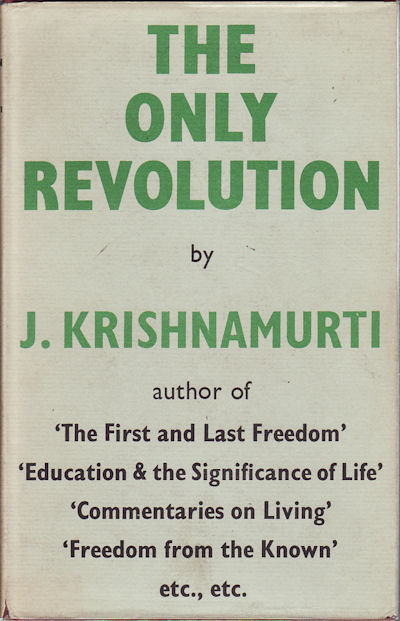
The following is an excerpt from ‘The Only Revolution’ by Jiddu Krishnamurti:

Meditation is not an escape from the world; it is not an isolating self-enclosing activity, but rather the comprehension of the world and its ways. The world has little to offer apart from food, clothes and shelter, and pleasure with its great sorrows.

Meditation is wandering away from this world; one has to be a total outsider. Then the world has a meaning, and the beauty of the heavens and the earth is constant. Then love is not pleasure. From this all action begins that is not the outcome of tension, contradiction, the search for self-fulfillment or the conceit of power.


The room overlooked a garden, and thirty or forty feet below was the wide, expansive river, sacred to some, but to others a beautiful stretch of water open to the skies and to the glory of the morning. You could always see the other bank with its village and spreading trees, and the newly planted winter wheat. From this room you could see the morning star, and the sun rising gently over the trees; and the river became the golden path for the sun.

At night the room was very dark and the wide window showed the whole southern sky, and into this room one night came – with a great deal of fluttering – a bird. Turning on the light and getting out of bed one saw it under the bed. It was an owl. It was about a foot-and-a-half high with extremely wide big eyes and a fearsome beak. We gazed at each other quite close, a few feet apart. It was frightened by the light and the closeness of a human being. We looked at each other without blinking for quite a while, and it never lost its height and its fierce dignity. You could see the cruel claws the light feathers and the wings tightly held against the body. One would have liked to touch it, stroke it, but it would not have allowed that. So presently the light was turned out and for some time there was quietness in the room. Soon there was a fluttering of the wings – you could feel the air against your face – and the owl had gone out of the window. It never came again.


It was a very old temple; they said it might be over three thousand years old, but you know how people exaggerate. It certainly was old; it had been a Buddhist temple and about seven centuries ago it became a Hindu temple and in place of the Buddha they had put a Hindu idol. It was very dark inside and it had a strange atmosphere. There were pillared halls, long corridors carved most beautifully, and there was the smell of bats and of incense.

The worshipers were straggling in, recently bathed, with folded hands, and they walked around these corridors, prostrating each time they passed the image, which was clothed in bright silks. A priest in the innermost shrine was chanting and it was nice to hear well-pronounced Sanskrit. He wasn’t in a hurry, and the words came out easily and gracefully from the depths of the temple. There were children there, old ladies, young men. The professional people had put away their European trousers and coats and put on dhotis, and with folded hands and bare shoulders they were, with great devotion, sitting or standing.

And there was a pool full of water – a sacred pool – with many steps leading down to it and pillars of carved rock around it. You came into the temple from the dusty road full of noise and bright, sharp sunshine, and in here it was very shady, dark and peaceful. There were no candles, no kneeling people about, but only those who made their pilgrimage around the shrine, silently moving their lips in some prayer.


A man came to see us that afternoon. He said he was a believer in Vedanta. He spoke English very well for he had been educated in one of the universities and had a bright, sharp intellect. He was a lawyer, earning a great deal of money, and his keen eyes looked at you speculatively, weighing, and somewhat anxious. He appeared to have read a great deal, including something of western theology. He was a middle-aged man, rather thin and tall, with the dignity of a lawyer who had won many cases.

He said: “I have heard you talk and what you are saying is pure Vedanta, brought up to date but of the ancient tradition.” We asked him what he meant by Vedanta. He replied: “Sir, we postulate that there is only Brahman who 5 creates the world and the illusion of it, and the Atman – which is in every human being – is of that Brahman. Man has to awaken from this everyday consciousness of plurality and the manifest world, much as he would awaken from a dream. Just as this dreamer creates the totality of his dream so the individual consciousness creates the totality of the manifest world and other people. You, sir, don’t say all this but surely you mean all this for you have been born and bred in this country and, though you have been abroad most of your life, you are part of this ancient tradition. India has produced you, whether you like it or not; you are the product of India and you have an Indian mind. Your gestures, your statue-like stillness when you talk, and your very looks are part of this ancient heritage. Your teaching is surely the continuation of what our ancients have taught since time immemorial.”

Let us brush aside whether the speaker is an Indian brought up in this tradition, conditioned in this culture, and whether he is the summation of this ancient teaching. First of all he is not an Indian, that is to say, he does not belong to this nation or to the community of Brahmins, though he was born in it. He denies the very tradition with which you invest him. He denies that his teaching is the continuity of the ancient teachings. He has not read any of the sacred books of India or of the West because they are unnecessary for a man who is aware of what is going on in the world – of the behaviour of human beings with their endless theories, with the accepted propaganda of two thousand or five thousand years which has become the tradition, the truth, the revelation.

To such a man who denies totally and completely the acceptance of the word, the symbol with its conditioning, to him truth is not a secondhand affair. If you had listened to him, sir, he has from the very beginning said that any acceptance of authority is the very denial of truth, and he has insisted that one must be outside all culture, tradition and social morality. If you had listened, then you would not say that he is an Indian or that he is continuing the ancient tradition in modern language. He totally denies the past, its teachers, its interpreters, its theories and its formulas.

Truth is never in the past. The truth of the past is the ashes of memory; memory is of time, and in the dead ashes of yesterday there is no truth. Truth is a living thing, not within the field of time.

So, having brushed all that aside, we can now take up the central issue of Brahman, which you postulate. Surely, sir, the very assertion is a theory invented by an imaginative mind – whether it be Shankara or the modern scholarly theologian. You can experience a theory and say that it is so, but that is like a man who has been brought up and conditioned in the Catholic world having visions of Christ. Obviously such visions are the projection of his own conditioning; and those who have been brought up in the tradition of Krishna have experiences and visions born of their culture. So experience does not prove a thing. To recognise the vision as Krishna or Christ is the outcome of conditioned knowledge; therefore it is not real at all but a fancy, a myth, strengthened through experience and utterly invalid. Why do you want a theory at all, and why do you postulate any belief? This constant assertion of belief is an indication of fear – fear of everyday life, fear of sorrow, fear of death and of the utter meaninglessness of life. Seeing all this you invent a theory and the more cunning and erudite the theory the more weight it has. And after two thousand or ten thousand years of propaganda that theory invariably and foolishly becomes “the truth”.

But if you do not postulate any dogma, then you are face to face with what actually is. The “what is”, is thought, pleasure, sorrow and the fear of death. When you understand the structure of your daily living – with its competition, greed, ambition and the search for power – then you will see not only the absurdity of theories, saviours and gurus, but you may find an ending to sorrow, an ending to the whole structure which thought has put together.

The penetration into and the understanding of this structure is meditation. Then you will see that the world is not an illusion but a terrible reality which man, in his relationship with his fellow man, has constructed. It is this which has to be understood and not your theories of Vedanta, with the rituals and all the paraphernalia of organized religion. 7

When man is free, without any motive of fear, of envy or of sorrow, then only is the mind naturally peaceful and still. Then it can see not only the truth in daily life from moment to moment but also go beyond all perception; and therefore there is the ending of the observer and the observed, and duality ceases.

But beyond all this, and not related to this struggle, this vanity and despair, there is – and this is not a theory – a stream that has no beginning and no end; a measureless movement that the mind can never capture.

When you hear this, sir, obviously you are going to make a theory of it, and if you like this new theory you will propagate it. But what you propagate is not the truth. The truth is only when you are free from the ache, anxiety and aggression which now fill your heart and mind. When you see all this and when you come upon that benediction called love, then you will know the truth of what is being said.

Buddha: How to approach the teachings

buddha

Going back to the Pali suttas, the Buddha also repeatedly warned against being attached to any particular teaching or teaching tradition:

‘Do not go by oral tradition, by lineage of teaching, by hearsay, by a collection of texts, by logic, by inferential reasoning, by reasoned cogitation, by the acceptance of a view after pondering it, by the seeming competence of a speaker, or because you think, ‘This ascetic is our teacher.’
AN 3.65 Kesaputti [Kālāma] Sutta

This really is quite a stark warning, and we could see this as a very ‘modern’ and scientific way of approaching this search for freedom from suffering.

The above text is an except taken from a larger article: Buddhism: How enlightenment happens


Levels of reality

water oceanic
Are there levels of reality?

I have often seen people talk and write about various levels of reality. Typically, they talk of the level of the absolute and the level of the relative. On the level of the absolute, everything is one, so they say. Whereas on the relative level, the level of being a person different rules apply. On the relative level differentiation exists, we talk to each other, we love one another, we get annoyed and irritated, we buy fast-food from time to time, and yet ultimately, at the highest and truest level we are told this is all oneness.

Well let me start off by saying that I reject the notion of levels of reality. I think reality has various aspects, but not levels per se. Now this may seem like a minor difference, a play of semantics if you will, but let me explain the difference.

Talking about the same thing in different ways

When I say reality has various aspects, all I really mean is that there are various ways you can talk about reality – actually there are various ways you can talk about anything. That doesn’t mean there are different levels of reality.

Lets take a simple example: lets take a human body. You can talk about a human body  in different ways. You can talk about it in terms of its size: you can say it is big, small, medium. You can talk about its age: is it a young or older body. You can talk about it in terms of organ systems such as the cardiovascular system or digestive system and how they function and describe the body that way, or you can talk about its anatomy and how various parts of it fit together. You can talk about the body’s name and culture – eg. maybe it is called John and it comes from the United Kingdom, you can talk about its occupation. You could talk about its fashion sense, its muscularity…

…ok ok, hopefully you get the idea: there are different ways you can talk about things. There are different conceptual frameworks from where we can view the body. And this is true for anything. We can talk about a pebble in terms of its age, size, geology or how good it would be to skim on a lake’s surface. We can talk about a lake in terms of its scenic beauty, how choppy its water are, its phosphorus content, or remark how it is all made up (mainly) of water.

Now, how many levels does a body or a pebble have? It doesn’t actually have any levels at all – there is only one body or stone (in the above examples) – it’s just that we can talk about them in various ways. In the same way there are no levels in reality, just different ways of talking about it.

No particular conceptual framework is intrinsically higher than another

Also note that no particular way of talking about the body or a pebble is intrinsically better that any other way. It just depends on what you want the conceptual framework to achieve. For example, if you want to skim a stone on the surface of a lake, then it’s less useful to talk about the geology of the stone, and more useful to look at it in terms of its shape and size with respect to achieving your goal (skimming it across the lake). You can’t legitimately claim that one way of viewing something is intrinsically higher and another way is lower, which is something you often hear when talking about ‘ultimate reality’ or the ‘highest level’. It just depends on how well the way you are conceptualising and viewing the object(s) in question fits in with your goal.

It depends on what you want to achieve

Similarly, it is not necessarily better to talk about the body in terms on physiology or organ systems compared to it’s occupation or fashion sense. As previously stated, it just depends on what you want to achieve. If the body has a disease, then understanding the physiology and how to correct any imbalance or defect in this is useful. Conversely if you are going out on a first date, then perhaps a degree of fashion sense would be useful.

No paradoxes, no contradictions

Also there in no contradiction in talking about a single object in different ways depending on the context. There is no paradox that a stone has both an age and a shape, or that a river is a single system made up of a variety of different things, all of which are in motion. There is a consistent underlying reality that underpins the various ways we talk about it. No contradiction or paradox at all.

Different ways of talking about the same experience

Remember, what we are talking about here is our experience of reality. Our reality is our experience – that’s all we know. We can talk about how everything we perceive is non-different to our consciousness, and we can also talk of how things interact within this consciousness, and the rules and consequences thereof. These are just different ways of talking about our experience and our experiences. No particular way is higher or lower, and there are no actual ‘levels’ that exist apart from our conceptualisations.

The description is not the described

We can chose how to conceptually carve up and talk about our experiential reality in order to achieve certain specific aims. To that end these conceptual maps are useful and often necessary. However we must not mistake any particular conceptual map of (our experience of) reality for reality, just as no particular way of describing the body is the body itself.